Introduction
The loss of sense of smell (anosmia or hyposmia) has emerged as an unexpected though significant and revealing early sign of severe acute respiratory syndrome coronavirus 2 (SARS-CoV-2) infection, occurring as the first sign of infection in up to 17 per cent of patients.Reference Hariyanto, Rizki and Kurniawan1,Reference Ninchritz-Becerra, Soriano-Reixach, Mayo-Yanez, Calvo-Henriquez, Martinez-Ruiz de Apodaca and Saga-Gutierrez2
The SARS-CoV-2 infection can occur asymptomatically or with various degrees of coronavirus disease 2019 (Covid-19) severity.Reference Hu, Song, Xu, Jin, Chen and Xu3–Reference Mizumoto, Kagaya, Zarebski and Chowell5 Olfactory dysfunction has been shown to occur in patients acutely infected with SARS-CoV-2 at rates of 25–98 per cent.Reference Hariyanto, Rizki and Kurniawan1,Reference Ninchritz-Becerra, Soriano-Reixach, Mayo-Yanez, Calvo-Henriquez, Martinez-Ruiz de Apodaca and Saga-Gutierrez2,Reference Koul, Begh and Kalsotra6–Reference Thakur, Sagayaraj and Prasad9 This large variability in reported rates of olfactory dysfunction is likely multifactorial, with sizeable differences in sample size between studies, and with some using subjective reports of smell loss and others using objective testing methods. Of note, individuals with mild Covid-19 tend to have higher rates of olfactory dysfunction than those with severe disease.Reference Ninchritz-Becerra, Soriano-Reixach, Mayo-Yanez, Calvo-Henriquez, Martinez-Ruiz de Apodaca and Saga-Gutierrez2,Reference Lechner, Chandrasekharan, Jumani, Liu, Gane and Lund10
Some reassuring data suggest that recovery rates from Covid-19-related anosmia within 30 days are as high as 68–85 per cent.Reference Ninchritz-Becerra, Soriano-Reixach, Mayo-Yanez, Calvo-Henriquez, Martinez-Ruiz de Apodaca and Saga-Gutierrez2,Reference D'Ascanio, Pandolfini, Cingolani, Latini, Gradoni and Capalbo8 There is, however, limited literature describing the long-term rates of olfactory dysfunction in patients with Covid-19 beyond four to eight weeks following confirmation of the initial SARS-CoV-2 infection.
The World Health Organization recently released a report describing a new clinical entity, ‘long Covid’, defined as viral symptoms lasting for more than four weeks after diagnosis.Reference Rajan, Khunti, Alwan, Steves, Greenhalgh and MacDermott11 This is not a well understood entity; however, some research has indicated that, at least in older individuals (aged over 70 years), loss of smell during the acute phase of the Covid-19 illness is a risk factor for developing long Covid.Reference Rajan, Khunti, Alwan, Steves, Greenhalgh and MacDermott11
Patients with Covid-19-related loss of smell have significant reductions in health-related quality of life and psychological well-being.Reference Elkholi, Abdelwahab and Abdelhafeez12 Moreover, Siegel et al.Reference Siegel, Kung, Wroblewski, Kern, McClintock and Pinto13 found that olfactory dysfunction in older adults was associated with decreased sexual motivation and satisfaction.
We present prospective data from a single-site cohort of SARS-CoV-2 positive patients; specially, we analysed the prevalence of olfactory dysfunction at six months after confirmed infection.
Materials and methods
Subjects
The recruited patients were adults (aged 18 years or older) with previously laboratory confirmed SARS-CoV-2 infection detected by polymerase chain reaction on nasopharyngeal swabs. Patients were recruited into the study at six months after SARS-CoV-2 diagnosis as part of the International Severe Acute Respiratory and Emerging Infection Consortium (‘ISARIC’) Covid-19 Research Response cohort, between 2 November 2020 and 18 December 2020.
This study was conducted at Fiona Stanley Hospital under the governance of the ISARIC Covid-19 Research Response cohort trial (RGS3976), approved by the South Metropolitan Health Service Human Research and Ethics Committee (Perth, Australia).
Patients’ demographic details were extracted from the medical records at initial presentation and prospectively, as part of the ISARIC Covid-19 Research Response trial. The extracted details included: age, sex, height, body mass index (BMI), weight, co-morbid medical conditions (chronic cardiac or pulmonary disease, hypertension, asthma, chronic liver or kidney disease, and neurological disorders), immunocompromise (human immunodeficiency virus (HIV), diabetes, malignant neoplasm, asplenia and immunosuppressive medications), smoking status and in-patient admission (if applicable). Data obtained via the ISARIC Covid-19 Research Response trial signs and symptoms instrument were also extracted. This instrument is a series of 30 self-reported yes or no questions pertaining to symptoms at the time of Covid-19 diagnosis (such as cough, headache, fever, hair loss and smell loss).
Olfactory testing
At the time of Covid-19 diagnosis, patients were asked a simple yes or no question relating to loss of smell. At the six-month follow-up review, recruited patients were asked the same subjective question and additionally completed a University of Pennsylvania Smell Identification Test (‘UPSIT’; Sensonics International, Haddon Heights, New Jersey, USA).Reference Doty, Shaman and Dann14 This smell test consists of 40 multiple choice questions, each with a scratch-and-sniff strip that has an embedded microencapsulated odorant. Participants are asked to decide which of the four choices best describes the odour. The smell test is well-validated and reliable (test–retest r = 0.94).Reference Doty, Shaman and Dann14 Completion of the test was supervised by trained research staff. The test is scored out of 40 points (1 point per correct choice, with no negative marking). It provides an index of absolute olfactory dysfunction (i.e. anosmia, mild microsmia, moderate microsmia, severe microsmia, anosmia or probable malingering), as well as relative dysfunction based upon age-adjusted normative percentile ranks.
Statistical analysis
Data management and statistical tests were performed in Stata® version 16.1 software. Continuous and categorical variables were described as mean ± standard deviation (SD) values and frequency (percentage) values, respectively. Multivariable linear regression analysis was conducted to investigate associations between smell test score and demographic characteristics (age, sex, weight, height and BMI). McNemar's test compared the difference between paired nominal data for loss of smell at the time of Covid-19 diagnosis and at the six-month follow up. We used univariate logistic regression analysis to examine potential associations between various patient co-morbidities and loss of smell. All tests were two-sided, with a p-value of less than 0.05 considered statistically significant.
Results
Patient demographics
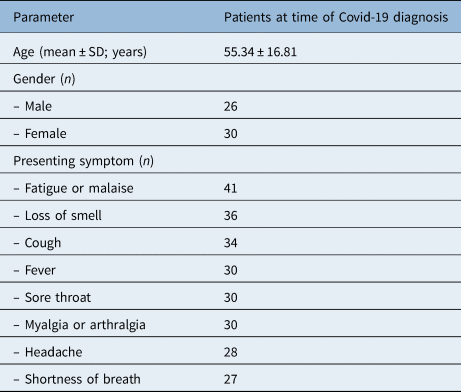
Fifty-six patients with Covid-19 were recruited into the cohort during the study period. The most commonly reported Covid-19 symptoms at the time of diagnosis were fatigue or malaise (n = 41; 73.2 per cent), loss of smell (n = 36; 64.3 per cent), and cough (n = 34; 60.7 per cent) (Table 1). Amongst those who required hospital admission (n = 9), the most common presenting symptoms were fever, shortness of breath, and fatigue or malaise (all symptoms were present in eight out of nine patients). The average age of the patients was 55.34 years (SD = 16.81 years) and there was a relatively balanced distribution of males (n = 26) and females (n = 30). Only 1 of the 56 patients in the cohort was an active smoker at the time of Covid-19 diagnosis.
Covid-19 patient cohort demographics and most common presenting symptoms

Total n = 56. Covid-19 = coronavirus disease 2019; SD = standard deviation
Olfactory dysfunction and recovery
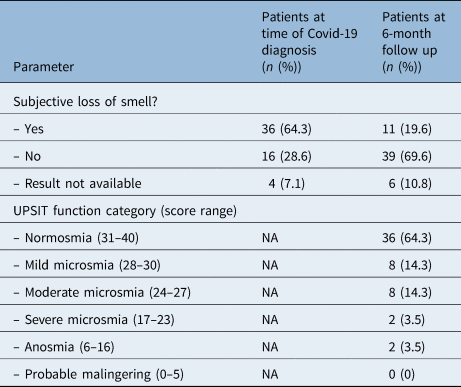
At the time of Covid-19 diagnosis, 64.3 per cent of patients (n = 36) reported subjective loss of smell. At the six-month follow up, only 19.6 per cent (n = 11) reported persistent loss of smell, and 69.6 per cent (n = 39) reported normal olfactory function. McNemar's test, which assessed the changes in subjective sense of smell, showed that 22 patients who reported loss of smell at the time of Covid-19 diagnosis had regained their sense of smell at six months (p < 0.001).
These findings are congruent with the University of Pennsylvania Smell Identification Test scores obtained, which reassuringly demonstrated that 64.3 per cent of patients (n = 36) were normosmic (score of 31–40) at six months after the Covid-19 diagnosis (Table 2). Smaller numbers of patients at six months had: mild microsmia (14.3 per cent, n = 8; score of 28–30), moderate microsmia (14.3 per cent, n = 8; score of 24–27), severe microsmia (3.5 per cent, n = 2; score of 17–23) or anosmia (3.5 per cent, n = 2; score of 6–16).
Olfactory dysfunction and six-month follow-up UPSIT scores

Total n = 56. Covid-19 = coronavirus disease 2019; UPSIT = University of Pennsylvania Smell Identification Test; NA = not applicable
Multivariable linear regression analysis of smell test scores at six months after the Covid-19 diagnosis revealed older age as a statistically significant variable, with each year increase in age being associated with a 0.21-point reduction in smell test score (p < 0.001; 95 per cent confidence interval = −0.28 to −0.14). Sex, weight, height and BMI were non-significant variables in the model.
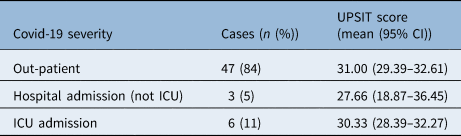
As a surrogate marker of disease severity, hospital admission (including admission to the intensive care unit) was compared with out-patient management. The analysis of smell test scores by this marker of severity revealed no significant difference in olfactory function between the groups (p = 0.41). The smell test scores for each group are presented in Table 3.
Mean UPSIT scores in out-patient, hospital admission and ICU admission groups

ICU = Intensive care unit; UPSIT = University of Pennsylvania Smell Identification Test; Covid-19 = coronavirus disease 2019; CI = confidence interval
Univariate logistical regression analysis of reported medical co-morbidities (chronic cardiac or pulmonary disease, hypertension, asthma, chronic liver or kidney disease, and neurological disorders), immunosuppression (HIV, diabetes, malignant neoplasm, asplenia and immunosuppressive medications) and smoking status against subjective loss of smell revealed no evidence of statistically significant relationships. Of interest, patients with chronic kidney disease did report less (subjective) smell loss at the time of Covid-19 diagnosis, though this was not statistically significant (p = 0.082).
Discussion
Using a validated 40-odorant smell test, we found that 64.3 per cent (n = 36) of our 56 patients had normal olfactory function at six months after Covid-19 diagnosis. Another 28.6 per cent of patients (n = 16) had only mild or moderate microsmia, and only 3.5 per cent (n = 2) were anosmic. This was in the context of 64.3 per cent of patients (n = 36) having subjective loss of smell at the time of Covid-19 diagnosis. These results are reassuring, demonstrating a high degree of olfactory recovery in the months following Covid-19 disease.
We believe this study is the first to examine long-term (six-month) outcomes for post-Covid-19 olfactory dysfunction. Although a number of studies have examined post-Covid-19 anosmia or hyposmia, finding rates of recovery up to four weeks after diagnosis of between 44 and 85 per cent,Reference D'Ascanio, Pandolfini, Cingolani, Latini, Gradoni and Capalbo8,Reference Lechien, Chiesa-Estomba, De Siati, Horoi, Le Bon and Rodriguez15,Reference Printza, Katotomichelakis, Metallidis, Panagopoulos, Sarafidou and Petrakis16 these investigations relied on subjective self-reporting of smell dysfunction. The current study objectively measured olfactory function with a validated instrument, the University of Pennsylvania Smell Identification Test. This is important, as the variability between awareness of olfactory dysfunction and objective testing, within the general population, is well known.Reference Wehling, Nordin, Espeseth, Reinvang and Lundervold17
D'Ascanio et al.Reference D'Ascanio, Pandolfini, Cingolani, Latini, Gradoni and Capalbo8 investigated 43 patients with subjectively reported Covid-19-related anosmia or hyposmia using a survey of olfactory function questions. In contrast to the present study, approximately 85 per cent of their patients experienced subjective resolution of anosmia or hyposmia at 30 days after Covid-19 diagnosis.Reference D'Ascanio, Pandolfini, Cingolani, Latini, Gradoni and Capalbo8 Moein et al.Reference Moein, Hashemian, Tabarsi and Doty18 examined longer-term outcomes for post-Covid-19 smell dysfunction in a cohort of 82 patients, and used the University of Pennsylvania Smell Identification Test to validate their finding that 61 per cent of patients at six to eight weeks after Covid-19 disease were normosmic.
In our cohort, 22 (61.1 per cent) of the 36 patients who subjectively reported loss of smell at the time of Covid-19 diagnosis reported a normal sense of smell at the six-month follow up, and this was congruent with the smell test scores of these patients (average score of 31.19 ± 4.97; 15 were normosmic and 6 had mild to moderate microsmia). Our six-month outcomes reflect those reported by Moein et al.Reference Moein, Hashemian, Tabarsi and Doty18 at six to eight weeks, and may suggest that the majority of olfactory recovery after Covid-19 occurs in the early phase. Further long-term prospective studies with larger cohort numbers and more regular smell testing are required to validate this finding.
Subjective loss of smell was identified as a predominating symptom of Covid-19 illness. It was the second most common presenting symptom experienced in our cohort (36 of 56 patients). There is a large volume of literature now echoing this finding.Reference Hariyanto, Rizki and Kurniawan1 Our data concur with this, and contribute novel understanding of the persistence of olfactory dysfunction after SARS-CoV-2 infection. This study further supports the use of olfactory testing during a diagnostic health consultation, given that olfactory dysfunction is a potential differentiating symptom in patients with suspected SARS-CoV-2 infection.
The rates of smell loss at the time of Covid-19 diagnosis were similar in those managed as out-patients versus in-patients in our cohort (30 out of 47 vs 6 out of 9 patients, respectively). This was further evaluated with a comparison of patients’ six-month University of Pennsylvania Smell Identification Test scores, with no significant difference in olfactory function between hospital or intensive care unit admitted versus out-patient management groups (p = 0.41). This finding suggests that disease severity may not have significant effects on olfactory loss; however, this is contrary to other larger studies which have highlighted mild as opposed to more severe Covid-19 disease as a significant predictor of olfactory dysfunction.Reference Ninchritz-Becerra, Soriano-Reixach, Mayo-Yanez, Calvo-Henriquez, Martinez-Ruiz de Apodaca and Saga-Gutierrez2,Reference Lechner, Chandrasekharan, Jumani, Liu, Gane and Lund10
Of all demographic factors and medical co-morbidities, only patient age was identified as a statistically significant variable. This is somewhat expected given that presbyosmia is a well-established clinical entity and this finding is mirrored in other similar studies.Reference Moein, Hashemian, Tabarsi and Doty18–Reference Wysocki and Gilbert22
Sense of smell is essential for determining the flavour, and therefore enjoyment, of foods and beverages; it also plays a role in warning us of environmental hazards such as gas and smoke. To our knowledge, no published research has addressed which odours are affected by Covid-19-related olfactory dysfunction. There have been correlations made between SARS-CoV-2 viral load and rates of smell dysfunction; however, it is unclear why certain odours are lost but others are not.Reference Mazzoli, Molinari, Tondelli, Giovannini, Ricceri and Ciolli23,Reference Xu, Chen, Zhu, Cui, Chen and Dai24 Regardless of the cause of smell disturbance, anyone with anosmia should be encouraged to check or install home smoke detectors and receive education regarding the hazardous smells they may not be able to detect.
The strengths of our study are: (1) the use of a well-validated and sensitive tool for olfactory function, which allows determination of varying degrees of olfactory dysfunction as well as the identification of specific odours affected; (2) the testing of a comparable sample of Covid-19 patients with respect to other, similar studies; (3) the follow up and testing of patients’ olfactory function at six months post-Covid-19 diagnosis, the longest duration of follow up in the literature to date; and (4) the epidemiology of Covid-19 in Western Australia, which has had very few cases, meaning that we can be certain of the infection timing and confident that re-infection was extremely unlikely, giving greater clarity to the natural history of olfactory dysfunction.
A limitation of this study is that olfactory function was assessed at only two time points for each patient, and the University of Pennsylvania Smell Identification Test was only used at the six-month time point. Therefore, we do not have trend data examining smell test scores from diagnosis through to six months. However, our six-month smell test data do complement the existing literature, as described above. In addition, all patients sat the smell test with guidance and supervision from trained research staff, with the 56 patients completing all 40 questions in a controlled environment. The University of Pennsylvania Smell Identification Test is an odour identification test; we did not conduct any formal chemosensory assessment of sensory thresholds at either the time of diagnosis or the six-month follow up.
• Loss of smell has emerged as an unexpected though significant and revealing early sign of coronavirus disease 2019 (Covid-19)
• There are limited data on long-term olfactory recovery past four to eight weeks after acute Covid-19 infection
• Loss of smell may predispose older adults to ‘long Covid’, with quality of life and safety implications for those affected
• At six months after Covid-19, approximately two-thirds of patients were normosmic, with only a small proportion (3.5 per cent) anosmic
• Hospital or intensive care unit admission did not lead to worse olfactory outcomes compared to out-patient management
• This study is the first to describe six-month outcomes for post-Covid-19-related olfactory dysfunction
Further research is required to validate the findings of the present study, using larger cohorts, and with more regular smell testing from diagnosis through to six months. Other areas for future research might include evaluation of how the Covid-19 vaccines affect olfactory dysfunction as a result of SARS-CoV-2 infection, and the identification of treatments for post-Covid-19 anosmia or hyposmia. At present, there are limited data supporting the use of a short course of corticosteroid nasal sprays to treat post-Covid-19 anosmia. Singh et al.Reference Singh, Jain and Parveen25 demonstrated, in a cohort of 120 patients, that the use of intra-nasal fluticasone during the acute phase of Covid-19 illness led to a statistically significant reduction in olfactory dysfunction. Abdelalim et al.,Reference Abdelalim, Mohamady, Elsayed, Elawady and Ghallab26 however, found that intra-nasal mometasone was not superior to simple olfactory training. Ivermectin, an anti-parasitic medication, given early in the course of Covid-19 may also improve self-reported olfactory dysfunction.Reference Chaccour, Casellas, Blanco-Di Matteo, Pineda, Fernandez-Montero and Ruiz-Castillo27 The European Clinical Olfactory Working Group strongly advocates the use of olfactory training to rehabilitate those with post-Covid-19-related anosmia or hyposmia.Reference Addison, Wong, Ahmed, Macchi, Konstantinidis and Huart28
Conclusion
Using a well-validated tool for testing olfactory function, we found that complete recovery from Covid-19-related anosmia or hyposmia occurs in around two-thirds of patients at six months after diagnosis, with anosmia or severe microsmia persisting in only a small percentage (n = 4; 7.14 per cent). Hospital or intensive care unit admission did not lead to worse olfactory outcomes compared to those managed in the out-patient setting.
Acknowledgements
The authors would like to acknowledge Jun Khai Wong and all involved in the Covid-19 Research Response team for their assistance, logistical support and resources, which allowed this project to proceed as planned. Funding was provided by the Lions Eye Institute (Perth, Western Australia) via The University of Western Australia International Severe Acute Respiratory and Emerging Infection Consortium (‘ISARIC’) Covid-19 Research Response (‘CRR’) trial.
Competing interests
None declared