I. INTRODUCTION
Compared with crystalline counterparts, bulk metallic glasses (BMGs) exhibit some favorable mechanical properties including high strength, high elastic strain limits, high hardness, and high fracture toughness, which are important qualities for engineering and structural materials.Reference Johnson1, Reference Inoue2 Among all BMGs, the Zr-based BMGs have the widest commercial success due to the superior glass formation ability (GFA) and good mechanical properties. Prior studies show that the GFA and plasticity of BMGs are sensitive to the alloy compositions.Reference Sun, Qu, Huang, Liss, Wei, Xing and Shen3–Reference Liu, Wang, Wang, Zhao, Pan and Wang5 Thus, control and optimization of the GFA and plasticity require an understanding of atomic-level structure.
Numerous experimental and theoretical studies have examined short- and medium-range order in metallic glasses. Fewer studies have addressed the details of the free volume distribution. Recently, Flores et al.Reference Flores, Sherer, Bharathula, Chen and Jean6 investigated the evolution of the open volume sites in a Zr-based BMG subjected to increasing amounts of inhomogeneous deformation by positron annihilation lifetime spectroscopy (PALS). Three lifetime components were observed in their work, suggesting the presence of three sites ranges of open volume sites, which are more complex than that described by Cohen and Turnbull.Reference Cohen and Turnbull7 While Flores’ work provides interesting insight into possible atomic arrangements, PALS provides the experimental capability to examine open volume sites with subatomic length scales and is useful for more directly analyzing the open volume distribution in metallic glasses.
As a unique gas element, hydrogen can be generally used as a probe to explore the structure of metallic glassy alloys and distribution of interstitial sites. Most glassy alloys contain some alloying elements that have a high affinity for hydrogen such as Zr, Ti, Hf, Mg, and rare earth elements. Thus, glassy alloys can readily absorb hydrogen. Subsequently, they exhibit high internal friction due to the reordering of the absorbed hydrogen.Reference Hasegawa, Takeuchi, Kato and Inoue8, Reference Hasegawa, Takeuchi, Kato, Yamaura and Inoue9 The electrochemical technique is currently the most popular method of hydrogenating metallic glasses. However, the hydrogenating metallic glasses are usually “ribbon” samples with a thickness of ∼20 μm, and fewer works study the “bulky” hydrogenated metallic glasses.
In our recent work, it was found that the hydrogen can been absorbed by Ti-based and Ti–Al-based alloys when melting under the gaseous mixture of hydrogen and argon, called as melt hydrogenation, leading to the microstructure refinement and decrease of oxygen contents in the alloys.Reference Su, Wang, Luo, Jiang, Guo and Fu10–Reference Liu, Su, Luo, Dong, Guo and Fu13 In this paper, the “bulky” hydrogenated metallic glasses were prepared by melt hydrogenation, and the effects of hydrogen on the structures of Zr-based metallic glasses were investigated by PALS.
II. EXPERIMENTAL PROCEDURES
Ingots of Zr55Cu30Ni5Al10 (Zr55) and Zr57Al10Cu15.4Ni12.6Nb5(Vit106) alloys were produced by arc melting the mixtures of constituent elements (purity > 99.9%) in the gaseous mixture of high-purity hydrogen and argon. The hydrogen percentage in gaseous mixture can be controlled by a hydrogen analyzer. Each ingot was melted for 5–6 times to improve the chemical homogeneity. Then, sample plates with a thickness of 3 mm were produced by suction casting method.
The hydrogen content of alloys was measured by LECO-ROH600 oxygen/hydrogen analyzer (LECO Corporation, St. Joseph Charter Township, MI). X-ray diffraction and transmission electron microscope measurements confirmed that the specimens containing hydrogen were amorphous. PALS experiments were carried out with fast–slow coincidence system with a time resolution of 186 ps and a radioactive 22Na positron source sandwiched between two pieces of the same specimen. Positron lifetime spectrum containing 2 × 10⁶counts was analyzed by the Lifetime9.0 computer program. The program gave three positron lifetimes as the best variance of fit (VOF) and stability. The VOF values for the three lifetimes fits were consistently the best and less than 1.1.
III. RESULTS
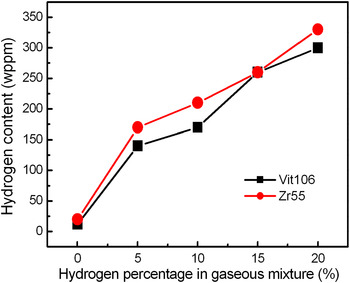
The hydrogen content of Zr55 and Vit106 alloys prepared under Ar + x%H2 atmospheres is shown in Fig. 1. With increasing the hydrogen content in gaseous mixture, the hydrogen solubility of Zr55 and Vit106 alloys gradually increases. It can be seen that Zr-based alloys with different hydrogen content can be prepared by controlling the hydrogen percentage in the gaseous mixture.
Changes in the hydrogen content of Zr55 alloys and Vit106 alloys with variation in hydrogen percentage in gaseous mixture.

Analysis of the annihilation spectra reveals three lifetime components for each specimen, corresponding to three positron trap sizes. This three-lifetime component fit to the data was determined to be the best possible fit by comparison of the VOFs for one, two, three, and four lifetime components. The VOF values for the three lifetime fits were consistently the best and less than 1.1, which are consistent with the data reported in Ref. Reference Flores, Sherer, Bharathula, Chen and Jean6.
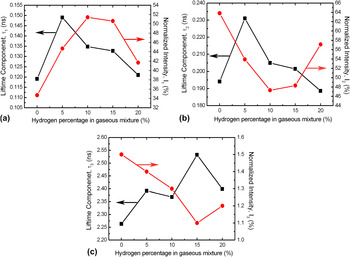
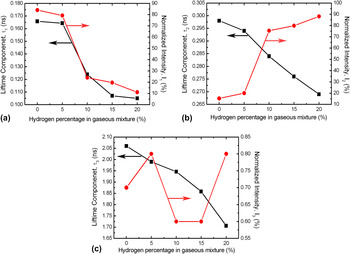
The shortest lifetime (τ1) and the intermediate lifetime (τ2) are attributed to positron annihilation in the densely packed bulk and the open volume defects of the alloys, respectively, while the longest lifetime (τ3) is assigned to ortho-Positronium (o-Ps) annihilation in voids as discussed below. The variation in these three components and their respective intensities for Zr55 and Vit106 alloys fabricated in Ar + x%H2 atmospheres are presented in Figs. 2 and 3. The intensities have been normalized to total 100% and are indicative of the relative concentration of each positron trap.
Magnitude and intensity of (a) the first lifetime component τ1, (b) the second lifetime component τ2, and (c) the third lifetime component τ3 for Zr55 alloys fabricated in Ar + x%H2atmospheres.

Magnitude and intensity of (a) the first lifetime component τ1, (b) the second lifetime component τ2, and (c) the third lifetime component τ3 for Vit106 alloys fabricated in Ar + x%H2atmospheres.

IV. DISCUSSION
According to the free volume theory,Reference Cohen and Turnbull7 defects in metallic glasses are simply defined as part of the distribution with free volume greater than a certain minimum, typically of the order of an atomic volume. Thus, we would expect to find a continuum of open volume sizes ranging from interstitial sites between densely packed atoms (corresponding to zero free volume) through defects of varying sizes. Several prior measurements have shown that these can be characterized by a single lifetime component corresponding to the bulk or “average” open volume site.Reference Flores, Suh, Dauskardt, Asoka-Kumar, Sterne and Howell14–Reference Nagel, Rätzke, Schmidtke, Faupel and Ulfert16 However, the current results suggest that free volume theory described by Cohen and Turnbull may not be an adequate description of the free volume distribution in the present glass. The existence of three distinct lifetime components indicates that certain open volume size ranges are preferred. Prior positron annihilation Doppler broadening spectroscopy studies have suggested that multiple positron traps exist in metallic glasses and that the size or concentration of these traps is changed by plastic flow or structural relaxation. Some research show the more numerous high energy shallow traps as Bernal holes and the low energy deeper traps as flow defects.Reference Suh, Asoka- Kumar, Sterne, Howell and Dauskardt17 More recent PALS measurements also suggest that the distribution of open volume may be three distinct lifetime components, where τ1 corresponds to annihilation in interstitial holes in the densely packed bulk of the structure, τ2 describes annihilation in larger flow defects, and τ3describes the lifetime of o-Ps in voids. In this paper, the results also confirm this view and analyze the effects of hydrogen on the structure of Zr-based BMGs by this view.
A. Changes of open volume with hydrogen addition for Zr55 alloys
Bernal’s work to characterize such a densely packed structure for a monatomic system led to the description of five canonical “holes” surrounded by 4–10 vertex atoms that combine to completely fill space.Reference Bernal18, Reference Bernal19 In this model, the primary structural unit of the glass was shown to be the tetrahedron, which has the highest packing efficiency. Tetrahedra alone cannot be combined to fill space, however, resulting in the long-range disordered structure, which includes some less efficiently packed polyhedra. These less efficiently packed regions may act as initiation sites for atomic rearrangements associated with plastic deformation. Sietsma and ThijsseReference Sietsma and Thijsse20 investigated the interstitial voids of the as-quenched and annealed state amorphous Pd52Ni32P16 and found that there are two kinds of interstitial voids, which are intrinsic voids surround by 9 or less and larger voids (holes) surrounded by 10 or more atoms. During structure relaxation, the concentration of interstitial voids in annealed state amorphous Pd52Ni32P16is more than that of as quenched due to the holes break up into interstitial voids. It suggests that the concentration of interstitial voids reflects the degree of dense-packed atomic configurations.
The shortest lifetime τ1 as shown in Fig. 2(a) ranging from 0.119 to 0.150 ns corresponds to annihilation in the densely packed bulk of the glass, where tetrahedral interstitial holes predominate. To extend this estimation of the size of the smallest open volume sites, we compare τ1 with the positron lifetimes in the bulk in crystalline (hexagonal close packed, hcp) Zr.Reference Campillo, Plazaola and Puska21 Experimental and computational evidence indicates that the positron lifetime in the bulk states of crystalline Zr is 0.162–0.165 ns, slightly longer than τ1 as shown in Fig. 2(a). Neglecting differences in positron affinity in the single-component and multicomponent systems, the longer lifetime in the crystalline Zr makes intuitive sense when one considers that the hcp crystal structure has one octahedral site for every two tetrahedral sites, meaning that the crystal is locally less densely packed than the ideal randomly packed structure. The intermediate lifetime τ2 as shown in Fig. 2(b) ranging from 0.188 to 0.231 ns corresponds to annihilation in flow defects. The shortest lifetime τ1 and intermediate lifetime τ2vary with hydrogen additions. Overall, both lifetimes generally decrease with increasing hydrogen content.
As shown in Figs. 2(a)–2(c), hydrogen addition causes a significant change in the concentration of the three open volume defects. It is worthy to notice that the concentration of tetrahedral interstitial holes and flow defects as a function of the hydrogen content present parabolic shape. For Zr55 alloys prepared in Ar + 10%H2atmospheres, the concentration of tetrahedral interstitial holes reaches a maximum, whereas the concentration of flow defects reaches a minimum. It suggests that tetrahedral interstitial holes predominate due to the proper hydrogen addition, resulting in even denser packing as noted above.
B. Changes of open volume with hydrogen addition for Vit106 alloys
Flow in metallic glasses is thought to be a diffusion-like process involving the stress-induced cooperative rearrangement of small groups of atoms referred to as “flow defects” or “shear transformation zones.”Reference Spaepen22, Reference Argon23 These flow defects are associated with open spaces, or “free volume” sites, distributed throughout the structure. Spaepen defines the free volume as the atomic volume in excess of the ideal structure defined by the dense random packing model. It is usually assumed that the amount and distribution of the free volume controls plastic flow.
The shortest lifetime τ1 as shown in Fig. 3(a) ranging from 0.105 to 0.165 ns corresponds to annihilation in the densely packed bulk of the glass, where tetrahedral interstitial holes predominate. The intermediate lifetime τ2 as shown in Fig. 3(b) ranging from 0.270 to 0.300 ns corresponds to annihilation in flow defects. The intermediate lifetime component may be compared with that of a crystalline point defect. Neglecting the formation of Positronium, which is rare in metals due to their high electron density, the positron lifetime for a monovacancy in crystalline Zr is 0.252–0.254 ns.Reference Campillo, Plazaola and Puska21 This is of similar order but smaller than τ2 as shown in Fig. 3(b). Again neglecting chemical effects on positron affinity, this result suggests that the open volume of the flow defect is larger than a Zr vacancy. The magnitude of the lifetime indicates that these defects may contain sufficient open volume to accommodate at least one additional atom with only local rearrangements, consistent with the requirements of a flow defect. The shortest lifetime τ1 and intermediate lifetime τ2decrease with increasing hydrogen content.
As shown in Figs. 3(a)–3(c), the sizes of interstitial holes, flow defects, and voids gradually decrease with the increase of hydrogen content. It is notable that the concentration of tetrahedral interstitial holes decreases with the increase of hydrogen content, whereas the concentration of flow defects increases. This suggests that the free volume increase associated with hydrogen content increase is a result of concentration increase of flow defects. Some research results have shown that the plasticity of metallic glass can be enhanced by introducing large amounts of free volume.Reference Huang, Shen and Sun24, Reference Tan, Zhang, Sun, Stoica, Li, Song, Kühn, Pan and Eckert25 Therefore, hydrogen addition may be used to improve the plasticity of Vit106 BMGs.
It is worthy to notice that the hydrogen addition induces different changes of structure for the Zr55 and Vit106 alloys, especially for the densely packed bulk and loosely packed flow defects within the glass. This suggests that the two kinds of Zr-based alloys possess different initial structure. Besides, additions of hydrogen can produce large negative heat of mixing between H–Zr (−69 kJ/mol) and H–Nb (−46 kJ/mol) binary pairsReference Takeuchi and Inoue26 and change the bonding energy between the atoms. Therefore, hydrogen addition may induce the different degree of changes in the Zr55 and Vit106 alloys. We also considered the relation between the type of element and the free volume. The electron momentum distributions obtained with positron annihilation spectroscopy are sensitive to both the valence and core electron contributions. The high momentum part of the momentum distribution is the result of annihilations with the orbital (core) electrons. Orbital electrons retain their atomic character even when embedded in a solid, and hence, the momentum distribution can be used to identify the chemical environment of a defect site. The elemental specificity of this technique has been established in past studies.Reference Flores, Suh, Dauskardt, Asoka-Kumar, Sterne and Howell14, Reference Kanungo, Gladeb, Asoka-Kumar and Flores27 In this paper, we use PALS to examine open volume sites. However, this method cannot provide momentum distribution. Thus, it needs further research in the relation between the type of element and the free volume.
V. CONCLUSIONS
The structural changes associated with the increase of hydrogen content in Zr-based BMGs have been investigated using PALS. Three lifetime components indicated that three distinct size ranges for open volume defects present in the glass. The smallest lifetime τ1 corresponds to annihilation in tetrahedral interstitial holes in the densely packed bulk of the structure, the intermediate τ2 corresponds to annihilation in flow defects, and the longest lifetime τ3 corresponds to the lifetime of o-Ps in voids. Hydrogen addition causes a significant change in the concentration of the tetrahedral interstitial holes and flow defects. When Zr55 alloys were fabricated in Ar + 10%H2atmospheres, the concentration of tetrahedral interstitial holes reaches a maximum, whereas the concentration of flow defects reaches a minimum, which may provide a more dense random-packed structure. For Vit106 alloy prepared in the gaseous mixture of hydrogen and argon, hydrogen addition decreases the concentration of tetrahedral interstitial holes and increases the concentration of flow defects.
ACKNOWLEDGMENTS
The financial support from the National Natural Science Foundation of China (50975060, 50901025), National Basic Research Program of China (2011CB610406), China Postdoctoral Science Foundation (201104420, 20090450840), Fundamental research funds for the central universities (HIT.BRET1.2010008), and Scientific and technological project in Heilongjiang Province (GZ09A206) are gratefully acknowledged.