1. INTRODUCTION
One of the most prevalent principles dictating the phonotactics of any given language is the sonority sequencing principle (SSP), which prohibits rises in sonority from the nucleus of a syllable to either edge (Clements, Reference Clements, Kingston and Beckman1990). Languages can repair SSP violations through any number of strategies including deletion, epenthesis and metathesis. The SSP I assume is Clements’ shown in (1), in which segments to the left are more sonorous than those to the right.

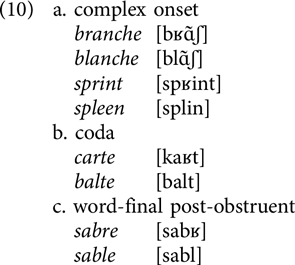
The most productive clusters in French are obstruent-liquid clusters (OLC; Lyche, Reference Lyche1993; Malécot, Reference Malécot1974; Kemp, Pupier, and Yaeger, Reference Kemp, Pupier, Yaeger, Shuy and Shunkal1980). These clusters are argued to hold a unique place in French phonology, as they are always tautosyllabic and can block the application of certain phonological rules (Lyche, Reference Lyche1993). Moreover, despite rising in sonority, these clusters can be realised in syllable onsets and codas. Examples of OLC are shown by the data in (2–4).

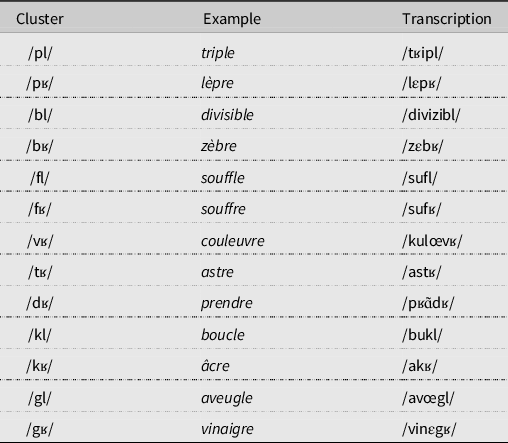
While the data in (2,3) are expected given the licensing of the coda cluster in (4) is a violation of the SSP formalized in (1), the more sonorous liquid is further from the nucleus than the obstruent that immediately precedes. Table 1 lists all 13 OLC licensed in French.
Obstruent-Liquid Clusters licensed in word-final position

Word-final OLC can surface one of three ways: faithfully like in (5a), without the liquid as in (5b), or as the onset of an epenthesised schwa like in (5c).

When OLC are realised pre-vocalically, the cluster never violates the SSP because it is always resyllabified to the onset of the following vowel like in (6a,b) or to the onset of an epenthesised schwa as in (6c).

Word-final OLC can also occurphrase-finally like in (7).

One final case of French OLC to consider are those that also contain /s/ like in (8). They introduce a fourth possible realisation shown in (8d).Footnote 2

/sOL/-clusters allow for the deletion of both the obstruent and the liquid with the maintenance of the /s/. There are four word-final /sOL/-clusters in French.Footnote 3

Before continuing, let us briefly consider the natural class of liquids defined by the feature set [+son; +cons; -nas]. The featural representation of /ʁ/ in French and to which class it belongs are contested. Some scholars (i.e. Dell, Reference Dell1973; Reference Dell1976) classify it as a liquid. Others, like Côté (Reference Côté2004) believe that it is a glide in coda position noting that it patterns similarly to /j/ in coda. Yet, others such as Colantoni and Steele (Reference Colantoni and Steele2005) argue for its status as a fricative. Following from Dell, I assume that /ʁ/ is a liquid and it is distinguished from /l/ by the feature [lat]. The status of /ʁ/ as a liquid can be captured by its phonological distribution which is similar to that of /l/ in many of the environments in which they overlap (adapted from Webb, Reference Webb2009).
It has been suggested that the variability of word-final OLC comes from a desire to avoid the rising coda. Much of the research on word-final OLC has considered the realisation of one variant or the other as a means of repairing a rising coda, but many analyses do not consider reduction and epenthesis as competing repair strategies. Thanks to recent advancements in phonological theory focusing on variation (c.f. Coetzee and Pater, Reference Coetzee, Pater, Goldsmith, Riggle and Yu2011 for an overview), we can better understand which factors – phonological or otherwise – condition the selection of one variant over another. I, therefore, suggest a reconsideration of word-final OLC through the lens of maximum entropy grammar (Goldwater and Johnson, Reference Goldwater, Johnson, Spenader, Eriksson and Dahl2003) and scaling the constraints of this grammar with any relevant extragrammatical information (à la Coetzee and Kawahara, Reference Coetzee and Kawahara2013). I find that schwa epithesis and cluster reduction do not occur to repair sonority sequencing violations, but instead to avoid codas and that grammatical and non-grammatical factors play a role in the selection of one repair strategy over the other.
2. PRIOR RESEARCH ON WORD-FINAL OBSTRUENT-LIQUID CLUSTERS
Many analyses of OLC only seem to consider either (1) the reduced variant and the faithful variant, thereby excluding schwa; (2) the schwaful variant and the faithful variant, while excluding the reduced variant; or (3) the reduced and schwaful variants but not the faithful realisation of the underlying cluster. Some analyses (Laks, Reference Laks1977; Wu, Reference Wu2018) have considered all three variants of only one liquid. Yet, these clusters with all three surface forms are mentioned by Fouché, (Reference Fouché1959: 96):
Lorsque l’e muet final est précédé d’une consonne + liquide (l,r) la chute peut ne pas avoir lieu. Si elle se produit, la liquide se prononce à voix chuchotée […] Ce n’est que dans la conversation familière que la liquide de l’e muet final disparaissent dans certains mots ou certaines expressions d’usage fréquent…
In one of the first formal treatments of OLC, Dell (Reference Dell1976) accounts for two possible surface forms: the reduced form or the schwaful form. Dell posits two rules to capture the distributions of the realisations of OLC. The first rule allows for the insertion of a schwa following a word-final consonant cluster when followed by another consonant. The second is an obligatory word-final liquid deletion rule. The optional epenthesis rule bleeds the liquid deletion rule allowing for the realisation of both [O] and [OLə] sequences. Dell, however, must propose a constraint on his derivation forbidding sequences of *[OLC], which Dell claims to be ungrammatical. Dell also acknowledges that extragrammatical factors may condition epenthesis and deletion including rate of speech, syntax, and the /OL/-final word itself (pp. 75–76).
Laks (Reference Laks1977) proposes an analysis of word-final /Oʁ/-clusters in a Labovian variable rules framework. Laks considers the variable realisations of these clusters pre-consonantally, pre-vocalically and pre-pausally. He expands upon Dell’s acknowledgment that extragrammatical factors may condition the realisation of OLC, and demonstrates variation across speakers that results from a complex interaction of the social standing of the speakers and spoken register. Boughton (Reference Boughton2015) also approaches OLC reduction as sociolinguistic variation and finds that OLC reduction is conditioned across and within varieties of French, but she does not consider a form in which a schwa is epenthesised. She finds that the pre-consonantal position favours the reduction of OLC over pre-vocalic and pre-pausal conditions. She also suggests that OLC reduction functions as a sociolinguistic marker, but what reduction marks and how this process is manifested sociophonologically is unclear.
Indeed, there have been analyses that have considered all three variants. For instance, in an impressively thorough study of cross-linguistic consonant cluster reduction, Côté (Reference Côté2000) suggests that in Québecois French, schwa can be epenthesised at the end of a word when that word ends in a consonant cluster (no matter the cluster) and the following word begins with a consonant, which can be observed by contrasting (11a) with (11b).

In a follow-up analysis of cluster reduction in Québecois French, Côté (Reference Côté2004) formalises a grammar which treats the reduction of rising codas differently depending on the distance of the rise in sonority. She suggests that the deletion of /ʁ/ – which she believes is a glide – is a more serious violation than the deletion of the less sonorous liquid /l/, which is more serious than the deletion of a nasal consonant. Her claims pertaining to /l/ and /ʁ/ were further supported by Boughton (Reference Boughton2015), who in a survey of prior studies of OLC reduction, shows that /l/ is systematically deleted far less often than /ʁ/.
Milne (Reference Milne2013) approaches the question of word-final clusters quantitatively, and he may be the first to propose an analysis of schwa epenthesis and cluster reduction as competing repair strategies. He furnishes a predictive analysis of cluster reduction and word-final schwa epenthesis in Québecois and Northern Metropolitan French. Milne is interested in all possible word-final clusters in French, not just OLC. His data come from a large corpus of political debates containing more than 200 speakers. Milne divides clusters into two groups: those which can reduce (like OLC) and those which cannot. He states that epenthesis can only occur after reducible clusters. Milne finds that reduction appears to be more common in Québec than in France, but he finds no difference between the varieties in rates of schwa epenthesis. Furthermore, Milne’s results indicate that the more likely a cluster is to reduce, the more likely it is to have a schwa inserted after it; suggesting that cluster reduction and schwa epenthesis are in competition with one another as a means of avoiding word-final clusters. Milne leaves the question open as to what factors condition the selection of any one realisation over the other, though.
Wu (Reference Wu2018) approaches word-final /Oʁ/-clusters computationally and finds that the following context, stylistic variation, and speaker gender all influence the selection of either repair strategy. She also finds that if schwa is not epenthesised, then there is a strong tendency to delete the /ʁ/. Like Boughton, Wu finds an effect of the following context, whereby the pre-consonantal context favours /ʁ/ deletion, while the pre-vocalic and pre-pausal contexts favour /ʁ/-retention.
3. DATA AND THE CORPUS
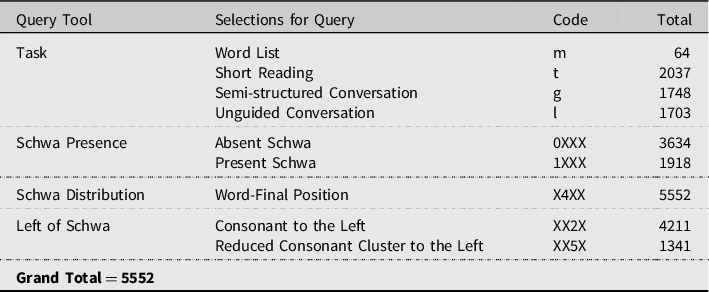
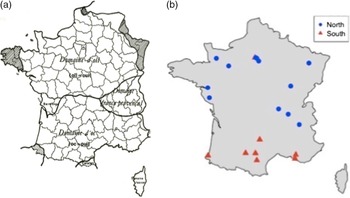
Data for this study come from the Projet phonologie du français contemporain corpus (PFC; Durand, Laks and Lyche, Reference Durand, Laks, Lyche, Pusch and Raible2002). Since the realisation of word-final OLC is linked to questions pertaining to schwa, the PFC schwa coding protocol is an appropriate starting point for this analysis as it can be specified for schwa realisation and reduced consonant clusters that precede a possible schwa epenthesis site. Only enquête points in Northern France were queried for this study, as there are significantly different rates of schwa realisation in the varieties of French spoken in Northern and Southern France. (Durand and Eychenne, Reference Durand, Eychenne, Crouzet and Angoujard2007). It has also been suggested that the schwa is subject to different phonological distributions in Northern and Southern French (Durand, Reference Durand1976). Northern Metropolitan French appears to have lost its word-final lexical schwa, while the more conservative Southern Metropolitan French has retained it. The division I define between Northern and Southern Metropolitan French follows from the historical division between the langues d’oc and other Gallo-Romance languages in France, primarily the langues d’oïl and franco-provençal illustrated in Figure 1. The output of this initial query is shown in Table 2.
PFC query for word-final OLC

Once the results of the query were obtained, a program (Griffiths to appear) was run to (1) remove word-final sites in which a schwa could be epenthesised but was not, (2) spot-check the accuracy of the existing protocol by matching orthography from the transcription with the coding protocol, (3) remove all tokens that did not contain OLC, and (4) further specify the context in which schwa appears from the general coding protocol to a more granular means of the preceding and following sounds themselves. This program left a grand total of 1,537 tokens.
4. ANALYSIS
4.1 Statistical analysis
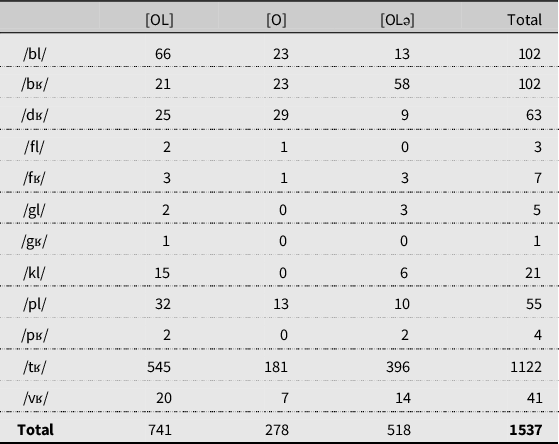
Data were subject to descriptive statistics and fit to a multinomial logistic regression from the nnet package (Ripley, Venables, and Ripley, Reference Ripley, Venables and Ripley2016) in R (R Core Team, 2019). The goal of this statistical analysis was to inform the relevant subset of Con to specify in the grammar and to understand which factors could scale the constraints in the formal grammar. Of the 1537 /OL/-final words, 741(48.2%) were realised faithfully, 518 (33.7%) were realised with an epenthesised schwa, and 278 (18.1%) were reduced. The data broken down by OLC and realisation are presented in Table 3.
All realisations of OLC by cluster

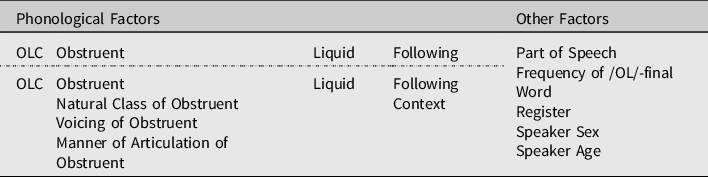
For this analysis, the dependent variable of OLC realisation was at three levels (faithful, reduced, schwaful), and the predictors were selected from the factors output by the PFC query and AP, shown in Table 4.
Variables sampled as predictors for model construction

Regarding the selection of the phonological factors as predictors, to avoid collinearity, when the OLC itself was selected as a predictor, no value from the obstruent nor liquid columns was selected. Second, speaker age and lexical frequency was obtained from Lonsdale and Le Bras (Reference Lonsdale and Le Bras2009) and was log-transformed along with speaker age. Finally, the variable “register” was the PFC task converted to a numeric scale increasing in register: the free conversation task was coded as 1, the semi-structured conversation as 2, the reading as 3, and the word-list as 4.
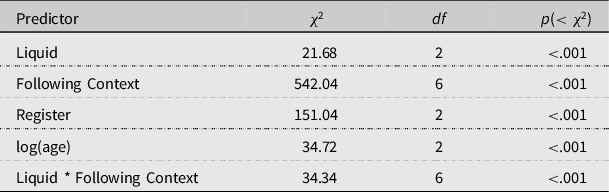
Among the potential models, the best model (AIC = 2399.257) consisted of a 2x4 interaction between the liquid and the following context and the discrete variables of register and (log-transformed) speaker age.Footnote 4 A likelihood ratio test, presented in Table 5, revealed that all variables and the interaction term were significant predictors of OLC realization.
Post-hoc likelihood ratio test for winning model

Post-hoc pairwise comparisons indicated an overall preference for the faithful realisation over either repair strategy (p<.001); however, there was no difference observed between the reduced and schwaful forms (f = .329; p = .57). Concerning the liquid in the OLC, a post-hoc chi-square test indicated that /Oʁ/-clusters were significantly more likely to be repaired than /Ol/-clusters (χ 2 = 20.256, df = 1, p<.001). This is in line with Boughton’s survey of OLC reduction; however, these results extend her findings to include repair through epenthesis as well. Neither /Ol/-cluster nor /Oʁ/-clusters had a preference in repair strategy (p = .99 and p = .32 respectively).
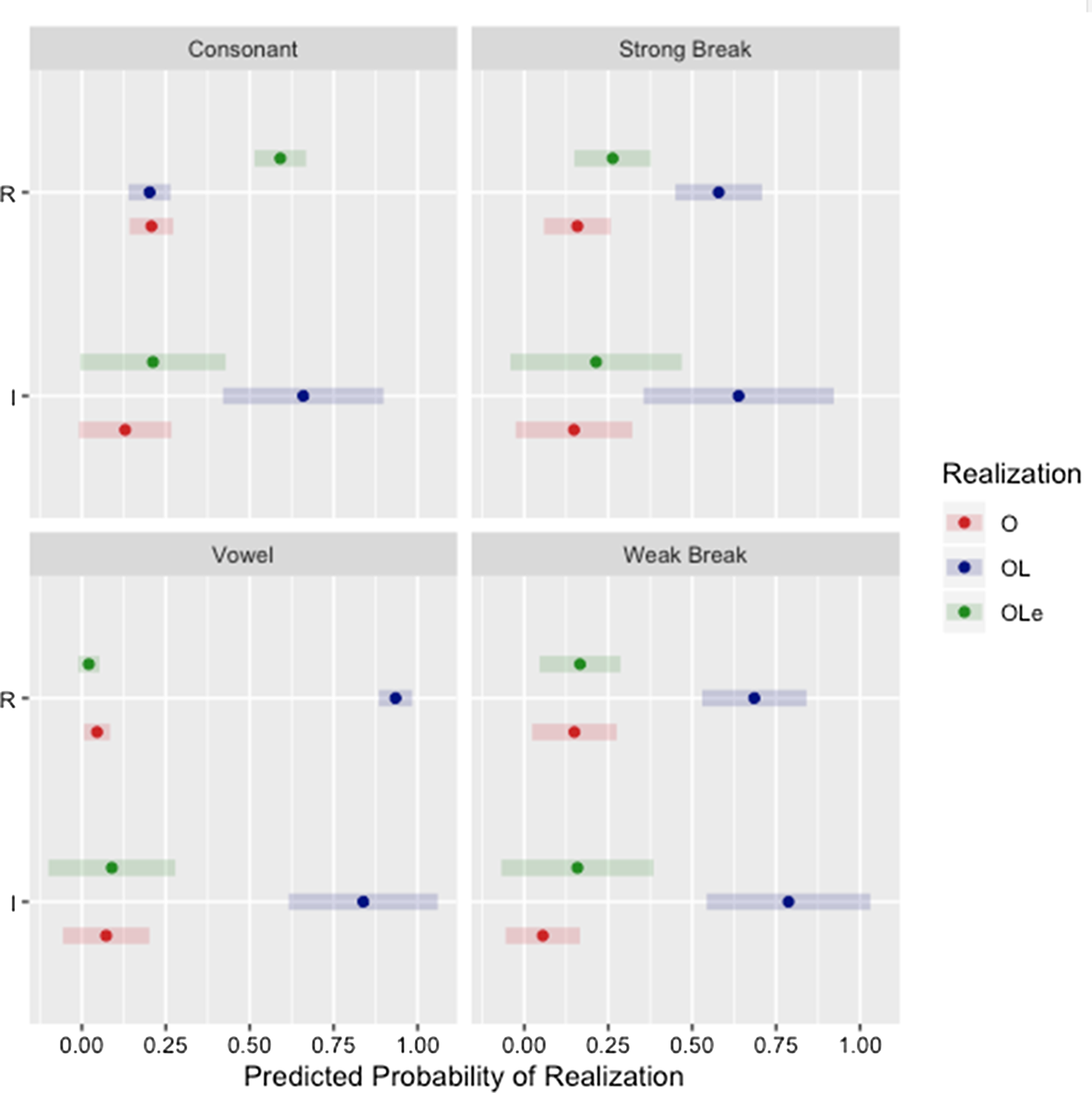
The context following the OLC was also found to condition OLC realisation. Repair was unlikely before prosodic breaks and vowels, and no difference in OLC realisation was observed between strong and weak breaks (p = .43). The faithful variant was most likely to occur pre-vocalically (p = .85). The interaction between the liquid and the following context is illustrated in Figure 2.
(a) Historical Division of Gallo-Romance Languages in France (Walter, Reference Walter1988: 59) vs. (b) North/South Division of PFC Enquêtes.

Interaction of liquid and following segment on OLC realisation.

In the pre-consonantal context, /Oʁ/-clusters are significantly more likely to be repaired than /Ol/-clusters, and there is no preference for repair strategy in the case of /Ol/-clusters. By contrast, /Oʁ/-clusters greatly prefer schwa epenthesis in the pre-consonantal context. The contrast between (12a,b) illustrates the asymmetry in the pre-consonantal condition.

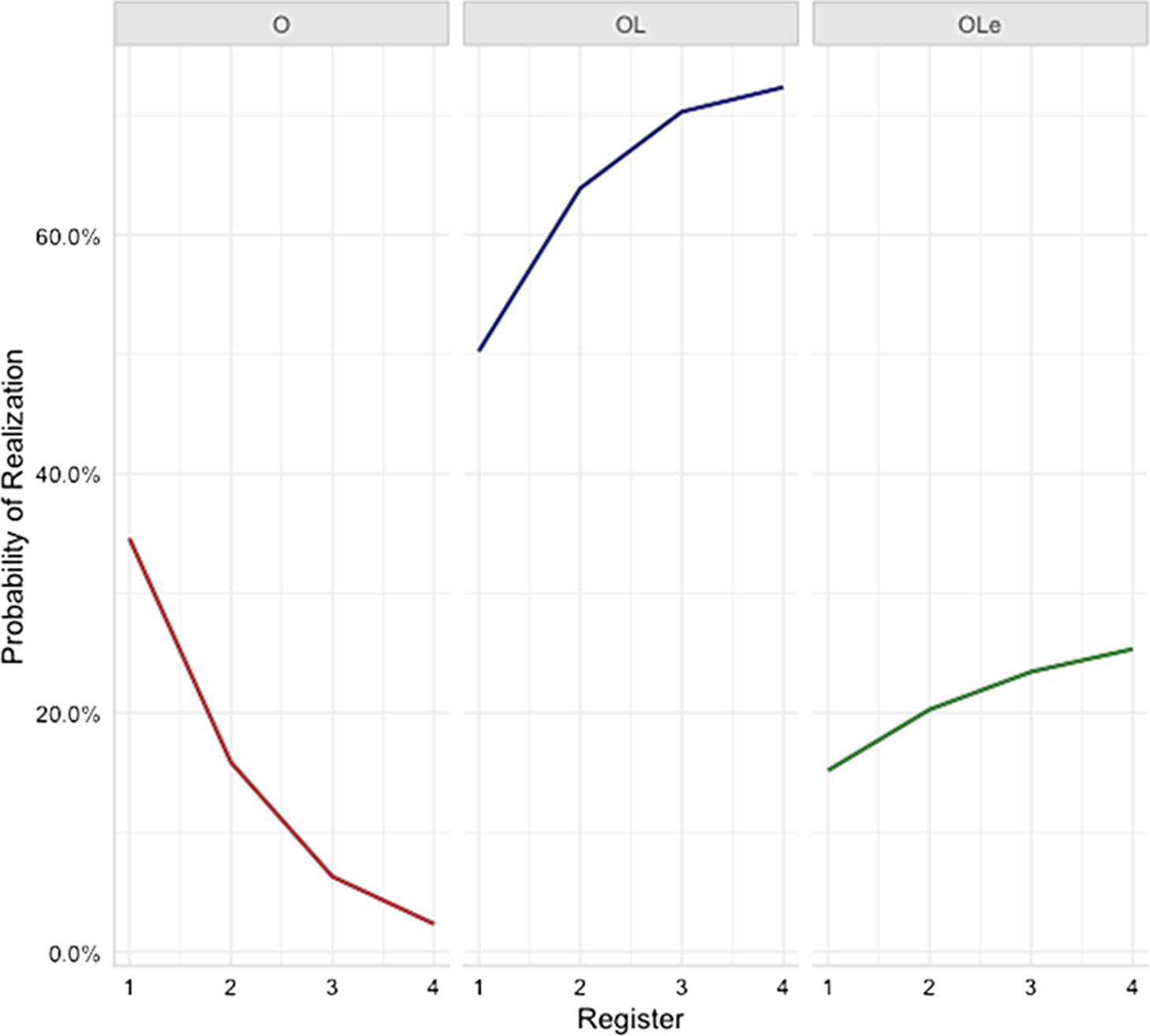
Speech register – or style – was also found to have a significant effect on OLC realisation. This effect is illustrated in Figure 3.
Effect of register on OLC realisation.

The results indicate that repair is more likely to occur, particularly through reduction, in less formal styles. The likelihood for faithfulness increases with register, but so does the likelihood for repair through schwa insertion.
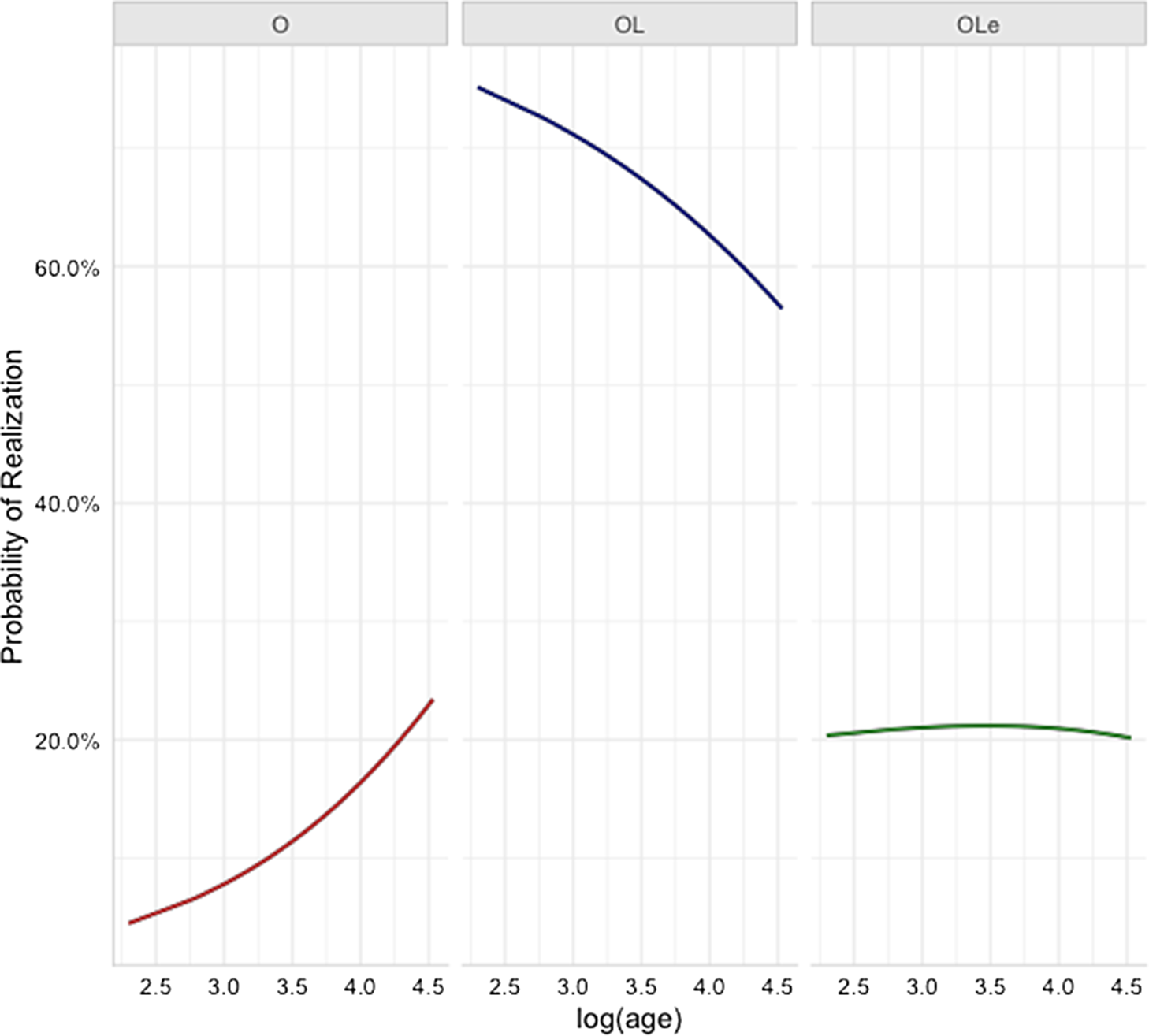
The last predictor found to have an effect on OLC realisation was speaker age, illustrated in Figure 4.
Effect of speaker age on OLC realisation.

The older the speaker, the more likely they were to realise the faithful variant, but as age increases, so does the likelihood of repair through reduction.
Let us briefly summarise the results thus far. The differences between /Ol/-clusters and /Oʁ/-clusters found in previous studies were confirmed: /Ol/-clusters are less likely to be repaired than /Oʁ/-clusters. As for the environment following the OLC, the most likely context for faithful OLC realisation was the pre-vocalic context, the most likely context for repair was the pre-consonantal context, and no difference was found between strong and weak prosodic breaks. There was a significant interaction between the liquid and the following context. The most drastic differences between liquids occurred pre-consonantally: /Oʁ/-clusters were likely repaired via schwa epenthesis, while the faithful realisation of /Ol/-clusters was most likely licensed. Two extragrammatical variables were found to have an effect on OLC realisation. First, there was an effect of register – or style – such that OLC were more faithfully realised in less elevated registers and when the register was elevated, the more likely the cluster was to be repaired via schwa insertion. Finally, older speakers were more likely to repair OLC than younger speakers, especially through cluster reduction. These results will be considered in the development of the MaxEnt grammar: more specifically, in defining the Inputs and environments of the OLC as well as the relevant subset of Con, which will be scaled by style and speaker age.
4.2 Maximum entropy grammar
The grammar of OLC will be formalised in maximum entropy grammar (MaxEnt; Goldwater and Johnson, Reference Goldwater, Johnson, Spenader, Eriksson and Dahl2003), which is a constraint-based grammar similar to Optimality Theory; however, unlike OT which ranks constraints in a discrete hierarchy of strict domination (C 1 ≫ C 2 ≫ C 3 ), MaxEnt proposes a gradient means of constraint ranking, in which the constraints are assigned a weight via an online error-driven learning algorithm. It has been suggested that theories of weighted constraints may be better at modeling phonological variation than theories of ranked constraints like OT (Pater, Reference Pater, McCarthy and Pater2016). There are several theories of weighted constraints often grouped under the umbrella of Harmonic Grammar (for a presentation of the variety of theories of weighted constraints, the reader is referred to Coetzee and Pater, Reference Coetzee, Pater, Goldsmith, Riggle and Yu2011). MaxEnt was chosen for the present analysis as it has been shown to be adept at capturing both inter- and intra-speaker variation (Bayles, Kaplan, and Kaplan, Reference Bayles, Kaplan and Kaplan2016).
MaxEnt is another iteration of multinomial logistic regression that has long been used in other fields of scientific inquiry (Jurafsky and Martin, 2008: 201). Even though the same mathematical underpinnings underlay MaxEnt grammar and the exploratory model presented in §4.1, there are some differences between the two that warrant an analysis comprised of both models. First, since MaxEnt is an adaptation of Optimality Theory, constraint weights must remain non-negative (Shih, Reference Shih2017) unlike the multinomial logistic regression, which can output negative coefficients. Both models also approach the question of OLC realisation slightly differently. The exploratory model presented in §4.1 relies on predictors that capture the distribution of OLC realisation, while the MaxEnt model relies solely on the phonological factors that contribute to OLC realisation. Moreover, unlike a standard regression model, the MaxEnt learner is able to consider variants that are unattested in the corpus if it is given them. Finally, the MaxEnt model allows for the formalisation of certain phonological principles as constraints thus generating a more fine-tuned picture of the phonology of OLC than what is available with a standard regression model. These two separate models complement one another in furnishing a more comprehensive picture of word-final OLC realisation.
MaxEnt learners require Inputs, Outputs and their probabilities of realisation, a constraint set, and each candidate’s violations of that constraint set. With such a robust learning foundation, a MaxEnt learner will never make assumptions external to the data. The learner pits Input-Output pairs against the constraint hierarchy, fitting them to a probability distribution defined by the proportions of the realisations of each candidate with respect to the others. Over the course of the learning process, the learner modifies the constraint weights, generating a weighting condition, which in some ways is comparable to the constraint hierarchy in classic-OT. To illustrate this, consider a hypothetical language that disprefers coda clusters and can optionally repair them through reduction. A simple MaxEnt grammar of clusters in this toy language is provided in (13).Footnote 5

The sample tableau in (13) differs from a traditional OT tableau in several ways. First, note that in the first column a winner is not selected, since more than one output is grammatical. Next, the numerical value above each constraint is that constraint’s weight assigned by the learner. Violations of a constraint are not marked by an asterisk, rather by negative integers. This is partially diacritic so that the harmony (or H-) score in the fifth column of the tableau can be calculated. The H- score for each candidate is obtained from the formula in (14).

where w k is the weight of constraint k of the constraint set K, s k is the number of times that a candidate C violates k expressed as a negative integer.
Relating the formula in (14) to the tableau in (13), the H-score for candidate b is obtained by multiplying its one violation of Max to that constraint’s weight (w = 1). This is done again with *Complex. The sum of those values is the H-score for that candidate (H = −1). The e H column is the probability distribution of each variant assigned by the learner. The H-score for each candidate is taken as a power of the base of the natural logarithm e. The column p shows each candidate’s probability of occurrence which is proportional to e H ; therefore, in (13) candidate b surfaces approximately 73% of the times that /lust/ occurs.
The formula in (14), and by extension the tableau in (13), treat all complex codas the same no matter the word, speaker, or context. Coetzee and Kawahara (Reference Coetzee and Kawahara2013) suggest that this can be remedied by scaling constraint weights with factors that may be external to the phonological grammar. Reconsidering our hypothetical language from (13), imagine that the word /lust/ is highly frequent, as opposed to the infrequent /nust/. Coetzee and Kawahara argue that a model of phonological variation must be able to account for the fact that, due to frequency, /lust/ is more likely to be reduced than /nust/. They suggest scaling the weight of faithfulness constraints, allowing them to have a stronger effect on less frequent words than more frequent words. The scaling of constraints incorporates non-grammatical factors into a formal phonological grammar that remains grammar dominant (Coetzee and Kawahara, Reference Coetzee and Kawahara2013: 77–79), meaning that the grammar defines what patterns are possible, while the scaling factor determines how a structure varies within the limits defined by the grammar. To capture the differences attributed to frequency, a negative scaling factor must be applied to /nust/ and a positive scaling factor must be applied to /lust/. This would result in /nust/ being mapped onto its faithful candidate more often than /lust/. This is illustrated by the addition of the scaling factor for frequency (s) in the tableaux in (15).

The inclusion of the scaling factor requires modifying the formula in (14) to (16).

where F k is the kth faithfulness constraint w k is the weight of the kth constraint, s is the scaling factor for frequency, F k (C) is the number of F k -violations of a candidate C, expressed as a negative integer, M n is the nth markedness constraint w n is the weight of this constraint, M n (C) is the number of M n -violations of a candidate C, expressed as a negative integer.
In their scaled grammars, Coetzee and Kawahara (Reference Coetzee and Kawahara2013) and Coetzee (Reference Coetzee2016) only examine simplification processes like deletion and assimilation, resulting in the implicit assumption that all variable processes are similarly affected by whatever causes the scaling of the faithfulness constraints; however, Coetzee and Kawahara (Reference Coetzee and Kawahara2013: 80) suggest that simplification processes like deletion and augmentation processes such as epenthesis may pattern differently given the same variable. This appears to be the case for the two repair strategies for OLC. For example, the effect of register on OLC realization found a negative correlation between formality and likelihood of reduction and a positive correlation between formality and likelihood of schwa insertion. To illustrate what this asymmetry may look like, let us again consider our toy language from above, and let us assume that our language can repair codas either through reduction or through epenthesis. Let us also assume an inverse relationship between the likelihood of epenthesis and lexical frequency, meaning that for frequent words Max must be scaled down and Dep must be scaled up, while the opposite would be the case for infrequent words. This would result in the grammar in (17).

The grammar in (17) shows that for frequent words the reduced variant is the most likely variant, while the epenthetic variant is most likely for infrequent words.
4.3 A MaxEnt grammar of word-final obstruent-liquid clusters
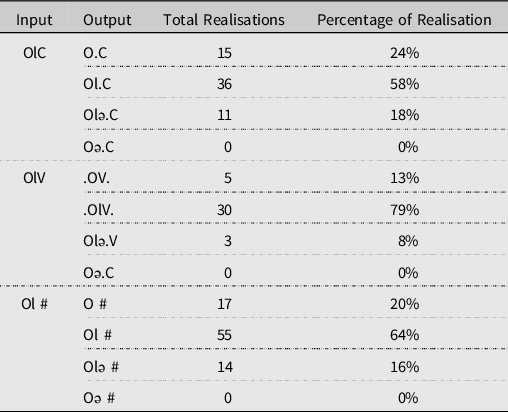
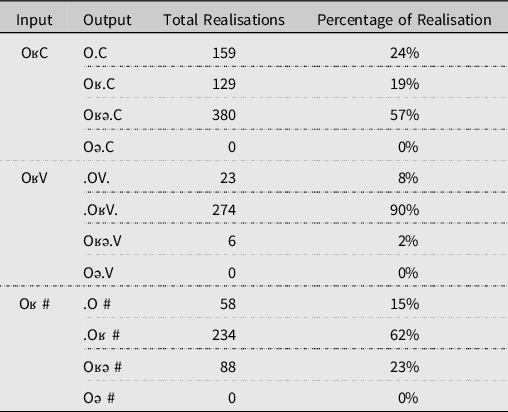
The learner was given four possible realisations of /Ol/-clusters and /Oʁ/-clusters in three contexts: (a) the faithful [OL], (b) the reduced [O], (c) the schwaful [OLə] and (d) a doubly-repaired [Oə] form. While the fourth form was unattested in this corpus, it has been documented (Eychenne, Reference Eychenne2006), but it is rare and could be attributed to a slip of the tongue. The training data is provided in Tables 6 and 7 for /Ol/- and /Oʁ/-clusters respectively.
Training data for /Ol/-clusters

Training data for /Oʁ/-clusters

In addition to the distribution data in Tables 6 and 7, the learner was also given the subset of Con outlined below. Let us begin by considering the constraints in (18).

The constraints in (18) formalise the factors that have traditionally been considered to be those that drive OLC repair. Son-Seq in (18a) penalises any violation of the SSP defined in (1), which occurs when a word-final OLC surfaces faithfully pre-consonantally or pre-pausally. The constraint in (18b) is a formalisation of the loi des trois consonnes (Grammont, Reference Grammont1894; Laks and Durand, Reference Laks and Durand2000: 32) or the tendency in French to realise a schwa in a [CC_C] environment. While the loi has been described as a tendency more so than a law (c.f. Laks and Durand, Reference Laks and Durand2000), it has long been considered the foundation for many analyses of French consonant clusters that have followed. The constraints in (19) penalise the possible violations against the optimal CV syllable.

French has a strong proclivity towards open syllables, with approximately 80% of its syllables being open (Wioland, Reference Wioland1985), and there is a tendency for these to be CV syllables, which Wioland shows to comprise about 55% of the syllables in spoken French. Only one realisation of OLC attested in this corpus fits this template: the pre-vocalic reduced variant (tab’ en bois). In other contexts, the reduced variant has a rime of VC, violating the constraint in (19a). The faithful variant doubly violates NoCoda with a rime of VCC, while the schwaful variant and the faithful pre-vocalic variant violate (19b) since OLC remain tautosyllabic.
The exploratory model above found an effect of phrase boundaries on OLC realisation. When a schwa is realised phrase-finally, stress must fall on the penultimate syllable, violating the preference for phrase-final stress in French. Consider again the data from (7), restated with stress as (20).

Note that in (20a,b) stress falls on the final syllable, while in (20c) stress is realized on the penult since, under most circumstances, schwa in French cannot be stressed. The constraint presented in (21) formalises the preference for phrase-final stress.

In addition to the aforementioned markedness constraints, I appeal to the alignment constraint in (22) and the faithfulness constraints in (23,24).

The alignment constraint in (22) penalises enchaînement since the pre-vocalic faithful and reduced variants take the following vowel as their nucleus. The constraint in (23) penalises schwa epenthesis, and the constraints in (24) penalise reduction. The two Max constraints in (24) are formalised separately since the statistical model suggests a difference between /Ol/-clusters and /Oʁ/-clusters. The distinguishing feature [lateral] captures the difference between /l/ and /ʁ/.
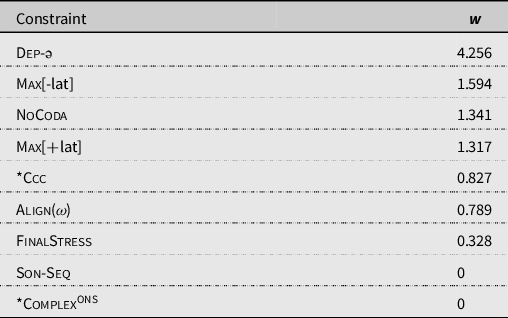
MaxEnt learning was conducted in Praat (Boersma and Weenink, Reference Boersma and Weenink2020) and resulted in the weighting condition in Table 8.
Weighting condition established by MaxEnt learner

As expected, the weighting condition suggests an overall proclivity for faithfulness, with three out of four of the most heavily weighted constraints penalising OLC repair. The most heavily weighted markedness constraint is NoCoda, and both *Complex Ons and Son-Seq remain unweighted suggesting that neither the sonority sequencing principle, nor a dispreference for complex onsets plays little to no role in motivating OLC repair.
4.4 Scaling the grammar
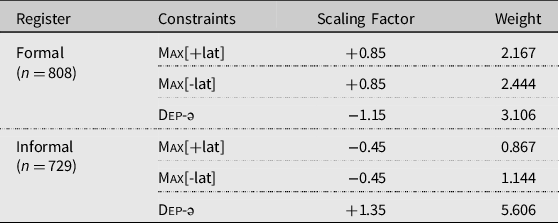
The first scaling factor considered was for style. It has been previously suggested that in constraint-based formalisations, faithfulness constraints play a larger role in more elevated registers (Boersma and Hayes, Reference Boersma and Hayes2001; Itô and Mester, Reference Itô and Mester2001; van Oostendorp, Reference van Oostendorp, Hinskens, van Hout and Wetzels1997). The present data show an effect of style, such that in more formal situations, OLC are more likely to surface faithfully, and as formality increases so does the likelihood that schwa epenthesis is chosen as a repair strategy as opposed to cluster reduction. This means that in more formal styles, the Max constraints must be scaled up, and Dep-ə must be scaled down. Register was split into two groups: Formal, which came from the reading tasks, and Informal from the conversational tasks. This was done due to the overall scarcity of tokens in the word-list task (n = 33).
Scaling factors were obtained by an iterative best-fit procedure executed in Praat (Boersma and Weenink, Reference Boersma and Weenink2020).Footnote 6 First, a uniform scaling factor was applied to the Max constraints and Dep-ə; however, the implementation of a uniform scaling factor never resulted in a decrease in mean square error, reinforcing the need for Dep-ə and the Max constraints to be scaled differently. The Max constraints were scaled first and were scaled down in increments of 0.05. Then, using the scaled values of the Max constraints that resulted in the lowest MSE, the procedure was repeated to scale Dep-ə down. This same process was repeated in the informal setting scaling the Max constraints down and scaling Dep-ə up. Table 9 shows the scaling factors of the constraints by register as well as the scaled weights of these constraints.
Scaling factors of Max and Dep constraints by register

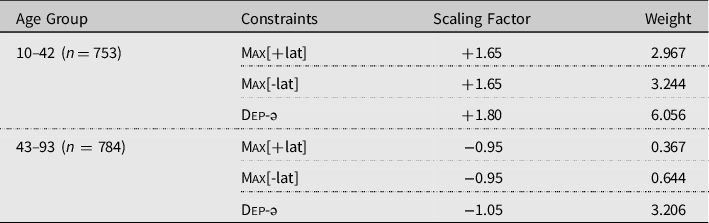
Scaling factors of Max and Dep constraints by age

Turning to age: younger speakers were more likely than older speakers to realise OLC faithfully, and as age increased so did the likelihood of repair, but at different rates for deletion and epenthesis. The best-fit procedure was implemented scaling the weights of the Max up first for younger speakers. Then using the scaled values of the Max constraints, Dep-ə was scaled up. This was repeated for older speakers, but the constraints were instead scaled down.
The formula in (25) captures the final grammar of OLC.

where R k is the kth faithfulness constraint against reduction, w k is the weight of the kth constraint, s r is the scaling factor for register, s a is the scaling factor for age F k (C) is the number of R k -violations of a candidate C, expressed as a negative integer, A i is the ith faithfulness constraint against epenthesis, w i is the weight of the ith constraint, s r is the scaling factor for register, s a is the scaling factor for age A i (C) is the number of A i -violations of a candidate C, expressed as a negative integer, M n is the nth markedness constraint w n is the weight of this constraint, M n (C) is the number of M n violations of a candidate C, expressed as a negative integer.
5. DISCUSSION
5.1 On word-final obstruent-liquid clusters
While there is a clear preference for faithfulness, the relatively high weighting of NoCoda and the zero-weighting of Son-Seq suggest that schwa epenthesis and cluster reduction function as strategies primarily as coda avoidance strategies and not sonority repair strategies. In addition, the unweighting of *Complex Ons suggests that in the case of word-final OLC, the structure of the onset is irrelevant. This could be attributed to the privileged status of OLC in the onset in French (Lyche, Reference Lyche1993) and cross-linguistically. In French, these clusters always remain tautosyllabic, and across languages they have been described as the perfect branching onset (Clements, Reference Clements, Kingston and Beckman1990). Taking other complex onsets into consideration may result in a higher weighting of *Complex Ons in French. Since *Complex Ons , remains unweighted, the schwaful variant incurs no markedness violations; however, the reduced variant will always violate faithfulness and markedness constraints.
The differences between /Ol/-clusters and /Oʁ/-clusters were mostly apparent in the pre-pausal context: reduction was generally preferred in the case of /Ol/-clusters (H = −2.658), while /Oʁ/-clusters preferred to surface faithfully (H = −2.682). The asymmetry between /Ol/-clusters and /Oʁ/-clusters may shed some light on why Son-Seq remains unweighted. Colantoni and Steele (Reference Colantoni and Steele2005) present diachronic and synchronic evidence arguing that /ʁ/ may be in the process of leaving the class of liquids and is transitioning into either an approximant or an obstruent. The results here would lend credence to their suggestion that /ʁ/ is transitioning toward the class of obstruents, as obstruent-obstruent codas do not violate the SSP. The status of /ʁ/ as a fricative may partially explain the zero weighting of Son-Seq, especially since the corpus contained 7 times more /Oʁ/-clusters than /Ol/-clusters.
Another possible explanation for the zero weighting of Son-Seq could be attributed to perception. As intuitive as the perception-based approach proffered by Côté (Reference Côté2004) is that there is a counterargument proposing that liquids (particularly those in clusters) may not be perceptually salient under certain circumstances. Yip (1993) shows that when adapting English loanwords into Cantonese, speakers may repair consonant-liquid clusters by breaking up the clusters with an epenthetic vowel or by deleting the liquid. The deletion of the liquid, she demonstrates, is due to their lack of perceptual salience.
The introduction of the scaling factors has major implications for the weighting condition given each context. The scaling down of the Max constraints in the informal setting resulted in both constraints being weighted below NoCoda. This shift only seemed to have an effect on pre-pausal /Oʁ/-clusters in the informal setting: the reduced variant was found to be the most harmonious (H = −2.485). The simultaneous scaling down of Dep-ə and scaling up of the Max constraints led to more drastic changes in formal registers. While Dep-ə was still weighted heaviest (w = 3.106), both Max constraints were weighted directly underneath it (w(Max[-lat]) = 2.444; w(Max[+lat]) = 2.167). The preference for the schwaful variant over the faithful variant in the pre-consonantal condition is the result of cumulative constraint interaction (Pater, Reference Pater, McCarthy and Pater2016). The combined violations of the lesser weighted *Ccc (w = 0.827) and NoCoda (w = 1.341) resulted in the faithful candidate being less harmonious than the schwaful candidate, despite it violating the heaviest Dep-ə (w = 3.106). The role *Ccc played in rendering the faithful candidate less harmonious in the pre-consonantal context suggests that the loi des trois consonnes is an active and powerful tendency in Northern Metropolitan French, especially in more elevated styles that allow for higher rates of schwa realisation. The relevance of the loi des trois consonnes is reinforced by the fact that the only context in which the schwaful variant was found to be most harmonious was the pre-consonantal environment.
Turning to the age effect, the application of the scaling factors for older speakers resulted in a preference for reduction irrespective of the liquid and the context following the OLC. In fact, the scaling down of the Max constraints for older speakers resulted in them being weighted below, NoCoda (w = 1.341), *Ccc (w = 0.827), and Align( ω) (w = 0.789). On the other hand, the faithful variant was preferred for younger speakers, irrespective of the liquid and the rightward context, as the scaling up of these constraints resulted in Dep-ə (w = 6.506), Max[-lat] (w = 3.244) and Max[+lat] (w = 2.967) being the three heaviest constraints. Further research is necessary in order to determine whether this age effect reflects a change in progress or is an example of age-grading.
Milne (Reference Milne2013) has shown that epenthesis and reduction are in competition with one another to repair word-final OLC. While there was no overall difference between rates of reduction and epenthesis, when the constraints militating against reduction and deletion are scaled, clear preferences for the reduced and/or schwaful variant emerge. This would suggest that the reasons a speaker may choose one strategy over the other to repair word-final OLC is dictated by extragrammatical factors: in particular register and age.
5.2 On constraint scaling
The present study also has implications for theories of constraint scaling. As stated above, Coetzee and Kawahara (Reference Coetzee and Kawahara2013: 80) suggest that simplification processes like deletion and augmentation processes such as epenthesis may need to be scaled differently. The present study suggests that this may in fact be the case as deletion and epenthesis patterned differently in all four conditions (formal, informal, older speakers, younger speakers) leading to different scaling factors for the Max constraints and for Dep-ə. There is one other possible explanation for the differences between the Max constraints and for Dep-ə, and that is that a model incorporating constraint scaling may scale each and every faithfulness constraint with its own respective scaling factor. This possibility raises questions about grammar dominance and the power of the model proposed above. Coetzee and Kawahara (Reference Coetzee and Kawahara2013: 78) compare their model of constraint scaling with a similar model of stochastic OT (Boersma and Hayes, Reference Boersma and Hayes2001: Appendix C). In the stochastic OT model, Boersma and Hayes suggest that the rankings of certain constraints can variably be changed in different registers. Coetzee and Kawahara argue that their model differs from Boersma and Hayes’ with respect to the notion of grammar dominance. In the model proposed by Boersma and Hayes, constraint rankings do not have to be changed by the same amount resulting in the possibility of the effect of register overriding the grammar. Further research is needed to understand if the different scaling factors for the Max constraints and for Dep-ə are the result of differences between simplification and augmentation processes or are a manifestation of the need for a more powerful model. An appropriate case study would be something along the lines of final clusters in Welsh, which are subject to epenthesis, reduction and metathesis (Hannahs, Reference Hannahs2009).
6. CONCLUSION
It has traditionally been suggested that schwa epithesis and the reduction of word-final OLC occur to repair the sonority violations of the rising coda; however, I have demonstrated that in the case of Northern Metropolitan French, the sonority profile of the clusters may not drive their repair. Instead, I have shown that reduction and epenthesis function primarily as coda avoidance strategies. Building upon the model proposed by Coetzee and Kawahara (Reference Coetzee and Kawahara2013) and Coetzee (Reference Coetzee2016), it was found that the selection of the repair strategy is largely dictated by extragrammatical factors. While this study has shed light on which factors condition the realisation of competing repair strategies, this is only a first step in understanding what it means for languages to have more than one repair or avoidance strategy at its disposal for a single phenomenon.