Introduction
The Newell’s Shearwater Puffinus newelli, or ‘a‘o, is an endangered shearwater species endemic to the Hawaiian Islands. The species was once thought to be extinct until a bird was found in 1954 on the island of O‘ahu after flying into a lighted window (Richardson Reference Richardson1955). This was followed in 1967 by the discovery of a breeding colony in the Makaleha Mountains on the island of Kaua‘i (the northernmost island within the main Hawaiian Islands) after a pig hunter reported that his dogs had been found with shearwater feathers in their mouths (Sincock and Swedberg Reference Sincock and Swedberg1969). Around 90% of the world’s population is now thought to exist on Kaua‘i, with smaller populations breeding on Maui and the Island of Hawai‘i, and historically on O‘ahu, Lāna‘i, and Moloka‘i (Pyle and Pyle Reference Pyle and Pyle2017, Ainley et al. Reference Ainley, Telfer, Reynolds and Raine2019). On Kaua‘i the species experienced a catastrophic decline of 94% between 1993 and 2013 (Raine et al. Reference Raine, Holmes, Travers, Cooper and Day2017), although this has since levelled off at a much smaller population level (Raine and Rossiter Reference Raine and Rossiter2020). Once widespread on the island, Newell’s Shearwater is now predominantly restricted to remote montane ranges in the interior, particularly in the north-west (Raine et al. unpublished data).
The Newell’s Shearwater faces numerous threats, which include collisions with powerlines (Cooper and Day Reference Cooper and Day1998, Podolsky et al. Reference Podolsky, Ainley, Spencer, Deforest and Nur1998, Ainley et al. Reference Ainley, Podolsky, Deforest, Spencer and Nur2001, Travers et al. Reference Travers, Driskill, Stemen, Geelhoed, Golden, Koike, Shipley, Moon, Anderson, Bache and Raine2021), the attraction of fledglings to artificial lights (Reed et al. Reference Reed, Sincock and Hailman1985, Telfer et al. Reference Telfer, Sincock, Byrd and Reed1987, Ainley et al. Reference Ainley, Podolsky, DeForest and Spencer1997, Cooper and Day Reference Cooper and Day1998), depredation by introduced mammalian predators, including feral cats Felis catus, black rats Rattus rattus and pigs Sus scrofa (Raine et al. Reference Raine, Driskill, Vynne, Harvey and Pias2020b), and the introduced Barn Owl Tyto alba (Raine et al. Reference Raine, Vynne and Driskill2019, 2020b), burrow takeovers by feral honey bees Apis mellifera (Raine et al. Reference Raine, Driskill, Rothe and Vynne2022), and habitat modification within breeding colonies due to invasive plants and pigs (Duffy Reference Duffy2010). The Newell’s Shearwater also undoubtedly faces threats at sea that, while poorly known, are important issues for similar species of seabirds worldwide and could include marine pollution (Sileo et al. Reference Sileo, Sievert, Samuel and Fefer1990, Derraik Reference Derraik2002, Kain et al. Reference Kain, Lavers, Berg, Raine and Bond2016), overfishing (Ainley et al. Reference Ainley, Walker, Spencer and Holmes2014, Morra et al. Reference Morra, Chikaraishi, Gandhi, James, Rossman, Wiley, Raine, Beck and Ostrom2019), and the effects of climate change and bycatch (Gilman et al. Reference Gilman, Kobayashi and Chaloupka2008). This combination of factors has led to the Newell’s Shearwater being listed under the IUCN Red Data List as “Critically Endangered” (BirdLife International 2019) and “Threatened” under the US Endangered Species Act (Telfer Reference Telfer1983).
A clear and detailed understanding of the breeding phenology of the Newell’s Shearwater is vital for several reasons. Multiple management actions are now being undertaken at montane colonies on Kaua‘i to help reduce depredation of breeding birds by introduced predators. Predator control actions can be strategically targeted to coincide with peak periods of vulnerability such as burrow maintenance (when adults are very active outside the burrows), incubation (when breeding adults are inside their burrows for extended periods of time), and chick emergence (when chicks are actively exercising in front of burrows prior to fledging) if these periods are clearly identified. Likewise, this species is particularly vulnerable to light attraction and grounding during the fledging period. Therefore, understanding peak fledging periods (both in terms of peak dates and peak times of night) can help target rescue operations and increase searcher efficiency. Lastly, the issue of powerline collisions, while known for many years, has recently been identified as being a critical reason for the dramatic decline of the species on the island (Travers et al. Reference Travers, Driskill, Stemen, Geelhoed, Golden, Koike, Shipley, Moon, Anderson, Bache and Raine2021). On Kaua‘i, powerline collisions of Newell’s Shearwater and the Hawaiian Petrel Pterodroma sandwichensis (another endangered endemic seabird nesting in similar habitats on Kaua‘i (Raine et al. Reference Raine, Driskill, Rothe and Vynne2022) have been quantified acoustically at the island level. However, there is a need to refine the methods used to split collision allocation between the two species, which can be achieved by understanding species differences in movement rates, dates, and diel timing. Assessing peak periods of adult attendance at burrows and the timing of key stages within the breeding phenology for both species can help identify which species is more likely to collide with powerlines on any given date or time within the breeding season.
The only existing published data on the breeding phenology of this species come from (i) “a dozen observations of eggs and nestlings” of the species when it was rediscovered in 1969 (Sincock and Swedberg Reference Sincock and Swedberg1969) and (ii) a cross-fostering experiment where Newell’s eggs were incubated by Wedge-tailed Shearwaters Ardenna pacifica at Kīlauea Point National Wildlife Refuge (Byrd et al. Reference Byrd, Sincock, Telfer, Moriarty and Brady1984, Telfer Reference Telfer1986). This paper builds upon these limited earlier studies by considering data from long-term colony-monitoring studies (undertaken between 2012 and 2019) of the species on Kaua‘i. As this is a nocturnal burrow-nesting species that nests in deep burrows in remote areas, obtaining an accurate assessment of the phenology is challenging. The use of motion-triggered cameras placed at the entrance of burrows of confirmed breeding pairs provides extremely accurate, season-long data that are needed to provide a detailed assessment of the phenology of this species. The entire breeding season for the species is considered, from first arrival to fledging, to provide an accurate description of the breeding phenology for this globally critical breeding population.
These data will be important for directing a wide range of management actions within Newell’s Shearwater colonies on Kaua‘i, including predator control, social attraction and translocation projects, and the recovery of fledglings attracted to light during the fallout season.
Study area
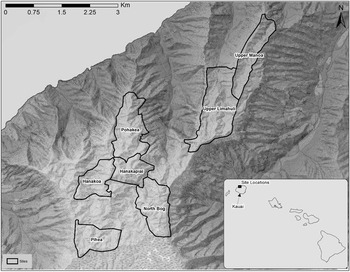
Monitoring work was undertaken at seven seabird management sites in the north-west of Kaua‘i. These were the Upper Limahuli Preserve (a 153-ha area owned by the National Tropical Botanical Gardens), the Upper Mānoa Valley (a privately owned 103.8-ha area), and five sites in Hono O Nā Pali Natural Area Reserve (a large 1,448-ha area owned by the State of Hawaii): Pihea, Pōhākea, North Bog, Hanakāpīʻai, and Hanakoa (Figure 1). All are located within the north-western section of Kaua‘i, at an elevation of between 500 m and 1,300 m above sea level. Habitat across all sites consists of intact wet montane forest, criss-crossed with deep drainages, narrow ridgelines, and steep valley walls, dominated by native species such as ‘ōhi‘a (Metrosideros polymorpha), lapalapa (Cheirodendron platyphyllum), and tree ferns (Cibotium spp.) in the canopy and large patches of uluhe fern (Dicranopteris linearis) in the understorey. All sites had active predator control operations in place to ensure that monitoring work in the colonies did not indirectly increase the vulnerability of birds breeding in these areas. Monitoring at four sites started in 2012 and has continued to the present day, while monitoring at Upper Mānoa Valley, Hanakāpīʻai, and Hanakoa started in 2015.
Location of study sites on the island of Kaua‘i.

Methods
Seabird monitoring was undertaken at management sites using a combination of near-monthly burrow checks and motion-triggered cameras throughout the breeding season. Burrows were located through a combination of nocturnal auditory surveys and dedicated ground searching. Auditory surveys were conducted for two hours after dark and 1.5 hours starting two hours before dawn (thus covering periods of peak vocal activity for Newell’s Shearwater). Maps were produced from auditory surveys with activity polygons and the locations of concentrated ground calling, which helped focus diurnal ground searching efforts. All burrows located within each colony were marked with a unique identification tag (coloured and numbered cattle tags) and their locations recorded using a hand-held GPS (Garmin Rino530HC× or Garmin Rino650). All burrows were then incorporated into the monitoring programme.
Burrow checks started in mid-February before the birds arrived to deploy cameras and continued near-monthly until December to recover monitoring equipment. Site access was either by foot (Pihea) or helicopter (all other sites). During burrow checks, each burrow was inspected to assess breeding status. For deep burrows where direct visual inspection was not possible, a hand-held camera (Panasonic Lumix or Olympus Tough Stylus TG4/TG5/TG6) was used to take photographs into the back of the burrow to assess burrow contents. A total of 270 unique Newell’s Shearwater burrows were monitored during the study period (2012–2019), with the largest number at Upper Limahuli Preserve (n = 167), Pōhākea (n = 58), and Hanakāpīʻai (n = 19). The breeding population across all seven management sites was estimated to be 1,326–1,870 breeding pairs (Raine et al. Reference Raine, Driskill and Rothe2022).
We determined the phenology of breeding Newell’s Shearwaters by measuring seabird activity at the burrows using motion-triggered cameras. A sub-set of up to 30 burrows were monitored at each colony by cameras (mainly Reconyx Hyperfire PC900 and HP2X, although a small number of Reconyx Ultrafire XP9 were also used). Cameras were mounted on poles located 0.9–1.5 m (3–5) feet away from the burrow entrance, with the camera pointed directly at the burrow mouth to catch all activity (both seabird and predator) at the burrow. Burrows with a good field of view and only one entrance were preferentially chosen. Cameras were installed prior to the arrival of seabirds and removed at the end of the season after all chicks had fledged. Burrow activity monitoring for this paper was conducted only at burrows that had confirmed established breeders (burrows occupied by prospectors, for example, were excluded). Birds were only considered to be established breeders if they were confirmed to have laid an egg at least once during their monitoring history. If burrows failed during the season, or the status of the birds using the burrow was uncertain, data collected from these burrows were removed from further consideration. If it was possible that burrow activity was missed by the camera (i.e. the camera was poorly positioned on a burrow, the camera malfunctioned, or there were multiple entrances) then the data were excluded from any further analysis.
Data analysis – cameras
All photographs taken by burrow cameras were individually viewed and digitally coded once teams were out of the field. When reviewing photographs, we collected burrow activity by collecting the date and time of: (i) adult arrival: (ii) adult departure: (iii) adult burrow maintenance: (iv) chick emergence: (v) chick exercising bouts: (vi) chick fledging. Adults and chicks were differentiated by the presence of down, the state of the feathers if no down was visible (adults have clearly worn and sun-bleached feathers, whereas chicks have ‘clean’ dark feathers), and behaviour (chicks engage in prolonged exercise bouts and explore their surroundings). Arrivals, departures, emergences, and fledgings were only included if the viewer was confident that the bird was actually undertaking the specified behaviour; if the behaviour was not clear, then it was not included in the analysis. Arrivals were considered valid if it was the first sighting of a bird on camera at night going directly into its burrow. For first arrival date, data were only collected if a camera was in position in front of the burrow before 15 March (two weeks before the earliest ever recorded breeding Newell’s Shearwater at any of the colonies under study, as per this study). Departures were considered valid if the bird was sighted leaving its burrow and walking out of the camera’s field of view and never returning for the rest of the night. After 2017, due to the time-consuming nature of digitising large volumes of camera images, data collected on seabird activity were restricted to the following; (i) date and time of first arrival at the burrow by an adult for that year: (ii) chick emergence date and time: (iii) chick fledging date and time.
The number of cameras and the duration and seasonal timing of burrow monitoring varied within and across seasons, depending on research and management priorities, which impacted the sample size for analyses presented in this paper. Analyses that required uninterrupted camera monitoring thus have reduced sample sizes. We used changes in adult bird activity at the burrow to determine the transition dates between different phases of breeding (e.g. end of exodus and the start of egg laying/incubation). We cross-referenced the camera data results with data collected by staff conducting burrow checks.
Annual total visitation rates of adult breeding birds at the burrow were also considered (available data from 2014 to 2017 only). For this analysis, only burrows that fulfilled all the following criteria were used: (i) cameras were in place before first arrival and left in place for the whole season; (ii) cameras were positioned in such a way that all arrivals and departures were being reliably caught on camera; (iii) the burrow had confirmed breeding; (iv) breeding was successful. Visitation rates were then calculated as total visits per burrow per day of active camera recordings.
Lastly, breeding probability in any given year was calculated for burrows of known breeding pairs, with key caveats. These caveats were: (i) the burrow had to belong to a confirmed breeding pair; (ii) there had to be at least two consecutive years of monitoring at the burrow after breeding had been confirmed; (iii) both adults were still presumed to be alive at the end of the prior breeding season (i.e. there was no confirmed depredation event of an adult at the burrow that year, the chick fledged as expected, and for burrows with cameras, adult activity patterns suggested that both adults were visiting the burrow and feeding the chick up to fledging). Breeding probability was then calculated for this sub-set of birds as the number of years with a confirmed breeding attempt divided by the number of years the burrow was monitored.
All statistics were carried out in R statistical software version 3.6.1. Means are presented with standard deviation (SD).
Results
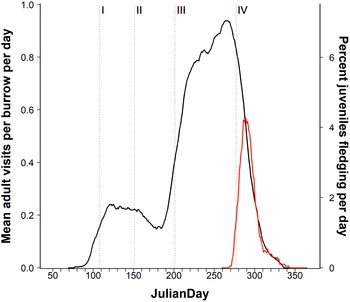
Throughout the breeding season there were clear fluctuations in adult activity at burrows with key inflection points evident throughout the season (Figure 2). Below we describe the activity patterns evident in each breeding stage from arrival, through pre-lay exodus, incubation, chick rearing, chick emergence, and fledging. Due to the asynchronous breeding season that we discovered for this species in this study, breeding phase and total season length can vary greatly at the scale of the colony level versus the burrow. We therefore present results at both the colony and individual burrow scale.
Mean visits per burrow (black line) per day at the colony level (all confirmed breeding pairs monitored by cameras between 2014 and 2017). Movement patterns represent the overall movement into and out of the colony of breeding birds across all burrows combined, which incorporates the asynchronous breeding patterns of individual pairs. The percentage of juvenile fledglings (red line) is also presented by day of year. Dotted lines represent the averages for critical stages of the phenology, as follows: ‘I’ mean first arrival; ‘II’ mean return from pre-lay exodus, commencement of incubation; ‘III’ mean hatching, start of chick rearing; ‘IV’ mean first emergence of chicks.

Arrival
The first arrival of adult Newell’s Shearwaters for the season at established breeding burrows was on average 18 April (n = 206, SD = 9.4 days, IQR = 11 days, earliest 27 March, latest 22 May; a difference of 56 days between earliest and latest first arrival). Of the arrivals 64.1% occurred within a two-week period centred on the mean, and 88.8% of arrivals occurred within a one-month period centred on the mean. There was a weakly significant difference during years 2013–2019 (Kruskal–Wallace χ² = 12.598, df = 6, P = 0.049), however a Bonferroni corrected post-hoc Dunn’s test indicated no significant difference. First arrival was also considered with respect to moon phase. First arrival date at the burrow was not influenced by moon illumination (R = 0.037, P = 0.61). Due to the birds’ asynchronous arrival, first arrivals were spread relatively equally across moon phase. Moon illumination at first day of arrival varied annually from zero or near zero to full moon, with annual mean first arrival varying around half moon illumination (e.g. 2013 mean illumination = 51 ± 34%, min = 2, max = 100). At the beginning of the season, activity around burrows covered a period of several days, during which time birds were recorded cleaning the entrances of dead leaves and twigs, as well as pushing out old nesting material or debris from within burrow chambers, and sometimes dragging in fresh vegetative material (such as uluhe Dicranopteris linearis and ʻōhelo ʻai Vaccinium reticulatum). During this period, mean burrow visitation rates were 0.6 ± 0.2 visits per night with this breeding phase lasting a mean of 18.7 ± 9.6 days (see Figure 3).
Mean visits per day at the burrow level. Movement patterns represent movement into and out of individual burrows by breeding pairs, which excludes the effects of asynchronous movement patterns evident in Figure 2 at the colony level. ‘I’ Arrival to pre-lay exodus, ‘II’ pre-lay exodus, ‘III’ incubation, ‘IV’ chick rearing. Width of bar is indicative of length of each breeding phase.

Pre-lay exodus
Monitoring showed that 89.6% of burrows (n = 67) had a period of inactivity (no birds present) of a week or more after initial arrival, with this inactivity period being on average 14.6 ± 6.6 days (min = 7 days, max = 34.6 days) in duration. The remaining seven burrows showed very little to no period of inactivity, with the largest gap for visitations at the remaining seven burrows ranging from 3.7 days to 6.8 days over this period. The average date for a period of inactivity to commence was 16 May ± 19.0 days (earliest 13 April, latest 20 June). Prior to initiation of incubation but following a clear period of inactivity, there were sporadic returns of one bird every 5–7 days at some burrows. We hypothesised that these were males returning occasionally to guard the burrow while the female continued to produce the egg at sea. Considering the full period of time encompassing the initial period of inactivity and sporadic returns (i.e. the full pre-lay exodus period), mean burrow visitation rates were 0.2 ± 0.2 visits per day with the pre-lay exodus period lasting a mean of 23.4 ± 7.1 days (see Figure 3).
Incubation
Birds returned again to their burrows after pre-lay exodus on average on 30 May ± 18.8 days (earliest 26 April, latest 30 June). As females are thought to lay their eggs within a day of returning from exodus (Harrison Reference Harrison1990), then this would be the average egg lay date as well. At a subset of burrows where the burrow was shallow enough to see an egg being incubated (n = 27), the earliest a bird was confirmed incubating an egg was 4 June and the latest was 27 July. An actual egg-laying date was recorded in 2019, with a bird recorded on camera physically laying an egg at the entrance to its burrow on 12 July at 01h39, but this seems to be an outlier based on the cumulative data (even more so as it was apparent that the egg became stuck partially emerged in the cloaca for many hours as the bird moved back and forth in front of the camera and was eventually laid outside the burrow). Given the cryptic nature of determining incubation period from camera activity, we examined incubation length at two scales, changes in colony mean activity and individual burrow activity, to estimate incubation duration with all available data. At the colony scale (Figure 2), adult activity patterns on cameras indicated that the mean laying date and mean start of hatch (see below) were 50 days apart. At the individual burrow scale, mean burrow visitation rates were 0.2 ± 0.1 visits per day during incubation, and (as detected by changes in activity outside the burrow) lasted an estimated 52.6 ± 1.5 days (see Figure 3), before increasing activity was detected, indicating hatch and the end of incubation.
Chick rearing
From 6 July onwards, adult visitations at burrows increased dramatically, presumably indicating the beginning of chick hatching, with a mean hatching date of 19 July, followed by chick provisioning (see Figure 2). This is very similar to the average hatch date of 21 July presented in Byrd et al. (Reference Byrd, Sincock, Telfer, Moriarty and Brady1984) and Sincock and Swedberg (Reference Sincock and Swedberg1969). Adult activity at burrows began to decrease rapidly from 23 September onwards as the fledging period approached. The last adult observation at an active burrow with a chick that fledged was on average 19 October (earliest = 4 October, latest = 17 November). The last adult observation was on average 3.4 days before the date that the chick fledged (min = 19 days before fledging, max = 13 days after fledging, SD = 6.2 days, n = 30). Again due to asynchronous breeding, the mean colony-scale chick rearing period spanned 121 days (Figure 2), however minimum and maximum dates further extended the period to 143 days (Figure 6). At the individual burrow scale, mean burrow visitation rates were 1.1 ± 0.2 visits per day during the chick rearing period and lasted 85.8 ± 8.7 days (see Figure 3).
Chick emergence and fledging
Chick emergence started on average on 4 October (n = 133, earliest 26 August, latest 20 November). There was a significant difference between years (2012–2019, Kruskal–Wallis, χ² = 15.5, df = 7, P = 0.025) with chicks in 2015 emerging significantly later than those in 2019 (average emergence date 2015 – 13 October, average 2019 – 29 September 29, difference 14 days). There was one outlier that was removed from the analysis, an extremely early emergence of a chick on 12 August. This was not considered to be a true emergence, as it involved a very small downy chick which followed the adult out of the burrow after it had been fed. In this instance it was chased back into the burrow by the adult and was not seen on camera again for many weeks. The emergence period was 15.5 ± 6.4 days (years 2012–2019, n = 94, min = 3 days, max = 44 days). There was no significant difference between years for the length of the emergence period (Kruskal–Wallis, χ² = 6.04, df = 7, P >0.05).
A subset of monitored burrows was assessed for chick exercising activity, consisting of burrows in which both chick emergences and fledges were recorded, and in which the camera was functioning for the entire duration of this period. An exercise event was considered to be any amount of time that a chick was outside its burrow, and behaviours included wing flapping, stretching, exploring surroundings, etc. Chicks completed on average 35.7 exercise events (SD = 14.9, min = 12, max = 64) between emergence and fledging, for an average total of 14.9 hours spent outside the burrow (SD = 8.3, min = 1.8 hours, max = 34.0 hours). The average amount of time a chick spent outside its burrow during exercise events was 25 minutes (SD = 42.8 minutes, min = 3 seconds, max = 9.7 hours).
Average fledge date was 19 October (n = 132, SD = 10.9, earliest 3 October, latest 1 December – a difference of 59 days between earliest and latest fledge date) (Figure 2). Monitoring showed that 60.3% of fledgings occurred within a two-week period centred on the mean, and 89.0% of fledgings occurred within a one-month period centred on the mean. There was a significant skew in fledging dates with a long right tail on the distribution (see Figure 2). There was a significant difference between years (2012–2019, Kruskal–Wallis, χ² = 19.79, df = 7, P = 0.006), in keeping with the emergence data, with chicks in 2015 also fledging significantly later than those in 2019 (average fledge date 2015 – 24 October, average 2019 – 14 October, difference 10 days). Chicks in 2012 also fledged significantly later than those in 2019 (average 2012 – 26 October, difference 12 days).
With respect to the timing of a fledging event, there were two distinct fledging peaks centred on the beginning and end of the night (Figure 4). A peak of 59.2% fledged before midnight, with the average fledge time in this first fledging peak being 132.5 ± 99.7 minutes after sunset (earliest fledge 18h23, 25 minutes after sunset). After midnight 40.8% fledged, with the average fledge time in this second fledging peak being 145.8 ± 103.1 minutes before sunrise (latest fledge 05h44, 49 minutes before sunrise). There was no significant difference between years for time of fledging (2012–2019, Kruskal–Wallis, χ ²= 7.95, df = 7, P >0.05). Time and night of fledging were also considered in relation to moon illumination, as fallout of this species on Kaua‘i is strongly correlated to moon phase (Telfer et al. Reference Telfer, Sincock, Byrd and Reed1987), with fallout typically occurring on dark nights with no moon illumination. Despite the correlation of moon phase and fallout previously reported, moon illumination did not influence the time of night of birds fledging. In general, fledging was equally spread across moon phases and moon positioning above or below the horizon. Around 55% of all fledgings occurred when there was no moon illumination (i.e. moon below the horizon at the time of fledging, or new moon), whereas 45% of all fledgings occurred when the moon was above the horizon. Furthermore, about a quarter (28.3%) of birds fledged when the moon was at 75% illumination or higher. There was therefore no relationship between fledging time and the presence or absence of the moon (one sample proportional binomial test X = 66, P >0.05).
Timing of fledging for Newell’s Shearwater chicks from their burrows.

Nightly temporal patterns
The nightly arrival and departure patterns of breeding birds were also considered across the breeding season. Overall, most birds (93%) arrived at the burrow prior to midnight and most birds (94%) departed the burrow after midnight (Figure 5). Arrivals started slowly with only 5% of birds arriving at the burrow by 51 minutes after sunset. Arrival rates then quickly increased with 50% of all arrivals occurring in a 61-minute period (66–127 minutes after sunset) and a median arrival time of 84 minutes after sunset. Of arrivals, 90% occurred by 223 minutes after sunset with few arriving over the remainder of the night. There was very little transit activity during the middle of the night, indicating that in most cases birds remained in their burrows throughout the night. Departures during this period were very low (approaching zero for most of the night) and only 10% occurred by 213 minutes before sunrise. Departures rates then quickly increased with 50% of the full night of departures occurring in a 32-minute period (98–66 minutes prior to sunrise) and a median departure time of 80 minutes before sunrise. Departures slowed toward sunrise, with only 5% of all departures occurring in the period spanning from 55 minutes prior to sunrise onwards (Figure 5).
Nightly patterns for breeding birds arriving and departing from burrows.

This pattern remained the same each month throughout the season, with the only exception being during the incubation period. During incubation, evening departures (prior to midnight) increased significantly to 16% from the 6% annual monthly rate (χ² = 55.175, df = 6, P <0.05). There was also a significant increase in arrivals after midnight during this period to 11% from the 7% annual rate (χ² = 16.646, df = 6, P <0.05).
Breeding season length and visitation patterns
Considering the earliest adult arrival at a burrow for the start of the breeding season (27 March) to the last time a chick fledged on camera (1 December), the maximum number of days that Newell’s Shearwaters breeding pairs are present on Kaua‘i each year is 250 days. At the individual burrow scale, the season length was 180.5 ± 18.4 days (see Figure 3), with 42.1 ± 14.2 days from first arrival to laying and 138.5 ± 7.9 days from incubation through to fledging. At the individual burrow scale, the annual adult visitation rate was 114.5 ± 14.7 visits per burrow across the whole season.
We found that variability, as measured by interquartile range, in individual Newell’s pairs season length (IQR = 20.5 days) is largely explained by variation in the number of days Newell’s take from first arrival to laying (IQR = 19.5 days) relative to variation in length of incubation and chick rearing (IQR = 4.5 days). Later arriving Newell’s pairs reduced season length by reducing the time from first arrival to laying (rs = −0.63, P = 0.038). The apparent flexibility to speed up this phase of breeding was driven by a significant reduction in the number of days in the pre-lay exodus phase (rs = −0.80, P = 0.003). Conversely, late-arriving Newell’s did not alter season length by significantly speeding up the incubation and chick rearing phase (rs = −0.82, P = 0.81) or feeding trip frequency during chick rearing (rs = 0.0046, P = 0.99).
Annual breeding probability
Breeding probability data were also available for a sub-set of breeding pairs on Kaua‘i that met the caveats described in the methods over the study period (n = 85). The breeding probability for confirmed breeders in any given year was 0.993. Of these burrows, only two pairs skipped a year (2.4% of all pairs), with one pair skipping two out of four years and the other skipping one year out of ten. In both cases, the pair skipped a year after a failed breeding season.
Breeding phenology for Newell’s Shearwater on Kaua’i
Based on the data presented above, the breeding phenology of the Newell’s Shearwater on Kaua‘i is as follows (Figure 6). Breeding birds arrive in the middle of April, undergo an exodus of approximately two weeks (although not all birds take an exodus) in mid-May and return to their burrows to lay their egg at the end of May. Incubation lasts for 50–52 days and continues through mid-July with average hatch date being 19 July. The chick-rearing period runs until the chicks fledge. Fledging starts in early October and peaks in mid-October, with the last birds fledging at the end of November. Breeding birds are asynchronous, with a 59-day gap between first and last fledging birds, although 89.0% of birds fledge within a one-month period centred on the mean.
Breeding phenology of the Newell’s Shearwater on Kaua‘i. Solid blocks are centred on the mean and bounded by the SD. Lines indicate the minimum and maximum dates recorded in this study for each stage.

Discussion
This paper has provided detailed information on the breeding phenology of the endangered Newell’s Shearwater on the island of Kaua‘i. Unlike seabirds breeding in tropical oceanic islands, this species has a spring–summer breeding season (like most Hawaiian seabirds), presumably due to a combination of prey availability and day length (Harrison Reference Harrison1990). Breeding birds are generally present on the island between the beginning of April and the middle of November. Considering the very first arrival ever recorded of a breeding adult and the very last recorded fledging date, Newell’s Shearwater breeding pairs and their chicks can be found on Kaua‘i over a 250-day period each year, from late March to early December. The timing of the breeding phenology was consistent throughout the study period, with the only exception being 2015 when chicks emerged and fledged significantly later than in other years. Constancy of breeding season is common among migratory shearwaters, which presumably is aligned with food availability in breeding and wintering grounds (Richdale Reference Richdale1963, Brooke Reference Brooke1977). Breeding pairs returned every year to breed (i.e. they did not take a year off), the only exception being two cases where a pair skipped a year after a failed breeding season. However, even when pairs had a failed breeding season the vast majority returned to breed the following year.
Contrary to that reported in Harrison (Reference Harrison1990), the breeding season of the Newell’s Shearwater was asynchronous, with 56 days between first and last arrival and 59 days between first and last fledge. Monitoring showed that 88.8% of breeding birds arrived within one month of each other, and 89.0% of birds fledged within one month of each other. An extended breeding period is found in some Puffinus shearwaters, e.g. Manx Shearwater P. puffinus (Brooke Reference Brooke1978, 2004) and Hutton’s Shearwater P. huttoni (Cuthbert and Davis Reference Cuthbert and Davis2002), but not in others, e.g. 85% of Short-tailed Shearwater Ardenna tenuirostris lay within a three-day period (Brooke Reference Brooke1978)) and almost all egg-laying for Buller’s Shearwater A. bulleri occurs in a five-day period (Harper Reference Harper1983).
Several hypotheses have been presented to explain the evolution of asynchronous breeding seasons in seabirds. Tropical and sub-tropical species may be less constrained than temperate species by dramatic changes in weather towards the end of the breeding season that could result in total breeding failure (Brooke Reference Brooke1990, Glencross et al. Reference Glencross, Lavers and Woehler2021). Alternatively, smaller species have a shorter breeding season than larger ones and thus have some flexibility in when they can initiate breeding each year (Brooke Reference Brooke1990). As a small sub-tropical Puffinus shearwater, both theories could explain the asynchronous breeding behaviour of the Newell’s Shearwater. Additionally, breeding synchrony could be related to seasonal migration; seabirds that undertake long-distance migration outside the breeding season, such as Buller’s Shearwater (Warham Reference Warham1990), Sooty Shearwater Ardenna grisea (Warham et al. Reference Warham, Wilson and Keeley1982, Hedd et al. Reference Hedd, Montevecchi, Otley, Phillips and Fifield2012), and Short-tailed Shearwater (Carey et al. Reference Carey, Phillips, Silk and Shaffer2014) may have evolved their synchronous breeding season to allow them time to migrate to distant wintering grounds. This hypothesis may also help explain the asynchronous breeding season of Newell’s Shearwater. From the small number of adults tracked to date, it appears that birds do not engage in long-distance migration and winter a few thousand kilometres away to the south-east of Kaua‘i in the central Pacific (Raine et al. Reference Raine, Driskill and Travers2021), while fledglings spend their first winter over 2,000km to the south-west in an area encompassing the North Pacific Equatorial Counter Current and Pacific Equatorial Divergence Provinces (Raine et al, Reference Raine, Anderson, Vynne, Driskill, Raine and Adams2020a).
We found that for most birds in this study there was a period of exodus after the birds returned to their burrows. This period averaged about two weeks of total inactivity and an additional week of sporadic returns and occurred in May. However, not all birds undertook an exodus period, and the exodus length was highly variable. Birds returned to lay in late May, with an incubation period of 50–52 days. This is comparable to other similar-sized shearwater species such as Manx (51 days) (Brooke Reference Brooke1977), Audubon P. lherminieri (50–53 days) (Snow Reference Snow1965), Hutton’s (50 days) (Cuthbert and Davis Reference Cuthbert and Davis2002), Fluttering P. gavia (50 days) (Berg et al. Reference Berg, Linnebjerg, Ismar, Gaskin and Rayner2018), and Wedge-tailed Shearwater (53 days) (Byrd et al. Reference Byrd, Sincock, Telfer, Moriarty and Brady1984).
The lengthy nestling phase (85.8 days) was longer than that reported for the Audubon’s Shearwater (75 days) (Brooke Reference Brooke2004) and Manx Shearwater (69 days) (Harris Reference Harris1966), similar to Hutton’s Shearwater (84 days) (Cuthbert and Davis Reference Cuthbert and Davis2002), and shorter than that for the Wedge-tailed Shearwater (103–115 days) (Byrd et al. Reference Byrd, Moriarty and Brady1983). It has been suggested that the variation in nestling phase between Puffinus species relates to frequency of chick provisioning and thus speed of chick growth, with tropical species being fed less often than temperate counterparts and thus having a longer chick rearing phase (Harrison Reference Harrison1990, Warham Reference Warham1990). However, this theory does not hold true for the Newell’s Shearwater, as adult visitations during the chick rearing phase were near-nightly.
Understanding breeding phenology of any species is vital to ensure that management actions are timed to key aspects of the breeding season. This is especially true of endangered species such as the Newell’s Shearwater. Building upon earlier and more limited studies, these data are extremely important for guiding a range of management activities and modelling endeavours. For example, predator control within colonies should be ramped up in March prior to the arrival of breeding birds, allowing for the removal of predators before the birds return to their burrows in late March. Adults are particularly vulnerable to predators such as cats in June through to mid-July when they are in their burrows incubating for weeks at a time, while in August to mid-November burrows will contain chicks which are vulnerable to rats as well as cats. In October to mid-November, chicks are also vulnerable to depredation from Barn Owls as our results show that during this period they will spend several weeks exercising outside their burrows prior to fledging, often for extended periods at a time.
Likewise, rescue campaigns for grounded fledglings should be aware of not only the dates of the fledging period (covering a two-month period, from the beginning of October to the end of November, with a peak in mid-October), but also the timing of fledging, which is often poorly known for seabird species, such as the related Wedge-tailed Shearwater (Urmston et al. Reference Urmston, Hyrenbach and Swindle2022). For Newell’s Shearwater, while there is a clear peak of fledging in the first few hours after dark, there is also a second peak a few hours before dawn. To maximise searcher efficiency for grounded birds, particularly around hotels, resorts, and businesses, two searches should therefore be undertaken to look for grounded birds. The first should be undertaken 2–3 hours after dark to locate the first group of grounded fledglings, while the second should be completed by 40 minutes before dawn. If the second search is not undertaken by this time a significant proportion of the night’s grounded fledglings may be missed as grounded birds will seek crawl spaces and other forms of cover once light is visible on the horizon, making them very difficult to find (Raine et al. in prep.). It is also worth highlighting the fact that birds fledge from burrows irrespective of moon illumination. Therefore, annual fallout patterns should not be considered representative of annual variation in fledging dates: rather, they are entirely a function of anthropogenic light attraction on dark nights with no moon during the time period the bird fledged, made worse when coupled with inclement weather conditions.
Having a good understanding of the phenology of this species is also important for directing searches for new breeding colonies. While it is obvious that there is no point in searching for new colonies when the birds are not on the island between December and March, search efforts should take the phases of the breeding phenology into consideration to maximise search effort. Breeding signs (such as guano, feathers, and scent) will only be present in abundance once adults are incubating, so ground searches for active burrows should commence in earnest in June and continue until mid-October when chicks are actively exercising outside burrows and signs will include the presence of down. After this period, although some burrows will still be occupied by chicks fledging towards the end of the season, the majority will be empty, and signs will be heavily reduced again, thus reducing searcher effectiveness.
For colony-monitoring purposes, sufficient burrow checks are necessary to assess accurately reproductive success rates and should encompass the entire breeding season. On Kaua‘i, a total of eight colony-monitoring trips are carried out at key intervals throughout the breeding season to ensure that key breeding phases (arrivals, incubation, chick rearing, and fledging) are all recorded. Checks are undertaken in late February/early March (deployment of monitoring equipment prior to arrival), April (arrival and pre-lay exodus), June (incubation), July (incubation and early chick rearing), August (chick rearing), October (peak fledging), November (late fledging), and December (removal of all monitoring equipment). We recommend that other projects monitoring this species follow the same protocols to ensure sufficient data are collected to calculate accurately reproductive success rates and allow for direct comparisons between management sites.
These data are also useful for projects engaged in translocation or social attraction efforts. Projects such as these are an important aspect of conservation as they aim to create highly protected colonies inside predator-proof fence enclosures, in many cases aiming to do so in areas that are more accessible to monitoring and management teams. Examples on Kaua‘i include the Nihoku Ecoystem Restoration Project (translocation and social attraction), Honopu (social attraction only), and Pōhākea (social attraction only). Using breeding phenology data will help to optimise the timings of these projects. For example, social attraction system speakers need to be turned on prior to the return of the first birds to breeding colonies in late March. While we do not currently have sufficient information to describe non-breeding and prospecting birds attending colonies, we would recommend turning speakers off prior to the first chick emergences in late August to reduce the attractiveness of the site to predators such as cats and Barn Owls, which could easily prey on chicks exercising outside their burrows. For translocation projects, it is important to monitor the burrows throughout the breeding season to gain an accurate depiction of whether or not a burrow is going to have a viable chick for translocation (as well as monitoring for predator interactions at the burrow). Translocation itself would need to occur in early September to (i) maximise the size of the chick prior to moving it to its new site and (ii) minimise the chance of viable chicks emerging, and thus imprinting on the natal colony.
Lastly, having detailed phenology data is a critical component to understanding powerline collision risk. Collision monitoring has shown that Newell’s Shearwaters are highly susceptible to collisions with powerlines and other similar hazards (Travers et al. Reference Travers, Driskill, Stemen, Geelhoed, Golden, Koike, Shipley, Moon, Anderson, Bache and Raine2021). The visitation data collected during this study clearly highlight the risk to individual breeding birds. Overall, breeding pairs of adult Newell’s Shearwaters arrived and departed from burrows on average 114 times over the course of a season. For birds breeding in areas where colony flyways cross powerlines or other similar hazards, each season each burrow pair would transit past hazards on both the inbound and outbound flight resulting in 228 potential crossings per year. Hypothetically, if a colony of only 100 burrows has a flyway that passes over high-collision-risk powerlines (due to factors such as topography, prevailing wind direction, and exposure height), there would be an average of 22,800 transits of breeding birds past the hazard in a single year, coupled with many more transits of non-breeders and sub-adults. The high frequency of nocturnal transits for Newell’s Shearwaters is a critical explanatory factor in the high powerline collisions detected in areas with infrastructure (Travers et al. Reference Travers, Driskill, Stemen, Geelhoed, Golden, Koike, Shipley, Moon, Anderson, Bache and Raine2021).
While we now have detailed information on the breeding phenology of breeding adults, the colony-attendance patterns of non-breeders within the population remain unknown. Future work will concentrate on addressing this group of birds, potentially using acoustic recordings and cameras positioned on known prospector burrows. Furthermore, an assessment of the breeding phenology of Newell’s Shearwater on other islands (such as Maui and Hawai‘i Island) is critical to understand whether there are any differences in the timing of breeding phenology between islands as this is something that occurs between island populations of another endangered Hawaiian seabird, the Hawaiian Petrel (Judge Reference Judge2011, Wiley et al. Reference Wiley, Welch, Ostrom, James, Stricker, Fleischer, Gandhi, Adams, Ainley, Duvall, Holmes, Hu, Judge, Penniman and Swindle2012). Lastly, an assessment of the breeding phenology of Hawaiian Petrel on Kaua‘i at the same level of detail as this paper will be critical to leveraging the data from this study to an assessment of species’ vulnerability to powerline collisions. By having a detailed knowledge of the breeding phenology of both endangered seabirds on Kaua‘i, we can then more rigorously allocate a species ratio to powerline collisions on the island (which are measured acoustically).
Acknowledgements
The majority of this work was undertaken through the Kaua‘i Endangered Seabird Recovery Project (KESRP), which is a joint project of the Department of Land and Natural Resources, Division of Forestry and Wildlife (DOFAW) and the Pacific Co-operative Studies Unit (PCSU) of the Research Corporation of the University of Hawaii. We would like to thank staff from both PCSU and DOFAW for their support during the data collection, particularly D. Duffy and L. Hara (PCSU), S. Mann, C. Mottley, A. Siddiqi, J. Omick, and D. Smith (DOFAW). We would also like to thank all of the field technicians who helped monitor the colonies over the study period, often in adverse weather conditions. Colony-monitoring work and predator control operations undertaken during this project was supported by the Kauaʻi Island Utility Co-operative under their Short-term Habitat Conservation Plan, the National Fish and Wildlife Foundation (through the American Bird Conservancy), and multiple state wildlife grants. Lastly, we would like to thank all the landowners who have provided access to their land and supported endangered seabird conservation in these areas. We therefore greatly appreciate the support and dedication of Ric Berry (Upper Mānoa), staff of the National Tropical Botanical Gardens (Upper Limahuli Preserve), and staff of the DLNR DOFAW Native Ecosystems Protection and Management Program (Hono O Nā Pali Natural Area Reserve).