1. Introduction
Unemployment has been shown to be associated with a variety of adverse outcomes, such as financial hardship, poorer health or greater divorce risks (e.g., Gallie et al., Reference Gallie, Jacobs, Paugam, Gallie and Paugam2000; Hansen, Reference Hansen2005; Schröder, Reference Schröder2013). It is thus considered as a serious life-disrupting event which may affect – in different ways – labour market entrants as well as older workers (e.g., Breen, Reference Breen2005; Henkens et al., Reference Henkens, Sprengers and Tazelaar1996).
A much discussed issue of high policy relevance is the degree to which the experience of unemployment inflicts longer-term ‘scars’, such as an increased likelihood of future unemployment (e.g., Gangl, Reference Gangl2004; Gregg, Reference Gregg2001). Due to scarring effects, the total costs of unemployment might be higher than the immediate loss of earnings, thereby increasing lifetime inequality (cf. DiPrete and Eirich, Reference DiPrete and Eirich2006). To address this, one obviously needs to take a life-course perspective. Moreover, institutional factors, which are often specific to particular welfare state regimes, matter greatly for our understanding of unemployment at various stages of the life course (e.g., Blossfeld et al., Reference Blossfeld, Buchholz and Hofäcker2006; Breen, Reference Breen2005). An issue of particular concern here is the extent to which welfare state interventions, such as active labour market policies, can mitigate longer-term scars of previous unemployment experiences (e.g., Gangl, Reference Gangl2004; Strandh and Nordlund, Reference Strandh and Nordlund2008).
The third wave of the Survey of Health, Ageing and Retirement in Europe collected retrospective life histories of older people in eleven European countries, which offer unique opportunities to track individuals’ unemployment experiences (for spells lasting more than six months) from their labour market entry to retirement, taking a cross-national comparative perspective. Our analysis of these so-called SHARELIFE data is – to the best of our knowledge – the first one covering people's entire employment career. We aim to provide answers to the following main questions: First, how does the prevalence of experiencing unemployment vary across different stages of individuals’ life course and what does the cross-national pattern of unemployment occurrence in early, mid and later life look like? Second, to what extent do we observe scarring effects of unemployment – and variations therein across different welfare regimes – in Continental Europe's contemporaneous older population?
The remainder of this article is structured as follows: Section 2 provides an overview of previous research; Sections 3 and 4 describe our data and measures, as well as our results; and Section 5 is the conclusion.
2. Previous research
Job loss is a major life-course risk, which itself is influenced by a variety of other adult life-course risks, such as health shocks (e.g., Arrow, Reference Arrow1996) or marital disruption (e.g., Covizzi, Reference Covizzi2008). Moreover, predictors of unemployment can even be traced back to one's childhood, that is, to a stage of the individual's life-course years before he or she entered the workforce (e.g., Anyadike-Danes and McVicar, Reference Anyadike-Danes and McVicar2005; Caspi et al., Reference Caspi, Entner Wright, Moffit and Silva1998). Specifically, parental background factors (socio-economic status [SES] and family functioning) as well as childhood health and cognitive skills have been shown to impact future educational and labour market outcomes (e.g., Currie, Reference Currie2009; Elman and O’Rand, Reference Elman and O'Rand2004; Haas et al., Reference Haas, Glymour and Berkman2011).
These findings provide evidence for an early onset of cumulative (dis-)advantage processes, which are likely to be aggravated once the individual exits the educational system. Namely, next to a variety of immediate economic and non-economic consequences following a difficult transition from school to work (e.g., Jacob and Kleinert, Reference Jacob and Kleinert2008), cumulative (dis-)advantage theory also suggests potential long-run negative effects of an early failure in the labour market: ‘Previous unemployment arguably scars a worker and creates unemployment because it reduces a worker's human capital, reduces a worker's psychological readiness for work, and makes a person less attractive to prospective employers’ (DiPrete and Eirich, Reference DiPrete and Eirich2006: 287f.; also see Arulampalam et al., Reference Arulampalam, Gregg and Gregory2001).
Scars have been shown to be reflected in higher risks of future job loss among those with previous unemployment experience (‘occurrence dependence’; e.g., Doiron and Gørgens, Reference Doiron and Gørgens2008; Gregg, Reference Gregg2001). What is more, unemployment scars may also reduce the quality of jobs available to previously unemployed workers (e.g., Dieckhoff, Reference Dieckhoff2011; see Gangl, Reference Gangl2004, for an extensive discussion). A number of empirical studies suggest that unemployment depresses subsequent wages (e.g., Eliason and Storrie, Reference Eliason and Storrie2006; Gangl, Reference Gangl2006) and is associated with lower subsequent job tenure (e.g., Belzil, Reference Belzil2001; Böheim and Taylor, Reference Böheim and Taylor2002). The evidence on the role that the length of unemployment might play in future employment prospects (‘duration dependence’) is fairly ambiguous, though (e.g., Böheim and Taylor, Reference Böheim and Taylor2002; Doiron and Gørgens, Reference Doiron and Gørgens2008; Luijkx and Wolbers, Reference Luijkx and Wolbers2009). Moreover, while the number of unemployment spells seems to matter for the extent of earnings losses (Stevens, Reference Stevens1997), there appears to be no such effect on the likelihood of exiting subsequent employment (Luijkx and Wolbers, Reference Luijkx and Wolbers2009).
Previous research has also shown that, independent of individual life-course characteristics, men's and women's career paths vary widely across countries characterised by different educational systems, labour market institutions and – more generally – welfare state regimes (e.g., Buchholz et al., Reference Buchholz, Hofäcker, Mills, Blossfeld, Kurz and Hofmeister2009; Sackmann, Reference Sackmann2001). Parallel to a growing interest in the labour market for older workers (e.g., Blossfeld et al., Reference Blossfeld, Buchholz and Hofäcker2006; Szinovaczs, Reference Szinovaczs2011), recent years have witnessed a plethora of studies investigating cross-national variation in patterns of labour market entry, including youth unemployment (e.g., Breen, Reference Breen2005; Scherer, Reference Scherer2005; Wolbers, Reference Wolbers2007). One general finding is that unemployment among labour market entrants tends to be particularly high in Southern European countries, which are also characterised by potentially huge unused labour capacity in the older population (cf. Brugiavini et al., Reference Brugiavini, Croda, Mariuzzo and Börsch-Supan2005; also see Sackmann, Reference Sackmann2001).
Negative long-term consequences of poor macro-economic conditions at labour market entry have been observed in a number of studies (e.g., Kahn, Reference Kahn2010; Raaum and Røed, Reference Raaum and Røed2006). With regard to unemployment scarring, though, Lupi and Ordine (Reference Lupi and Ordine2002) argue that in a high youth unemployment environment, such as Southern Europe, individual unemployment experiences tend to be perceived as ‘normal’ and do not necessarily signal that the worker is of poor quality, as is the case in Northern Europe, where youth unemployment is less common (see Gibbons and Katz, Reference Gibbons and Katz1991, for related evidence from mass layoffs). Moreover, next to differences in macro-economic conditions in general, and the level of unemployment in a particular labour market in particular, the institutional regulation of job loss is likely to matter to the extent to which unemployment is associated with cumulative disadvantages (e.g., Dieckhoff, Reference Dieckhoff2011; see Gangl, Reference Gangl2006, for an elaborate theoretical framework). The effect of unemployment insurance (UI), for example, ‘goes significantly beyond preserving economic status through earnings-related benefits during unemployment spells, but rather presumes that the welfare state has a positive effect on workers’ capacity to recover from unemployment – and thus on preventing career scars and negatively cumulating career dynamics in the longer run’ (Gangl, Reference Gangl2004: 1323; italics in the original; also see Belzil, Reference Belzil2001). Further institutional features of labour markets which might affect scar effects are amongst others a country's employment protection legislation (EPL) (e.g., Gangl, Reference Gangl2006) or active labour market policy (ALMP), (e.g., Strandh and Nordlund, Reference Strandh and Nordlund2008) programmes.
Comparing such regulations and programmes cross-nationally reveals a pattern of institutional labour market regimes that follows ‘classic’ welfare state typologies (cf. Gangl, Reference Gangl2006; Tatsiramos, Reference Tatsiramos2009; also see Gallie and Paugam, Reference Gallie and Paugam2000). Accordingly, the countries covered by our study can be categorised as social-democratic (or universal), conservative and Mediterranean. Social-democratic regimes are generally characterised by a combination of flexible labour markets, strongly commodifying UI systems providing almost universal access to generous unemployment benefits and ALMPs investing significantly in worker retraining (see Elvander, Reference Elvander2002 for a more nuanced comparison of the Nordic labour market regimes). Conservative welfare states also have a tradition of strong UI, but are somewhat weaker in their ALMPs and much stronger in their regulation of labour markets through EPL than their social-democratic counterparts. Under the Mediterranean welfare regime, EPL is strongest whereas ALMPs are weaker and UI is generally less encompassing and less generous than elsewhere (but note that Spain resembles the ‘conservative’ group of countries in terms of UI generosity; cf. Tatsiramos, Reference Tatsiramos2009).
There is ample evidence demonstrating that these differences in labour market regimes correspond not only to differences in aggregate labour market outcomes, but also to differences in unemployment scarring. At the macro-level, higher employment rates (lower unemployment rates, respectively) have been shown to be positively associated with measures of policy generosity, especially ALMPs, and negatively associated with institutions and policies inducing labour market rigidities, such as strong EPLs (see, for example, Botero et al., Reference Botero, Djankov, La Porta, Lopez-de-Silanes and Shleifer2004; Bruno and Rovelli, Reference Bruno and Rovelli2010). At the micro-level, a beneficial effect of UI on subsequent employment stability has been observed in countries with relatively generous benefit systems (albeit at the cost of a prolonged period of unemployment; e.g., Gangl, Reference Gangl2004; Tatsiramos, Reference Tatsiramos2009). Moreover, Gangl (Reference Gangl2006: 1009) suggests institutional complementarities between UI and EPL, providing evidence that the ‘positive effects of UI systems [are] enhanced by relatively dynamic labour markets that provide ample job opportunities and permeable labour market boundaries’. Finally, ALMP programmes aiming to maintain or enhance unemployed workers’ human capital have been shown to increase individuals’ probability of reaching their pre-unemployment incomes and to reduce their risk of exiting the labour market (Strandh and Nordlund, Reference Strandh and Nordlund2008).
It is clearly beyond the scope of the present analysis to account for the complexities in the evolution, shifts and changing roles of specific labour market institutions in European welfare states after World War II (see Bonoli, Reference Bonoli, Clasen and Clegg2011; Emmenegger, Reference Emmenegger2011; Nickell et al., Reference Nickell, Nunziata and Ochel2005 for such accounts) and their potential role in shaping the effects of previous unemployment experiences on individuals’ subsequent labour market outcomes. The insights obtained from the studies reported above still lead us to hypothesise that Scandinavian-type, i.e., social-democratic, labour markets constitute the most favourable context for workers to recover from unemployment (cf. Gangl, Reference Gangl2006).
3. Data and method
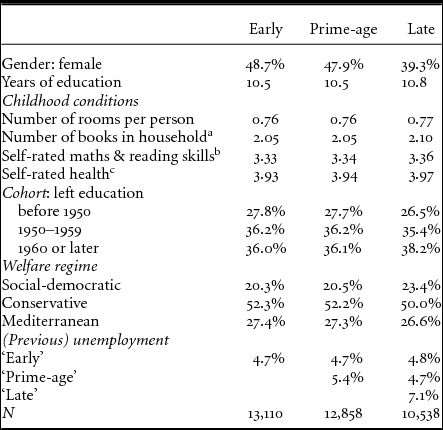
This study uses data from SHARELIFE, the third wave of the Survey of Health, Ageing and Retirement in Europe (SHARE; a detailed description of methodological issues is given in Schröder, Reference Schröder2011; also see Börsch-Supan et al., Reference Börsch-Supan, Hank, Jürges, Schröder and Harkness2010, Börsch-Supan et al., Reference Börsch-Supan, Hank, Jürges, Schröder and Harkness2013). Individual life histories of respondents aged fifty or older, who had already participated in at least one of the previous SHARE waves, were collected between October 2008 and August 2009. Eleven countries are represented in our analysis: Austria, Belgium, Denmark, France, (West) Germany, Greece, Italy, the Netherlands, Spain, Sweden, and Switzerland (see Blom and Schröder, Reference Blom, Schröder and Schröder2011, for a detailed account of retention rates by country, age and gender). Respondents of formerly socialist countries (Czech Republic, Poland and East Germany) as well as individuals younger than age sixty at the time of the SHARELIFE interview are excluded, which results in an analytic sample of roughly 13,000 observations; see Table 1 for descriptive sample statistics.
Descriptive sample statistics

Notes: a Ranging from ‘none or very few (0–10 books)’ [1] to ‘enough to fill two or more bookcases’ [5]. b Ranging from ‘much better’ [1] to ‘much worse’ [5] in comparison to other children in the respondent's class; c Ranging from ‘poor’ [1] to ‘excellent’ [5].
Source: SHARELIFE. Authors’ calculations.
SHARELIFE provides basic information on the work histories of respondents who reported to have ever done any paid work, beginning with the year when they left full-time education until the date of the interview. The definition of unemployment in the data rests solely on the individual's self-reported activity status (‘Which of these best describes your situation?’), irrespective of whether searching for a job and independent of receipt of unemployment benefits. We might therefore provide a conservative measure of unemployment occurrence, particularly among individuals with a low labour force attachment. Women with younger children living in a traditional ‘male breadwinner’ social context, for example, have been suggested to report periods of unemployment solely as having been a homemaker (see Jürges, Reference Jürges2007). Moreover, SHARELIFE allows us to identify periods of unemployment only if the gap between two jobs (or between leaving full-time education and the respondent's first job, respectively) was longer than six months. Errors in the retrospective reporting of unemployment spells should thus be a relatively minor issue in our analysis, because recall error has been suggested to be a problem when shorter spells are considered (e.g., Manzoni et al., Reference Manzoni, Luijkx and Muffels2011).
We observe individuals across their entire working life. Our main variables of interest are three binary indicators of unemployment periods (none vs. any) during different major phases of the individual's career: early (that is, within the first three years after having left full-time education; cf. Luijkx and Wolbers, Reference Luijkx and Wolbers2009), prime-age working years (between the end of ‘early’ and age forty-nine), and late (age fifty or over; cf. Blossfeld et al., Reference Blossfeld, Buchholz and Hofäcker2006). We use these variables to perform separate analyses of unemployment risks in each career phase. To ensure that an individual had been at risk of becoming unemployed at all, she must have reported at least one employment spell in her early, prime-age, and/or late career, respectively, in order to be included in the analytic sample for a particular phase (resulting in the different sample sizes displayed in Table 1). Note that this restriction leads to a substantial decline in the proportion of women in the ‘late career’ sample. Information on individuals’ previous experience of unemployment enters the models for unemployment during prime-age and later years as an explanatory variable. We interpret significant associations of unemployment in t–1 with the risk of experiencing a period of unemployment in phase t of one's career as indication of scarring effects.Footnote 1
All control variables refer to measures which were determined before the individual first entered the labour market. That is, we estimate the total scarring effect excluding potentially confounding factors which themselves might have been affected by earlier experiences of unemployment, such as health, parenthood or marital status (e.g., Hansen, Reference Hansen2005; Kreyenfeld, Reference Kreyenfeld2010; Schröder, Reference Schröder2013). Next to gender and years of education (derived from SHARE's wave 1 and 2) as basic socio-demographic variables, we focus on information regarding respondents’ childhood conditions at age ten: parents’ socio-economic status – operationalised by the number of rooms per person and the number of books in the household (ranging from ‘none or very few (0–10 books)’ [1] to ‘enough to fill two or more bookcases’ [5]), a composite measure of self-rated maths and language skills (ranging from ‘much better’ [1] to ‘much worse’ [5] in comparison to other children in the respondent's class), and self-rated health (ranging from ‘poor’ [1] to ‘excellent’ [5]); see Haas, Reference Haas2007, for an evaluation of the reliability of retrospective childhood health reports.
Finally, we roughly account for the historical period during which the SHARELIFE respondents graduated (pre-1950, 1950s, 1960 or later) as well as for the respective welfare state context, grouping the countries covered by our study into three clusters labelled as social-democratic (DK, SE), conservative (AT, BE, CH, DE_west, FR, NL), and Mediterranean (ES, GR, IT). Moreover, in a supplementary analysis, we draw on statistics provided by the International Labour Organization to take into consideration the labour market situation in each country at the time of individuals’ labour market entry. That is, for all cohorts who left education in 1929 or later, we account for the unemployment rate in the year when the respondent completed her full-time education. Unfortunately, we were not able to obtain youth unemployment rates, and even information on overall unemployment rates has not been available for all years in all countries, resulting in a significant decline of the sample for this part of the analysis.
4. Results
Descriptive findings
While differences in unemployment levels at various stages of an individual’s career are rather modest, ranging from about 4 per cent to 7 per cent on average (that is, if the pooled SHARELIFE sample is considered), we observe substantial variations across different welfare state regimes (see Figure 1). We find that by far the highest prevalence of early career unemployment is in the Mediterranean countries (almost 12 per cent), which, however, exhibit the lowest unemployment rate among older workers (between 3 per cent and 4 per cent). The reverse is true under the conservative and social-democratic regimes, where unemployment in the first years after leaving education is a relatively minor issue (2 per cent or less), but affects more than 10 per cent of workers aged fifty-plus in the conservative and nearly 8 per cent in the social-democratic countries (for more detailed accounts of cross-national differences in unemployment at various stages of the life course see Blossfeld et al., Reference Blossfeld, Buchholz and Hofäcker2006; Breen, Reference Breen2005).
Prevalence of unemployment (in %) at different life-course/career stages across welfare state regimes Source: SHARELIFE, weighted. For sample information see Table 1. Authors’ representation.
Multivariate results
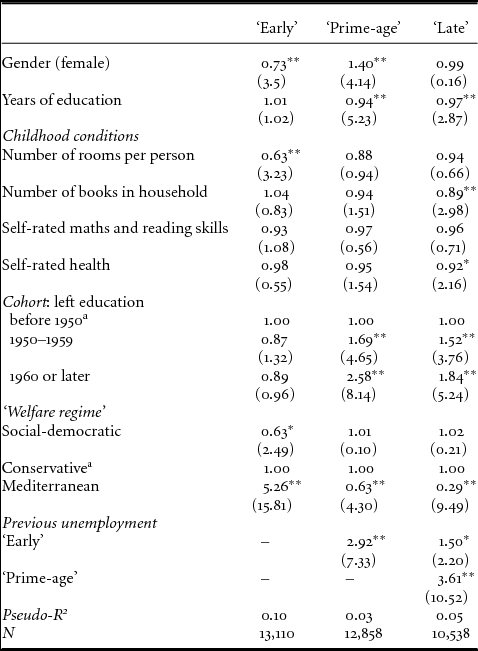
We estimated logistic models for three ‘events’, namely the experience of at least one unemployment spell during the individual's early, mid, and late career (see Table 2), whose results we discuss jointly. Looking at our socio-demographic controls, we first find that women are less likely than men to be unemployed at the beginning of their career, but are more likely to report periods of unemployment during the ‘prime-age’ working years, probably due to difficulties finding a family friendly job. In the late career phase, however, we do not observe significant differences between men and women. Secondly, while education does not seem to affect individuals’ unemployment risk upon entering the labour market, more years of education significantly reduce the odds of being unemployed during ‘prime-age’ and ‘late’ career phases.
Odds ratios from logistic regressions for ‘early’, ‘prime-age’, and ‘late’ unemployment (z-values; standard errors clustered by country-year)
Notes: Significance: ** p<0.01, * p<0.05. a Reference category.
Source: SHARELIFE. Authors’ calculations.
With regard to the role of childhood conditions, we find that the number of rooms per person in the parental household bears a statistically significant correlation to the dependent variable in the ‘early unemployment’ model. That is, more rooms (supposed to reflect a higher parental SES) are associated with substantially lower odds of being unemployed in the first years after the individual's exit from full-time education. We observe a similar relationship between the number of books in the parental household and individuals’ ‘late’ unemployment risks. Our composite measure of maths and reading skills, however, turned out to be insignificant throughout. The coefficient of the last childhood measure, subjective health, is insignificant in the ‘early’ and ‘prime-age’ unemployment models, but suggests that better health at age ten is associated with significantly lower odds of unemployment in ‘late’ working life.
Turning to our cohort and welfare regime indicators, we observe similar associations in the models for mid and late career unemployment. Those who graduated after 1950, and particularly those who completed their education in the 1960s or later, exhibit significantly higher odds of losing their job than those who left education before 1950. Individuals living under a Mediterranean welfare regime face much smaller unemployment risks in their mid and late career, compared to their counterparts in conservative or social-democratic countries. A very different picture emerges, however, when looking at the ‘early unemployment’ model. There are, first, no statistically significant cohort differences and, second, the odds of job loss turn out to be particularly high in the Mediterranean and lowest in the social-democratic countries.
Finally, we find clear indication of scarring effects. There is a large positive total effect of having experienced unemployment in the first three years of one's career on further unemployment risks before and after age fifty. Although the odds ratio of our ‘early unemployment’ indicator in the ‘late career’ model is much smaller than the respective odds ratio in the ‘mid career’ model, the observed correlation remains significant, even if unemployment during the prime-age working years (which is also a significant predictor of later unemployment) is controlled for in the regression. That is, early and mid life experiences of unemployment have independent and strong associations with the risk of losing one's job after the age of fifty.
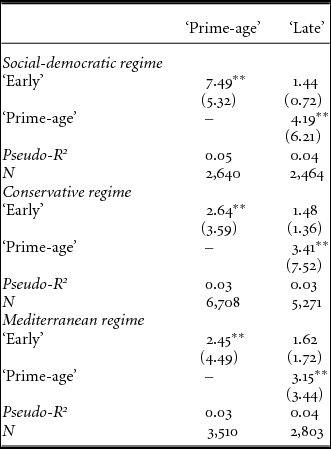
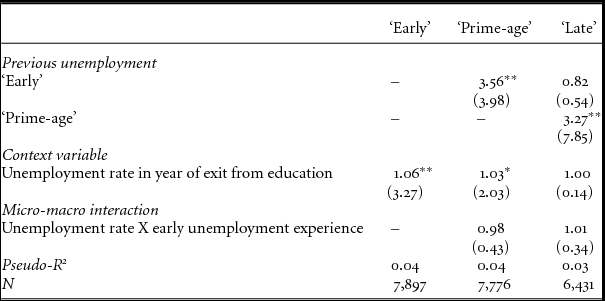
Additional models employing interactions of ‘early’ unemployment with gender and cohort did not provide any additional insights. However, scarring effects among prime-age respondents in social-democratic countries were found to be substantially larger than among their counterparts living under conservative or Mediterranean regimes (see Table 3). The large scarring effect of ‘early’ unemployment in social-democratic countries might be attributable to the relatively low odds of Scandinavians becoming unemployed early in their career. The underlying argument here is similar to the one put forward by Lupi and Ordine (Reference Lupi and Ordine2002), who suggest that individual unemployment experiences in a high youth unemployment environment may be perceived as ‘normal’ instead of signalling that the worker is of poor quality, thus leaving fewer scars. To test this, we estimated a model controlling for country-level unemployment rates at the time of individuals’ exit from education (also see De Vreyer et al., Reference De Vreyer, Layte, Wolbers, Hussain, Gallie and Paugam2000). While we find the expected positive association between individuals’ risk of unemployment in an early career phase and the national unemployment rate in the year when they left education, the respective interaction term turned out to bear no statistically significant association with later life experiences of unemployment (see Table 4).
Odds ratios from logistic regressions for ‘prime-age’, and ‘late’ unemployment (z-values; standard errors clustered by country-year), separate models by welfare regimea
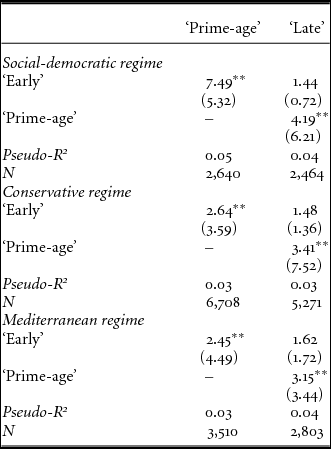
Note: a All variables displayed in Table 2, except welfare regime dummies, are controlled for in the models.
Source: SHARELIFE. Authors’ calculations. Significance: ** p<0.01, * p<0.05.
Odds ratios from logistic regressions for ‘early’, ‘prime-age’ and ‘late’ unemployment, controlling for unemployment rate when exiting educationa (z-values; standard errors clustered by country-year)
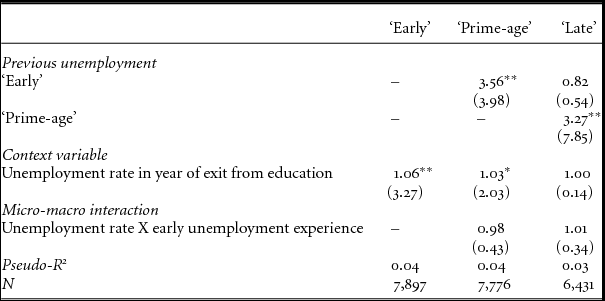
Notes: a Respondents who left education before 1929 are excluded. Cases with missing information on the unemployment rate when exiting education were also dropped. All variables displayed in Table 2, except welfare regime dummies, are controlled for in the model.
Source: SHARELIFE. Unemployment rates retrieved from: Yearbook of Labour Statistics, Time Series. International Labour Organization, Geneva. 1943–44, 1954, 1961, 1969, 1974, 1979, 1989–90, 1999, 2009. Authors’ calculations. Significance: ** p<0.01, * p<0.05.
5. Summary and conclusions
Barely any previous research on the long-term effects of previous unemployment on subsequent labour market outcomes covered a period of more than a decade after individuals had lost their job (e.g., Eliason and Storrie, Reference Eliason and Storrie2006; Luijkx and Wolbers, Reference Luijkx and Wolbers2009). This seems particularly unfortunate against the background of growing pressure on workers in Europe and elsewhere to maintain a continuous employment history until reaching legal retirement age in order to ensure an adequate pension income (e.g., Wise, Reference Wise2010). Exploiting unique retrospective data from SHARELIFE, our study contributes to closing the existing knowledge gap by tracking older Europeans’ experiences of longer unemployment spells (i.e., more than six months) from their labour market entry to retirement. Our main findings and conclusions can be summarised as follows.
First, we observe significant differences in the life-course patterns of unemployment between welfare state regimes. Individuals’ risk of becoming unemployed ‘early’ in their labour market career is highest in Mediterranean and lowest in Scandinavian countries, whereas ‘late’ unemployment is most likely under conservative or social-democratic regimes and least likely in Mediterranean countries (whose workers also exhibit the lowest odds of reporting a period of unemployment during their ‘prime-age’ working years). Both labour market institutions (such as EPL) and elements of a country's educational system (e.g., its vocational specificity) are likely to play an important role here and deserve further attention (see Scherer, Reference Scherer2005; Wolbers, Reference Wolbers2007). It also seems important to investigate to what extent the cohort differences we observed in our analysis – with higher risks of unemployment during later career phases in younger cohorts – reflect unintended consequences of institutional changes.
Second, higher parental SES and better childhood health predict a lower risk of unemployment during different stages of one's employment career. These findings are consistent with recent research suggesting a lasting impact of early life circumstances on older adults’ chances of ‘success’ in other life domains as well (e.g., Brandt et al., Reference Brandt, Deindl and Hank2012). The underlying causal mechanisms linking adverse childhood conditions and unemployment across the individual's life course clearly require further investigation (for related discussions see Caspi et al., Reference Caspi, Entner Wright, Moffit and Silva1998; Elman and O’Rand, Reference Elman and O'Rand2004).
Third, and finally, our analysis of SHARELIFE data confirms previous research in that we provide clear evidence of long-term scarring effects, showing that they are indeed permanent ones, as we observe them even among older workers close to retirement. We find that early and mid life experiences of unemployment bear in them independent and strong associations with the risk of losing one's job after the age of fifty. This observation holds for men as well as for women and is stable across school-leaving cohorts and welfare regimes. However, seemingly contrary to the hypothesis that social-democratic labour markets constitute the most favourable context for workers to recover from unemployment, there is some indication that prime-age workers in Scandinavian countries are more strongly affected by unemployment scarring than their counterparts living under conservative or Mediterranean welfare regimes. One explanation for this unexpected result might be that ‘early’ unemployment in countries like Denmark or Sweden, where the overall odds of becoming unemployed around labour market entry are lowest, is a particularly strong signal for the poor quality of the worker (although an interaction between ‘early’ unemployment and the national unemployment rate at the time of the individual's exit from education turned out to be insignificant). Since the decrease over time in the initially very large scarring effect of ‘early’ unemployment is larger in the Scandinavian countries than it is elsewhere (from odds ratio [OR] = 7.5 in the ‘prime-age’ model to OR = 1.4 in the ‘late career’ model; see Table 3), one might assume that the full effect of typical social-democratic labour market institutions (weak EPL, strong UI and extensive ALMPs), which have been suggested to be effective in reducing scar effects such as long-term earnings losses (e.g., Gangl, Reference Gangl2006), may only unfold in the longer run over the course of an individual’s career (also see the discussion in van Berkel and Hornemann Møller, Reference Van Berkel, Hornemann Møller and Gallie2004).
Our analysis of scarring effects in SHARELIFE is limited in several ways, leaving a number of open questions for future research. To begin with, it remains a methodological challenge to distinguish actual scar effects from unobserved heterogeneity in workers’ personal characteristics, ‘which would generate an apparent effect of past unemployment even if path-dependent CA [cumulative advantage] was not occurring’ (DiPrete and Eirich, Reference DiPrete and Eirich2006: 288; also see Belzil, Reference Belzil2001). More specifically, in our study, we focused on ‘occurrence dependence’. Although the findings reported above suggest that our relatively simple measure is a powerful predictor of individuals’ subsequent unemployment risks, future studies may also account for the number or duration of unemployment spells (e.g., Doiron and Gørgens, Reference Doiron and Gørgens2008; Stevens, Reference Stevens1997). This might be particularly important, because SHARELIFE does not allow identifying periods of unemployment shorter than six months.
Moreover, what we estimated is the total effect of previous unemployment on subsequent unemployment. How much of the observed association is mediated through mechanisms related to adverse effects of unemployment on, for example, individuals’ health (Schröder, Reference Schröder2013) or marital stability (Hansen, Reference Hansen2005) still needs to be answered. And to what extent do long-lasting scar effects for outcomes other than future unemployment vary across welfare state regimes? How, for example, are older Europeans’ life-time earnings (retirement incomes, respectively) influenced by employment discontinuities due to periods of unemployment (see Gangl, Reference Gangl2006, for a related analysis)?
Eventually, it looks like we have only just begun to understand the role of macro-economic conditions (e.g., De Vreyer et al., Reference De Vreyer, Layte, Wolbers, Hussain, Gallie and Paugam2000; Lupi and Ordine, Reference Lupi and Ordine2002) and specific welfare state interventions (e.g., Gangl, Reference Gangl2004; Strandh and Nordlund, Reference Strandh and Nordlund2008) in the observed variations of unemployment and its scar effects across individuals’ life course, different cohorts and countries. Moreover, next to considering the multifaceted interplay between specific institutional arrangements and the scar effects of unemployment, it seems important to explore further the impact of general macro-structural trends – such as globalisation or population ageing – on the evolution of social inequalities across individuals’ life course (cf. Buchholz et al., Reference Buchholz, Hofäcker, Mills, Blossfeld, Kurz and Hofmeister2009).
Acknowledgements
We are grateful for comments by two anonymous reviewers. This paper uses data from SHARELIFE release 1 as of November 24th 2010 and SHARE release 2.5.0, as of May 24th 2011. The SHARE data collection has been primarily funded by the European Commission through the 5th framework programme (project QLK6-CT-2001-00360 in the thematic programme Quality of Life), through the 6th framework programme (projects SHARE-I3, RII-CT-2006-062193, COMPARE, CIT5-CT-2005-028857, and SHARELIFE, CIT4-CT-2006-028812) and through the 7th framework programme (SHARE-PREP, 211909 and SHARE-LEAP, 227822). Additional funding from the U.S. National Institute on Aging (U01 AG09740-13S2, P01 AG005842, P01 AG08291, P30 AG12815, Y1-AG-4553-01 and OGHA 04-064, IAG BSR06-11, R21 AG025169) as well as from various national sources is gratefully acknowledged (see www.share-project.org for a full list of funding institutions).