Introduction
Despite the widespread use of antibiotics to treat early head and neck infections, deep neck abscesses remain relatively frequent. Deep neck abscesses are usually secondary to contiguous spread from local sites, especially infected tonsils. The most frequent deep neck infection is peritonsillar abscess (quinsy). In our experience, parapharyngeal abscess is the second most frequent deep neck abscess. However, these two conditions can be associated, particularly in the presence of major suppuration around the palatine tonsils.Reference Page, Biet, Zaatar and Strunski1, Reference Page, Peltier, Medard, Celebi, Schmit and Strunski2
Although the pathology of peritonsillar and parapharyngeal abscesses is fairly similar, their management can differ in many ways and remains controversial, especially concerning the choice of medical therapy (e.g. use of steroids and choice of antibiotics) and surgical technique.Reference Alaani, Griffiths, Minhas, Olliff and Lee3–Reference McClay, Murray and Booth13
Immediate tonsillectomy remains controversial, although several publications have reported the efficacy and safety of this technique as first-line treatment for peritonsillar abscess.Reference Berry, Pascal and Whittet14–Reference Johnson, Stewart and Wright21
Immediate tonsillectomy has become a routine procedure for the management of peritonsillar abscess in our department, since its introduction in early 2007.Reference Page, Peltier, Medard, Celebi, Schmit and Strunski2 We have decided to extend the indication for immediate tonsillectomy to include first-line treatment of parapharyngeal abscess, and the early results of this procedure are presented in this paper.
Materials and methods
The study was approved by the Amiens University Medical Centre's institutional review board prior to commencement.
This retrospective study was based on a 46-month period from January 2005 to October 2009.
Population
During this period, 60 patients were hospitalised for peritonsillar abscess and 30 for parapharyngeal abscess.
Immediate tonsillectomy was used to treat 31 patients: eight females and 23 males, with a mean age of 32 years (range: seven to 83 years).
Method
The study inclusion criteria were: male and female patients regardless of age; presence of either peritonsillar abscess or parapharyngeal (paratonsillar) abscess; and surgical treatment by immediate tonsillectomy.
The diagnosis of these deep neck abscesses was based on both clinical and radiological assessment, as follows. The diagnosis of peritonsillar abscess was purely clinical (being based on observation of oropharyngeal asymmetry with deviation of the tonsil towards the opposite side), and was confirmed by trans-oral aspiration prior to immediate tonsillectomy. The diagnosis of parapharyngeal abscess was suspected clinically (due to a lateral cervical mass and oropharyngeal asymmetry with medial shift of the tonsil but no marked alteration of the uvula) and was confirmed by contrast-enhanced, high-resolution computed tomography (CT) scanning of the neck. Computed tomography scanning was also performed in cases of severe peritonsillar abscess to exclude a deeper, associated abscess (e.g. parapharyngeal or retropharyngeal abscess), and in the presence of complications (e.g. extensive cellulitis or Lemierre's syndrome).
In all patients, first-line, pre-operative medical treatment consisted of intravenous antibiotics (amoxicillin plus clavulanic acid, 2 g thrice daily, or 150 mg/kg for children under 15 years, in the absence of penicillin allergy) and intravenous steroids (methylprednisolone, 1 mg/kg per day).
Surgical management consisted of immediate tonsillectomy.
Patients were discharged from hospital when their oropharynx had regained a normal appearance, and after resolution of local and systemic symptoms. They were reviewed at 10, 21 and 45 days post-operatively.
Results
Clinical data
Abscess site
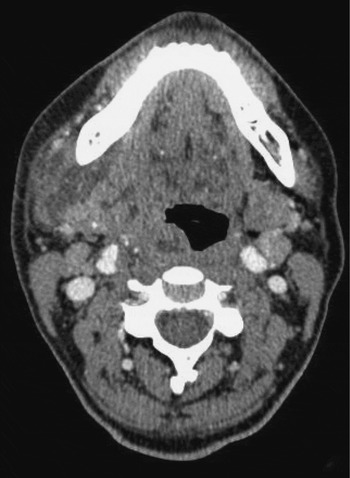
Thirteen patients had a unilateral peritonsillar abscess (nine males and four females). Thirteen patients had a unilateral parapharyngeal abscess (nine males and four females) (Figure 1). Five males had both a peritonsillar abscess and a parapharyngeal abscess.
Axial computed tomography scan showing right parapharyngeal abscess associated with a small right retropharyngeal extension.

Abscess complications
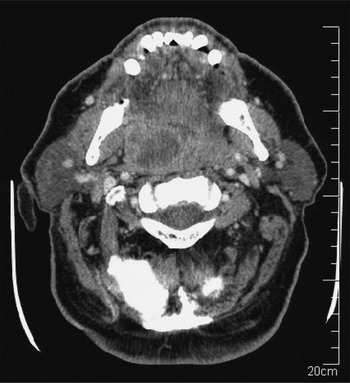
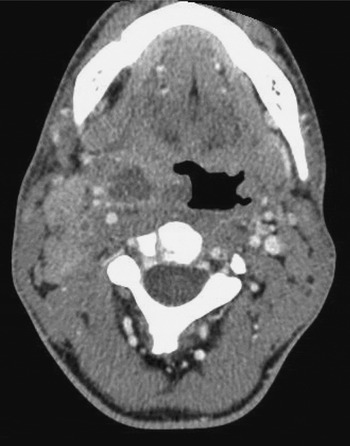
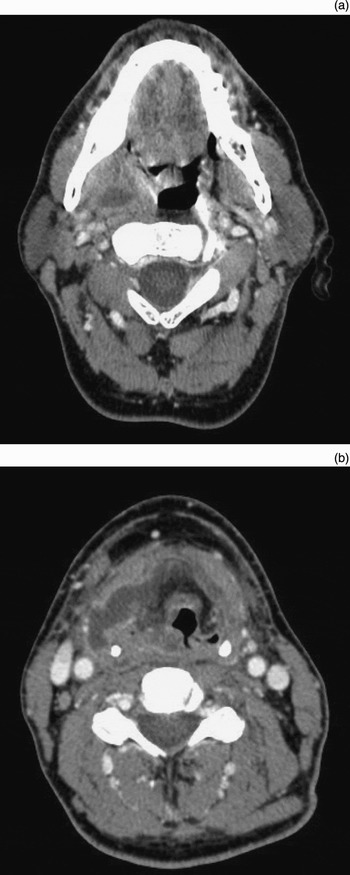
An 83-year-old man with a history of respiratory failure presented with acute dyspnoea requiring emergency orotracheal intubation, immediately followed by tonsillectomy for right obstructive peritonsillar abscess associated with bilateral tonsillitis; extubation was uneventful (Figure 2). A 13-year-old boy had a parapharyngeal abscess associated with suppurative ethmoiditis with subperiosteal orbital abscess, treated by simultaneous immediate tonsillectomy and endonasal ethmoidectomy. A 25-year-old man had true Lemierre's syndrome (with jugular vein thrombosis, pulmonary microabscesses and Fusobacterium necrophorum parapharyngeal abscess) (Figure 3). A 53-year-old man had a right parapharyngeal abscess associated with an extensive deep neck abscess with cutaneous, parapharyngeal and anterior paralaryngeal extensions (Figure 4). Finally, a 28-year-old man had a parapharyngeal abscess associated with a jugular vein thrombosis.
Axial computed tomography scan showing a right obstructive peritonsillar abscess, associated with bilateral tonsillitis and parapharyngeal inflammation.

Axial computed tomography scan showing a right parapharyngeal abscess associated with a right internal jugular vein thrombosis (Lemierre's syndrome).

Axial computed tomography scans showing right parapharyngeal abscess (a), associated with extensive deep neck abscess with cutaneous, parapharyngeal and anterior paralaryngeal extensions (b).

Microbiological findings
Pus samples were taken for microbiological culture. There was no growth in 13 cases, and polymicrobial flora in five cases. A single microbial species was grown in 13 cases: streptococcal species in seven cases, Prevotella bivia in two, and one case each of methicillin-sensitive Staphylococcus aureus, amoxicillin-sensitive Escherichia coli, F necrophorum (in the Lemierre's syndrome patient) and Eikenella corrodens.
Immediate tonsillectomy
In this series, 18 of 60 patients (30 per cent) underwent immediate tonsillectomy for peritonsillar abscess (including that associated with parapharyngeal abscess), and 18 of 30 patients (60 per cent) underwent immediate tonsillectomy for parapharyngeal abscess (including that associated with peritonsillar abscess).
Bilateral immediate tonsillectomy was performed in all patients.
All procedures were performed in the ENT and head and neck surgery department, except for one procedure performed on a Sunday morning in the emergency surgery department. ‘Classical’ capsular dissection of the palatine tonsils was performed by a senior surgeon (CP), using a similar technique to ‘classical’ dissection tonsillectomy in adult patients. The peritonsillar space was fairly easily identified and dissected due to the presence of the purulent collection, particularly in cases of simple peritonsillar abscess. However, dissection was also fairly easy in cases of parapharyngeal abscess. The presence of a suppurative fistula between the parapharyngeal and peritonsillar spaces was always rapidly identified. Finally, all patients underwent effective intra-oral drainage of their abscess(es).
No haemorrhagic complications (particularly delayed bleeding) were observed at the operative sites. Poor haemostasis of a nonpathological, contralateral tonsil required an immediate return to the operating theatre (two hours after immediate tonsillectomy) in one 45-year-old man.
Post-operative data
Patients' mean hospital stay after immediate tonsillectomy was 2.84 days (median: 3 days).
The duration of antibiotic therapy ranged from 10 to 15 days (mean: 11.5 days; median: 10 days). Intravenous antibiotic therapy was administered, during hospitalisation, for 2 to 8 days (mean: 4.35 days; median: 4 days). Oral antibiotic therapy was prescribed for 7 days after discharge from hospital, in combination with oral disinfection.
Discussion
The treatment of peritonsillar and parapharyngeal abscesses remains controversial, particularly with regard to surgical management.
Our recent experience
In a previous study, we highlighted the fact that peritonsillar abscess always has a favourable course after two to three days of local treatment (aspiration or drainage) combined with antibiotics and steroids, initially administered intravenously.Reference Page, Peltier, Medard, Celebi, Schmit and Strunski2 We concluded that aspiration should be performed as a first-line procedure, although immediate tonsillectomy can be proposed in cases of recurrent tonsillitis or in patients with a history of peritonsillar abscess. In another previous study, on parapharyngeal abscess, we concluded that uncomplicated parapharyngeal abscesses required first-line medical management (i.e. intravenous antibiotics combined with steroids) and follow-up CT scanning.Reference Page, Biet, Zaatar and Strunski1 Only complicated or extensive parapharyngeal abscesses require surgical management, and immediate tonsillectomy should be preferred whenever possible in these cases, essentially for aesthetic reasons.
Published data
In a meta-analysis of peritonsillar abscess treatment, Johnson et al. concluded as follows.
‘Overall, grade C evidence indicates that several methods of initial surgical drainage are equally effective, and the recurrence rate is low. The literature does not specifically address different treatments for children and adults.’Reference Johnson, Stewart and Wright21
The treatment of choice for parapharyngeal abscess is classically operative drainage via a neck incision, although neck incision and/or intra-oral drainage with or without immediate tonsillectomy may also be performed.Reference Brook4, Reference Sichel, Dano, Hocwald, Biron and Eliashar5, Reference Amar and Manoukian12
However, several recent papers have suggested that medical management (i.e. intravenous antibiotics) with CT follow up may be sufficient to manage parapharyngeal abscesses, particularly uncomplicated abscesses and those occurring in paediatric populations.Reference Wagner, Espitalier, Madoz, Picherot, Bordure and Malard8–Reference Daya, Lo, Papsin, Zachariasova, Murray, Pirie, Laughlin and Blaser11
Microbiology, antibiotics and medical management
Most oropharyngeal abscesses are polymicrobial infections. The predominant anaerobic organisms isolated from parapharyngeal abscesses are prevotella, porphyromonas, fusobacterium and peptostreptococcus species; the predominant aerobic organisms are group A streptococcus (Streptococcus pyogenes), S aureus and Haemophilus influenzae. Anaerobic bacteria can be isolated from most abscesses whenever appropriate culture techniques are used, while S pyogenes is isolated in only approximately one-third of cases. More than two-thirds of deep neck abscesses contain β-lactamase-producing organisms.Reference Brook4, Reference Kieff, Bhattacharyya, Siegel and Salman6 The results of our series are consistent with these data, as streptococcal species were isolated in the majority of cases. No antibiotic-resistant bacteria were found in this series, in line with our previous studies, justifying ‘simple’ antibiotic therapy.Reference Page, Biet, Zaatar and Strunski1, Reference Page, Peltier, Medard, Celebi, Schmit and Strunski2
The first-line intravenous antibiotic of choice is amoxicillin plus clavulanic acid (150 mg/kg per day), because more than two-thirds of deep neck abscesses contain β-lactamase-producing organisms.Reference Page, Peltier, Medard, Celebi, Schmit and Strunski2–Reference Brook4, Reference Kieff, Bhattacharyya, Siegel and Salman6 A brief course of intravenous steroids (4–5 days) also appears to be useful to rapidly relieve oral symptoms, especially pain and trismus, as observed in all patients in our series after 24 to 48 hours of steroids.Reference Ozbek, Aygenc, Tuna, Selcuk and Ozdem7
Changing practices
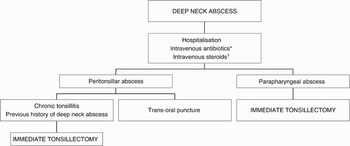
Based on our surgical experience, our department's management of peritonsillar and parapharyngeal abscesses has changed. Since its introduction in early 2007, immediate tonsillectomy has become our first-line treatment for parapharyngeal abscess and many types of peritonsillar abscess (Figure 5).
Management of peritonsillar and parapharyngeal abscesses. *Amoxicillin plus clavulanic acid, 2 g thrice daily or 150 mg/kg for children under 15 years, in the absence of penicillin allergy; †methylprednisolone 1 mg/kg per day.

Immediate tonsillectomy is not a new procedure: Templer et al. highlighted the value of this procedure for first-line treatment of peritonsillar abscess in 1977.Reference Templer, Holinger, Wood, Tra and DeBlanc18 No serious complications, particularly haemorrhagic and anaesthetic complications, were observed, and these authors concluded that ‘…the total hospitalization time will as a rule be shortened and a second convalescent period avoided’.
Several recent papers have also reported the value of immediate tonsillectomy.Reference Berry, Pascal and Whittet14–Reference Suzuki, Ueyama and Mogi17, Reference Lehnerdt, Senska, Jahnke and Fischer19 Windfuhr and Chen considered that immediate tonsillectomy was as safe as classical tonsillectomy, and 100 per cent efficient in terms of abscess evacuation.Reference Windfuhr and Chen15 In these authors' study, histological examination of the tonsils indicated a differential diagnosis including cancer and lymphoma (two cases in this series). These authors concluded that ‘…immediate tonsillectomy can be recommended as a safe surgical procedure in non-selected patients to evacuate quinsy without an additional risk of bleeding thus making a second hospital stay unnecessary’. Berry et al., Fujimoto et al., Suzuki et al. and Lehnerdt et al. all reached similar conclusions by demonstrating a very low haemorrhagic complication rate that did not differ from that of elective tonsillectomy.Reference Berry, Pascal and Whittet14, Reference Fujimoto, Aramaki, Takano and Otani16, Reference Suzuki, Ueyama and Mogi17, Reference Lehnerdt, Senska, Jahnke and Fischer19 Only Giger et al. reported a higher haemorrhagic complication rate after immediate tonsillectomy, compared with elective tonsillectomy; however, this high incidence was mainly due to patients with prior aspirin intake (because of pain) or bleeding contralateral to the abscess.Reference Giger, Landis and Dulguerov20 These authors suggested that unilateral immediate tonsillectomy should be performed to reduce the risk of contralateral morbidity.
Finally, Johnson and colleagues' meta-analysis demonstrated the efficacy and safety of immediate tonsillectomy for peritonsillar abscess.Reference Johnson, Stewart and Wright21
In our opinion, immediate tonsillectomy is a simple, effective and safe surgical technique and can be used as first-line treatment for all peritonsillar abscesses. Our routine procedure, since early 2007, has been to perform immediate tonsillectomy for peritonsillar abscess in patients with recurrent tonsillitis or a history of peritonsillar abscess or other deep neck abscess. As a result of the current study, we now propose immediate tonsillectomy for all patients with peritonsillar abscess.
The problem of parapharyngeal abscess
Since its introduction in early 2007, immediate tonsillectomy has become the first-line treatment for parapharyngeal abscess in our department. Between 2004 and 2006, it was only indicated as second-line treatment in the case of complications, or when there was clinical or radiological evidence of inefficacy after several days of intravenous antibiotics.
Peritonsillar and parapharyngeal abscesses are fairly similar anatomically, because most parapharyngeal abscesses are paratonsillar (representing parapharyngeal suppuration very lateral to the palatine tonsils, which are the source of the infection) or indeed truly associated with peritonsillar abscess. The classical neck incision for drainage of parapharyngeal abscess is not as easy as it may appear, and can be dangerous. Local inflammation and bleeding make dissection difficult, with a risk of damage to the cranial nerves (essentially the Xth, XIth and XIIth nerves) and jugular and carotid vessels. For this reason, we consider that the internal approach to parapharyngeal abscess drainage, following tonsillectomy, is easier and safer. A suppurative fistula between the widely opened paratonsillar and pharyngeal space and the peritonsillar space is always found, ensuring effective drainage of the abscess. Also, the internal approach does not leave an unsightly external scar.
• Deep neck abscesses are usually secondary to contiguous spread from local sites, particularly infected tonsils
• Although the pathology of peritonsillar abscess (quinsy) and parapharyngeal abscess is fairly similar, their management can differ in many ways and remains controversial
• Immediate tonsillectomy appears to be a safe and effective surgical technique for the management of peritonsillar and parapharyngeal abscesses
Judging from our experience, the post-operative course after immediate tonsillectomy for peritonsillar abscess is similar to that after classical elective tonsillectomy. In our series, six patients were initially treated with intravenous steroids and antibiotics alone (for two to five days) for relatively small, uncomplicated parapharyngeal abscesses, prior to surgery, and two patients also underwent CT follow up. Our patients' post-tonsillectomy course was fairly spectacular, with all patients being discharged from hospital two or three days after surgery, pain-free.
In contrast, conservative treatment of parapharyngeal abscess can take some time to be curative, and can be expensive (in terms of duration of hospital stay and CT follow up). Conservative treatment may also fail to be effective, particularly in the case of abscesses larger than 20 mm along their long axis (as suggested by Wagner et al.), leading to further delay.Reference Wagner, Espitalier, Madoz, Picherot, Bordure and Malard8 Finally, repeated CT scans are both costly and associated with unnecessary irradiation, particularly in children.
Berry et al. and Templer et al. reported that the major drawback of immediate tonsillectomy was the inconvenience of adding a relative emergency to operating theatre lists, in terms of the personnel and theatre facilities required.Reference Berry, Pascal and Whittet14, Reference Templer, Holinger, Wood, Tra and DeBlanc18 Fortunately, this was not a problem in our department.
Conclusion
Immediate tonsillectomy appears to be a safe and effective surgical technique for the management of peritonsillar and parapharyngeal abscesses, and markedly reduces patients' hospital stay (when performed early in the course of the disease) and duration of antibiotic therapy. Immediate tonsillectomy has become the first-line treatment for parapharyngeal abscess and several types of peritonsillar abscess in our department.