Foxtail sophora, from eastern Europe and Asia, is an increasing weed problem in drylands throughout the west of Iran (Vaisi et al. Reference Vaisi, Minbashi, Sabeti and Mohammadi2013). Once established, foxtail sophora can substantially reduce the yield of several major dryland crops, including wheat (Triticum aestivum L.) and chick pea (Cicer arietinum L.), but because of its height, interference with harvest operations is the most important economic concern (Vaisi et al. Reference Vaisi, Minbashi, Sabeti and Mohammadi2013). Lack of suitable registered herbicides for control of broadleaf weeds in chick pea and control of late-emerging foxtail sophora after herbicide applications in winter wheat have contributed to the increase in the population of this weedy species in the drylands of western Iran.
Licorice (Glycyrrhiza glabra L.), another dominant weed species, is now harvested for medicinal use, resulting in reduced infestations and increased area for further spread of foxtail sophora (Nosratti et al. Reference Nosratti, Alizadeh and Rahimian2011; Vaisi et al. Reference Vaisi, Minbashi, Sabeti and Mohammadi2013).
Information on foxtail sophora ecology and its harmful effects on crops is not well documented. Some insights can be gained from comparisons with licorice, which is similar in terms of canopy size, height, and rhizomatous growth habit. Licorice was reported to cause winter wheat yield losses of up to 38% at a density of 25 plants m−2 (Mir Kamali Reference Mir Kamali1995). Foxtail sophora is a rhizomatous weed species that relies mostly on its belowground parts for colonizing a habitat. However, seeds have a vital role in its distribution, population establishment (Baskin and Baskin Reference Baskin and Baskin2014), and persistence (Egley and Chandler Reference Egley and Chandler1978).
Seed germination and the successful establishment of a species in farmland are affected by a wide range of factors, including temperature, soil solution osmotic potential, soil pH, light quality and quantity (Del Monte and Dorado Reference Del Monte and Dorado2011; Malik et al. Reference Malik, Norsworthy, Riley and Bridges2010; Sabila et al. Reference Sabila, Grey, Webster, Vencill and Shilling2012; Wu et al. Reference Wu, Li, Xu and Dong2015), agronomic management practices (e.g., tillage and irrigation) (Schutte et al. Reference Schutte, Tomasek and Davis2014), and maternal plant growing conditions (Finch‐Savage and Leubner‐Metzger Reference Finch‐Savage and Leubner‐Metzger2006).
Temperature is an important factor affecting the timing of weed seed germination. Constant and alternating temperature regimes may have a different effect on seed germination of various weed species (Baskin and Baskin Reference Baskin and Baskin1988). However, such information is not available for foxtail sophora. Light, acting as a soil-depth indicator, is considered an important ecological determinate for seed germination (Crisraudo et al. Reference Crisraudo, Gresta, Luciani and Resticcia2007). This mechanism prevents germination from deeper layers of soil. Generally, light is needed for germination of small-seeded weed species (Chauhan et al. Reference Chauhan, Gill and Preston2006a). Light penetration and temperature are also affected by seed burial depth (Shaw et al. Reference Shaw, Mack and Smith1991). Burial depth of seeds also affects the availability of moisture and seedling emergence (Koger et al. Reference Koger, Reddy and Poston2004; Shaw et al. Reference Shaw, Mack and Smith1991). All these factors could affect foxtail sophora germination and emergence in the field. Microenvironmental attributes of soil such as soil salinity, water content, and pH can greatly affect seed germination (Koger et al. Reference Koger, Reddy and Poston2004). Most of the Iranian dryland crops are generally grown on soils under varying moisture, salt, and acidity conditions (Ahmadi Reference Ahmadi1999). Hence, being aware of the response of foxtail sophora to these factors would be helpful in predicting its potential range.
Better knowledge of the ecology of foxtail sophora may help to develop strategies for the management of this weed species. Although foxtail sophora is a problematic weed of dryland farming systems of western parts of Iran, little information is available about the factors influencing its germination and emergence. Therefore, the objective of this study was to determine the effect of different abiotic factors on the seed germination and seedling emergence of foxtail sophora.
Materials and Methods
Site and Seed Description
Mature pods of two populations of foxtail sophora were collected at maturity from about 200 plants growing in several wheat (wheat population) and chick pea (chick pea population) fields (and pooled to make a single seed sample for each population) at the Dryland Agricultural Research Institute, Sararood, Kermanshah, Iran (34.32°N, 47.28°E), during September 2015. Seeds of both populations were considered mature when the plants of foxtail sophora had completely senesced. Seeds were liberated from the pods by hand; care was taken not to damage the seed coat. The 1,000-seed weight of foxtail sophora was about 23 g (±0.9 g) for both populations. Seeds were kept at room temperature (21±2 C) for about 10 d until initiation of the experiment.
Protocol for Germination Tests
Four replications of 40 seeds of foxtail sophora were placed in 9-cm petri dishes lined with two layers of Whatman No. 1 filter paper, moistened with either 6 ml of distilled water or a treatment solution. The petri dishes were sealed with Parafilm® to prevent evaporation and then placed in a germination chamber (JAL TEB, model: 200 L) in the Physiology Laboratory of the Campus of Agricultural and Natural Resources, Razi University, Kermanshah, Iran.
Germination tests were conducted for 14 d at 25 C under light/dark (16/8 h) conditions. The criterion for germination was visible protrusion of the radicle. The number of germinated seeds was counted daily until day 14 after initiation of the experiment.
Effect of Light and Temperature on Germination
Incubation temperatures consisted of constant (10, 15, 20, 25, 30, and 35 C) and fluctuating (5/10, 10/20, and 15/25 C) (16-h high/8-h low) temperatures under two regimes of light/dark and continuous darkness. To apply light treatments, petri dishes were sealed in transparent polyethylene bags, while dark treatments were wrapped in aluminum foil. Light intensity of 150 µmolm−1s−1 was produced in the germinator chamber by using fluorescent lamps. These temperature and light conditions were chosen to simulate natural conditions experienced during spring and summer in western Iran.
Effect of Salinity on Germination
Foxtail sophora seeds were exposed to 12 levels of salinity using solutions containing 0 (control), 40, 80, 120, 160, 200, 240, 280, 320, 360, 400, and 800 mM of sodium chloride (NaCl). Treated petri dishes were placed in conditions as described in the protocol for the germination test. These salt concentrations were used on the basis of soil/water salinity found in different parts of Iran.
Effect of pH on Germination
The effect of different pH levels (4, 5, 6, 7, 8, 9, and 10) was evaluated on the germination of foxtail sophora. For the preparation of buffered solutions of different pH values, 2 mM potassium hydrogen phthalate buffer solution was adjusted to pH 4 with 1 N HCl. A 2 mM solution of MES [2-(N-morpholino)-ethanesulfonic acid] was adjusted to pH 5 and 6 with 1 N NaOH. A 2 mM solution of HEPES [N-(2-hydroxymethyl) piperazine-N-(2-ethanesulfonic acid)] was adjusted to pH 7 and 8 with 1 N NaOH. Buffer solutions of pH 9 and 10 were prepared with 2 mM tricine [N-Tris(hydroxymethyl)methylglycine] and adjusted with 1 N NaOH. Petri dishes were incubated under light and temperature regimes as described in the germination test protocol.
Effect of Moisture Stress on Germination
The effect of different osmotic potentials on seed germination was assessed by incubating seeds in polyethylene glycol 6000 (Merck, Darmstadt, Germany) solutions with osmotic potentials of 0, −0.1, −0.3, −0.5, −0.7, −0.9, −1.1, −1.3, and −1.5 MPa. The solution was prepared based on the method described by Michel (Reference Michel1983). The seeds were incubated in light and temperature regimes as described in the germination test protocol.
Effect of Sowing Depth on Seedling Emergence
The effect of sowing depths of 0, 2, 4, 6, 8, and 10 cm on seedling emergence of foxtail sophora was evaluated. Foxtail sophora seeds were placed at the specified depths in a pot (25-cm height, 15-cm diameter). Seeds were scattered onto the soil surface and covered with the same soil to achieve the desired depth. Seeds located on the soil surface were covered with three sheets of filter paper to provide constant water supply to the seeds. For each burial depth, 45 seeds per replication were used.
The soil used for this experiment was a loam comprised of 30% sand, 40% silt, and 30% clay with 0.50% total organic matter and a pH of 6.9. Afterward, pots were placed in a germinator chamber as detailed in the germination test protocol. Pots were watered regularly after seed sowing until the pots reached field capacity. Emergence was counted weekly for 30 d or until emergence no longer occurred. Seedlings were considered emerged when the two cotyledons could be seen at the soil surface and were then removed carefully after weekly counts to avoid soil disturbance.
Statistical Analyses
All experiments were assigned in a completely randomized design with four replications and were repeated twice. Data were pooled across runs because of the lack of a significant run by treatment interaction. In addition, germination responses to all evaluated factors were consistent between the two populations of foxtail sophora; hence, data from the two populations were pooled. According to Bartlett’s test, data obtained in this study met the assumptions of homogeneity of variance. Therefore, ANOVA was performed on nontransformed data using SAS software (v. 9.1, SAS Institute, Cary, NC). A functional three-parameter logistic model using SigmaPlot (v. 12.0, Systat Software, Point Richmond, CA) was used for germination percentages obtained in the NaCl and osmotic stress experiments (Chauhan et al. Reference Chauhan, Gill and Preston2006a).
 $$G ( \,\%\, )\,{\equals}\,{\raise0.5ex\hbox{$\scriptstyle {G_{{{\rm max}}} }$}\kern-0.1em/\kern-0.15em\lower0.25ex\hbox{$\scriptstyle {\left[ {1{\plus}\left( {X\,/\,X_{{50}} } \right)^{{{\rm G}_{\rm rate}}} } \right]}$}}$$
where, G is total germination (%) at NaCl concentration or osmotic potential x, G max is maximum germination (%), X 50 is NaCl concentration or osmotic potential for 50% inhibition of the maximum germination (%), and G rate is slope. The seedling emergence data obtained from different sowing depths were analyzed using an exponential-decay curve model (Norsworthy and Oliveira Reference Norsworthy and Oliveira2006):
 $$E( \,\%\, )\,{\equals}\,E_{{{\rm max}}} {\times} e^{{\left( {{\minus}E_{{{\rm rate}}} {\times}x} \right)}} $$
in which, E is seedling emergence percentage at burial depth x, E max is maximum seedling emergence, and E rate is the slope.
Results and Discussion
Effect of Light and Temperature on Germination
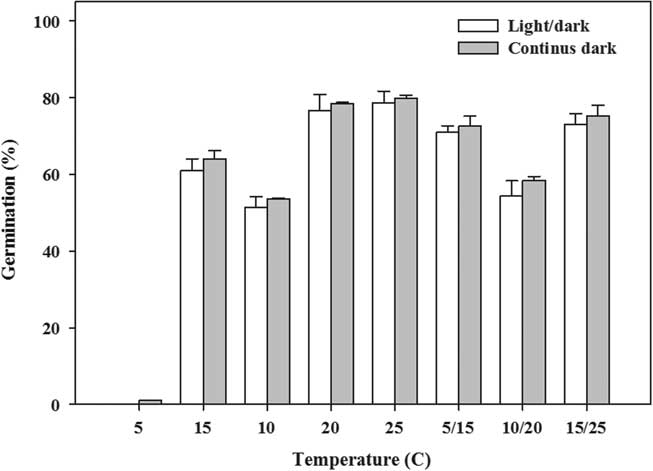
Irrespective of temperature regime, seed germination was similar between light/dark and dark conditions (Figure 1). Seed germination of foxtail sophora did not respond to light, indicating that seeds of this species are nonphotoblastic (P<0.001) (Figure 1). These results suggest that under sufficient moisture and temperature conditions, the seeds of this species will germinate regardless of being buried under soil and/or crop canopy or on the soil surface. Several researchers have shown a positive effect of light on seed germination of several weed species (Chauhan et al. Reference Chauhan, Gill and Preston2006a; De Cauwer et al. Reference De Cauwer, Devos, Claerhout, Bulcke and Reheul2014; Lee et al. Reference Lee, Chauhan and Johnson2011). Other studies, however, reported that light might have no effect on seed germination (Singh et al. Reference Singh, Ramirez, Sharma and Jhala2012; Zhou et al. Reference Zhou, Deckard and Messersmith2005) or even inhibit germination in some weed species (Sharma and Born Reference Sharma and Born1978).
Effect of constant and fluctuating (16-h high/8-h low) temperatures and light (light/dark and continuous darkness) (16/8 and 24 h) on seed germination of foxtail sophora. Seeds were incubated for 14 d. Vertical bars represent the mean±standard error.

Foxtail sophora is a dominant weed of dryland wheat and chickpea, which typically germinate during midspring. At that time of the year, the wheat canopy may have already covered the ground. The nonphotoblastic characteristic of foxtail sophora seed may explain the plant’s ability to germinate in dryland wheat fields after canopy coverage (Fenner and Thompson Reference Fenner and Thompson2005).
Seeds of foxtail sophora germinated over a wide range of temperatures. Germination was different for constant and alternating temperatures. Highest germination was observed at the constant temperature of 25 C, while the lowest germination (<1%) was achieved at 5 C (P<0.05). Likewise, Jain and Singh (Reference Jain and Singh1989), Reddy and Singh (Reference Reddy and Singh1992), and Silva et al. (Reference Silva, Parreira, Alves and Pavani2009) determined that summer broadleaf weeds achieved optimum germination at constant temperatures of 25 to 35 C. In some weedy species, alternating temperatures are required to promote seed germination, and these species typically require light for germination (Batlla and Benech-Arnold Reference Batlla and Benech-Arnold2006; Fenner and Thompson Reference Fenner and Thompson2005). Both these signals (light and fluctuating temperatures) indicate a position close to the soil surface to enable seedlings to emerge.
The mean temperature in the region exceeds 20 C after mid-May, which is suitable for foxtail sophora seed germination and seedling establishment. Moreover, at temperatures lower than the optimum range, germination is reduced, indicating that germination of this weed species is prevented during the coldest months of winter. Because foxtail sophora reaches maximum germination at temperature regimes (constant and alternating) around 25 C, its seedlings would emerge during spring and early summer in Iran. This would lead to the delayed emergence of foxtail sophora in winter crops, including wheat and chick pea. These results suggest that this weed would escape typical POST herbicide applications in western Iran, which are applied in early spring.
Effect of Salinity on Germination
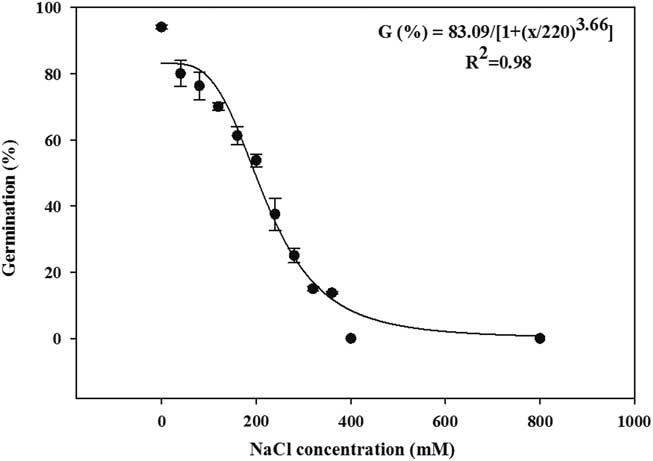
Germination of foxtail sophora decreased with increasing salt concentrations (Figure 2). Foxtail sophora germination in both populations was more than 80% at NaCl concentrations up to 40 mM. The NaCl concentration needed to inhibit 50% of the maximum germination was 220 mM (Figure 2). At 360 mM of NaCl, foxtail sophora seeds were still able to germinate. Seed germination was completely inhibited at salt concentrations greater than 600 mM.
Effect of sodium chloride (NaCl) concentration on germination of foxtail sophora seeds incubated at the temperature of 25 C under light/ dark (16/8 h) conditions for 14 d. The lines represent a three-parameter logistic model fit to the data. Data represent the mean±standard error of the mean (n=8).
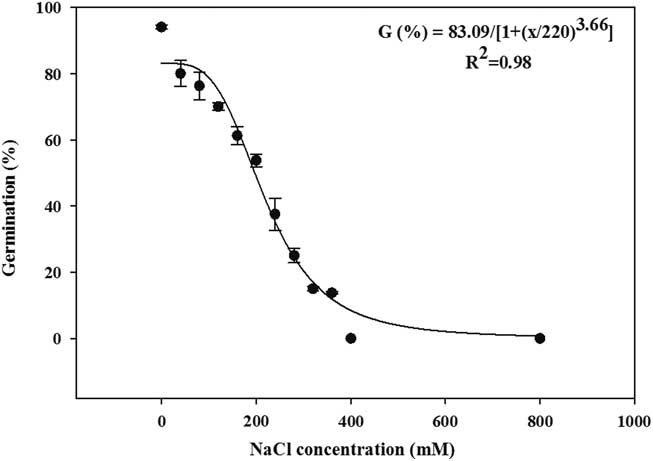
Ebrahimi and Eslami (Reference Ebrahimi and Eslami2012) determined that Ceratocarpus arenarius L. (a species well adapted to semi-arid climatic conditions of eastern Iran) had 80% germination at 160 mM NaCl. The X 50 parameter of the regression (representing the NaCl concentration at which 50% of the maximum germination is inhibited) was between 215 and 226 mM, which indicates moderate salt tolerance of foxtail sophora during germination when compared with many other weed species reported previously (Boyd and Hughes Reference Boyd and Hughes2011; Chauhan et al. Reference Chauhan, Gill and Preston2006b; Sabila et al. Reference Sabila, Grey, Webster, Vencill and Shilling2012; Wu et al. Reference Wu, Li, Xu and Dong2015). Similar to our results, Wei et al. (Reference Wei, Cheng, Liu, Liu, Yang and Zheng2015) reported foxtail sophora as a moderate-halophyte species. The results of our study indicate that foxtail sophora is able to germinate in soils common in Iran, as the mean salinity levels of most farmlands located in the western parts of Iran are below 250 mM NaCl (Ahmadi Reference Ahmadi1999). Based on these results, foxtail sophora has the potential to spread into more areas in Iranian drylands, and preventive measures are required to contain this weed.
Effect of pH on Germination
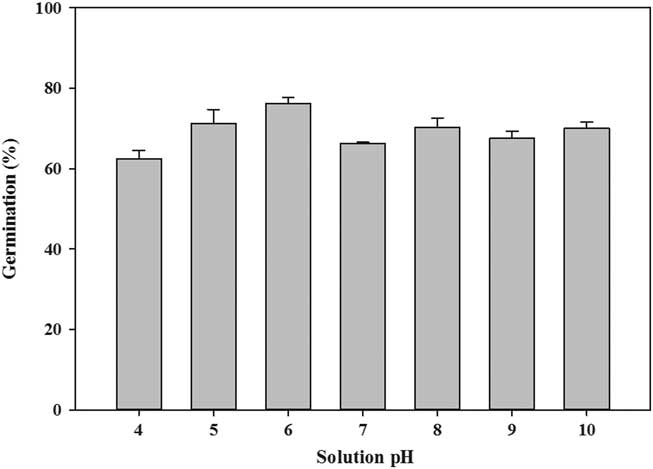
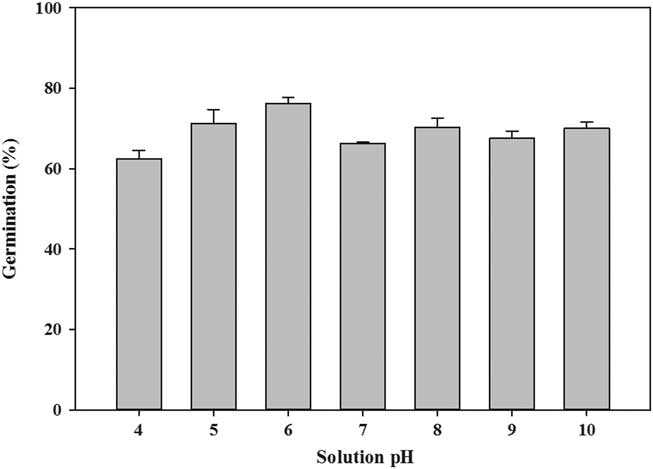
In general, the response of both populations of foxtail sophora germination to acidity did not follow a specific trend. The maximum germination (76%) of foxtail sophora was observed at pH 6, whereas at pH 4, germination was 62% (P<0.05) (Figure 3). Both populations of foxtail sophora germinated well over a wide range of pH values. This indicates foxtail sophora’s potential to germinate under a wide range of soil pH conditions and infest different habitats.
Effect of buffered pH solutions on germination of foxtail sophora seeds incubated at the temperature of 25 C under light/ dark (16/8 h) conditions for 14 d. Data represent the mean±standard error of the mean (n=8).
Effect of Moisture Stress on Germination
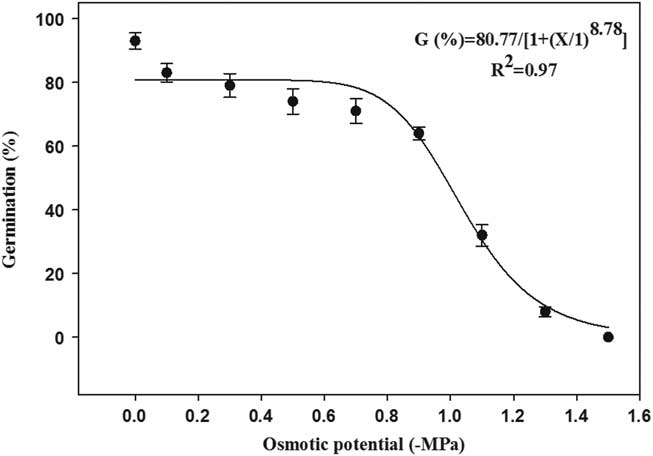
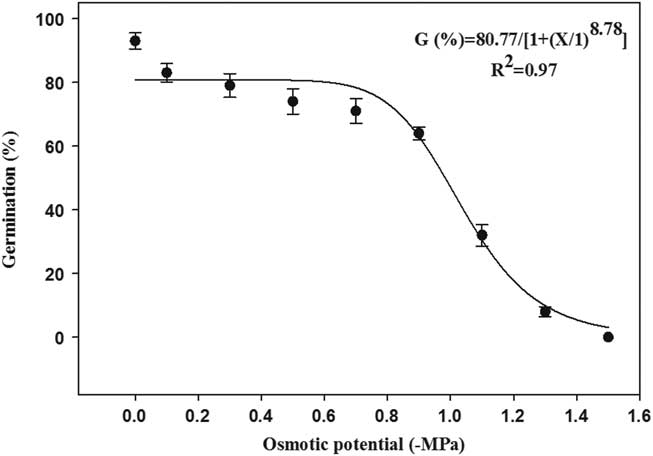
Germination of foxtail sophora was 93% in the nonstressed (control) conditions (Figure 4). A reduction in osmotic potentials reduced seed germination of both populations of foxtail sophora. Seed germination was >60% up to the osmotic potential of −0.9 MPa, but declined to 32% at the osmotic potential of −1.1 MPa. At the osmotic potential of −1.3 MPa, 8% germination occurred, but at osmotic potentials lower than −1.5 MPa, no seeds germinated. An osmotic potential of −1.0 MPa was needed to inhibit 50% germination of the maximum germination, which was considerably greater than values reported for common lambsquarters (Chenopodium album L.) growing under arid and semi-arid climatic conditions (Eslami Reference Eslami2011). Rainfall in western parts of Iran typically decreases after midspring, and almost no precipitation occurs during summer. The tolerance of a particular weed species to water stress can lead to increases in its growth potential under dryland farming conditions (Gutterman and Gendler Reference Gutterman and Gendler2005). We conclude that foxtail sophora is highly tolerant to water stress during germination and, based on our observations, can tolerate dry soil conditions in dryland fields.
Effect of osmotic potentials (−MPa) on germination of foxtail sophora seeds incubated at the temperature of 25 C under light/ dark (16/8 h) conditions for 14 d. The lines represent a three-parameter logistic model fit to the data. Data represent the mean±standard error of the mean (n=8).
Effect of Sowing Depth on Seedling Emergence
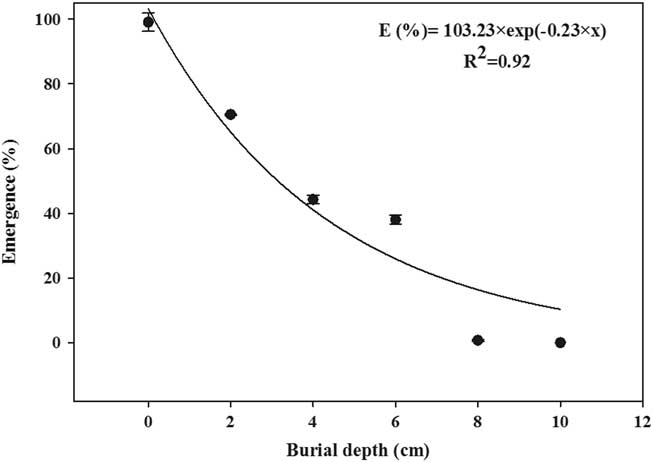
The response of foxtail sophora seedling emergence to different sowing depths is shown in Figure 5. Seed germination of foxtail sophora was maximum (99%) for the seeds placed on the soil surface, and seedling emergence decreased with increasing sowing depths (P<0.05). The emergence of foxtail sophora decreased sharply when seeds were sown deeper than 6 cm, and no seedlings emerged from the burial depth of 8 cm.
Seedling emergence of foxtail sophora in response to burial depth (cm) when grown in a germinator chamber with temperature of 25 C under light/ dark (16/8 h) conditions for 30 d. The lines represent a two-parameter exponential decay model fit to the data. Data represent the mean±standard error of the mean (n=8).

The emergence values obtained in our experiment were lower than those obtained by Chauhan and Johnson (Reference Chauhan and Johnson2008) for other large-seeded weedy members of the Fabaceae family. They reported that giant sensitiveplant (Mimosa invisa Mart.) emergence was 80% to 94% at depths of 0 to 2 cm, and no seedlings emerged from seeds buried at 10 cm. This is probably due to larger seed size of giant sensitiveplant, which may have greater carbohydrate reserves (Baskin and Baskin Reference Baskin and Baskin2014). Reduced seedling emergence with increasing seeding depths has also been reported in several weed species (Chauhan et al. Reference Chauhan, Gill and Preston2006c; Schutte et al. Reference Schutte, Tomasek and Davis2014). These results indicate that although emergence was reduced at deeper seed burial depths, a significant proportion of seedlings (50%) could still emerge from a depth of about 4 cm. This could mean that burying seeds through a shallow-tillage operation to reduce foxtail sophora density may not significantly improve the control of this weed species. Annual conventional tillage (typically not deeper than 30 cm), which is a common practice across dry farmlands in Iran, by weakening and breaking down the seed coat and bringing up seeds from deeper in the soil, may actually increase foxtail sophora emergence. Therefore, conducting tillage operations with a sweep cultivator (with tillage depth of 10–15 cm) may be better for the management of this weed species.
In conclusion, foxtail sophora establishes annually from seeds in new areas; therefore, a greater understanding of the factors influencing germination and establishment will help to develop effective management strategies. The information obtained from this study could help to predict the spread of foxtail sophora to new areas. Based on our results, foxtail sophora is capable of infesting most Iranian dryland farmlands, particularly those located in western parts, which are characterized by semi-arid conditions. Widespread harvesting of licorice (previously a strong competitor with foxtail sophora and now a valuable medicine plant) has resulted in an increased density of foxtail sophora. In addition to this, factors such as optimal emergence from shallow depths, late seedling emergence and consequent escape from herbicide applications in wheat crops, and lack of suitable herbicides in chick pea crops suggest that this weed could become more problematic in the dryland cropping systems in future years. The practical implication of this study would be using tillage operations such as sweep cultivators that bury the seeds of foxtail sophora below their maximum depth of emergence.
Acknowledgments
We would like to acknowledge Razi University for financial support of this study.