

Introduction
This paper is a contribution to the debate on how to make British health-care services more responsive to the needs of older people who are members of recent immigrant groups. The focus is on Chinese-origin elders, and the objective is to document their diverse migrant histories, cultural backgrounds and attitudes to both ‘traditional’ and Western health-care practices. The underlying argument is that if health-care professionals had a better understanding of the diversity of Chinese older people, this would make a valuable contribution to making the services more sensitive to their needs and reduce their exclusion from mainstream health care. The paper has four sections. The first argues that more awareness of the cultural diversity of ethnic-minority groups will increase the sensitivity of health-care services to their needs, and so raise their ability to access and benefit from the services. The reader's attention is drawn to two questions: what is the attitude of people of Chinese culture to their traditional health beliefs, values and practices? Is there a tradition among the Chinese of actively using elements of foreign culture to enhance their quality of life? The second and third parts of the paper address these two questions by discussing the various strategies adopted by Chinese-origin older people in Britain to improve their health, and by examining the responses in China to new (western) medical knowledge and practices. The fourth part considers the ways in which the sensitivity of British health-care services to the needs of ethnic-minority groups can be improved, with a focus on the use of the culturagram instrument and procedure.
Cultural diversity and British health care
Whether mainstream health-care services can improve the quality of life of ethnic-minority people has been vigorously debated in the United Kingdom (UK) and elsewhere in recent years. On the one hand, there is a view that the government should enable such groups to have equal access to mainstream health-care services. By doing so, the government may give them more control over their lives and direct more resources to their health and welfare. On the other hand, there is a worry that mainstream services do not meet the cultural minority groups' needs and preferences (Devore and Schlesinger Reference Devore and Schlesinger1999; National Audit Office 2004). Imposing mainstream services on minorities may reduce their say about how their health should be promoted. To avoid this problem, some call for the development of culturally-sensitive health and care services (Gilligan and Furness Reference Gilligan and Furness2006). These would build from ethnic-minority groups' own understanding of their experiences, needs and the most appropriate ways of meeting their needs (Torsch and Ma Reference Torsch and Ma2000; Manning, Cornelius and Okundaye Reference Manning, Cornelius and Okundaye2004). Advocates of this course suggest that distinctive health-care services should be developed with the emphasis on the ethnic-minority groups' traditions. Examples of these services include therapies based on African-centred world-views of the interconnectedness of all things and the spiritual nature of human beings, or those that draw from Taoist views of ideal mental health (Schiele Reference Schiele2000; Yip Reference Yip2005). The argument is that the greater the range of health-care practice, the more likely that the distinctive needs of users from different cultural backgrounds will be met (Kropf and Isaac Reference Kropf, Isaac, Harrison, Thyer and Wodarski1996). Moreover, culturally-distinct services may give ethnic-minority groups more say over how their health-care needs are provided for, more choice about whether or to what extent to use mainstream services, and more opportunities to use selectively both mainstream and culturally-distinctive services (Chau and Yu Reference Chau, Yu and Shaw2004).
It is manifestly not good practice to impose on an ethnic-minority group mainstream health-care services that are incompatible with their values and customs, and equally it should not be taken for granted that all members of an ethnic-minority group invariably prefer to use culturally-specific health care. Most ethnic groups in any country are heterogeneous, not least in their attitudes to mainstream and ‘traditional’ health care (Chau and Yu Reference Chau, Yu, Warnes, Warren and Nolan2000; Payne Reference Payne2005). In their discussion of culturally-sensitive services for Arab clients in Western nations, Al-Krenawi and Graham (Reference Al-Krenawi and Graham2000) argued that Western cultural norms have penetrated much of the Arab world, but with variable effects in different communities and societies. Cox and Ephross (Reference Cox and Ephross1998) suggested that welfare professionals should be aware of the diversity of the ethnic groups that they serve, and both Congress (Reference Congress1994) and Torres (Reference Torres2006) warned that the over-generalisation of racial or ethnic-group characteristics is a sign of limited understanding.
It is also important to note that some ethnic-minority groups have a long tradition of exchange with other cultures. Not all of a minority's ancestors have lived in isolated or hidebound communities; indeed, some have a rich history of contacts with other societies. Undoubtedly some have been repelled by different cultures, but others have willingly adopted selected elements. Consequently, it may be wrong to assume that an ethnic-minority group, even one that predominantly leads culturally distinctive lives, has no interest in using mainstream health-care services. To enhance the effectiveness of culturally-sensitive health-care services as a means to improve the quality of life of ethnic-minority groups, and to raise their control over their lives, two questions should be asked: ‘What is the ethnic-minority groups’ attitude to their traditional values and/or practices?' and ‘Do they have a tradition of actively using elements of foreign culture to enhance their quality of life?’ In this paper, we address these two questions with particular reference to Chinese-origin older people in the UK. To answer the first question, we shall discuss the diverse strategies used by many Chinese older people to promote their health; to answer the second, we discuss the Chinese people's heritage of exploring different methods of promoting their health given their exposure to foreign influences by examining the development of western medicines in China.
Chinese people's diverse strategies for promoting health
The opinion is widespread in western countries that Chinese people, particularly in the older age groups, shape their lives according to cultural traditions and so define and promote their health on the basis of traditional principles. Some analysts and government reports have asserted that Chinese people prefer to receive support and advice from within their own communities and are keen to uphold traditional principles (e.g. Jones Reference Jones1979; Home Office 1985; Watson Reference Watson and Watson1977). For instance, in discussing the role of cultural factors in shaping the Chinese community, a British Broadcasting Corporation (BBC) website asserted that, ‘since Confucian thought has dominated the Chinese way of life for 2,000 years, it is unlikely to cease its influence – even after two or three generations of participation in British society’ (BBC 2008). Congress and Lyons (Reference Congress and Lyons1992) observed that Chinese people's attitudes to food draw on concepts from classical Chinese philosophy such as Yin and Yang. The website of the Chinese Mental Health Association in London argues that elements of Chinese culture, such as the importance of maintaining ‘face’, prevent members of Chinese communities from discussing their mental health problems and from seeking advice about mental health services.Footnote 1 A survey by the Chinese National Healthy Living Centre indicated that some Chinese respondents preferred Chinese to western medicines, because they believed that the former provided cures for illness rather than just palliating the symptoms (Wong Reference Wong2006). Such topics have become obligatory at British conferences about the health-care needs of people of Chinese backgrounds (Chau, Yu and Cheung Reference Chau, Yu and Cheung2002)
There is ubiquitous evidence of Chinese older people's use of traditional medicine to care for and restore their health, and it is clear that mainstream health-care services are insufficient to meet their health-care needs. The principle is now widely accepted that for health-care services to provide appropriate and acceptable help, they must be made sensitive to Chinese cultural orientations and cultural needs. Many studies have suggested how this can be done (Chau Reference Chau2007; Green et al. Reference Green, Bradby, Chan, Lee and Eldridge2002; Hung Reference Hung2001; Tran Reference Tran2006; Yu Reference Yu2000; Wong Reference Wong2006). It has variously been proposed that:
• Chinese people have distinctive ways of conceptualising illness and health, most of which are based on the concepts of balance and energy. To understand their health-care needs, it is important that practitioners have knowledge of this understanding.
• Since most Chinese medicines are provided in the private sector, Chinese people may not be able to afford them. It is necessary to provide more publicly funded National Health Service (NHS) ‘Traditional Chinese Medicine’ (TCM) clinics.
• Even though many Chinese people prefer to use Chinese medicines, they have doubts about the authenticity and skills of all its practitioners, and there is a need for stronger regulation of Chinese medications and medical practitioners.
• Many Chinese people learn or are acculturated to culturally-specific health-related behaviours from childhood. For example, many have never been accustomed to taking a (western-style) bath because it is seen as a stagnant pool, but instead prefer to shower or to body-wash by scooping water from a large bucket or bowl. It is important for health professionals to understand and respect such customs and beliefs.
• Some Chinese people think that the quality of Chinese medicines provided to Chinese people in other societies is better than in the UK. To meet their needs, it may be necessary to subsidise them to consult Chinese-medicine practitioners overseas.
Even if all these suggestions were implemented, there is no guarantee that the health-care needs of all Chinese older people in the UK would be adequately met, because not all prefer traditional therapies. Indeed many have accepted that western (or science-based) interventions can cure diseases, and some use combinations of Chinese and western medicines to promote their health (Chau and Yu Reference Chau, Yu and Shaw2004). Tran (Reference Tran2006) and Liao and McIlwaine (Reference Liao and McIlwaine1995) showed that some Chinese people prefer to use both western health-care and Chinese traditional medicines. The same was found by Gervais and Jovchelovtich in their study of the health beliefs of Chinese communities: ‘the Chinese in our sample do not consider that their traditional medical knowledge and beliefs clash with Western biomedicine’ (1998: 51). It is then well established that not all Chinese people reject western medicines and that some prefer them. To meet the health-care needs of this group, many suggestions have been made about how to promote access to and the use of western medicine (Chau Reference Chau2007; Green et al. Reference Green, Bradby, Chan, Lee and Eldridge2002; Tran Reference Tran2006; Yu Reference Yu2000; White et al. Reference White, Harland, Bhopal, Unwin and Alberti2001) including:
• Interpreters play an important role not only in helping medical practitioners understand the needs of Chinese patients but also in enabling them to express their views about health-care practices. To strengthen Chinese people's access to health-care services, it is necessary to expand interpretation services.
• Many Chinese people in the catering industries work unsocial hours. It is difficult for them to attend medical checks in normal working hours, so greater flexibility in general practitioner (GP) surgery (or primary health-care centre) opening hours is needed.
• To enable more Chinese people to know about mainstream health-care services, information about them should be provided through the Internet and Chinese satellite-television programmes, and at Chinese social centres and businesses such as grocery stores and supermarkets.
• Those of Chinese origin have a low uptake of mental health services, partly because many in the community have different interpretations of common symptoms of psychiatric malaise such as sleeplessness, lack of energy and depression. Hence, more discussion about the meanings of these symptoms should be promoted between health-care professionals and Chinese people.
• There is a tendency for Chinese people to use both Chinese and western medicines in combination. To reduce toxic interactions from multiple medications, it is important that mainstream health professionals, particularly GPs, ask about the use of Chinese medicines.
• More people of Chinese origin should be encouraged to study medicine and to become GPs so that they can attract more Chinese people to use western medicine.
• Many Chinese people define health as an absence of illness. Their use of health-care services is reactive and by custom. Although they are conscious of the importance of healthy eating and healthy behaviours (for example using the concepts of heat, cold, wet and dryness to classify the functions of food), they have little interest in preventive services such as medical check-ups and smoking cessation groups. There is a strong case for more communication between health-care professionals and Chinese people on the meaning of health and the value of health promotion and preventive measures.
Several studies of the needs of Chinese older people in Britain have provided evidence of the variability in the preferred forms of health care. Chau and Yu (Reference Chau, Yu and Shaw2004) showed that traditional Chinese health concepts deeply influence their health-seeking behaviour and knowledge. Some respondents to their study not only preferred to consult Chinese-medicine practitioners but also drew on the Yin and Yang concepts of hot, cold, wet and dry to define and assess what they described as ‘western’ food. One remarked, for example, ‘it is important to keep your body in balance, free from excessive heat, excessive cold, excessive wet and excessive dryness’ (Chau and Yu Reference Chau, Yu and Shaw2004: 74). Some respondents added that excess heat could be reduced by eating mostly fruit and vegetables; and that excess wetness and dryness was caused by drinking too much Coca-Cola and coffee. It is interesting to note that although their prescriptions for keeping healthy are similar to those of western nutritionists, the reasoning is different and less biomedical. At a national conference of Chinese-origin older people resident in the UK organised by the Joseph Rowntree Foundation in 2002, the participants made interesting suggestions for improving access to mainstream health services through videos and television channels, and recommended more interpretation services (Chau, Yu and Cheung Reference Chau, Yu and Cheung2002). Chau (Reference Chau2007) found that some Chinese older people wanted Chinese medicine and meals to be available in NHS hospitals.
The diversity of the Chinese in Britain
It is important to note that the diverse strategies used by Chinese older people in the UK to promote their health reflect the heterogeneity of the Chinese community. There is evidence that there are three important dimensions of difference, with the first being the duration of residence in the country. Wong (Reference Wong2006) identified three major waves of Chinese immigration since the 1950s. The first, during the 1960s, was predominantly of young labour migrants from Hong Kong, most of whom worked in the catering trade and are now in old age (Yu Reference Yu2000). The second wave, during the 1970s and 1980s, involved many dependants of the first-generation immigrants who had generally lived in Hong Kong into middle age (Chiu Reference Chiu1991), but also the immigration of Chinese people of all ages from Vietnam and, in anticipation of the return of Hong Kong to China, some of its residents who were granted UK citizenship. The third wave began during the 1990s and was made up mainly of Mandarin speakers from the province of Fujian in southeast China who sought asylum (Wong Reference Wong2006). It is not surprising, therefore, that there is great variability in the ages at which the migrants came to the UK, and in their knowledge and experience of both traditional and western medicines.
The second important dimension of heterogeneity is the variability of the migrants' local family ties and their capacity to support people who have reached old age. Many in the second generation of the Chinese-origin population have integrated well into British mainstream society (BBC 2008).Footnote 2 They not only speak fluent English and have extensive experience of using the NHS but are also willing to help and look after their elder family members. They play an important role in helping older people use the mainstream health services, by being interpreters and by passing on information about available health services. Some argue, however, that the family support of older people in the Chinese-origin population is commonly over-estimated (Chau and Yu Reference Chau and Yu2001). Many Chinese older people do not live with their relatives but in independent households (Yu Reference Yu2000). Some second-generation Chinese people find it difficult to meet the demands of their parents (Chiu and Yu Reference Chiu and Yu2001). Certainly those older people who do not receive sufficient care from their children are likely to have difficulties in accessing the mainstream health-care services because of language barriers and slight knowledge of the services.
The third dimension of variability among Britain's minority ethnic groups is their geographical distribution. The Chinese tend to be more dispersed than the UK's other minority groups. While in aggregate those of Chinese origin are numerous, they have never clustered to the same extent as other groups and in no local authority is their representation very high (Home Affairs Committee 1985; Warnes Reference Warnes, Coleman and Salt1996; Yu Reference Yu2000). Those who live in large cities such as London, Leeds, Manchester and Sheffield have the benefit of the advocacy work and practical support of Chinese community associations and centres, but these rarely exist in smaller towns, so less pressure has been exerted on the local NHS trusts or the local government authority to provide health- and social care services tailored to their needs (Chau and Yu Reference Chau and Yu2001). In the larger cities, many Chinese older people whose children are professionals or in white-collar occupations, and who are strongly supported by them, use mainstream health-care services. By contrast, those older people who live alone in small towns and know little English do not find it easy to access mainstream services or interpreters. As a result, they are more likely to rely on Chinese medicines and traditional methods to promote their health. Some find it hard to access any health-care services.
The Chinese experience of organising health care in response to foreign cultures
This section discusses Chinese people's heritage of exploring different methods to organise their health and health care in response to foreign culture, with a focus on the development of western medicines in China. Many centuries ago, Chinese officials were sceptical about foreign medicine but after the middle period of the Qing dynasty (1644–1912), their attitude changed and they tried hard to promote both western medicine and TCM. This response to western medicine was consistent with the Chinese custom of assessing the value of new knowledge, which uses two criteria. The first is whether the new knowledge reinforces their traditional knowledge, for timelessly the Chinese have believed that their ancestors possessed rich and sophisticated knowledge. Learning from the past was thus seen as an important way of acquiring knowledge and relating to their roots (Chau Reference Chau2000; He et al. Reference He, Bu, Tang and Sun1991; Liang Reference Liang1996). This attitude was reinforced by Confucianism and Confucian scholars who believed that ancient kings in pre-history had successfully met the Heaven's demands (Eno Reference Eno1990; Li Reference Li1997). By studying the moral precepts and teachings of classical kings and philosophers, such as K'ung Tzu [Confucius] (551–479 BC) and Mengzi [Mencius] (372–289 BC), Confucian scholars believed that they could determine the will of Heaven (or the Gods) (Eno Reference Eno1990). This also explained why many sovereigns and historians, under the influence of Confucianism, so revered classical works that they devoted substantial resources to their exegesis and to the study of history (de Bary and Bloom Reference de Bary and Bloom1999; Zhang Reference Zhang1993). In short, whether Chinese people accept new knowledge of foreign provenance depends on whether they find that it strengthens their traditional knowledge.
The second criterion is the usefulness of knowledge in solving common problems. It is interesting to learn that in traditional China philosophers tried to attract supporters by stressing the value of their ideas in improving the people's quality of life. For example, Confucius emphasised that the ideal society (the Grand Union) would guarantee people a secure life through a well-developed social support network:
The world becomes a commonwealth; men of talent and virtue are selected, and mutual confidence and harmony prevail. Then people not only love their own parents and care for their own children, but also those of others. The aged are able to enjoy their old age; the youth are able to be fully employed; the juniors respect their elders; widows, orphans and handicapped are well cared for (Chung and Haynes Reference Chung and Haynes1993: 38).
The view that good knowledge must have practical value was discussed succinctly by Zhu Xi, a scholar during the Song dynasty (960–1279 AD). He argued that knowledge and actions are as indispensable to each other as eyes and legs – a person cannot walk without legs, although he has eyes, and he cannot see without eyes, although he has legs – paraphrased from Chan (Reference Chan1963: 609). Applying these two criteria, during the Qing dynasty (1644–1911) and in the subsequent Republic of China, many Chinese people decided neither to resist using western medicines nor to discard TCM in favour of western medicine, but instead used western medicines to strengthen their health and to reinforce TCM.
Western medicine began to be practised in China during the early 19th century (Wong and Wu Reference Wong and Wu1936). British clinicians opened a dispensary for Chinese people in Macao in 1820, and opened an ophthalmic hospital in Canton City in 1835 (Hillier and Jewell Reference Hillier and Jewell1983). Before the first Opium War with Britain in 1840, Qing dynasty officials believed in the superiority of TCM and restricted the spread of western medicines, but after the country's defeats in the two later Opium Wars (in 1841 and 1858), their stance changed. Rather than restricting its spread, they were keen to learn from it. To strengthen the Confucian order, the ‘self-strengthening movement’ was instigated. This introduced several reforms based on western models, such as the factory system for textile manufacture. Moreover, missionary physicians were accepted and western-model medical schools established, among them the Viceroy's Medical School at Tientsin and St Luke's Hospital in Shanghai (Wong and Wu Reference Wong and Wu1936). In 1887, 150 missionary physicians entered China. Towards the end of the 19th century, the TCM–western medicine integrationist school emerged and advocated the complementary use of traditional and western medicines (Chen and Hao Reference Chen and Hao2003). Tang Rongchuan, a representative of this school and a Chinese-medicine practitioner, wrote in 1884:
We are all human beings with a common desire. Western medicine has its advantages, and of course our own medical system is not free of shortcomings. Since Western medicine has just been introduced and is not thoroughly understood, and since there are many mistakes appearing in the traditional system, I have collected here materials from Ling Shu [Miraculous Pivot] and Su Wen [Plain Questions] and interpreted them in both traditional Chinese and Western terms without making any discrimination against different nations. I intend to compromise and conciliate them as one (cited by Cai Reference Cai1988: 525).
To integrate western medicine and TCM, Zhang Xi-Chun, a Chinese medical practitioner, during the 1920s combined aspirin (a typical western drug) and gypsum fibrosum (a TCM medication) to create a new formula with which to treat febrile arthritis (Wang, Chen and Xie Reference Wang, Chen and Xie1999). After the foundation of the People's Republic of China in 1949, Chinese leaders continued to stress that TCM and western medicines were complementary. At the National Health Congress in August 1950, the government stressed that TCM should be integrated with western scientific medicine. In 1956, Mao Zedong, the paramount leader, remarked: ‘As for medicine, we should study the laws of TCM with the modern scientific techniques of the Western countries, and thus develop a new medical science in China … Chinese and Western (science) should combine organically … TCM and Western medicine must combine’ (cited by Chen and Hao Reference Chen and Hao2003: 230). In 1970, the First National Conference on the ‘Integration of Western Medicine with TCM’ was held to demonstrate the achievements of national research on the combined use of western medicine and TCM, and in 1981, the government set up the Chinese Association of Integrated Western Medicine and TCM. In 1997, the First World Conference on ‘Integrated Western and Chinese Medicine’ was held in Beijing. Furthermore, the government equips traditional Chinese medical hospitals with modern western diagnostic and therapeutic facilities in order to ‘scientise’ themselves and to compete with modern science-based medical hospitals (Fan Reference Fan2003). Commenting on this development, Wang, Chen and Xie (Reference Wang, Chen and Xie1999) argued that the coexistence of the western medical system and the TCM is the distinguishing feature of modern Chinese medicine. Given this heritage, China has a well-established cultural tradition of using different types of medicines. To justify their use of Chinese medicines, the Chinese refer to the sceptical attitudes of the Qing dynasty officials, and to justify their use of western medicines, they refer to the open attitudes of authoritative scholars after the Opium Wars. It is therefore incorrect to infer that the Chinese people who associate strongly with their cultural heritage invariably prefer to use TCM.
Promoting more diverse health-care services
This section points to ways in which more favourable conditions can be created for the provision of diverse health-care services for Chinese-origin older people in the UK. As noted earlier, many suggestions have been made about how to provide more western and Chinese medicine services for Chinese people, but achieving this is not straightforward, partly because it is difficult to assess accurately the health-care needs and preferences of ethnic-minority groups. These difficulties are reflected in Wong's reflections about health-care practitioners' views about Chinese people:
I rarely meet elderly Chinese people. … I can tell from my experience that the Chinese are a hidden community. My job is to locate difficult-to-target groups and try to get them together to express their views and opinions. However, I have met no Chinese representatives to come to our regular meetings. … We can explain from a cultural point of view. Chinese people tend not to ask, not to talk (but) that doesn't mean they are not problematic. They just keep to themselves and as time goes by, they become isolated from the mainstream society, which makes them more difficult to get out into the community (2006: 37).
To cope with these barriers to communication, a tool that can be used pro-actively to specify and assess Chinese older people's health-seeking behaviour would be of great help. One such is the culturagram which is now briefly described. We begin with its origins, form and theoretical advantages, and then exemplify its use with reference to three contrasting cases.
The culturagram
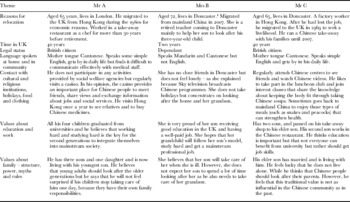
The culturagram is an assessment tool that was developed by the American social work researcher, Elaine Congress, to improve practitioners' understanding and ability to empower culturally diverse families (Congress Reference Congress1994). Congress has discussed the abstract principles that underlie the tool, its advantages and components (e.g. Congress Reference Congress1994, Reference Congress and Congress1997, Reference Congress2004; Congress and Brownell Reference Congress, Brownell and Roberts2007). The culturagram has ten components or topics for investigation: reasons for relocation; legal status; time in community; language spoken at home and in the community; health beliefs; impact of trauma and crisis events; contact with cultural and religious institutions, holidays, food and clothing; oppression, discrimination, bias, and racism; values about education and work; and values about family structure.Footnote 3 To collect information about these ten items, practitioners are encouraged to design specific questions themselves. For example, for obtaining information about the reasons why immigrants go to the United States of America (US), it is suggested that practitioners consider asking these two questions: ‘What brought you to the US?’ ‘Why did you decide to leave (country of origin)?’ For obtaining information about the values held by immigrants about family structure, it is suggested that practitioners ask them this question: ‘Do you believe that the man should be the family breadwinner?’Footnote 4
There are four important advantages of describing a cultural group using the culturagram. Firstly, it helps practitioners to understand and to specify the differences among individuals and families from similar racial and ethnic backgrounds, which discourages over-generalisations of racial or ethnic-group characteristics (Congress and Kung Reference Congress, Kung, Congress and Gonzalez2005). Secondly, the culturagram makes practitioners understand that culture can be manifest in different aspects of life, such as patterns of social and inter-personal relationships, habits of thinking and religious ideals (Congress Reference Congress and Congress1997). Thirdly, the culturagram helps practitioners identify specific areas for intervention. For example, analysts have used the culturagram to assess issues of elder abuse, battered women and patients (Brownell Reference Brownell1997; Congress Reference Congress2004; Congress and Brownell Reference Congress, Brownell and Roberts2007). Fourthly, the culturagram can be applied to the assessment of both individuals and families. As Congress explained, ‘completing the culturagram with an immigrant family helps each member to see his or her own story of transition and relocation as unique and worthwhile’ (1997: 14). Given these advantages, health-care practitioners find it advantageous to use the culturagram to understand people's views on the merits and demerits of different health services, the resources available for them to promote their health, the division of responsibilities in meeting the health needs of different members of the family, and how they promote their health through international contacts.
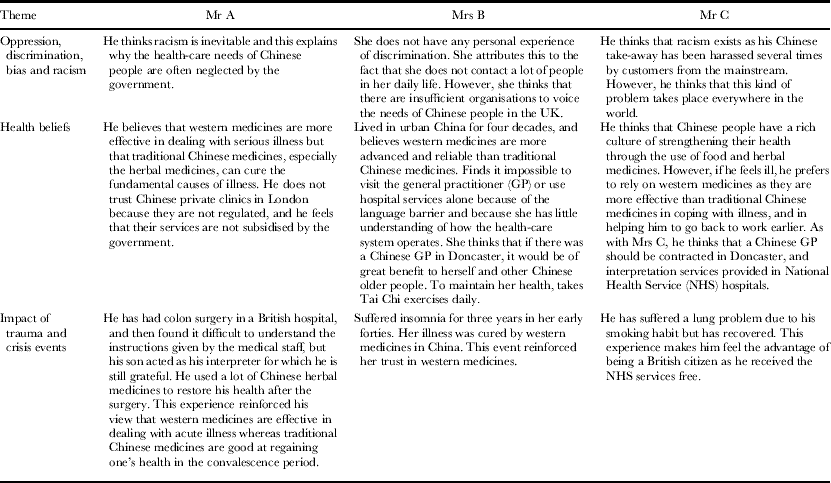
Three individual case studies exemplify the use of the tool and the kinds of information it compiles. Mr A migrated to the UK from Hong Kong during the 1960s, worked in catering and now lives in London (Table 1). He can speak basic English but finds it difficult to communicate well with medical staff. Mrs B migrated in her late sixties from mainland China to Doncaster, an industrial town in northern England, principally to help look after her three-year-old grandson. She speaks no English. Mr C migrated to the UK in 1969, worked in the catering trade in Doncaster, and speaks only simple English. Mr A and Mr C are accustomed to using both western medicines and TCM to promote health, whereas Mrs B (although until recently living in China) prefers to use only western medicine (Table 2). To reduce the risk of being exploited by Chinese-medicine practitioners, Mr A argues that the UK government should regulate the practitioners of Chinese medicine and the quality of their services, and that Chinese medicine services should be financially supported by the government (or general taxation) in the same way as NHS services. Mrs B and Mr C similarly apply the principle of ‘equal treatment’ in arguing that a Chinese GP should be contracted in Doncaster, and interpretation services provided in NHS hospitals. The three Chinese older people have their own distinctive ways of promoting their health. Mr A goes to Hong Kong regularly to buy Chinese medicines, while Mr C from time to time goes to mainland China to enjoy health-enhancing meals – note that both strategies involve multi-national contacts. Mrs B knows how to practise Tai Chi and tries to strengthen her health by doing this exercise. The families of all three individuals play an important role in providing care to their members. Mr A lives with his son, and when he was in hospital for colon surgery, his son acted as his interpreter. Mrs B looks after her grandson. Mr C is taken care of by his elder son. However, neither Mr A nor Mrs B would be surprised if their families could not look after them. Mr C thinks that traditional Chinese values are no longer as influential in the Chinese community as in the past.
Seven themes of the culturagram applied to three Chinese-origin UK residents

Note: 1. A medium-sized town in South Yorkshire that until the 1970s relied heavily on coal mining and railway engineering employment.
Three health-related themes of the culturagram applied to three Chinese-origin UK residents
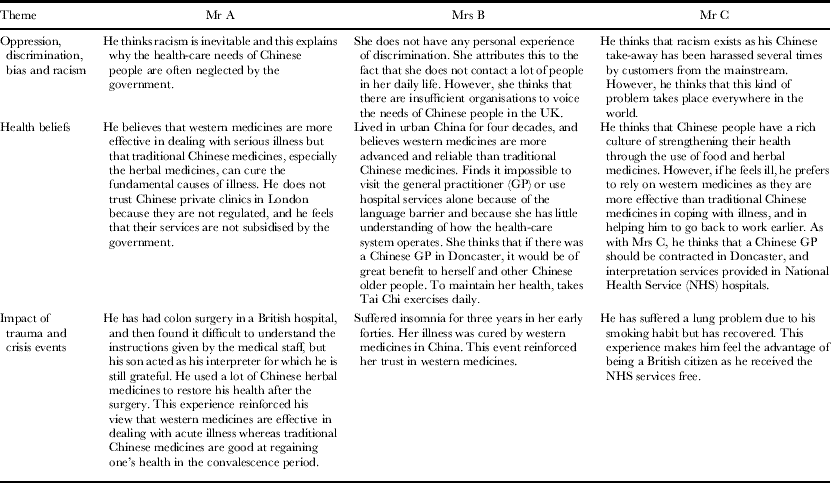
It is manifest that the culturagram rapidly identifies similarities and differences among the three Chinese older people in their support needs and health-care preferences and beliefs. While the three individuals cannot fully represent the diversity of Chinese-origin older people in the UK, even such a limited sample establishes some key dimensions of variation. For example, those Chinese older people with no legal civil status cannot access all the NHS services and have to rely on TCM and some over-the-counter medicines to cope with their illness. Secondly, those Chinese older people who master good English and believe in western medicines are likely to be more willing and able to use the mainstream health-care services, and thirdly, those older people who live alone find it more difficult to engage informal interpreters to help them use the services provided by the NHS. It would be useful to encourage Chinese older people to take an active role in making use of the culturagram to express their health needs, partly to gain a better understanding of the differences within the community.
Conclusions
This paper is a contribution to the debate on the ways in which to make British health-care services more responsive to the needs of older people who are members of recent immigrant groups. Firstly, it has shown that Chinese older people prefer diverse strategies to strengthen their health; secondly, it has demonstrated how this diversity arises from the heterogeneity of the Chinese community, from the sophisticated responses to western medicines by the Chinese state and people during the Qing dynasty and in the People's Republic of China; and thirdly, it has discussed the methods for making health-care services more sensitive to the diverse needs of Chinese older people with the focus on the culturagram. It is important to stress that finding ways to make health-care services sensitive to the diverse needs of ethnic-minority groups in general, and the diverse needs of Chinese older people in particular, involves more than documenting their health-care needs. It serves to draw readers' attention to the principles that health-care services should be made user-centred and needs-oriented. Hence, in designing and implementing actions to increase the sensitivity of health-care services to the needs of Chinese older people, we should bear two factors in mind. Firstly, the type and degree of diversity of health care needs of Chinese older people is always changing. Hence, it is necessary to continue modifying the types and supply of health-care services in response to changing needs. Secondly, we should continue to improve the methods for promoting favourable conditions for the provision of health-care services.
Acknowledgements
The authors would like to thank the helpful and critical comments made by the editor and reviewers on the earlier drafts of this article.