INTRODUCTION
Headdresses are used universally as visual indicators or markers of rank in religious, sociopolitical, and military hierarchies. A level of, sometimes extreme, intricacy is thus found in the decoration, adornments, and symbolism of military headdresses, hats, and helmets in the Western world. Similarly, we have rich evidence of the importance of headdresses in the Amerindian world in societies of varying degrees of complexity and organization from the cultures of the North American Great Plains to the South American lowlands (Paterek Reference Paterek1996; Schoept and Monnier Reference Schoept and Monnier1985). In Mesoamerica, representations of headdresses abound in the archaeological record, from the Olmec to the Maya, the Zapotec, and the Aztec (Vela Reference Vela2016). As Olko (Reference Olko2014:70) shows in her thorough documentation and discussion of Aztec elite apparel and insignia of rank, “[o]ne can truly speak of an elaborate symbolic code or language regulating the use of specific head adornments that conveyed different messages about the rank and status of their wearers.” In this paper, we examine Teotihuacan headdresses, with the specific aim to contribute to the understanding of the sociopolitical organization of the Classic-period metropolis of central Mexico. Needless to say, this is a topic that has already been the subject of investigations by other scholars, among them Séjourné (Reference Séjourné1996b), Millon (Reference Millon and Berrin1988), Taube (Reference Taube2000a, Reference Taube, Boone and Urton2011), Paulinyi (Reference Paulinyi2001), and Conides and Barbour (Reference Conides, Barbour and Gallut2002), and we shall return to several of these important studies in the following. An even greater amount of research has been undertaken on Classic Maya headdresses, and in certain cases we benefit from the insights that have been achieved in this field, for example when it comes ritual investitures of headdresses and the power and privileges associated with each station (Helmke Reference Helmke2010; Proskouriakoff Reference Proskouriakoff1950:46–58; Schele and Miller Reference Schele and Miller1986:67–69, 103–131; Tuszyńska Reference Tuszyńska2016; Van Stone Reference Van Stone1996). In terms of an attempt to interpret headdresses at Teotihuacan, however, we opt for a diachronic rather than a synchronic approach. Thus, as we know that the central Mexican cultures of the Early to Late Postclassic periods inherited and continued a number of practices and beliefs from their Epiclassic and Classic cultural forebears in the central Mexican highlands, we begin by reviewing the sociopolitical significance of one specific headdress in Late Postclassic Mexica culture.
THE ROYAL TURQUOISE HEADBAND OF THE MEXICA
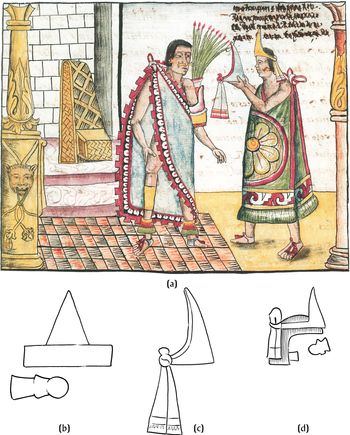
In her recent book Insignia of Rank in the Nahua World, Olko (Reference Olko2014:33) notes that “[a]mong the highest-ranking status objects were head adornments made of a huge variety of materials.” Among the many headdresses she discusses, it is the ruler's diadem, the well-known xiuhhuitzolli, “something pointed turquoise” (Siméon [Reference Siméon1977:770] provides the gloss “corona, mitra, diadema adornada con piedras preciosas”), to which we shall pay particular attention for reasons that will become clear further on. During elaborate investiture and coronation rituals, the new Aztec huey tlatoani would receive this relatively simple headband (Figure 2). The symbolic meaning of the headdress is closely related to fire, and its embodiment as the Xiuhcoatl, “fire serpent,” and the deity Xiuhtecuhtli, or “Lord of the Year.” It can be traced back to the Early Postclassic Toltec, and, as we shall see, it is likely to have had its origin in Classic-period Teotihuacan. The pointed shape of the front of the diadem is reminiscent of the way in which the Aztec depicted sunrays, as noted more than a century ago by Paso y Troncoso (Gamio Reference Gamio1922:vol. II, p. 285), possibly indicative of a relationship between the power of the fiery sun and the ruler. The term xiuhitl, however, not only means “turquoise” in Nawatl, the substance from which these headdresses were characteristically fashioned in the Postclassic, but also “year” (Molina Reference Molina2001:159v; Siméon Reference Siméon1977:770–771), and this is precisely why the turquoise diadem also alludes to the yearly cycle of the sun and its life-giving powers. In fact, the original meaning and symbolism of this headdress may have been primarily tied to solar and temporal symbolism, only later to be adorned with the homonymous turquoise, the namesake of this crown (Taube Reference Taube, King, Carocci, Cartwright, McEwan and Stacey2012; Thibodeau et al. Reference Thibodeau, Luján, Killick, Berdan and Ruiz2018). This is an observation that we will return to later in this paper since it is relevant to our understanding of Teotihuacan headdresses. Olko (Reference Olko2014:41) observes that, although most commonly worn by the huey tlatoani, the xiuhhuitzolli could also appear with delegates of “royal power in military and legal domains,” thus undoubtedly serving to indicate their acting on behalf of, or as an extension of, the ruler and the power and authority of the royal house. This suggestion is important, since we also have evidence to suggest that individuals wearing headdresses embodying and representing the power of institutions at Teotihuacan travelled far and wide in Mesoamerica in the Classic period (Nielsen and Helmke Reference Nielsen and Helmke2014; Nielsen et al. Reference Nielsen, Helmke, Fenoglio and Saint-Charles Zetina2019a; Taube Reference Taube, Boone and Urton2011). We will return to the possible Classic-period predecessor to the xiuhhuitzolli in the second half of the paper.
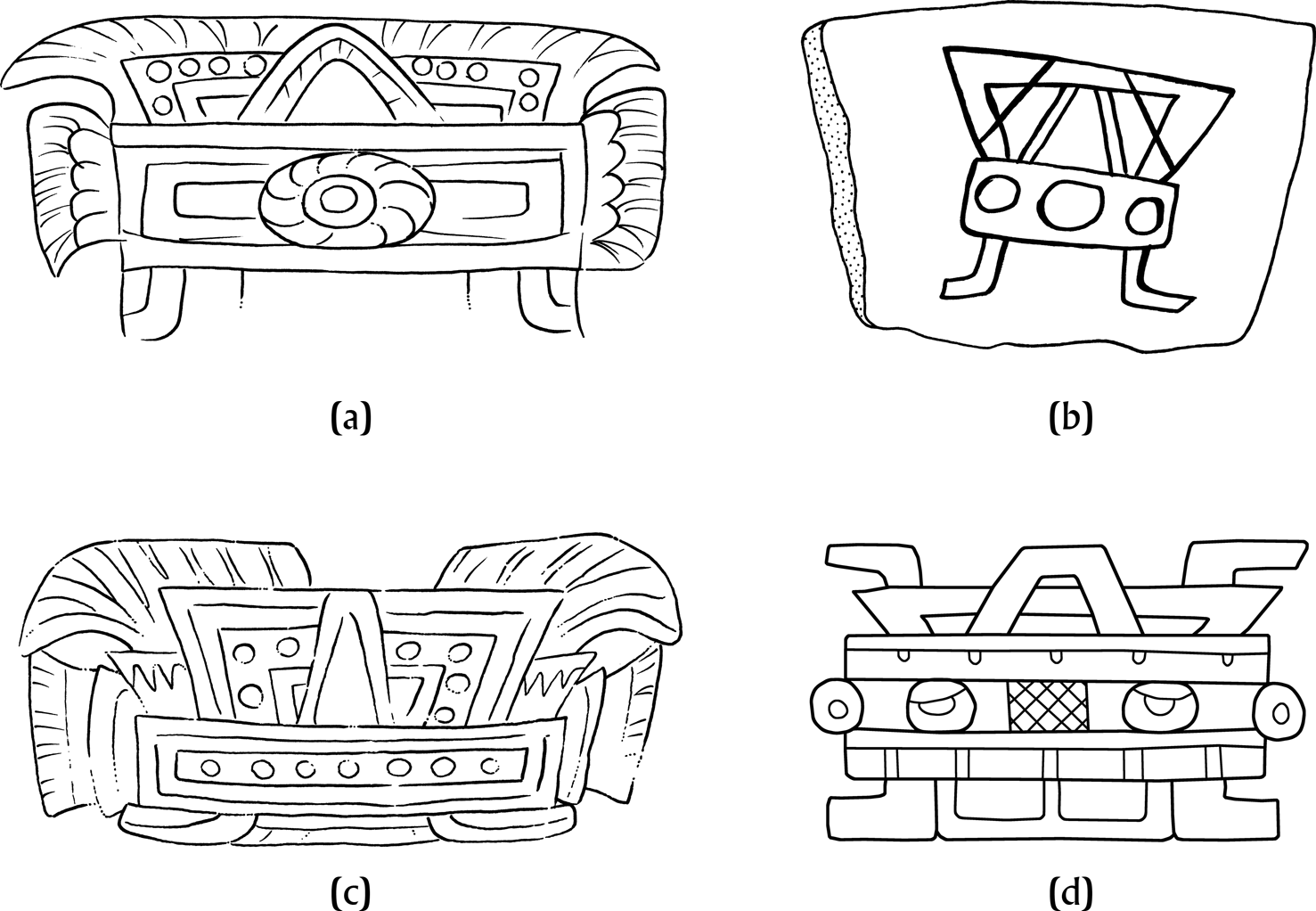
A selection of elementary year sign headdresses: (a) Teotihuacan vessel (after Séjourné Reference Séjourné1966a:104, Figure 86i); (b) incised sherd (after Séjourné Reference Séjourné1966a: 156, Figure 138d); (c) painted and stuccoed vessel in the collections of the Los Angeles County Museum of Art; and (d) polychrome bowl found at Tikal (after Culbert Reference Culbert1993:Figures 64c2). Drawings by Helmke.

Examples of the Mexica xiuhhuitzolli. (a) The coronation of Moctezuma as depicted in the Historia de las Indias de Nueva España e islas de tierra firme. © Biblioteca Nacional de España. (b) Detail of the Codex Borbonicus (Reference Codex Borbonicus1974:f. 10) showing a frontal depiction of the headdress and the nose ornament. (c) Detail of the Historia de las Indias (after Matos Moctezuma Reference Matos Moctezuma, McEwan and López Luján2009:Figure 13). (d) The name glyph of Moctezuma, written with the xiuhhuitzolli, replete with complete set of hair and nose plug in the Codex Mendoza (Berdan and Anawalt Reference Berdan and Anawalt1993:vol. III, p. 38). Drawings by Helmke.

TEOTIHUACAN: A SOCIAL HIERARCHY EXPRESSED THROUGH HEADDRESSES
At Teotihuacan, as elsewhere in Mesoamerica, when researchers use the term “headdress,” it refers to a wide range of shapes and types made especially of wood, cloth, feathers, paper, and other types of perishable material. Headdresses were worn by members of all walks of life in ancient Teotihuacan, as evidenced by ceramic figurines and murals such as those from Templo de la Agricultura and Tepantitla, as well as by deities and supernatural beings (Conides and Barbour Reference Conides, Barbour and Gallut2002; de la Fuente Reference de la Fuente and de la Fuente1995a; Garcia-Des-Lauriers Reference Garcia-des-Lauriers2000:103–147; Miller Reference Miller1973; Scott Reference Scott2001; Séjourné Reference Séjourné1966a, Reference Séjourné1996b; Taube Reference Taube2000a; von Winning Reference von Winning1987). Séjourné’s (Reference Séjourné1996b:55–79) work constitutes a wonderful collection of depictions of headdresses, as well as a fascinating attempt to assemble possible remains of different headdresses based on her study of figurines.
One of the most well-known Teotihuacan headdresses is the so-called Tassel Headdress, which has been discussed by several authors, among them Paulinyi (Reference Paulinyi2001) and, of course, in the seminal work by Millon (Reference Millon1973, Reference Millon and Berrin1988; see also Garcia-des-Lauriers Reference Garcia-des-Lauriers2000:105–113; von Winning Reference von Winning1987:vol. II, pp. 53–55, Figures 1–3). While we will not delve into previous analyses of this particular headdress, we think Millon (Reference Millon1973:305) was entirely right in suggesting that it was “associated with a social group of high rank from the city which…was involved in foreign relations, possibly on a diplomatic level.” The Tassel Headdress was thus frequently worn by Teotihuacanos represented outside the great metropolis, for example in the Maya area and at Zapotec Monte Albán, strongly suggesting its association with high-ranking representatives of the Teotihuacan state apparatus (Millon Reference Millon and Berrin1988; Taube Reference Taube, Boone and Urton2011). The procession depicted in the Techinantitla murals further suggest that different individuals could carry this title simultaneously, each distinguished, named, and qualified by the glyphic compound in front of them (Millon Reference Millon and Berrin1988:119–121; Taube Reference Taube2000a:10–12). As for the varying degree of complexity with which the headdress was represented, Paulinyi's (Reference Paulinyi2001:24–26) hypothesis aside, we do not see sufficient evidence that the number of tassels served to indicate an internal ranking among the wearers. In fact, as demonstrated by Millon, when represented in writing, the Tassel Headdress is abbreviated to its single identifying attribute— the tassel—and in no instance does the principle of pars pro toto involve multiple tassels or a numerically significant combination of these (Helmke and Nielsen Reference Helmke, Nielsen and García2019a). As such, we must conclude that the number of tassels is not relevant to the signification embodied in the headdress, nor its representations in the visual arts.
At times, the tassels are combined with droplets, presumably blood drops, which may in turn link the Tassel Headdress and its significance to another type of headdress displaying a row of bleeding human hearts. Magnificent examples of this headdress appear in the Teotihuacan-style murals from El Rosario in Querétaro. Worn by warriors seemingly impersonating the Storm God, the headdresses also display impressive eagle feathers (Nielsen et al. Reference Nielsen, Helmke, Fenoglio and Saint-Charles Zetina2019a).
Another kind of headdress that is associated with Teotihuacan culture, and specifically the martial superiority of the Teotihuacan army and its warriors, is the shell-platelet headdress or helmet (Garcia-des-Lauriers Reference Garcia-des-Lauriers2000:114–124; Stuart et al. Reference Stuart, Carrasco, Jones and Sessions2000; Taube Reference Taube1992). From the Calpulalpan Bowl we know that individuals wearing the shell-platelet headdress could be further distinguished or named, and that the wearers stood in some kind of hierarchical relationship with those wearing the Tassel Headdress (Millon Reference Millon1973; Taube Reference Taube2000a:10–12). Taube (Reference Taube1992) has suggested that the headdress was associated with the War Serpent, although at times it also exhibits feline features, and that it was later appropriated by those Mesoamerican cultures that very directly experienced the might of Teotihuacan (Nielsen Reference Nielsen2003; Stone Reference Stone, Diehl and Berlo1989). It thus became quite widespread in the Maya lowlands in the Late and Terminal Classic periods. When mentioned in the glyphic texts of the Maya, the shell-platelet headdress is named ko'haw, ostensibly a loanword that was ultimately preserved in Colonial Tzotzil as <kovov> (Nielsen and Helmke Reference Nielsen and Helmke2011:347–348). These few ephemeral linguistic glimpses demonstrate the importance of this particular item of material culture and the significant material import of Teotihuacan on Maya culture and language.
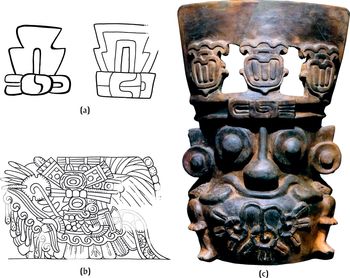
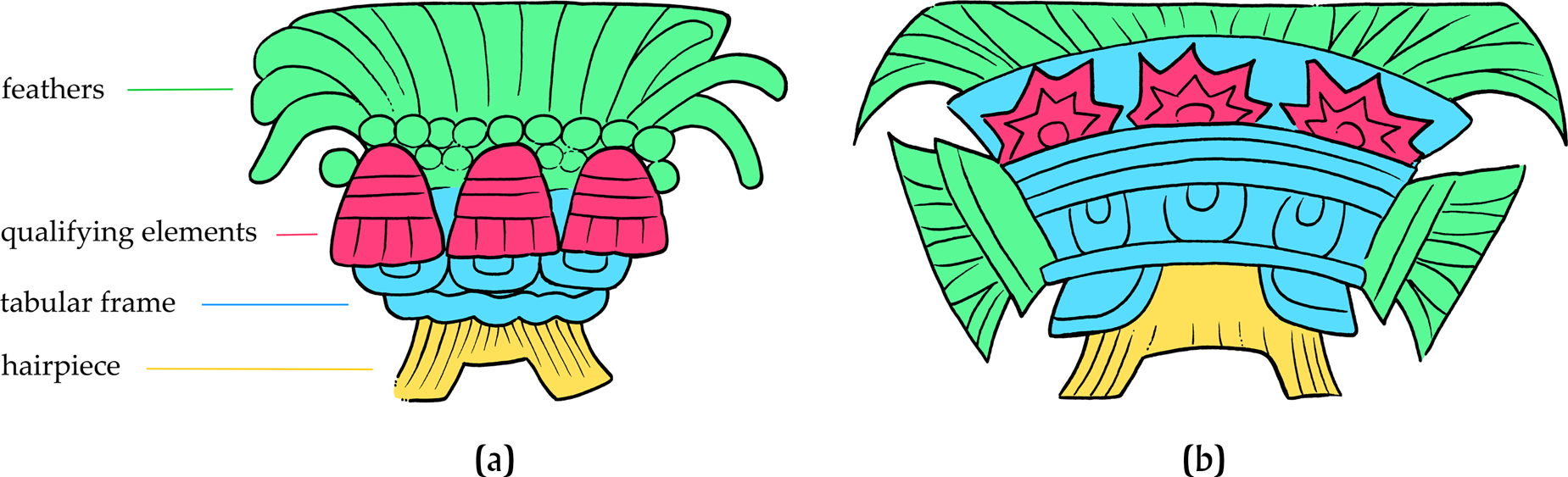
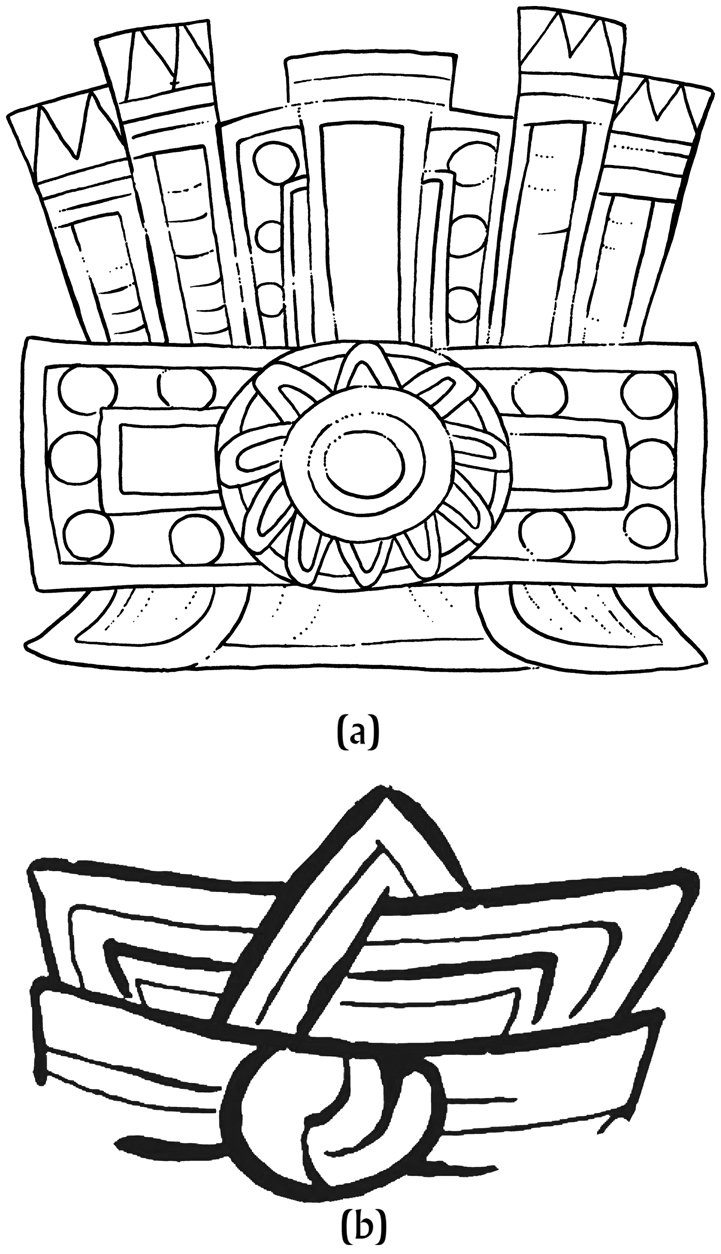
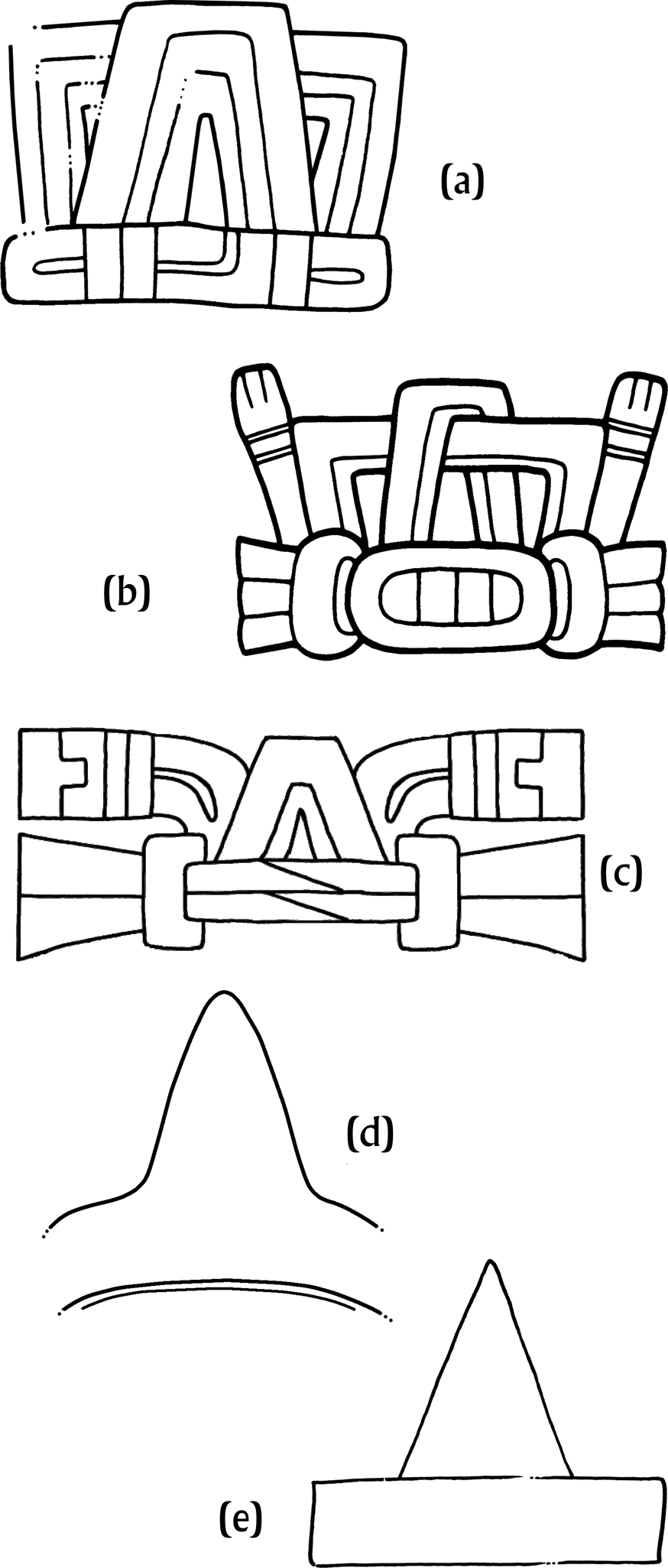
In addition to those already discussed, a fairly common category of Teotihuacan headdresses are those that are marked by a knotted element, either of cloth or bark paper, bound on the forehead, in contrast to the Aztec diadems which are typically bound at the back of the head (Figure 3; Stuart Reference Stuart2015). Above the knotted element appears whatever element or object that qualifies the headdress and its wearer, for example the “almena” headdress involving an architectural merlon, (Figure 3a; also labelled the “Xi” glyph by earlier scholars [Caso Reference Caso1967:174–175]), and those worn by the Storm God (Figure 3b), on one occasion marked by flowering squashes (Figure 3c) and a large circular mirror in yet another instance (for additional examples, see Cabrera Castro Reference Cabrera Castro and de la Fuente1995a:131–132, Figures 14–14.2; López Luján et al. Reference López Luján, Neff, Sugiyama, Carrasco, Jones and Sessions2000). Another element found in combination with the knotted headband is the Year Sign, which we shall discuss in detail later. However, we also see the Year Sign qualifying a different and more elaborate type of headdress. This is a relatively common headdress at Teotihuacan and, though qualified by different elements or objects, all examples share some generic properties, namely a tabular frame, often with a circular mirror at the front, and a hairpiece or wig attached below (Figure 4). Good examples are the Tassel Headdress on the Calpulalpan bowl as already mentioned, or the Star Headdress from a stuccoed and painted tripod in the Museo Nacional de Antropología. As for the hairpiece, it remains unclear as to what material they were made of, but these were very likely of paper, as we know that the Aztec used imitation paper hair in headgear known as tzoncalli, “wig,” and ihuitzoncalli, “feather wig,” (Olko Reference Olko2014:68–69). The sources also refer to xiuhtzontli, “turquoise hair,” and teuctzontli, “lordly hair,” and both were equated with rulership—and it is telling that the name of Moctezuma is frequently represented by the turquoise diadem and the hairpiece as though the hairpiece was an integral part of the headdress (Figure 2d). It is worth noting that wigs were also in use in ancient Egypt (Fletcher Reference Fletcher2002; Tassie Reference Tassie2008), and that wigs formed an essential part of the repertoire of markers of rank and social status in seventeenth- and eighteenth-century Europe and continues to do so in a few conservative circles such as the courts of Britain and the Commonwealth (Kwass Reference Kwass2006; McLaren Reference McLaren1999). As for the qualifying elements placed atop the tabular frame, they range from the Year Sign, tassels and stars to bleeding hearts and the heads of raptorial animals, including birds, felines, and canines (Cabrera Castro Reference Cabrera Castro and de la Fuente1995b; de la Fuente Reference de la Fuente and de la Fuente1995b:119).
Teotihuacan headdresses with bound knots at the front. (a) A selection of headdresses qualified by almenas. Drawings by Helmke. (b) The Storm God wearing a mirror headdress. Photograph by Mario Carrieri after Berrin and Pasztory (Reference Berrin and Pasztory1993:240). (c) The Storm God wearing a headdress of flowering squash blossoms. Drawing by Nicolas Latsanopoulos after Nielsen and Helmke (Reference Nielsen, Helmke and Robb2017a:Figure 18.3).

Teotihuacan (a) Tassel and (b) Star headdresses with their characteristic features marked and segregated. Drawings by Helmke.

It thus appears that ancient Teotihuacan scribes and artists could choose between different ways of representing headdresses with similar meanings: the “abbreviated” and more simple written version that combines the knotted band— quite likely a logogram for “headband”—with one or more qualifying elements, and a more complex, iconographic, and perhaps more naturalistic version of the actual headdress in all of its splendor (Figure 5).
Two different ways of representing Teotihuacan headdresses in writing, both qualified by the Year Sign: (a) full elaborate and naturalistic representation, and (b) abbreviated version with possible logogram for “headdress” (knotted band) combined with its qualifying element above. Drawings by Helmke.

THE ORIGINS AND TRANSFERRAL OF HEADDRESSES
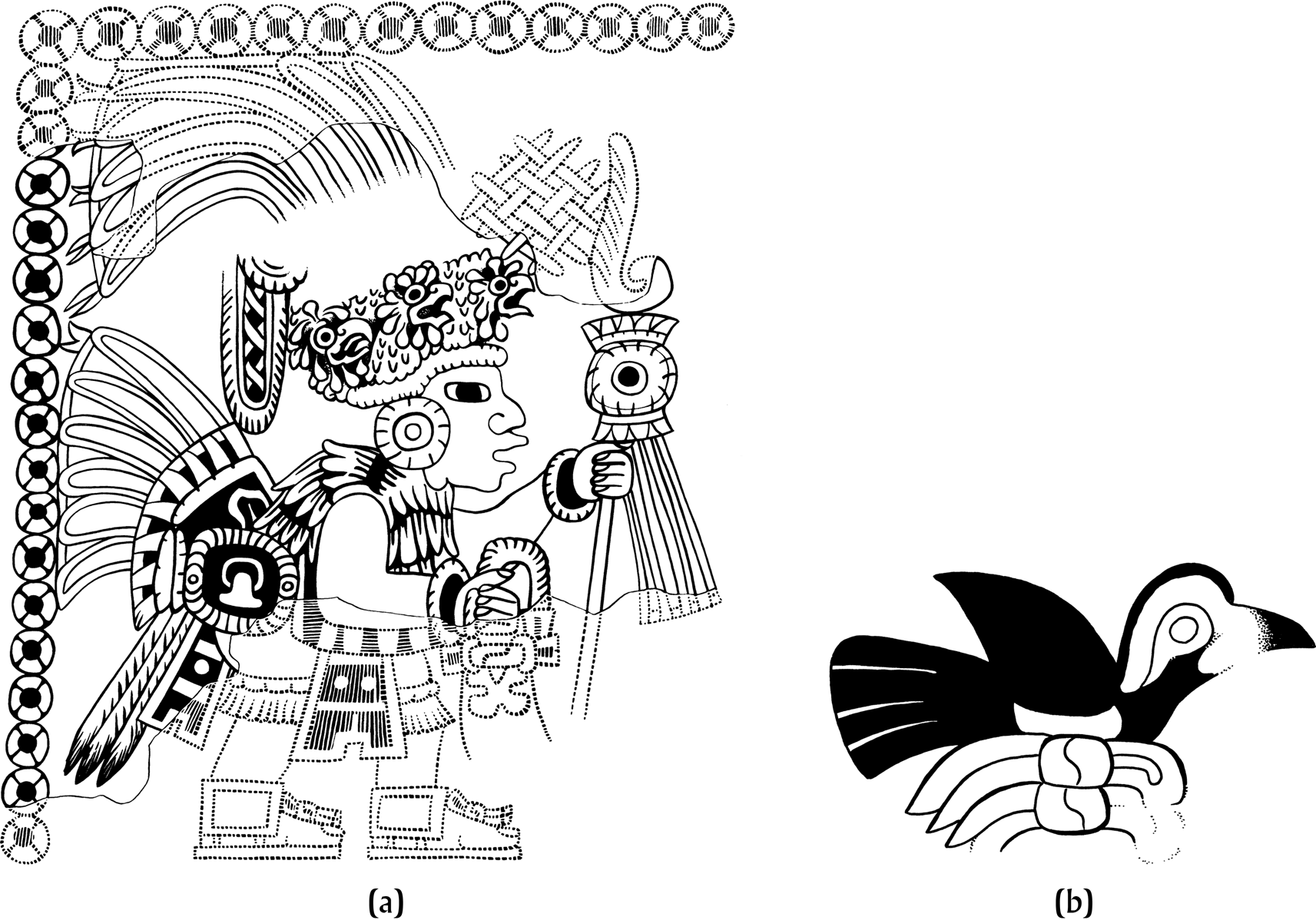
While it is impossible to account for the development and origins of all the many types of headdresses, there are some intriguing clues as to the mythic origins that the Teotihuacanos themselves attributed to a few of them. Thus, the rare headdress composed of several bird heads, worn by a staff-carrying individual in a mural from Zona 11, may be related to a widespread pan-Mesoamerican myth about two heroic mythic figures that succeeded in slaying a polycephalous giant bird as part of a series of cosmogonic events (Helmke and Nielsen Reference Helmke and Nielsen2015; Nielsen and Helmke Reference Nielsen and Helmke2015). Just as Maya rulers wore the head of this Great Celestial Bird (also known as the Principal Bird Deity, an analogous creature to the monstrous Wuqub Kaqix of the Popol Wuj), so too did Teotihuacan rulers wear this prestigious headdress as they were invested into office (Figure 6a; Nielsen and Helmke Reference Nielsen and Helmke2015:34–35). At Totometla, the murals depict a bird atop the knotted or bound signs, providing a glyphic record to the same prominent headdress that evidently was known as a “bird headdress” (Figure 6b).
Possible variants of the same “bird headdress” as depicted: (a) worn by a high-ranking individual with staff in Mural 2, Room 2 of Zone 2 at Teotihuacan (drawing by Felipe Dávalos after Nielsen and Helmke [Reference Nielsen and Helmke2015:Figure 20b]) and (b) in its glyphic form from the murals at Totometla (drawing by Helmke after Juárez Osnaya and Ávila Rivera [Reference Juárez Osnaya, Ávila Rivera and de la Fuente1995:Lámina 18]).

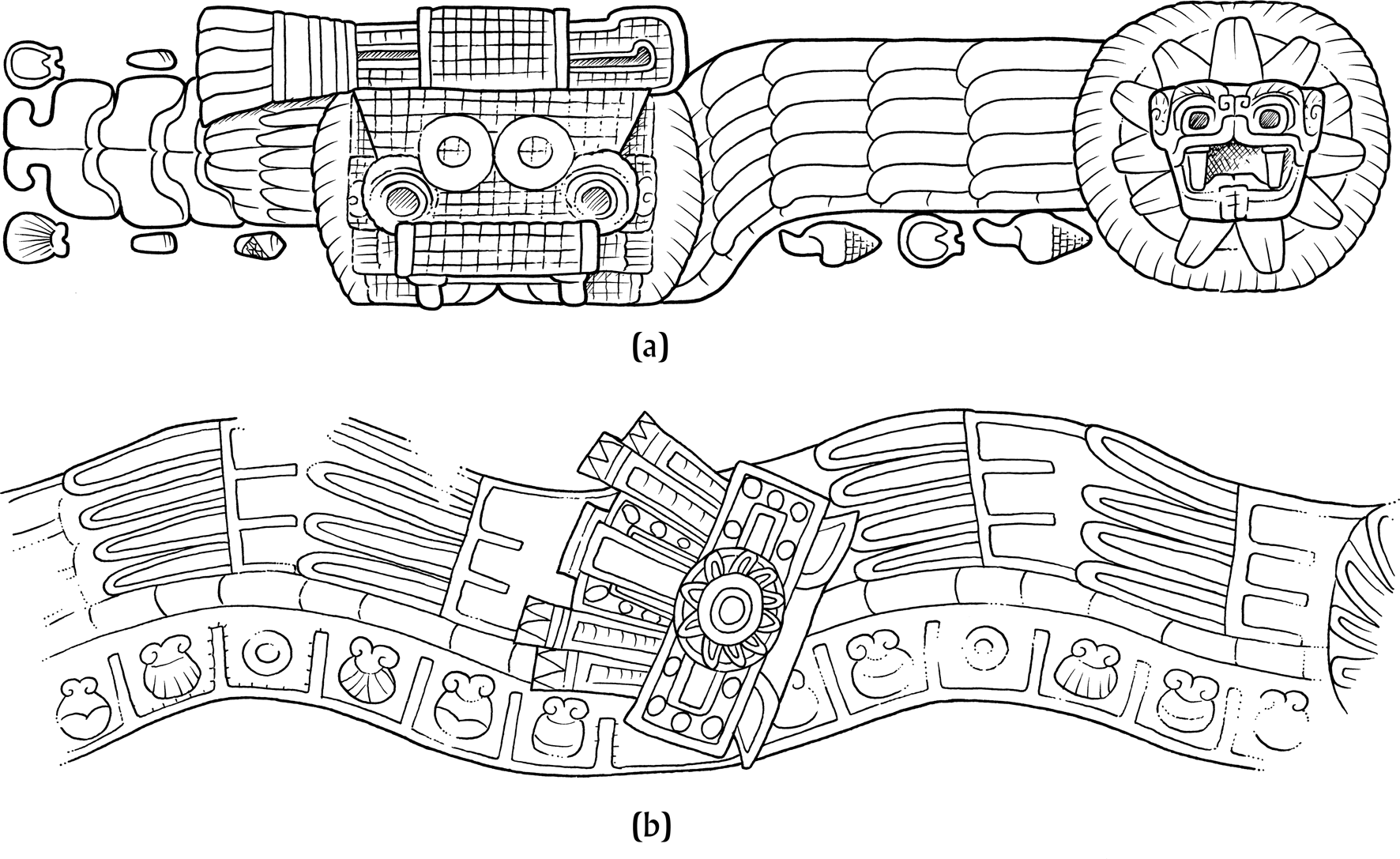
The reliefs and sculptures of the façade of the Pyramid of the Feathered Serpent show the Feathered Serpent slithering across the waves of a primordial watery environment marked with pallid sea shells, bivalves, and conches, and carrying forth the aforementioned shell-platelet headdress on its back (Figure 7a; López Austin et al. Reference López Austin, Luján and Sugiyama1991; Taube Reference Taube1992). Similarly, in the murals of Zacuala, an undulating feathered serpent supports a headdress with the Year Sign and torches on its back, as it too writhes across an aquatic environment, framed by a row of sea shells denoting the watery deep (Figure 7b; de la Fuente Reference de la Fuente and de la Fuente1995b:334–337). These two, surviving examples hint at a much wider set of mythic narratives recounting how important headdresses, and the offices they symbolize, were brought forth by these supernatural serpentine creatures (Helmke and Nielsen Reference Helmke, Nielsen and Robb2017:133). Given their contexts and the association of these scenes with the primordial sea, we can see that these tales provide a mythic backdrop for the origin and subsequent acquisition of these headdresses and their eventual integration into human society and social structure.
Headdresses carried on the back of the Feathered Serpent: (a) shell-platelet headdress from the Pyramid of the Feathered Serpent and (b) Year Sign headdress from Zacuala. Drawings by Helmke after Helmke and Nielsen (Reference Helmke, Nielsen and Robb2017:Figure 17.3).

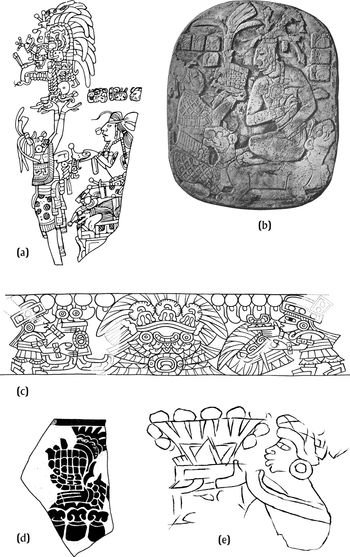
From Maya as well as Aztec sources, we know of the elaborate rituals and ceremonies that surrounded the transferal of power, including royal investitures (Helmke Reference Helmke2010; Townsend Reference Townsend and Boone1987). For instance, an engraved bone depicts a young Maya figure on his throne, being presented a headdress fashioned from the head of the Great Celestial Bird (Figure 8a; Nielsen and Helmke Reference Nielsen and Helmke2015:8–9, Figure 4). The glyphs accompanying this scene provide us with the exact verbal expression used to describe such coronation ceremonies, namely k'ahlaj usak huun, “tied is the white headband” (Schele et al. Reference Schele, Mathews and Lounsbury1990; Zender Reference Zender2016). Salient examples of comparable coronation scenes include the Bonampak Panel that illustrates the presentation of a huun, or paper headband crown, to the new ruler (Schele and Miller Reference Schele and Miller1986:116, Figure II.8; Stuart Reference Stuart2012:123), and a comparable scene is found on the Oval Palace Tablet at Palenque, which shows a seated Ixsak K'uk’ handing a headdress to her son, K'inich Janaab Pakal (Figure 8b; Schele and Miller Reference Schele and Miller1986:114, Figure II.5). In the Palenque case, it is not the headband, but a Maya version of the Teotihuacan shell-platelet headdress (which Schele somewhat humorously called the “drum major” headdress on account of its form). Another example of the ceremonial presentation of a mask and other paraphernalia is seen on a looted panel from a site in Tabasco or Chiapas. In this case, the objects presented and to be transferred are related to the Storm God and thus once more derived from the regalia and practices of Teotihuacan (Stuart et al. Reference Stuart, Carrasco, Jones and Sessions2000:503–505, Figure 15.29).
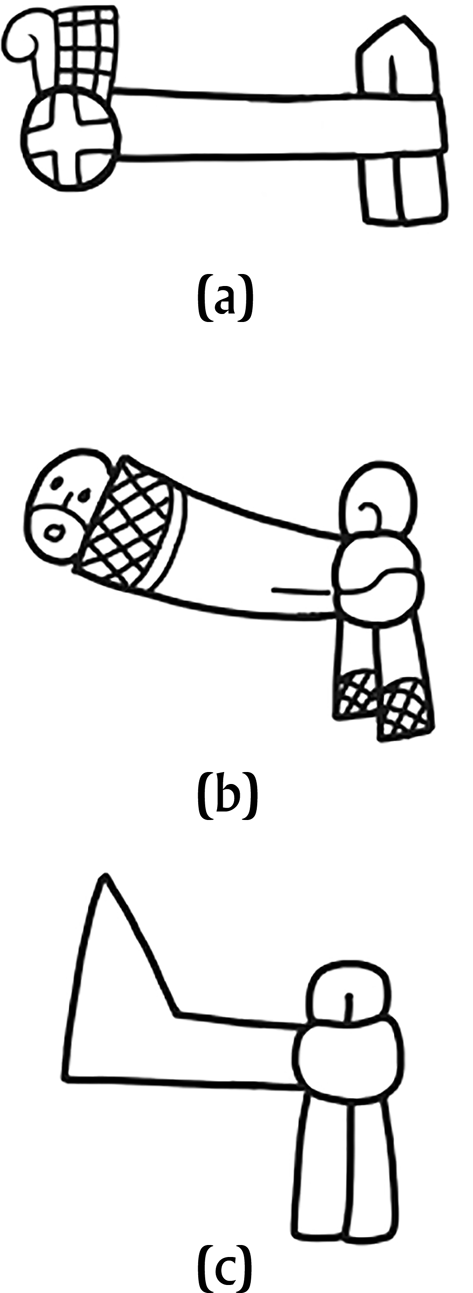
Transferals of headdresses in Classic Maya and Teotihuacan iconography: (a) coronation scene on the Dallas Bone (drawing by Linda Schele, courtesy of the Los Angeles County Museum of Art); (b) the Oval Tablet at Palenque (after Lothrop Reference Lothrop1929:Plate 1b); (c) detail of roll-out drawing of stuccoed and painted Teotihuacan tripod vessel showing individuals transferring ear flares, mirror, nose bar, and headdress to a bundle representing the Storm God (drawing by Nicolas Latsanopoulos); (d) incised sherd in the ex-Hasso von Winning collection (after von Winning Reference von Winning1981:Figure 5b); and (e) incised bowl from La Ventilla, Teotihuacan (drawing by Helmke).

Significantly, there are important examples of similar practices of transferals or investitures in the iconography of Teotihuacan that have been overlooked for the most part. A stuccoed and painted tripod shows human individuals walking away from two silhouetted Storm Gods, holding different objects that can all be identified as defining attributes of the deity: a nose bar with fangs, an object composed of feathers (presumably a headdress), large earspools, and a back-mirror (Figure 8c; Nielsen and Helmke Reference Nielsen, Helmke and Robb2017a:141, Figure 18.3). The human figures march toward a bundle or armor stand of the Storm God composed of the very same attributes: a large headdress, earspools, nose bar, and mirror. It is as if we are shown how these objects originally derived from the Storm God himself. Donning these items would presumably allow the wearers to establish a close connection to the deity, if not even embody attributes of the very Storm God itself. Even more to the point, is an incised ceramic sherd published by von Winning (Reference von Winning1987:vol. I, p. 80, Figures 4j–4I) showing a hand holding forth a shell-platelet helmet, as well as a necklace of sea shells, which are often worn by Teotihuacan warriors (Figure 8d; Sugiyama Reference Sugiyama2005:168–170). Finally, an incised scene inside a bowl from La Ventilla depicts a female figure presenting a headdress, composed of the tabular frame, artificial hair, a spray of feathers, and with the Year Sign as its distinctive qualifying element (Figure 8e). Evidently, headdresses along with other kinds of adornments and paraphernalia played a symbolic and concrete central role in the passing on of power and privileges in Teotihuacan, just as they did elsewhere in ancient Mesoamerica.
HEADDRESSES AND HOUSES
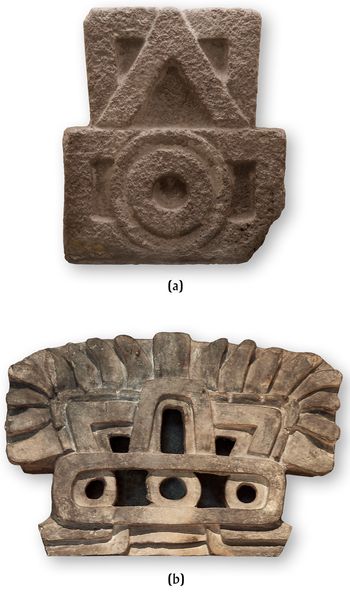
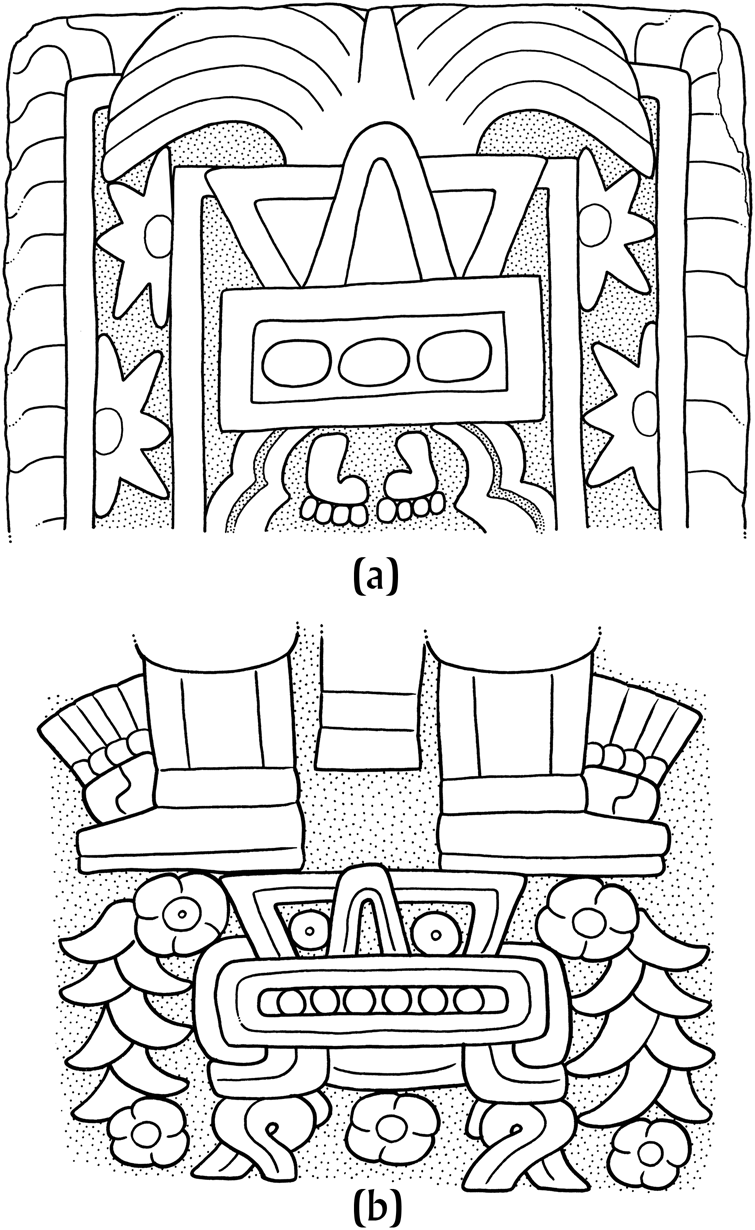
Building on earlier work, we note that headdresses can appear in combination with particular structures, depicted as houses, but often referring specifically to ritual structures, or temples (Conides and Barbour Reference Conides, Barbour and Gallut2002; Nielsen and Helmke Reference Nielsen and Helmke2014:118–121). In these cases, the headdress and the particular structure are often marked by one and the same qualifying elements, and a good example is the Star Headdress rendered on a stuccoed and painted tripod in the Museo Nacional de Antropología that we also mentioned previously (Figure 9a). It appears together with a structure that is identified by a shield with a star. In another instance, the building is embellished with stars and a large headdress is set at the doorway (Séjourné Reference Séjourné1966a:Figure 95). Interestingly, another tripod shows the Tassel Headdress paired with a structure that is qualified by a shield and two darts, probably relating it, as well as the headdress, to warfare (Figure 9b). We may thus conclude that there is a direct relationship between the headdresses and the buildings and this leads us to suggest that headdresses, and their wearers, represent the “houses,” institutions and social groups associated with these specific structures at Teotihuacan. As Taube (Reference Taube, Boone and Urton2011:84–87) first showed and was later expanded upon by the authors, stylized houses also appear in several headdresses (Nielsen and Helmke Reference Nielsen and Helmke2014:130–133), thereby emphasizing the close connection between specific sociopolitical offices or groups and specific temples, houses, or building complexes associated with these offices. As we have also pointed out in previous research, particular almenas named the actual structures they adorned, such as the “storm god house,” “feline house,” and “bird house” (Nielsen and Helmke Reference Nielsen and Helmke2014). At the Patio de los Pilares in the Quetzalpapalotl Palace, Acosta (Reference Acosta1964:27–33) and his team excavated several almenas in the shape of the Year Sign, suggesting that the name of this complex involved this sign and was somehow related to the meaning and significance of this sign. From the West Group Plaza of the Street of the Dead Complex a nearly identical almena has been recovered, representing a simplified headdress, suggesting another structure here with a similar function (Figure 10a; Nielsen and Helmke Reference Nielsen, Helmke and Robb2017b). Drawing together all of these observations, is a set of large clay almenas, representing the full Year Sign headdress, replete with a broad spray of feathers that have been found at Atzompa, Oaxaca, suggesting a local emulation of a structure with clear reference to Teotihuacan institutions (Figure 10b; Caso and Bernal Reference Caso and Bernal1952:340, Figure 506). It is precisely to the Year Sign and its function as part of headdresses that we now turn.
Two examples of headdresses appearing in combination with stylized temples or houses: (a) star headdress, (b) tassel headdress. Drawings by Helmke after Conides and Barbour (Reference Conides, Barbour and Gallut2002:Figures 5 and 7).

Almenas in the shape of the Year Sign headdress from: (a) the West Plaza Group, Street of the Dead Complex, Teotihuacan and (b) Patio 2, Atzompa, Oaxaca. Photographs by Helmke.

THE YEAR SIGN HEADDRESS: CROWNING YEARS AND INDIVIDUALS
One of the most often discussed signs in Teotihuacan iconography and writing is the so-called Year Sign (Figure 11; also known as the “trapeze-and-ray” sign and even the Mexican Year Sign in the literature of the Maya area; Caso Reference Caso1967:144–179; Gamio Reference Gamio1922:vol. II, pp. 284–285; Heyden Reference Heyden, Cordy-Collins and Stern1977; Langley Reference Langley1986:142–153; Urcid Reference Urcid1993:144–145, Figure 9; von Winning Reference von Winning1987:vol. II, pp. 25–28, Figures 1–4). Known from Late Postclassic times among the Aztec and Mixtec, where it most frequently occurs with year-bearers (Caso Reference Caso1967:178, Figure 15), it has been suggested that the sign itself was intimately related to the calendar and possibly even was a depiction of some kind of instrument for stellar observation (Digby Reference Digby and Hammond1974). Yet the Year Sign appears in other contexts as well, for example in Aztec sculptures of the Goddess of Maize and the deity of rain and storms, Tlaloc. In the Codex Borbonicus (Reference Codex Borbonicus1974:pp. 30–31), the goddess impersonators wear enormous headdresses with Year Signs and these were known in Nawatl as meyotli, derived from the term tonameyotl, “the sun's ray or brilliance” (Heyden Reference Heyden, Cordy-Collins and Stern1977:216, Figures 18–21; glossed in Siméon Reference Siméon1977:716 as “rayo, luz, brillo del sol”). It should be noted that in, the context of the headdresses worn by the impersonators in the Codex Borbonicus, the Year Sign has retained its original form, literally unchanged since Classic times, whereas in the case of the royal diadem, the shape has been simplified and reduced to the central, pointed element. As such, the prominent triangular element of the headdress may well represent a solar ray, thereby motivating its nominal designation.
Year signs in headdresses worn by humans and supernatural entities. (a) Early Classic Teotihuacan stucco vessel representing the personification of pulque. (b) Late Classic Maya ceramic vessel with an avian figure. (c) Late Postclassic Tula stela fragment with human dignitary (after de la Fuente et al. Reference de la Fuente, Trejo and Solana1988:Figure 125). (d) Epiclassic Xochicalco stela with a Storm God. Drawings by Helmke. (e) Detail of the early Colonial Codex Borbonicus (Reference Codex Borbonicus1974:p. 30) showing a deity impersonator.

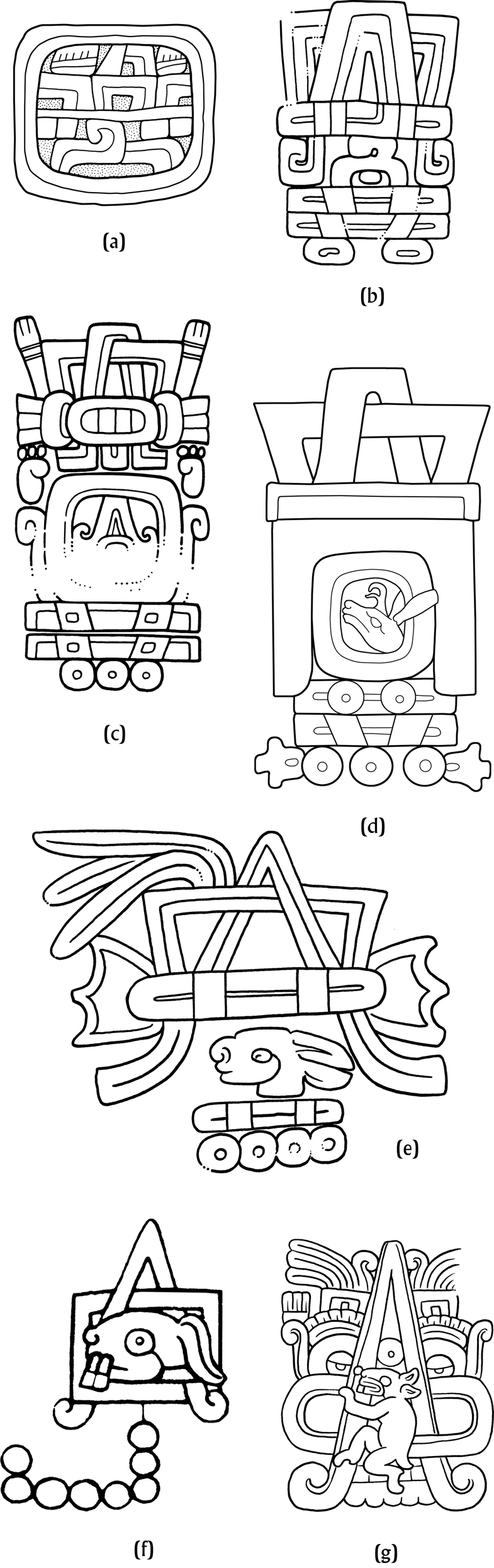
Tracing the sign back from the Late Postclassic to the Epiclassic and Classic periods, we find that the Year Sign also appears with calendrical notations and is an integral part of headdresses (Helmke and Nielsen Reference Helmke and Nielsen2011:15–17). At Tula, Cacaxtla, and Xochicalco it thus forms part of headdresses of deities and individuals of high rank (Figure 11; de la Fuente et al. Reference de la Fuente, Trejo and Solana1988; Foncerrada de Molina Reference Foncerrada de Molina1993; Smith Reference Smith and Hirth2000; Taube Reference Taube, Carrasco, Jones and Sessions2000b:276–280; Urcid Reference Urcid1993:144–145). On an Aztec stone slab, the Year Sign is marking the year “1 Rabbit” (Figure 12g), and a comparable practice is frequently encountered in the Mixtec codices, where the Year Sign also qualifies dates such as “8 Rabbit” as year-bearers (Figure 12f). Examples from the Epiclassic period includes Xochicalco Stela 2, where the date “13 Flint” is topped by the Year Sign headdress with two torches (resembling the example from Zacuala) and a large knotted element below, duplicating the Teotihuacan examples with knot signs as markers of headdresses (Figure 12c). The Year Sign occurs frequently in the writing and iconography of Xochicalco, while curiously absent from the texts of contemporary Cacaxtla, and will be subject to further analyses in a future study of the inscriptions of Xochicalco. Panel 2 of Texmilincan records the year “12 Reptile Eye” and again the knotted headband below reveals that this is, in fact, a headdress (Figure 12b). Finally, on Teotenango Stela 1, several calendrical dates are shown wearing the Year Sign headdress in a version that clearly includes a wig in each case (Figure 12d; Caso Reference Caso1967:162, Figure 19; Helmke and Nielsen Reference Helmke and Nielsen2011:15, Figure 9).
The development of the Year Sign in headdresses as part of calendrical records from Early Classic to Late Postclassic times, with examples drawn from the following places and cultures: (a) Teotihuacan (tripod vase); (b) Texmilincan (Panel 2); (c) Xochicalco (Stela 2); (d) Teotenango (Stela 1); (e) Zapotec (stone monument); (f) Mixtec (Codex Nuttall); and (g) Aztec (stone tablet). Drawings by Helmke.

Going further back in time to Teotihuacan, headdresses incorporating the Year Sign are common in mural art in Zona 3 (de la Fuente Reference de la Fuente and de la Fuente1995c:88), the White Patio in Atetelco (Cabrera Castro Reference Cabrera Castro and de la Fuente1995b: 211), and on ceramic objects (Séjourné Reference Séjourné1966a, Reference Séjourné1996b; von Winning Reference von Winning1987:vol. II, pp. 25–27, Figures 1–4). A stuccoed and painted tripod, now in the de Young Museum in San Francisco, displays a unique solar image (Nielsen and Helmke Reference Nielsen, Helmke, Tiesler and Scherer2018:Figure 4.3b). Radiating flame-like elements surround a disk, suggesting an antecedent form of the Aztec solar disk with its characteristic solar rays or darts (Nielsen and Helmke Reference Nielsen, Helmke, Tiesler and Scherer2018:79). In the center of the disk is a Year Sign and a knotted piece of cloth or paper beneath it, denoting a headband (Figure 5b; Helmke and Nielsen Reference Helmke and Nielsen2011:15, 17). The occurrence of the Year Sign headdress within the flaming solar disk suggests that the headdress may have carried meanings similar to those attributed to the Aztec xiuhhuitzolli headband as related to fire, time, and rulership. That the Year Sign headdress formed part of titles (much as the Tassel Headdress that we saw earlier) is suggested by two Teotihuacan-style vessels from Escuintla in Guatemala (Taube Reference Taube2000a:19–20, Figures 14e and 16b). Here individuals appear with a name or titular glyph in front of them that is composed of the Year Sign headdress complete with a knotted band, but also earspools and a necklace, suggesting a more complex set of adornments to accompany the headdress.
It should be noted that the Year Sign headdress also appear as part of toponyms, or place names, for example on the monument displayed at Frida Kahlo's Casa Azul and on a stela reportedly from Acatempan in Guerrero (Figure 13; Nielsen et al. Reference Nielsen, García, Guzmán, Englehardt and Carrasco2019b). Other examples also include Teotihuacan-style mirrors from Copan (the Margarita Tomb) and Querendaro in Michoacan (Nielsen Reference Nielsen2006:3–5, Reference Nielsen, Morton and Peuramaki-Brown2019). Thus, the Year Sign is quite frequently represented on Teotihuacan-style monuments and artifacts in other parts of Mesoamerica, indicating that it was a sign that was considered emblematic to Teotihuacan culture. Another remarkable example is Stela 3 from the site of Los Horcones, on the Pacific coast of Chiapas, which displays the Teotihuacan Storm God wearing the Year Sign headdress (again with torches), and the Year Sign also reappears in the brief glyphic inscriptions on the back and the sides of the monument (Navarrete Reference Navarrete1986:7–11; Taube Reference Taube2000a:41–43).
Toponymical use of the Year Sign. (a) Teotihuacan-style stela in the Museo Frida Kahlo (after Helmke and Nielsen Reference Helmke, Nielsen and García2019b:Figure 6b). (b) Detail of the basal register of a stela monument from Acatempan, Guerrero. Drawings by Helmke.

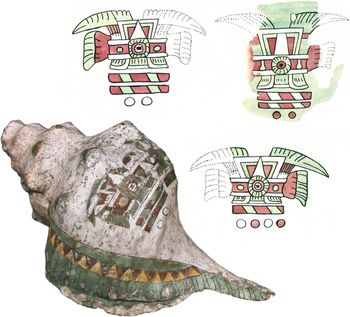
These observations lead us to the occurrences of the Year Sign headdress in combination with calendrical dates at Teotihuacan. On the two famous stuccoed conch shells, elaborate versions of the headdress appear above the numbers nine and 12 but without any accompanying day signs from the 260-day calendar, perhaps suggesting a rare case of underspelling, assuming that the signs in question would have been implicit for Teotihuacano readers (Figure 14). Apart from these, the Year Sign headdress frequently occurs with the Reptile Eye glyph (Figure 12a; Caso Reference Caso1967:160–161, Figure 17; Helmke and Nielsen Reference Helmke and Nielsen2011:16, Figure 9a; von Winning Reference von Winning1987:vol. II, pp. 15–27), which undoubtedly functioned to mark important calendrical stations. Elsewhere we have suggested that the Reptile Eye sign corresponds to the day sign “Reed” in the Teotihuacan 260-day calendar, used, when crowned by this distinctive headdress, to name a given year (Helmke and Nielsen Reference Helmke and Nielsen2011:15–20; Helmke et al. Reference Helmke, Nielsen, Leni and Campos2013:92–93). The Year Sign headdress also shows up in combination with calendrical dates on Teotihuacan-style monuments outside of Teotihuacan itself, for example on Stela 1 from Fracción Mujular in Chiapas (Navarrete Reference Navarrete1986:17–21, Figures 11 and 12a; Taube Reference Taube2000a:42, Figure 33d). These examples suggest that the individuals and the dates wearing or associated with the Year Sign headdress have something in common, in other words, that they share the obligations and responsibility tied to the headdress. This in turn implies that calendrical periods, such as months or years, were perceived of as living beings that could be invested in an office, on par with human officiants. From Classic Maya writing we have excellent evidence that calendrical entities, such as the k'atun periods, could be personified as zoomorphic or anthropomorphic beings and be depicted as seated upon cosmic thrones (Stuart Reference Stuart2011:256–257). Similarly, the first day of a “month” in the 365-day Haab calendar is referred to as the chum, “seating,” drawing a direct parallel to the seating or enthronement of rulers by using precisely the same verb and idiomatic expression (Nielsen and Helmke Reference Nielsen, Helmke, Tiesler and Scherer2018:95–98; Schele Reference Schele1980:28–51; Thompson Reference Thompson1950:119–120, Figure 19). The question remains why some dates, most likely named years, were adorned with the Year Sign headdress from Classic to Postclassic times in central Mexico, but the evidence suggests some position, role, or responsibility modeled upon the sociopolitical realities of these cultures. What eventually became known among scholars as the Year Sign was probably originally a marker of some exalted position in Teotihuacan society, an office whose primary symbol was a characteristic headdress. The incised image from La Ventilla reminds us that the transferal of this particular headdress was an important event and rite of passage in ancient Teotihuacan.
The painted conch shell from Teotihuacan with its glyphic decorations Photograph by Helmke, watercolors after Caso (Reference Caso1967:Figures 4–5).

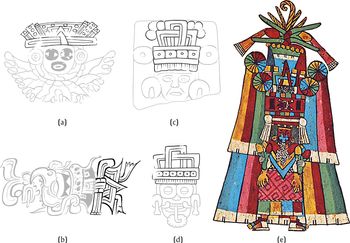
As we mentioned at the beginning, the most prestigious headdress of the Aztec was the xiuhhuitzolli, “something pointed turquoise,” with xiuhuitl meaning “turquoise” as well as “year” in Nawatl. It has been suggested that the Aztec royal headdress and the Teotihuacan Year Sign headdress could be related, their pointed elements possibly representing the same stylized solar ray, and “[i]t is thus extremely likely that the ‘year sign’…ultimately led to the xiuhhuitzolli form.” (Olko Reference Olko2014:51). Reconstructing the diachronic evolution and graphic development of the Year Sign headdress to the xiuhhuitzolli diadem (Figure 15) supports Olko's hypothesis, and thus further suggests that the Year Sign headdress carried a similar meaning at Teotihuacan, namely that of a high, even supreme, political and religious office, and there can be little doubt that it must have been reserved for a select and exalted few. While we have representations of the headdress depicted in isolation and in other cases worn by calendrical dates at Teotihuacan (Figures 1, 5, and 12a), however, the Year Sign headdress is relatively rarely depicted as worn by human figures and, when the Year Sign is embedded in the headdresses of coyote warriors at Atetelco (Cabrera Castro Reference Cabrera Castro and de la Fuente1995b:Figure 18.7) or in the elaborate headdresses worn by the marching priestly figures from Zona 3 (de la Fuente Reference de la Fuente and de la Fuente1995c:Figures 8.3 and 8.4), they are not necessarily depictions of rulers, but could be lower-ranking individuals associated with the ruler, as we saw earlier in the case of the Aztec. Equally, we find representations of supernatural beings or deities, such as the personified spirit of agave or the pulque god (Figure 11a; Nielsen and Helmke Reference Nielsen, Helmke, Cicero and Helmke2017c:136; Miller and Taube Reference Miller and Taube1993:163) or the Storm God as represented on Los Horcones Stela 3, wearing the Year Sign headdress, which is most likely to signal the omnipotent power and importance of these beings. We are thus in a position where we will be able to identity depictions of rulers by their diagnostic headdresses, although these depictions are limited and few in the extant corpus for Teotihuacan.
The development of the Year Sign headdress to the xiuhhuitzolli diadem, showing how the shape is gradually simplified from Epiclassic to Late Postclassic times: (a) Texmilincan (Panel 2); (b) Xochicalco (Stela 2); (c) Loma Teba (panel); (d) Tula (small Atlantean figure); and (e) Codex Borbonicus (Reference Codex Borbonicus1974:p. 10). Drawings by Helmke and Ángel Iván Rivera Guzmán.

CONCLUSIONS
From the review presented above it is clear that the Year Sign headdress marks the high status and duties of its wearer and, when found in combination with calendrical year-bearers marks, these as crowned and invested with commensurate status for the coming period, as though personified entities of time. This is a pattern seen throughout Mesoamerica and, in much the same way that kings ruled over their dominions, named periods of time ruled over their own temporality. There are in fact a great many points of equivalence in these observations for the entirety of Mesoamerica, from the Classic to the Postclassic, as has already been suggested by Stuart (Reference Stuart2015). Thus, whereas specific attributes and representational conventions differ from culture to culture, there is an essential and fundamental unity in the way headdresses of paramount rulers were represented. Comparing for instance, as Stuart has done, the headdresses of Zapotec texts at Monte Albán, those of the Classic Maya ajaw, “orator, king,” and the xiuhhuitzolli of the imperial Aztec are all essentially diadems, bound at the back of the head, with distinctive elements at the brow (Figure 16). Once more, we see the essential equivalence between these headdresses, each including the bound element at the back that functions as a reductive sign for the headdress itself. As we have seen, the same sign is also found in the texts and representational conventions of Teotihuacan, where likewise it also functions as a logogram for “headdress.”
A comparison between the royal headbands or diadems of the (a) Zapotec, (b) Maya, and (c) Aztec (after Stuart Reference Stuart2015:Figure 1).

To this, we can note the use of these headdresses as crowns for calendrical dates, serving to name particular named years. This is a convention found in the writing of Monte Albán (Caso Reference Caso1928:46, Figure 21, Reference Caso1967:178, Figures 15m–15o; Urcid Reference Urcid2001:111–113), in the texts of Teotihuacan, often topping the Reptile Eye (“Reed”) sign (Caso Reference Caso1967:159–161; Helmke and Nielsen Reference Helmke and Nielsen2011:15), in Ñuiñe (Rivera Guzmán Reference Guzmán and Iván2014) and Epiclassic writing (Helmke and Nielsen Reference Helmke and Nielsen2011:15–19, Reference Helmke, Nielsen and García2019a), and Classic Maya writing (Stuart Reference Stuart2015). This pattern would endure into the Colonial period, such as the renditions of k'atun wheels of the Yucatec Maya in which the headdresses of old were replaced with the crown of European monarchs, just as examples of the twentieth day sign Ajaw—as for instance in the Book of Chilam Balam of Ixil—are written, not with a headband, but with a European crown (Bricker and Miram Reference Bricker and Miram2002). Interestingly, these European crowns echo the radiate diadems of late Roman Emperors, usurped from the solar deity Helios whose crown represents glorious solar rays. Returning to Mesoamerica and Teotihuacan, it seems inevitable to conclude that the Year Sign, for all its apparent ambiguity and pervasiveness, was paramount on account of its sociopolitical, mythical, and religious importance to the still elusive rulers of Teotihuacan, and even symbolized their supreme power.
RESUMEN
Los tocados, como opulentos marcadores de rango y afiliación, ofrecen una oportunidad única para examinar los roles sociopolíticos y los oficios en Teotihuacan. En particular, a la luz de los pocos textos jeroglíficos sobrevivientes del sitio, las representaciones de tocados, ya sea en forma aislada, como parte de investiduras rituales, o portadas activamente por individuos, son de hecho una de las pocas formas de lograr una comprensión más profunda de las estaciones sociales, los oficios, así como de su estructura y los aspectos institucionales de la antigua metrópoli, expresados en estos tocados. En este trabajo, primero discutiremos las propiedades elementales de los tocados en la iconografía teotihuacana, así como los ritos de investiduras por los cuales se adquirieron estos marcadores simbólicos. A partir de entonces, sugerimos que varios tipos de tocados también están asociados específicamente con casas nombradas en Teotihuacan, lo que indica su estrecha afiliación con ciertas instituciones de poder. Finalmente, nos enfocamos en algunos de los tipos específicos de tocados, y especialmente aquellos calificados por el llamado “Signo de Año” (Figura 1). En base de comparaciones con los registros calendáricos del clásico y epiclásico—en que las fechas también están coronadas por el mismo tocado—así como con la diadema de los gobernantes mexicas del posclásico tardío, el xiuhhuitzolli, presentamos una nueva interpretación de su significado en Teotihuacan.
ACKNOWLEDGMENTS
Earlier versions of this paper were presented at the International Symposium on the Sociopolitical Organization of Teotihuacan in San Juan Teotihuacan in 2017 and at the symposium “City as Cosmos: Art and Archaeology at Teotihuacan” celebrated at the Los Angeles County Museum of Art in 2018, as part of the Teotihuacan exhibit curated there. We wish to express our gratitude to the organizers of these symposia, and in particular the many good comments and suggestions we received from the other participants at these two meetings, especially those of Annabeth Headrick, Leonardo López Luján, Linda Manzanilla, Zoltán Paulinyi, David Stuart, and Karl Taube. We also want thank Sergio Gómez Chávez for his permission to document and include the drawing of the incised bowl excavated at La Ventilla. Equally, many thanks to the Velux Foundation (grant No. 00021802) for financial support of our research, and the Biblioteca Nacional de España, David Stuart, Ángel Iván Rivera Guzmán, and Nicolas Latsanopoulos for allowing us to include their wonderful photographs and drawings. Finally, our gratitude to the editors and to Nancy Gonlin, in particular, for seeing this paper to publication.