


I. INTRODUCTION
Since 2006 we have more devices connected to the network than human beings on Earth. This trend, initially stimulated by the development of mobile personal devices, is being consolidated through a technological development that provides always decreasing connectivity costs, reduced dimensions, and lower power consumption. It is quite a few years since we talk about the Internet of things (IoT), meaning an evolution of Information and Communication Technology (ICT) to an increasing widespread connectivity, in which not only the people can communicate with other people or remotely manage machines, but also the “smart objects” themselves can autonomously interact with each other and with people. This new scenario involves the production of large amounts of data (Big Data), and makes it necessary to develop new techniques and tools for their analysis (Data Science), aimed to the extraction of knowledge and the consequent support to strategic decisions in social, economic, political, and industrial fields.
The IoT evolution of ICT finds vast areas of application also in agriculture as monitoring and decision making means when, for instance, irrigation versus water consumption should be taken into account. The plant water status is, in fact, the result of the interaction between the atmospheric demand in terms of transpiration and the water availability in the soil explored by the root system. A condition of water deficit occurs when the sucking of the radical apparatuses, due to poor water availability, does not meet the transpiration demand. Therefore, monitoring water availability is fundamental for a correct irrigation management in order to avoid both water stress conditions, which would negatively affect the crop yield, and the excessive distribution of water, which in addition would represent a waste of resources and could contribute to the spread of pollutants and create a favorable environment for plant diseases.
Among the monitoring systems, the most common ones are based on the measurement of soil water content by means of sensors of various types (tensiometers, capacitance probes, etc.). However this is an indirect measure of the water status of the plant and suffers from measurement uncertainties due to the fact that, in localized irrigation systems, the water content is highly variable as a function of the distance from the emission point and the terrain depth. To obtain a reliable measurement of the water deficit, the measurement should be taken on the plant and not on the soil or into the atmosphere, as only the plant responds simultaneously to the weather and soil conditions.
The emphasis of the application of monitoring systems in agriculture has been improved in recent years thanks to the development of innovative wireless sensor networks that are able to allow for the communication of the collected sensor data to a remote host. In [Reference Bhanu1] the design and development of an agricultural monitoring system, using wireless sensor network to increase the productivity and quality of farming without a continuous monitoring, has been presented. In this work it is reported that temperature, humidity, and carbon dioxide levels are important factors for the productivity, growth, and quality of plants in agriculture. Such system periodically measures these parameters, thus the farmers or the agriculture experts can monitor these data from the web in real-time. Another published paper [Reference Dasgupta2] deals with the monitoring of physical parameters such as soil moisture and humidity involved in a regular agriculture plantation, also introducing a Scatter Radio Networks approach [Reference Kampianakis3, Reference Daskalakis4]. In [Reference Konstantopoulos5], an innovative methodology for energy scavenging, used to supply the wireless sensor, is introduced, the source being the plant itself. Also [Reference Rodríguez de la Concepción6] presents an innovative solution for the realization of wireless sensor networks suitable to characterize the microclimatic behavior in agriculture. The nodes are equipped with sensing units in order to measure several physical parameters. They are designed with the purpose of minimizing power consumption, and are capable of working for a whole season without any energy harvester.
Following this trend, the idea behind the project presented in this paper is the development of a “dust” network of wireless sensors for detecting the temperature differential between the leaves and the air. The single sensor is meant to be autonomous, non-invasive, and cost effective compared with commercial monitoring systems. Exploiting real-time data on leaf-air temperature gradient has the advantage of getting the information on water deficit from the plant itself. This information can then be used as an actuator of a smart irrigation system. The following Section II summarizes the sensor network design in terms of architecture, technological choices, and in-field issues that has been faced during the implementation. Section III focuses on the leaf compatible temperature clip sensor design, explaining mechanical and technological aspects of the “wired” and “wireless” sensor prototypes. In Section IV measurement results are described in terms of temperature data interpretation and water saving, while in Section V general conclusions on the project are summarized.
II. THE SENSOR NETWORK
The goal of this project is the real time monitoring of leaf-air temperature gradient, which is directly related to the plant water deficit, in order to plan and manage an intelligent irrigation system. To achieve this result:
-
• an “ad hoc” temperature sensor, compatible with the leaf structure, has been developed. This will be used to monitor the plant temperature;
-
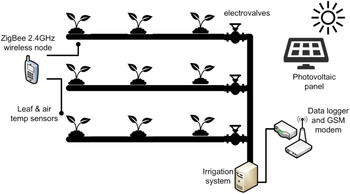
• a number of sensors have been placed on the field in order to have a dusted network and collect data from different points in the plantation (see Fig. 1);
-
• a commercial acquisition system has been foreseen in order to collect the data from the custom temperature sensor and other sensors needed to calibrate the predictive behavioral model, as shown in [Reference Daskalakis4], to be used as a management decision support in an automated irrigation system.
Wireless self-autonomous temperature sensor network, data collection, and intelligent irrigation system.

In order to prove the concept and build the decision support system based on measured data, a commercial transmitting node and acquisition system has been taken into account. These nodes from eKo PRO Series Systems are powered by a small built-in photovoltaic panel, they use a 2.4 GHz ZigBee protocol to exchange data with a base station that collects and stores the information received. The characteristic of being self-autonomous offers the possibility to place the sensors very close to the plants, avoiding cable connections that can disturb the daily management of the crop. The same base station can be exploited to pilot the irrigation system.
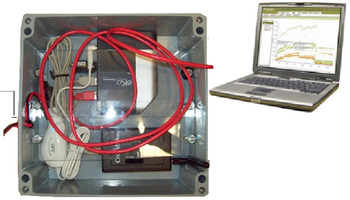
The temperature sensor clips have been connected to a number of wireless nodes, together with other kinds of sensors such as soil humidity sensors (needed to calibrate the system), leaf wetness sensors (in order to avoid over watering and thus potential plant diseases). The receiver is linked to a data-logger for data storage that can be connected to a PC for data visualization. The base station, data-logger, and gateway have been placed in a watertight box (Fig. 2), far from the crop. To power the system a photovoltaic panel of 70 W 12 V was used. In order to ensure non-stop operation even at night time, a battery was included.
Water resistant box containing the base station, data-logger, and gateway powered by the photovoltaic panel and accessible by laptop of remotely via GSM network.

III. TEMPERATURE SENSOR CLIP DESIGN
In order to assess the differential between the leaf and the environment temperature we need at least two temperature sensors: one for the ambient temperature, placed in a high position with respect to the vegetation and not exposed to direct solar radiation, and the other for the plant temperature, placed in direct contact with the leaf, not exposed to solar radiation and protected from the heat coming from the soil.
Differently from air, the leaf temperature measurement entails considerable problems from a practical point of view, as it requires to closely interacting with the delicate balance of the leaf. For this reason a custom sensor has been developed using a commercial electronic component selected so as to have the size and weight to enable an easy placement on the edge of the leaf.
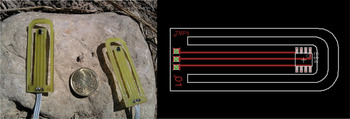
A first “wired” prototype (Fig. 3) has been conceived in order to prove the concept, derive the data for building the behavioral model and solve the mechanical issues. It exploits an Analog Devices TMP36 temperature sensor that provides a measurement range between −40 and +125 °C and an accuracy of ±1 °C. The printed circuit board (PCB) has been designed in order to guarantee electrical and electronic connections with the transmitting nodes and at the same time ensuring a mechanical compatibility with a quite wide leaf (a melon crop has been taken into account in this project).
“Wired” sensor temperature prototype (left) and layout (right).

As shown in Fig. 3 the PCB has been cut in the shape of a clip in order to be easily fixed on the edge of the leaf, limiting the barrier to a correct photosynthesis. The dimensions (15 × 50 mm2) and weight (3 g) of the sensor clip are quite moderate. Further, it is very low cost, allowing the possibility to place a dust of sensors to have a widespread detailed source of data. The sensor has also low current consumption (<50 µA) ensuring a very low self-heating (<0.1 °C in still air).
The development of a temperature sensor housed in a clip shaped PCB is a simple and at the same time innovative solution, because, once the dimensions and the dielectric substrate are established, being the material suitable to guarantee the foreseen properties of mechanical elasticity, it allows to use the empty spaces left to place other electronic devices, for instance a supply source and a printed antenna that increase the potentiality of the circuit.
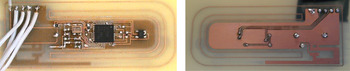
Following this vision we designed a second clip prototype (Fig. 4) that, powered by a small lithium battery (like those used in watches), integrates the electronics needed to condition and transmit the data wirelessly, avoiding the wiring that is currently indispensable to connect the sensors to the transmitting nodes. The chosen transceiver is the CC2530 chip by Texas Instrument that exploits the 2.4 GHz IEEE 802.15.4 ZigBee transmitting protocol. The overall size of the clip sensor is 22 × 53 mm2.
“Wireless” sensor temperature prototype top (left) and bottom (right)-work in progress.

Compared with the wired sensor prototype, this self-autonomous wireless sensor would be much more cost-effective. The wired sensor needs to be connected to the transmitting node, which in our case has a cost of several hundreds of Euros, serving only four sensors, with a total power consumption of 0.6 mA (3 V supply) and a maximum transmitted power of 3 dBm. The wireless clip prototype costs between €15 and 20, but could surely be much lower in mass production. Its power consumption is around 30 mA (3 V supply) in transmitting mode, with a maximum transmitted power of 4,5dBm (programmable). In a further development, the battery would be replaced with a rechargeable one and the clip will be supplied of a small photovoltaic panel.
IV. MEASUREMENT RESULTS
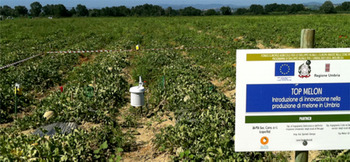
The developed temperature sensor network has been used to monitor a melon crop (see Figs 5 and 6) in Umbria (Italy) for two consecutive years. The melon is a crop whose production (under qualitative and quantitative points of view) is strongly conditioned by the water availability and the control of various types of plant diseases. The introduction of innovative production processes cannot therefore ignore the study and application of techniques in order to optimize both the use of water resource and health protection measures.
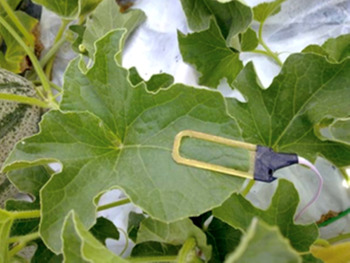
Temperature sensor applied to a melon leaf.

Wireless sensor network installation on a melon crop in Umbria.

The monitoring of the melon plants was carried out through the following sensors: leaf clip temperature sensors, leaf commercial wetness sensors, air temperature sensors, and commercial soil water content sensors. The measurement data were transmitted every 15 minutes by the eKo Pro Series wireless nodes to the gateway. The collected data were stored in a dedicated on site server; they were accessible through a laptop or sent by email exploiting the GSM network. A database was weekly updated with new records containing information on date, time, and temperature.
Air temperature was detected in various positions and with different tools in order to calibrate the system. Firstly two temperature sensors were positioned within a screen; the custom leaf sensor and a commercial sensor. The comparison between these two different hourly scale measurements was the leaf temperature sensor validation. The measured values are very close and the small difference is systematic and applies both to the minimum and the maximum values. In particular, the custom sensor provides about 0.6 °C less than the commercial.
The first year was devoted to acquire temperature data, calculate temperature gradient, and build a behavioral model to be used to manage a day-to-day irrigation plan. The data have been collected during the entire growing process of the melons, from planting to harvesting.
During the second year these results have been used to manage the watering plan; a dedicated irrigation system has been conceived, using electro-valves controlled by our systems according to real-time measured data. If the temperature gradient is over a certain maximum limit then the system opens the valves and waters the crop. It is clear that this kind of irrigation management is very flexible; watering times or time ranges can be diversified according to leaf temperature on different parcels belonging to the same cultivation.
As reported in [Reference Jackson7] the canopy temperature is inversely proportional to the intensity of the transpiration process and is then correlated with the crop water status. The measurement must therefore be carried out during daylight hours (when the photosynthetic and transpiration processes are actually taking place) and needs to be referred to the environmental temperature.
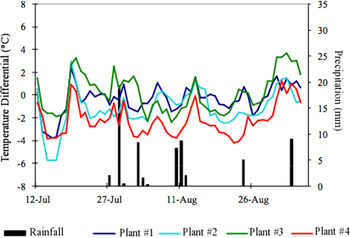
Fig. 7 shows some in-field measurements results related to four melon plants (four leaf sensors). The graph reports information about the temperature differential (T leaf − T air), taking into account meteorological events (rainfalls). The gradient has the same qualitative shape for the four plants and this shows that the sensors are measuring the same water stress on different samples. The temperature of the air is always lower or equal than the temperature of the leaf (good water availability and thus allowing a correct evapotranspiration) except in those periods when no water has been provided (no irrigation, no rain).
Temperature differential (T leaf − T air) measurements versus water availability.

The analysis of collected data showed that the leaf temperature (T leaf) follows a trend similar to that of the air temperature (T air). In particular, by analyzing the differential ΔT dynamic (T leaf − T air), it is observed that this is typically negative (leaf cooler than air) in the daytime and negative (leaf warmer than air) in the night hours.
The measurements were averaged in the time window between 12.00 a.m. and 4.00 p.m., where ΔT showed the highest correlation with the soil water potential. They show variability in absolute values but also an overall agreement in terms of trend, which is consistent with the irrigation and meteoric inputs. This variability is due to the installation of the sensors and to their limited number, surely to be improved to ensure a better characterization. Despite this variability, the measures of ΔT showed a significant correlation with the corresponding soil water potential measurements, a result that has been exploited for the following automatic irrigation management. By relating the soil water potential, measured with the calibration time-domain reflectometer probes, with the leaf-air temperature differential a linear relationship was obtained as reported in [Reference Vergni and Vinci8]. Such equation gives an optimum threshold between −1.6 ÷ −2 °C (corresponding to a soil water potential of −50 ÷ −46 cbar).
The automatic irrigation system, managing watering on the basis of the temperature differential data, has been implemented during this second experimental phase. It is worth underlining that the control units for irrigation management available on the market are very efficient for what concerns automation but very poor in terms of soil and plant parameters monitoring. Unusually these units can, in fact, be interfaced with soil water content sensors (or simple rain sensors) that are not capable of providing detailed and timely information on actual irrigation requirements derived from the plant itself. Therefore, the proposed approach allows to combine the advantages of a detailed crop monitoring to those of the automatic management.
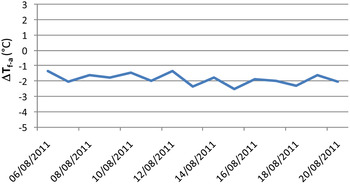
The area covered by the automated irrigation system was approximately 2000 sqm. Every day at 5.00 p.m. the system was set to verify whether, during the time window between noon and 4.00 p.m., the average value of the leaf-air temperature differential had exceeded the threshold value set to −2 °C. If so, the system was programmed to give the prompt for the electrovalve opening. The closure of the valve was set taking into account the flow rate and maximum irrigation dose applied for specific soil-crop units. As can be seen from the graph in Fig. 8, the automated water management was allowed to maintain a constant temperature differential value of −2 °C. In addition it allowed the temperature gradient to be contained below −1 °C (good water availability, no stress) without overwatering and with a water resource saving of 24% in the pilot area compared with common manual irrigation systems. The irrigation water volumes used by the automated management were compared with those exploited in traditional systems.
Values of thermal leaf-air differential detected in the irrigation sector during the automated irrigation management period (average values in the time slot noon–4.00 p.m.).

V. CONCLUSIONS
The purpose of this work is to verify the actual relationship between the water stress of the leaves (and hence of the plant) and the leaf-air temperature differential. In order to have a diffused and detailed amount of data, a wireless temperature sensor network has been designed and applied to a real melon crop in Umbria (Italy). A custom clip-shaped temperature sensor has been designed and realized, solving some mechanical issues related to the leaf structure. These leaf temperature sensors have proven effective in monitoring water stress and automatic management of irrigation. The collected data have been used to actuate an intelligent irrigation system resulting in water resource saving (and consequently fuel/money waste for a more limited use of pumps) and moderate use of plant health protection measures.
Regarding the water stress monitoring, various advantages have been found with respect to more conventional sensors that are based on soil water content detection in the soil. In particular:
-
• the plant water status is done directly on the leaf and not indirectly derived from the soil;
-
• the difficulty and uncertainty in the installation, which are critical aspects when using soil water content sensors, are reduced;
-
• the simple, non-invasive, and cost effective leaf temperature sensors allow to increase their number in order to obtain more reliable, detailed and “dust” information.
-
• their use in an automated irrigation system has proved effective and has allowed to achieve significant reductions in water consumption and avoiding health protection measures due to overwatering, thus making the leaf sensor even more “eco-friendly”.
In conclusion the project demonstrated the effectiveness and importance of using environmental monitoring systems in agriculture and especially in crops with high water requirements. The proposed sensor allows, in fact, to gain valuable and detailed information on the actual water status of crops that can be profitably used to optimize irrigation management. Such monitoring systems are not very expensive and their cost is widely justified in high-income crops if we take into account water saving and qualitative production improvement. The use of the proposed innovative leaf temperature sensor would allow to reduce the costs of the instrumentation and to simplify the installation.
ACKNOWLEDGEMENTS
The activity has been carried out in collaboration with the Department of Civil and Environmental Engineering of the University of Perugia, Italy. During 2016 the leaf-sensor has been adopted as a pilot project in the frame of the exchanges between Italian secondary school and University. In particular the students of the ITTS “Alessandro Volta” technical and technological institute of Perugia (Italy) further developed both the sensor hardware and firmware driving the interaction between Secondary School and University.
FINANCIAL SUPPORT
The activity has been carried out within the project “TOP MELON-Innovation introduction in melon production in Umbria”, funded by Regione Umbria within the Rural Development Program PSR Umbria 2007–2013 measure 124.
CONFLICT OF INTEREST
None.
 Valeria Palazzari received a degree in Electronic Engineering and a Ph.D. degree in Information and Electronic Engineering at the University of Perugia, Italy, in 2000 and 2003, respectively. Since 2000, she has been with the High Frequency Electronics laboratory (HFElab), Department of Engineering, University of Perugia. In 2003 she joined the ATHENA Research Group, Georgia Institute of Technology, Atlanta. Her research interests range from the modeling, design, and realization of microwave integrated circuits in SiGe BiCMOS technology to packaging technologies for RF and wireless systems.
 Paolo Mezzanotte received the Ph.D. degree from the University of Perugia, Italy, in 1997. Since January 2007, he is Associate Professor with the same University, teaching the classes of Radiofrequency Engineering. His research activities concern numerical methods and CAD techniques for passive microwave structures and the analysis and design of microwave and millimeter-wave circuits. More recently his research interests were mainly focused on the study of advanced technologies such as LTCC, RF- MEMS, and microwave circuits printed on green substrates. These research activities are testified by more than one hundred publications in the most important specialized journals and at the main conferences of the microwave scientific community.
 Federico Alimenti received the Laurea and the Ph.D. degrees from the University of Perugia, Italy, in 1993 and 1997, respectively, both in Electronic Engineering. In 1996 he was recipient of the URSI Young Scientist Award and Visiting Scientist at the Technical University of Munich, Germany. Since 2001 he has been with the Department of Engineering at the University of Perugia teaching the class of Microwave Electronic. Between 2011 and 2014 he was the scientific coordinator of the ENIAC ARTEMOS project. In 2013 he was the recipient of the IET Premium (Best Paper) Award and the TPC Chair of the IEEE Wireless Power Transfer Conference. In the summer 2014 he was Visiting Professor at EPFL, Switzerland. His interests are about microwave circuit design. He has authored a European Patent and more than 150 papers in journals and conferences. Federico Alimenti (H-index equal to 14, Scopus) is Senior IEEE Member.
 Francesco Fratini received a degree in Electronic Engineering at the University of Perugia, Italy in 2009. Since 2010, he collaborated with the Department of Agricultural, Food and Environmental Science (DSA3), University of Perugia, in the following areas of research: crop water stress monitoring, automated irrigation systems, and rainfall simulation for soil erosion studies.
 Giulia Orecchini received a degree in Electronic Engineering and a Ph.D. degree in Information and Electronic Engineering at the University of Perugia, Italy, in 2008 and 2012, respectively. In Autumn 2008 she joined the ATHENA Research Group, Georgia Institute of Technology, Atlanta. Her research interests concern the development of RFID electronic systems and technologies exploiting new technologies such as electronics on paper, CNT, and graphene.
 Luca Roselli (M92 SM01), MG in 1988. In 1991 he joined the University of Perugia, where he is currently teaching Applied Electronics and coordinating the HFE-Lab as Associate Professor. In 2000 he founded the spin-off WiS Srl. From 2008 to 2012 he was member of the BoD of ARTsrl. He organized the VII CEM-TD-2007 and the first IEEE-WPTC-2013. He is member: of the list of experts of Italian Ministry of Research, of the IEEE Technical Committees MTT-24 (past chair), -25 and -26; of the ERC Panel PE7, of the AC of IEEE-WPTC and chairman of the SC-32 of IMS. He is involved in the boards of several International Conferences and he is reviewer for many international reviews (including IEEE-Proceedings, -MTT and -MWCL). His research interest is HF electronic systems, with special attention to RFID-NFC, new materials and WPT. He published more than 220 contributions (HFi 23, about 1850 scitations – Scholar).