INTRODUCTION
With the aim of generating fusion energy by fast ignition (Tabak et al., Reference Tabak, Hammer, Glinsky, Kruer, Wilks, Woodworth, Campbell, Perry and Mason1994), using terawatt (TW) to petawatt (PW) laser power, and picosecond (ps) and shorter duration, a rarely reported anomaly was measured within the broad stream of the research. Instead of the usually emitted very intense and hard X-rays, only very lower intensities and softer X-rays were measured (Zhang et al., Reference Zhang, He, Chen, Li, Zhang, Wong, Li, Feng, Zhang, Tang and Zhang1998), and instead of the usually expected 22 MeV fast Cu ions, only half MeV ions were measured, where the number of the ions did not depend on the laser pulse energy (Badziak et al., Reference Badziak, Kozlov, Makowksi, Parys, Ryc, Wolowski, Woryna and Vankov1999). This was clarified (Hora et al., Reference Hora, Badziak, Boody, Höpfl, Jungwirth, Kralikova, Kraska, Laska, Parys, Perina, Pfeifer and Rohlena2002) from the fact that these anomalous measurements were done with exceptionally clean laser pulses, where any prepulse was suppressed by a factor of 108 (contrast ratio) up to about 10 ps before the main pulse arrived at the target. Under these conditions, it could be concluded that no relativistic self focusing could have been involved, where the usually generated longer prepulse permitted relativistic self-focusing (Hora et al., Reference Hora, Badziak, Read, Li, Liang, Liu Hong, Zhang, Osman, Miley, Zhang, He, Peng, Glowacz, Jablonski, Wolowski, Skladanowski, Jungwirth, Rohlena and Ullschmied2007) of the laser beams down to a wavelength diameter with extremely high intensity causing very complex relativistic effects (Cowan et al., Reference Cowan, Parry, Key, Dittmire, Hatchett, Henry, Mody, Moran, Pennington, Phillips, Sangster, Sefcik, Singh, Snavely, Stoyer, Wilks, Young, Takahashi, Dong, Fountain, Parnell, Johnson, Hunt and Kuhl1999).
This omission of self-focusing was observed under very special conditions using similar clean laser pulses with very high contrast ratio (suppression of prepulses by a factor of 108 or more until dozens of ps before the arrival of the main pulse), where the interaction occurred within the plane geometry of the target only (Sauerbrey, Reference Sauerbrey1996), as a most exceptional case. This all could be explained by the acceleration of the very fast ions as a block from the skin layer surface in full agreement with the acceleration by the nonlinear (ponderomotive) force (Hora et al., Reference Hora, Badziak, Boody, Höpfl, Jungwirth, Kralikova, Kraska, Laska, Parys, Perina, Pfeifer and Rohlena2002, Reference Hora, Badziak, Read, Li, Liang, Liu Hong, Zhang, Osman, Miley, Zhang, He, Peng, Glowacz, Jablonski, Wolowski, Skladanowski, Jungwirth, Rohlena and Ullschmied2007). This skin layer acceleration by the nonlinear force (SLANF) was confirmed experimentally from the highly directed space charge neutral plasma blocks with directed current densities above 1011 A/cm2 of ions up to 100 keV (Badziak et al., Reference Badziak, Glowacz, Jablonski, Pahys, Wolowski and Hora2004, Reference Badziak, Glowacz, Hora, Jablonski and Wolowski2006).
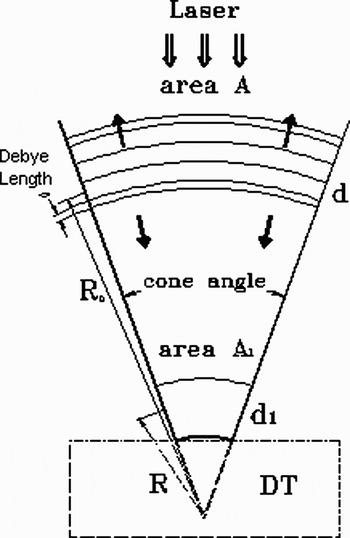
The use of these extremely intense ion currents for fusion energy generation was mentioned before (Hora, Reference Hora2003, Reference Hora2007; Hora et al., Reference Hora, Badziak, Glowacz, Jablonski, Skladanowski, Osman, Cang, Zhang, Miley, He, Zhang, Rohlena, Ullschmied and Jungwirth2005; Osman et al., Reference Osman, Cang, Hora, Li-Hua, Hong, Xiantu, Badziak, Parys, Wolowski, Woryna, Jungwirth, Králikova, Krása, Láska, Pfeifer, Rohlena, Skála and Ullschmied2004). This is similar to the very high gain laser fusion energy scheme of Nuckolls and Wood (Reference Nuckolls and Wood2005), by using very intense 5 MeV electron beams produced by 10 PW/ps laser pulses. These schemes are all special modifications of the fast ignition scheme (Tabak et al., Reference Tabak, Hammer, Glinsky, Kruer, Wilks, Woodworth, Campbell, Perry and Mason1994), however, it is a postulate of Dean (Reference Dean2008) to aim at a single laser-plasma interaction process, which may be reached at present only by the here discussed ion option scheme (Ghorannviss et al., 2008, see third and fourth paragraph of Section 1, and see Fig. 1). One problem with the ion beam option is indicated in Hora et al. (Reference Hora, Badziak, Read, Li, Liang, Liu Hong, Zhang, Osman, Miley, Zhang, He, Peng, Glowacz, Jablonski, Wolowski, Skladanowski, Jungwirth, Rohlena and Ullschmied2007). It consists in the fact that the initially accelerated plasma blocks are rather thin and can be changed into more massive blocks by conically guided motion. Another problem is given by the conditions of extremely high energy flux densities of the directed blocks at interaction with the deuterium tritium fuel (Ghoranneviss et al., Reference Ghoranneviss, Malekynia, Hora, Miley and He2008; Hora et al., Reference Hora, Malekynia, Ghoranneviss, Miley and He2008).
Schematic description of spherical laser irradiation on a deuterium tritium layer (upper part) to generate a plasma block moving into a cone. The thermal broadening of the block, while having a highly directed 80 keV ion energy for moving into a deuterium tritium target, leads to an isochoric volume of very much larger thickness of the block (Hora et al., Reference Hora, Badziak, Read, Li, Liang, Liu Hong, Zhang, Osman, Miley, Zhang, He, Peng, Glowacz, Jablonski, Wolowski, Skladanowski, Jungwirth, Rohlena and Ullschmied2007).

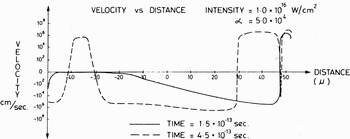
The here reported studies are following the earlier noticed numerical results that the thickness of the laser accelerated blocks can be highly increased by dielectric plasma effects, if an appropriate initial plasma density may be produced as given by the theory of Rayleigh density profiles. The motivation for this direction of research was given by earlier one-dimensional one-fluid hydrodynamic computations (Fig. 2), where the dielectric swelling of the laser field was generating plasma blocks of more than 20 vacuum wavelengths thickness (Lawrence, Reference Lawrence1978; see Hora, Reference Hora1991, Section 10.5) by using Rayleigh profiles. After first summarizing properties of these profiles, we report very detailed results about thick, nonlinear force driven (Hora, Reference Hora1991, Section 8) plasma block generation using the very general genuine two-fluid hydrodynamics (Lalousis & Hora, Reference Lalousis and Hora1983; Hora et al., Reference Hora, Lalousis and Eliezer1984; Cang et al., Reference Cang, Osman, Hora, Zhang, Badziak, Wolowski, Jungwirth, Rohlena and Ullschmied2005).
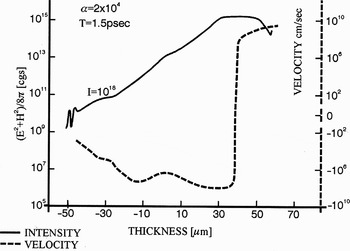
Generation of blocks of deuterium plasma moving against the neodymium glass laser light (positive velocities v to the right) and moving into the plasma interior (negative velocities) at irradiation by a neodymium glass laser of 1018 W/cm2 intensity onto an initially 100 eV hot and 100 µm thick bi-Rayleigh profile (see Hora, Reference Hora1991, Fig. 10.17) with minimum internal reflection. The electromagnetic energy density (E 2 + H 2)/(8π) is shown at the time of 1.5 ps after begin of the constant irradiation for comparison with the results of Cang et al. (Reference Cang, Osman, Hora, Zhang, Badziak, Wolowski, Jungwirth, Rohlena and Ullschmied2005).

ANALYTICAL SOLUTIONS WITH RAYLEIGH PROFILES
One of the fundamental problems of wave propagation in plasmas is the fact that these plasmas are nearly always inhomogeneous. The problems are summarized by Hora (Reference Hora1991, Section 7). This all is related to the solution of the ordinary linear differential equation for the spatial-dependent electric field amplitude E(x) (here depending on the spatial coordinate x), combined with the spatial dependence of the magnetic field H(x) (here also dependent on x) by the Maxwell equations,

where ω is the radiation frequency of the laser, c is the vacuum speed of light, and n is the real part of the refractive index of the plasma, given by

where ωp is the spatially and temporally varying plasma frequency, ν is the similarly varying electron-ion collision frequency of the plasma, e is the charge, m is the mass, and n e is the density of the electrons in the plasma. For the analytical discussions in this section, the collision frequency is assumed to be zero (collisionless plasma) in difference to the following numerical hydrodynamic equations with spatially and temporally varying ν and ωp. The oscillation (Eq. (1)) is trivial if n e is constant (homogeneous plasma). In this case, the solutions of Eq. (1) are given by elementary functions cos(x), sin(x), or exp(ix). But for x-dependent n(x), as in all the inhomogeneous plasmas, the solution of Eq. (1) contains the main part of all mathematics of the 19th-century, which means Bessel, Hankel, or Neumann functions, which may be presented by infinite series of orthonormal functions.
For the general case of plasmas with no specific variation of the electron distribution n e(x), even all these higher functions cannot be used directly. One has, for instance, to use Fourier series of an infinite number of elements containing Bessel etc. functions as later applied in functional analysis. Another way to solve the general wave Eq. (1) is to use the Jordan-Wentzel-Kramers-Brillouin (JWKB) approximation, as was necessary for wave problems in quantum mechanics. A further approximate solution for plasmas uses the approximate presentation of the inhomogeneous optical medium by dividing it into a large number of layers with constant values of n, and solving the problem by multilayer reflection. A paradoxical result was shown numerically (Lawrence & Hora, Reference Lawreence and Hora1980), where such a multilayer arrangement gave a solution different from the exact one.
In this situation, it was rather unique that Rayleigh (Reference Rayleigh1880) found a solution to the wave (Eq. (1)) for an inhomogeneous medium with a refractive index of the form

with constant α. The solution was exactly expressed by elementary functions and amplitude E 0

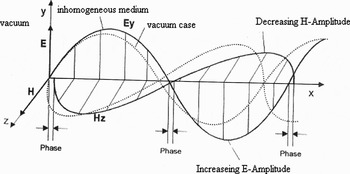
With this exact solution, the reflection between a homogeneous and an inhomogeneous Rayleigh medium could be solved precisely (Schlick, Reference Schlick1904), and its was clarified (Hora, Reference Hora1957) that there exist only two such exact solutions in the inhomogeneous optical medium, one for a wave moving to +x and one for a wave moving to –x. There were no internal reflections appearing, as it was suggested within the many-layer approximation. This result with no internal reflection being shown generally for any medium (not only for the Rayleigh case), which was a rather surprise for Osterberg (Reference Osterberg1958). The exact solutions for a Rayleigh medium for x > 0 are shown in Figure 3 (Hora, Reference Hora1994). The decreasing refractive index in the plasma causes an increase (swelling) of the electric field amplitude, while the Maxwell equations enforce a reduction of the magnetic field amplitude, such that the Poynting vector in the collisionless plasma is constant. The dielectrics cause an increase of the wavelength in the plasma. The value of α causes a phase shift between E and H. This phase shift enforces the reflectivity at the boundary between the vacuum (x < 0) and the inhomogeneous Rayleigh medium though the refractive index Eq. (2) is continuous (Schlick, Reference Schlick1904, Hora, Reference Hora1957).
Exact electromagnetic wave field in a Rayleigh density profile of a collisionless plasma connected with vacuum at x < 0 (full line) compared with the vacuum field (dotted line). x = 0 coincides with the origin of the coordinate system (Hora, Reference Hora1994).

For the dynamics of the plasma, in the presence of sufficiently high intensity laser beams, the nonlinear (ponderomotive) forces f NL are driving the electron fluid of the plasma, while the ion fluid is then following by attraction due to the electric fields apart from the thermokinetic forces given by the gas-dynamic pressure (excluded in this section, but included in the following computations). The force f NL may be given in the simplified form for one dimension by

With respect to the result for the Rayleigh profiles (Eq. (4)), the main limitation is that propagating waves are considered to require an oscillating exponential function. This is fulfilled as long as

where the limit for α is given for neodymium glass lasers. It was evaluated before (Hora, Reference Hora1957) that propagating waves can have values very close to this limit without causing too high reflectivity at the boundary toward vacuum. In the following, we shall consider mostly cases where (n 2–1) = −n e/n ec is close to unity where n ec is the critical density with ω = ωp. Apart from the fast oscillating part in Eq. (4), where the absolute value of the exponential function is equal or less than 1, the ponderomotive action is given, with the Rayleigh refraction index Eq. (3), by

this is constant, confirming that the whole plasma is then accelerated as an undistorted block. This property of the Rayleigh profile with respect to the nonlinear (ponderomotive) force is very significant and important to generate uniformly fast moving plasma blocks for applications, and it was immediately seen from the plasma blocks in Figure 2.
COMPUTATION WITH GENUINE TWO-FLUID HYDRODYNAMICS
The generation of the plasma blocks as SLANF is indeed restricted only to the very thin plasma depth of the skin layer. Nevertheless, the dielectric properties are causing an effective increase of the optical wavelength in the plasma above the values of the vacuum. This could be immediately seen when the genuine two-fluid computations were performed for irradiation of plasmas with initial linearly increasing density ramps (Cang et al., Reference Cang, Osman, Hora, Zhang, Badziak, Wolowski, Jungwirth, Rohlena and Ullschmied2005). The much thicker skin layers with initial Rayleigh density profiles was shown in the one-fluid computations (Lawrence, Reference Lawrence1978) as given in Figure 2. For further illustration, Figure 4 is showing how rather thick compressing blocks of plasmas were seen in the one-fluid computations, where the detailed hydrodynamics including heating, equipartition, and thermal driving of the plasma was producing standing wave components, causing density ripples by the nonlinear force and rather complicated properties at later times, mostly after a few ps of interaction.
One fluid computation (Lawrence, Reference Lawrence1978) of the velocity of a deuterium plasma of initially 100 µm thickness of an initially bi-Rayleigh density profile with α = 5 × 104 cm−1 and 100 eV temperature, at 1016 W/cm2 irradiation of neodymium glass laser radiation. The generated plasma block moving against the laser light (to the right hand side) is about 5 wavelength thick at 150 fs irradiation time, and without increasing the velocity to higher values than few 106 cm/s, the block gets a thickness of nearly 20 wave length at 450 fs.

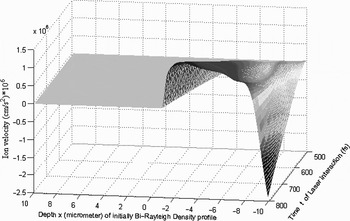
For comparison with Figure 4 for the irradiation intensity I of 1016 W/cm2 of the neodymium glass lasers on deuterium plasmas, the interaction of a 300 fs laser pulse with an initially 10 eV hot plasma with an alpha value of 0.959 × 104 cm−1, and an initially 20 µm thick bi-Rayleigh density profile (in contrast to the 100 µm thick profiles considered (Hora, Reference Hora1991, Fig. 10.17)) was studied. The print of the ion velocity profile for this study is shown in Figure 5. Again a compressing plasma block of about 7.5 vacuum wavelengths thickness is generated.
Ion velocity vi(x) profiles of a 20 µm initially bi-Rayleigh deuterium plasma layer with α = 0.959 × 104 cm−1 at an initial temperature of 10 eV depending on time t for a 300 fs laser pulse of 1016 W/cm2 intensity beginning at 500 fs.

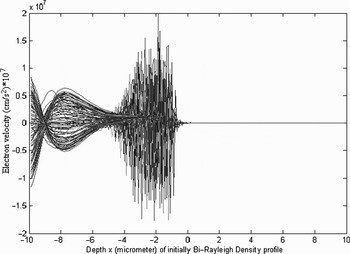
For the same case, Figure 6 shows the printout of the profiles of the electron velocity in the x-direction (parallel to the laser axis). These correspond to the laser driven Langmuir oscillations with maximum amplitudes of 2 × 107 cm/s. It is noticed that the maximum quiver velocity under these conditions (perpendicular to the x-direction) is 1.59 × 109 cm/s, confirming the result obtained by many earlier numerical studies (Hora, Reference Hora1991) that the longitudinal electric field is always smaller by at least a factor of 10 compared with the transversal electric field of the laser.
Overdrawn electron velocity profiles parallel to the laser propagation vex(x) of the case of Figure 5.

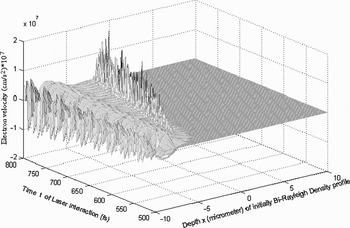
The printout of the electron velocity profiles depending on time (Fig. 7) is of interest with its wedge-like result. Apart from the oscillating motion against the laser light between −10 and −9 µm, one sees that the wedge develops with a speed of about 1.5 × 109 cm/s, therefore sufficiently below relativistic conditions permitting the quasi-stationary computations of the laser field and of the laser energy density for the nonlinear force in due course for each time step as performed in the code.
Time resolved result of Figure 6.

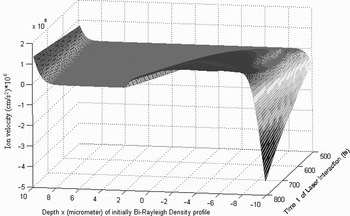
To show how sensibly the computation reacts on very minor changes of the parameters—this may not be related to the final practical problems of the experiments—Figure 8 shows different results, compared with those presented in Figure 5, for the ion velocity profiles, when the initial density profile is increased by 0.1%.
Ion velocity results for the same case as in Figure 5 but with initial temperature 100 eV and a 0.1% higher initial density.

Further the acceleration of the plasma in the compressing block is considered, which was formed during the 300 fs interaction at 3 × 1018 cm/s2. This is compared with the results obtained by Sauerbrey (Reference Sauerbrey1996) (see Hora et al., Reference Hora, Badziak, Read, Li, Liang, Liu Hong, Zhang, Osman, Miley, Zhang, He, Peng, Glowacz, Jablonski, Wolowski, Skladanowski, Jungwirth, Rohlena and Ullschmied2007) for an acceleration of 1020 cm/s2 where KrF laser pulses of the same duration are interacting with fully ionized carbon at 10 times higher laser intensity. The comparison results in an agreement that a dielectric swelling by a factor of 4.33 to 6.5 is included in our case (Fig. 5). This higher swelling than in the case of Sauerbrey (Reference Sauerbrey1996) is reasonable, because the effective skin layer has to be enlarged by about the same factor to obtain the nearly 7.5 vacuum-wavelength thick plasma block moving into the target.
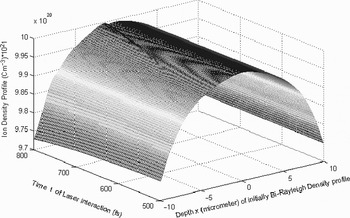
For completion, Figure 9 is showing the ion density profile where one can see the generation of the caviton, though the time is very short for the interaction involved.
Ion density profile to the case of Figure 8.

PLASMA BLOCKS AT VARYING LASER INTENSITY
The detailed case discussed in the preceding section is related to a 100 times lower laser intensity than considered in the case shown in Figure 2. Figure 10 presents the overdrawn printout of the ion velocity profiles for 300 fs laser pulses, the same α, but an initial temperature of 100 eV at irradiation by a 1018 W/cm2 laser pulse.
It should be realized that the following comparison is very much simplified, since any time dependence of the swelling factor and the difference in the initial temperature is resulting in much more complicated details. Nevertheless, we compare the case of the Figure 5 with an ion velocity in the compressing block of 1.3 × 106 cm/s with that of Figure 10 with a 100 times higher laser pulse intensity. The ion velocity is then 11.4 × 106 cm/s and one may relate these numbers by

where I is the laser intensity and ɛi the ion energy in the block. This numerically derived result (8) agress exactly with the measured energy of the fast directed ions (Badziak et al., 1999)
Overdrawn velocity profiles for the same conditions as in Figure 5, but at initial temperature 100 eV and at intensity 1018 W/cm2 of the laser pulse.

These elaborations were performed mainly to demonstrate that rather thick blocks of the “effective skin layer” may be available for the plasma block ignition processes in the area A1 of Figure 1. This is one alternative option of fast ignition for fusion energies at comparably low compression or even solid state density of the deuterium tritium fuel. These advanced results for increased thicknesses were used as parameters for estimating how the block ignition of low compressed or uncompressed solid fusion fuel may eventually be possible (Hora, Reference Hora2007). We note that the block ignition scheme is just in an early stage of exploration, and by far not comparable with the generation of fusion energy using nanosecond laser pulses (Moses et al., Reference Moses, Miller and Kauffman2006, Bigot, Reference Bigot2006) for spherical compression of fuel. It should not be neglected that a number of phenomena have to be clarified for the block ignition first, e.g., the stopping power mechanism of the alpha particles in the fusion reaction, for instance, whether these are following the Gabor (Reference Gabor1952) collective effect (Hora et al., Reference Hora, Malekynia, Ghoranneviss, Miley and He2008). Significant experimental results (Kerns et al., Reference Kerns, Rogers and Clark1972; Bagge & Hora, Reference Bagge and Hora1974; Hoffmann et al., Reference Hoffmann, Weyrich, Wahl, Gardes, Bimbot and Fleurier1990, Reference Hoffmann, Blasevic, Ni, Rosmej, Roth, Tahir, Tauschwitz, Udera, Vanentsov, Weyrich and Maron2005) drastically indicated that standard binary collision models for the stopping power do not agree with the measurements, and the collective effect is predominant.
CONCLUSIONS
Based on the very detailed genuine two-fluid hydrodynamic plasma code (Lalousis & Hora, Reference Lalousis and Hora1983; Cang et al., Reference Cang, Osman, Hora, Zhang, Badziak, Wolowski, Jungwirth, Rohlena and Ullschmied2005) laser interaction shows how plasma blocks of many vacuum wavelength thickness of plasma in the direction of the laser beam are generated, similar to earlier one-fluid computations (Lawrence, Reference Lawrence1978, Hora, Reference Hora1991) but now with very many more details. The larger thickness is a result by using initial plasma densities with Rayleigh profiles while initial linear ramps of densities could not produce (Cang et al., Reference Cang, Osman, Hora, Zhang, Badziak, Wolowski, Jungwirth, Rohlena and Ullschmied2005) such large thicknesses.