I. Puzzle: a weak universal welfare state
The Korean welfare state has made some notable expansionary moves over the last few decades. The population coverage of social insurance programs has been substantially expanded since democratization in the late 1980s and especially after the Asian Financial Crisis of the late 1990s. The national pension scheme, which had been expanded to cover all workplaces with 10 or more employees in 1988, was extended to farmers and fishermen in 1995, and to all self-employed in 1999.Footnote 1 In 1989, the national health insurance program was expanded to cover the self-employed and reformed in 2003 to a single insurer system by integrating multiple autonomous insurance societies under the National Health Insurance Cooperation. Unemployment insurance was introduced in 1995 and expanded by 1998 to cover all workplaces with at least one employee. Observers of the changes once predicted that Korea might become similar to the conservative welfare states of Western Europe (Ramesh, Reference Ramesh and Linda2003).
In addition to working towards universal coverage of social insurance, the government has expanded the coverage of the previously means-tested, general tax-funded programs. In 2008, the government introduced the Basic Old Age Pension, which aimed to eventually provide universalistic income support for the elderly. The scheme currently provides cash benefits to bottom 70% of the elderly (above 65) population. Since the 2000s, the government has rapidly increased its commitment to early childhood education and childcare as well. During the Roh (2003–2008) administration, tax-funded childcare benefits were extended for the first time to middle-class families. In 2013, a new integrated curriculum for pre-school-aged children (the Nuri Curriculum) was introduced, supported by policies for free education and care for all 5-year-olds (2012) and for all 3 and 4-year-olds (2013). Observers of such changes suggest that the country might be moving closer to the social democratic welfare states of the Nordic countries (Kuhnle, Reference Kuhnle2004), considering that Korea's social protection schemes are less occupationally-stratified and more universalistic in coverage compared with those in conservative welfare states (Estévez-Abe and Kim, Reference Estévez-Abe and Kim2014; An and Peng, Reference An and Peng2016).
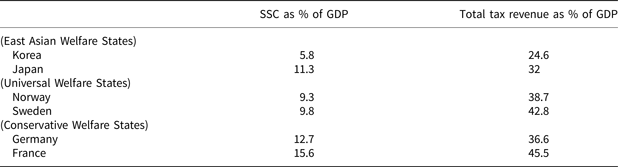
Despite the country's progress in expanding the population coverage or breadth of the welfare state, the generosity or depth of protection remains shallow. Korean social insurance system maintains a ‘low-contribution-low-benefit’ strategy (Kwon, Reference Kwon2003; Kang et al., Reference Kang, Jang, Lee and Park2012). As summarized in Table 1, social security contributions (SSC) from employers and employees together account for only 5.8% of the GDP, much lower than those in Japan as well as most European welfare states.Footnote 2 The country's non-contributory welfare programs are also constrained by its modest tax revenue accounting for less than a quarter of GDP (24.6%). Ambitious universalistic programs such as the Nuri Curriculum inevitably face fiscal challenges. Some local governments have repeatedly refused to allocate the budget for the Curriculum, complaining that the program is simply beyond their fiscal capacity.Footnote 3
Social Security Contribution (SSC) and Tax Revenue across Welfare Regimes

Source: OECD, 2014.
While existing comparative analyses suggest that the broad-but-shallow system of social protection is common to East Asian countries,Footnote 4 the feature is more pronounced in South Korea even when compared with other ‘productivist’ or ‘developmental’ welfare states in the region (Holliday, Reference Holliday2000; Kwon Reference Kwon2005; Rudra, Reference Rudra2007). As seen in Table 2, the breadth of protection (measured by the proportion of potential beneficiaries actually reached) in Korea is wider than that in Singapore, but the depth of protection (operationalized by per capita expenditure normalized as % of poverty-line income in each country) is markedly shallower.
Social Spending Depth and Breadth in Three East Asian Countries

The data are from the Asian Development Bank’s Social Protection Index (SPI).
Spending data are from 2013; Depth and Breadth data are from 2012-the latest available data.
To account for the weak (i.e., low generosity) universalistic (i.e., broad coverage) feature of the Korean welfare state existing studies focus on the political elites’ responses to simultaneous pressures from democratization and economic globalization. The financial crisis of 1997, which exposed an unprecedentedly large segment of citizens to economic insecurity, coincided with the rise to power for the first time in the nation's history of a progressive leadership (i.e., the Kim administration 1997–2002, followed by the Rho administration 2003–2008). On the one hand, the political will and leverage of progressive presidents explain a modest transition toward a universalistic welfare state amid the weak power resource of the left (Yang, Reference Yang2017). On the other hand, the post-crisis imperatives to correct the maladjustment to globalization (Song, Reference Song2003) and to bolster industrial competitiveness (Kwon and Holliday, Reference Kwon and Holliday2007) account for the largely instrumental, rather than de-commodifying, nature of the transition, which limited the generosity of welfare programs.
This paper contributes to the literature by offering a citizen-centered perspective on the country's move toward a weak universal welfare state. In Section II, I begin by highlighting that the current status of the welfare state rather accurately mirrors the popular attitude. A substantial majority of Koreans support welfare state expansion, yet a large segment of the supporters decline to share the fiscal burden associated with the desired expansion. A question that logically follows is: why are citizens sympathetic to welfare state expansion reluctant to pay for it? Answering the question in the context of South Korea is key to discussing the prospect of either a continuation of or a break from the weak universalism in the country.
In Section III, I propose a set of explanations that posit risk pooling as a dominant motivation for welfare state support. I argue that, despite a broad-based need for public risk pooling through the welfare state, citizens are reluctant to increase their contribution due to (1) the (perceived) unfairness in contribution among citizens with similar capacity and (2) the (perceived) unfairness in the fiscal exchange with the government. In Section IV, my expectations are empirically tested using a nation-wide survey conducted in 2014 by the Korea Institute of Public Finance (KIPF). Section V concludes with policy implications.
II. Many Koreans say ‘I Support Welfare State but Won't Pay More’
According to a nation-wide survey of nearly 6000 respondents (KIPF, 2014), a significant majority (59%) support welfare state expansion. Around a third consider themselves as neutrals. Only 11% oppose the expansion. The picture dramatically changes, however, when the same respondents are asked about willingness to pay (WTP) for the expansion. Nearly half of the self-identified supporters reject any burden-sharing, not even a 1% tax increase (see Table 3).
Distribution of Welfare Preferences among Korean Citizens (KIPF, 2014)

a Do you support the expansion of welfare policy for the low income?.
Of course, all societies have citizens who exhibit the so-called ‘something for nothing’ attitude (Citrin, Reference Citrin1979, Reference Citrin1997). As Sears and Citrin describe in the context of the USA ‘the disjoint between opinions about tax and spending is entrenched among a substantial portion of the citizenry in all segments of society’(Sears and Citrin, Reference Sears and Citrin1985: 260). Edlund and Johansson Sevä (Reference Edlund and Johansson Sevä2013a) find that the disjoint is also observed in the context of the most mature and generous welfare states such as Sweden. According to Svallfors (Reference Svallfors2011), however, the proportion of the Swedish citizens willing to pay more for their welfare state is still larger than the proportion who want the government to increase welfare spending, leading the author to conclude that the Swedish welfare state still enjoys a ‘bedrock of support’ among its population (Svallfors, Reference Svallfors2011). This is in contrast to South Korea, where the population that want the government to expand the welfare state far outnumber the willing contributors (59% and 45%, respectively in Table 3). In essence, the ‘something for nothing’ attitude seems prevalent enough to render the fiscal base for welfare state expansion frail. Some even suggest that such an attitude is one of the most representative characteristics of the welfare attitudes among Koreans (Kim and Yeo, 2011).
Why do individuals supportive of expanding welfare transfers reject any tax increase for the expansion? Existing literature proposes several explanations. The most well-known one is ignorance or confusion. The connection between tax and transfer policies is too complicated to understand for ordinary citizens (Bartels, Reference Bartels1996, Reference Bartels2005), which leads the ill-informed to hold contradicting policy preferences such as supporting regressive tax cuts and progressive transfers at the same time. It is plausible that Koreans who generally lack personal experience with welfare policies find it more difficult to comprehend the tax and transfer nexus underpinning the welfare state, and are thus more prone to show ignorance-induced inconsistencies in attitudes than ordinary Swedish citizens.
Being in a vulnerable economic position might also force one to be a free rider. In the Swedish context, the attitudes of supporting yet being unwilling to pay for the welfare state are indeed observed mainly among the economically vulnerable (Edlund and Johansson Sevä, Reference Edlund and Johansson Sevä2013a). If so, the prevalence of ‘something for nothing’ attitudes in Korea might be attributable to the fact that there are more economically vulnerable citizens in the country than in the generous welfare states such as Sweden.
While I do not dismiss these explanations, I present in Section III an alternative explanation highlighting the citizen perceptions of the tax and transfer system (un)fairness. I begin with an argument that the primary function of the Korean welfare state has been risk-pooling. With the decline of labor market security and alternative means of protection, the need for public risk-pooling has become increasingly broad-based. The resulting expansion of the welfare state to cover more people and more risk types, however, has made it challenging for citizens to assess and the government to assure the fairness of the risk pooling system. The welfare state supporters’ unwillingness to pay is then attributed to (1) the perception of unfair contribution vis-à-vis others with similar capacity and (2) the perception of unfair fiscal exchange with the government.
III. Theoretical framework
Risk-pooling welfare state
To understand citizens’ attitude towards the welfare state, one must begin by asking what is seen as a primary role of the welfare state in the eyes of citizens. Existing studies suggest that individuals’ perception of the welfare state and their opinion towards it reflect their experience of having lived in one or another kind of welfare regime (Andreß and Heien, Reference Andreß and Heien2001; Edlund and Johansson Sevä, Reference Edlund and Johansson Sevä2013b; Jæger, Reference Jæger2006, Reference Jæger2009; Larsen, Reference Larsen2007). One important distinction made in the literature is the welfare regime's relative focus on inter-class redistribution versus horizontal risk-pooling. While the two functions co-exist in almost all existing welfare states (Iversen and Rehm, Reference Iversen and Rehm2016), they can be viewed as analytically distinct; for instance, Barr (Reference Barr2001) distinguishes the risk-pooling or ‘Piggy Bank’ function of the welfare state from the redistribution or ‘Robin Hood’ function. While social protection in the liberal welfare state of the USA is shallow in terms of generosity, the financing of the protection is based on highly progressive taxation (Beramendi and Rehm, Reference Beramendi and Rehm2016), which fosters a socioeconomic class cleavage over social protection. This leads citizens to focus on the ‘‘Robin Hood’ function when forming attitudes toward the welfare state. On the other hand, the social insurance programs in conservative welfare states have relied on fiscal contributions from labor market insiders and protected these insiders. The relative socio-economic homogeneity within risk pools induces citizens to focus on the ‘Piggy Bank’ function in assessing the desirability of the welfare state. These societies exhibit weaker class-based cleavages (Fernández-Albertos and Manzano, Reference Fernández-Albertos and Manzano2016), but instead could develop salient insider-outsider cleavages.
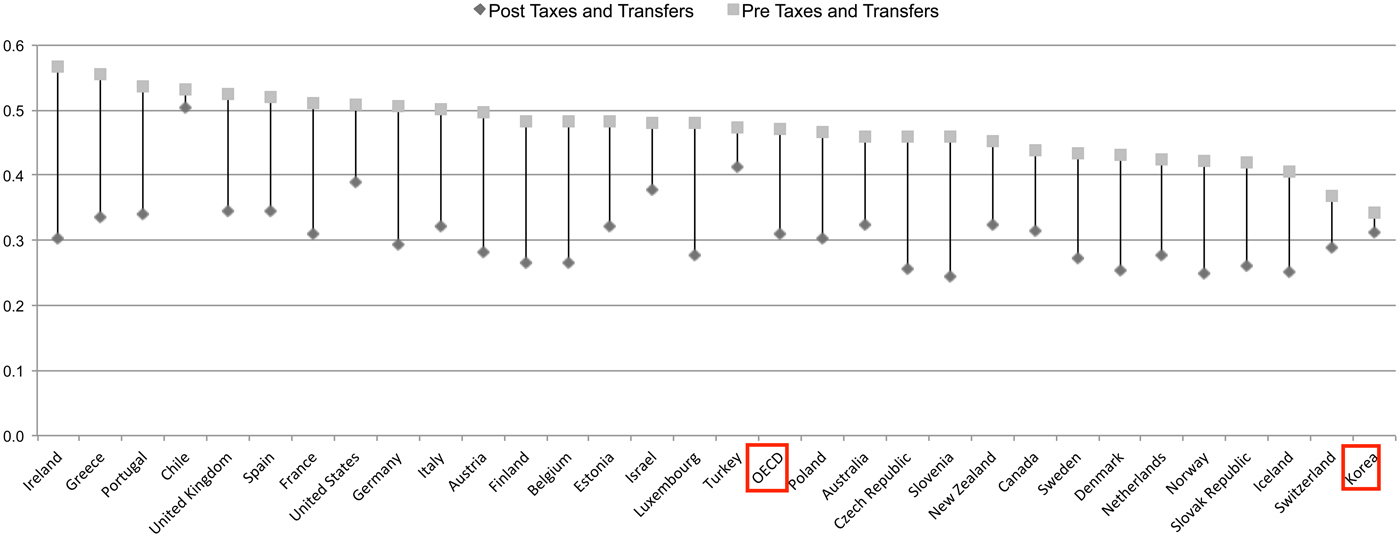
What about South Korea? The tax and transfer system underpinning the Korean welfare state has been one of the least progressive in the OECD (See Figure 1), and even among the regional neighbors (recall Table 2). Part of the reason is historical. As South Korea began industrialization under exceptionally low inequality (Rodrik, Reference Rodrik1995; Acemoglu et al., Reference Acemoglu, Angélica Bautista, Querubin and Robinson2007), the socio-economic class cleavage was weak, to begin with. Moreover, the country experienced a labor shortage already in the early 1980s, still in the middle of its labor-intensive industrialization process. The shortage encouraged employers to offer better working conditions to their workers via generous pay increases, a guarantee of lifetime employment, as well as various fringe benefits. Such private, company-level measures served as ‘surrogate’ social protection (Song, Reference Song2003; Kim Reference Kim2010) and managed to keep the industrial labor fragmented (Yang, Reference Yang2017). Class-based agendas never made it to the center stage of national electoral politics even after the country's democratization.
Differences in GINI Index between Pre and Post Taxes and Transfers (Source: OECD, data as of 2011/2012).

Rather, welfare state expansion in democratized Korea has been a process of the harmonization of risk pooling among the relatively socio-economically homogeneous populations. Instead of relying on private (either company level or family level) solutions to insure themselves against various social risks, an increasing share of the population encompassing the rural farmers and the urban self-employed delegated the government to manage their risks. Welfare state attitudes of individual citizens should be understood in this broad context.
The following subsection presents my main hypotheses based on the assumption that the Korean welfare state, as perceived by its citizens, is primarily a piggy bank type of a risk-pooling welfare state, rather than a redistributive welfare state.Footnote 5 The expectations about support for the expansion of a risk-pooling welfare state are followed by the expectations about supporters’ willingness to increase contributions to the public risk pool. I then present an additional set of hypotheses presupposing that individuals view inter-class redistribution as the primary role of the welfare state. I test both sets of hypotheses in Section IV. Although the two sets of hypotheses are not mutually exclusive, I expect to find more consistent support for my main hypotheses than the additional set.
Main hypotheses
Support for the expansion of public risk-pooling
Citizens who face higher social risk but enjoy an inadequate level of protection under the existing system are expected to be more supportive of the expansion of public risk-pooling. In South Korea, as in many other economies, individuals’ employment status is a key determining factor for both the level of exposure to labor market risks and the level of protection. Existing empirical studies note that there is a significant difference between regular/permanent workers and temporary/irregular workers not only in wages but also in access to employer-provided non-obligatory welfare services (Bae, 2005; Oh, 2014). Before the financial crisis, the non-wage benefits workers at large firms received amounted to a third of monthly wages (Song, Reference Song2003). This kind of benefits is less generous for employees at small and medium-sized firms and non-existent for temporary workers. The latter are often banned from joining the company union that represents regular workers (Koo, Reference Koo2007), so are excluded altogether from the negotiation for company welfare.
Aside from regular workers at large firms, another group that enjoys a particularly generous level of protection under the current system is public sector employees. They are covered by a separate occupational scheme (Public Employees’ Pension scheme) providing more generous benefits than the rest of the population's National Pension, and are entitled to maternity and childcare leave that are often not accessible in practice to private sector workers. In short, the public sector employees are better protected against the risks arising from life cycle uncertainties. I thus expect that regular employees in the public sector, together with regular employees at large private firms, would be less enthusiastic about expanding public risk pooling than the rest of the population. Workers with a temporary contract, to the contrary, would be more supportive of the expansion due to their higher risk of future income loss and the lack of access to company welfare. I thus propose the following hypotheses:
H1.1. Regular employees in the public sector or at large private firms are less likely to support the expansion.
H1.2. Employees with a temporary contract are more likely to support the expansion.
At the macro level, a series of post-crisis reforms toward labor market flexibility has reduced the proportion of industrial workers entitled to company welfare. Even the relatively well-organized workers in big firms experienced large-scale layoffs or faced aggressive early-retirement plans (Koo, Reference Koo2007). The proportion of temporary employment without proper protection has sharply increased. As of 2015, temporary workers account for 22.3% of all dependent employees in South Korea, which is double the OECD average (11.3%). The trend has generated a growing need for public risk pooling, which explains broad-based support for welfare state expansion in Korea.
Supporters’ WTP
An individual who supports the expansion of public risk-pooling would be willing to pay for it as long as she believes her contribution would deliver that extra protection she needs. This depends on, among others, two key conditions. First, other participants of risk-pooling should not free-ride and deplete her contribution. That is, the risk-pooling system should uphold the inter-citizen fairness or horizontal fairness (vis-à-vis other citizens). Second, the pooled resource should be managed properly to allow participating citizens to receive adequate and timely protection. That is, there should be a fair fiscal exchange between a citizen and the government or reciprocal fairness (vis-à-vis government). In South Korea, the recent expansion of the welfare state to cover more people and more risk types has made it increasingly challenging for ordinary citizens to assess and the government to assure the system fairness.
Take the case of the national health insurance system integration in 2000, which was a move primarily to address the inequity in contributions between the self-employed at different regional health insurance societies. ‘Horizontal inequity, whereby people with the same earnings paid different contributions depending on which insurance society they were (mandatorily) enrolled in, despite identical statutory benefits, caused concerns about the unfair burden of health insurance contributions’ (Kwon, Reference Kwon2008). The integration reform in 2000, however, failed to address the equity between employees and the self-employed. Indeed, this dimension of the horizontal equity was substantially worsened since the integration. According to Jones (Reference Jones2010: 10), ‘contributions of employees have increased much faster than those of the self-employed since 2000’ and by 2008, ‘employees’ contributions were 87% higher than the self-employed, compared with 40% in 2000’. One reason for the gap is a lack of transparency about the income of the self-employed (Jones, Reference Jones2010: 24). Various estimations suggest that the reported income of self-employed households is as low as 50% to, at best, 80% of the real income, and the under-report rate is higher for the higher income self-employed.Footnote 6 The steady increase in the already sizeable self-employed population (Yang and Klassen, Reference Yang and Klassen2010) may continue to undermine the sense of horizontal fairness and increase the concerns over the long-term financial viability of the current system.
Similarly, rows over pension reform which have continued over the past few years also focus on issues of horizontal fairness, in this case between civil servants covered by the Public Employees’ Pension and the rest of taxpayers enrolled in the National Pension. While the latter went through substantial reform measures for financial sustainability,Footnote 7 the planned reforms for the Public Employees’ Pension repeatedly met a strong backlash from the unionized public employees. An editorial in The Korea Times writes that ‘ordinary citizens are asking why they are forced to pay more taxes to shore up the civil servants’ pension fund. Especially, company workers are raising questions about the fairness in pension reform.’Footnote 8
The debates over the general tax-funded child care have also centered mainly on horizontal, non-class-based, distribution of benefits between different types of households. Jang (2013)’s content analysis of major daily newspaper articles from March 2012 to May 2013 finds that both conservative and progressive voices were supportive of general tax-funded child care programs. One key area of contention, instead, was how the limited pool of resource should be shared between stay-at-home mothers and working mothers. Conservative media and politicians asserted that stay-at-home mothers overuse the all-day-service at the disadvantage of working mothers who need the service more. A survey conducted in 2015 by the private polling agency Realmeter reflects a broader public concern on the matter. 62% of the respondents were in favor of restricting stay-at-home mothers’ use of all-day (12-hour) care.Footnote 9 In 2016, the government decided to restrict the free daycare access for stay-at-home mothers to up to 7 hours daily.
Apart from the perception of inter-citizen unfairness, citizens might perceive that the government is at fault for not providing a full protection equivalent to taxpayers’ contribution (Feld and Frey, Reference Feld and Frey2007). Citizens’ belief about reciprocal fairness vis-à-vis the government, as with government legitimacy in general, is ‘grounded in evidence concerning government performance and updated with changes in government behavior’ (Levi and Sacks, Reference Levi and Sacks2009: 311–312). In South Korea, the reciprocal fairness perception has been hampered by repeated allegations of a waste of taxpayers’ money to government corruption and mismanagement. For instance, the National Board of Audit and Inspection estimates that indiscreet overseas investments by the state-owned companies under the former president Lee Myung-bak (2008–2012) ‘energy diplomacy’ platform led to the loss of public funds amounting to Won3.4tn ($ 3.1bn).Footnote 10 In areas more directly relevant to the welfare budget, salient events like the arrest of the Chief of the National Pension Service (NPS) on charges of illegally ordering the fund to vote for the Samsung merger undermine the citizens’ reciprocal fairness perception. Despite the fund's proxy advisers’ recommendation to block the merger, in 2015 the NPS voted in favor of Samsung, which costed pensioners billions of dollars in lost value.Footnote 11 The event raised public concerns over the transparency in the NPS’ exercise of voting rights.Footnote 12
In short, without enhancing the transparency and independence of the fiscal authorities, citizens would continue to doubt the reciprocal fairness of the risk pooling system. They would decline to increase their contribution because (they believe) the government should be able to offer more generous protection without collecting more taxes from them. Based on the discussion, I propose the following hypotheses:
H1.3. The supporters’ WTP would decrease when other taxpayers with similar capacity are seen as contributing less than they are.
H1.4. The supporters’ WTP would decrease when government benefits are perceived to be less than commensurate with their tax payments.
At the macro level, wide-spread unfairness perceptions result in a weak fiscal support base for welfare state expansion even when the diminishing accessibility and adequacy of private protection foster broad-based demand for public risk pooling.
Additional hypotheses
This subsection presents an additional set of hypotheses which assume that the primary motive of welfare state support is pro-poor redistribution.
Support for the expansion of redistributive transfers
The expansion of the redistributive welfare spending entails increased net transfers to the poor. I thus hypothesize that self-interested individuals with lower economic status would be more supportive of the expansion (Meltzer and Richard, Reference Meltzer and Richard1981) than the rest of the population. The perception of vertical (inter-class) inequity under the current system, which provokes a normative (as well as self-interested) commitment to equality (Norton and Ariely, Reference Norton and Ariely2011; Rueda Reference Rueda2016; Dimick et al., Reference Dimick, Rueda and Stegmueller2017), might also explain one's support for redistributive spending. Compared with those who think the system assures inter-class fairness, those perceiving the current system to be regressive would exhibit a higher level of support for redistributive transfers as a means to mitigate the pro-rich bias.
H2.1 Citizens of the lower economic class are more likely to support the expansion.
H2.2 The perceived regressiveness of the current tax system would increase the support for the expansion.
Supporters’ WTP
The WTP is expected to vary among the supporters of redistributive transfer expansion. In general, lower economic class supporters would be less willing to contribute not only because they are less capable (Edlund and Johansson Sevä, Reference Edlund and Johansson Sevä2013a), but also because they consider themselves as the legitimate recipients of such transfers. Moreover, given that the supporters of a redistributive welfare state are inequality-averse, the upper economic class supporters value an additional dollar forgone to improve inequality less than the poor (Dimick et al., Reference Dimick, Rueda and Stegmueller2017) so would exhibit a higher WTP than the lower economic class supporters.
The perceived inter-class unfairness could also drive the WTP among the supporters of a redistributive welfare state. More specifically, the perception that the current tax system is regressive would undermine the WTP among the lower economic class supporters, because their net benefits are smaller under a regressive system than under a fair system where the rich contribute more. Among the upper economic class supporters, however, the perceived regressivity should not undermine the WTP. The perception might even encourage the wealthy supporters to pay more because their increased contribution could mitigate the system's regressivity.
H2.3. Supporters with lower economic class would be less willing to contribute.
H2.4. The perceived regressivity of the tax system would decrease (/increase) the WTP among the supporters with low (/high) economic status.
IV. Empirical analysis
I empirically test the hypotheses derived in the previous section using the 7th wave of the National Survey of Tax and Benefit (conducted in 2014 and made publicly available in 2016). In light of my focus on the disjoint in welfare attitudes, the Survey of Tax and Benefit has an important advantage over other national social surveys. As part of the survey, the participants report in detail their income and wealth breakdowns, payments of different type of taxes including SSC, and the receipt of various cash and in-kind benefits. The survey also features a high retention rate; 87% of the respondents in the 2014 survey have been participating in at least six waves. The repeated participation allows the respondents to be well-informed about new taxes and transfers and keep a good track of their contributions and benefits. I thus expect the respondents of the survey to be more knowledgeable about tax and transfer systems than those of other surveys and much less subject to the ignorance-induced attitudinal instability.
Data and operationalization
Dependent variables
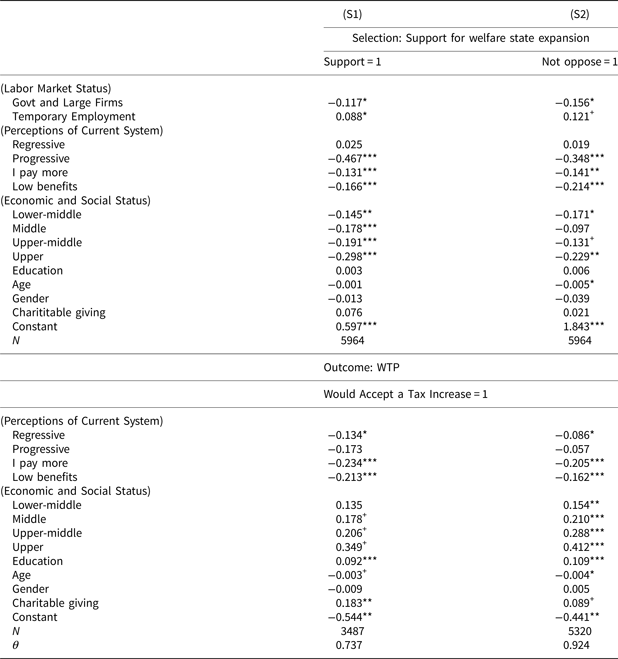
My dependent variables are the two dimensions of welfare state attitudes: (1) support for welfare state expansion (Support hereafter) and (2) willingness-to-pay for the expansion (WTP hereafter). The Support question in the survey is translated as follows: ‘Do you support the expansion of welfare policy for the low income?’. Respondents who are neutral to or supportive of the expansion are then asked about their willingness to contribute to the expansion. The WTP among those who oppose the welfare state expansion, while expected to be low, is unknown.Footnote 13
It is important to note that the Support question's wording that mentions ‘the low income’ as the beneficiary might bias my findings. Unfortunately, the survey does not contain any other question on support for welfare state expansion. The bias from the wording, however, should work in favor of the redistributive welfare state hypotheses and make it harder to prove my main hypotheses which draw on the risk-pooling motivation. Or, the wording might not create much bias after all, given that it does not specify who the low-income beneficiaries are (i.e., the strictness of income test).Footnote 14
Independent variables
I include two indicators of labor market status to capture the level of protection enjoyed under the existing system: permanent employment at Government/Large Firms Footnote 15 (H1.1) and Temporary Employment (H1.2).
As an indicator of the horizontal fairness perception vis-à-vis other taxpayers (H1.3), I employ a dummy variable indicating those respondents who believe their tax burden to be higher than that of the others with similar economic capacity (I Pay More). To capture the reciprocal fairness perception vis-à-vis the government (H1.4), I include a dummy variable indicating those respondents who think the level of government benefits is lower than their tax contribution (Low Benefits).
The primary indicator of economic class (relevant for H2.1, H2.3, and H2.4) is Income. I also introduce Real Estate Asset as an additional indicator of economic class. Existing literature suggests that real estate investment has been the most important means of wealth accumulation by the Korean middle class (Koo, Reference Koo2007) and that real estate asset has contributed most to the increase in inequality during the past decade (Nam 2008).
To capture inter-class unfairness perceptions (H2.2 and H2.4), I employ two mutually exclusive dummy variables. They come from a single question that asks individuals about the inter-class fairness of the current tax system. Those who think the system favors the poor are assigned to Progressive, and those who think the system favors the rich are assigned to Regressive. The rest of the respondents (those who belove the system is fair for all or favors the middle class) belong to the reference category.
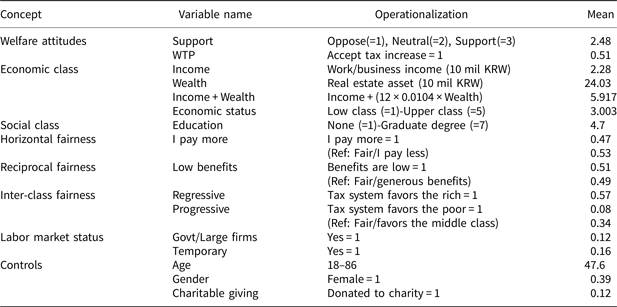
I also include a set of control variables. Education is included to capture the variation in social class. While the level of Education tends to be correlated with economic class, it is also expected to reduce the ignorance-driven disjoint in attitudes through raising capability to understand and scrutinize government policy. I also control for the respondents’ experience with Charitable Giving. I expect the variable to capture the variation in sympathy and altruistic personality among respondents. In addition, all models control for Age and Gender. See Table 4 for descriptive statistics.
Descriptive Statistics

Ref, reference category.
Findings
Support for welfare state expansion
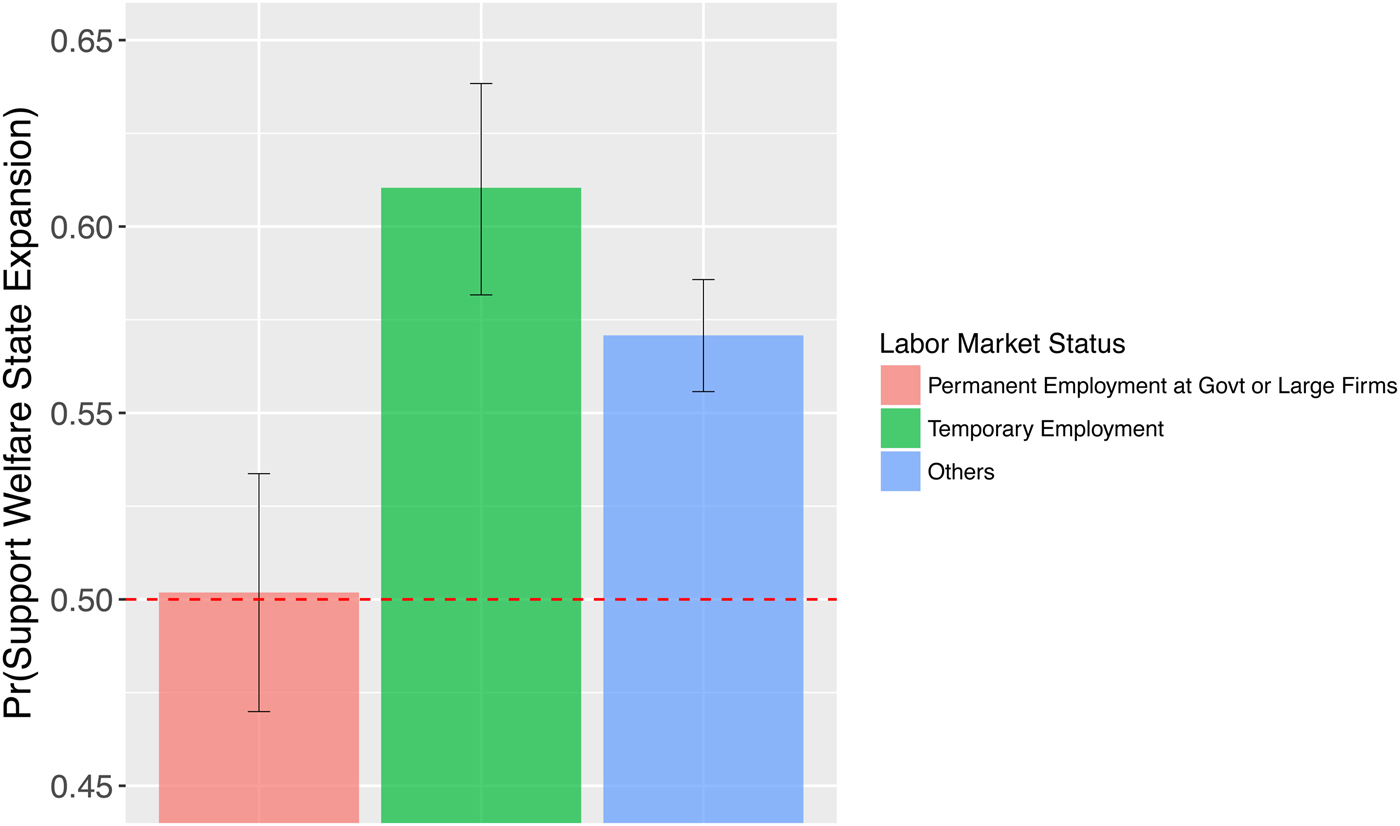
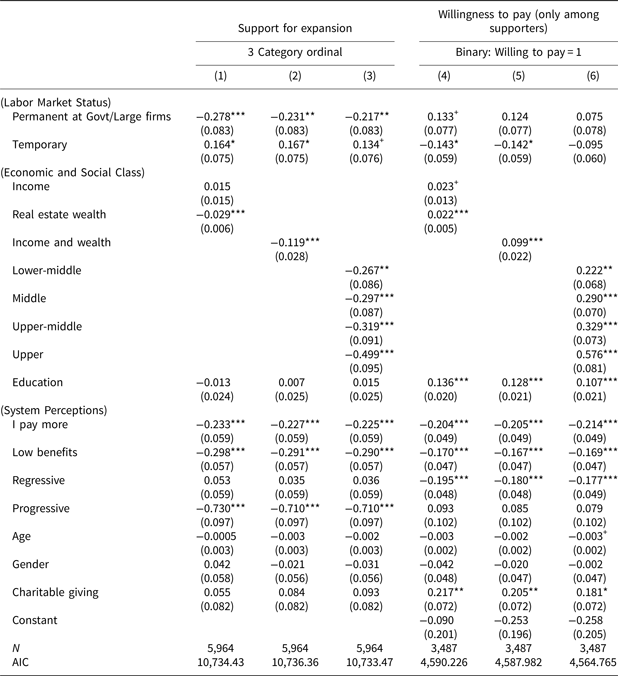
I begin by estimating models of Support. The results are reported in the first three columns of Table 5. Across all three models (Models 1–3), The effects of the labor market status variables are consistent with H1.1 and H1.2. Employment at Government/Large Firms has a negative effect on support as expected in H1.1. The effect of Temporary Employment is positive as hypothesized in H1.2. Based on the estimates of Model 1, Figure 2 visualizes predicted probabilities for Support (on the y-axis) over different labor market status while controlling all other variables at their mean values. The vertical black lines indicate 90% confidence intervals. Those with temporary contract are over 10% points more likely to support welfare state expansion than those with permanent positions in the public sector or at large firms. The findings lend support to my argument that the risk-pooling needs of the insecure spur welfare state support.
Effect of Labor Market Status on Support.

Determinants of Welfare State Attitudes

+P < 0.1; *P < 0.05; **P < 0.01; ***P < 0.001.
Moving on to the indicators of economic class, (logged) Income is not statistically significant in Model 1.Footnote 16 Lower income citizens are no more likely to support welfare state expansion than higher income citizens. The result is in line with the findings from the existing studies (Lee, 2009; Kim and Yeo, 2011) and against H2.1. Meanwhile, an additional indicator of economic class, (logged) Real Estate Wealth, has a negative and significant effect on Support. On the one hand, this result might be interpreted as supporting evidence for H2.1. Wealth might indeed be a more appropriate indicator of economic class than income (Nam, 2008). On the other hand, the result should be interpreted with caution. Real Estate Wealth might be a proxy for something other than economic class. As existing literature suggests (Schwartz and Seabrooke, Reference Schwartz and Seabrooke2008; Ansell, Reference Ansell2014), freehold ownership of housing sharply reduces the income requirements of the elderly and functions as a private alternative to social protection. When viewed in this way, the adverse effect of Real estate wealth on Support might be picking up the lower risk-pooling needs among the homeowners who already enjoy a decent level of aging and retirement security. The interpretation is in line with the risk-pooling welfare state perspective.
In Model 2, I employ an indicator of economic status that combines income and real estate wealth (Income and Wealth). In combining the two numeric indicators to one, I used the government's property-to-income-conversion rate (0.0104, month) applied to the owner-occupied property.Footnote 17 The coefficient estimate for this combined indicator is negative and significant.
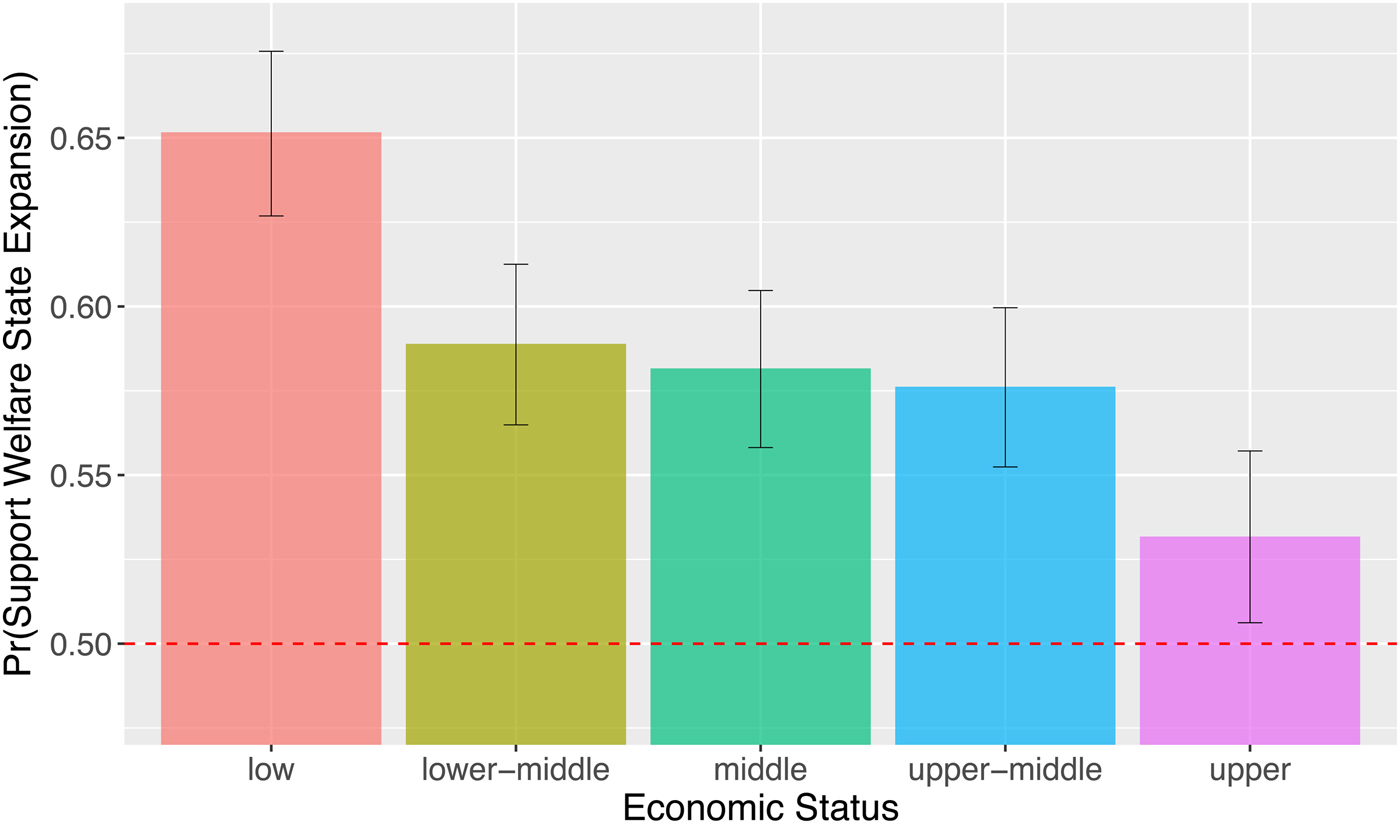
In Model 3, I employ a quintile measure of economic class (based on Income and Wealth). I enter them as separate dummy variables to allow for the potential non-linearity in economic status effect. The respondents whose income and real-estate wealth combined belong to the bottom 20% of the sample are classified as the low income, 21–40% as the lower-middle, 41–60% as the middle, 61–80% as the upper-middle, and those at the top 20% are classified as the upper income. The economic status effect based on Model 3 is visualized in Figure 3. I plot the predicted probabilities for Support (on the y-axis) by economic class. All other variables at set their mean values. The vertical black lines indicate 90% confidence intervals. While the lower and upper classes show distinctively higher and lower support, respectively, the support levels among the three middle groups (i.e., lower-middle, middle, and upper-middle), accounting for 60% of the respondents, are indistinguishable. Also, the probability that an upper-class citizen would support the expansion of the welfare state is still above 50% even when the 90% confidence intervals are taken into account. In sum, my findings suggest that a class cleavage over welfare attitude is observed in Korea once wealth is factored in, yet the magnitude of the cleavage is moderate.
Effect of Economic Status on Support.

As for the fairness perceptions variables, contrary to H2.2, the effect of Regressive is not significant in any Support model. Those believing that the system favors the rich are no more likely to support welfare state expansion than those who think the system is fair for all/favors the middle class. Interestingly, the coefficient estimate of Progressive is negative and highly significant in all three models. While the population who think the current system is progressive is small (only 8% of the respondents; recall Table 4), they exhibit much lower support for welfare state expansion than the rest of citizens. Lastly, I Pay More and Low Benefits both reduce the likelihood of Support.
Supporters’ WIP
The last three columns of Table 5 report the WTP models (Models 4–6). As noted earlier, only supporters of the welfare state expansion are included in the analysis.Footnote 18 In line with my main hypotheses (H1.3 and H1.4), the coefficient estimates of I Pay More and Low Benefits are negative and significant in all three models. The findings hold controlling for economic vulnerability (captured by economic status), ignorance (captured by education), and selfish/altruistic personality trait (captured by charitable giving).
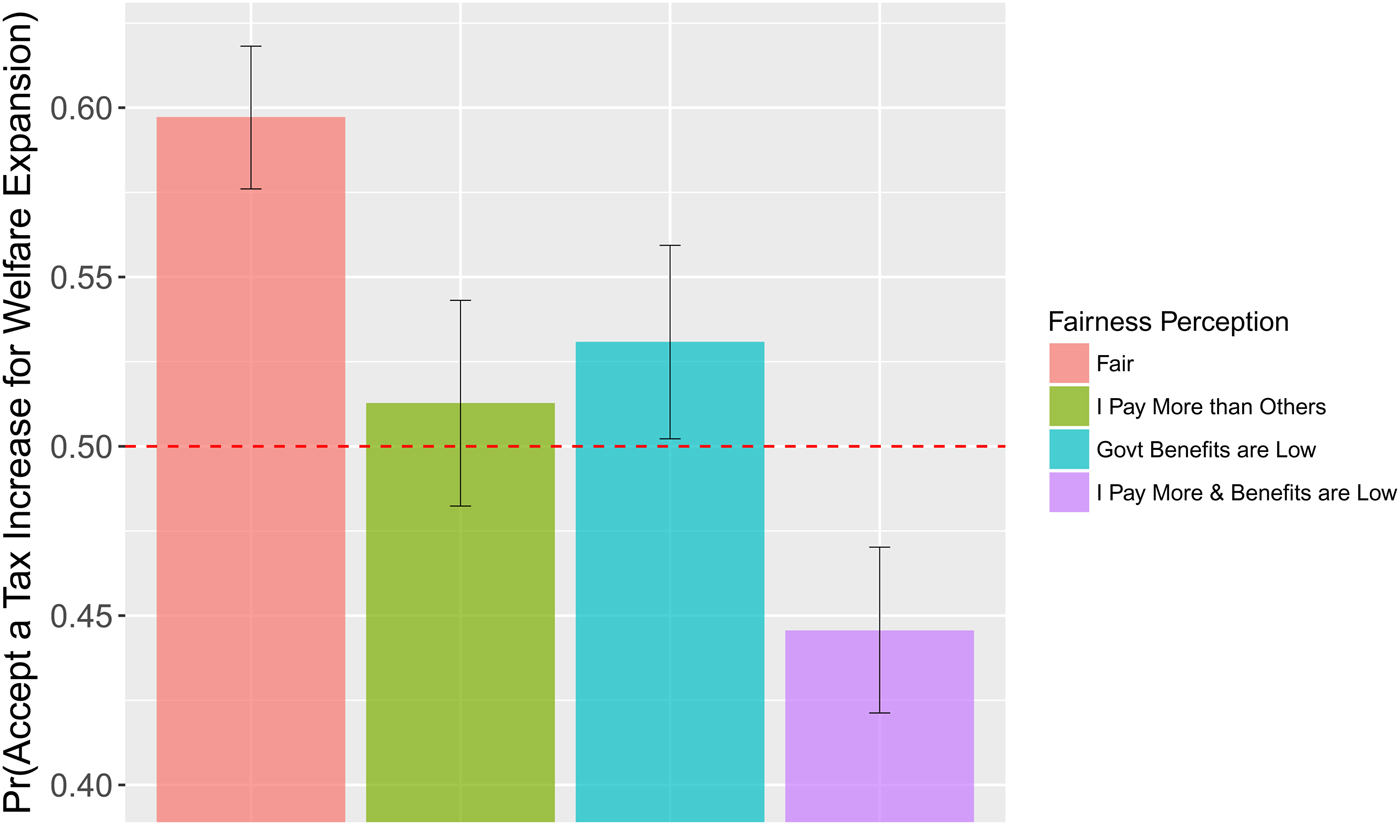
The substantive effects of I Pay More and Low Benefits on the supporters’ WTP are visualized in Figure 4. I plot the predicted probabilities of WTP (on the y-axis) over different combinations of fairness perceptions. The vertical black lines indicate upper and lower 90% confidence intervals. All else being equal (i.e., set at the sample mean values), when a welfare state supporter believes that the current system imposes a disproportionate tax burden on him and delivers low benefits, the probability that he accepts a tax increase for welfare state expansion is less than 45%. The finding attests to the importance of considering perceptions of horizontal (inter-citizen) and reciprocal (vis-à-vis the government) unfairness as sources of the disjoint in welfare attitudes.
Effect of Horizontal and Reciprocal Fairness Perceptions on WTP.

When it comes to the economic class variables, both Income and Real Estate Wealth are significant and positive. This lends support to H2.3. Temporary as an indicator of labor market insecurity also lowers WTP. These findings together are consistent with the explanation that economic vulnerability induces free riding on the welfare state (Edlund and Johansson Sevä, Reference Edlund and Johansson Sevä2013a). Education has a positive and significant effect on WTP, consistent with an expectation that education reduces the likelihood of an ignorance-driven disjoint in attitudes.
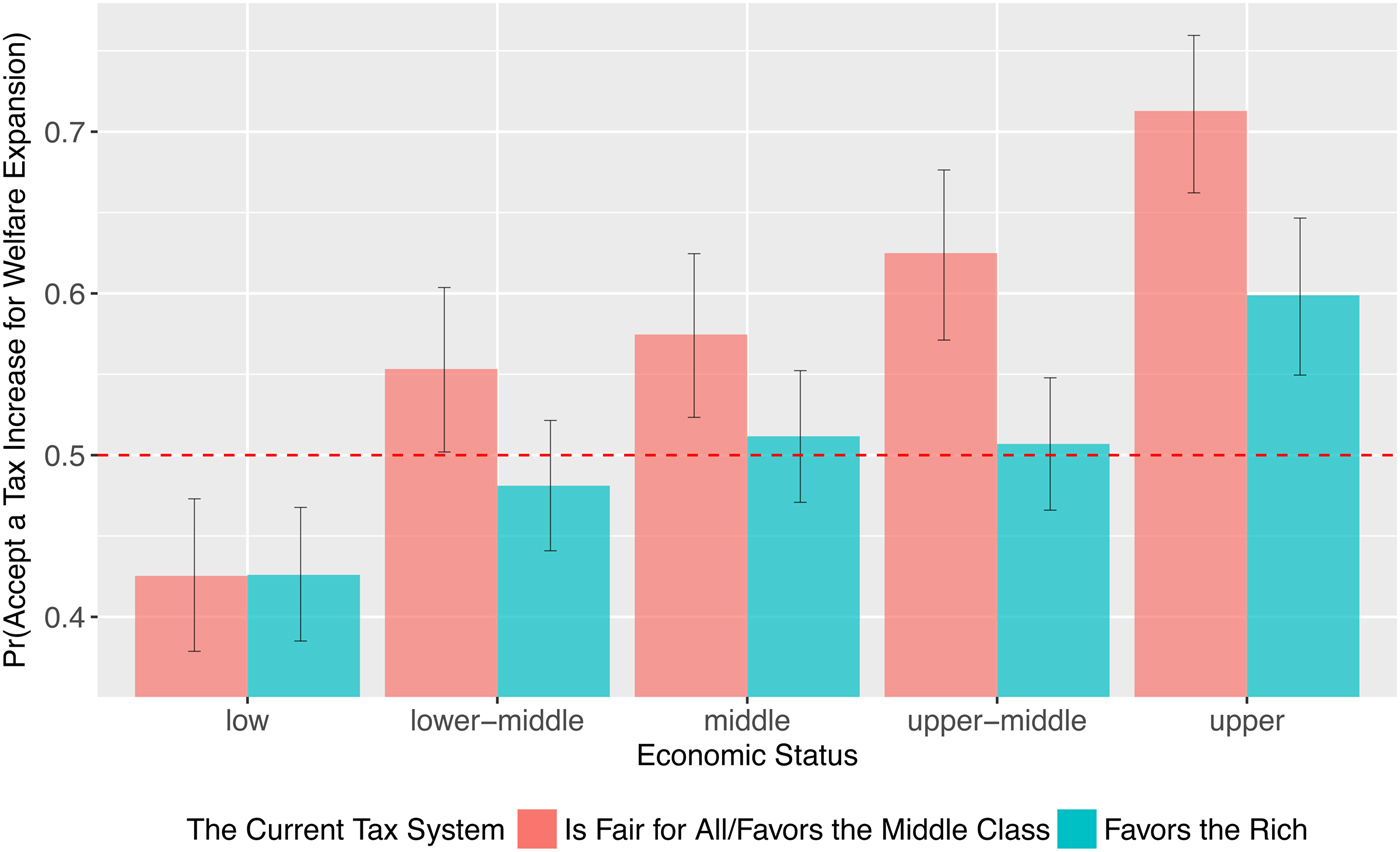
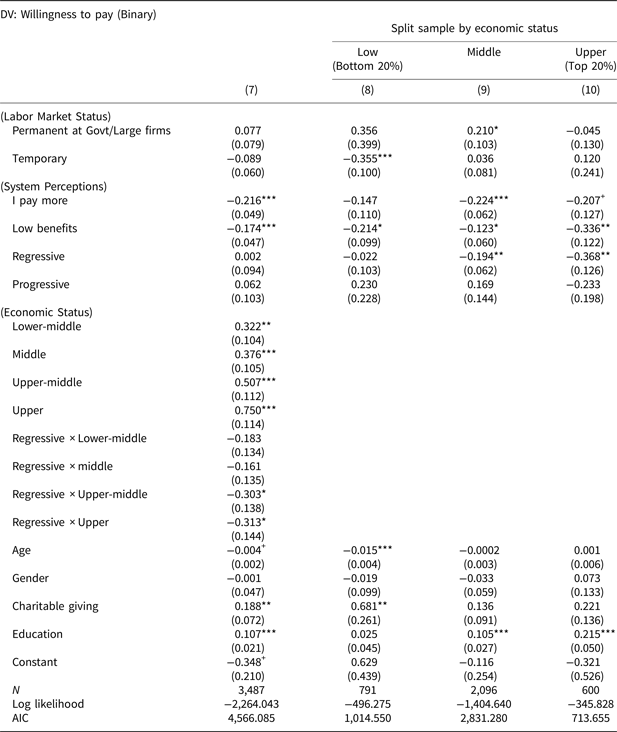
While Regressive was not a significant determinant of Support, it has a significant and negative effect on WTP in Models 4–6. To further explore the effect in light of H2.4, Model 7 in Table 6 examines how economic class and Regressive interactively shape WTP among supporters. Figure 5 visualizes the interaction effect estimated in Model 7. This time, I plot the predicted probabilities of WTP (on the y-axis) over economic status (on the x-axis) while fixing all other variables at their sample mean values. See the vertical black lines for upper and lower 90% confidence intervals. Contrary to H2.4, the WTP among the supporters with low economic status (the bottom 20%) is not affected by the system regressivity perception. Interestingly and, again, contrary to the expectation from H2.4, the WTP-undermining effect of Regressive is stronger among the richer respondents. Among the upper middle and upper-class respondents, WTP declines by over 10% points when the system is seen as regressive.
Effect of Economic Status and Redistributive Fairness Perception on WTP.

Determinants of the Welfare State Supporters’ Willingness to Pay

+P < 0.1; *P < 0.05; **P < 0.01; ***P < 0.001.
What explains this counterintuitive finding? One potential explanation from the risk-pooling perspective is that the perceived regressivity of the existing system is associated with the perception of increasing inequality and decreasing socioeconomic homogeneity of the risk-pooling population. An affluent supporter of public risk-pooling would become more cautious about her contribution when many others sharing the same risk pool seem increasingly unable to contribute as much as her. That is, the increasing socioeconomic heterogeneity could undermine the expansion of the risk-pooling welfare state. In this sense, inter-class redistributive fairness is complementary to the viability of public risk-pooling. As for the lower economic class supporters, their WTP is driven less by the system fairness perceptions. Similar to the Swedish context, many of these citizens seem to be economically vulnerable free riders.
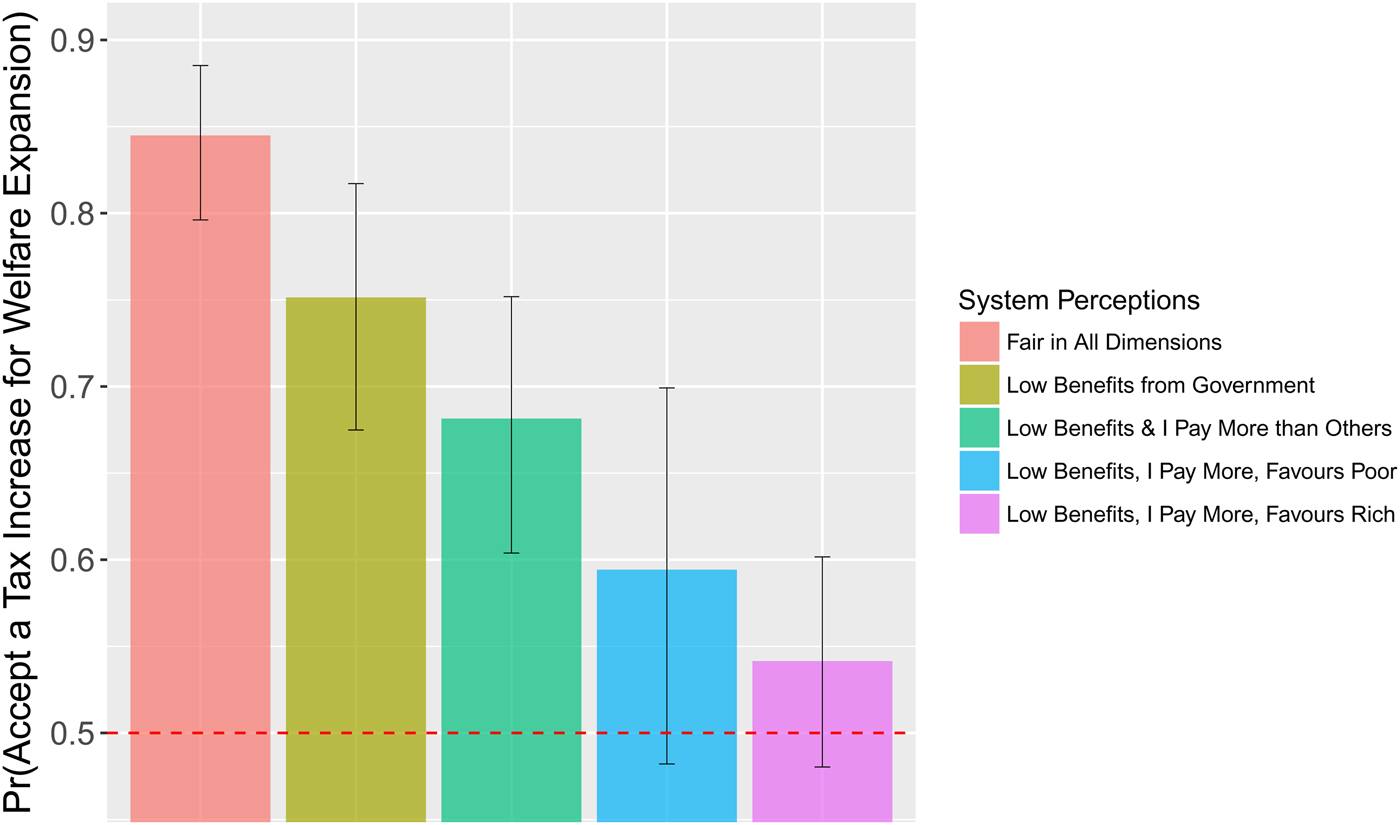
In Models 8–10, I divide the sample into three groups by economic status and estimate split sample models: Lower (Model 8), Middle (combining lower-middle, middle, and upper-middle categories, Model 9) and Upper (Model 10), respectively. The effects of all covariates are thus allowed to vary by economic status. The estimates suggest that horizontal and reciprocal unfairness perceptions have stronger effects on the non-poor supporters’ WTP. The WTP-undermining effect of horizontal unfairness (I Pay More) is strongest among the middle-class supporters (i.e., in Model 9). The perception of reciprocal unfairness vis-á-vis the fiscal authority (Low Benefits) has the strongest WTP-undermining effect among the upper-class supporters (i.e., in Model 10). Furthermore, redistributive unfairness (captured by Regressive) also has the strongest WTP-undermining effect among the upper-class supporters (i.e., in Model 10) and the weakest effect among the lower class supporters (i.e., in Model 8), which again contradicts H2.4. Based on the estimates from Model 10, Figure 6 visualizes how various dimensions of unfairness perceptions in combination can undermine the WTP among the upper-class supporters.
WTP among the Affluent Welfare State Supporters.

My findings implicate that the profiles of supporters showing the unfairness perceptions-induced disjoint in welfare attitude are distinct from those of vulnerable free riders. Above all, the former tend to have a higher economic status. But how substantial is the aggregate impact of unfairness perceptions on the society as a whole? How common is it for citizens with upper economic status to hold such unfairness perceptions?
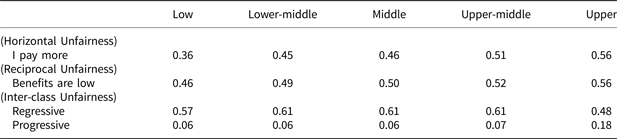
As summarized in Table 7, both horizontal and reciprocal unfairness perceptions are prevalent among the richer citizens. Over a majority of the upper-middle (51%) and upper (56%) classes think they pay more taxes than the others with similar economic capacity, while only a third of the lower class (36%) share the perception. Also, 56% of the upper class exhibit reciprocal unfairness perception, as opposed to 46% of the lower class. Furthermore, the WTP-undermining redistributive unfairness perception (Regressive) is not uncommon among the upper class. 48% of these citizens think that the current tax system favors the rich. In essence, the attitude of ‘I support the expansion but won't pay more’ among Koreans is in substantial part attributable to the unfairness perceptions shared among the relatively affluent citizens.
System Fairness Perceptions by Economic Status in Quintiles (Group Mean)

V. Conclusion
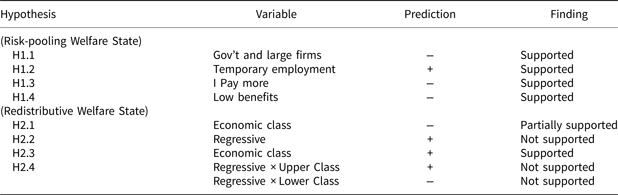
The weak universalistic welfare state of South Korea mirrors popular welfare attitudes: a majority of Koreans across different economic classes support welfare state expansion, yet a large segment of the self-proclaimed supporters is unwilling to contribute to the expansion. I argue that such a widespread disjoint or inconsistency in attitudes can be more fully understood when welfare state expansion is viewed as the expansion of public risk-pooling. While the structural change in the labor market has undermined the viability of firm-level protection and generated broad-based support for public risk pooling, many supporters are reluctant to increase their contribution as they do not think the existing system of risk pooling to be fair. As summarized in Table 8, I provide empirical support for my explanations (H1.1–H1.4) by analyzing a nation-wide survey.
Hypotheses testing

My findings have significant implications for welfare state development in emerging economies where political support for welfare state expansion is broad-based, yet the fiscal support base remains frail. First, by designing and framing the tax and transfer policy reforms in ways to mitigate horizontal unfairness perception, governments could tap into the economically capable (i.e., middle and upper class) citizens’ WTP. This would include reviewing various tax exemption criteria and options for tax avoidance as well as stricter prosecution of tax evasion.
Second, a move to deep universalism requires the public's appreciation of the government-provided protection. The well-known fiscal illusion thesis (Wagner, Reference Wagner1976; Pommerehne, Reference Pommerehne1978) implicates that citizens tend to underestimate the tax price of government provision, which allows and incentivizes politicians to expand spending. The expansion is especially likely where citizens face a highly complex tax system. Where citizens are used to a low-burden-low-benefit system, however, the fiscal illusion might play out differently. Citizens underestimate the costs of government provision, especially of new social programs that offer forward-looking protection, due to the lack of experience with such programs. The underestimation would make the taxpayers unwilling to accept any tax increase, and, in turn, retard the full-scale implementation of the programs. In the survey I analyzed, half of the respondents said the value of government benefits was less than commensurate with the amount of taxes they paid. A key lesson for social protection protagonists is that, rather than avoiding the discussion of costs, they should communicate the price of the new government program transparently. Doing so would allow the citizens supportive of the protection to better appreciate its value. This, combined with efforts at addressing the leakages and inefficiencies in spending, would foster reciprocal fairness perception vis-à-vis the government and increase the citizens’ willingness to contribute to the welfare state.
Third, excluding a substantial minority of the higher income from the nearly universalistic welfare programs risks further increasing the reciprocal unfairness perception within this group. In South Korea, the top 20% of the households cannot benefit from government college tuition subsidies. The top 10% of the households would not be eligible for the newly introduced children's allowance program.Footnote 19 While such targeted exclusion could serve a short-term cost saving purpose, it might end up undermining the fiscal support base for the programs. Recall that the WTP of the affluent welfare state supporters is much higher than that of the poor, yet more sensitive to unfairness perceptions. As Figure 6 shows, the perception of reciprocal unfairness alone can reduce their WTP by 10% points.
Lastly, governments should be cautious in adopting an inter-class fairness frame in promoting tax and welfare reforms. I find in the context of South Korea that the perceived pro-poor bias in the system, right or wrong, undermines the support base for welfare state expansion (recall the sizable negative coefficient estimates of progressive in Models 1–3). At the same time, the perceived pro-rich bias undermines the supporters’ WTP (recall the negative coefficient estimates of regressive in Models 4–6). All in all, skillfully promoting a pro-middle class or fair-for-all frame would help sustain the existing broad-based coalition for welfare state expansion without constraining its fiscal support base.
Of course, the implications derived from the study of South Korea, a country with a relativity weak socio-economic class cleavage, might not travel to other emerging economies. Future research should explore how different dimensions of system fairness perceptions shape fiscal as well as political support bases for welfare state expansion in other contexts.
Acknowledgements
I thank Rieko Kage and the participants of the Symposium Democratization, Taxation, and the Welfare State in the Developing World for their valuable comments on the earlier version of the paper. Junko Kato, Seiki Tanaka, and James Mahon provided additional insightful comments on the revised version.
Sijeong Lim is assistant professor at the Division of International Studies, Korea University (Seoul, Korea). She received her doctoral degree in Political Science from University of Washington, Seattle. Before joining the faculty at Korea University, she was assistant professor at the University of Amsterdam. Her research explores how various dimensions of economic globalization shape social and environmental policy developments. She has published in Socio-economic Review, World Development, Regulation & Governance, and Public Administration Review, among others.
Appendix
Determinants of Welfare State Attitudes: Sample Selection Models