Introduction
During a botanical expedition to Merak in Trashigang district, easternmost Bhutan, carried out by the Blue Poppy Society, Japan, and the National Biodiversity Centre, Bhutan, in the summer of 2014, numerous plants of great scientific interest were encountered. Among them were two populations of a species of Roscoea Sm. that appeared to represent a new taxon.
Roscoea is a genus of 21 species belonging to the tribe Zingibereae, subfamily Zingiberoideae. It is distributed from Himachal Pradesh in the west to Sichuan in the east, and as far south as Mount Victoria in Burma (Cowley, Reference Cowley2007; Mao & Bhaumik, Reference Mao and Bhaumik2008). These species are among the most cold-tolerant of Zingiberaceae, occurring from 1000 to 5000 m altitude. The plants are geophytes, producing their leaves and flowers in the summer, and dying down to their rhizomes during the winter.
In 2014, on the way from Samdrup Jongkhar to Trashigang, the first two authors saw some beautiful plants of Roscoea with large, whitish flowers streaked and flashed with purple on the labellum, by a huge rocky cliff named Melong Brak (= mirror cliff) to the right of the road, on a hill at 2200 m altitude. Later, east of Trashigang, on the way from Chaling to Merak, more plants of the same Roscoea were encountered on mossy, stony, west- to south-west–facing slopes at 2800–3200 m altitude. The plants in both populations resembled Roscoea purpurea Sm. but did not seem to belong to this species.
Roscoea purpurea is the type species of Roscoea. Cowley (Reference Cowley2007, pp. 45–55) indicated that it was distributed very widely from Himachal Pradesh to the Bhutan–Assam border in the east, but her map (Cowley, Reference Cowley2007, p. 47) shows a clear disjunction between eastern Nepal and eastern Bhutan. Cowley could find no collections of this species from Sikkim or western Bhutan.
Specimens of Roscoea purpurea collected in eastern Bhutan and nearby Arunachal Pradesh (formerly Assam) are to be found in a number of herbaria and have been recognised by earlier authors as somewhat divergent morphologically from Roscoea purpurea. The earliest such collection is Cooper 4182 (BM, E), collected on 24 July 1915 at Lingtsi Dyong (modern spelling, Lhuntse Dzong). Ludlow & Sherriff 309 (BM) was collected at Kuru Chu, near Lingtsi (Lhuntse) in July 1933. Kingdon-Ward 11529 (BM) was collected at Nyukmadung in Arunachal Pradesh in May 1935, and Kingdon-Ward 13755 (BM) at Orka La, Arunachal Pradesh (often spelled Warge La in Bhutan) in June 1938 (see below for discussion of this collection locality). Ludlow, Sherriff & Hicks 20845 (BM, E) was collected at Tobrang, Trashi Yangsi (Yangtse) Chu, in July 1949. These collections have been variously determined as Roscoea purpurea Sm. (Cowley, Reference Cowley1982) or Roscoea purpurea forma alba Cowley (Cowley, Reference Cowley2007).
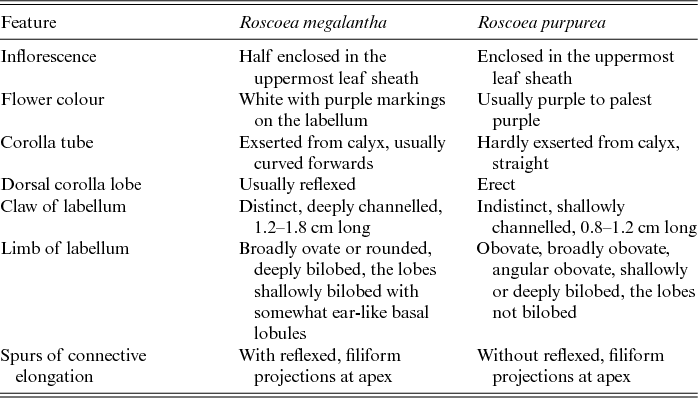
When we examined our collections from eastern Bhutan and the specimens just cited, we were convinced that the plants in eastern Bhutan and adjacent Arunachal Pradesh were sufficiently distinct as to be a species clearly different from the related Roscoea purpurea. Table 1 summarises the features separating Roscoea megalantha from R. purpurea.
Comparison of the major features separating Roscoea megalantha from R. purpurea.

Roscoea megalantha Tosh.Yoshida & R.Yangzom, sp. nov.
Roscoeae purpureae Sm. affinis, sed dorsali petalo reflexo, labelli ungue distincto et profunde canaliculato, labelli limbo late ovato vel rotundato, atque calcaribus connectivi praeditis projectris reflexis filiformibus differt. – Type: Eastern Bhutan, Samdrup Jongkhar, Melong Brak, 2200 m, 27°01′29′′N, 91°30′13′′E, 27 vi 2014, Rinchen Yangzom 630 (holo THIM, iso E). Figs 1–4 .
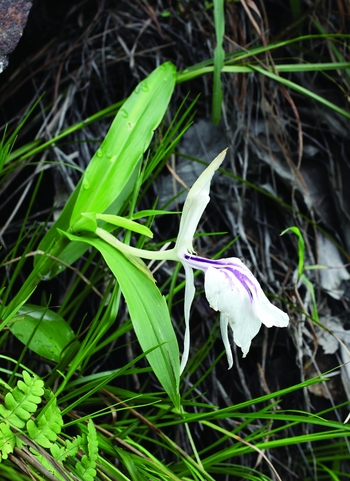
Roscoea megalantha at the type locality, whole plant. (Photograph by T. Yoshida, 27 June 2014.)
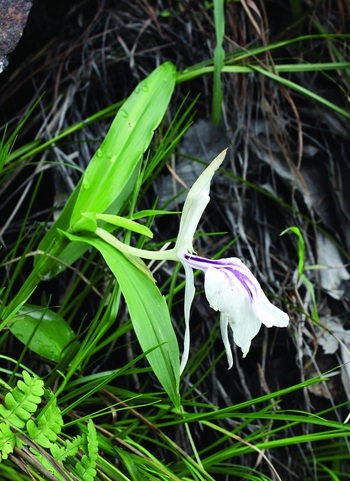
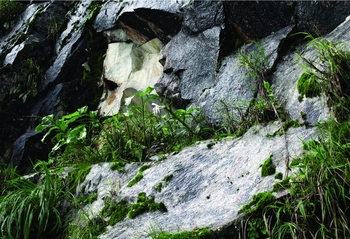
Roscoea megalantha at the type locality, habitat. (Photograph by T. Yoshida, 8 July 2014.)

Roscoea purpurea Sm. forma alba Cowley, The Genus Roscoea 55 (2007). – Type: India, Assam, Orka La, 2440–2740 m, vi 1938, Kingdon-Ward 13755 (holo BM).
Roscoea purpurea auctt. non Sm., Cowley, Kew Bull. 36(4): 752 (1982) (pro parte, quoad Kingdon-Ward 11529, 13755); R.M. Sm., Fl. Bhutan 3(1): 195 (1994); Dunlop, Alpine Gardener 76(2): 203 (2008), pro parte.
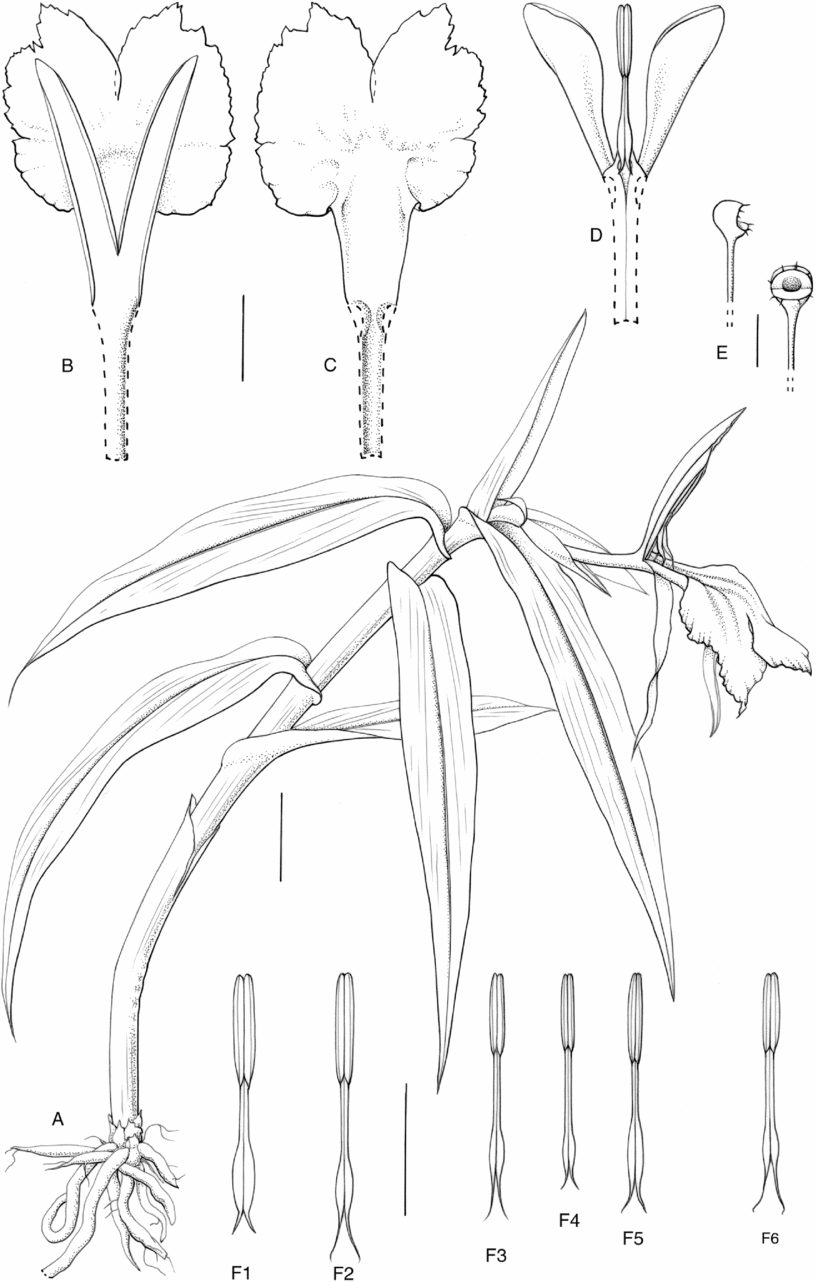
Plants 15–45 cm tall including underground pseudostem 7–15 cm long. Tuberous roots several, to 7 cm long or more, 0.5 cm in diameter. Sheathing leaves, leaves and bracts 6–8 in all. Sheathing leaves 2–4, mostly membranous, apex leafy and recurved except lowest one. Leaf blades 3–6, ascending or spreading, elliptic to oblong-lanceolate, 5–18 × 1.3–3.5 cm, glabrous, base ± auriculate except uppermost one, margin undulate, apex acuminate; leaf sheath striate. Inflorescence half enclosed in the uppermost leaf sheath. Flowers 3 or 4, white with purple markings on the claw and labellum interrupted by two parallel lines of white streaks, the amount of purple varying considerably between individuals. Bracts 3.5–15 × 1–1.5 cm wide, usually longer than calyx, occasionally shorter than calyx in small plants, green and leafy in large plants, pale green and submembranous in small plants, apex obtuse, acute or acuminate. Calyx tubular, 4.5–8 cm long, membranous, oblique, apiculate and bi- or tridentate at apex, occasionally bilobed in large plants. Floral tube slender, 4.5–10 cm long, usually exserted from calyx, rarely as long as calyx, usually curved forwards; dorsal corolla lobe usually reflexed at the base with an angle of c.75° between dorsal corolla lobe and claw of labellum, 4–6.5 × 1–1.5 cm, narrowly elliptic to oblong, concave, cucullate at apex; lateral corolla lobes 2, linear oblong, 3.5–7 × 0.4–0.5 cm; labellum 4–7 × 1.8–4 cm including distinct claw, the claw deeply channelled, 1.2–1.8 × 1.2–1.4 cm, the limb broadly ovate or rounded, deeply bilobed, the lobes deflexed, triangularly acute, obtuse or acuminate at apex, irregularly toothed on the upper margins, shallowly bilobed with somewhat ear-like basal lobules. Staminodes 2, petaloid, reflexed and housed in dorsal corolla lobe, narrowly obovate 3.2–4.5 × 0.8–1.5 cm, base attenuate and narrowly clawed. Stamen white; filament short, erect; anther versatile, L-shaped, thecae narrow, 10–15 mm long; basal connective elongation 10–18 mm long without spurs, the spurs 5–8 mm long, pointed, with reflexed projections at apex, the projections filiform, 1–3 mm long. Pistil white; style filiform, held between spurs of connective. Fruit unknown.
Etymology
The epithet comes from the Greek for large flower.
Distribution
Eastern Bhutan and adjacent western Arunachal Pradesh of India; 1800–3500 m altitude.
Habitat and ecology
On west to south-west–facing rocky cliff faces or stony slopes exposed to the wet summer monsoon, often shrouded in mist in the summer daytime, somewhat shaded by adjacent rocky cliffs or trees; rooting into humid blackish soil among rocks with other herbs, mosses and ferns, below 3500 m altitude.
Proposed IUCN conservation status
Near Threatened. This species has a small extent of occurrence (4708 km2) and small area of occupancy (40 km2), which might qualify it as Endangered under criterion B1 or B2, but more than 10 populations are known and there is little evidence of decline in the populations. Likewise, the evidence does not allow an assessment of Vulnerable. Most populations have not been surveyed recently, and numbers of individuals at each population are not known. At the type locality, c.50 mature, flowering individuals and c.150 young plants were counted. The populations within Sekteng Wildlife Sanctuary and Bumdeling Wildlife Sanctuary are protected, but others, including the one from which the type specimen was collected, are not under protection and may be threatened by road widening.
Specimens examined. Bhutan. Lhuntse: Lingtse Dyong (Lhuntse Dzong), 24 vii 1915, Cooper 4182 (BM, E); Kuru Chu, near Lingtsi (Lhuntse), 22 vii 1933, Ludlow & Sherriff 309 (BM). Mongar: Saleng, 30 vi 1969, Bowes-Lyon 15739 (BM). Samdrup Jongkhar: Melong Brak, 27 vi 2014, R. Yangzom 630 (E, THIM). Trashigang: Kamlong-Wamrong, before Wamrong, 2330 m, 25 v 2000, Dorji, Pearce & Cribb 48 (K); west of Merak village, 2400 m, 27°19′31′′N, 91°44′01′′E, 28 vi 2014, T. Yoshida 4437 (TI). Trashi Yangtse: Chorten Kora, N of Trashi Yangtse, 3 vi 1985, Bowes-Lyon 9054 (E); Tobrang, Trashi Yangsi (Yangtse) Chu, 5 vii 1949, Ludlow, Sherriff & Hicks 20845 (BM, E).
India. Arunachal Pradesh: Nyukmadung (below Senge Dzong), Balipara Frontier Tract, 27 v 1935, Kingdon-Ward 11529 (BM); Orka La, Bhutan Frontier, Assam Himalaya, 8000–9000 ft, 17 vi 1938, Kingdon-Ward 13755 (BM).
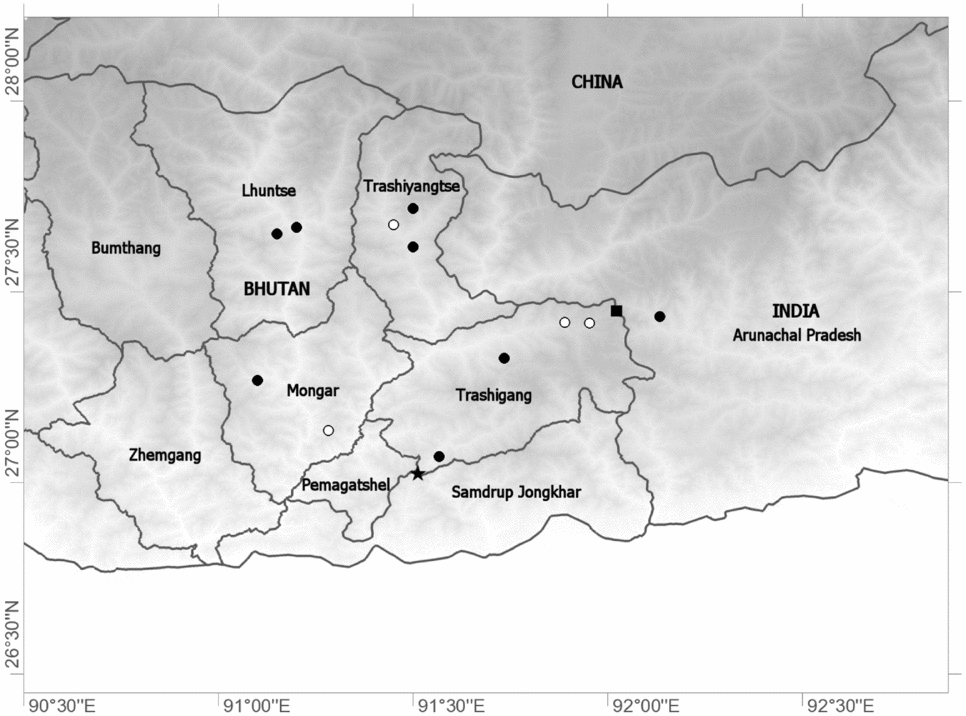
Kingdon-Ward 13755 (BM) was said by Cowley (Reference Cowley2007) to have been collected in Assam, Orka La, 2440–2740 m, June 1938. The Orka La (Warge La) is located on the border between Bhutan and Arunachal Pradesh (Assam in Kingdon-Ward), at 4150–4350 m altitude. This is the point indicated by the black square in Fig. 3, but we have reason to think it may be inaccurate. First, in Field Notes of Trees, Shrubs and Plants Collected by Kingdon-Ward in 1938, privately published for Lionel de Rothschild, the specimen was recorded as follows: ‘KW 13755. Roscoea purpurea? “Height 4–6 inches. The leafy stem bears a succession of large yawning flowers, white splashed purple on the lower lip. Forms large colonies on steep rocky pine covered slopes high above Dirang Dzong. 7,000–8,000 feet. July.”’ The range of 7000–8000 ft equates roughly to 2130–2440 m, much lower than the Orka La. Note that the herbarium label gives the altitude as 8000–9000 ft. Second, Roscoea megalantha has only been seen on very foggy slopes or cliffs below 3500 m altitude, exposed to the south-west monsoon and not receiving strong morning sunshine. These conditions are not found at the Orka La. Third, we have seen photographs taken by travellers in this region showing that Roscoea megalantha is found on the vast, south-west–facing slopes between Dirang and Sela Pass (Ze La in Kingdon-Ward). Therefore we believe that Kingdon-Ward 13755 may not have been collected precisely at Orka La but, rather, close to Dirang Dzong. All the places named in this paragraph were visited by Kingdon-Ward in the 1930s. Schweinfurth & Schweinfurth-Marby (Reference Schweinfurth and Schweinfurth-Marby1975) show on their map 2 the paths that Kingdon-Ward took; he seems to have reached almost as far as the Orka La.
Distribution of Roscoea megalantha. ●, Herbarium specimens; ○, field reports by Dorji Gyeltshen and Shun Umezawa; *, the type collection locality; ■, the collection locality of Kingdon-Ward 13755.

Roscoea megalantha Tosh.Yoshida & R.Yangzom sp. nov.. A, Habit; B, labellum and lateral corolla lobes, abaxial view; C, labellum, adaxial view; D, lateral staminodes and anther; E, upper style and stigma, lateral and frontal views; F1–6, anthers, showing variation in dimensions and spurs. Scale bars: A, 3 cm; B–D and F, 2 cm; E, 2 mm. A drawn from R. Yangzom 630; B–E from Dorji, Pearce & Cribb 48 (spirit collection at K); F1 from Dorji, Pearce & Cribb 48 (spirit collection at K); F2 from R. Yangzom 630 (dried); F3–5 from Bowes Lyon 9054 (dried); and F6 from Ludlow et al. 20845 (dried).

As Kingdon-Ward aptly expressed it, the large flowers of this species look as if they are yawning because the dorsal corolla lobes are usually reflexed more widely than those of Roscoea purpurea, in which the dorsal corolla lobes are always erect. The cultivated plants of Roscoea purpurea KW 13755, photographed by Gary Dunlop (Reference Dunlop2008, p. 203), which appear to be descended from one of Kingdon-Ward's collections, and R. purpurea forma alba, photographed by Brian Mathew in 1958 (Cowley, Reference Cowley2007, p. 55), look similar to those recently photographed in the field by travellers, but with shorter corolla tubes. Photographs taken in the field show various lengths of corolla tube, and many plants in the photographs have long and forward-curved corolla tubes with reflexed dorsal corolla lobes.
In Bhutan, there are now three species of Roscoea: R. alpina Royle, R. bhutanica Ngamr. and R. megalantha (Smith, Reference Smith and Noltie1994; Ngamriabsakul & Newman, Reference Ngamriabsakul and Newman2000).
Key to the species of Roscoea in Bhutan
-
1a. Leaf blades 3–6 at anthesis, well spread; plant 15–45 cm tall Roscoea megalantha
-
1b. Leaf blades usually 2–3(–6) at anthesis, forming a tuft; plant usually < 20 cm tall_________________________2
-
2a. Leaf blades lanceolate-ovate to oblong; bracts acute; lateral staminodes obliquely spathulate_________________________Roscoea bhutanica
-
2b. Leaf blades linear, broadly elliptic or lanceolate; bracts obtuse to truncate; lateral staminodes circular to elliptic_________________________Roscoea alpina
Acknowledgements
We are grateful to Tashi Yangzome Dorji, Programme Director of the National Biodiversity Centre, Ministry of Agriculture and Forests, Royal Government of Bhutan, for her official approval of our collaborative field research and the related material transfers among us, and to the members of the Blue Poppy Society, Japan, for their financial support to our field research. We thank Phillip Cribb (K), who allowed us to see his slides and field notes taken while gathering Roscoea megalantha with Yeshey Dorji in 2000. Special thanks go to Dorji Gyeltshen for additional distribution records, and to the following for providing valuable field data and allowing us access to their photographs: Tokuo Kobayashi, Junko Makino, Atsuko Shibata and Shun Umezawa.