Introduction
At 14.28 hours (Beijing time) on 12 May 2008, a catastrophic earthquake measuring 8.0 on the Richter scale struck Wenchuan, Sichuan, China. Official figures stated that 69 227 were confirmed dead and 374 643 injured, with 17 923 listed as missing. The earthquake spread about 100 000 km2, destroyed almost 6.5 million homes and affected approximately 46 million people, left about 15 million people evacuated from their homes and led to about 5 million people living in temporary shelters. The direct economic losses estimated officially were reported at 123.8 billion dollars. Official figures stated that there were 316 after-shocks which were more than 4.0 on the Richter scale until 30 June 2010 (http://www.csi.ac.cn/sichuan/index080512001.htm; website in Chinese).
A few studies have reported increased post-traumatic stress disorder (PTSD) among adolescents after earthquakes (Goenjian et al. Reference Goenjian, Walling, Steinberg, Karayan, Najarian and Pynoos2005; Roussos et al. Reference Roussos, Goenjian, Steinberg, Sotiropoulou, Kakaki, Kabakos, Karagianni and Manouras2005; Wu et al. Reference Wu, Chen, Weng and Wu2009; Liu et al. Reference Liu, Yang, Ye, Zeng, Xiang and Yuan2010b ). PTSD may arise in the weeks or months after an earthquake (Neria et al. Reference Neria, Nandi and Galea2008), and often co-occurs with depression (Salcioglu & Basoglu, Reference Salcioglu and Basoglu2008). Although there are several longitudinal studies regarding the prevalence and risk factors of PTSD among children or adolescents following the Wenchuan earthquake (Chen, Reference Chen, Wang, Zhang and Shi2010; Liu et al. Reference Liu, Wang, Shi, Zhang, Zhang and Shen2011 a, Reference Liu, Yang, Yuan, Zhang, Han, Cao and Xiong b ; Yang et al. Reference Yang, Liu, Zeng, Xiang, Liu, Hu, Li, Li, Hou and Yuan2011; Ye et al. Reference Ye, Liu, Chen, Zhang, Yang, Liu and Yuan2011), few had a measure of depression considering the high prevalence of depression in earthquake survivors. Further studies need to explore the relationship between PTSD and depression.
China's one-child policy, which limits couples to have one child, was established by Chinese leader Deng Xiaoping in 1978 to limit population growth in China. As a result, most children born thereafter were only-children. A previous study among 2250 adolescents found that only-child participants were less likely to have PTSD and depression symptoms than child-with-sibling participants 6 months after the Wenchuan earthquake in China (Fan et al. Reference Fan, Zhang, Yang, Mo and Liu2011). However, further studies with a longitudinal design on the demographic risk factors of PTSD in adolescents with a Chinese culture background are needed.
Research has shown inconsistent findings on the relationship of trauma-related factors (e.g. injury to self, family member injury or death, home damage, property damage, direct exposure to the earthquake) and the severity of PTSD symptoms in adolescents. Roussos et al. (Reference Roussos, Goenjian, Steinberg, Sotiropoulou, Kakaki, Kabakos, Karagianni and Manouras2005) found that after the Ano Liosia earthquake in Greece of 1999, PTSD was positively associated with house damage, but not with the death or injuries of family members in adolescents. A recent Wenchuan earthquake study indicated that home damage, as well as injury to self and family member injury were risk factors of PTSD in adolescents (Ma et al. Reference Ma, Liu, Hu, Qiu, Wang, Huang, Wang, Zhang and Li2011). In another 1-year follow-up study, only parent injury and severe property damage were found as risk factors for PTSD (Liu et al. Reference Liu, Yang, Ye, Zeng, Xiang and Yuan2010b ). Further follow-up studies are needed to better identify the relationship of trauma-related factors and PTSD.
The aims of this study were: (1) to explore longitudinally the rates of PTSD and depression in adolescents after the Wenchuan earthquake; and (2) to identify independent predictors of PTSD symptoms in the longitudinal study.
Method
Study population
The survey was conducted in a boarding high school (grades 11–12) at 6, 12 and 18 months after the Wenchuan earthquake. This high school is located only 10 km away from the epicentre of the Wenchuan earthquake, and was severely damaged during the earthquake. The students were not dispersed to other schools outside of the county after the earthquake. The school provided dormitories for the students who needed to stay in school. After the earthquake, these students studied and lived in temporary houses for 15 months until the school was rebuilt. This school was selected for two reasons: (a) the school is a public school with common characteristics of all local schools so that the characteristics of the students were representative of and comparable with all students in this district; and (b) the principals, teachers and students in this school were willing to participate in the study.
We chose students from grade 11 for this study so that all the participants could be followed up before they graduated from high school. A total of 746 students from grade 11 were followed up in this study. Of the sample, 737 (98.8%) students finished questionnaires at 6 months after the earthquake. In the 12-month follow-up, 685 (91.8%) students finished questionnaires. In the 18-month follow-up, 563 (75.5%) students finished questionnaires. In the end, 548 (73.5%) students completed all the measures. All students were Chinese Han. Consent was obtained from the school administration and the participants. This study was approved by the Human Ethics Committee of Sichuan University.
Measurements
The measuring instruments for traumatic stress consisted of two parts. The first part of the survey was to assess demographic characteristics, trauma characteristics, and personal and family history. Trauma characteristics were measured by a self-reported scale and included injury to self, number of family member injury or death, extent of damage to home and property, etc.
The second part was to measure the symptoms of PTSD and depression. PTSD was assessed using the PTSD Checklist-Civilian Version (PCL-C) (Blanchard et al. Reference Blanchard, Jones-Alexander, Buckley and Forneris1996), which is a self-report 17-item symptom scale that corresponds to Diagnostic and Statistical Manual of Mental Disorders, fourth edition (DSM-IV) criteria (APA, 2000), and is commonly used when a clinical interview is not feasible (Dobie et al. Reference Dobie, Kivlahan, Maynard, Bush, McFall, Epler and Bradley2002). Total score ranges from 17 to 85, and a cut-off score of 50 has been used to classify whether an adolescent has clinically significant PTSD symptoms or not (Jia et al. Reference Jia, Tian, Liu, Cao, Yan and Shun2010; Liu et al. Reference Liu, Yang, Ye, Zeng, Xiang and Yuan2010b ). The PCL-C has been shown to have high internal consistency (Cook et al. Reference Cook, Elhai and Arean2005), and has been commonly used with adolescents (Garrison et al. Reference Garrison, Bryant, Addy, Spurrier, Freedy and Kilpatrick1995; Cuffe et al. Reference Cuffe, Addy, Garrison, Waller, Jackson, McKeown and Chilappagari1998; Elklit, Reference Elklit2002; Barnes et al. Reference Barnes, Treiber and Ludwig2005; Calderoni et al. Reference Calderoni, Alderman, Silver and Bauman2006; Liu et al. Reference Liu, Yang, Ye, Zeng, Xiang and Yuan2010b ). Cronbach's α coefficient of the PCL-C in the present study ranged from 0.891 to 0.894.
The Beck Depression Inventory (BDI) was used to assess the severity of depression (Beck et al. Reference Beck, Ward, Mendelson, Mock and Erbaugh1961). The Chinese version of the BDI has been validated, showing good convergent validity and reliability (Shek, Reference Shek1991). The BDI consists of 21 items, and each item is scored 0–3. The total score ranges from 0 to 63 (total score ⩽4 points: no depression; 5–13 points: mild depression; 14–20 points: moderate depression; ⩾21 points: major depression) (Wang et al. Reference Wang, Wang and Ma1999, Reference Wang, Chan and Deng2006). A total score of 14 was used as a cut-off point of depressive symptoms in this study (Wang et al. Reference Wang, Chan and Deng2006). Cronbach's α coefficient of the BDI ranged from 0.811 to 0.912 in the present study.
Translation and back-translation of these instruments followed previously published guidelines (Brislin, Reference Brislin and Brislin1976). All questionnaires were pretested with adolescents in this school who had been exposed to the earthquake.
Statistical analyses
We used t tests to evaluate differences in continuous variables and χ2 tests were used to examine associations between categorical variables. Stepwise multiple linear regression analyses were performed to identify independent predictors of PTSD symptoms. Values of p<0.05 was considered to be statistically significant. Data were analysed using SPSS (version 13.0; SPSS, Inc., USA).
Results
Sample characteristics
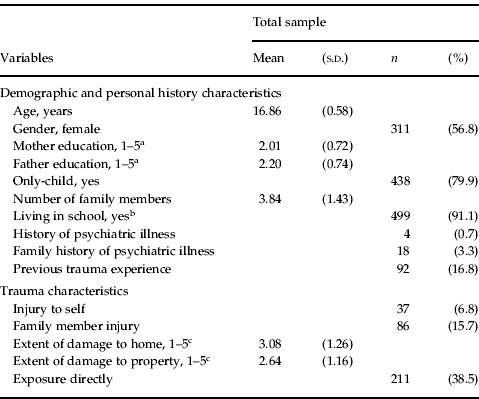
There were no deaths of students or family members in the school during the earthquake. The age of these students was from 15 to 18 years. Approximately 80% of students were only-children. Most students (91.1%) were living in school at the time of the earthquake (Table 1).
Characteristics of subjects (n=548)

s.d., Standard deviation.
a 1=no schooling/illiterate/primary school; 2=secondary school; 3=high school; 4=university studies; 5=postgraduate studies and above. b Living in school means that the students were living in school until they graduated from the high school even after the earthquake. c 1=no damage; 2=minimal damage; 3=moderate damage; 4=severe damage; 5=collapsed.
Compared with students from one-child families, the adolescents with siblings had significantly more family members than the only-child participants [mean 4.39 (s.d.=0.95) v. mean 3.70 (s.d.=1.49), p=0.000], and a higher extent of damage to property [mean 2.87 (s.d.=1.20) v. mean 2.58 (s.d.=1.14), p=0.019]. Compared with the only-child participants, the adolescents with siblings were more likely to live in school (96.4% v. 89.7%, χ2=3.977, df=1, p=0.046), and had more family member injury (22.7% v. 13.9%, χ2=5.146, df=1, p=0.023).
Post-traumatic stress and depressive reactions
When a cut-off score of 50 was used for the PCL-C, a total of 53 (9.7%) student survivors were classified as subjects with PTSD symptoms in the 6-month, seven (1.3%) in the 12-month, and nine (1.6%) in the 18-month follow-ups, respectively. When a cut-off score of 14 was used for the BDI, a total of 216 (39.4%) student survivors were classified as subjects with depression symptoms in the 6-month, 202 (36.9%) in the 12-month, and 161 (29.4%) in the 18-month follow-ups, respectively.
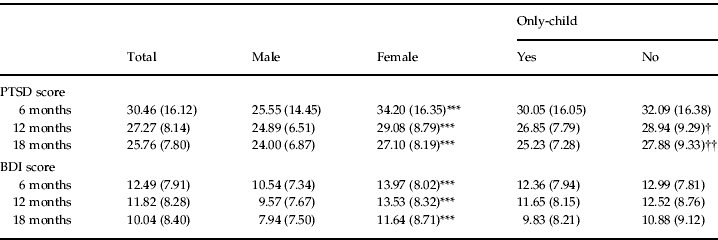
Table 2 presents the results of PTSD and depression symptoms scores at the 6-, 12- and 18-month follow-ups. Female adolescents had significantly higher scores of PTSD and depression symptoms in the 6-, 12- and 18-month follow-ups than male adolescents. Only-child adolescents had significantly lower scores of PTSD at 12 and 18 months' follow-up than child-with-sibling adolescents.
PCL-C and BDI scores of subjects at 6, 12 and 18 months after the earthquake

Data are given as mean (standard deviation).
PCL-C, PTSD Checklist-Civilian Version; BDI, Beck Depression Inventory; PTSD, post-traumatic stress disorder.
*** Mean value was significantly different from that for males (p<0.001, unpaired t test).
Mean value was significantly different from that for only-children: † p<0.05, †† p<0.01 (unpaired t test).
Independent predictors of severity of PTSD
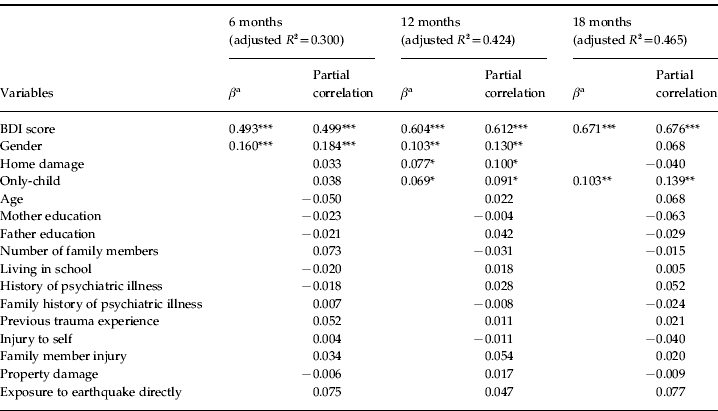
Table 3 presents the results of a stepwise multiple regression analysis of the contributive factors in predicting the severity of PTSD symptoms at 6, 12 and 18 months after the earthquake. The strongest predictors of the severity of PTSD symptoms at 6 months after the earthquake included BDI score, which accounted for 27.8% of the total variance, and gender, accounting for 2.4% of the variance. The strongest predictor of the severity of PTSD symptoms in the 12 months after the earthquake was also BDI score, which accounted for 40.6% of the total variance, and the next variable was gender, which accounted for another 1.1% of the total variance. Home damage and child-with-sibling together contributed an additional 1.2% to the variance. The most significant variables predicting the severity of PTSD symptoms in the 18 months after the earthquake included BDI score, which accounted for 45.7% of the total variance, and child-with-sibling accounting for 1.1% of the variance.
Predictors of PCL-C scores at 6, 12 and 18 months after the earthquake using multivariate linear regression

PCL-C, PTSD Checklist-Civilian Version; BDI, Beck Depression Inventory.
a Standardized regression coefficient.
* p<0.05, ** p<0.01, *** p<0.001.
Discussion
The present study is one of the first longitudinal follow-up studies on both PTSD and depression symptoms among high school students after the Wenchuan earthquake in China. Strengths of this study include the representative high school samples and the high follow-up rate. This study should also be significant for policy making for adolescents' psychological rehabilitation after earthquakes.
In the present study, 38.5% of students reported that they were directly exposed to the severe damage of the earthquake. As there were no deaths of students or family members, so many students might endorse subjectively that they were not directly exposed to the earthquake in this study.
In previous studies, the prevalence of PTSD in children and adolescents after earthquakes has ranged from 4.5% to 95% (Salcioglu & Basoglu, Reference Salcioglu and Basoglu2008). Evidence has indicated that the prevalence of PTSD in adolescents was from 2.5% to 60.8% from 4 to 13 months after the Wenchuan earthquake (Liu et al. Reference Liu, Yang, Yuan, Zhang, Han, Cao and Xiong2010a , b; Fan et al. Reference Fan, Zhang, Yang, Mo and Liu2011; Ge et al. Reference Ge, Wu, Sun and Zhang2011; Ma et al. Reference Ma, Liu, Hu, Qiu, Wang, Huang, Wang, Zhang and Li2011; Wang et al. Reference Wang, Long, Li and Armour2011). In the present study, the prevalence of PTSD symptoms of adolescent survivors was 9.7% in the 6 months after the earthquake, which is consistent with previous studies. The prevalence of PTSD symptoms in this study declined to 1.3% at 12 months and 1.6% at 18 months after the earthquake, which is lower than found in other studies on the Wenchuan earthquake (Liu et al. Reference Liu, Yang, Ye, Zeng, Xiang and Yuan2010b ). This might be due to: (1) less loss of loved ones; (2) fewer injuries; (3) timely and effective social support from the Chinese government; and (4) less negative influence of the media, as students seldom watched television in school. Evidence has indicated that viewing television images of disasters exacerbated PTSD and depression among persons directly affected by disasters (Ahern et al. Reference Ahern, Galea, Resnick, Kilpatrick, Bucuvalas, Gold and Vlahov2002).
The results of this study indicated that the PTSD symptoms among high school survivors might reduce significantly 12 months after the earthquake, and increase a little at the 18 months follow-up. In a previous follow-up study in children after the Wenchuan earthquake, Liu et al. (Reference Liu, Wang, Shi, Zhang, Zhang and Shen2011) found that the prevalence of PTSD was increased from 11.2% to 13.4% between 6 and 12 months (Liu et al. Reference Liu, Wang, Shi, Zhang, Zhang and Shen2011). Consistent with this pattern, Orcutt et al. (Reference Orcutt, Erickson and Wolfe2004) found low levels of PTSD symptoms, with little increase over time, and higher levels of initial symptoms with a significant increase over time from a study of a large cohort of Gulf War veterans.
In previous studies, the prevalence of depression in child and adolescent survivors of earthquakes ranged from 13.6% to 76% (Salcioglu & Basoglu, Reference Salcioglu and Basoglu2008). In a recent Wenchuan earthquake study, the prevalence of depression was 24.5% at 6 months among adolescents after the Wenchuan earthquake (Fan et al. Reference Fan, Zhang, Yang, Mo and Liu2011). In this study, the prevalence of depression in adolescents was 39.4%, 36.9% and 29.4% in the 6, 12 and 18 months after the earthquake, respectively which is consistent with previous studies in Western children and adolescents after earthquakes (Salcioglu & Basoglu, Reference Salcioglu and Basoglu2008). The results of the present study indicated that a significant number of adolescents would need culture-specific interventions for depression after a deadly earthquake.
The results of the multiple regression analysis in the present study indicated that BDI scores were found to be the best predictor of severity of PTSD symptoms in the 6-, 12- and 18-month follow-ups (explaining 27.8%, 40.6% and 45.7% of the variance, respectively). The results are consistent with the high correlation between PTSD and depression in previous studies (Roussos et al. Reference Roussos, Goenjian, Steinberg, Sotiropoulou, Kakaki, Kabakos, Karagianni and Manouras2005).
Evidence has indicated that being female is a risk factor associated with PTSD (Alisic et al. Reference Alisic, Jongmans, van Wesel and Kleber2011; Ma et al. Reference Ma, Liu, Hu, Qiu, Wang, Huang, Wang, Zhang and Li2011). In a study of 6–7 months after the 1999 Athens earthquake, girls reported significantly more PTSD, anxiety and depressive symptoms than boys (Giannopoulou et al. Reference Giannopoulou, Strouthos, Smith, Dikaiakou, Galanopoulou and Yule2006). In a recent follow-up study, Ye et al. (Reference Ye, Liu, Chen, Zhang, Yang, Liu and Yuan2011) found that girls had 1.46 times higher risk than boys for PTSD after the Wenchuan earthquake. The results of the present study also demonstrated that being female was a risk factor of PTSD symptoms in the 6 and 12 months after the Wenchuan earthquake. The vulnerability of females for PTSD, also observed in the adult trauma literature, might be due to the different coping styles and socio-economic status of women and men (Gavranidou & Rosner, Reference Gavranidou and Rosner2003).
A previous Wenchuan earthquake study indicated that military first responders from only-child backgrounds had an increased risk of PTSD after deployment to the earthquake region compared with those from child-with-sibling families (Wang et al. Reference Wang, Jin, Nunnink, Guo, Sun, Shi, Zhao, Bi, Yan, Yu, Wang, Gao, Zhao, Ou, Song, Chen, Lohr and Baker2010). However, another study among adolescents found that only-child participants were less likely to have PTSD and depression symptoms than those of children-with-siblings 6 months after the 2008 Wenchuan earthquake (Fan et al. Reference Fan, Zhang, Yang, Mo and Liu2011). In the present study, only-children were also found to be less likely to have PTSD symptoms than children-with-siblings in the 12 and 18 months after the earthquake. The results of the present study indicate that adolescents who come from multiple-child families need more specific interventions for PTSD after the earthquake. The possible reasons may include: (1) adolescents who came from multiple-child families received less support from their parents; (2) a higher extent of damage to property in multiple-child families; and (3) more family member injury in multiple-child families. Adolescents from one-child families may be educated more by their parents about how to face stress by themselves. The relationship between adolescents from one-child families and PTSD needs further study.
In the 12-month follow-up of this study, home damage was found to be a predictor of severity of PTSD symptoms, which is consistent with a previous Wenchuan earthquake study showing that house destructed was a risk factor of PTSD in Chinese adolescents (Ma et al. Reference Ma, Liu, Hu, Qiu, Wang, Huang, Wang, Zhang and Li2011). However, in another study of the Wenchuan earthquake, home damage and property loss were not related to PTSD and depression symptoms in child survivors (Fan et al. Reference Fan, Zhang, Yang, Mo and Liu2011). Further studies are needed to determine the relationship between home damage and PTSD.
The results of this 18-month follow-up study indicated the trend of PTSD and depression symptoms among high school students after the earthquake. The results of this study showed that PTSD symptoms might reach their highest level at 6 months after the earthquake, then reduce significantly at 12 months and maintain at a stable level at 18 months after the earthquake. The results of this study are consistent with previous Wenchuan earthquake studies in the long term (Yang et al. Reference Yang, Liu, Zeng, Xiang, Liu, Hu, Li, Li, Hou and Yuan2011). Authors of the present study suggest that culture-specific interventions should be provided in the early stage after an earthquake for reducing the PTSD symptoms. The effectiveness of psychological intervention on PTSD symptoms needs further study.
There are some limitations of the present study. First, as the study focused on adolescents, the results of this study may not be applicable to adults or young children. Second, the sample size is relatively small. Third, some other variables, such as secondary stressors after the earthquake, anxiety, etc, were not measured in this study.
In conclusion, the results of the present study indicated that depression symptoms were a predictor of PTSD symptoms in the 18-month follow-up study. Other predictors included being female and being a child with siblings. The PTSD symptoms may change gradually in the different stages after the earthquake. These results may help to identify adolescents with an elevated risk for PTSD symptoms after the earthquake so that they can be targeted for appropriate mental health interventions.
Acknowledgements
This study was supported by grants from the Sichuan Program for Sciences and Technology (grant no. 2008HH0008 to D.-Z.F.) and the Program for New Century Excellent Talents in Universities in China (grant no. NCET-04-0863 to D.-Z.F.).
Declaration of Interest
None.