


Introduction
Soil degradation, including decreased fertility and increased erosion, due to long term cultivation is a major concern in agricultural systems (Jianping, Reference Jianping2006). Achieving global food security in a sustainable and eco-friendly manner has triggered efforts on a large scale to find out viable solutions for improving soil and environment quality. Biochar has caught the attention of scientists and policy makers for its potential benefits for carbon sequestration, improvement of soil quality and crop yield, while decreasing greenhouse gas emissions (Stavi and Lal, Reference Stavi and Lal2013). A wide range of raw materials are used as the feedstock for biochar production, including wood chip, organic wastes, plant residues, and poultry manure (Sohi et al., Reference Sohi, Krull, Lopez-Capel and Bol2010). In Punjab (India), a total of 55 million tons of crop residues are annually produced, of which rice straw alone accounts for more than 22 million tons (Yadvinder-Singh and Sidhu, Reference Singh and Sidhu2014).
After harvest, the rice residue left on the field causes considerable crop management problems as it interferes with the normal tillage operations and seeding. Disposing of surplus rice residues through burning is the most convenient option for the farmers due to the lack of user-friendly, cost and time effective options (Yadvinder-Singh et al., Reference Singh, Thind and Sidhu2014). It is estimated that farmers of North-West states of Punjab, Haryana, and Uttar Pradesh in India burn about 23 million tons of rice residues annually (NAAS, 2017). Burning leads to the substantial loss of plant nutrients (especially N and S) and organic carbon, affecting the soil health negatively (NAAS, 2017). The detrimental effects of crop residue burning on air pollution and soil health call for an effective crop residue management system for attaining agricultural sustainability.
The conversion of rice straw into biochar and its subsequent use in agriculture seem to be an ecologically sound option for improving soil fertility and crop yield. In fact, biochar as a soil amendment has been recommended to improve soil quality and crop productivity (Novak et al., Reference Novak, Lima, Xing, Gaskin, Steiner, Das, Ahmedna, Rehrah, Watts and Schomberg2009). However, there is considerable variation in soil and crop responses to biochar that results from many factors such as biochar physicochemical properties, climate, soil type, fertilization status, and crop (Liu et al., Reference Liu, Lu, Yang and Wang2016). On one hand, biochar has been reported to stimulate microbial activity (Smith et al., Reference Smith, Collins and Bailey2010) which causes the loss of soil organic matter, while on the other hand it has been shown to reduce the emission of greenhouse gases from soils (Taghizadeh-Toosi, Reference Taghizadeh-Toosi2011). Biochar applied to soils plays a key role in nutrient cycling and potentially increases N retention (Agyarko-Mintah et al., Reference Agyarko-Mintah, Cowie, Singh, Joseph, Van Zwieten, Hardin and Smillie2017; Ding et al., Reference Ding, Liu, Wu, Shi, Yang and Zhong2010; Zheng et al., Reference Zheng, Wang, Deng, Herbert and Xing2013), reducing N leaching losses and increasing fertilizer N utilization efficiency (Knowles et al., Reference Knowles, Robinson, Contangelo and Clucas2011; Laird et al., Reference Laird, Fleming, Wang, Horton and Karlen2010; Lehmann et al., Reference Lehmann, da Silva, Steiner, Nehls, Zech and Glaser2003; Steiner et al., Reference Steiner, Glaser, Teixeira, Lehmann, Blum and Zech2008).
Rice husk ash (RHA) is abundantly available from rice mills and power houses in India using rice husk as a fuel. It contains significant quantities of P, K, Ca, Mg, and other essential elements but very little N (Thind et al., Reference Thind, Singh, Singh, Singh, Sharma, Vashistha and Singh2012), with its chemical composition being likely different from that of rice straw biochar (RSB). Currently, limited information is available on the effect of RSB addition on crop yields, N response, and soil health in rice–wheat cropping systems in South Asia. Our hypotheses were that (i) RSB will significantly increase rice and wheat yields through its positive impact on soil fertility and soil biological health and (ii) a positive interaction is expected between N fertilization and biochar supply as biochar affects soil N transformations such as adsorption, nitrification, and leaching, increasing N availability. The objective of this study was to evaluate the effects of RSB and RHA at various N levels on soil fertility, soil biological properties, plant growth, and crop yields in the rice–wheat system on a sandy loam in North-West India.
Materials and Methods
Preparation of RSB and RHA
A cylindrical metal oil drum (200 L capacity) with both sides intact used for preparing biochar by Venkatesh et al. (Reference Venkatesh, Korwar, Venkateswarlu, Gopinath, Mandal, Srinivasarao and Grover2010) was slightly modified to use as a charring kiln. The modification included making a square-shaped hole of 16 x 16 cm in the center of the top side of the drum for loading the rice residue. The inner sides of the charring kiln were pre-cleaned by burning some waste jute bags so as to make free from residual hydrocarbon. After air drying for 15 days and reaching 15% moisture, rice straw was loaded through top square hole. While loading, few stalks were smeared with diesel and placed at the bottom to aid initial ignition. After the ignition, clay was used to seal the bottom edges of the drum. After the reduction in thickness of smoke, the drum was rolled in such a way that its square-shaped hole faced the pit which was already dug so as to fit in the cut slot. This step reduced the flow of oxygen so that the rice straw was not burnt to ashes. The rice straw was subjected to partial combustion until the fire became clear and produced a very thin blue smoke. We ensured that no smoke escaped from the drum. The drum was left for cooling as temperature inside reached 380°C, with an average temperature during the pyrolysis of 250°C. After cooling, the sealed clay was removed and the biochar was taken out from the kiln. The system worked with an efficiency of 35%. RHA was collected from a nearby rice mill that uses rice husk as a fuel. The chemical properties of RSB and RHA used in the study are presented in Table 1.
Chemical characteristics of rice straw biochar (RSB) and rice husk ash (RHA) used in this study

Experimental details
A field experiment was conducted for 3 years (between 2013 and 2016) at the experimental farm of the Punjab Agricultural University, Ludhiana, India (30°54′N, 75°98′E, and 247 m a.s.l.). The initial pH of soil was 6.67, electrical conductivity (EC) was 0.10 dS m−1, and Walkley and Black organic carbon was 0.4%, with a sandy loam texture (67% sand and 13% clay). Soil available P and K were 6 mg kg−1 and 63 mg kg−1, respectively. The experiment was laid out in split-plot design, with three replications. Treatments were comprised of three soil amendments given by no amendment (control), RSB (5 Mg ha−1), and RHA (5 Mg ha−1) in main plots and four levels of N (0, 40, 80, and 120 kg ha−1) in split-plots. The recommended N rate for rice and wheat is 120 kg N ha−1 (Bhatti, Reference Bhatti and Kaur2018; Bhatti and Kaur, Reference Bhatti2018). Both RSB and RHA were incorporated into the soil during land preparation in each rice and wheat crop. Whole of P as single superphosphate and K as muriate of potash were applied uniformly, following the recommendation (Bhatti, Reference Bhatti and Kaur2018; Bhatti and Kaur, Reference Bhatti2018): 26 kg P ha−1 to wheat and no P to rice; and 25 kg K ha−1 to each rice and wheat at sowing/transplanting. In wheat, half of N as urea was applied at land preparation as basal dose and the remaining half was applied immediately before the first irrigation at 25 days after sowing (DAS). The second, third, and fourth irrigations to wheat were applied at 55, 85, and 115 DAS, respectively. Rice received a total of between 16 and 20 irrigations, depending on the amount and distribution of monsoon rains. The flood irrigation method was used for both wheat and rice, and the depth for each irrigation was about 75 mm. The source of irrigation was both canal and tube well waters; the electric-powered tube well water was used when the canal water supply was not available. The wheat was sown at a row spacing of 22.5 cm using a seed cum fertilizer drill between October 25 and 30, during the 3 years of study. Rice seedlings (30 days old) were transplanted during the first week of June, every year. Standard agronomic practices were used to raise both the crops to maturity.
Soil and plant analyses and nitrogen use efficiency
Composite soil samples were collected from 0–7.5 to 7.5–15 cm depth from each plot at 60 DAS during wheat crop in 2015/16 and homogenized thoroughly. The sub-samples were oven dried to determine moisture content. One portion of fresh soil samples refrigerated at 4°C was used for the estimation of N-NH4 + and N-NO3 − contents. The other portion was air dried and used for the determination of pH, EC, and available P and K contents. Surface soil samples (0–15 cm depth) were also collected after 3 years of the rice–wheat system (after the harvest of wheat in 2015/16) to evaluate changes in soil fertility. Soil samples were analyzed for mineral N (N-NH4 + and N-NO3 −) content in 2 M KCl extracts by the micro-Kjeldahl distillation method (Keeney and Nelson, Reference Keeney and Nelson1982). Soil pH and EC (1:2, soil: water) were determined using a pH meter (FE20, Mettler Toledo, GmbH, Switzerland) and a conductivity meter (FE30, Mettler Toledo, GmbH, Switzerland), respectively (Jackson, Reference Jackson1973). Soil organic carbon (SOC) was analyzed using the Walkley and Black rapid titration method (Jackson, Reference Jackson1973), while available P analysis followed the Olsen method (Olsen et al., Reference Olsen, Coleman, Watnate and Dean1954). Available K was quantified in ammonium acetate extracts using a flame photometer (Jackson, Reference Jackson1973) and soil dehydrogenase activity evaluated by the TTC reduction method (Casida et al., Reference Casida, Klein and Santoro1964).
Tiller density in wheat was recorded at 60 DAS in 2015/16, considering 50 cm row length within each plot. The plant samples (aboveground biomass) collected at 60 DAS were air-dried followed by oven-drying at 65°C to a constant weight. Grain and straw samples of rice and wheat were collected at harvest each year and dried at 65°C for 48 h for the analysis of total N content. The total N content in wheat grain, straw sub-samples, and aboveground biomass at 60 DAS was estimated by the modified micro-Kjeldhal method (Jackson, Reference Jackson1973). Total P and K contents in aboveground biomass at 60 DAS were estimated in diacid digests using vanadomolybdophosphoric acid (Jackson, Reference Jackson1973). The total N content in grain and straw of both rice and wheat at maturity was estimated as described for the aboveground biomass.
The agronomic efficiency (AEN) and recovery efficiency (REN) of applied N for rice and wheat were calculated as described by Baligar et al. (Reference Baligar, Fageria and He2001),
 $${\rm{AEN}}({\rm{kg\,\,grain}}/{\rm{kg\,\,N\,\,applied}}) = {{({\rm{grain\,\,yield\,\,in\,\,N\,\,fertilized\,\,plot}} - {\rm{grain\,\,yield\,\,in\,\,no\,\,N\,\,plot}})} \over {({\rm{quantity\,\,of\,\,N\,\,fertilizer\,\,applied\,\,in\,\,N\,\,fertilized\,\,plot}})}}$$
 $${\rm{REN}}\left( {\rm{\% }} \right) = {{\left( {{\rm{total\,\,N\,\,up\,\,take\,\,in\,\,N\,\,fertilized\,\,plot}} - {\rm{total\,\,N\,\,in\,\,no\,\,N\,\,plot}}} \right)} \over {\left( {{\rm{quantity\,\,of\,\,N\,\,fertilizer\,\,applied\,\,in\,\,N\,\,fertilized\,\,plot}}} \right)}}{\rm{X}}100$$
Statistical analysis
The data obtained were subjected to the analysis of variance using R software (version 3.2.0, R Core Team, University of Auckland, New Zealand). When significance was detected, treatment means were compared using Fisher’s protected least significant difference (LSD) test (Steel et al., Reference Steel, Torrie and Dickey1997).
Results
Chemical composition of biochar and RHA
RSB contained much higher concentration of total C, N, P, and K as compared to RHA (Table 1). A total amount of 30 Mg ha−1 each of RSB and RHA was applied in the three cycles of the rice–wheat system. On the basis of chemical analysis, RSB supplied 318 kg ha−1 of N, 84 kg ha−1 of P, and 1695 kg ha−1 of K. The values of total N, P, and K for RHA were 102, 48, and 345 kg ha−1, respectively. While the total C concentration in RSB was 37%, RHA contained negligible C concentration (Table 1).
Soil properties
At 60 DAS of wheat in 2015/16, soil amendments (RSB and RHA) and N rates showed no significant effect on soil pH in both 0–7.5 cm and 7.5–15.0 cm soil layers (Table 2). EC was significantly (p ≤ 0.05) increased by RSB and RHA as compared to the control at 0–7.5 cm depth only (Table 2). The effect of N levels on EC was not significant in both the soil layers (Table 2).
Effects of soil amendment with rice straw biochar (RSB) and rice husk ash (RHA) and nitrogen level on soil pH (1:2), electrical conductivity (EC), available P, and available K contents in soil at 60 days after wheat sowing in 2015/16

Both RSB and RHA significantly increased soil available P content at both 0–7.5 and 7.5–15.0 cm depths (Table 2). Such increases due to RSB and RHA were 57 and 39% over control (no amendment) at 0–7.5 cm depth, respectively. The corresponding increase in P content at 7.5–15 cm depth was 37 and 26.5%, respectively. Graded N levels showed a non-significant effect on available P content at both soil depths (Table 2). Available K content was also significantly affected by soil amendments (Table 2). While RSB increased soil available K between 200% (soil surface layer) and 72% (soil subsurface layer), increases due to RHA were about 37% in the soil surface layer and 11% in the subsurface layer in relation to control treatment. Both RSB and RHA had a non-significant effect on the total mineral N content at 0–7.5 cm depth (Table 3). However, RSB and RHA caused a significant increase in mineral N content at 7.5–15.0 cm depth (Table 3). Increasing N levels resulted in a significant increase in mineral-N in both soil layers (Table 3).
Effects of soil amendment with rice straw biochar (RSB) and rice husk ash (RHA) and nitrogen level on mineral N (N-NO3 − and N-NH4 +) content in soil at 60 days after wheat sowing in 2015/16

Growth and nutritional status of wheat plants
Tiller density was significantly higher in RSB and RHA by 22.7 and 13% over control (Table 4). The tiller density increased with increasing N rate, and the increase was 57% at 120 kg N ha−1 over control (no-N). Dry shoot weight of wheat plants at 60 DAS was significantly increased by both RSB (+20%) and RHA (+14%) over no amendment treatment (Table 4). Application of N at 120 kg N ha−1 significantly increased dry shoot weight by 70% as compared to control.
Data revealed a non-significant effect of RSB and RHA on N concentration in wheat shoots at 60 DAS (Table 4). However, each incremental dose of N caused a significant increase in shoot N concentration. For instance, the increase in shoot N concentration at 120 kg N ha−1 compared to no N control was about 30%. Both RSB and RHA had a significant effect on shoot P and K concentrations compared to no amendment (Table 4). Shoot P concentration increased from 2.2 g kg−1 in no amendment to 2.7 g kg−1 in RSB treatment. Application of 120 kg N ha−1 reduced the P concentration from 2.5 g kg−1 in no N treatment to 2.3 g kg−1. A significant interaction was recorded in plant K concentration between soil amendment and N levels (Supplementary Material Table S1 available online at https://doi.org/10.1017/S0014479719000218). In no amendment treatment, K concentration dropped significantly from 3.28% in no-N control to 2.70% when N was applied at 120 kg ha−1. However, there was an increasing trend in shoot K concentration with increasing N level under RSB and RHA supplying.
Effects of soil amendment with rice straw biochar (RSB) and rice husk ash (RHA) and nitrogen level on tiller density, shoot weight, N, P, and K concentrations at 60 days after wheat sowing in 2015/16

Soil fertility and dehyrogenase activity
RSB significantly increased SOC over control, while RHA showed no significant effect (Table 5). In relation to the no amendment treatment, an increase of 39% in SOC was recorded with the addition of RSB. Both RSB and RHA increased the available P content by 35.9 and 14.5% and also available K content by 181 and 17% (surface layer) over the no amendment treatment, respectively (Table 5). As compared to non-amended control soil, addition of RSB and RHA significantly increased the DHA by 27.7 and 22.2%, respectively (Table 5).
Effects of soil amendment with rice straw biochar (RSB) and rice husk ash (RHA) on soil fertility (0–15 cm) averaged across N levels at wheat harvest in 2015/16

Crop yield
There was a significant interaction effect of N levels and soil amendments on grain yields of both rice and wheat in all crop seasons (Table 6). The grain yield of rice increased significantly with increasing N level up to 120 kg N ha−1 in non-amended plots as well as in plots amended with RHA (Table 6). In RSB-amended plots, the grain yield of rice increased significantly up to 80 kg N ha−1 (Table 6), which was statistically similar to that obtained with the application of 120 kg N ha−1 on non-amended soils. The mean grain yield of rice (averaged over N levels) was 12–16% higher on RSB plots as compared to non-amended control (Table 6). The grain yield of wheat also increased significantly with the application of nitrogen up to 120 kg ha−1 on non-amended or RHA-amended soils (Table 6). Like rice, statistically similar wheat grain yields were obtained with the application of 80 kg N ha−1 on RSB-amended soil and with the application 120 kg N ha−1 on non-amended soil (Table 6). In 2013/14 and 2015/16, wheat grain yield at 80 kg N ha−1 on RSB plots was 7.7 and 11.9% higher than that at 120 kg N ha−1 on non-amended plots, respectively. The mean grain yield of wheat (averaged over N levels) was 15–20% higher on RSB plots as compared to non-amended control (Table 6). Our study showed that RHA did not affect N supply to both wheat and rice.
Effects of soil amendment with rice straw biochar (RSB) and rice husk ash (RHA) and nitrogen level on the grain yield of rice and wheat in rice–wheat system

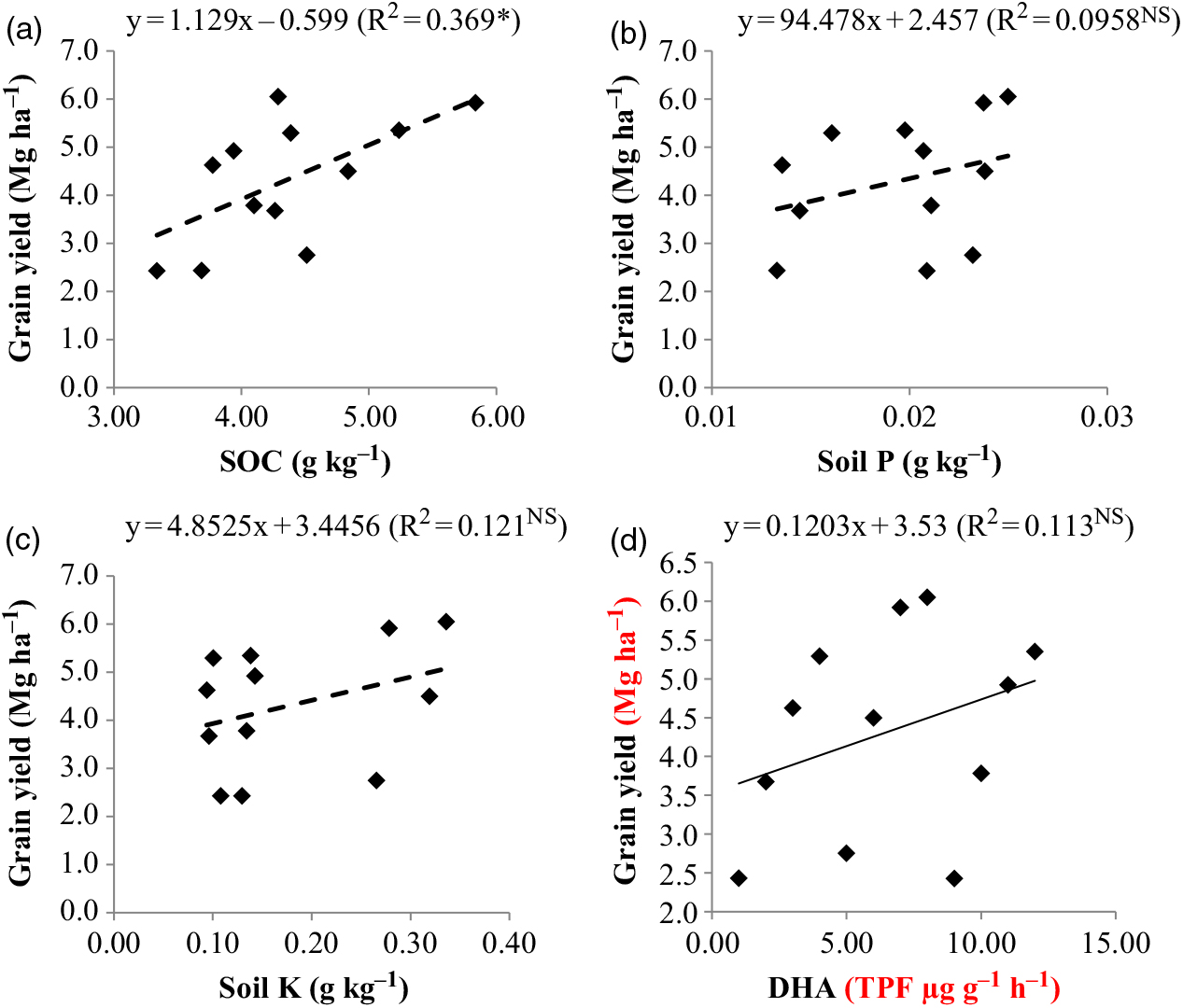
A significant positive correlation at 0–7.5 and 7.5–15 cm was recorded between the soil mineral-N and N concentration in wheat shoots at 60 DAS (Figure 1). The correlations were also positive and significant between the available soil P and shoot P concentration (Figure 1). Similarly, a strong positive correlation was observed between soil available K and shoot K concentration (Figure 1). Among the soil fertility parameters, SOC content and soil mineral N content at 0–7.5 cm and 7.5–15.0 cm depth showed significant correlations with wheat grain yield (Figure 2). However, the correlations between wheat yield and available P or available K contents in soil were non-significant (data not shown).
Relationship between N (a), P (b), and K (c) concentrations in wheat shoot and soil, at 0–7.5 cm and 7.5–15 cm soil depth at 60 days after wheat sowing in 2015/16. Significance of relationships is shown at p ≤ 0.05 (*) and p ≤ 0.01 (**).

Relationship between grain yield of wheat and soil organic carbon (a), soil P (b), soil K (c), and dehydrogenase activity (DHA) (d). Significance of relationships is shown at p ≤ 0.05 (*). NS means non-significant.
N use efficiency
Application of RSB resulted in higher agronomic efficiency of N (AEN) in rice at 40 and 80 kg N ha−1 as compared to RSB- and non-amended control (Table 7). However, differences between the amendments were non-significant at 120 kg N ha−1. At 80 kg N ha−1, AEN in rice on RSB-amended soil was 40.5 and 52.8% higher than in RHA- and non-amended soil, respectively. As expected, AEN in both rice and wheat decreased with increasing N level, irrespective of soil amendment. In wheat, AEN at 80 kg N ha−1 on RSB-amended soil was 27.3 and 46.3% higher than in RHA- and non-amended soil, respectively (Table 7). The recovery efficiency of N (REN) was significantly higher in RSB as compared to RHA- and non-amended soil at all N rates in both rice and wheat (Table 7). RHA resulted in significantly higher REN in both rice and wheat than the non-amended soil at 40 and 80 kg N ha−1. However, RHA- and non-amended control had similar values of REN at 120 kg N ha−1. The REN in rice at 80 kg N ha−1 was 54.9% in non-amended control and was increased to 65.1 and 81.5% in RHA and RSB, respectively (Table 7). A similar trend in REN was observed in wheat, reaching 58.2, 66.6, and 81.4% in non-amended control, RHA and RSB, respectively.
Pooled (averaged over 3 years) agronomic efficiency of N (AEN) and recovery efficiency of N (REN) as affected by soil amendment with rice straw biochar (RSB) and rice husk ash (RHA) and N level in rice and wheat in the rice–wheat system

Discussion
Effect of RSB and RHA on soil fertility and biological health
Soil amendments did not show any effect on soil pH because of soil buffering capacity and leaching losses of alkaline cations (e.g., Ca and K), particularly, in such highly permeable sandy loam soil under the rice–wheat system requiring large inputs of irrigation water (about 200 cm). However, Chintala et al. (Reference Chintala, Schumacher, McDonald, Clay, Malo and Papiernik2014) have reported a significant increase in pH and EC of acid soil with the application of maize stover biochar. Possibly, long-term addition of high rates of biochar on fine-textured soils might increase soil pH. On the other hand, a significant increase in soil EC in RSB (Table 2) could be due to release of ionic species held on to the biochar surface, as found by Chintala et al. (Reference Chintala, Schumacher, McDonald, Clay, Malo and Papiernik2014) and Oguntunde et al. (Reference Oguntunde, Abiodun, Ajayi and van de Giesen2008). Application of amendments (RSB and RHA) also significantly increased the mineral N in the 7.5–15.0 cm soil depth, which is a likely consequence of reduced soil N losses via leaching and denitrification (Sohi et al., Reference Sohi, Krull, Lopez-Capel and Bol2010). In addition, amendments contained a significant amount of total N (e.g., 1.06% in RSB and 0.34% in RHA), which might have contributed toward the increase in soil mineral N content (Table 1). Biochars have also been shown to increase adsorption of NH4 + in soil due to the increase in cation exchange capacity, thereby retaining more exchangeable N-NH4 + as compared with non-amended soil (Ding et al., Reference Ding, Liu, Wu, Shi, Yang and Zhong2010). As expected, fertilizer N application caused a significant increase in mineral N concentration in soil compared to no N control (Table 3).
Remarkable increases in available P and K in both surface and subsurface soil layers due to RSB could be caused by its composition, a rich source of P (0.28%) and K (5.7%). RSB might have mineralized over the experimental period and also favorably altered the dynamics of the applied and native soil P (Alburquerque et al., Reference Alburquerque, Salazar, Barron, Torrent, Campillo, Gallardo and Villar2013). Similarly, RHA also contained substantial amounts of P and K that resulted in an increase in available P and K contents in the soil. The increase in soil available P under RHA and RSB was reflected in increased P concentration in plant tissues at 60 DAS (Table 2). Earlier reports on application of biochar also showed a significant increase in the availability of basic cations such as K in soil (El-Eyuoon and Amin, Reference El-Eyuoon and Amin2016). The greater increase in available P and K in the soil surface compared with the subsurface layer was possibly due to the accumulation of more biochar in the top layer. Consistent with our results, El-Eyuoon and Amin (Reference El-Eyuoon and Amin2016) and Zhang et al. (Reference Zhang, Liu, Gao, Zhang, Chen, Hui, Yang and Yang2015) reported significant increases in available P and K contents in soil with biochar application. In another study, Singh et al. (Reference Singh, Gupta, Singh and Singh2013) also reported a significant increase in available P in soil amended with RHA. Among the possible ways to increase P and K availability in nutrient poor soils, there are (1) the addition of soluble nutrients contained in the biochar (Sohi et al. Reference Sohi, Krull, Lopez-Capel and Bol2010) and the mineralization of the labile fraction of biochar containing organically bound nutrients (Lehmann et al., Reference Lehmann, Czimczik, Laird, Sohi, Lehmann and Josep2009); (2) decrease in phosphate adsorption (Nelson et al., Reference Nelson, Agudelo, Yuan and Gan2011); and (3) reduction of nutrient leaching due to the presence of carboxylate groups on the biochar surface (Liang et al., Reference Liang, Lehmann, Solomon, Kinyangi, Grossman, O’Neill, Skjemstad, Thies, Luizão, Petersen and Neves2006).
An increase of 39% in SOC under RSB treatment over non-amended soil was found after 3-year period (Table 5). In an earlier study, Sharma et al. (Reference Sharma, Thind, Singh, Singh and Singh2015) reported a significant increase in SOC with the application of RHA in a rice–wheat system and an increase in SOC over control with the addition of RSB is in line with the findings of Ouyang et al. (Reference Ouyang, Tang, Yu and Zhang2014) and Sohi et al. (Reference Sohi, Krull, Lopez-Capel and Bol2010). Like in Ouyang et al. (Reference Ouyang, Tang, Yu and Zhang2014), RSB in our study was prepared at relatively low temperatures, which causes a marked increase in its SOC content.
The higher DHA under RSB and RHA treatments (Table 5) suggests that microbial activity was significantly increased in biochar-treated soil compared to non-amended soil. Sharma et al. (Reference Sharma, Thind, Singh, Singh and Singh2015) also reported that RHA increased the DHA in the surface soil layer. DHA is considered correlated with the availability of soil organic carbon (Moeskops et al., Reference Moeskops, Sukristiyonubowo, Sleutel, Herawaty, Husen, Saraswati, Setyorini and De Neve2010), and Ouyang et al. (Reference Ouyang, Tang, Yu and Zhang2014) have shown that the enhanced soil enzyme activities are partly attributable to the increased organic carbon through biochar supply. Biochar application improved soil aeration due to improvement in the soil structure (Ouyang et al. Reference Ouyang, Tang, Yu and Zhang2014), which might also partly contributed to the enhanced oxidative activities. The higher volatile matter and more aliphatic C–H bonds in biochar produced at low temperatures improve its degradation, which may be accompanied by higher enzyme activities such as DHA (Bruun et al., Reference Bruun, Ambus, Egsgaard and Hauggaard-Nielsen2012; Ouyang et al., Reference Ouyang, Tang, Yu and Zhang2014). Under rice cultivation, biochar addition has improved soil C retention, with a consequent increase in soil microbial activity and crop yield (Feng et al., Reference Feng, Xu, Yu, Xie and Lin2012).
The increase in soil fertility given by mineral N, available P, and K with the application of biochar led to increases in aboveground biomass accumulation and in tiller density of wheat (Tables 2, 3, and 5). In an earlier study using RSB, Zhang et al. (Reference Zhang, Liu, Gao, Zhang, Chen, Hui, Yang and Yang2015) reported a significant increase in plant shoot weight and rice grain number per panicle with the biochar application. Changes in the soil nutrient status particularly P and K are due to direct nutrient addition by biochar, an increase in adsorption of cations and reduction in leaching losses (Spokas et al., Reference Spokas, Cantrell and Novak2011). Then, biochar application induced positive changes in soil fertility, thereby resulting in a significant increase in N, P, and K concentration of wheat plants. Accordingly, Loria and Harpole (Reference Loria and Harpole2013) reported increases in plant N, P, and K concentrations using a meta-analysis of data from a large number of biochar experiments. As expected, application of N at 120 kg N ha−1 increased dry shoot weight by 70% compared to control (Table 4). In fact, nitrogen is a major component of chlorophyll and amino acids, the building blocks of proteins, and its application is well known to increase plant growth and biomass accumulation (Ullah et al., Reference Ullah, Ali, Durrani, Shabaz, Hafeez, Hafeez, Ishfaq, Fayyaz, Rehman and Waheed2018).
Crop yield and N use efficiency as affected by biochar
In our study, increases in grain yields of rice and wheat were recorded with the application of RSB and N fertilization (Table 6). Consistent with our study, Chan et al. (Reference Chan, Zwieten, Meszaros, Dowine and Joseph2007) and Zhang et al. (Reference Zhang, Liu, Gao, Zhang, Chen, Hui, Yang and Yang2015) also reported that biochar increased N availability, crop yields, and N use efficiency. High rice and wheat yields were obtained with the application of 80 kg N ha−1 on RSB-amended soil and with the application 120 kg N ha−1 on non-amended soil (Table 6). These results indicate that RSB supplied 40 kg N ha−1 to each of rice and wheat. Application of biochar for enhancing crop yields is based on its effects in soil fertility, including increases in N availability and in soil microbial activity (Table 5). The increase in grain yields of rice and wheat with the application of RHA was lower compared with RSB due to its lower N content, with the increase in crop yield due to RHA being attributed to increases in availability of P and K in soil (Gupta et al., Reference Gupta, Singh, Singh, Thind, Singh and Singh2013; Thind et al., Reference Thind, Singh, Singh, Singh, Sharma, Vashistha and Singh2012), and its favorable effect on soil physical conditions and microbial processes (Demeyer et al., Reference Demeyer, Nkana and Verlu2001).
Herein, increases in AEN and REN in rice and wheat were recorded with the application of RSB and N (Table 7), which can be ascribed to increases in soil N supply and reduction in N losses. Earlier studies by Cao et al. (Reference Cao, Meng, Liang, Yang and Chen2017) and Yao et al. (Reference Yao, Gao, Zhang, Inyang and Zimmerman2012) showed that incorporation of biochar in a sandy soil increased retention of ammonium and nitrate, thereby reducing N loss by leaching and reducing N2O emissions (Wu et al., Reference Wu, Jia, Wang, Chang and Startsev2013). Accordingly, Zhang et al. (Reference Zhang, Liu, Gao, Zhang, Chen, Hui, Yang and Yang2015) reported that combined application of biochar and N fertilizer increased the AEN and REN in rice over no biochar.
Relationships between soil fertility, plant nutritional status, and grain yield
Significant positive correlations recorded between the mineral-N, available P, and available K contents in soil and P and N concentration in aboveground biomass of wheat suggested that biochar and RHA supplied significant amounts of these nutrients to plants (Figure 1). Higher bioavailability and release of biochar’s N, P, and K in soil have been reported in a number of earlier studies (Bayu et al., Reference Bayu, Mosissa and Nebiyu2016; Mete et al., Reference Mete, Mia, Dijkstra, Abuyusuf and Hossain2015; Yu et al., Reference Yu, Ying and Kookana2009). Among the soil fertility parameters, SOC content showed significant correlation with wheat grain yield (Figure 2). While shoot P and K concentrations in wheat showed significant and positive correlations with available P and K contents in soil, poor relationships were observed between available P and K contents in soil and grain yield of wheat (Figure 2). However, application of RSB and RHA increased the availability of P and K in the soil. Both rice and wheat crops received optimum doses of P and K fertilizers, thereby masking the effect of the increased nutrient availability in soil on the grain yield of wheat with the application of RSB and RHA. The beneficial effects of improvement in soil nutrient supply on plant growth and yield are generally observed at suboptimal levels of fertilizer application (Thind et al., Reference Thind, Singh, Sharma, Singh, Sran and Singh2017).
Conclusion
Our study showed that RSB application improves soil fertility (N, P, and K and organic C) and biological health. As a consequence, it increased crop growth, nutrient uptake, and grain yield in a rice–wheat system on a sandy loam soil. In plots amended with RSB, both rice and wheat needed 80 kg N ha−1 for obtaining the optimum grain yield as compared to 120 kg N ha−1 recommended for non-amended crops. Then, RSB prepared at low temperatures at 5 Mg ha−1 supplied about 40 kg N ha−1 to the rice–wheat crop system. Strong positive relationships between the soil N, P, and K contents and plant N, P, and K concentrations suggested the increase in bioavailability of these nutrients from the biochar. Compared with RSB, RHA proved to be a poor source of N but can supply significant amounts of P to wheat crop.
Supplementary material
For supplementary material for this article, please visit https://doi.org/10.1017/S0014479719000218.
Author ORCIDs
R. K. Gupta 0000-0002-0146-9922
Acknowledgements
The authors are grateful to three science academies of India: Indian Academy of Sciences, Indian National Science Academy, and National Academy of Sciences, India, for grant of the Summer Research Fellowship to Ashaq Hussain, and to Punjab Agricultural University, Ludhiana, Punjab (India) for providing the necessary facilities for carrying out the field and laboratory work.



