Introduction
In Okinawa, the southernmost region of Japan, sugarcane is the primary agricultural product. The white grub beetle Dasylepida ishigakiensis Niijima et Kinoshita (Coleoptera: Scarabaeidae) was first recognized as a harmful sugarcane pest (Sadoyama et al., Reference Sadoyama, Oroku and Nakamori2001) on the islands of Miyako and Irabu in 1997. Since that time, research has been carried out to elucidate the life cycle, developmental characteristics and adult mating behaviours of this insect (Oyafuso et al., Reference Oyafuso, Arakaki, Sadoyama, Kishita, Kawamura, Ishimine, Kinjo and Hirai2002; Arakaki et al., Reference Arakaki, Sadoyama, Kishita, Nagayama, Oyafuso, Ishimine, Ota, Akino, Fukaya, Hirai, Yamamura and Wakamura2004; Tanaka et al., Reference Tanaka, Yukuhiro, Yasui, Fukaya, Akino and Wakamura2008; Tokuda et al., Reference Tokuda, Tanaka, Maeno, Harano, Wakamura, Yasui, Arakaki, Akino and Fukaya2010; Harano et al., Reference Harano, Tokuda, Kotaki, Yukuhiro, Tanaka, Fujiwara-Tsujii, Yasui, Wakamura, Nagayama, Hokama and Arakaki2012; Nishide et al., Reference Nishide, Harano, Tanaka, Nagayama, Arakaki, Fujiwara-Tsujii, Yasui and Wakamura2013). Recently, the chemical structure of the female sex pheromone and the behavioural responses of male beetles to this pheromone have been characterized (Wakamura et al., Reference Wakamura, Yasui, Akino, Yasuda, Fukaya, Tanaka, Maeda, Arakaki, Nagayama, Sadoyama, Kishita, Oyafuso, Hokama, Kobayashi, Tarora, Uesato, Miyagi and Osuga2009a). The aim of the present study was to estimate the optimal timing and duration of synthetic pheromone release for the purpose of controlling beetle populations in the field.
The life cycle of the white grub beetle is 2 years long, and the second-instar and third-instar larvae feed on the roots and stems of sugarcane, causing both plant damage and death (Oyafuso et al., Reference Oyafuso, Arakaki, Sadoyama, Kishita, Kawamura, Ishimine, Kinjo and Hirai2002; Arakaki et al., Reference Arakaki, Sadoyama, Kishita, Nagayama, Oyafuso, Ishimine, Ota, Akino, Fukaya, Hirai, Yamamura and Wakamura2004). Generally, eggs are laid in March, hatch in April, undergo moulting to reach the second-instar stage in August and reach the final third-instar stage in October. At this point, the larvae can remain as third instars for as long as 1 year, during which they enter a summer diapause period (Tanaka et al., Reference Tanaka, Yukuhiro, Yasui, Fukaya, Akino and Wakamura2008). Diapause ends during the autumn of their second year and is followed by pupation. Adults emerge in late autumn, after which they enter a second, short diapause period that is eventually brought to an end by low winter temperatures. On relatively warm evenings in February, the adults emerge from the soil for a short period of time to mate, after which they return to the soil. Mated females remain in the soil where they lay eggs until they die, whereas males may re-emerge from the soil to mate multiple times (Arakaki et al., Reference Arakaki, Sadoyama, Kishita, Nagayama, Oyafuso, Ishimine, Ota, Akino, Fukaya, Hirai, Yamamura and Wakamura2004; Tokuda et al., Reference Tokuda, Tanaka, Maeno, Harano, Wakamura, Yasui, Arakaki, Akino and Fukaya2010; Harano et al., Reference Harano, Tanaka, Tokuda, Yasui, Wakamura and Arakaki2010a, Reference Harano, Tokuda, Kotaki, Yukuhiro, Tanaka, Fujiwara-Tsujii, Yasui, Wakamura, Nagayama, Hokama and Arakaki2012).
The fact that D. ishigakiensis spends most of its life cycle in the soil is important, as soil-dwelling insect pests are notoriously difficult to control. Although the soil can be ploughed with a tractor to kill the larvae (Kijima and Tarora, Reference Kijima and Tarora2010), this control measure requires enormous time and effort and is complicated because the optimal time for ploughing coincides with the period of sugarcane harvesting. Insecticide use is another potential option, although one runs the risk of contaminating drinking water supplies (Fukaya et al., Reference Fukaya, Yasui, Akino, Yasuda, Wakamura, Tanaka, Maeda, Hirai, Yasuda, Nagayama and Arakaki2009).
Recently, it has been discovered that the sex pheromone of D. ishigakiensis is (R)-2-butanol (Wakamura et al., Reference Wakamura, Yasui, Akino, Yasuda, Fukaya, Tanaka, Maeda, Arakaki, Nagayama, Sadoyama, Kishita, Oyafuso, Hokama, Kobayashi, Tarora, Uesato, Miyagi and Osuga2009a, Reference Wakamura, Yasui, Mochizuki, Fukumoto, Arakaki, Nagayama, Uesato, Miyagi, Oroku, Tanaka, Tokuda, Fukaya, Akino, Hirai and Shigab), and there has been considerable interest in using this pheromone to disrupt mating behaviours in this species (Yasui et al., Reference Yasui, Wakamura, Fujiwara-Tsujii, Arakaki, Nagayama, Hokama, Mochizuki, Fukumoto, Oroku, Harano and Tanaka2012). However, to effectively implement this technique in the field, it is necessary to determine the fecundity and behaviours of adult females around the time of mating. Furthermore, to reduce the cost of pheromone use, it is important to determine the minimum treatment amount and duration necessary to achieve mating disruption. Mating delays have negative impacts on various aspects of reproduction in a variety of insects, including lepidopteran species (Wakamura and Takai, Reference Wakamura and Takai1995; Witzgall et al., Reference Witzgall, Kirsch and Cork2010) and coleopteran species (Arakaki et al., Reference Arakaki, Nagayama, Kobayashi, Hokama, Sadoyama, Mogi, Kishita, Adaniya, Ueda, Higa, Shinzato, Kawamitsu, Nakama, Wakamura and Yamamura2008). However, there is no available information on the effects of mating delays in D. ishigakiensis. Therefore, in this study, we investigated the effects of mating time on mating success, timing of oviposition, number of eggs laid, hatchability and adult lifespan using field-collected adult beetles. We also carried out experiments using laboratory-reared adults, for which the timing of adult emergence and the process of ovarian development have been characterized previously (Tanaka et al., Reference Tanaka, Yukuhiro, Yasui, Fukaya, Akino and Wakamura2008).
Materials and methods
Handling of field-collected adult white grub beetles
The white grub beetles began flying in late January of 2011 on Miyako Island in Okinawa (latitude: 24.5 °N; longitude: 125.3 °E), and over 300 male beetles were collected using traps baited with the synthetic pheromone (R)-2-butanol on 4 February (Wakamura et al., Reference Wakamura, Yasui, Akino, Yasuda, Fukaya, Tanaka, Maeda, Arakaki, Nagayama, Sadoyama, Kishita, Oyafuso, Hokama, Kobayashi, Tarora, Uesato, Miyagi and Osuga2009a; Yasui et al., Reference Yasui, Wakamura, Tanaka, Harano, Mochizuki, Nagayama, Hokama and Arakaki2010). During the same night, approximately 200 single female beetles were collected in the pheromone-treated fields (Yasui et al., Reference Yasui, Wakamura, Fujiwara-Tsujii, Arakaki, Nagayama, Hokama, Mochizuki, Fukumoto, Oroku, Harano and Tanaka2012) between 19.00 and 19.30 h. These single females were assumed to be virgins and were used in the experiments. The reasons for assuming these females to be virgin are threefold: (1) after 19.00 h, it is extremely rare to find single females in untreated sugarcane fields, because virtually all females would have been located by a male and would already be in the process of copulation (Arakaki et al., Reference Arakaki, Hokama, Nagayama, Yasui, Fujiwara-Tsujii, Tanaka, Mochizuki, Naito, Hongo and Wakamura2013); (2) mating generally begins at approximately 18.45 h and continues for longer than 1 h (Arakaki et al., Reference Arakaki, Sadoyama, Kishita, Nagayama, Oyafuso, Ishimine, Ota, Akino, Fukaya, Hirai, Yamamura and Wakamura2004; Harano et al., Reference Harano, Tanaka, Yasui, Wakamura, Nagayama, Hokama and Arakaki2010b); and (3) mated females do not emerge from the soil for a second round of mating (Arakaki et al., Reference Arakaki, Sadoyama, Kishita, Nagayama, Oyafuso, Ishimine, Ota, Akino, Fukaya, Hirai, Yamamura and Wakamura2004). Therefore, single females captured between 19.00 and 20.00 h in pheromone-treated fields almost certainly represent virgin females that have not yet been located by a male (Yasui et al., Reference Yasui, Wakamura, Fujiwara-Tsujii, Arakaki, Nagayama, Hokama, Mochizuki, Fukumoto, Oroku, Harano and Tanaka2012). As a further precaution, we dissected several of the collected females and confirmed their virginity. In addition, male and female paired beetles were collected in the field on 4 February, and these females were used as controls that were not allowed to mate in the laboratory. All these beetles were shipped by air to the laboratory at the National Institute of Agro-biological Sciences at Ohwashi (NIASO) located in Ibaraki, Japan.
Mating in the laboratory
The female beetles collected on Miyako Island were individually housed in plastic cups (diameter, 6 cm; height, 3.5 cm) and incubated at 20 °C under natural light cycles in Tsukuba. To carry out the mating experiment, virgin females and males were placed in a plastic box (20 cm × 30 cm × 12 cm) according to the procedures described earlier (Harano et al., Reference Harano, Tanaka, Tokuda, Yasui, Wakamura and Arakaki2010a; Tokuda et al., Reference Tokuda, Tanaka, Maeno, Harano, Wakamura, Yasui, Arakaki, Akino and Fukaya2010). After the mating experiment, the female beetles were returned to their former cups and maintained under the same conditions described above. Mating trials were carried out on 14 February, 24 February, 7 March, 17 March and 25 March, allowing us to test females in which mating was delayed by 10, 20, 31, 41 and 49 days, respectively, compared with the control females mated in the field on 4 February. These delayed mating intervals were chosen based on the overall length of flight season of this beetle, which typically ranges from early February to mid-March (Oyafuso et al., Reference Oyafuso, Arakaki, Sadoyama, Kishita, Kawamura, Ishimine, Kinjo and Hirai2002). For each mating trial, 20–50 pairs of females and males were used. However, the number of successfully mated pairs could not be precisely determined, and mating success declined dramatically after 7 March, leading to only a few pairs being mated for the last two intervals. Each mated female was held in a plastic cup and examined every 2 days for oviposition, and the first day on which eggs were found was recorded as the oviposition day for that respective female. Because oviposition continues for several days, the females that were found to be laying eggs were transferred to a new cup until oviposition had ended. The eggs were maintained at 20 °C in the dark to determine the percentage that hatched. The lifespans of the mated females were also recorded. To determine the total number of eggs produced by each female, the number of eggs remaining in the abdomens of the females after death was determined by dissection, which was added to the total number of eggs laid. In this study, unfertilized eggs deposited prior to mating were not included in the egg counts, as these eggs quickly decompose and are difficult to accurately count.
Handling of laboratory-reared adult white grub beetles
Third-instar larvae were collected on Miyako Island in 2011 and reared at 24 °C under a 16 h light–8 h dark photoperiod until adult emergence, as described previously (Tanaka et al., Reference Tanaka, Yukuhiro, Yasui, Fukaya, Akino and Wakamura2008; Tokuda et al., Reference Tokuda, Tanaka, Maeno, Harano, Wakamura, Yasui, Arakaki, Akino and Fukaya2010). Following adult emergence, adult females were individually reared in plastic cups with humus at 20 °C. On the 45th, 60th or 80th day post-emergence, females were placed in plastic containers with sexually mature virgin males, as described above for the field-collected adults. Ovarian development begins around day 60, and mature oocytes and eggs are commonly found by day 80 (Tanaka et al., Reference Tanaka, Yukuhiro, Yasui, Fukaya, Akino and Wakamura2008). Males were maintained at 16 °C in the dark for 60–75 days to minimize the effects of exhaustion and physiological ageing prior to mating. Mated pairs were treated in the same manner as the field-collected adults, and the proportion of females that produced fertilized eggs, the number of eggs laid by each of these females, the hatching rate of their eggs and the number of progeny produced were recorded as described above.
Statistical analysis
The percentages of females that produced progeny were analysed using the Steel–Dwass test or a χ2 test at a 5% significance level. The time spans between mating and oviposition were compared using Fisher's protected least significant difference (PLSD) test, an ANOVA and a t-test. The numbers of eggs laid and adult longevity were analysed using Fisher's PLSD test following an ANOVA, and hatchability percentages were compared using the Steel–Dwass test at a 5% significance level.
Results
Effects of mating delay on reproductive performance in field-collected adults
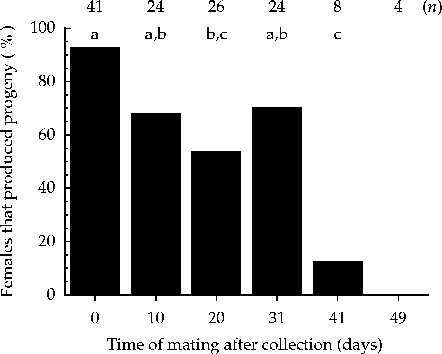
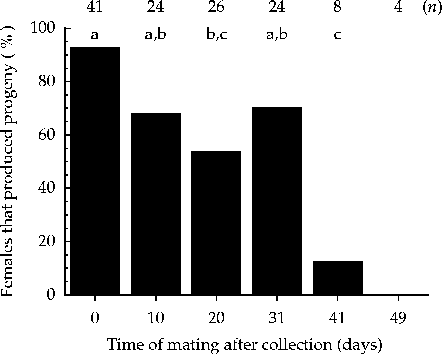
Of the 41 females that were collected in the field as mated insects on 4 February, 92% produced progeny. However, the proportion of females that produced progeny, which we refer to as ‘mating success’, was significantly reduced when matings were performed in the laboratory (Fig. 1; Steel–Dwass test; P< 0.05 each). Among the groups in which mating was delayed by 10–31 days, mating success ranged from 70.3 to 53.6%, and no significant differences were found between these groups (Fig. 1; Steel–Dwass test; P>0.05). Furthermore, when mating was delayed by 41 days, mating success was lowered to 12.5%. Finally, for the longest mating interval, only four pairs of beetles mated and no females laid viable eggs, although over 20 females were tested.
Percentage of Dasylepida ishigakiensis females that produced progeny after mating on different dates after collection. Numerals at the top of the bar graphs are the number of females engaged in mating for the respective mating dates. Different letters above bars indicate a significant difference at the 5% level with a χ2 test.
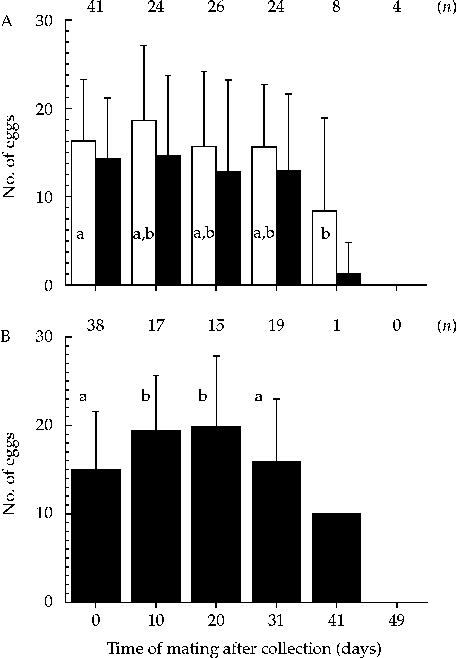
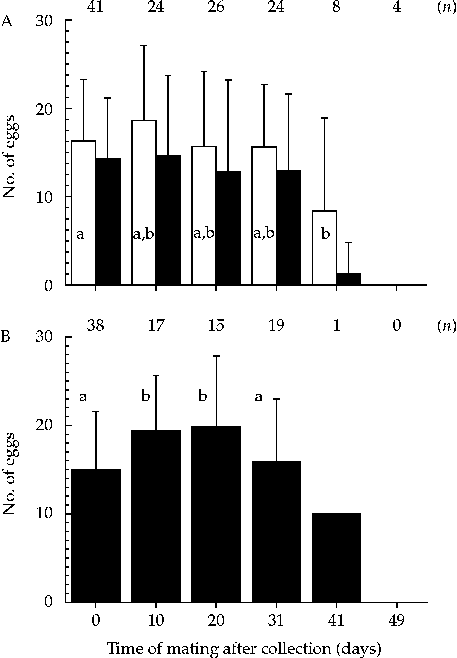
The total number of eggs, including those deposited and those found within females after death, were not significantly different between females mated on days 0, 10, 20 and 31 post-capture (Fig. 2A; ANOVA; P>0.05). However, the majority of females mated on day 41 post-capture produced a few or no eggs. A similar pattern was also observed when considering the mean numbers of eggs laid (Fig. 2A). Figure 2B shows the number of eggs laid by females that produced progeny. Significant differences were found between females that were mated on different days post-capture (ANOVA; F= 2.97; df = 3, 85; P= 0.04). Note that because only one female laid eggs when mated on day 41 post-capture, data from this group were not included in the statistical analysis.
Numbers (mean ± SD) of eggs generated (open bars) and those laid (closed bars) by all tested Dasylepida ishigakiensis females after mating on different dates after collection (A) and the numbers of eggs laid by the females that produced progeny (B). Different letters above bars indicate a significant difference at the 5% level with Fisher's PLSD test after ANOVA.
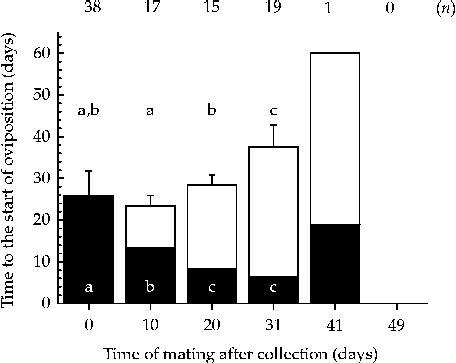
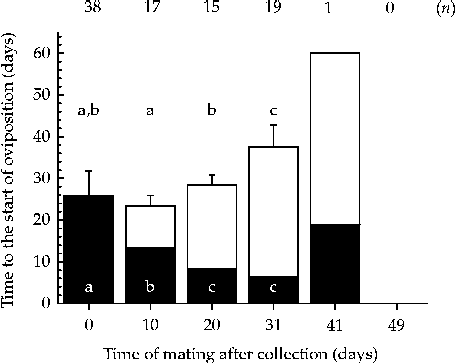
For control females, the time between mating and start of oviposition was approximately 26 days. This period tended to decrease as mating was delayed, at least until day 31 (closed bars; Fig. 3). Interestingly, the overall length of the mating delay (open bars; Fig. 3) plus the time between mating and oviposition – or the total length of time since the date of capture – remained relatively constant, at least until day 31 post-capture (open bars; Fig. 3). For the longest interval, a further delay in mating time pushed back the start of oviposition, although this result was based on only one beetle.
Time (mean ± SD) required from the time of collection (open bars) or from the time of mating (closed bars) to the start of oviposition for Dasylepida ishigakiensis female adults that produced progeny. Different letters above bars indicate significant difference among different mating dates at the 5% level with Fisher's PLSD test after ANOVA.
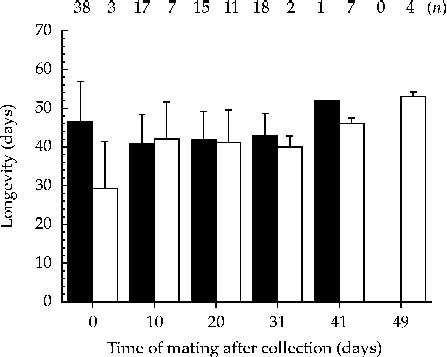
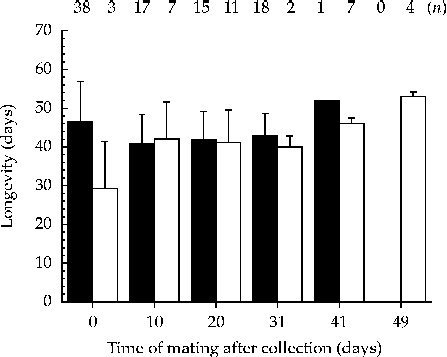
The mean longevity of female beetles after collection in the field was 46.6 days (Fig. 4), which was not significantly influenced by mating delay (ANOVA; F= 2.149; df = 3, 84; P>0.05).
Longevity after collection (mean ± SD, days) for Dasylepida ishigakiensis females that laid eggs (solid bars) and those that did not lay eggs (open bars) after mating on different dates.
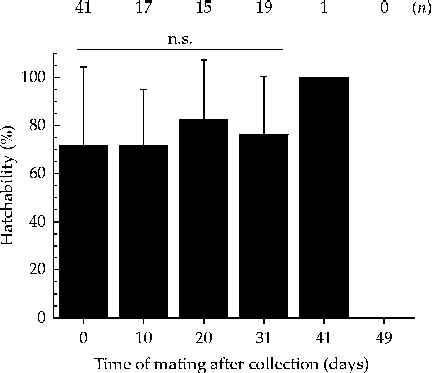
The hatchability of eggs laid by females that produced progeny was not significantly influenced by mating delay (Fig. 5).
Hatchability (mean ± SD) of eggs laid by the respective Dasylepida ishigakiensis females after mating on different dates. n.s. indicates no significant difference between the groups, indicated by a horizontal line with the Steel–Dwass test at the 5% level.
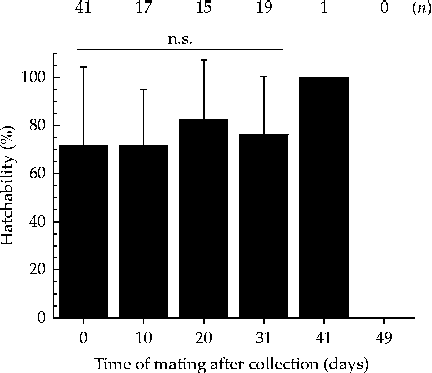
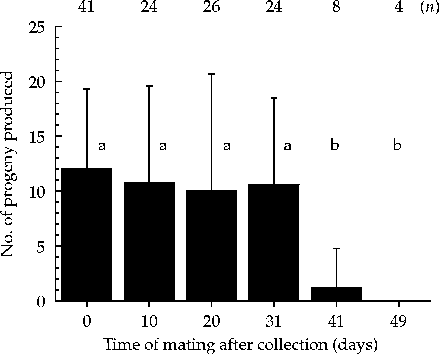
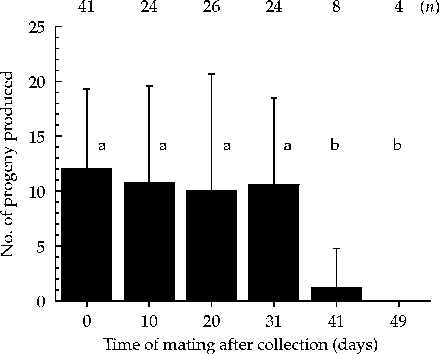
Figure 6 shows a comparison between the mean numbers of progeny produced by all the mated females that were tested, including those that produced eggs but no progeny. The mean progeny production was not affected by mating delay, except for the group in which mating was delayed until day 41 or later.
Number (mean ± SD) of progeny produced by the respective Dasylepida ishigakiensis females that mated on different dates after collection. Different letters above bars indicate a significant difference among the different mating dates at the 5% level with Fisher's PLSD test after ANOVA.
Effects of mating delay on reproductive performance in laboratory-reared adults
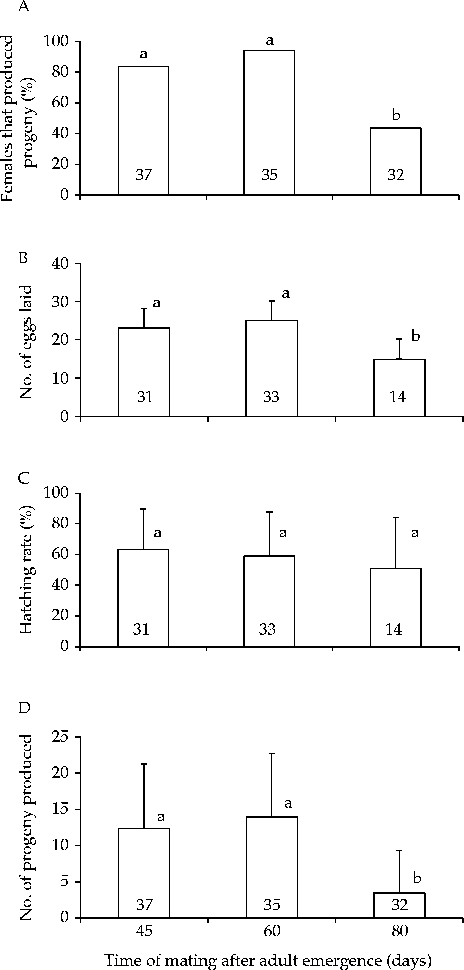
For females mated on days 45 and 60 post-emergence, the proportions that produced progeny were 83.8 and 94.3%, respectively (Fig. 7A), and no significant difference was found between these two values (χ2 test; P>0.05). In contrast, for females mated on day 80 post-emergence, the proportion that produced progeny was only 43.8%, which was significantly different from the above values (χ2= 12.12 and 20.38 for days 45 and 60, respectively; df = 1; P< 0.05 each).
Effects of mating time on various reproductive parameters (mean ± SD) in laboratory-reared Dasylepida ishigakiensis females that were allowed to mate with a male on days 45, 60 and 80 after adult emergence: (A) the percentages of females that produced progeny after mating analysed with a χ2 test, (B) the number of eggs laid by females after mating analysed with Fisher's PLSD test after ANOVA, (C) the hatchability of eggs laid by females after mating analysed with the Steel–Dwass test and (D) the number of progeny produced by females after mating analysed with Fisher's PLSD test after ANOVA. Numbers in bars indicate n. Different letters above bars indicate a significant difference among the different mating dates at the 5% level.
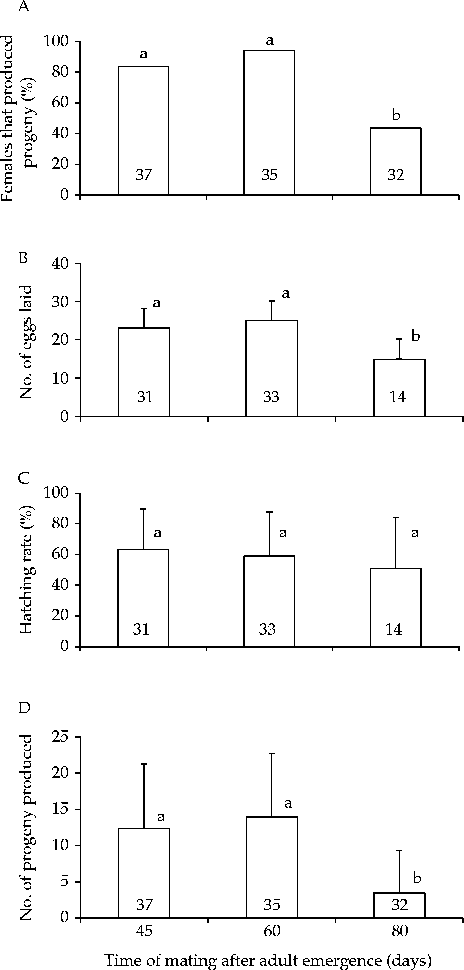
The numbers of eggs laid by females that produced progeny were also similar between females mated on day 45 and those mated on day 60 post-emergence (Fig. 7B; t-test; P>0.05). However, this measure was significantly reduced in females mated on day 80 when compared with that in females mated on day 45 (t= 4.05; df = 43; P< 0.05) and those mated on day 60 (t= 5.23; df = 45; P< 0.05). The time between mating and first oviposition was similar for females mated on days 45 (96.4 ± 7.3 days; n= 31) and 60 (92.2 ± 7.7 days; n= 33), although the difference was statistically significant (t= 2.35; df = 62; P< 0.05). The corresponding data for females mated on day 80 were not recorded, as some of these beetles began to lay unfertilized eggs prior to mating. The mean adult lifespans ( ± SD) in females mated on days 45, 60 and 80 were 117.81 ± 13.98 days (n= 37), 111.06 ± 11.14 days (n= 35) and 104.86 ± 857 days (n= 32), respectively, which were not significantly different from one another (Steel–Dwass test; P>0.05).
The hatchability of eggs laid by females that produced progeny was not significantly influenced by mating delay (Fig. 7C; Steel–Dwass test; P>0.05).
The mean numbers of progeny produced by all the mated females used in this study, including those that produced eggs but no progeny, were not significantly different between females mated on day 45 and those mated on day 60. However, progeny production was significantly reduced by a further delay in mating (Fig. 7D; Fisher's PLSD test; P< 0.05).
Discussion
In the present study, we tested the effects of mating delay on the reproductive performance of D. ishigakiensis females, both in beetles collected as adults in the field and in laboratory-reared beetles, for which similar results were obtained. Mating success – defined as the proportion of females that produced progeny relative to the number that were mated – was negatively affected when mating occurred relatively late in adulthood. Furthermore, consistent patterns were observed for several other parameters, including the number of eggs laid, number of eggs that produced progeny and hatchability, consistent with reports from lepidopteran species (Kiritani and Kanoh, Reference Kiritani and Kanoh1984; Henneberry and Clayton, Reference Henneberry and Clayton1985; Wakamura et al., Reference Wakamura, Takai, Kozai, Inoue, Yamashita, Kawahara and Kawamura1989; Rogers and Marti, Reference Rogers and Marti1994; Wakamura and Takai, Reference Wakamura and Takai1995; Torres-Vila et al., Reference Torres-Vila, Rodríguez-Molina and Stockel2002; Huang and Subramanyam, Reference Huang and Subramanyam2003; Michereff et al., Reference Michereff, Vilela, Filho, Nery and Thièbaut2004; Jiao et al., Reference Jiao, Zuan and Sheng2006; Walker and Allen, Reference Walker and Allen2011). On the other hand, lifespan and the time between mating and oviposition were not greatly affected by mating delay. These findings should be considered in the context that this species does not feed as adults and that the nutrients allocated for egg production are obtained during the larval stage (Oyafuso et al., Reference Oyafuso, Arakaki, Sadoyama, Kishita, Kawamura, Ishimine, Kinjo and Hirai2002; Harano et al., Reference Harano, Tanaka, Yasui, Wakamura, Nagayama, Hokama and Arakaki2010b, Reference Harano, Tokuda, Kotaki, Yukuhiro, Tanaka, Fujiwara-Tsujii, Yasui, Wakamura, Nagayama, Hokama and Arakaki2012).
Conspicuous reductions in mating success and hatchability were observed in D. ishigakiensis when mating occurred late in adulthood. In the experiment with field-collected adults, it is possible that these reductions were due to the resorption of developing oocytes as well as exhaustion and ageing in both the females and males, as has been observed in other insects (Barrer, Reference Barrer1976; Proshold et al., Reference Proshold, Karpenko and Graham1982). These beetles were maintained at 20 °C under laboratory conditions, except during the mating trials, which were carried out at room temperature (~25 °C). Furthermore, relatively few mating pairs were obtained from these field-collected adults (Fig. 1). Other factors potentially responsible for the age-dependent reductions in mating ability and fertility may include the reduced production of sex pheromones, cessation of calling behaviour, reduced female receptivity to mating, loss of egg viability and increases in oocyte degradation products that can interfere with sperm migration and fertilization, as has been observed in other insect species (Torres-Vila et al., Reference Torres-Vila, Rodríguez-Molina and Stockel2002; Stelinski and Gut, Reference Stelinski and Gut2009; Walker and Allen, Reference Walker and Allen2011). In D. ishigakiensis species, female adults change the concentration and chemical make-up of their pheromones as they age (Yasui et al., Reference Yasui, Wakamura, Tanaka, Harano, Mochizuki, Nagayama, Hokama and Arakaki2010; Fujiwara-Tsujii et al., Reference Fujiwara-Tsujii, Yasui, Wakamura, Mochizuki and Arakaki2012). However, considering that mating in this species is largely dependent on males locating females and that sexually active males can mate with sexually immature females in diapause, it is unlikely that such temporal changes in pheromone release would be responsible for the reductions in mating success observed in this study, as males and females were confined together within small containers (Tanaka et al., Reference Tanaka, Yukuhiro, Yasui, Fukaya, Akino and Wakamura2008). Furthermore, in the experiment with laboratory-reared beetles, males were maintained at 16 °C to minimize exhaustion before being mated with 80-day-old females that had been maintained at 20 °C. In this group, although more than 30 females underwent mating, less than 50% of these produced progeny (Fig. 7C). This result suggests that prolonged mating delays cause physiological changes in D. ishigakiensis females that can lead to substantial declines in fertility, and these findings support the proposal that mating disruption may be an effective technique for population control in this pest species.
The experiment with laboratory-reared D. ishigakiensis adults indicates that mating prior to ovarian development in females does not affect their reproductive performance (Tanaka et al., Reference Tanaka, Yukuhiro, Yasui, Fukaya, Akino and Wakamura2008), as oocytes were observed in all the females mated on day 60 but not in any of the females mated on day 45 under 20 °C.
Although the results obtained from laboratory studies cannot always be simplistically applied to infer the behaviours of insects in the field, our results may provide useful guidelines regarding the time and length of pheromone application for disrupting sexual communication in D. ishigakiensis. We suggest that pheromones be applied starting in mid-January, as adults first begin to appear above the ground for mating in late January on Miyako Island (Oyafuso et al., Reference Oyafuso, Arakaki, Sadoyama, Kishita, Kawamura, Ishimine, Kinjo and Hirai2002). Virgin adult females remain capable of reproduction for a long period, and efforts to use sex pheromones for disrupting mating behaviours should include this time period. We also observed that females subjected to long mating delays exhibited reduced reproductive output and laid unfertilized eggs prior to mating. Furthermore, we maintained females at 20 °C, which is similar to the mean soil temperatures recorded at a depth of 20–40 cm during February and March in this region (Tanaka et al., Reference Tanaka, Yukuhiro, Yasui, Fukaya, Akino and Wakamura2008). Therefore, sex-pheromone treatments for the purpose of disrupting mating behaviours should also cover this period.
Acknowledgements
The authors thank Ikuko Hashimoto for her assistance with the rearing of insects at NIASO and two anonymous reviewers for improving the manuscript greatly.