Herbicide resistance continues to increase globally with 478 current cases of unique resistance (Heap Reference Heap2016). With each additional case of resistance, herbicide options become increasingly more limited. To exacerbate the problem, no new herbicide modes of action have been introduced for more than 25 yr (Duke Reference Duke2012), novel herbicide research capacity is diminishing due to company mergers, and weed management in field crops continues to be primarily herbicide based. New methods and new thinking about weed management are needed to allow continued sustainable crop production in western Canada. Targeting weeds at different or additional life cycle stages would help to increase weed management efficacy and diversity.
Increasing herbicide resistance has renewed interest in “older” herbicides such as fluridone. Fluridone is a phytoene desaturase–inhibiting herbicide, HRAC Group F1 and WSSA Group 12 (Bartels and Watson Reference Bartels and Watson1978; Heap Reference Heap2016). These herbicides block carotenoid biosynthesis and cause bleaching and desiccation (Heap Reference Heap2016). Fluridone was initially tested for use in cotton (Gossypium hirsutum L.) (Banks and Merkle Reference Banks and Merkle1979; Waldrep and Taylor Reference Waldrep and Taylor1976) but was not labeled for field use. Research into the compound declined due to residue carryover to subsequent crops (Banks and Merkle Reference Banks and Merkle1979; Hill et al. Reference Hill, Norsworthy, Barber, Roberts and Gbur2016), availability of herbicides with more effective control spectrums, and the introduction of herbicide-resistant cotton cultivars. However, fluridone has continued to be used as an aquatic herbicide from SePro (Shaner Reference Shaner2014), and resistance has evolved in hydrilla [Hydrilla verticillata (L. f.) Royle] in the United States (Heap Reference Heap2016). In addition to having herbicidal activity, fluridone has been reported to be a germination stimulant (Goggin and Powles Reference Goggin and Powles2014); it has been shown to release dormancy and induce germination in laboratory studies with rigid ryegrass (Lolium rigidum Gaud.) and tedera (Bituminaria bituminosa C. H. Stirt. vars albomarginata and crassiuscula) (Castello et al. Reference Castello, Croser, Lulsdorf, Ramankutty, Pradhan, Nelson and Real2015; Goggin et al. Reference Goggin, Steadman, Emery, Farrow, Benech-Arnold and Powles2009). Biologically active fluridone residues can persist for >385 d (Schroeder and Banks Reference Schroeder and Banks1986), which can impact subsequent crops but can also potentially impact subsequent weed populations.
Glyphosate-resistant weed evolution in cotton in the United States has resulted in an increased need for alternate herbicide options and a resurgence of fluridone research (Braswell et al. Reference Braswell, Cahoon, York, Jordan and Seagroves2016; Cahoon et al. Reference Cahoon, York, Jordan, Seagroves, Everman and Jennings2015; Hill et al. Reference Hill, Norsworthy, Barber, Roberts and Gbur2016). Fluridone was registered in cotton in 2016 (Braswell et al. Reference Braswell, Cahoon, York, Jordan and Seagroves2016) with label restrictions based on soil characteristics, location, and recropping intervals (Anonymous 2016a, 2016b). Fluridone carryover may still restrict its use, although some tolerant rotational crops have been identified (Cahoon et al. Reference Cahoon, York, Jordan, Seagroves, Everman and Jennings2015; Hill et al. Reference Hill, Norsworthy, Barber, Roberts and Gbur2016). Additionally, the dual activity of fluridone as a germination stimulant and herbicide has highlighted its potential for additional weed control uses (Goggin and Powles Reference Goggin and Powles2014). A compound that stimulates germination at a desired time and then exerts control may be valuable, and fluridone may be a viable option (Goggin and Powles Reference Goggin and Powles2014), especially for annual weeds that persist in the soil seedbank. A chemical that can stimulate emergence from the seedbank and thereby reduce survival rates restricts a stage of the life cycle with significant impacts on overall population growth rate (Davis Reference Davis2006; Tidemann et al. Reference Tidemann, Hall, Harker and Alexander2016).
Most seedlings that germinate in late fall in western Canada are killed by frost in October or November; this leaves few opportunities for weeds that emerge in the fall to survive until the following growing season. Facultative or obligate winter annual species are exceptions that typically survive fall frosts. Some winter annual species such as false cleavers (hereafter called “cleavers”) are significant problems in western Canada (Leeson et al. Reference Leeson, Thomas, Hall, Brenzil, Andrews, Brown and Van Acker2005). Germination stimulation in combination with winter temperatures may be enough to control some weeds, although a stimulant that also has herbicidal activity may be ideal to prevent an increase in winter annual weed competition.
A number of characteristics would be required of a compound used for both germination stimulation and herbicidal activity. Germination stimulation or weed seed dormancy would need to be sufficiently altered to affect the following year’s populations of key weed species. Efficacy would need to occur shortly after fall application at economically feasible rates across a range of edaphic conditions and with low phytotoxicity to common rotational crops. The objective of this study was to determine efficacy levels of fluridone in Alberta field studies as a combination germination stimulant and herbicide. Because efficacy was studied under field conditions, fall emergence counts were used as a proxy for germination stimulant measures, and spring plant population densities were used as a proxy for herbicidal efficacy. In addition, rotational tolerance of common annual crops to fall-applied fluridone was determined.
Materials and Methods
This study was conducted following completion of a weed seed retention study described in Tidemann et al. (Reference Tidemann, Hall, Harker, Beckie, Johnson and Stevenson2017) at Lacombe, AB, in 2014 and 2015 and St Albert, AB, in 2015. In that study, populations of wild oat, cleavers, and volunteer canola were established across crop plots in individual areas. Fababean (Vicia faba L.) and wheat were seeded at 30 or 60 seeds m−2 and 200 or 400 seeds m−2, respectively, in a randomized complete block design (Tidemann et al. Reference Tidemann, Hall, Harker, Beckie, Johnson and Stevenson2017). No herbicides were applied in the previous study, so no herbicide residues were present nor was there an effect of previous herbicides on populations (Tidemann et al. Reference Tidemann, Hall, Harker, Beckie, Johnson and Stevenson2017). For the current study, the 1× seeding rate (30 and 200 seeds m−2, respectively) (Tidemann et al. Reference Tidemann, Hall, Harker, Beckie, Johnson and Stevenson2017) of each crop was split into two smaller plots with four replicates of each chemical treatment in a split-plot design. Chemical treatments included a untreated control and 734 g ai ha−1 of fluridone (SePro, Carmel, IN). The fluridone rate is twice the rate of that used by Goggin and Powles (Reference Goggin and Powles2014) due to relatively high organic matter content at the two study locations. The St Albert soil was a silty clay with 12.7% organic matter and pH 7.8. Lacombe soil was a loam to clay loam with 9% to 10% organic matter and pH between 6.4 and 7.5. Overall, there were four treatments: two crop and two chemical treatment combinations. Fluridone was applied using a single-nozzle CO2-pressurized hand-boom sprayer with a Combo-Jet® ER80-02 nozzle (Wilger, Saskatoon, SK) on October 7 in Lacombe in 2014 and 2015, and October 8 in St Albert in 2015. Spray volume was 100 L ha−1. Plot sizes were 1.2 by 11 m at Lacombe and 0.6 by 6 m at St Albert. Treatments were applied directly to the soil without incorporation.
Beginning 1 wk after treatment application, weed density was quantified in each of the three weed sections in each plot (cleavers, wild oat, and canola). Densities were determined in a 0.25-m2 quadrat in each weed section (3 densities per plot). In the wild oat section, counts of grass weeds including wild oat and volunteer wheat were combined to account for potential errors in differentiation of 1-leaf seedlings. Densities were assessed weekly until daily temperature maximums were below 5 C with frost at night or until the occurrence of snow. Density assessments began again as early as possible following snowmelt in the spring and continued until crop seeding.
To determine tolerance of common crops in central Alberta to fluridone, wheat (‘Harvest’), canola (Lacombe: ‘L150’; St Albert: ‘L130’), and field pea (‘Meadow’) were seeded perpendicular to the chemical treatments in the cleavers, wild oat, and volunteer canola sections, respectively. Crops were seeded on May 15, 2015, and May 6, 2016, at Lacombe, and on May 19, 2016, at St Albert. Lacombe was seeded with a Conserva Pak™ (Conserva Pak™ Seeding Systems, Indian Head, SK, Canada) air drill with 23-cm row spacing, while St Albert was seeded with a Fabro plot drill (Fabro Enterprises, Swift Current, SK, Canada) with 20-cm row spacing. Canola was seeded at 150 seeds m−2, peas at 100 seeds m−2, and wheat at 200 seeds m−2. Plant density counts were conducted following crop emergence. In addition, visual ratings were conducted 7 to 14 d after treatment (DAT), 21 to 28 DAT, and 35+ DAT to assess fluridone phytotoxicity using a 0% to 100% injury scale, where 0% is no injury and 100% is complete death. Plant biomass for both crops and weeds was harvested at ground level from the same 0.25-m2 quadrats used for density assessments after the completion of visual ratings and before weed seed set. All weeds present in a section were collected for biomass, not just target weeds. Biomass samples were dried at 70 C until weight stabilized (indicating no further moisture loss) and then weighed. Data on weather and precipitation were acquired from weather stations located closest to the trial sites.
Statistical Analysis
Crop-emergence densities and crop and weed biomass were evaluated using Proc Mixed ANOVA in SAS v. 9.4 (SAS Institute, Cary, NC), where location, crop, herbicide, and their interactions were fixed effects and replicate was a random effect. Preplanned contrasts were used to test for differences between fluridone-treated and untreated crops.
Weed density data were converted to a percentage of the untreated control for each assessment date (for both fall and spring assessments) within each replicate. Preliminary examination of the data showed no consistent emergence patterns over time, making regressions of any type unusable and noninformative for comparing stimulant activity of fluridone to untreated controls. Instead, ANOVA analyses using α=0.1 were conducted for each density assessment date in the spring and fall for both total and target weeds in each of the three weed sections for each location separately (total ANOVAs=162). Fixed effects included crop and chemical, while random effects included replicate. An LSMestimate statement was used to obtain least-squares means (LS-means) estimates of emergence as a percentage of the untreated control for fluridone as a single factor, fluridone in fababean, and fluridone in wheat. In addition, the LSMestimate statement compared these LS-means estimates with a test value of 100 to provide a contrast with the untreated emergence, which had no variance (untreated emergence=100 % of the untreated).
When the LSMestimate contrast with the test value (100) was significant (P<0.1) and the fluridone estimate was greater than the untreated estimate, it was deemed a potential incidence of stimulant activity; when the contrast was significant but the fluridone estimate was less than the untreated estimate, it was determined a potential control incident. The number of potential stimulant incidents in the fall (desired stimulation timing) were evaluated out of a total of 18 (fall total and target weeds [2], weed section [3], location [3]), while the number of potential control incidents in the spring (desired control timing) were also evaluated out of 18 (spring total and target weeds [2], weed section [3], location [3]). If a contrast was significant at a single assessment date in the fall for a specific weed section at a specific location, it was assessed as a potential stimulant event; the significance did not need to occur across the entire assessment time to be considered due to potential confounding effects of stimulation and subsequent herbicidal activity. The same methodology was used when considering spring assessments that may indicate control—the control did not need to occur across the entire time range to be considered potential evidence of control. This is a less conservative evaluation of potential stimulation/control but is appropriate to determine potential activity in a field environment and also for using a product that has confounding effects.
In addition to significant contrasts, LS-means estimates were evaluated for any instances in which fluridone was greater than the untreated control estimate in all fall assessments. These instances may indicate a trend for/against stimulation activity in a highly variable weed-emergence data set that limits significance. The percentage of estimates greater than the untreated in fall assessments was calculated for >100%, >110%, >125%, >150%, and >200% of the untreated to allow for evaluation of trends and the scale of potential stimulation.
Results and Discussion
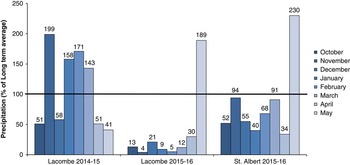
Weather conditions for all 3 site-years were dry during critical months (Figure 1). At all locations, precipitation following fall fluridone application was limited, which may have limited both fall weed seed germination and herbicide activity. In the 2015–2016 winter season, precipitation continued to be limited at both locations (Figure 1). The month of April was dry in both years and both locations; Lacombe 2014–2015 had 51% of the long-term average (LTA) precipitation, while Lacombe and St Albert in 2015–2016 had 30% and 34% of the LTA precipitation, respectively. The precipitation in May of 2015–2016 for both locations shown in Figure 1 is somewhat misleading, as minimal rain was received until near the end of May; sites were under dry conditions for most of the month. This lack of precipitation may have limited fluridone efficacy in the study.
Precipitation as a percent of the long-term average at each site year from October through May. The bold line indicates 100% of the long-term average precipitation. Data values for each month are labeled above their respective bars.

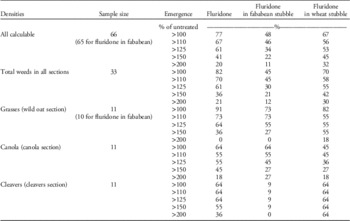
Of the 18 possible fall stimulation events, none showed significant stimulation (data not shown) at α=0.1. However, when investigating nonsignificant comparisons, the LS-means estimate of fall weed densities in fluridone-treated plots was greater than that of the untreated control 77% of the time (Table 1), which may indicate some actual stimulant activity. Weed densities in fluridone treatments on fababean stubble were greater than with no treatment 48% of the time and 67% of the time in wheat stubble plots (Table 1). While having estimates greater than the untreated control may simply be variability, fluridone treatment estimates were >125% of the untreated control nearly 60% of the time and >150% of the untreated control more than 40% of the time. The pattern toward potential stimulation is stronger in wheat than in fababean stubble, with more than 30% of the fluridone in wheat treatment estimates >200% of the untreated control (Table 1). It is possible that residual nitrogen germination effects (Egley Reference Egley1986) in fababean stubble disguised the fluridone germination stimulant effect. This is speculation, however, and the specific reason behind preceding crop affecting fluridone activity is not known.
Percentage of fall assessments at all site-years and locations where least-squares estimates of weed densities treated with fluridone were greater than the untreated control (>100%).Footnote a

a Percentages are calculated for fluridone alone as a factor, fluridone in fababean, and fluridone in wheat.
Fluridone-treated populations showed the highest potential for fall stimulation in grass weeds in the wild oat section; 91% of the time, fluridone-treated weed densities were greater than the untreated control (Table 1). When looking at larger differences, regardless of crop, 64% of the time fluridone densities were greater than 125% of the untreated control. In wheat plots, 55% of the densities remained greater than 150% of the untreated control. Canola showed less potential stimulation in overall numbers than grass weeds (max. 64% of the time fluridone treatment estimates were greater than the untreated control). However, the differences between densities in fluridone-treated and untreated plots seemed to have a larger magnitude (up to keep together, 27% of the time fluridone treatment densities were greater than 200% of the untreated). Cleavers in fababean plots showed minimal trends toward stimulation (in 9% of cases fluridone treatment densities were greater than 100% of the untreated), while 64% of the time fluridone densities were greater than 200% of the untreated control in wheat plots. Why preceding crop appeared to have such a great effect on stimulation is unclear. These trends do not definitively show stimulation but suggest some stimulant activity sufficient to warrant further research. Research conducted in a more controlled environment may help to clarify fluridone activity. Significant stimulant activity is not evident under Canadian field conditions, unlike the report by Goggin and Powles (Reference Goggin and Powles2014) of effects of fluridone applied under controlled conditions. However, high organic matter content (>9%), low precipitation, and variability due to field conditions could account for at least some of the difference in results.
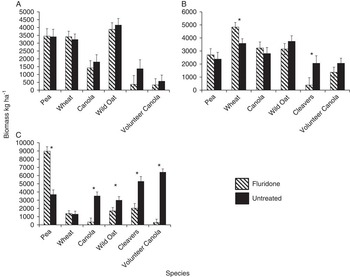
Fluridone’s potential herbicide activity could provide POST weed control of both broadleaf and grass weed species (Banks and Merkle Reference Banks and Merkle1979). Based on significant contrasts in weed densities in the spring, 33% of the time there was significant control in fluridone treatments across site-years (data not shown). Most of these cases occurred for total weeds (5 out 6), with cleavers controlled as a target weed in one case. With only one significant case of target weed control, differential efficacy between broadleaves and grasses is not clear. Visual evidence of herbicidal activity suggested greater efficacy on broadleaf weeds versus grass weeds. Previous research has shown activity on both broadleaf and grass weeds (Banks and Merkle Reference Banks and Merkle1979). Based on weed biomass, there were no significant differences at Lacombe in 2014, but there was a trend of lower biomass in each weed section in the fluridone treatments compared with the untreated plots (Figure 2A). At Lacombe in 2015, there was a significant decrease in weed biomass in the cleavers section, accompanied by an increase in biomass in the wheat crop (Figure 2B). The wheat crop was established in the cleavers section of the plot, and so biomass differences were likely associated with decreased competition. At St Albert in 2015, there were significant differences in both crop and weed biomass for every crop and weed except wheat (Figure 2C). Weed biomass was consistently reduced after fluridone treatment regardless of species, with the largest decrease occurring in the volunteer canola section. The field pea crop, which was grown in the canola section, showed a large biomass increase, possibly associated with the reduction in weed competition in that section. The canola crop was also impacted, with a significant biomass reduction (Figure 2C).
Crop and weed biomass at (A) Lacombe 2014–2015, (B) Lacombe 2015–2016, and (C) St Albert 2015–2016. Asterisks (*) indicate significant differences between fluridone and untreated control treatments within a species based on single degree of freedom contrasts (P<0.05) (bars denote SE).

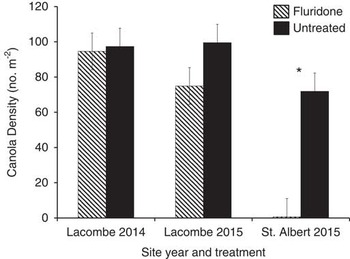
In addition to a biomass reduction, canola crop emergence densities were significantly reduced at St Albert in 2015 (Figure 3). Visual estimates consistently showed greater than 90% injury of the canola crop after fluridone treatment at this location (data not shown). Fluridone appears to have high levels of herbicidal activity on canola. The same injury was not observed at Lacombe in either year. While this could be due to use of different canola cultivars, it is more likely due to lack and timing of precipitation. Limited precipitation in April and May of the 2014–2015 study at Lacombe limited fluridone activity (Figure 1); very little visual evidence of fluridone activity was observed. In the Lacombe 2015–2016 trial, the amount of precipitation was not as limiting for activity. However, the timing of precipitation might have resulted in different injury levels than at St Albert. The canola crop in Lacombe emerged under dry conditions and was established at the time of precipitation; the small proportion of seeds that germinated from late-May precipitation exhibited fatal fluridone symptoms. St Albert was seeded later than Lacombe, resulting in canola emergence during the period of precipitation and higher crop injury levels, likely due to increased fluridone availability in soil water and increased herbicide activity on less mature canola seedlings. These results suggest that timing and amount of precipitation may be critical determinants of canola crop safety to fluridone. Wheat and pea biomass were not negatively affected by fluridone, but minor injury symptoms were observed on both crops at St Albert in 2015–2016 (unpublished data).
Canola crop density at emergence in fluridone and untreated control plots for each site-year. Asterisks (*) indicate significant difference between the fluridone-treated and untreated plot densities based on single degree of freedom contrasts (P<0.05) (bars denote SE).

Some germination stimulant activity, based on plant emergence, may be occurring as a result of fluridone application, but variability between sites and years and the confounding effects of herbicidal activity make conclusions difficult. For example, lower spring weed biomass could be a result of fall germination stimulation followed by winterkill, spring herbicidal activity, or both effects combined. The time of precipitation events, and the resultant chemical activation, could influence germination and germination stimulation before winter, which might decrease populations, or in spring, which might increase weed populations. Fluridone showed herbicidal activity, reducing biomass of volunteer canola, cleavers, and wild oat, although biomass differences were not significant for all site-years. A higher than typical rate of fluridone was used to ensure activity on high organic matter soils but may have also increased crop phytotoxicity. Fluridone phytotoxic effects on wheat and canola have been previously reported (Goggin and Powles Reference Goggin and Powles2014; Hill et al. Reference Hill, Norsworthy, Barber, Roberts and Gbur2016; Shea and Weber Reference Shea and Weber1983), and the prevalence of these crops in western Canadian rotations is of concern, particularly in areas with lower organic matter content than the study locations. While fluridone may provide an effective germination stimulant and herbicide tool combined, the rate structure, consistency of efficacy, and crop tolerance issues would need further research before it proves to be a viable tool in western Canada. Risks of injury to subsequent crops by fluridone outweighed the benefit of germination stimulant or herbicidal control of herbicide-resistant weeds under the conditions of this study. Future studies should include fluridone effects on weed populations over multiple years to minimize the effects of variability in populations within a year. An effective rate structure of fluridone could also be better defined, as it is possible that the high rates used in this study were the cause of crop injury; however, lower rates may also further limit the stimulant activity, which was not observed to be significant in this study. Studies that include removal of emerged plants may also help to eliminate the confounding effects of stimulation and herbicidal control. In the broader context, whether it is stimulation followed by winterkill or herbicidal activity that kills the weeds is unimportant as long as the population is being managed. However, knowledge of which effect is occurring is helpful for identifying the targeted stage in weed life cycles, to determine whether the seedbank is being targeted or whether fluridone is simply a new herbicide option for some crops.
Acknowledgments
The authors would like to thank L. Michielsen, P. Reid, E. Sroka, J. Zuidhof, E. Martin, and K. Topinka for their work on this project. In addition, we are grateful for the help and contributions of many graduate and summer students. Funding for this project was provided by the Alberta Crop Industry Development Fund and through the National Science and Engineering Research Council, Alberta Wheat Commission, and Izaak Walton Killam Scholarships for BDT.