Implications
We aimed to investigate the effects of nest box climate on mink young mortality and growth, as hypothermia has been suggested to be the primary reason for early kit mortality. The knowledge obtained in this study contributes to the understanding of the causation of kit mortality in farmed mink, which is important for (1) reducing kit mortality, (2) preventing reduced kit welfare and (3) improving mink production efficiency by increasing kit survival.
Introduction
Maternal care is essential for offspring survival and growth, particularly in species giving birth to altricial offspring, such as the American mink (Neovison vison). Dams provide offspring with basic needs – nutrition, heat and protection – in the first weeks of life in the wild, as well as in farm conditions. Nevertheless, offspring death occurs and the mortality rate is highest in the 1st week of life in several domestic species (Nowak et al., Reference Nowak, Porter, Lévy, Orgeur and Schaal2000; Mellor and Stafford, Reference Mellor and Stafford2004). This is observed, for example, in mouse (Brown et al., Reference Brown, Mathieson, Stapleton and Neumann1999; Weber et al., Reference Weber, Hultgren, Olsson and Algers2015) and mink (Martino and Villar, Reference Martino and Villar1990; Schneider and Hunter, Reference Schneider and Hunter1993; Malmkvist et al., Reference Malmkvist and Palme2007); species which share several similarities, for example being multiparous with altricial young and having extensive maternal care. The mortality rate of live-born mink kits during the 1st week has been reported in the range of 14% to 40% (Martino and Villar, Reference Martino and Villar1990; Malmkvist and Palme, Reference Malmkvist, Gade and Damm2008 and Reference Malmkvist, Houbak and Hansen2015), depending on access to nesting material, among other factors. Kit mortality occurs shortly after birth; 93% of live-born kits found dead in the 1st week die in the first 3 days after birth (Malmkvist et al., Reference Malmkvist and Palme2007). Many (41% to 78%) mink kits that die in the first days of life show no sign of a physical lesion, congenital defect or infection (Martino and Villar, Reference Martino and Villar1990; Schneider and Hunter, Reference Schneider and Hunter1993). Thus, a great number of apparently vigorous offspring die before reaching age of pelting (harvesting of the valued winter fur) or reproduction.
Several factors threaten vigorously born mink kits, even in protected farm conditions. Hypothermia and/or starvation have been proposed to be the main reasons for the early death of mink kits (Martino and Villar, Reference Martino and Villar1990), as they are born altricial with no fur, a high surface-area-to-volume ratio (Harjunpää and Rouvinen-Watt, Reference Harjunpää and Rouvinen-Watt2004) and low mobility, and are functionally blind and deaf (Brandt et al., Reference Brandt, Malmkvist, Nielsen, Brande-Lavridsen and Surlykke2013). Results of one study support hypothermia as one reason for death, as kit mortality was higher in nest boxes with low minimum temperatures 2 days after birth (Malmkvist and Palme, Reference Malmkvist, Houbak and Hansen2015). The mean BW of vigorous mink kits at birth is in the range of 9 to 11 g (Schneider and Hunter, Reference Schneider and Hunter1993; Hoy et al., Reference Hoy, Mengs and Wenzel2000; Tauson et al., Reference Tauson, Chwalibog and Tygesen2006), with fat reserves accounting for only 1.4% of BW (Tauson et al., Reference Tauson, Chwalibog and Tygesen2006). In addition, energy stored in the form of liver glycogen at birth is equivalent to only 0.15 kJ (Tauson et al., Reference Tauson, Chwalibog and Tygesen2006). Given their low insulation and reduced behavioural and physiological thermoregulatory capacity (Kostron and Kukla, Reference Kostron and Kukla1978; Harjunpää and Rouvinen-Watt, Reference Harjunpää and Rouvinen-Watt2004; Tauson et al., Reference Tauson, Chwalibog and Tygesen2006), mink kits are ectothermic poikilotherms; they obtain their heat mainly from the surroundings and their body temperatures can fluctuate accordingly (Harjunpää and Rouvinen-Watt, Reference Harjunpää and Rouvinen-Watt2004). Selection for increased litter size is reported to reduce kit birth weight by ~0.2 g for each additional kit in a litter (Schneider and Hunter, Reference Schneider and Hunter1993; Hoy et al., Reference Hoy, Mengs and Wenzel2000), which is expected to increase individual kit vulnerability to hypothermia. Several protective and adaptive mechanisms counter these risks; for example, mink kits obtain heat or reduce heat loss in the critical 1st week by (1) direct contact with the dam, (2) milk intake (3) huddling with siblings and (4) the nest box climate. However, the nest temperature drops when the dam leaves the nest box, depending on the nest insulation capacity and the ambient temperature. Thus, mink kits are considered to be vulnerable to hypothermia, especially in the 1st days after birth. This period is concurrent with the period of greatest kit mortality.
Temperature is not only important to kit survival, but is also expected to affect kit growth, as body temperature directly affects the metabolic rate, especially in ectotherms. As summarised by Angilletta et al. (Reference Angilletta, Steury and Sears2004), an increase in environmental temperature by 10°C, and corresponding elevation of body temperature, increases the growth rate of marine ectotherms by 2- to 16-fold. No previous study has examined whether mink kit growth is correlated directly with nest temperature. However, Malmkvist and Palme (Reference Malmkvist, Gade and Damm2008) found that the addition of barley straw to dams and plastic screen within the nests elevated nest box temperature significantly, which could have been the reason for the increased kit growth rate (by ~15%) in the 1st week of life and reduced kit mortality (by ~33%) compared with litters raised in more barren nest boxes. Given the low BW of mink kits at birth, the growth rate in the 1st days of life is considered important to reduce the risk of hypothermia and increase survival.
On mink farms some nest are found to have humid nesting material within the nest box. Whether the high humidity is caused by the dams urinating inside the nest box, the kits having diarrhoea, condensed water or the dams pulling wet nesting material into the nest is unknown. In this study we include, for the first time, humidity measures to see if it affects the litters growth and survival during the 1st week after birth.
The aim of the present study was to test the effects of in nest climate (nest box temperature and humidity) on early survival and growth of farmed mink kits. We hypothesised that litters in warm nest boxes would experience less hypothermia-induced mortality and show greater vitality (indicated by growth rate and survival) through day 7 after birth. In general, according to theory and the results of previous studies, we expected to find the highest mortality rate and lowest growth rate in farmed mink kits housed in nest boxes with the lowest minimum temperature during this critical early period.
Methods
Animals and housing
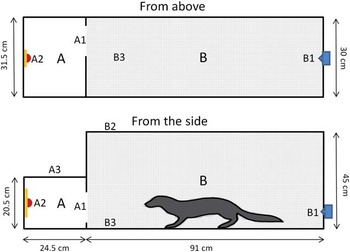
This study included data from 749 first-parity, 1-year-old female farmed brown mink, each of which delivered one litter during April/May 2014 or 2015. Each female was mated with the same male twice at an interval of 8 to 9 days, according to the standard farm procedure (for description see Malmkvist et al., Reference Malmkvist and Palme1997), in the period from 2 to 20 March. The majority of the mated females were transferred to a maternity unit before parturition (95%), whereas a few stayed in the same cages under otherwise identical maternity unit conditions (5%). Parturition took place in late April and early May. Maternity unit conditions consisted of a mink housing facility with natural light only, with the females placed in every second commercial standard-production cage system (Figures 1 and 2; Hedensted-Gruppen, Hedensted,Denmark). Each wire cage was equipped with a whelping net to prevent the kits from falling through the cage floor. A wooden nest box was connected to each wire cage, including a wired nest box insertion (W: 30 cm, H: 19 cm, L: 24 cm) with a wood sheet underneath to prevent draught. A building brick or an Easybrick (compressed, chopped heat-treated straw; Dansk Dyrestimuli A/S, Nykøbing Mors, Denmark) was placed at the bottom in front of the nest box entrance. In the first-third of the cage bottom, in front of the nest box, a paper sheet was placed under the whelping net to prevent nesting material from falling out of the cage. Shredded barley straw was always available at the top of the nest box insertion through wire mesh (mesh size: 2.5×2.5 cm). Standard commercial wet feed was given once a day at 1045 h±15 min (energy density: 122.7 kcal/g; metabolisable energy: 50.1% protein, 39.9% carbohydrate, 10.0% fat; Holstebro Minkfodercentral, Holstebro, Denmark). Water was available ad libitum via a drinking nipple in the cage (c.f. Figure 1).
Illustration of the cage system for a mink female and her litter. A: wooden nest box with top lid made of wire; A1: nest box entrance; A2: temperature logger; A3: straw allocated on top of the nest box lid; B: wire cage; B1: drinking nipple; B2: site for daily fed provision; B3: paper sheet beneath whelping wire net; place for allocation site for nesting material delivered manually after opening the front cage lid. Each cage was additionally equipped with an elevated platform (a shelf) and a moveable soft plastic tube, according to Danish regulations for the keeping of mink.

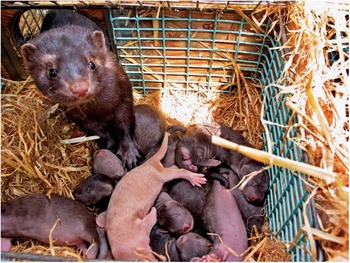
Mink female entering from the wire cage into the nest box (usually with wire lid closed and covered by straw) with her litter. Maternal behaviour in mink includes nest building, licking, grooming and nursing. Temperature and humidity of the nest box interior were measured every 15 min, with data for days 1 to 6 after birth included in the analysis of the effect of nest climate on kit survival and growth in the present study. Photo: Jesper Clausen.

The local outdoor temperature differed between the two experimental years, with 2014 having above normal temperatures for the location of the research farm during the week with the most deliveries; the measured daily temperature averaged 9.1°C with a daily range from minimum to maximum being 0.7°C to 21.3°C (Danish Meteorological Institute DMI). During the same week in 2015, the daily temperature averaged 6.4°C with minimum −0.7°C and maximum 12.8°C. The sum of precipitation for these particular weeks was 0.2 mm in 2014, and 11.1 mm in 2015 (DMI). The experimental year is included in the statistical models to account for differences according to year.
Study design
Before parturition, ~250 g chopped, heat-treated straw (Easystrø for mink; Dansk Dyrestimuli A/S) was placed in each nest box insertion. For nest building, dams were given further access to ample amounts of nesting materials (type and proportion of experimental cages: chopped straw 44.4%; straw and sheep wool 31.6%; straw and wood wool combined with either lambs or rabbit wool 15.7%; chopped straw and hemp mix 8.3%) in the cages (Figure 1), as part of another experiment. The nesting materials were delivered to the cages for the dams to retrieve starting at least 3 days before delivery, and replenished three times a week (on Monday, Wednesday and Friday) if ~50% (in 2014) or 75% (in 2015) of the previously provided material had been used. The difference in procedure and range of different nesting materials, together with the large number of delivering dams over two different production years, was expected to provide variation in nest box climate data, enabling testing of the hypothesis of the present study.
Data collection
Nest box climate
The nest box climate was measured every 15 min on days 1 to 6 after birth (starting at 2400 h on the day of birth) using iButton temperature and humidity loggers (resolution: 0.6% relative humidity, ⩽0.5°C; DS1923; Maxim Integrated, San Jose, CA, USA). Temperature is given in Celsius with 0°C equal to 273.15 K. The loggers were fixed on the inner sides of the wired nest insertion sidewalls (5 cm above the bottom and equidistant from the nest box walls), opposite the nest box entrances, in custom-made wooden holders, with the measuring perforation exposed to the nest box interior (c.f. Figure 1).
Reproduction, weight and mortality
The nest boxes were checked cautiously three times daily (between 0800 h and 1200 h, 1200 h and 1600 h, and 1900 h and 2000 h) from 4 days before the expected time of birth (calculated in relation to the last mating day) through day 7 after birth. This monitoring was performed to register the birth day (day 0) by sound of the kits and to sample visible dead kits. The lung float test was done to determine whether dead kits were stillborn (Malmkvist et al., Reference Malmkvist and Palme2007). Litter size, kits sex and mean kit weight for each gender within a litter were registered on days 1 and 7.
Statistical analysis
The SAS software (version 9.4; SAS Institute Inc., Cary, NC, USA) was used for statistical analyses and the JMP software (version 12; SAS Institute Inc.) was used to create the figures. The significance level was set to 0.05. The models tested below were reduced by excluding parameters one by one, according to the highest P-value >0.05. Daily nest box temperature parameters (days 1 to 6; T mean, T min, T max and coefficient of SD (T var)) were included separately in the models. The daily mean humidity parameter (H mean) was also included in the models. Year was included in the models as a categorical variable, taking into account potential annual variation in reproduction. An XY-plot was created to illustrate the effects of litter size on the number of live-born kits that died and kit growth from raw data, with presentation of the slopes of the straight lines describing the relationships.
Number of live-born kits that died on days 0 to 7
The number of live-born kits that died from birth to day 7 was counted for each litter. The litter composition parameters totborn (total number of kits born: live-born+stillborn), liveborn and liveborn sex ratio were included in the model to test the effects of (1) stillborn kits on live-born sibling vitality, (2) litter size on kit vitality and (3) sex ratio within litters. The number of live-born kits that died in each litter was tested in a Poisson distribution, with liveborn serving as the offset value (Proc GENMOD in SAS). The full model reduction test was performed twice: test 1 included climate measures from days 1 to 3 and test 2 included climate measures from day 1 only.
Test 1:
 $$\eqalignno{ {\rm log}\left( {{\rm Rate}_{{{\rm DEAD}}} } \right) \,{\equals}\, {\rm }\mathop \sum\limits_{i\,{\equals}\,1}^3 \left\{ {\beta _{{1,i}} {\times}T_{{{\rm mean},i}} {\plus}\beta _{{2,i}} {\times}T_{{{\rm var},i}} {\plus}\beta _{{3,i}} {\times}T_{{{\rm min},i}} }\right \cr \quad {\left {\plus}\beta _{{4,i}} {\times}T_{{{\rm max},i}} {\plus}\beta _{{5,i}} } \right. \left. { {\times}H_{{{\rm mean},i}} } \right\} \cr {\plus}{\rm }\beta _{6} {\times}R_{{L_{{{\rm sex}}} }} }\right \cr \quad {\left{\plus}{\rm }\beta _{{{\rm year}}} {\plus}\beta _{8} {\times}N_{{{\rm Tot}\_{\rm born}}} {\plus}\beta _{9} }\right } \cr \quad {{\left{\times}N_{{{\rm Liveborn}}} \right }} \cr {{\left \ \quad i\, {\rm indexing}\,{\rm day}\,(1\,{\rm to}\,3) $$
Test 2:
 $$\eqalignno{ {\rm log}\left( {{\rm Rate}_{{{\rm DEAD}}} } \right)\,{\equals}\, & \beta _{1} {\times}T_{{{\rm mean},1}} {\plus}\beta _{2} {\times}T_{{{\rm var},1}} {\plus}\beta _{3} {\times}T_{{{\rm min},1}} {\plus}\beta _{4} \cr & {\times}T_{{{\rm max},1}} {\plus}\beta _{5} {\times}H_{{{\rm mean},1}} {\plus}\beta _{6} {\times}R_{{L_{{{\rm sex}}} }} {\plus}\beta _{{{\rm year}}} \cr &{\plus}\beta _{8} {\times}N_{{{\rm Tot}\_{\rm born}}} {\plus}\beta _{9} {\times}N_{{{\rm Liveborn}}} $$
Kit growth from days 1 to 7
The kit growth model included 709 litters consisting of at least one kit on day 7. To measure kit growth, mean kit weight gain from days 1 to 7 was calculated for each sex within each litter, and sex was included in the model as a categorical variable. The animal ID of the dams was included in the model as a random effect to take repeated measures (male and female kits) within litters into account. Daily temperature and humidity parameters for days 1 to 6 were included in the model. The litter composition traits: Totborn, mean litter size on days 1 to 7 and mean litter sex ratio of live kits on days 1 to 7 were calculated and included in the model. A mixed effects model was performed to test for differences in mean kit growth (Proc Mixed in SAS).
 $$\eqalignno{ {\rm Growth}_{{j,k,l}} \,{\equals}\,\mathop \sum\limits_{i\,{\equals}\,1}^6 \left\{ {\beta _{{1,i}} {\times}T_{{{\rm mean},i,l}} {\plus}\beta _{{2,i}} {\times}T_{{{\rm var},i,l}} {\plus}\beta _{{3,i}} {\times}T_{{{\rm min},i,l}} }\right \cr \quad {\left {\plus}\beta _{{4,i}} {\times}T_{{{\rm max},i,l}} {\plus}\beta _{{5,i}} } \right. \cr & {\times}H_{{{\rm mean},i,l}} {\plus} \alpha _{{{\rm sex}, j}} {\plus} \alpha _{{{\rm year},k}} }\right \cr \quad {\left{\plus}\beta _{6} {\times}R_{{{\rm MeanSex}, k,l}} {\plus}\beta _{7} {\times}N_{{{\rm Totborn},k,l}} {\plus}\beta _{8} }\right } \cr \quad {{\left {\times}N_{{{\rm MeanLitterSize},k,l}} {\plus}V_{{{\rm Dam},l}} {\plus}{\epsilon}_{{j,k,l}} }\right }} \cr \quad {{\left i\,{\equals}\,1,\,2,\:\,\ldots\,\:,\,6\,{\rm day} \right}} \cr \quad \left j\,{\equals}\,1,\,2\,{\rm sex} }\right \cr \quad {{\left k\,{\equals}\,1,\,2\,{\rm year} \right}} \cr \quad \left {\rm l}{\equals}1,2,\:\,\ldots\,\:,\,709\,{\rm litter} $$
Results
Nest box climate on days 1 to 6
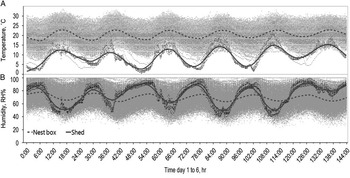
Temperature fluctuated daily in the shed and in the nest boxes on days 1 to 6, with maximums occurring around 1600 h and minimums occurring around 0500 h (Figure 3a). Thus, the daily environmental temperature cycle affected the nest box temperature. However, average nest box temperatures were markedly higher than housing temperatures and fluctuated less, which showed that the nests buffered the environmental temperature. The difference in temperature among nest boxes is shown by a range of around 20°C through the daily cycles. The range and daily fluctuation in nest box temperature also tended to decrease with time from birth, with the least fluctuation observed on day 6 (Figure 3a). Temperature affected nest box humidity and nest boxes thereby also buffered daily fluctuations in humidity (Figure 3b). As expected, there were also nests with a constant saturated humidity (RH close to 100%).
Temperature (°C; a) and relative humidity (RH%; b), measured every 15 min on days 1 to 6 after birth. Light grey dots represent nest box temperature/humidity measures for individual nests with litters (n=709). Broken line represents the mean mink nest box temperature/humidity. Dark grey dots represent the housing shed temperature/humidity, measured in 2015 on days 1 to 6 after the mean birth day (day 0=28 April 2014 and 28 April 2015). Solid line represents mean housing shed temperature/humidity (three loggers distributed in shed).

Number of live-born kits that died on days 0 to 7
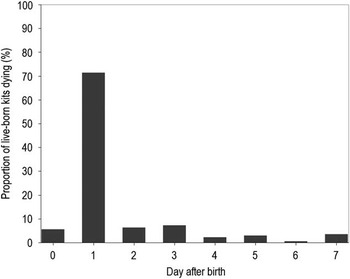
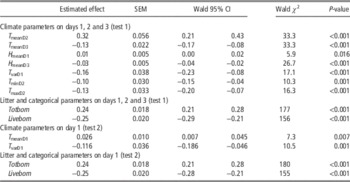
The dams gave birth to 6009 kits, 5375 of which were as live-born (89.4%). Of live-born kits that died from birth until day 7, 535 with known litter ID were collected. Some kits were missing based on the counting days 1 and 7, however, never found and collected. In some case a dead kit was collected, but could not with certainty be assigned to a particular litter as found away from a cage, for example on the ground. Collected and missing live-born kits in total counted for 1066 kits on days 0 to 7. Of dead kits collected within the 1st week, 90.7% died on days 0 to 3 and 77.0% died on days 0 to 1 (Figure 4); these results are consistent with those reported previously (Malmkvist et al., Reference Malmkvist and Palme2007; days 0 to 3: 93% and days 0 to 1: 74%). The finding mean that the test of the causal effect of nest box climate on live-born mortality should focus on climate in the period from days 1 to 3 (test 1) or even before day 1 (test 2).
Proportion of live-born kits dying per day during the 1st week after birth, with days 0 to 7 counts for 100%. In total, 535 dead live-born kits were collected during days 0 to 7 from 709 litters.

Test 1: effects of climate on days 1 to 3 on early live-born kit mortality
The test included climate parameters from days 1, 2 and 3. Seven of 15 climate parameters had significant effects on the number of live-born kits that died in the 1st week (Table 1). In general, relative humidity in the nest boxes was affected by nest temperature as expected, but with some nest with a relative humidity constantly on 100% during days 1 to 6. The two significant mean temperature parameters T meanD2 and T meanD3 had significant but conflicting correlations with the number of live-born kits that died (Table 1). H meanD1 and H meanD3 also had conflicting effects, and these effects were estimated to be marginal (Table 1). Consequently, humidity did not seem to play a major role in the number of live-born kits that died. Large nest box temperature fluctuations on day 1 (T varD1) were correlated negatively with the number of live-born kits that died (Table 1). This number was also correlated negatively with high T minD2 and T maxD2 values, as expected. However, the effects were minor (Table 1) and occurred after 77% of the live-born kit mortality. Therefore, these parameters did not seem to have major effects on kit mortality.
Live-born mortality days 0 to 7.

CI=confidence interval.
The effects of daily climate measured in nest and litter size on the number of live-born kit deaths days 0 to 7 after birth for 709 litters from first-parity mink dams delivering in 2014 or 2015. Only parameters being significant are presented with maximum likelihood estimates for mean, variation and test statistics. Test 1 is for days 1 to 3 after birth. Test 2 is for the 1st day after birth.
Test 1: effects of litter composition on early live-born kit mortality
The estimated risk of live-born kit death was greatest in large totborn litters (Table 1). Raw data indicated that the number of live-born kits that died increased marginally with increasing totborn (slope=0.14) and liveborn (slope=0.14) litter sizes. However, when liveborn was included in the model, the risk of live-born kit death decreased with increasing liveborn litter size (Table 1). The difference between totborn and liveborn values is the number of stillborn kits; thus, kits in litters with stillborns were at greater risk of dying. Liveborn sex ratio did not affect the number of kits that died; kits of both sexes seemed to have similar risks of death, and high and low sex ratios did not increase potential lethal competition within litters. The number of live-born kits that died did not differ significantly between years.
Test 2: effects of climate on day 1 and litter composition on early live-born kit mortality
In Test 2, only climate data from day 1 were included, which is the day with the highest number of live-born dead kits collected. Mean nest box temperature was correlated positively with the number of live-born kits that died; however, the estimated effect was negligible (Table 1). As in test 1, large nest box temperature fluctuations were correlated with reduced kit mortality (Table 1). T minD1 did not affect the number of kits that died. The effects of litter size, liveborn and totborn values, liveborn sex ratio and year were similar in tests 1 and 2 (Table 1).
Kit growth
Effect of climate on early kit growth
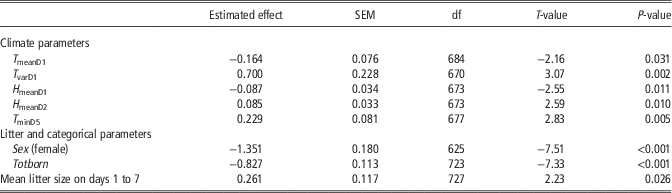
Five of 30 climate parameters had significant effects on mean kit growth from days 1 to 6 (Table 2). Three of these parameters were for day 1, which indicated that if temperature affected kit growth, then day 1 was the most important day. T meanD1 was correlated negatively with kit growth. Large nest box temperature fluctuations on day 1 were correlated not only with reduced live-born kit mortality (tests 1 and 2), but also with increased kit growth (Table 2). Kit growth was correlated with high minimum temperature on day 5 only. Conflicting effects of mean daily humidity on days 1 and 2 and a marginal estimated effect indicated that humidity did not significantly affect kit growth. T max and T min had no significant effect – which further emphasise that the temperature effect is marginal if at all have an effect on kit growth.
Kit growth days 1 to 7.

Fixed effects of daily climate days 1 to 6 and litter composition on mean kit growth (in grams) on days 1 to 7 in 709 litters from first-parity mink dams delivering in 2014 or 2015. Only parameters being significant are presented with maximum likelihood estimates for mean, variation and test statistics.
Effects of litter composition on kit growth
Male kits grew significantly more than their female siblings (Table 2). Increasing totborn litter size not only increased the risk of live-born kit death, but also reduced kit growth significantly (Table 2). Raw data showed similar negative correlations with totborn (slope: male=−0.699, female=−0.645) and mean litter size on days 1 to 7 (slope: male=−0.428, female=−0.325). When mean litter size on days 1 to 7 was included in the model, estimated mean kit growth increased with this variable (Table 2). The mean sex ratio on days 1 to 7 did not affect kit growth.
Discussion
Nest box climate is not the primary cause of kit mortality or growth retardation
Nest box temperature on postnatal days 1 to 6 had surprisingly little effect on early kit survival and growth through day 7 in our study. These results contrast with the hypothesis that suggested hypothermia was a main cause of kit loss during the 1st week after birth (Martino and Villar, Reference Martino and Villar1990, Schneider and Hunter, Reference Schneider and Hunter1993; no data on climate included). Based on the results of this large-scale 2-year study, we cannot confirm the hypothesis that low nest box temperature is the major cause of mink kit mortality within the 1st week of life. The lack of a significant effect may be because mink kits did not experience lethal low temperatures in our study. The dams’ nest-building behaviour evidently buffered the nest box climate sufficiently. Mink dams can build nests within 1 day when given access to proper nesting material (Malmkvist and Palme, Reference Malmkvist, Houbak and Hansen2015), and dams in the present study had an adequate period of access to these materials. The potential insufficiency of nesting materials or access thereto in previous studies may underlie the difference in results. Likewise, Malmkvist and Palme (Reference Malmkvist, Gade and Damm2008) found that temperatures were higher in nest boxes with nesting material than in those without such material (15.8°C v. 14.2°C), and that kit mortality was lower in nests with material (22% v. 40%). Climates differ among fur-producing countries, and climate challenges can be of great importance in some countries, but not in others (as in the present study). The amount and type of nesting material may also differ among farms and countries, which can result in great differences in nest box climate challenges experienced by kits. Yearly local climate fluctuation is also expected to affect kit vitality; however, we found no difference in effect between 2014 (above normal temperature during the birth period) and 2015 in the current study. We cannot exclude the possibility that nest temperature effects would have been more pronounced under a harsher climate regime and without sufficient nesting materials to satisfy the dams’ nest-building behaviour.
However, under relatively favourable housing conditions, some temperature parameters were correlated with kit loss and growth in this study. Unexpectedly, large fluctuations in nest temperature on postnatal day 1 were associated with both reduced live-born kit mortality and improved kit growth during the 1st week of life. We cannot conclude whether this temperature fluctuation had a positive effect on kit vitality, or it was the result of the behaviour of dams with good maternal traits. Kits in nests with high mean temperatures on postnatal day 1 had reduced growth, contrary to our a priori expectation. This result suggests that heat stress in warm nests affected kit growth negatively; however, this effect was present for only 1 day. Although these findings were unexpected, they do indicate the existence of significant climate effects on the 1st day of kits’ lives. We also found increased kit mortality in nests with low maximum and minimum temperatures on day 2, in agreement with previous results (Malmkvist and Palme, Reference Malmkvist, Houbak and Hansen2015) and suggestions that hypothermia could count as a cause of kit mortality (Martino and Villar, Reference Martino and Villar1990). Although this effect, albeit marginal, is supportive of hypothermia as a dead cause, it should be noted that 77% of live-born kits that died in the 1st week died on the 1st postnatal day; nest temperatures on day 2 were measured after the majority of kit loss had occurred. Thus, the influence of nest temperature on day 2 on mink kits could be explained by several factors, such as (1) inferior nest quality and maternal care, (2) presence of fewer heat-producing kits in high mortality litters, (3) reduced time that dams spent in nest boxes due to a reduced number of living kits and (4) deficient maternal care, with dams’ positioned outside nests resulting in kit mortality and cold nests. We thus recommend that future studies include examination of these factors (e.g. by observing maternal care in combination with temperature nest measurement) to improve our understanding of the effects of nest climate on the early survival and growth of mink kits.
In general, the daily mean nest box humidity in the 1st week of life did not affect kit vitality, in terms of growth and survival as measured in our study. Future investigations of climate effects in this setting should focus on days 0 and 1. Such studies will require more precise determination of birth times, so that only climate measures from after birth on day 0 are included. However, to increase kit survival and growth when dams have sufficient access to nesting material, we suggest that researchers focus on factors other than nest box climate, which does not appear to be a risk factor for mink kit survival or growth in the critical 1st week of life. Rather maternal traits and other factors may play a key factor in explaining the large variation that exist between mink kept in relatively similar and protected conditions on farms.
Litter size affects kit growth and survival
The total number of kits born (i.e. totborn) consistently affected kit survival and growth in the present study. The risks of death and reduced growth increased with total litter size among kits that survived the critical 1st days of life. Similar results have been found in multiparous pigs in a commercial production setting (Quiniou et al., Reference Quiniou, Dagorn and Gaudré2002). Mink kits in large litters have been reported to have reduced BW at birth (Schneider and Hunter, Reference Schneider and Hunter1993; Hoy et al., Reference Hoy, Mengs and Wenzel1998; Malmkvist and Palme, Reference Malmkvist, Houbak and Hansen2015), equivalent to findings for piglets (Quiniou et al., Reference Quiniou, Dagorn and Gaudré2002) and dog pups (Hoy et al., Reference Hoy, Mengs and Wenzel2000). The lower birth weight in large litters is likely induced by in utero competition for nutrients, as documented in pigs, in which the mean blood flow per foetus is reduced with each additional foetus (Reynolds et al., Reference Reynolds, Ford and Ferrell1985; Père and Etienne, Reference Père and Etienne2000). Duration (days) from second mating to birth, was shortened marginally in litters with additional offspring, when using data from the current study (Spearman’s r=−0.055). Therefore, a marginal reduction in birth weight could be due to shortened gestation in mink, as found in pigs (Garnett and Rahnefeld, Reference Garnett and Rahnefeld1979), but not in mammals in general (e.g. not in dogs; Tsutsui et al., Reference Tsutsui, Hori, Kirihara, Kawakami and Concannon2006; Seki et al., Reference Seki, Watanabe, Ishii, Kinoshita, Aihara, Takeiri and Otoi2010). However, due to the delayed implantation in mink several factors can affect the duration from mating until the day of birth. A reduced birth weight is expected to result in the birth of more vulnerable mink kits, as reported for piglets (Rutherford et al., Reference Rutherford, Baxter, D’Eath, Turner, Arnott, Roehe, Ask, Sandøe, Moustsen, Thorup, Edwards, Berg and Lawrence2013). Hoy et al. (Reference Hoy, Mengs and Wenzel1998) found that mink kits with low birth weights were more vulnerable to reduced growth and had a greater risk of death during the suckling period, but they did not account for litter size. Uterine conditions may also have prolonged effects on kit growth postnatally, as found in non-mammalian lizards, in which a large number of eggs reduced postnatal growth with no effect on egg weight or parental care (Bleu et al., Reference Bleu, Massot, Haussy and Meylan2012). In this study, large totborn litters have higher proportions of stillborn kits and kits with low BWs and vitality. Large litters are also expected to be stressors to dams and kits during the gestational and suckling periods.
Totborn litter size influenced kit growth and survival negatively, whereas the litter size of living kits (liveborn and mean litter size on days 1 to 7) influenced kit growth and survival positively. Two things can be deduced from these findings. First, a large number of kits, including stillborn kits, can be indicative of birth problems and stress in dams (e.g. leading to birth-induced mortalities as reported in Malmkvist et al., Reference Malmkvist and Palme2007). Second, the increased growth and reduced mortality risk of kits in large live-born litters indicate the absence of significant postnatal competition for maternal resources within litters in the 1st week. In other words, resource restriction occurs prenatally, rather than postnatally, in mink. Kits with high growth rates are expected to be less vulnerable to cold climates, which could explain the correlation between growth and large mean litter size on days 1 to 7. Thus, litter size affects kit vitality and should be considered in efforts to reduce kit mortality.
The positive correlations between large live-born litters and high kit survival and growth indicate the existence of maternal traits with positive effects on reproduction, such as those conveying resilience to stress during gestation and birth. Malmkvist et al. (Reference Malmkvist and Palme2007) pointed out several maternal behavioural traits in dams that are affected negatively by birth problems, those traits could explain the differences in the number of live-born kits that died and in kit growth in this study. Access to straw as a nesting material reduces baseline female stress during gestation, as indicated by a reduced concentration of faecal cortisol metabolites (Malmkvist and Palme, Reference Malmkvist, Houbak and Hansen2015). Likewise, access to nesting material had a positive effect on the birth process by reducing the variation in inter-birth intervals (Malmkvist and Palme, Reference Malmkvist, Gade and Damm2008), which was correlated negatively with the number of live-born kit deaths (Malmkvist et al., Reference Malmkvist and Palme2007). Thus, access to straw reduces kit mortality; however, the results of the current study suggest that this finding is due to lower stress levels in dams around the time of birth, and not due to climate effects. Although access to some nesting material reduced the number of live-born kits that died in the 1st week, inclusive stillborn kits by ~50% (Malmkvist and Palme, Reference Malmkvist, Gade and Damm2008). There is still room for improvement when given access to straw, as live-born kit mortality during the 1st week in this study was found to be ~20% and previously found to be in the range of 14% to 18% (Malmkvist and Palme, Reference Malmkvist, Houbak and Hansen2015). To increase kit vitality, the main focus should therefore be on (1) the avoidance of increasing selection on litter size uncritically at the cost of the number of live-born kits; and (2) improving the dams’ welfare in the gestational and birth periods to reduce the risk of difficult birth, as stillbirths increase risks in remaining kits in the litter.
In conclusion, the buffering effects of nests built by dams (that were offered ample nesting material) resulted in markedly higher temperature and less temperature fluctuation in nest boxes compared with the ambient temperature in the current study. Under these circumstances, nest box climate was not a primary cause of kit mortality or reduced growth. Rather, the total number of kits born was the major contributor to live-born kits’ risks of death and reduced growth, whereas a large number of live-born kits had positive effects on kit growth and survival in farmed mink.
Acknowledgements
This study received financial support from Ministry of Environment and Food, Denmark, to the GUDP (Green Developmental and Demonstration Programme) project ‘Management to improve kit survival, animal welfare and efficiency in Danish mink production’, and from the Danish Fur Levy Foundation and Kopenhagen Fur to the project ‘More viable mink kits at weaning’. T.M.S. further received support from an Aarhus University PhD grant. The funding sources had no involvement in the study design, data collection, analysis, interpretation or other part of the preparation and submission of the paper. The authors thank Anna Feldberg Marsbøll, Anne Sandgrav Bak and the technical personnel and staff at the research farm at Aarhus University for their great efforts in data collection.