INTRODUCTION
Specialized palliative care consultation teams (PCCTs) play an important role in acute care hospitals in terms of enabling the adoption of palliative care early in disease trajectories, as is stated in the WHO definition of the term (Sepulveda et al., Reference Sepulveda, Marlin and Yoshida2002). In many Western countries, palliative care consultation services were established in the 1990s (Palliative Care Australia, 1999; Pan et al., Reference Pan, Morrison and Meier2001; Kuin et al., Reference Kuin, Courtens and Deliens2004; National Council for Palliative Care, 2007), and their usefulness has been investigated by systematic review (Higginson et al., Reference Higginson, Finlay and Goodwin2002), randomized controlled trials (Hanks et al., Reference Hanks, Robbins and Sharp2002; Rabow et al., Reference Rabow, Dibble and Pantilat2004), comparative study of different consultation types (Schrijinemaekers et al., Reference Schrijinemaekers, Courtens and van den Beuken2003), before-and-after studies of intervention by PCCTs (Ellershaw et al., Reference Ellershaw, Peat and Boys1995; Abrahm et al., Reference Abrahm, Callahan and Rossetti1996; Jack et al., Reference Jack, Hillier and Williams2003, Reference Jack, Hillier and Williams2004), descriptive studies of PCCT recommendations (Manfredi et al., Reference Manfredi, Morrison and Morris2000; Homsi et al., Reference Homsi, Walsh and Nelson2002; Kuin et al., Reference Kuin, Courtens and Deliens2004), examinations of newly identified problems by PCCTs (Braiteh et al., Reference Braiteh, El Osta and Palmer2007; Vernooij-Dassen et al., Reference Vernooij-Dassen, Groot and van den Berg2007), satisfaction surveys of referring staff (Carter et al., Reference Carter, McKinlay and Scott2002; Virik & Glare, Reference Virik and Glare2002), and cost-effectiveness analyses (Axelsson & Christensen, Reference Axelsson and Christensen1998; Hanson et al., Reference Hanson, Usher and Spragens2008).
In Japan, the number of hospitals with a PCCT has drastically increased to 351 over the past few years because the government cancer policy has strongly supported the dissemination of specialized palliative care. However, there is limited information available concerning the activities and usefulness of PCCTs in Japan. Morita et al. (Reference Morita, Fujimoto and Tei2005b) implemented a prospective study of 111 referred patients and collected data regarding the reasons for referral, patients' characteristics, symptom severity at the time of referral, improvement of symptoms during the first week, and types of therapeutic interventions performed after PCCT consultation. Yoshimoto et al. (Reference Yoshimoto, Ishino and Hisada2005) conducted a prospective study of 149 referred patients and reported that pain and dyspnea were improved after PCCT consultation. Nevertheless, these results were obtained at a general hospital, and data concerning PCCT activities were not collected.
In exploring the usefulness of PCCTs, the referring staff's views are also important (Fischberg & Meier, Reference Fischberg and Meier2004). PCCTs can only take action to help patients and families upon receiving a referral from ward staff. Thus, to ensure consistent referrals, it is important to investigate how referring staff view the usefulness of PCCTs and whether they are satisfied with their activities and patient outcomes.
Showa University Hospital is a 1,100-bed acute care hospital without a palliative care unit (PCU). A PCCT based at this hospital has been playing a pioneering role in Japan. In 1992, three physicians developed the PCCT to provide direct care for terminally ill patients, and, in 1999, a certified nurse specialist in oncology joined the PCCT, and the team's focus changed to consultation. The full-time members of the PCCT are a palliative care physician and a nurse. The physician was trained as a pain clinician and has worked in the PCCT for two and a half years (in Japan, there is no certification system for palliative medicine). The nurse has officially qualified as a “certified nurse specialist in oncology” and has 10 years of clinical experience. In addition, the PCCT has a psychiatrist as a part-time member, available in the same hospital. (These three types of professionals are required for coverage by the National Medical Insurance.) After referral, the initial assessment of patients is undertaken by the palliative care physician or the nurse, either alone or together, and detailed advice about any identified problems is communicated to the ward staff directly and written in the patient's case notes. A follow-up is then carried out by the palliative care physician and/or the nurse on the basis of the patient's and ward staff's needs. Ward rounds by all PCCT members are undertaken for all referred patients once a week. Multidisciplinary care conferences including pharmacists, a medical social worker, and link-nurses are performed once a week, and all patients are reviewed.
The aims of this study are to clarify the activities, patient outcome, and referring staff's views of an established PCCT in a university hospital in Japan.
METHODS
This was a prospective study to follow the activities of a PCCT and the patients referred to it for 28 days over a 1-year period.
Subjects
The subjects were patients referred to the PCCT between February 2004 and March 2005. As a certain number of patients were expected to decline due to their condition deteriorating (Hanks et al., Reference Hanks, Robbins and Sharp2002; Stromgren et al., Reference Stromgren, Sjogren and Goldschmidt2005), we adopted a health professional-assessed tool (STAS-J) to cover a greater number of patients and asked for a self-assessment questionnaire (EORTC QLQ-C30) to be filled out by those patients who were able to do so. Inclusion criteria were (a) presence of a malignant disease and (b) an age of 20 years or older. Exclusion criteria were (a) previous referral to the PCCT, (b) not having been of informed of their diagnosis, (c) family refusal, (d) no direct PCCT involvement with the patient, and (e) refusal of the attending physician to allow the patient to participate. In the ward staff evaluation, primary nurses of all patients referred to the PCCT during the study period were asked to fill out a questionnaire.
Measurements
PCCT Activities
Providing support
From the literature (Manfredi et al., Reference Manfredi, Morrison and Morris2000; Zhukovsky, Reference Zhukovsky2000; Blackford & Street, Reference Blackford and Street2001; Homsi et al., Reference Homsi, Walsh and Nelson2002; Virik & Glare, Reference Virik and Glare2002), 10 categories of support provided by PCCTs were identified: pain management, other physical symptom management, psychiatric symptom management, emotional support for the patient, emotional support for the family, informing the patient, informing the family; transition to home, transition to PCU, and end-of-life care.
The number of visits to patient/ward staff
The number of times the PCCT visited patient/ward staff was recorded on a daily basis.
Patient Outcome
Support Team Assessment Schedule–Japanese version (STAS-J)
This is a health professional-assessed tool for palliative care including 9 items: pain, other physical symptoms, patient anxiety, family anxiety, patient insight, family insight, communication between patient and family, communication among staff, and communication between patient and staff. Each item is rated from 0 to 4, and a higher score represents worse symptoms or more serious problems. The reliability and validity of the Japanese version of STAS has been confirmed (Miyashita et al., Reference Miyashita, Matoba and Sasahara2004).
EORTC QLQ-C30 (version 3.0)
This is a patient-assessed questionnaire including a total of 30 items and is composed of six functioning scales: physical (5 items), emotional (4 items), role (2 items), cognitive (2 items), and social functioning (2 items), as well as global health status (2 items). This questionnaire also comprises three symptom scales: vomiting (2 items), fatigue (3 items), and pain (2 items), and 6 single items: dyspnea, insomnia, appetite loss, constipation, diarrhea, and financial difficulties. The items of global health status are rated from 1 (very poor) to 7 (excellent), and the remaining items are rated 1 (not at all) to 4 (very much). The responses were converted to 0–100 scales according to the scoring manual. Higher mean scores represent better functioning or more severe symptoms. The reliability and validity of the Japanese version of the EORTC QLQ-C30 has been confirmed (Kobayashi et al., Reference Kobayashi, Takeda and Teramukai1998).
Patient Characteristics
Demographic data regarding the patient's age, sex, primary cancer site, presence or absence of metastasis, specialty of referring physician, ECOG PS, whether or not the patient was receiving anticancer treatment, patient outcome when the observation period ended, reason(s) for referral, date of admission, and date of death were collected.
Referring Staff's View
We asked primary nurses of the referred patients three ad hoc items by questionnaire: (a) How did the PCCT affect the referred patient, (b) to what extent are you satisfied with the support provided by the PCCT for the referred patient, and (c) do you think that the PCCT needs to be improved? In cases where a need for improvement was indicated, we asked subjects to write their views. Prior to the study, a pilot test was conducted to confirm the face and content validity of the questionnaire, using two ward nurses who had previously referred patients to the PCCT as subjects.
Data Collection
After initial assessment by the PCCT, the researcher (T.S.) was introduced to the patient by a member of the PCCT and obtained written informed consent. PCCT members checked all provided support when the observational period had finished, which was either at the time of the patient's death, the patient's discharge, or 28 days after referral. Data concerning the number of visits to patient/ward staff were collected on a daily basis by the researcher, and STAS-J and EORTC QLQ-C30 were assessed at the time of referral and on days 7, 14, and 28. STAS-J was assessed by the ward nurse charged with the patient on the assessment day. As ward nurses were not familiar with STAS-J, simple instructions were attached to the sheet and the researcher gave directions when needed. EORTC QLQ-C30 was completed by the patient on the assessment day. Patient demographic data were collected through the patient case note or the PCCT chart. A staff questionnaire was given to the primary nurse of the patient referred to the PCCT when the observational period had finished. To reduce response bias, the questionnaire could be returned anonymously to the researcher by mail, and it was clearly stated that no PCCT members would have access to individual responses.
This study was approved by the Institutional Review Board of Showa University Hospital.
Analysis
Activities of the PCCT were analyzed using descriptive statistics. The number of visits to patients/ward staff per day was calculated by dividing the total number of visits to patients/ward staff by the total number of working days during the observation period.
The items of STAS-J were analyzed after collapsing them into dichotomous variables: “none/a little” (0, 1) and “over moderate” (2–4). To investigate the change in referred patients, each item of the STAS-J and the subscale of the EORTC QLQ C-30 was compared between the initial assessment and day 7; data were obtained for 45 patients for STAS-J and 22 patients for EORTC QLQ C-30. Data for days 14 and 28 were not used because too many patients had withdrawn by that time.
In the analysis of staff evaluation, we used descriptive statistics as well as determining the differences in patient background and PCCT activities between respondent cases and nonrespondent cases. Written comments were categorized based on the similarity of content.
Statistical tests were performed by Fisher's exact test, T test (nonpaired, paired), the Wilcoxon rank-sum test, and the McNemar test where appropriate. P values <.05 were considered to be significant with a two-tailed statistical test. All statistical analyses were performed using the statistical package SAS (version 9.1; SAS Institute Inc., Cary, NC, USA).
RESULTS
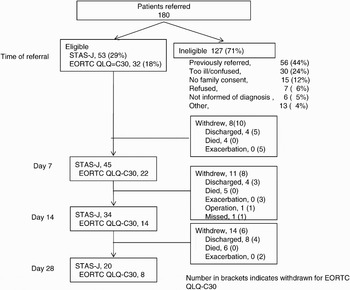
Of 180 patients referred to the PCCT during the study period, 53 patients were eligible. The main reasons for ineligibility were previous referral (44%), too ill/confused (24%), and no family consent (12%) (Fig. 1).
Participants and flow during the study period.

As a result of the comparison between eligible and ineligible patients, there was no significant difference in patient background, the number of types of support provided by PCCT, and the number of PCCT visits to the patient/ward staff (data not shown).
Patient Characteristics
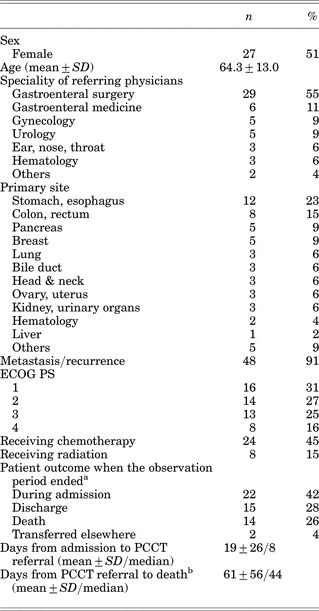
Table 1 shows the characteristics of the patients who participated in the study. Just over half of the patients were female (51%) and the mean age was 64 years old. Over half of the patients were referred by gastroenteral surgery, 11% were referred by gastroenterological medicine, and 9% were referred by both gynecology and urology. Fifty-eight percent of patients scored under 2 in the ECOG PS, and about half of patients had anticancer treatment at the time of referral.
Characteristics of patients (N = 53)

PCCT: Palliative Care Consultation Team.
aObservation period means from time of the referral to day 28, discharge, or death.
bData from 35 patients who were confirmed dead during the research period (from February 2004 to March 2005).
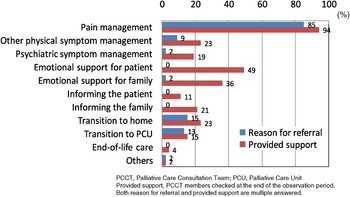
The main reasons for referral were pain management (85%), transition to home (15%), and transition to PCU (13%; Fig. 2).
(Color online) Reasons for referral and support provided by PCCT (N = 53).

PCCT Activities
Figure 2 shows the support that the PCCT provided after referral. The median number of referral reasons was 1 (range 1–3); in contrast, the median number of types of support was 3 (range 1–7). The main types of support offered were pain management, 94%; emotional support for patient, 49%; and emotional support for family, 36%. The mean number of visits to the patient or ward staff was 0.8 (SD = 0.3) per day or 0.7 (SD = 0.2) per day, respectively.
Change in Patient Outcome
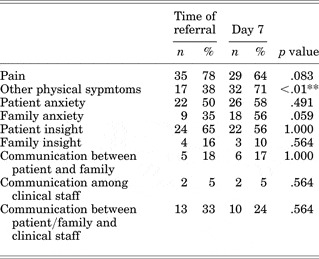
Table 2 shows the change in STAS-J items at day 7. “Other physical symptoms” were significantly exacerbated (p < .01). No significant differences were observed in any of the other items.
Change of “over moderate” in STAS-J during first week (N = 45)
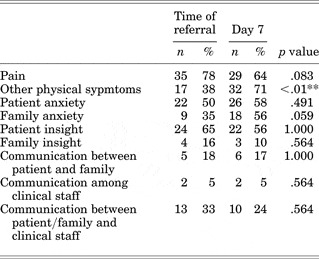
STAS-J: Support Team Assessment Schedule–Japanese version. STAS-J was assessed by ward nurses who were charged with patient on the assessment day. Scores range from 0 to 4, with a higher score representing worse symptoms or more serious problems, and collapsed into “none/a little” (0, 1), and “over moderate” (2–4). The number in the table is the frequency of “over moderate.” McNemar Test was used.
**p < .01.
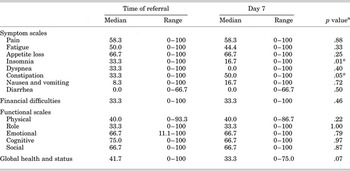
Table 3 shows the change in EORTC QLQ C-30 subscales at day 7. Only insomnia improved significantly (p < .01). On the other hand, constipation was significantly exacerbated (p < .05). There were no significant differences in any functional scales.
Change in EORTC QLQ-C30 during first week (N = 22)
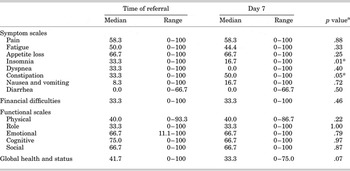
Scores range from 0 to 100, with a higher score representing a higher level of functioning or more severe symptoms.
aWilcoxon rank-sum test was used.
*p < .05.
Referring Staff Evaluation
Of 180 questionnaires distributed, 98 questionnaires were returned (54%). Responses were obtained from 68 nurses. The 68 nurses had a median clinical experience of 4 years, and most of them were female (97%).
The results showed that the number of responses was significantly greater when the patients were referred from physicians in the surgical department (p < .02), when the observational period ended during admission (p < .001), when the PCCT provided support over 1 week (p < .001), when a greater amount of kinds of support was provided by the PCCT (p < .03), and when “informing the family” was provided more by the PCCT (p < .02).
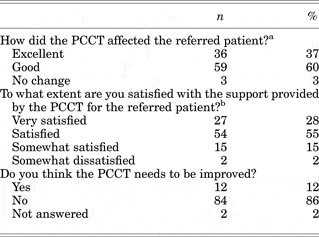
Of 98 respondents, more than 90% considered the effect of the PCCT on the referred patients as “excellent” or “good,” and were also satisfied with the support provided by the PCCT (Table 4). Twelve percent of respondents thought that the PCCT needed improvements. The respondent comments included “increasing the time for support,” “enhancing cooperation with ward staff,” “providing more information to patients and ward staff,” “constant involvement in the case,” “educating ward staff about the methods of psychosocial support,” and “defining who explains the cost of the PCCT.”
Ward nurses evaluation of PCCT support (N = 98)

PCCT: Palliative Care Consultation Team.
aRated by four-response categories: excellent, good, no change, and worse.
bRated by six categories from “very satisfied” to “very dissatisfied.”
DISCUSSION
This study evaluated an established PCCT at a university hospital using a multifaceted approach.
It was found that the PCCT provided more support than requested from referring staff and that the provision of psychosocial support was exceptional. These results are consistent with previous studies (Kuin et al., Reference Kuin, Courtens and Deliens2004; Braiteh et al., Reference Braiteh, El Osta and Palmer2007). This is probably due to the PCCT not only addressing the reason for referral but also undertaking comprehensive assessments of referred patients, and the assessment of psychosocial problems is difficult for general staff (McDonald et al., Reference McDonald, Passik and Dugan1999). In other words, the PCCT is aware of the problems that ward staff overlook and is thus able to provide extra support for patients and families.
Pain, which is the main reason for referral, was not improved during the first week. This result is not consistent with previous studies (Morita et al., Reference Morita, Fujimoto and Tei2005b; Yoshimoto et al., Reference Yoshimoto, Ishino and Hisada2005). A possible cause of this inconsistency is differences in clinical activities among PCCTs. The PCCT of the present study took an educational approach (Sasahara et al., Reference Sasahara, Sanjo and Umeda2008) and, unlike PCCTs of previous studies, did not prescribe medications. Therefore, pain might not have been relieved sufficiently early. To confirm this hypothesis, a study with a longer observational period and a large number of patients is needed. In addition, the variation of clinical activities of PCCTs, their applicability (hospital type and degree of team maturation), and benefit should be discussed. It was shown that insomnia was significantly improved after 1 week, which means that the intervention for insomnia by the PCCT was adequate and the ward staff implemented the PCCT recommendation rapidly. Constipation was exacerbated during the first week. We assume this was caused by opioid medication being initiated or increased following a suggestion by the PCCT and that this was a temporary phenomenon. As with the results for pain, a study with a longer observation period is needed to confirm whether or not our assumption is correct.
The support by the PCCT was highly evaluated and satisfied the primary nurses. Some comments for improving the activities of the PCCT were noted. The PCCT should bear in mind those comments, but we do not think that the PCCT should necessarily accept and implement the changes requested by the ward nurses, because the PCCT itself has a significant educational role for staff (Dunlop & Hockley, Reference Dunlop, Hockley, Dunlop and Hockley1998). If the PCCT provides support merely as the ward staff requires, this would deskill their competence in palliative care (Jack et al., Reference Jack, Oldham and Williams2002).
This study also provided information about the backgrounds of patients referred to the PCCT. More than half of referred patients scored under 2 in performance status, and nearly half of referred patients were receiving anticancer treatment. These results show that patients are referred to PCCTs early in the disease process (Morita et al., Reference Morita, Fujimoto and Imura2005a). Moreover, when we compare patients from the present study with those admitted to PCU in Japan (Tada et al., Reference Tada, Hashimoto and Matsushita2004), the current patients presented more severe levels of pain, fatigue, dyspnea, nausea and vomiting, and constipation. This indicates that one of the main roles of PCCTs is symptom management (Morita et al., Reference Morita, Fujimoto and Imura2005a).
Our study has several limitations. First, we were only able to evaluate some of the patients referred to the PCCT. Although we confirmed that there was no major background difference between participants and nonparticipants, this result might have other selection biases. Second, we evaluated the PCCT according to aspects of the PCCT's activities, patient's quality of life (QOL), and the referring staff's view. However, other important aspects of the PCCT, such as the transfer of care and education of ward staff, should also be evaluated. Third, the respondents to the staff evaluation might have had a more positive attitude toward the PCCT because the evaluations obtained concerned patients in which the PCCT had a deeper involvement.
In conclusion, we evaluated an established PCCT working in a university hospital using multiple aspects. The PCCT performed comprehensive assessments and provided extra support for referred patients. No patient's QOL was improved, with the exception of insomnia at 1 week after referral to the PCCT. Ward staff highly evaluated the activities of the PCCT. In the evaluation of PCCTs, further research about the variation of clinical activities of PCCTs, their applicability, and benefit is needed.
ACKNOWLEDGMENTS
We are very grateful to all the patients, families, and nurses who participated in the study. We would also like to thank Hitomi Miki, a clerk at the Center for Palliative Care, Showa University Hospital, for her generous assistance throughout the course of this research. This study was supported by grants from the Health Care Science Institute.