Introduction
Tropical forests represent unique habitats in regard to biodiversity conservation and provision of ecosystem services at a global scale, such as climate regulation and carbon storage, and provision of forest products for the livelihood of rural/traditional populations (Houghton et al. Reference Houghton, Byers and Nassikas2015, Maass et al. Reference Maass, Balvanera, Castillo, Daily, Mooney, Ehrlich, Quesada, Miranda, Jaramillo, García-Oliva, Martínez-Yrizar, Cotler, López-Blanco, Pérez-Jiménez, Búrquez, Tinoco, Ceballos, Barraza and Ayala2005, Portillo-Quintero et al. Reference Portillo-Quintero, Sanchez-Azofeifa, Calvo-Alvarado, Quesada and do Espirito Santo2015). Unfortunately, tropical forests have been rapidly converted into human-modified landscapes (Arroyo-Rodríguez et al. Reference Arroyo-Rodríguez, Melo, Martínez-Ramos, Bongers, Chazdon, Meave, Norden, Santos, Leal and Tabarelli2017). Particularly in the case of seasonally dry tropical forests (SDTFs sensu Pennington et al. Reference Pennington, Lavin and Oliveira-Filho2009), forest conversion has already reached 60% of some areas in Mexico (Trejo & Dirzo Reference Trejo and Dirzo2000), 90% in the Brazilian Caatinga (Silva et al. Reference Silva, Leal and Tabarelli2017) and 95% in Peru (Hasnat & Hossain Reference Hasnat, Hossain and Bhadouria2019). In addition to extensive habitat loss, remaining forests are frequently disturbed by slash-and-burn agriculture, exploitation of forest products such as firewood for charcoal, and livestock production; i.e. chronic human disturbance (Dons et al. Reference Dons, Smith-Hall, Meilby and Fensholt2015; Singh Reference Singh1998). Collectively, such a disturbance regime has converted several dry forests into mosaics consisting of second-growth forest patches and agricultural fields (Pulla et al. Reference Pulla, Ramaswami, Mondal, Chitra-Tarak, Suresh, Dattaraja, Vivek, Parthasarathy, Ramesh and Sukumar2015, Sobrinho et al. Reference Sobrinho, Tabarelli, Machado, Sfair, Bruna and Lopes2016). This conversion can not only impair the delivery of ecosystem services but also the forest resilience, leading to trajectories of intense degradation (Arroyo-Rodríguez et al. Reference Arroyo-Rodríguez, Melo, Martínez-Ramos, Bongers, Chazdon, Meave, Norden, Santos, Leal and Tabarelli2017, Melo et al. Reference Melo, Arroyo-Rodríguez, Fahrig, Martínez-Ramos and Tabarelli2013), even desertification (Portillo-Quintero et al. Reference Portillo-Quintero, Sanchez-Azofeifa, Calvo-Alvarado, Quesada and do Espirito Santo2015, Tabarelli et al. Reference Tabarelli, Siqueira, Backé, Wirth, Leal, Oliveira and Koptur2017).
Accordingly, forest regeneration and resilience in human-modified landscapes have received increased attention in recent years (Arroyo-Rodríguez et al. Reference Arroyo-Rodríguez, Melo, Martínez-Ramos, Bongers, Chazdon, Meave, Norden, Santos, Leal and Tabarelli2017, Barros et al. Reference Barros, Ribeiro, Vanderlei, de Paula, Silva, Wirth, Cianciaruso and Tabarelli2021, Derroire et al. Reference Derroire, Balvanera, Castellanos-Castro, Decocq, Kennard, Lebrija-Trejos, Leiva, Odén, Powers, Rico-Gray, Tigabu and Healey2016, Poorter et al. Reference Poorter, Bongers, Aide and Zambrano2016, Portillo-Quintero et al. Reference Portillo-Quintero, Sanchez-Azofeifa, Calvo-Alvarado, Quesada and do Espirito Santo2015), including the role played by plant resprouting (Barros et al. Reference Barros, Ribeiro, Vanderlei, de Paula, Silva, Wirth, Cianciaruso and Tabarelli2021, Bond & Midgley Reference Bond and Midgley2001). In fact, the focus towards resprouting ability has escalated in the last two decades as a substantial proportion of flora are able to resprout in response to biomass loss and environmental changes (Barros et al. Reference Barros, Ribeiro, Vanderlei, de Paula, Silva, Wirth, Cianciaruso and Tabarelli2021, Buisson et al. Reference Buisson, Le Stradic, Silveira, Durigan, Overbeck, Fidelis, Fernandes, Bond, Hermann, Mahy, Alvarado, Zaloumis and Veldman2018, Kammesheidt Reference Kammesheidt1999, Pausas et al. Reference Pausas, Pratt, Keeley, Jacobsen, Ramirez, Vilagrosa, Paula, Kaneakua-Pia and Davis2016). In the regeneration context, the presence of species with the ability to resprout has been recognized to act as a ‘shortcut’ for a faster recovery, since it can temporarily skip the most vulnerable ontogenetic stages (i.e. seedlings and young plants germinated from seeds) and allow biomass recovery to restart from stumps and roots, and progress vigorously (Barros et al. Reference Barros, Ribeiro, Vanderlei, de Paula, Silva, Wirth, Cianciaruso and Tabarelli2021, Kennard et al. Reference Kennard, Gould, Putz, Fredericksen and Morales2002). Furthermore, resprouting can be triggered not only by human disturbances but also by biomass loss caused by herbivory (Bellingham & Sparrow Reference Bellingham and Sparrow2000), water deficit (Kennard et al. Reference Kennard, Gould, Putz, Fredericksen and Morales2002) and fire (Pausas et al. Reference Pausas, Pratt, Keeley, Jacobsen, Ramirez, Vilagrosa, Paula, Kaneakua-Pia and Davis2016). Thereby, resprouting has been intensively examined in fire-prone ecosystems such as Mediterranean shrublands, Californian chaparral and the Cerrado, commonly referred to as the Brazilian savanna (Pausas et al. Reference Pausas, Pratt, Keeley, Jacobsen, Ramirez, Vilagrosa, Paula, Kaneakua-Pia and Davis2016, Rizzini & Heringer Reference Rizzini and Heringer1962, Schwilk & Ackerly Reference Schwilk and Ackerly2005). Although resprouting has been previously reported in SDTFs under anthropogenic disturbances (Barros et al. Reference Barros, Ribeiro, Vanderlei, de Paula, Silva, Wirth, Cianciaruso and Tabarelli2021, Kammesheidt Reference Kammesheidt1999, Vieira et al. Reference Vieira, Scariot, Sampaio and Holl2006), the extent to which forest resilience relies on this mechanism remains an open question (see Pausas et al. Reference Pausas, Pratt, Keeley, Jacobsen, Ramirez, Vilagrosa, Paula, Kaneakua-Pia and Davis2016 and Buisson et al. Reference Buisson, Le Stradic, Silveira, Durigan, Overbeck, Fidelis, Fernandes, Bond, Hermann, Mahy, Alvarado, Zaloumis and Veldman2018 for recent reviews).
The Caatinga dry forest in north-east Brazil represents one of the largest tracts of dry forest (800 000 km2) globally (Silva et al. Reference Silva, Leal and Tabarelli2017). As one of the most-populated dry forest regions (Tabarelli et al. Reference Tabarelli, Siqueira, Backé, Wirth, Leal, Oliveira and Koptur2017), slash-and-burn agriculture and livestock farming have pushed native forests into dynamic vegetation mosaics primarily consisting of agricultural fields, second-growth stands of varying ages and, to a much lesser extent, old-growth forest stands (Souza et al. Reference Souza, Sfair, De Paula, Barros, Rito and Tabarelli2019). Remaining forest cover (both secondary and old-growth) represents a key resource for the livelihood of rural populations (mostly small landholdings) by providing firewood, fodder for goats and cattle, timber and nutrients for slash-and-burn agriculture, among a myriad of products exploited by locals (Specht et al. Reference Specht, Santos, Marshall, Melo, Leal, Tabareli and Baldauf2019). This socio-ecological context is likely to disfavour seedling recruitment and benefit woody plant species able to resprout (see Sampaio et al. Reference Sampaio, Salcedo and Kauffman1993), with consequences for the Caatinga forest resilience yet to be investigated. It is worth mentioning that the Caatinga land-use patterns represent most of the challenges experienced by dry forest globally, making the Caatinga’s challenges particularly interesting (Silva et al. Reference Silva, Leal and Tabarelli2017).
Here we offer a preliminary description of an extensive clonal propagation and resprouting driving the regeneration of a Caatinga dry forest following slash-and-burn regeneration in north-east Brazil. To check the flora’s ability to resprout and thus guarantee forest regeneration across old fields, we also experimentally examined woody plant species’ ability to resprout (13 species) while in the seedling stage (i.e. the most sensitive plant ontogenetic stage). We integrated our findings with previous ones (Barros et al. Reference Barros, Ribeiro, Vanderlei, de Paula, Silva, Wirth, Cianciaruso and Tabarelli2021, Rito et al. Reference Rito, Arroyo-Rodríguez, Queiroz, Leal and Tabarelli2017 a, Souza et al. Reference Souza, Sfair, De Paula, Barros, Rito and Tabarelli2019) to present a working hypothesis about plant resprouting as a key mechanism allowing forest regeneration in harsh conditions but also causing biotic simplification due to an increasing dominance of resprouting species.
Methods
Study area
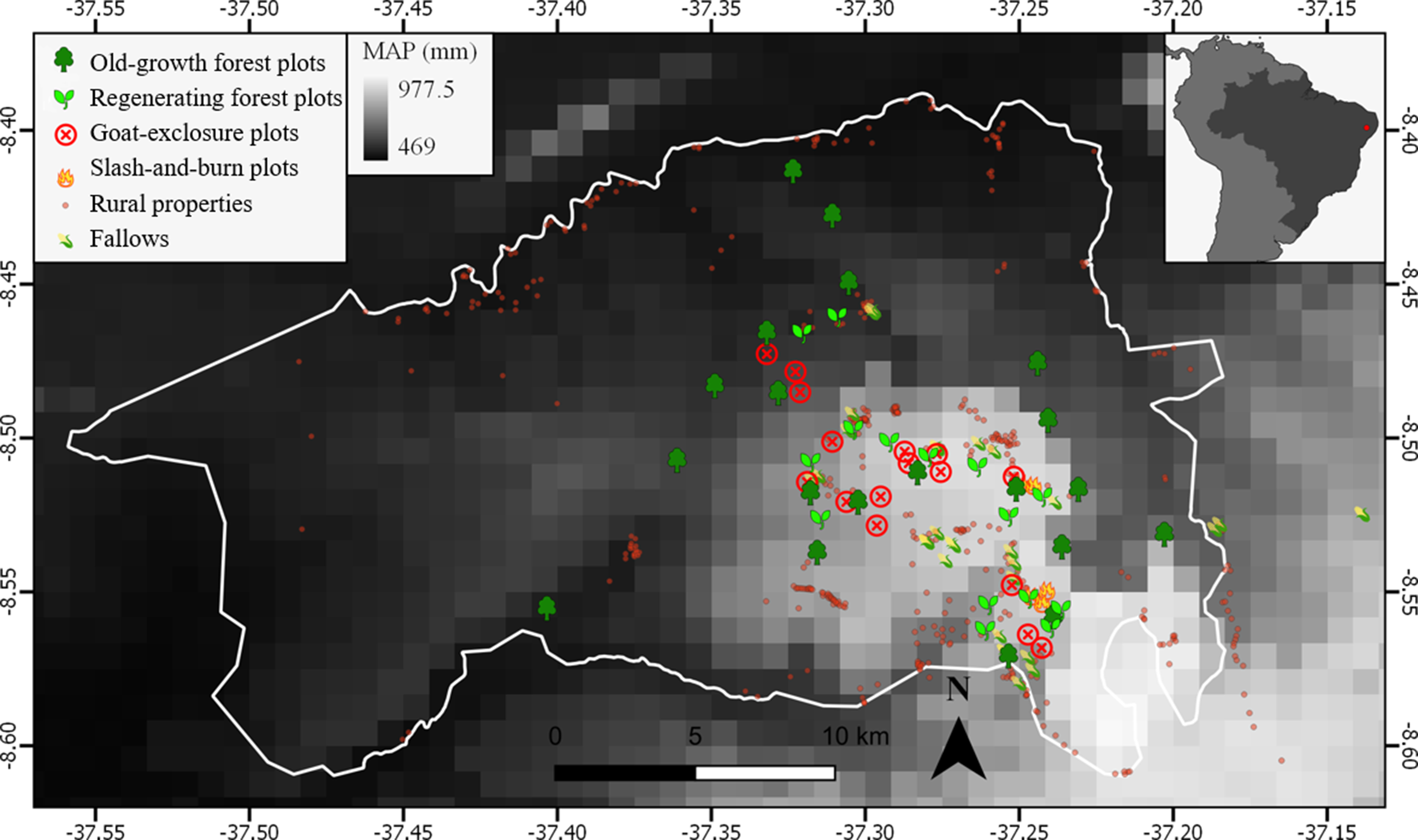
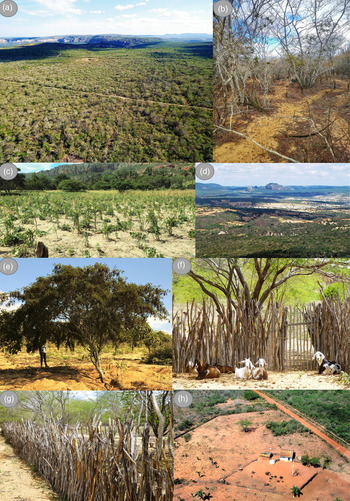
The study was carried out in human-modified landscapes in the Catimbau National Park (8º24′00″S, 37º14′40″), north-east Brazil. Catimbau has been the venue of a long-term ecological research project (i.e. a PELD-CNPq site) based on a network of permanent plots (Figure 1). This 607-km2 protected area is mostly composed of flatlands and naturally impoverished sandy soils, with an annual mean temperature of 23°C and annual precipitation ranging from 480–1100 mm based on a 30-year historical average (Rito et al. Reference Rito, Arroyo-Rodríguez, Queiroz, Leal and Tabarelli2017 a). Catimbau is originally covered by a small-statured dry forest dominated by species of Fabaceae and Euphorbiaceae (Rito et al. Reference Rito, Tabarelli and Leal2017 b). Nearly 300 rural families still live within the Catimbau area, with slash-and-burn agriculture and free-ranging goat raising as the main types of land use (Specht et al. Reference Specht, Santos, Marshall, Melo, Leal, Tabareli and Baldauf2019). Thereby, the current landscape is a mosaic consisting of croplands, old fields, secondary and old-growth forest stands (Souza et al. Reference Souza, Sfair, De Paula, Barros, Rito and Tabarelli2019). Both old-growth and regenerating forest stands are dominated by few tree species, such as Pityrocarpa moniliformis (Benth.) Luckow & R. W. Jobson, Cenostigma pyramidale (Tul.) Gagnon & G.P. Lewis (Fabaceae), and Croton tricolor Klotzsch ex Baill (Euphorbiaceae) (Figure 2a; Rito et al. Reference Rito, Tabarelli and Leal2017 b; Souza et al. Reference Souza, Sfair, De Paula, Barros, Rito and Tabarelli2019), while they serve as sources of key forest products, such as timber, firewood and fodder (Arnan et al. Reference Arnan, Leal, Tabarelli, Andrade, Barros, Câmara, Jamelli, Knoechelman, Meneses, Menezes, Oliveira, Paula, Pereira, Rito, Sfair, Silva, Souza, Specht, Vieira and Andersen2018).
Network of permanent research plots comprising the long-term ecological research project PELD Catimbau. The configuration of the focal landscape consists of: 20 old-growth forest stands, 15 regenerating stands, 16 goat-exclosure plots, 6 slash-and-burn plots, approximately 300 rural properties and 24 fallows.

Forest regeneration across old fields and species resprouting ability
A total of 32 old fields were selected to examine the mechanisms of forest regeneration in the context of slash-and-burn agriculture in our focal landscape (see Figures 1 and 2). Old fields or fallows are crop fields that were abandoned after producing corn and beans in the last five years; i.e. no more than five years since land abandonment. Among the 32 fields, two of them (14 m × 14 m and 40 m × 40 m, respectively) covered by P. moniliformis seedlings/recruiters were excavated in order to identify potential connections between seedlings and remaining adult plants; i.e. root resprouters or root suckers sensu Jenik (Reference Jenik1994) rather than true seedlings from seeds.
Representation of the Catimbau National Park in the context of human-modified landscape and land use. The current landscape is a mosaic consisting of (a) old-growth stands dominated by a few tree species such as Pityrocarpa moniliformis; (b) regenerating stands (e.g. a 40 year-old abandoned stand after slash-and-burn agriculture); (c) active croplands; (d) degraded and forested areas; (e) a few remaining adult trees in fallows (e.g. P. moniliformis); (f) goats found across the Park; (g) timber fences built after the extraction of forest products; (h) rural property.

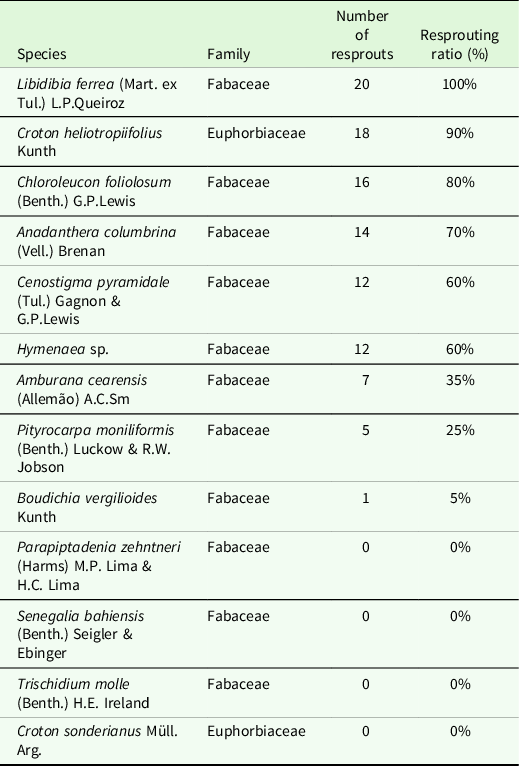
To check the resprouting ability of woody plant species from basal buds (i.e. coppice shoots sensu Jenik Reference Jenik1994), we selected 13 woody plant species and submitted their seedlings to experimental clipping (Table 1). In total, 260 six-month-old seedlings (i.e. 20 seedlings per species) were monitored over two months. Overall, these species occur abundantly in the Catimbau landscape with some of them, such as P. moniliformis, C. pyramidale and S. bahiensis, collectively representing nearly 30% of both stem number and aboveground forest biomass (Rito et al. Reference Rito, Tabarelli and Leal2017 b, Souza et al. Reference Souza, Sfair, De Paula, Barros, Rito and Tabarelli2019). Seedlings were maintained under 50% shading cloth and watered three times per week. Their heights were measured before clipping (June 2018) and then they were clipped at soil level using pruning shears. After two months, we measured their survival, resprouting ratio (i.e. percentage of resprouting individuals) and height. The experiment was carried out in plant beds of a research facility near the Catimbau National Park from June to August 2018.
Number of resprouts and resprouting ratio of the species used in the experimental clipping.

Data analysis
To test whether the resprouting ability varied among species, we performed Peason’s chi-squared test. To assess the differences among the height of the resprouts, we performed an analysis of variance (ANOVA) followed by a post-hoc Tukey test. We also ran a generalized linear model to access whether the initial height of the seedlings influenced the height after clipping. The normal distribution of the residuals and homogeneity of the variance were accessed using the Shapiro–Wilk and Levene tests, respectively. The data was square root transformed when necessary. All the analyses were performed with R software (version 3.5.1).
Results
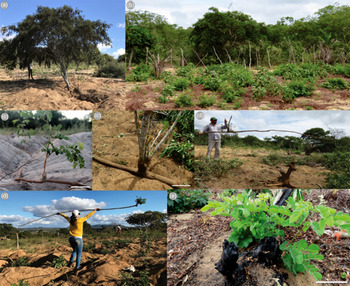
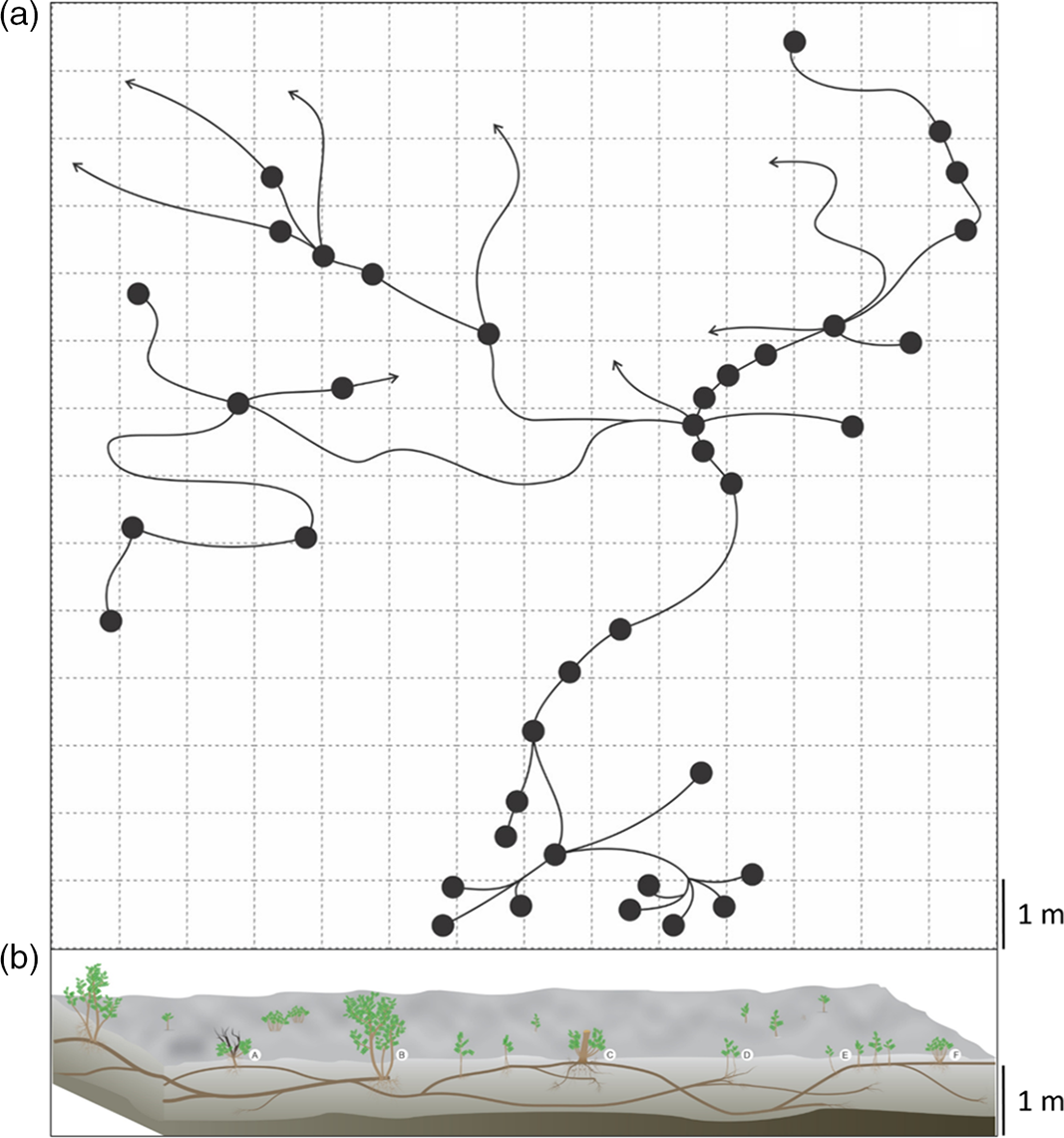
What appeared to be ‘seedlings’ popping up around P. moniliformis stumps and adults (Figure 3a) were in fact condensed sets of root suckers (sensu Jenik Reference Jenik1994) in both old fields (Figure 3b, c). They were physically connected to the stumps and remaining adult trees via complex networks of long, ramified horizontal roots up to 30 cm below the soil surface, without taproots (Figure 3d), and reached more than 10 cm of diameter close to the adults. In total, we mapped 39 and 783 root suckers connected via a network of horizontal roots, which summed 96 m and 910 m in length (Figure 4a), respectively; one single horizontal root exceeded 60 m in length. We also documented resprouting from stumps left in the fields, i.e. epicormic and coppice shoots (Figure 3e). Pityrocarpa moniliformis had between 0.25–0.5 sprouts per m2, with a few seedlings from a couple of other woody plant species (C. heliotropiifolius, Jatropha mutabilis (Pohl) Bail, Senna cana (Nees & Mart.) H.S. Irwin & Barneby).
The species Pityrocarpa moniliformis exhibiting long horizontal roots across a cassava field in the Caatinga dry forest (a); an area of forest recovering after slash-and-burn agriculture dominated by a condensed set of P. moniliformis root suckers connected by roots (b); individuals lacking taproots, but exhibiting horizontal roots connected to the network (c, d); remaining stumps starting to resprout after fire (e). Photos were taken in the Catimbau National Park, north-east Brazil. White scale bars represent 10 cm.

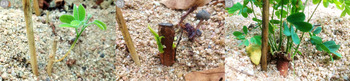
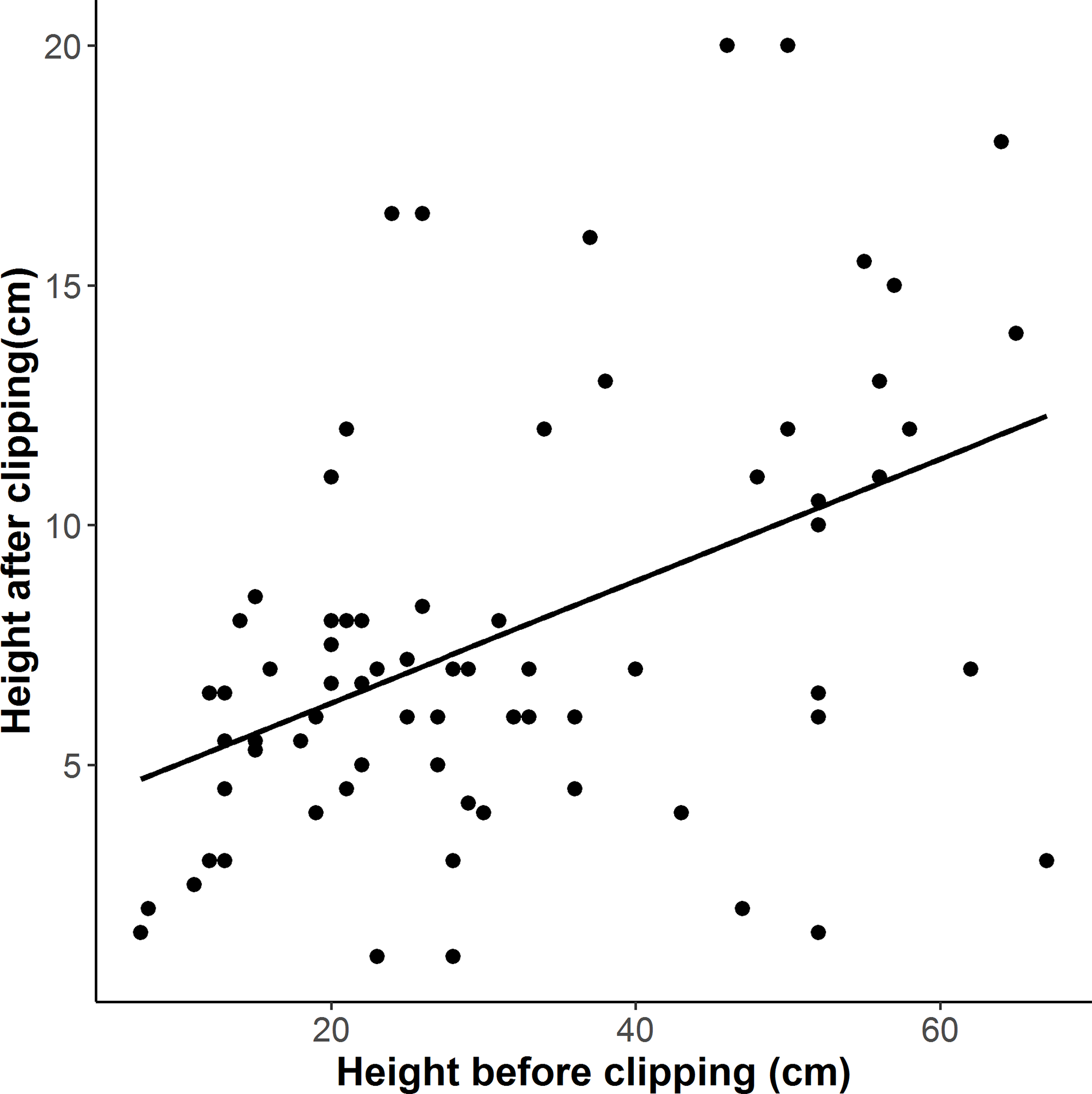
Regarding the responses of the seedlings to the experimental clipping, 33% (87) out of the 260 seedlings resprouted (Figure 5). Among all the 13 species, nine of them resprouted at some level, varying between 5–100% (χ² = 143, df = 12, P < 0.001, see Table 1). The height of the seedlings prior to clipping exerted a positive influence on the height of the resprouts (P < 0.0001, t = 4.2, r² = 0.2, Figure 6).
(a) Map of root suckers of the species Pityrocarpa moniliformis connected to a network of horizontal roots; black dots represent the root suckers, lines represent the roots, arrows represent the roots entering the ground, squares represent a 1 m² area; (b) schematic drawing of the set of root suckers and different forms of regrowth of P. moniliformis observed in the field: (A) post-fire, (B) root cutting, (C) stem cutting, (D) regrowth at root termination, (E) sequentially isolated root suckers, (F) several converging root suckers starting from the same point.

Seedlings resprouting after clipping at soil level. (a) Pityrocarpa moniliformis, (b) Hymenaea sp., (c) Libidibia ferrea.

Relationship between the height of the seedlings before the clipping and height of the resprout after 2 months of experimental clipping; P < 0.0001.

Discussion
Although our findings are based on a small sample size (i.e. two fallows), the ecological dominance of old fields by P. moniliformis through vegetative propagation and aggressive resprouting (from both stumps and roots) is particularly relevant as it apparently triggers and drives Caatinga forest regeneration following slash-and-burn agriculture. Moreover, the Caatinga flora seems to support a considerable number of woody plant species able to resprout even at the seedling stage. Some of these species are able to combine both clonal propagation via root suckers and resprouting from basal and lateral buds (e.g. P. moniliformis and C. pyramidale). Additionally, even though the resprouting ability is commonly addressed basically in binary terms (i.e. resprouter vs non-resprouter species), the resprouting ratio greatly varies among the species, with some species exhibiting high resprouting ratio (i.e. 80–100%), such as L. ferrea, C. heliotropiifolius and A. cearensis, and others with an extremely low ratio (5%), such as B. vergilioides, at least under experimental conditions. The taller the seedling, the more vigorous the resprouting following biomass loss, suggesting that a larger plant has also accumulated more belowground resources. Finally, such a resprouting-mediated regeneration following slash-and-burn agriculture depends on the persistence of key plant structures (particularly roots and stumps) through the cycles of crop production and the time of field abandonment.
Strategies involving clonal propagation and resprouting have been observed across several taxa and ecosystems, with fire-prone ecosystems supporting a higher proportion of resprouting species into local/regional flora (Espelta et al. Reference Espelta, Retana and Habrouk2003, Jaureguiberry et al. Reference Jaureguiberry, Cuchietti, Gorné, Bertone and Díaz2020, Pausas & Keeley Reference Pausas and Keeley2014). Unfortunately, such information is still scarce for dry forest flora where fire does not occur naturally, although many human-disturbed forests have been documented to support a high density of resprouters, i.e. coppicing individuals (McDonald Reference McDonald2010, Vieira & Scariot Reference Vieira and Scariot2006). Our findings suggest that a substantial proportion of the Caatinga flora is able to resprout (70%), at least via basal buds (coppicing), although we addressed a small subset (13 species) of the Catimbau flora (see Barros et al. Reference Barros, Ribeiro, Vanderlei, de Paula, Silva, Wirth, Cianciaruso and Tabarelli2021, Rito et al. Reference Rito, Arroyo-Rodríguez, Queiroz, Leal and Tabarelli2017 a, Trindade et al. Reference Trindade, Sfair, de Paula, Barros and Tabarelli2020). In addition to the species being able to resprout after coppicing, we have also documented resprouting/clonal propagation for some species under field conditions (e.g. C. pyramidale, C. tricolor, Annona leptopetala (R.E.Fr.) H.Rainer (Annonaceae), Cnidoscolus quercifolius Pohl (Euphorbiaceae), Senna rizzinii H.S. Irwin & Barneby (Fabaceae)) in the Catimbau landscape and the list of resprouting/clonal propagation species in the Caatinga dry forest is far from complete, as suggested by other reports (Figueirôa et al. Reference Figueirôa, Pareyn, Araújo, Silva, Santos, Cutler, Baracat and Gasson2006, Sampaio et al. Reference Sampaio, Salcedo and Kauffman1993, Schacht et al. Reference Schacht, Mesquita, Malechek and Kirmse1989).
Besides the resprouting ability, some Caatinga species are also able to support dense and extensive root networks of root suckers, and thus dominate fallows as documented for P. moniliformis. According to local farmers in the Catimbau landscape, such clonal/resprouting populations require intensive weeding through several cultivation/crop cycles to be completely removed from fields as new resprouts emerge from roots and stumps following clear-cutting. They reported that the individuals of P. moniliformis in our 40 m × 40 m old field have been repeatedly cut at soil level for 16 years and kept resprouting (M. Tabarelli personal correspondence). Such a resilient root network is likely to serve as a source of nutrients and water for the root suckers, conferring important advantages for recovering aboveground biomass compared with seedlings (see Clarke et al. Reference Clarke, Lawes and Midgley2010, Hayashi & Appezzato-da-glória Reference Hayashi and Appezzato-da-glória2009). It implies increased resilience under harsh abiotic conditions, especially when biomass production is reduced and seedling mortality increases during the dry season (Pausas et al. Reference Pausas, Pratt, Keeley, Jacobsen, Ramirez, Vilagrosa, Paula, Kaneakua-Pia and Davis2016). The documented positive correlation between seedling size and resprouting vigour reinforces the importance of carbohydrate stocks (i.e. non-structural carbohydrates) to support a faster biomass recovery (O’Brien et al. Reference O’Brien, Leuzinger, Philipson, Tay and Hector2014). Such advantages would also explain the observed dominance of P. moniliformis across old fields, regenerating forest stands (4–70 years old) and patches of old-growth forest in the Catimbau National Park (Rito et al. Reference Rito, Arroyo-Rodríguez, Queiroz, Leal and Tabarelli2017 a, Souza et al. Reference Souza, Sfair, De Paula, Barros, Rito and Tabarelli2019).
Both clonal propagation and resprouting tend to be advantageous in habitats where true seedlings have limited chances of successful establishment and adults are exposed to severe limitations in terms of productivity or excessive biomass loss via disturbances (Pausas & Keeley Reference Pausas and Keeley2014, Schwilk & Ackerly Reference Schwilk and Ackerly2005). Human-modified landscapes of the Caatinga dry forest integrate processes that, in theory, discriminate against seedlings and favour the resprouting individuals. We refer to strong seasonality and droughts, soil degradation and over-browsing by exotic livestock (e.g. goats), herbivory by leaf-cutting ants and regular weeding of crop fields as the interacting forces that make seed germination, seedling establishment and growth particularly difficult (see Knoechelmann et al. Reference Knoechelmann, Oliveira, Siqueira, Wirth, Tabarelli and Leal2020, McDonald Reference McDonald2010, Werden et al. Reference Werden, Calderón-Morales, Alvarado, Gutiérrez, Nedveck and Powers2020). On the other hand, the adult biomass loss due to (1) the exploitation of wood, fodder, medicinal plants, (2) slash-and-burn agriculture, including weeding, and (3) strong seasonality and droughts are expected to stimulate resprouting/clonal reproduction as the successful mechanism of species persistence and reproduction, as postulated by several models (Bellingham & Sparrow Reference Bellingham and Sparrow2000, Bond & Midgley Reference Bond and Midgley2001, Pausas et al. Reference Pausas, Pratt, Keeley, Jacobsen, Ramirez, Vilagrosa, Paula, Kaneakua-Pia and Davis2016).
Conclusions
The Caatinga dry forest apparently supports a relatively high proportion of resprouting woody plant species, some of them with the ability of clonal propagation, that play an ecosystem-level role by being responsible for early forest regeneration and high abundance/biomass across both regenerating and old-growth forests. We propose as a working hypothesis that slash-and-burn agriculture, livestock production, collection of forest products and natural disturbances (e.g. seasonality and droughts) may drive forest regeneration by favouring woody plant species capable of resprouting and/or clonal propagation from old fields to regenerating forest stands. Such an ecosystem-level impact from resprouting woody plants is a novel finding for biotas in which fire has not represented a natural evolutionary and ecological force such as the Caatinga dry forest (Silva et al. Reference Silva, Leal and Tabarelli2017). Although resprouting has been proposed as a key mechanism of dry forest resilience, intense selection/favouring of resprouting species by human disturbance may cause biotic homogenization, as species and even plant life-forms vary greatly in terms of resprouting capacity (Vesk & Yen Reference Vesk and Yen2019). Hence, considering that millions of hectares of dry forests are exploited annually by local populations for charcoal production, slash-and-burn agriculture and livestock production (Chidumayo & Gumbo Reference Chidumayo and Gumbo2013; Heinimann et al. Reference Heinimann, Mertz, Frolking, Egelund Christensen, Hurni, Sedano, Chini, Sahajpal, Hansen and Hurtt2017; Sunderland et al. Reference Sunderland, Apgaua, Baldauf, Blackie, Colfer, Cunningham, Dexter, Djoudi, Gautier, Gumbo, Ickowitz, Kassa, Parthasarathy, Pennington, Paumgarten, Pulla, Sola, TNG, Waeber and Wilmé2015), an assessment of the generality of the patterns found here is necessary to establish the ecological role currently played by clonal propagation and resprouting as key mechanisms of forest regeneration in SDTFs.
Acknowledgements
This publication was possible thanks to the support provided by the Long-Term Ecological Research Project (PELD-PRONEX Catimbau – Process 441386/2016-4) ‘Anthropogenic disturbances, climatic changes and the future Caatinga biota: implications for semi-arid sustainability’. We would also like to thank the reviewers and editor for their constructive suggestions.
Financial support
We thank Conselho Nacional de Desenvolvimento Científico e Tecnológico (CNPq PELD process 441386/2016-4), Coordenação de Aperfeiçoamento de Pessoal de Nível Superior - Brasil (CAPES, Finance Code 001), and Fundação de Amparo à Ciência e Tecnologia do Estado de Pernambuco (FACEPE, PRONEX process APQ-0138-2.05/14). MFB and ADM also thank CAPES (Grant 88887.127412/2016-00), CNPq (Grant 301340/2020-0) and FACEPE (BCT-0085-2.03/19) for the scholarships received.