Introduction
Antarctic terrestrial and freshwater ecosystems provide harsh conditions for organisms, which are exposed to low temperatures and seasonal extremes of illumination with long winters without light and summers with continuous sunlight. Moreover, many lakes on the Antarctic continent, particularly those at high latitudes, have low nutrient availabilities and are permanently ice-covered, leading to low production of algae and thereby low food supply for higher organisms. These features generally lead to low biodiversity and abundance among herbivorous zooplankton. The lakes in the Dry Valleys of the McMurdo Sound region of Antarctica constitute an extreme of these extreme systems with their permanent, several metres thick, ice cover. Both the species diversity and population sizes of zooplankton previously recorded here are low, comprising a few species of rotifers, while crustaceans have, with the exception of copepod nauplius larvae in Lake Joyce (Roberts et al. Reference Roberts, Priscu, Wolf, Lyons and Laybourn-Parry2004), never been recorded. The reason for this may be either that they were not present during previous samplings, or that the samplings hitherto have mainly been focused on physical and chemical properties and on the microbial components of these lakes (Priscu Reference Priscu1997, Roberts et al. Reference Roberts, Priscu, Wolf, Lyons and Laybourn-Parry2004, Herbei et al. Reference Herbei, Lyons, Laybourn-Parry, Gardner, Priscu and McKnight2010). In the present study we have therefore focused on assessing the species-richness of larger zooplankton, including rotifers and crustaceans, that is, assessing how many species that manage to maintain viable populations in this extreme environment. We have done so by sampling the water column of Lake Hoare and filtering larger volumes of lake water than in previous studies. This approach revealed a far higher number of planktonic rotifer species than previously reported and provides further evidence that a calanoid copepod of the genus Boeckella has a viable population in the Dry Valley lakes.
Materials and methods
Lake Hoare
Lake Hoare is situated in Taylor Valley (77°37.661′S, 162°54.574′E) one of the Dry Valleys of the McMurdo Sound region, Antarctica. Historically, the lake might have been almost completely dried out about 1000 years ago, i.e. re-colonization of organisms may have had a relatively short time to occur (Lyons Reference Lyons, Howard-Williams and Hawes1997). In addition, re-colonization of aquatic organisms may also have been affected by the glacial history, as has been the case with, for example, copepods in the Arctic (Samchyshyna et al. Reference Samchyshyna, Hansson and Christoffersen2008). The Dry Valleys receive < 50 mm precipitation per year and have a mean temperature of -18°C (Roberts et al. Reference Roberts, Priscu, Wolf, Lyons and Laybourn-Parry2004), making them one of the driest, coldest and harshest environments on Earth. The lakes of the Dry Valleys are ice-covered throughout the year, although in late summer a moat of water opens up close to the shore. Due to the low precipitation their only inflow is generally from glacier meltwater and they usually lack surface outflows. Lake Hoare has a surface area of about 1.9 km2 and maximum depth of 34 m (Roberts et al. Reference Roberts, Priscu, Wolf, Lyons and Laybourn-Parry2004). The ice thickness in summer has been estimated at between 3 and 6 m (Howard-Williams et al. Reference Howard-Williams, Schwarz, Hawes and Priscu1998, Roberts et al. Reference Roberts, Priscu, Wolf, Lyons and Laybourn-Parry2004). We only recorded a thickness of about 2 m, but we did not include the 1 m thick layer of porous, partly melted snow/ice cover on top of the regular ice in our measurements.
Sampling procedure
Our sampling was on 2 February 2010 along a depth profile at 1, 4, 9 and 15 metres, but only the surface sample was taxonomically investigated here in order to focus on the pelagic fauna and excluding any possibility of contamination of animals from the benthic mat. We used a Jiffy drill to enlarge holes previously drilled by the LTER project above the deepest point (Roberts et al. Reference Roberts, Priscu, Wolf, Lyons and Laybourn-Parry2004). 20 l of water were taken from each depth using a Limnos water sampler (2l volume). In order to reduce the risk of contamination of these ecosystems with alien species all equipment was kept dry for at least a month and was rinsed in alcohol (70%) prior to sampling. Moreover, all nets were new, eliminating the risk of contamination of samples. Each 20 l sample was filtered through a 50 μm net and the zooplankton obtained were retrieved from the net, rinsed into 50 ml centrifuge tubes and preserved in Lugol's solution for later identification. In the laboratory, zooplankton from the whole volume, not just a subsample of each sampling, was counted. We used a Petri dish with eight sub-chambers, each 26–33 mm (Nalge Nunc, USA), and inspected the samples with a stereo microscope at 40x magnification. Taxonomic determinations were made using dissecting and compound microscopes, as well as Leica DMI 4000B inverted microscope at 25-945x magnification, which was also used for the photographs taken.
Results
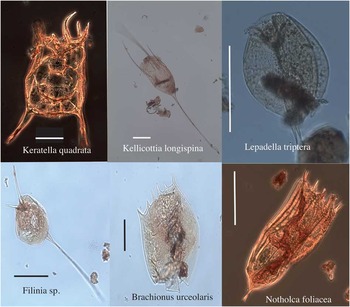
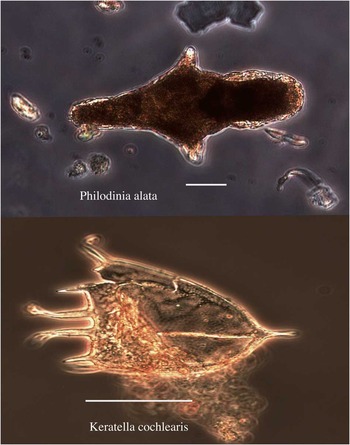
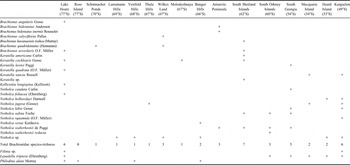
We recorded nine species of rotifer and one calanoid copepod in the water column of Lake Hoare (Table I) and the species-richness was similar in the nearby Lake Fryxell (own observations). Most of the rotifers we found belong to the Brachionidae family including Brachionus angularis Gosse, which is a new record for the Antarctic. Also Brachionus urceolaris O.F. Müller (Fig. 1) was found in the lake and although this species has been reported from the Antarctic by Segers (Reference Segers2007), no location was given. Keratella cochlearis Gosse (Fig. 2) has been reported from the South Shetland Islands (Paggi Reference Paggi1983) and from Molodezhnaya (Kutikova Reference Kutikova1991). Keratella quadrata (O.F. Müller) is a new record for the Antarctic and this species was very common in Lake Hoare (Fig. 1), with more than 100 individuals per litre in the surface waters. The specimens were of varying size and development of the posterior spines was extremely variable and may represent more than one species. Most specimens had a pair of similar-sized and prominent posterior spines, whereas others were asymmetrical with one long and one short posterior spine. It should be noted that this was a true observation, i.e. the shorter spine had not broken off in the sampling process. Finally some specimens had a pair of very short posterior spines reminiscent of K. testudo (Ehrenberg, 1831) and one individual was seen that did not have posterior spines at all. Kellicottia longispina (Kellicott) (Fig. 1) is also a new record for the Antarctic and was very common in Lake Hoare with more than 50 individuals per litre in the surface waters. Notholca foliacea (Ehrenberg) (Fig. 1) is a common species in many parts of the world, but another new record for the Antarctic.
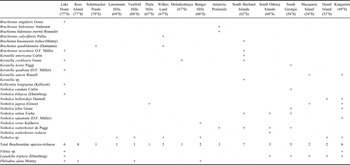
The Antarctic distributions of rotifers with special reference to the Brachionidae family including the genera Brachionus, Keratella, Kellicottia and Notholca. References: Lake Hoare, this study; Ross Island, Murray Reference Murray1910, Cathey et al. Reference Cathey, Parker, Simmons, Yongue and van Brunt1981; Schirmacher Ponds, Kutikova Reference Kutikova1991; Larsemann Hills, Dartnall Reference Dartnall1995b; Vestfold Hills, Dartnall Reference Dartnall2000; Bunger Hills, Korotkevich Reference Korotkevich1958, Kutikova Reference Kutikova1958a, Reference Kutikova1958b; Thala Hills, Opalinski Reference Opalinski1972; Wilkes Land, Thomas Reference Thomas1965, Reference Thomas1972, Dartnall Reference Dartnall2005a; Molodezhnaya, Kutikova Reference Kutikova1991; Antarctic Peninsula, Heywood Reference Heywood1977, Dartnall Reference Dartnall1980, Kuczynski Reference Kuczynski1987; South Shetland Islands, de Paggi Reference De Paggi1982, Kuczynski Reference Kuczynski1987, Janiec Reference Janiec1993, Janiec & Salwicka Reference Janiec and Salwicka1996; South Orkney Islands, Dartnall & Hollowday Reference Dartnall and Hollowday1985; South Georgia, Dartnall & Heywood Reference Dartnall and Heywood1980, Dartnall & Hollowday Reference Dartnall and Hollowday1985, Hansson et al. Reference Hansson, Tranvik, MacAlister, Ellis-Evans and Dartnall1996, Dartnall Reference Dartnall2005b; Macquarie Island, Dartnall Reference Dartnall1993, Dartnall et al. Reference Dartnall, Hollwedel and Paggi2005; Heard Island, Dartnall Reference Dartnall1995a, Reference Dartnall2003, Reference Dartnall2006; Kerguelen, Russell Reference Russell1959, Lair & Koste Reference Lair and Koste1984, de Smet Reference De Smet2001.
Rotifers previously never recorded on the Antarctic continent, including: Filinia sp. (length without seta: 130 μm); Kellicottia longispina (Kellicott) (length without spines: 170 μm); Notholca foliacea (Ehrenberg) (length without spines: 135 μm); Lepadella triptera (Ehrenberg) (length without spines: 75 μm); Brachionus urceolaris Müller; (length without spines: 175 μm); Keratella quadrata (Müller) (length without spines: 125 μm). Scale bar in each part represents 50 μm. Picture: Jan-Erik Svensson.

Beyond the family Brachionidae, three other species of rotifers were identified, including Filinia sp. The Filinia specimen (Fig. 1) we saw exhibited characteristics of both F. pejleri Hutchinson, 1964 and F. terminalis (Plate, 1886), but since the caudal spine seta was narrow and in most cases appeared not to originate terminally we consider F. terminalis as more probable. Russell (1959) reported F. maior Carlin, 1943, now recognized as a synonym of F. terminalis, from the Iles Kerguelen. However, Lair & Koste (1984) described the Kerguelen Filinia as a new sub species namely Filinia terminalis kerguelensis, which De Smet (2001) corrected to F. pejleri. Since the species determination of this taxa is still under discussion, we will here categorize it as Filinia sp. Irrespective of species, this is the first time this genus is recorded from the Antarctic continent. Lepadella triptera (Ehrenberg) (Fig. 1) is a small cosmopolitan species but this is the first time it has been recorded on the Antarctic continent. Philodina alata (Murray), with its characteristic ‘protruding wings’ (Fig. 2), was very common in Lake Hoare (up to 400 individuals per litre).
Rotifer species previously recorded on the Antarctic continent, including Philodina alata Murray, Reference Murray1910 (length 225 μm) and Keratella cochlearis Gosse (length without spines: 75 μm). Scale bar in each part represents 50 μm. Picture: Jan-Erik Svensson.

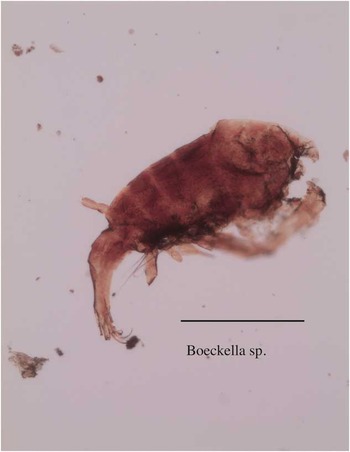
In addition to the above listed rotifers we recorded one complete specimen of the calanoid copepod (Fig. 3) plus the remains, assorted indistinguishable body parts, of a few others, presumably the same species. The complete specimen, a Boeckella (length 1.1 mm), was a juvenile thereby excluding the possibility for further taxonomic analysis beyond the genus level (Prof G. Boxshall, personal communication 2010). Several species of copepods are common on the sub-Antarctic islands, and the hitherto most southern recording of an adult copepod is at Prince Charles Mountains (71°S, Table II). Our recording of a Boeckella in Lake Hoare is the first time a sub-adult copepod has been recorded in freshwaters as far south as 77°S.
A juvenile specimen of the calanoid copepod Boeckella sp. from Lake Hoare, McMurdo Dry Valleys, Antarctica. Scale bar represents 500 μm. Picture: Jan-Erik Svensson.

The distribution of calanoid copepods in Antarctic and sub-Antarctic freshwater lakes from 46–77°S. References: Lake Hoare, this study (2010); Prince Charles Mountains, Bayly & Burton Reference Bayly and Burton1993; Mac. Robertson Land, Bayly et al. Reference Bayly, Gibson, Wagner and Swadling2003, Laybourn-Parry et al. Reference Laybourn-Parry, Madan, Marshall, Marchant and Wright2006; Bunger Hills, Bayly Reference Bayly1994, Bayly et al. Reference Bayly, Gibson, Wagner and Swadling2003; South Shetland Islands, Campos et al. Reference Campos, Arenas and Steffen1978, Paggi Reference Paggi1983, Janiec Reference Janiec1993; South Orkney Islands, Heywood Reference Heywood1970; South Georgia, Mrazek Reference Mrazek1892, Ekman Reference Ekman1905, Harding Reference Harding1941, Hessen et al. Reference Hessen, Sandoy and Ottesen1989, Dartnall Reference Dartnall2005b; Macquarie Island, Evans Reference Evans1970, Dartnall et al. Reference Dartnall, Hollwedel and Paggi2005; Heard Island, Bayly Reference Bayly1992, Dartnall Reference Dartnall1995a, Reference Dartnall2003, Reference Dartnall2006; Kerguelen, Brady Reference Brady1875, Brehm Reference Brehm1954, Smith & Sayers Reference Smith and Sayers1971, Gay Reference Gay1981, Reference Gay1982; Marion Island, Smith & Sayers Reference Smith and Sayers1971, Kok & Grobbelaar Reference Kok and Grobbelaar1978; Iles Crozets, Dreux Reference Dreux1970, Smith & Sayers Reference Smith and Sayers1971.

*denotes that the taxa is present in epishelf lakes at this location.
Discussion
Our data on zooplankton from Lake Hoare, combined with a literature review of the Antarctic and sub–Antarctic region, shows that the species-richness above c. 67°S declines to only one or a few species recorded (Table I). Hence, it is very surprising that the species-richness in Lake Hoare, situated at 77°S and the focus of our study, has a species-richness at the same level as the sub-Antarctic islands and that several cosmopolitan species are common components of the fauna in this lake (Table I). The presence of a relatively large number of planktonic species of rotifers and a calanoid copepod in Lake Hoare was a surprise and has never been reported before. Planktonic rotifers are not unknown from the Antarctic and sub-Antarctic islands (Table I), but they generally occur in small numbers. In total, 25 species of rotifers belonging to the Brachionidae family have been identified from the Antarctic and sub-Antarctic region (Table I), including a mixture of cosmopolitan and endemic species. Lepadella triptera, with its wide distribution (Segers Reference Segers2007) which has been recorded on the sub-Antarctic islands of South Georgia (Dartnall Reference Dartnall2005b), Marion Island (Smith & Dartnall, personal communication 2010), Iles Kerguelen (De Smet Reference De Smet2001), Heard Island (Dartnall Reference Dartnall2003), and Macquarie Island (Dartnall Reference Dartnall1993, Dartnall et al. Reference Dartnall, Hollwedel and Paggi2005), as well as on Signy Island in the Maritime Antarctic (Dartnall & Hollowday Reference Dartnall and Hollowday1985). Philodina alata is an Antarctic endemic species that was originally described from the McMurdo Sound area (Murray 1910) and has repeatedly been reported from there by Dougherty & Harris (1963) and Cathey et al. (1981). It has also been reported from both Bunger Hills and Obruchev Hills (Korotkevich 1958, Kutikova 1958b) and from Vestfold Hills (Dr John Gibson, personal communication 2006).
Generally the species-richness of Brachionidae declines with increasing latitude so it is puzzling that the species-richness in Lake Hoare (six rotifer species) is at the same level, or higher, than at the sub-Antarctic islands, which are situated more than 20° further north. Similarly, why does Lake Hoare plankton include four cosmopolitan species that have not been found elsewhere in Antarctica? The historical origin of the Antarctic fauna is discussed in depth by Convey et al. (Reference Convey, Gibson, Hillenbrand, Hodgson, Pugh, Smellie and Stevens2008). One possible explanation is that the rotifers found in our study have been there during evolutionary time, but that previous samplings were not designed to look for such low abundances. This is a possibility since only a few studies in these extreme habitats have focused on these organisms and they did not sample such large volumes of water as we did. Instead, the majority of previous studies have focused on phytoplankton, bacteria and biogeochemistry, although Roberts et al. (Reference Roberts, Priscu, Wolf, Lyons and Laybourn-Parry2004) noted low abundances of (unidentified) rotifers in Lake Hoare and Laybourn-Parry et al. (Reference Laybourn-Parry, Madan, Marshall, Marchant and Wright2006) found only the rotifer genus Philodina in the nearby Lake Fryxell. All the rotifer species we recorded in Lake Hoare were, however, also found in Lake Fryxell at relatively high abundances (0.05–400 individuals per litre, depending on taxa).
Another potential explanation is that the rotifers may have been temporally absent. Some rotifers have a periodicity of seven years (Dartnall Reference Dartnall2005a), which may have made them “invisible” to sampling over long periods. However, having six or more species in such synchronisation makes this explanation seem unlikely. Another possibility is that resting eggs have been cryo-preserved from the period before the drying out (several thousand years) and are now hatched. Although copepod resting eggs have been shown to be viable at least 332 years (Hairston et al. Reference Hairston, van Brunt and Kearns1995), this scenario seems very unlikely.
We also found one complete (Fig. 3), and several incomplete individuals of the copepod genus Boeckella, which is the first recording of a sub-adult crustacean at this high latitude, although Roberts et al. (Reference Roberts, Priscu, Wolf, Lyons and Laybourn-Parry2004) found copepod nauplii in Lake Joyce. These findings strengthen the conclusion that the distribution of this copepod genus has to be expanded another 6° further south than any previous freshwater copepod sightings.
Another question is how did the fauna get to the Dry Valleys and could they be recent introductions by either humans or birds (Green et al. Reference Green, Jenkins, Bell, Morris and Kingsford2008)? Arguments against this are that there are very strong restrictions for entering the area and very few people have been allowed to visit these lakes. However, these restrictions are relatively recent and introductions may have occurred before these rules were enacted. The harsh conditions, and the almost complete absence of birds, also reduces the possibility for invading species to enter the area and to establish this way. However, the possibility that these small animals have been unintentionally introduced by humans cannot be excluded. Another possibility is that resting eggs of rotifers have been transported by wind from other continents, a process that has been shown to transport pollen from South America to sub-Antarctic Islands (Marshall Reference Marshall1996). However, these islands lie far closer to another continent than the Dry Valleys and rotifer resting eggs are denser than pollen making this explanation very unlikely.
Could global climate change be a possible explanation? This hypothesis can be rejected since global warming does not appear to be affecting the Dry Valleys; instead there seems to be a net cooling in this region by 0.7°C per decade between 1986 and 2000 (Doran et al. Reference Doran, Priscu, Lyons, Walsh, Fountain, McKnight, Moorhead, Virginia, Wall, Clow, Fritsen, McKay and Parsons2002). Moreover, Fountain et al. (Reference Fountain, Nylen, MacClune and Dana2006) stated that the McMurdo Dry Valleys glaciers are in equilibrium with the current climate, and thereby contrast with glacial trends elsewhere on the Antarctic Peninsula and at temperate latitudes.
Hence, the most probable explanations are that either these rotifer species have been here during evolutionary time, but not previously recorded, or they have been relatively recently introduced. However, since they all seem to exist at all depths and in viable, albeit low, abundances, any introduction must have occurred some time ago. This notion is strengthened by the fact that the temperatures, and thereby growth rates, are low, suggesting that it would take a considerable time to establish a population that can be detected by sampling. Future genetic studies may provide an answer to whether or not these rotifer taxa have been present during evolutionary time or if they are recent introductions.
There is an ongoing, and long-lasting, discussion regarding whether or not microorganisms exhibit any biogeographical patterns or should we expect that “everything is everywhere” (Fenchel et al. Reference Fenchel, Esteban and Finlay1997, Finlay Reference Finlay2002). Although rotifers are generally considered to show biogeographical patterns, our results suggest that some cosmopolitan rotifer taxa are now present on this last continent suggesting that they approach the “everything is everywhere” distribution. Moreover, our study clearly shows that several rotifer species, and also the copepod Boeckella, are physiologically able to withstand and maintain viable populations in the harsh climate of the permanently ice-covered Dry Valleys lakes, which have been described as “end-members amongst the world's spectrum of limnological entities” (Fritsen & Priscu Reference Fritsen and Priscu1999).
Acknowledgements
Financial and logistic support for this study was provided by the Swedish Research Council (VR), the Swedish Antarctic Research Programme and the United States Antarctic Research Programme. D. Fontaneto and G. Boxshall kindly assisted with professional taxonomic guidance. We especially thank Addie Coyac at the US Antarctic Research Programme for valuable assistance throughout the field study. Two anonymous reviewers gave helpfully critical comments on an earlier version of the manuscript.