INTRODUCTION
This article addresses the role of stancetaking in performance in a minority language-planning event. In contexts of minority language revitalization, where the symbolic value of the language outstrips its everyday use, many public, promotional events have a performative character, portraying idealized forms of practice. Often, the models for the kinds of minority language use put on display are monolingual ones that contrast with the complex, plurilingual realities of the sociolinguistic context. Here, I focus on a sequence of stagings of Corsican language and culture during a three-day event in 2011 that included plurilingual, heteroglossic performances.
The event in question was the public launch of the first Casa di a Lingua ‘Language House’ on the island. Conceived of as part of a four-year language-planning program approved by the Corsican Regional Assembly in 2007, these ‘language houses’ are federations of local cultural associations charged with organizing activities and events featuring the Corsican language. The events of the language-themed weekend to be analyzed below included cooking demonstrations by local residents, a photo memory event narrated and emceed by a professional actor, and an amateur improvisational performance.
Given the current sociolinguistic context, where French is the dominant, unmarked code of both the public sphere and everyday communication, these events had multiple intended functions. They were designed to position the minority language as having a key, legitimate role in the public domain, as well as to model and incite its use in everyday, private-sphere contexts. As the 2007 language plan made explicit, Casa di a Lingua initiatives were also meant to propel Corsican language revitalization efforts out of their strongholds in official, institutional, educational domains, connect with a collective memory and understanding of Corsican as a language of community and heritage, and project the language into future contexts of use and value (see Perrino, this issue, for another language revitalization context). Implicit in these goals is a recognition of the tensions of identity created by the confluence of dominant ideologies of language and identity that posit a primordial, essential link between speaking a language and ‘authentic’ cultural membership and the success of Corsican language planning. In conditions of language shift, these tensions lead to both linguistic and cultural insecurity and ultimately work against increasing use and acquisition of Corsican. The Casa di Lingua mission was also informed by two language ideological positions adopted in the 2007 plan: (i) a ‘polynomic’ one that identifies multiple ‘right ways’ of speaking Corsican, and (ii) a ‘plurilingual repertoires’ perspective, which validates multiple levels and types of competencies across multiple languages (not just Corsican) spoken by individuals.
In this analysis, I mobilize the notion of stance to explore the ways in which humorous, playful heteroglossic stagings and improvisational performances reflect, engage with, and potentially mediate some of the tensions of Corsican language revitalization. In addition to appraising the extent to which these performances model a polynomic, plurilingual community of linguistic practice, I also consider how they may constitute a metalinguistic community, defined by shared reflexive orientations towards sociolinguistic practices. In doing so, I make an argument for the unique cultural and sociolinguistic functions of play, performance, and improvisation in situations of language shift.
STANCE, HETEROGLOSSIA, REENTEXTUALIZATION
Stance is offered here as a productive analytical frame to add to the Bakhtinian toolkit for the analysis of both the semiotic processes at work in these heteroglossic performances as well as for their sociolinguistic significance. In the final improvisational event analyzed below, ‘double-voicing’ captures the historical, interdiscursive links between the voices of the actors and the real people/figures they animate. As Bauman (Reference Bauman2005:146) writes, a ‘Bakhtinian framework offers us a discourse-centered way of elucidating and calibrating the terms, modes and degrees of mutual alignment and distancing in discourse and social relations’. The concept of the stance triangle (see Figure 1) adds the element of the stance object to the dynamic of alignment, which, as we see below, allows us to isolate multiple types and genres of such objects. Secondly, the stance triangle focuses attention on the constitutive role of the process of alignment: stancetaking does not just respond to, but also characterizes objects in particular ways. As Bauman points out (2005:149), Bakhtin and his circle devoted scant attention to performance, and did not theorize audiences. Here, stance provides a framework for the incorporation of audiences into the dynamics of signification. ‘The engagement of the audience’, Bauman writes, ‘of course reminds us that stancetaking is a reciprocal process’ (2011:712). By entering into performance, the performer inevitably invokes the complementary stance of the audience member (2011:712). Pushing this, and Bell's (Reference Bell1984, Reference Bell, Eckert and Rickford2001) notion of audience and design a step further, a focus on stance explores the processes through which performance is not only adapted to audiences, but how the reciprocal nature of performance also interpellates audiences as particular kinds of persons and collectivities.
The stance triangle.

Dubois defines stance as:
a public act by a social actor, achieved dialogically through overt communicative means (language, gesture, and other symbolic forms), through which social actors simultaneously evaluate objects, position subjects (themselves and others), and align with other subjects, with respect to any salient dimension of the sociocultural field. (Dubois Reference Dubois and Englebretson2007:163)
He uses the figure of the stance triangle (see Figure 1) to illustrate this process.
The dialogic dimension of stance captures the dynamic interplay between insider and outsider stances, voices, and representations that is central to the performance data under analysis. This can be seen in two focal, paired events. The first was what I call the ‘photo memory event’, where photos, collected from the members of a local cultural association and other archives documenting people and events from the last fifty years, were projected on a screen. These collective memories were presented in an interactive viewing of a slideshow by professional Italian actor and producer, Orlando Furioso, who has long been a central figure in the artistic life of the city. This event was followed by an improvisational performance in which the same photos were projected on a transparent screen and the actors animated the people and scenes depicted, both from behind the screen and sometimes in dialog with the pictures from in front of the screen. Both Orlando's presentation of the photos and the actors' improvisations based on them involved complex acts of stancetaking that positioned actors and audiences with respect to one another, and with respect to a number of stance objects: the collective past, cultural figures represented in the photos, and sociolinguistic indexicalities. In terms outlined in Jaffe (Reference Jaffe and Jaffe2009a), we thus have interpersonal stancetaking (speakers taking up a position towards their audiences/interlocutors) with respect to sociolinguistic, metasociolinguistic, and language ideological stance objects: types of speakers or personae, models of language, and how they are conventionally assumed to be connected (Jaffe Reference Jaffe and Jaffe2009a). A further perspective on stance developed in Jaffe (Reference Jaffe and Jaffe2009b) is crucial to my analysis of the implications of these performances for how audiences are positioned as sociolinguistic and cultural subjects. That is, the performance of stances by social actors ascribes or attributes paired or complementary stances to the stancetaker's interlocutors. Thus, stancetaking engages in processes of both individual and collective identity production that are relevant to minority-language contexts such as the Corsican one.
Heteroglossia is present at all three points of the stance triangle. Multiple voices and sociolinguistic types are evoked with the following range of sociolinguistic material deployed by speakers (S1): Corsican, French, fragments of English, Italian, as well as multiple accents used in the performance of the voices of locals (past and present), Continental French, and German and English tourists. Stance objects (O) are also multiple, layered, and multi-scalar, ranging from specific utterances, to multiple personae, to different levels of sociolinguistic indexicalities. Audiences (S2) are also diverse, addressed and positioned in a variety of ways through performance. And finally, there is the intrinsic heteroglossia of any performances of ‘other people's words’: all reported or performed speech is ‘double-voiced’. As Woolard, Bencomo, & Soler-Carbonell (Reference Woolard, Soler-Carbonell and Ribot Bencomo2014:135) points out, Bakhtin concludes that the ‘ultimate evaluative stance can be difficult to pin down’ for this kind of speech. Many analyses of comedic double-voiced performances (Woolard Reference Woolard and Heller1988; Jaffe Reference Jaffe2000; Chun Reference Chun2004; Jacobs-Huey Reference Jacobs-Huey2006, among others) have confirmed both the multilayered and ambiguous nature of such performances and the strategic indeterminacy offered to performers who can take up positions of both closeness and distance from the words and personae they enact (Jaffe Reference Jaffe2000; Jaffe & Walton Reference Jaffe, Walton, Thurlow and Mroszek2011). The indeterminacy of double-voiced comedic performance—for both performers and audiences—emerges as a critical tool in the creative mediation of language ideological tensions evoked above and described in detail in the next section.
The notion of stance also complements longstanding approaches to performance in yet another way. Both stance and performance highlight shared criteria of evaluation as the ground on which community is enacted. This is related to Bauman's key point that performers are ‘accountable’ to their audiences with reference to performance esthetics and by extension, to the sociocultural grounding of their art (Reference Bauman1977, Reference Bauman2000). That is, the notion of stance highlights the dynamic way in which evaluative frameworks function, tying speakers/performers and their interlocutors/audiences together in ways that can both reproduce traditional models of language, identity and society and, by laying them open to scrutiny, potentially create spaces for their transformation (Bauman Reference Bauman2000).
Below, I trace the stances that are inhabited and made available to audiences across four events, arranged in both chronological order and in order of increasing theatricality. I couple the use of stance with a focus on how the process of reentextualization (Bauman & Briggs Reference Bauman and Briggs1990) of memories and personae that takes place between the photo memory slideshow and the improvisational performance reformulates the affordances of the stance triangle, shifting the nature of the stance object and repositioning performers and audiences to it. These linked events put diverse audience members in dialog with the actors' interpretations and the social and sociolinguistic types they portray. I argue that in the movement from the slide show to the improvisational sketch, the reentextualization by an intimate outsider (Orlando Furioso) of semiotic resources (the photos) and their surrounding practices from the intimate group to the public sphere offers and dramatically heightens for the audience a stance of intimacy with the Corsican language as a traditional form of heritage while simultaneously legitimating new uses and relationships with the language that break with conventional language revitalization goals of producing new, ‘fully competent’ ‘native speakers’. In the analysis of the performance events, I also examine the way that stancetaking and reentextualization create links between the staged uses of Corsican and the everyday practices that the event is intended to influence. This exploration of the linguistic and social ideologies embedded in these performances and practices, as well as in the participation frameworks—and positionalities—they create for audiences, has to be understood with respect to the current sociolinguistic context and the history of language shift and revitalization on the island. In the next section, I provide a brief sociolinguistic overview that both frames the specific ethnographic data that follows and contextualizes a discussion of the specific kinds of stancetaking explored in this material.
SOCIOLINGUISTIC CONTEXT: LANGUAGE IDEOLOGICAL CURRENTS AND TENSIONS
Corsica has experienced a sharp decline in the number of minority-language speakers—glossed as ‘language shift’—as well as a language revitalization movement that has gained momentum over the last three decades. Language shift from Corsican to French took place fairly rapidly in the period between 1920 and 1960. Schools were powerful vectors of sociolinguistic change, both with the language ideologies they conveyed and the opportunities they offered. Like schoolchildren in other minority-speaking regions of France, Corsican schoolchildren were taught that French was the language of superior reason, elegance, moral, and civic virtue, and that the minority language was a worthless ‘patois’ (Jaffe Reference Jaffe1999). French was also a genuine tool of upward mobility and many Corsicans learned French and joined the civil and colonial services in droves, living and working on the mainland and in the French colonies. There, many of them met and married non-Corsicans and lived and worked primarily in French. Both on and off the island, French started replacing Corsican as the dominant language of young people, to such an extent that by the mid 1960s, many young Corsicans either did not speak it or did not speak it well. It was starting at this moment—in the context of social movements across Europe—that young Corsican intellectuals began to frame this language shift as ‘loss’ and to militate for the defense and promotion of the Corsican language. The primary arena in which this promotion has made gains is in the sphere of education, where the general primary school curriculum today includes three hours a week of Corsican and approximately 20% of schoolchildren are enrolled in Corsican-French bilingual programs. Corsican is also a subject and medium of instruction in secondary and university education.
Corsican language activism has reproduced several dominant, French language ideologies that defined the sociocultural and political fields in which the defense and promotion of Corsican took place. The first is an ideology of language as a bounded, homogenous formal code. In this framework ‘legitimate speakers’ are defined as having ‘full linguistic competence’ of a ‘pure’ or traditional variety. Early Corsican language activists also reproduced the monolingual ideology (one language = one people) associated with nineteenth-century nationalist discourse and French language policy. Finally, the principle that there is an essential, primordial link between a language and a culture is also an ideological position (see Jaffe Reference Jaffe1999).
As I have documented in a variety of analyses (see e.g. 1993, 2013), there is a disjuncture between these idealized monolingual models of ‘full’ competence, ‘authentic’ speech, and the mixed kinds and levels of competence and practice that characterize the contemporary Corsican sociolinguistic situation. As suggested above, this translates into a profound tension at the level of individual and collective experience, where not speaking Corsican, or not speaking it ‘fully’ or ‘well’, can be experienced as a form of cultural delegitimation (Jaffe Reference Jaffe1993, Reference Jaffe2013). At the same time, the last thirty years have also seen the emergence of discourses and practices that are defined in contrast to dominant language ideologies. They are an effort to mediate ideological tensions related to legitimate linguistic ownership and embrace plurilingual, heteroglossic, practice-based ways of looking at the role of language in acts of identification.
Two such ideological frameworks have been formally mobilized in Corsica. The first is the notion of ‘polynomy’ coined by the French sociolinguist Marcellesi. He defines a polynomic language as:
A language with an abstract unity, which users recognize in multiple modes of existence, all of which are equally tolerated and are not distinguished hierarchically or by functional specialization. It is accompanied by tolerance of phonological and morphological variation by users, who also view lexical diversity as a form of richness… [This abstract unity] comes out of a dialectic movement whose existence is based on the massive affirmation by its speakers to give it a specific name and to declare its autonomy from other recognized languages. (Marcellesi Reference Marcellesi and Ravis-Giordani1989:170, my translation)
Of interest in the context of the current analysis of heteroglossic improvisational performance is that the ‘abstract unity’ of a polynomic language is not so much linguistic as social: it is the community that applies the label of ‘language’ to a set of linguistic practices that can include ‘multiple modes of existence’. This approach is thus a significant break from the dominant, formal, monolingual ideology of language evoked above (see Jaffe Reference Jaffe, Duchêne and Heller2007).
The second ideological framework is the concept of ‘plurilingual citizenship’, promoted by the Council of Europe and incorporated into Corsican language-planning documents.
Plurilingual citizenship represents yet another shift away from a monolingual ideological frame for Corsican language promotion. The following excerpt from the 2005 report of a Corsican Special Committee on language links the concept of plurilingual citizenship with a shift away from the ‘purely local’ to wider, European contexts and ‘exchange value’.
The building of Europe, globalization of exchanges, tourism, shifts in population, the mixing of urban populations all lead us to shift our conceptions of language and identity from the purely local and ancestral to values of exchange and openness in all of the following: cases concerning the learning of the language by new residents, cases of contact with other languages, recognition of a Mediterranean and a European identity, cultural exchanges or the economic valorization of cultural specificity (labels, ‘identity’ products, tourism…). (Assemblée de Corse 2005, my translation)
We can also note references to heterogeneous, plurilingual repertoires that include contact (not monolingual) varieties. In the 2007 language-planning document that established the language houses, bilingualism is represented as ‘reconcil[ing] the Corsican community with its language and allow[ing] it to move definitively beyond a conflictual historical relationship with French’, and plurilingualism is represented as ‘giv[ing] all people the chance to develop their own linguistic repertoires in accordance with their own goals and needs, whether they relate to their [cultural] origins or to other aspirations’ (Collectivité Territorial de Corse 2007, my translation).
In summary, contemporary Corsican language planning is articulated at the nexus of two ideological movements: an ‘older’, traditional conceptualization of Corsican as a language of primordial heritage (the community still has ‘its language’, in the above text) and a ‘newer’, polynomic, plurilingual conceptualization in which Corsican is a key, but not sole element, in a heterogeneous linguistic and cultural repertoire linked both to local, traditional cultural heritage and to personal and wider (regional/European/global) identity aspirations.
CASE DI A LINGUA: ‘LANGUAGE HOUSES’
Here we turn to the 2011 language-planning weekend. As mentioned in the introduction, the Case di a Lingua are virtual rather than material; they are federations of cultural and linguistic associations and structures in different Corsican microregions established in a five-year master plan for the Corsican language by the Corsican Territorial Collectivity (CTC). In that master plan, the general objectives of the Case di a Lingua were described as facilitating the local enactment of language policy, energizing existing initiatives, while creating and coordinating a network of cultural actors working on behalf of the Corsican language in both microregional and regional contexts. These general objectives reflected a push to bring language promotion into the ‘everyday’ and to expand language promotion beyond the schools and other institutional contexts. The text of the Case di a Lingua mission statement also identified a number of specific initiatives and goals that included encouraging relationships and interactions between Corsican learners and Corsican speakers (linguistic ‘godparents’, multigenerational activities, festivities), acting as an intermediary for activities and events organized around the Corsican language and around the theme of plurilingualism, and making Corsican language visible and creating spaces for the privileged use of Corsican.
These goals indirectly index several features and tensions in the current sociolinguistic context. First, the stated commitment to create Corsican-language speaking spaces shows that those spaces are scarce; second, the focus on creating new intergenerational communities of Corsican language practice that include proficient speakers and learners reveals that this is not happening on its own. Finally, there is the reference to plurilingualism, which we recognize as an overt response to the monolingual bias of much of the history of Corsican language-planning efforts.
PAROLLE OFFERTE: WORDS GIVEN
The November 2011 event planned by the Casa di a Lingua of the Balagne region of Corsica was titled Parolle Offerte ‘words given’. The text of the overview/introduction to the event published in the local newspaper (below) echoes the orientations of the mission statement above. It frames the event as fundamentally performative and compensatory with respect to everyday sociolinguistic practices and relationships, normative language ideologies, and ways in which language activism has been conducted in the past.
In these three days, workshops, encounters and exchanges around different themes discussed in lingua nustrale [‘our language’] will allow people to use Corsican while enjoying themselves. “The objective is multilingualism,” remarked Toni Casalonga of the Voce Cultural Center. “All languages are thus welcome.” If Corsican speakers are essential for these events, especially to help to enrich others' vocabularies, no one should have any reticences or hang-ups. People who use Corsican very little or who don't speak it are also invited to participate. Because the goal is to share the richness of the language and culture of the island. Not to promote a closed elite group. And the organizers all agree that “We need to get rid of people's inhibitions with respect to the language”. Too many people in Corsica do not dare to use it for fear of ‘speaking badly’, of making mistakes, of using inappropriate terms. “Why is that? Do you only socialize with people who speak a perfect French?” is the pointed question asked by Dominique Bianconi of the Svegliu Calvese [cultural group]. Point well taken. “Through play, I am sure that people will speak Corsican,” remarked Serges Lipszyc, director of l'Aria [Theater Center]. An open approach that—these local actors hope—will be followed by numerous other events. To tackle Corsican through interaction. And encounter. (Corse-Matin, Nov. 7, 2011, my translation)
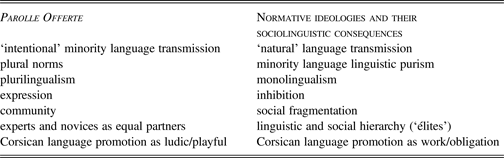
Table 1 depicts the oppositions between the Parolle Offerte event and the everyday sociolinguistic reality mobilized in the newspaper article.
Oppositions indexed by compensatory frame of Parolle Offerte.
First, with respect to the title of the event, we can note the portrayal of Corsican as a gift from expert speakers to novices. This stands in implicit contrast with the ‘natural’ intergenerational transmission of Corsican that is no longer taking place. The event frame thus counters dominant heritage language ideologies of Corsican as the ‘natural’ ‘Mother Tongue’ of Corsicans (see Jaffe Reference Jaffe1999), signaling a shift from static models of identity to intentional acts of identification.
Other notable themes in the newspaper article include the explicit naming of Corsicans' insecurities and reticence about speaking in Corsican and the series of remedies provided by Parolle Offerte. These include an emphasis on play and pleasure and on exchange among equals in a community that includes languages other than Corsican. This occurs within a frame that legitimates participation by nonspeakers, novice speakers, and experts. All of these ‘remedies’ point to some of the unintended consequences of minority language activism that I have documented on Corsica over the years, that is, that activism can create new forms of linguistic and social hierarchies and inhibit rather than encourage more use of Corsican (Jaffe Reference Jaffe1993, Reference Jaffe2013).
Since Parolle Offerte unfolded over the course of a weekend, I trace across a sequence of subevents how language was thematized and subject to increasing levels of performative entextualizations, culminating in the focal improvisation. I begin with the least staged and reflexive: a hands-on baking event that took place on a terrace outside a restaurant in a small village called Pigna. While intended for children, it also functioned as a recipe exchange for adults. The organizers both guided the children's participation and explained their recipes to other onlooking adults. In the following transcript of a brief segment of this interaction, Woman 1 (W1) moves from overseeing several children at one end of a long table as they mix ingredients into a dough to a position at the other end of the table where she interacts with Woman 2 (W2) and the adult participants, one of whom (A1) asks a question.
(1) Outdoor cookie-making activityFootnote 1

What is going on here in is normal practice: an adult (Woman 1) addresses the children in French and the children use French exclusively. Both she and Woman 2, another organizer, speak both French and Corsican to one another and to the assembled audience of recipe-takers. Though the cooking and recipe sharing is not taking place in a private kitchen, it is in a small village where many people know each other. In the context of my own ethnographic experiences, this event is what could take place in a private kitchen writ large, entextualized as a cooking demo.
As I watched this event, the outside patio filled up with more members of the local associations involved in the Casa di a Lingua. Speaking exclusively in Corsican, some of these new arrivals began to mutter that the demo was not in Corsican, and eventually, there were one or two louder requests: parlate corsu! ‘speak Corsican!’ These calls resulted in Woman 1 making some additional switches to Corsican, but they did not result in the activity switching to monolingual Corsican. In short, the women who led the demonstration only minimally recontextualized cooking talk and recipe demonstrations as stagings of language in keeping with the Corsican-language agenda of the Casa di a Lingua (exemplified in the calls of some of the late arrivals to speak Corsican). In the relatively intimate context of the village and the small crowd, interactions were more ‘everyday’ than they were performances. The event also illustrates a tension between the compensatory role of these events—to create Corsican-language speaking spaces, and the plurilingual ideology of the Case di a Lingua. In this context, the only ‘other’ language is the traditional, dominant partner, French. Given sociolinguistic habits on Corsica, giving people free rein to speak any combination of languages from their repertoires simply reproduces the everyday conditions in which Corsican is a minority code. Thus the Pigna event shows that the goal of inserting Corsican as a significant part of a plurilingual repertoire into the everyday does not happen naturally. In the next event, this recognition led to a more self-conscious set of language practices and heightened staging of language choice and use.
COOKING AGAIN: INCREASED STAGING
The next event took place two days later in Calvi, a small town close to the village of Pigna. Here, the demonstrations were maximally staged by the Italian cultural figure, Orlando Furioso. A Sicilian writer, actor, and director who has lived on Corsica for over thirty years, he is a central figure in both the local theater and cultural scene in this region and in the Corsican mediascape as a whole, appearing in both plays and on television. In addition to the place he has made for himself in the cultural life of the island, it is important to recognize the linguistic and cultural intimacy he enjoys on the island on the basis of both his Italian and Sicilian origins. Italian is Corsican's closest linguistic partner, and there is a significant degree of intercomprehension between the two languages. As a speaker of a marked variety (dialetto) of Italian, Orlando also shares with Corsicans a position of being a distinctive linguistic and cultural minority within a nation-state.
In the cooking event in Calvi, Orlando ushered a group of children around a community center where professional chefs and amateur cooks were preparing traditional foods. The professional chefs narrated their own demos, and the intent was probably for the local women to do so as well, but as in Pigna, these women were not fully ‘on board’ with the linguistic mise-en-scène and often said very little at all. In the following transcript, we join Orlando as he oversees both the elderly woman chef who is making her own batter and the children who, as in the previous event, are getting to try their hand at mixing. His chef remains completely silent, but Orlando provides a spirited narration of the action.
(2) Dramatic recipe narration
Orlando's patter serves several functions. First, it makes the mundane activity of assembling, weighing, and stirring ingredients into a performance. With respect to the theme of Parolle Offerte, it also offers Corsican as a vehicle for the experience of the children, the local chef, and the many adults watching (and filming) what was going on. That is, it creates a Corsican-speaking space where the key participants (the children and older chef) had not, and might well have not spontaneously created it themselves. It also creates an alignment of the culinary activity and the Corsican language as authentic signs of Corsicanness.
By reframing the cooking event as a performance, Orlando ratifies his status as entertainer and therefore asserts his legitimacy to participate in the event. At the same time, he transfers some of that legitimacy to his audience. That is, Orlando's narration engages both the children and his local chef as participants as he simultaneously speaks about and for them. Both are discursively incorporated into a performance of Corsican, aligned with a collective voice, spoken by Orlando. Orlando's linguistic stance thus confers a paired, complementary one to other participants. The children, by being spoken to, are also positioned as competent hearers of the language. Performance—and this specific performer—thus play a signal role in this event as it contrasts with the cookie event in Pigna. Through artful performance, Orlando lifts this event out of the everyday Corsican sociolinguistic context, in which speaking Corsican is either not thematized (and does not happen regularly) or is framed as a litmus test of authenticity that excludes some practices and participants. At the same time, the ‘homeliness’ of the recipes, the presence of community members lends an ‘everyday’ quality to the event. In short, both the Calvi and the Pigna cooking events combine performance and the everyday, but in inverse quantities. Corsican, as a language that has become a stance object, emerges as a language whose current and projected vitality exists at the nexus of the staged and the mundane.
PHOTO SLIDESHOW: NARRATING OTHERS' COLLECTIVE PAST
The next event segment under analysis took place later on the same day as the cooking event, in the same community center, also emceed by Orlando. The lights were dimmed and a Powerpoint slideshow of photos collected by a local cultural group from personal and newspaper archives was projected on the wall. The photos showed the life of the community, including pictures from different eras, some in people's homes, and some in public places. The audience included many elderly people, some of whom were depicted in their youth in the projected photos. It was a very interactive and noisy event; each photo the occasion for loud commentary from the audience. As he did in the cooking demo, Orlando actively scaffolded audience participation. In contrast to the previous example, however, he conferred a stance of authentic ownership on that audience by occupying a different role from them with respect to the depicted photos.
The brief transcript below opens as Orlando shows a photo of a social event, asking ‘Where's this party?, and continues with him going into the crowd to find Gracieuse, an old lady shown some thirty years before in the photo, and getting her to stand up in front of the screen. The transcript should be read with a mental image of a boisterous response from the crowd, a great deal of overlapping speech, and a generally festive atmosphere.
(3) Finding Gracieuse
This brief segment illustrates Orlando's unique, multidimensional positionality with respect to this group of people. He is at once stage manager, intimate stranger, and sympathetic witness to their memories. This position, at the interstice of ‘inside’ and ‘outside’, allows him to create the conditions in which the audience exercises agency (in the form of noisy dialog among themselves and with Orlando) in the staging of themselves. This agency includes linguistic choice. Orlando's framing of the event in Corsican is met with both French (seen in the extract above) and Corsican (not seen above) audience participation. The event was a fully bilingual one that did not leave any room for calls to ‘speak Corsican’, as we saw in Pigna, because its bilingualism was integrated into Orlando's skilled performance. Orlando's consciousness of his position as a performer and insider/outsider and their affordances for Corsican language promotion is made more explicit in the next segment, where he introduces the sketches to be performed by a local actors' troupe using the very same photos as prompts and visual backdrops.
In the introduction to this event, Orlando underscored its ludic, lighthearted nature. He said the group of actors ‘didn't even know if it would work’ and asked for the audience's indulgence if it seemed that they were laughing at anyone known to the audience in the photos. In (4) below, he makes the connection between representational play and linguistic play, retrospectively characterizing the whole day's events as having been about ‘playing around’ with the Corsican language. He then presents his own way of speaking as the perfect exemplar of that play. This idiolect—which people who knew him well called ‘Orlandese’ or ‘Orlandish’—was his own particular blend of Corsican, French, and Italian (with possible influences from his native Sicilian). In the transcript below, the Italian/Sicilian elements are represented in bold italics, though the proximity of Corsican, Italian, and Sicilian create some bi- or multivalent utterances that cannot always be definitively assigned to a single language. These are noted textually.
(4) Introduction of photo improvisation in ‘Orlandese’
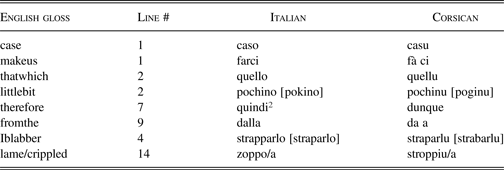
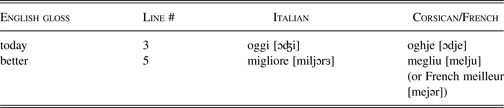
In this transcript, there is a close coordination of plurilingual, hybrid linguistic form and Orlando's advocacy of playful and creative uses of Corsican that do not hew closely to standard language ideologies. Table 2 lists, in the middle column, the Italian words used by Orlando in the segment, contrasted with their Corsican equivalents in the right hand column. Table 3 identifies two pronunciations that do not permit them to be assigned definitively to either Corsican, Italian, or (in the case of ‘best’) French. Table 4 illustrates the deliberate language play Orlando engages in on line 14 with the words for ‘soup’ and ‘lame’.
Orlando's use of Italian in (4).
Bivalent or ambiguous usage in (4).
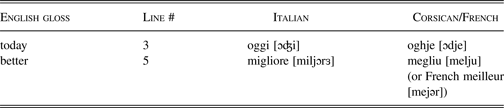
Deliberate language play in (4).

In this sequence, Orlando both claims and performs his mixed code as participating in a Corsican-speaking world. He offers it up as an example to show that if he can happily mangle Corsican, ‘anyone can speak’. Notice that he doesn't say ‘it’ (line 6)—there is no single, named language or code—what he evokes is the verb—parlate, parlate puru ‘speak, go ahead and speak’. Language boundaries, in this frame, are not presented as critical identity boundaries. Rather, they are mobilized as resources for playful, creative expressions in an example of what Makoni & Pennycook (Reference Makoni, Pennycook, Makoni and Pennycook2006) refer to as the ‘disinvention’ of language. One example of this is Orlando's play around the word ‘soup’, which he pronounces zuppa twice (which could be Corsican or Italian), seemingly savoring the word before he plays with the sound and transforms it into the Italian word for ‘crippled’ or ‘limping’—zoppa on line 14, an utterance that has no sense other than its phonetic resonance. Performance, in this case, provides a forum for ideological critique of unitary perspectives on language, at the same time as esthetic pleasure is thematized and linked to mixed practice. The voice of the sympathetic outsider/insider—Orlando—in Corsican is proposed as a legitimate one with which Corsicans who are ‘imperfect’ speakers can align.
IMPROVISED SKETCHES
Following Orlando's playful, heteroglossic framing, we turn now to the photo improvisation itself, where the mix of voices is even more dramatic. A selection of the photographs from the slideshow was projected onto a transparent mesh screen from a distance that rendered their human images at a more or less life-sized scale. From behind the screen, the actors, whose silhouettes were visible, improvised lines that animated the people depicted in the pictures; they also came around in front of the screen and engaged in dialog with and about the people on the screen. In some cases (see (5) starting on line 31 below) the front-of-screen location was staged as being an extension of the scene in the photo, in this case, establishing the actors as onlookers to a depicted event. We can immediately note the complex, multilayered, and heteroglossic nature of the actors' performed relationships to the figures in the pictures—variously as their shadow inhabitants or as other, embodied characters defined in contrast and sometimes (as we see below) disalignment with them. This complex participant framework dramatizes the fragmentation of participant roles and effectively makes stancetaking a central element of the performance and its humor. It also blurs the lines between participant roles: that is, there is not always a straightforward answer to the question of whether the actors are speaking as themselves or as performed characters in their commentary about the characters depicted on the screen. The following transcript comes from the first photo sketch performed. In the picture shown on the screen, there is a group of people sitting outside a restaurant holding a sign and smiling broadly for the purpose of the picture-taking event. The sign depicts a large fish (presumably a specialty of the restaurant) captioned with hand-painted, large block letters that reads ENTRAMI IN CULIS ‘fuck me’. The term itself is a form of language play: the -is ending has been tacked on to the word culu in the Corsican expression Entrami in culu in a form of mock Latin. The actors portray the figures in the picture as tourists by animating them in British, German, and Continental/Parisian French accents (these accents are the basis for how they are labeled below). In other words, all of the French spoken in the sketch deviates from normative Corsican pronunciations.
(5) Rude fish (bold=English; bold underlined italics = German sounding)
Here, we return to the stance triangle to explore the cultural and sociolinguistic dynamic introduced by the tourists as stance objects for both the characters performed by the actors in the sketch and the audience watching it.
Tourists are, of course, quintessential outsiders and consumers of local authenticity. This is particularly salient in the region where the sketch was performed, as it is one of the most heavily frequented tourist destinations on the island. The tourists are also ‘othered’ by their use of the rude expression Entrami in culis as though it were the name of the fish they enjoyed at the restaurant: they are figured as victims of a Corsican linguistic joke, perpetrated by restaurant staff at their expense. The joke is heightened by the German tourist's mispronunciation of the word on line 12. The tourists' outsider status is further established by the movement of some of the actors—now speaking Corsican, the code the tourists do not understand—from behind to in front of the screen to a location that is staged as across the street, the vantage point of the camera's viewfinder. Thus Corsican is both implicated as one of the codes in the ‘bad language’ the tourists misappropriate and as the language in which they are directly mocked. It is also the language that insulates the Corsican-speaking personae (and by extension, the actors and audience) from sharing with the tourist personae ‘having an accent in French’—and having that accent appropriated for humorous purpose. We can also note that ‘having an accent in English’ is not thematized or problematized: though the actors' pronunciations of ‘very’ and ‘cheese’ are not ‘native’ their only purpose in the performance is to further mark the national identities of the personae. In the French mediascape, a Corsican accent is subject to such appropriations. Finally, an ‘authentic’ Corsican product—acquavita—is depicted as being responsible for getting the tourists drunk, which results in them being characterized as speaking ‘nonsense’.
To summarize, the ‘outsiderness’ of the tourists as stance objects reciprocally creates and enhances the ‘insiderness’ of the Corsican-speaking characters in the sketch and the audience who is watching. It is through this process that the audience is recruited to the ‘authentic’ linguistic and cultural insider stances performed by the actors in the improvisation. In addition, both audience and actors are positioned as sociolinguistically sophisticated reflexive subjects. From a linguistic standpoint, the audience's comprehension of Corsican is presupposed by the focal phrase entrami in culis; knowledge of Corsican is also required for full comprehension of the last part of the sketch, which is spoken in Corsican alone. Corsican is also bundled as a linguistic medium of alignment with the actors' physical alignment with the audience when they come around to the front of the screen and with their mocking of the tourists (lines 38–42.)
Stance triangle 1: Insiderness.
In addition to this relatively transparent co-construction of ‘insider-outsider’ positions, the dynamic, mediating role played by Orlando in the lead-up to the improvisation also has implications for issues of affect and intimacy as they relate to the Corsican language. This is depicted in Figure 3.
Stance triangle 2: Primary and secondary intimacy.
That is, in the photo memory part of the afternoon, we see Orlando taking up—and performing—an affective stance of secondary intimacy with the photos. He owns this stance by long association and participation in the life of the community, but they are not ‘his’ specific memories. This stance both derives from and constitutes the older audience members' affective stance of primary intimacy relative to those photos. Orlando also stages both his and the older audience members' stances in front of an audience that is diverse in age, knowledge of the photos, and Corsican language competence. In effect, the staging of these memories simultaneously projects and ‘scales up’ intimacy from a personal to a collective level. Heritage—as shared memory—is thus dramatized as both something that a group has, and as something that can be shared beyond the confines of the group, exemplified in the person of Orlando and projected onto the audience as a whole.
IMPLICATIONS: IDEOLOGICAL TENSIONS AND SHIFT INORSICAN LANGUAGE PLANNING
In this final section, I explore the implications of the events and performances analyzed above with respect to the way the Parolle Offerte event as a whole responded to ideological and social tensions associated with Corsican language planning. One of the goals of the language houses and the weekend as a whole was to create an inclusive model of community relative to Corsican that incorporated multiple languages (plurilingualism) and both novice and expert Corsican speakers and learners.
Here we return to the photo memory event. In it, Orlando's use of Corsican is the vehicle for the reentextualization of the photos as collective heritage. Like the photos, Corsican is a form of heritage that is ‘fully owned’ by some, but not all of the people present in the audience. However, it is portrayed as shared/collective and learnable by anyone who wants to experience a particular kind of belonging, embodied in Orlando. The slideshow event thus presents and legitimates two affective stances to the photo memories and by extension, to the Corsican language: one traditional, ‘given’ and ‘primary’; the other ‘secondary’, acquired and accessible through apprenticeship. This dual stance is consistent with the mission of the Case di a Lingua, and aligns with contemporary models of language planning and language learning as intentional rather than ‘natural’ (essential) or inherited (see Table 1). This event was also a bilingual one: Corsican is not represented as the exclusive language of participation or membership. It thus mitigates the linguistic and cultural insecurities created in a context where language shift has diminished knowledge of the language and language revitalization has given it a surfeit of symbolic and cultural value.
The improvisational performance also establishes grounds for the experience of community related to Corsican as a sociolinguistic resource. This takes place when the photos are used as the backdrop for improvisation, shifting in their nature as stance objects. Originally artifacts of real memories, they are reentextualized as prompts. Orlando's advance apology for any perceived irreverence in this redeployment of the pictures acknowledges (and thus interactionally constitutes) the primary intimacies that some audience members had with the photos while simultaneously reframing them as common resources as opposed to personal memories. As common resources, then, they have an inclusive function, positioning the wider audience (which includes many people who have no primary connection to the photos) not as ‘secondary’ to the ‘owners’ but as occupying a shared position taken up in response to the performer's enacted stances to the people who are depicted in the photos. In some cases, this involves the shared insiderness of opposition to tourists; in other sketches (which are not examined here due to space constraints) it involves shared insider knowledge of familiar local types such as fisherman and shepherds, Corsicans returning from the French continent, and their discursive and linguistic practices.
In this second reentextualization of the photos, then, all of the people depicted in them are transformed from ‘real’ people with local histories and identities to figures or personae who are reperformed as recognizable types. Thus in addition to Bell & Gibson's observation about the important role played by mediated performances ‘in associating linguistic resources with various characterological figures’ (2011:558), this example shows that the shared recognition of those types and the linguistic forms (accents, propositional content, etc.) that conventionally index them—that is, metapragmatic awareness—is the currency of intimacy and identity invoked by the metasociolinguistic stancetaking of the performance. This metasociolinguistic stance is simultaneously a language ideological one, because it implicitly proposes metapragmatic knowledge related to Corsican as one of the ‘guises’ (in Marcellesi's terms) that can be recognized by the collectivity in a polynomic perspective. In other words, in contrast to language planning organized around purely linguistic definitions of ‘speech community’, this event incorporates a sociolinguistic perspective.
The more general significance of this ‘meta’ dimension in minority language contexts can be understood in light of Bauman's comments about the reflexivity and performance in the analysis of identity:
Verbal performances, then, turn out to be reflexive in several dimensions; not only are they linguistic forms about language, but also cultural forms about culture, social forms about society. Such performances, then, represent for participants an arena for the display, contemplation, and manipulation of salient elements, practices, and relationships that allow language to serve as a resource for the expression of identity. (Bauman Reference Bauman2000:5)
I would argue that the reflexivity highlighted by Bauman is not just a property of performance, but is also an inherent property of the contemporary sociolinguistic circumstances of Corsican and other minority languages. These circumstances have removed those languages from the everyday, unreflexive fabric of daily interaction and made them into stance objects. In other words, their identity functions have an inherently reflexive, ‘meta’ quality. The issue, in minority language planning, is precisely establishing the grounds (the nature of language, the nature of community) on which language will be valued and used. In this respect, the reflexive dimensions of performance are not just windows on or vehicles for the expression of identity, but rather are homologous with the forms of identification related to minority languages. That is, those forms of identification are most often self-conscious acts of stancetaking—deliberate choices to perform and inhabit a linguistic identity other than a dominant one.
The specific performances in question also put forward a corollary to this perspective: that their heteroglossic nature also has a homologous, or iconic relationship with the Corsican sociolinguistic context. That is, the heteroglossia of the performances we have seen is not bracketed as a special feature of performance, but is generalized beyond the performance/language-planning event as a feature of both individual and collective identity and practice in everyday contexts. This is the implicit claim made by Orlando in his introduction to the improvisation. One vehicle for this generalization beyond the performance is the person of Orlando as performer and community member. As the reference to ‘Orlandese’ above indicates, Orlando's use of mixed codes and ‘imperfect’ Corsican was part of his habitual speech practice off as well as onstage. This is not to say that Orlando never assumes a monolingual voice, but that that in both his public/professional and more informal interactions, he consistently assumes a plurilingual one. Nor do his performances hinge around a contrast between a ‘standard/monolingual’ and ‘nonstandard/hybrid’ ways of speaking; thus he does not dramatize (and thereby valorize) his control of monolingual ‘standard’ language. Thus when he tells the audience that they too can ‘babble on’ in an imperfect Corsican, he is both speaking in his role of MC and indexing everyday contexts of use and shared, community criteria of evaluation that apply to them. His insiderness, then, is invoked as a warrant for his invitation to the audience to align with heteroglossic, plurilingual perspectives on language and to reject monolingual, purist language ideologies.Footnote 4
Another vehicle for the generalization of a heteroglossic framework beyond the performance event is improvisation and the nature and intensity of the kinds of alignments improvisational actors take up with respect to the personae they perform and the language that they use to perform them. In fully scripted performances, actors are animators of the authors' words; in improvisation, they are also authors. Whereas the fragmentation of participant roles introduces the possibility of greater distance or insulation from reported or performed speech (see Irvine Reference Irvine, Silverstein and Urban1996), the fusion of participant roles (here, authorship + animation) does the opposite, foregrounding the potential for ‘leakage’ (Hill & Irvine Reference Hill, Irvine, Hill and Irvine1993) of reported/performed speech onto the speaker. This leakage ‘distributes responsibility’ (Hill & Irvine Reference Hill, Irvine, Hill and Irvine1993:13) for the reported speech across the original and quoting speaker. In the case of the improvisational sketches, the actors' improvisations cannot be solely attributed to the figures they animate. They thus share some of the qualities of Orlando's introduction to their performance by suggesting a potential alignment between those actors' professional (stage) and personal stances. This in turn frames audience alignment as implicating audience members both in their immediate roles as viewers of the sketches and in their lives outside the event.
The nature and trajectory of the photos themselves (between the ‘private/individual’ and the ‘public/collective’) also materializes and exemplifies the porous boundaries (and thus the interconnection) between performance and the everyday. With respect to time, the photos play an important role in linking the Corsican-speaking past and the present context of language revitalization. The past is honored, as a source of shared identity and value, but it is also creatively appropriated for playful contemporary purposes. Orlando's effort to deflect any possible offense (apologizing in advance) related to this humorous appropriation reflects the delicacy of coordinating the competing, co-present language ideological orientations in contemporary Corsican society.
The significance of the bridging of the performative and the everyday relates to the mission of the Case di a Lingua and to the compensatory orientation of Parolle Offerte (depicted in Table 1). The Case di a Lingua were intended to bring language planning out of the official, institutional, academic spheres and to make Corsican relevant in more than a symbolic fashion in people's lives. Given that performance is understood as a form of orchestrated action that is by definition distinct from everyday practice, if the events of the Parolle Offerte weekend had remained ‘purely’ performance, that relevance might have been tenuous. This kind of gap between Corsican language displays and habitual communicative practice is a very familiar feature of school plays and festivals, where children produce rehearsed Corsican language performances that are not, and are not taken as indices of communicative competence in the language. Thus, along with the performative validation of the diverse audience's affective relationship with the language, the bridging of the performative and the everyday embedded in the events analyzed here can be seen as the mechanism through which the compensatory functions of the Parolle Offerte weekend can be realized.
The contrast between the Pigna cookie-baking event and the ones that took place in the Calvi community center also highlights the role of intentionality, craft, and expertise in performance as it serves language-planning objectives. As we have seen, the creative mediation of ideological tensions in Corsican language promotion did not happen ‘naturally’ in the Pigna event and would not have done so in the Calvi cooking and photo events without Orlando's narrative and dramatic expertise. Just as language learning in contexts of language shift has to be intentional, so too does language use. The bridging of the performative and everyday in the Calvi events and performances also disrupts some foundational ideologies of sociolinguistic authenticity, which are based on a rigid opposition between ‘real/natural’ speech and any form of language practice understood to be designed, intentional, or ‘prompted’ (Bucholtz Reference Bucholtz2003; Coupland Reference Coupland2003; Bell & Gibson Reference Bell and Gibson2011). This opposition, as Wolfson long ago pointed out, rests on the myth of speech untouched by social contexts and intentions (Reference Wolfson1976; see also Bauman Reference Bauman2011). So long as these ideologies remain intact, language planning and practice that does not recreate the kinds of spontaneous, informal uses of Corsican practiced by ‘native speakers’ in the past is often deemed inadequate or artificial. In contrast, when Corsican language planning is embedded in the kinds of performances analyzed here, the use of Corsican is framed as quintessentially anchored in sociocultural context. This in turn makes it possible to reimagine how Corsican may be defined and used in the changing contexts of use and value brought on by histories of language shift and revitalization. This includes creative, playful uses of the language as well as participation by speakers with varying degrees of passive and active competence in Corsican-language events. These uses of Corsican, along with other languages and language fragments in performance, also expose ‘natural’ speech (and by extension, ‘native speakers’) as tropes or ideologies, and underscore the extent to which minority languages in the contemporary context are never ‘just’ about communication: they are always, to some extent, put on stage.
Finally, the ludic key of the events, highlighted in the newspaper introduction to Parolle Offerte, has several significant functions. First, it allows Orlando to use Corsican as the matrix language for events that thereby compensate for and contrast with the French dominance of the wider society without making monolingual Corsican practice a litmus test of authentic membership. In contrast with the serious call to “Speak Corsican!” by the language activists dissatisfied with the amount of Corsican being used in the Pigna cookie event, Orlando's call to “Go ahead and speak!” is both playful and also models and encourages language play. The frame of ‘play’ and improvisation detaches language production from rigid, purist evaluative frameworks that inhibit would-be speakers of the minority language and makes room for bi- and plurilingual practice. Secondly, in all of the activities and performances emceed by Orlando, Corsican is also not imposed but rather integrated as an organic part of events that participants can enjoy for their entertaining qualities. Like ritual and carnival, these ludic, performative frames allow normative understandings of speech and society to be challenged (Bauman & Briggs Reference Bauman and Briggs1990:63) while allowing both performers and audiences to maintain ‘strategic indeterminacy’ (Jaffe Reference Jaffe2009c; see also Hall Reference Hall2005). Thus even if the notion that all Corsicans can use a mixed code like ‘Orlandese’ with impunity is not completely plausible, Orlando's humorous presentation ‘floats’ what is a radical application of the polynomic principle that, at the same time it can be laughed at, is nevertheless introduced for public contemplation.
In this analysis, I have argued for the utility of stance as a way of understanding how performance in a minority language-planning event configures sociolinguistic relationships. These include relationships between co-present participants (S1 and S2) as well as the generalization of those relationships with reference to models of collective linguistic and cultural heritage and contemporary practice. In doing so, I have highlighted the constitutive role of stancetaking in performance. That is, because performers and their audiences have linked roles within a shared matrix of cultural knowledge and evaluative criteria, performers' stancetaking both offers and confers sociolinguistic stances on those audiences. In some cases, those stances are constructed on the basis of alignment; in other cases they are constructed around paired, differentiated roles. The examples analyzed also show that stancetaking not only constitutes speakers and audiences (S1 and S2) in reference to a fixed stance object, but can also play a constitutive role in defining the stance object itself. This work takes place within individual acts of stance as well as across different moments of stancetaking, as the example of the reentextualized photos illustrates. Ultimately, I have suggested that the ‘meta’ stance objects implicated in these performances are ideological ones: the Corsican language, the nature of community, and the meaning of heritage. The Parolle Offerte event thus allow us to track subtle but important shifts with respect to the nature of Corsican as a stance object and the relationships Corsicans have with it. These include shifts towards plurilingual, polynomic orientations, the recognition of the heteroglossic nature of the sociolinguistic context, and the reflexive, sociolinguistic perspectives on communities of Corsican language practice.