Introduction
Social choice theory demonstrates that the conditions for the existence of a majority-rule equilibrium such as a core or a Condorcet winner in multi-dimensional policy spaces are very restrictive (Davis et al. Reference Davis, DeGroot and Hinich1972; Plott Reference Plott1967).Footnote 1 Furthermore, if no equilibrium exists, majority rule is completely indeterminate (McKelvey Reference McKelvey1976; Schofield Reference Schofield1978). Hence, according to these so-called ‘chaos theorems’, the intransitivities comprise the whole policy space and decision-making can reach any conclusion given the appropriate agenda. Riker (Reference Riker1982) offers the most far-reaching interpretation of the implications of the theorems for democratic theory and argues that the indeterminacy of majority rule renders the outcomes of all majority decisions arbitrary and essentially meaningless.
In light of the McKelvey–Schofield theorems, the apparent empirical stability of democratic decisions demands explanation. A substantial amount of research stresses the role of institutions in inducing equilibria in collective decisions (e.g. Shepsle and Weingast Reference Shepsle and Weingast1981). However, as Riker (Reference Riker1980) notes, institutions can be changed; at least in the long run, therefore, institutions are endogenous to the democratic process. Consequently, an ultimate explanation for the viability of democratic decisions must refer to a preference-based theory. So far, the dominant preference-based solution concept for majority decisions with an empty core is the uncovered set (UCS) developed by Miller (Reference Miller1980). An alternative x covers alternative y, if and only if x beats y in a pairwise vote, and x beats any alternative z that is beaten by y.Footnote 2 The UCS comprises all alternatives that are not covered by another alternative.
Although the UCS has received substantial empirical support in the laboratory (e.g. Bianco et al. Reference Bianco, Lynch, Miller and Sened2006, Reference Bianco, Lynch, Miller and Sened2008) and in the field (e.g. Bianco and Sened Reference Bianco and Sened2005; Jeong Reference Jeong2008; Kam et al. Reference Kam, Bianco, Sened and Smyth2010), I argue that its underlying behavioral model of individual decision-making is incomplete. In particular, while purely theoretical treatises of the UCS do not make an assumption about the substance of individual preferences, all empirical applications presuppose an explicit preference assumption and researchers usually employ a traditional rational choice model assuming egoistically motivated individuals that maximize their own material self-interest. In this study, I test whether prosocial motivations offer an additional factor to explain the stability of majority decisions. Individuals exhibiting a prosocial orientation also take the well-being of other individuals into account and behave in their interest. Hence, in addition to their immediate self-interest, fairness considerations play an important part in an individual’s decision calculus.
Theoretical models demonstrate how prosociality can promote the predictability of majority decisions (see Frohlich and Oppenheimer Reference Frohlich and Oppenheimer2007; Wittman Reference Wittman, Breton, Galeotti, Salmon and Wintrobe2003). Moreover, committee decision-making experiments with an equilibrium offer substantial empirical evidence for the importance of prosociality in majority decisions. In such a situation with a non-empty core, the UCS collapses to the core (Cox Reference Cox1987). Eavey and Miller (Reference Eavey and Miller1984) and Sauermann and Kaiser (Reference Sauermann and Kaiser2010) find that the success rate of the core in majority decisions with discrete sets of alternatives varies with its fairness properties. Similarly, Eavey (Reference Eavey1991) and Sauermann (Reference Sauermann2016, Reference Sauermann2018, Reference Sauermann2020b) vary the fairness properties of the core in spatial committee decisions and find that distributional concerns cause significant deviations from the core if the equilibrium provides an unfair distribution of payoffs.
Finally, the existing overly supportive experimental evidence on the UCS does not exclude the possibility that prosociality is the true underlying reason for the predictability of majority rule.Footnote 3 The UCS usually occupies a central region of the policy space between voters’ ideal points. However, this is also the region which commonly offers relatively equally distributed payoffs to voters. Hence, the empirical support for the UCS could be due to the fact that it coincides with the region of the policy space containing distributionally fair alternatives. In order to investigate the importance of prosociality for the predictability of majority rule, I conduct laboratory committee decision-making experiments that systematically vary the fairness properties of the UCS. The experimental results overwhelmingly support the prosociality explanation.
Experimental design
In the experiment, five-member committees have to select points from a two-dimensional policy space consisting of 100 by 100 units. In order to avoid possible framing effects, I use neutral language throughout the experiment. Hence, committee members are labeled A, B, C, D, and E, and the dimensions of the policy space are called X and Y without referring further meaning to the context of the decision. Committee members are represented by their unique ideal points in the policy space. During the experiment, subjects play for tokens and the number of tokens earned is a decreasing function of Euclidean distance between the final outcome and a subject’s ideal point. After the experiment, tokens are converted into money at a rate of €1.10 per 100 tokens. The experiment is programmed in z-Tree (Fischbacher Reference Fischbacher2007), and subjects interact anonymously via a computer network without knowing the identity of other members of their committee. During the experiment, subjects have the opportunity to communicate via a chat within their committee.
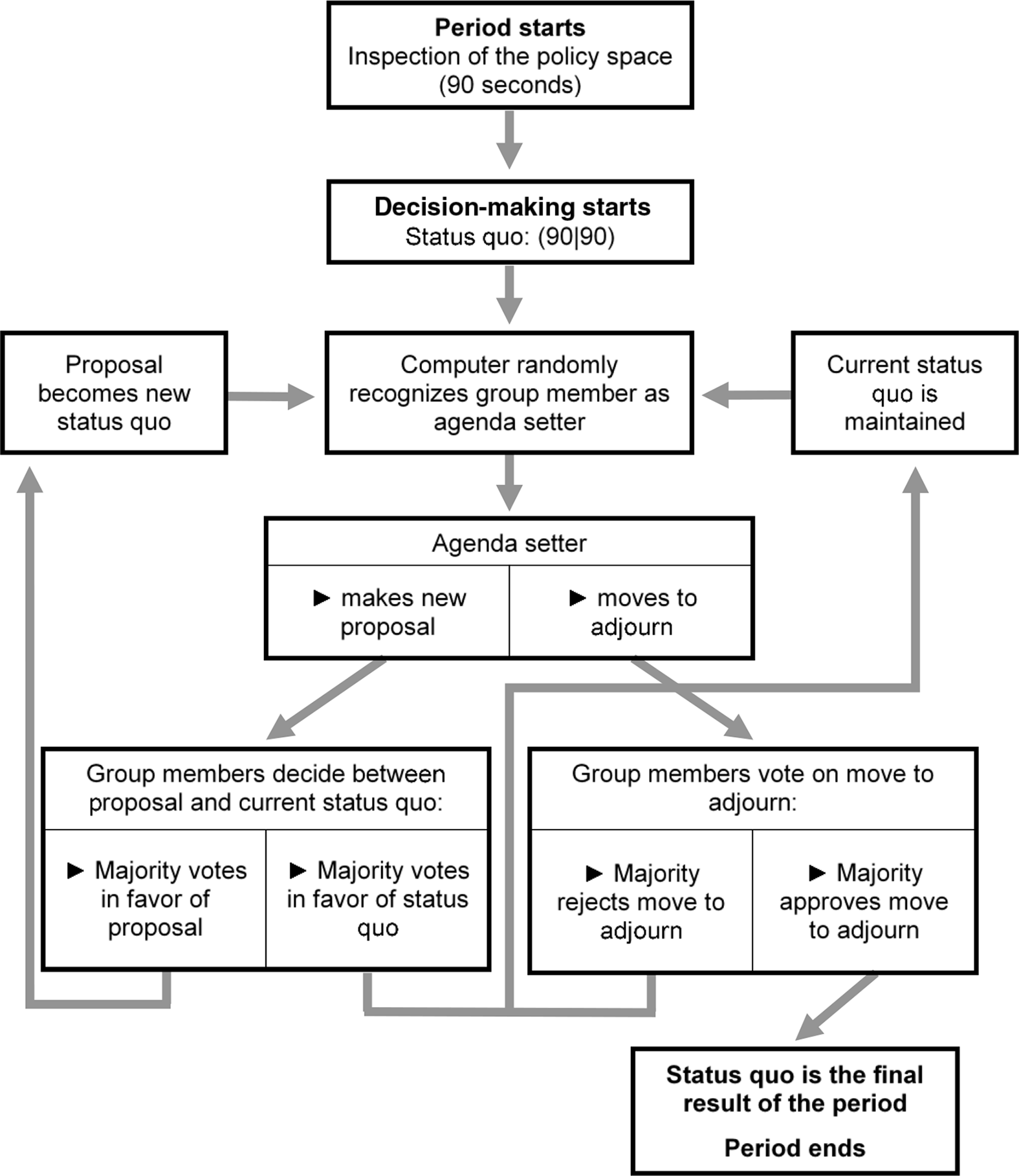
The experiment consists of two periods, and committees make two collective decisions under identical rules. The flow chart in Figure 1 illustrates the decision-making process in a period.Footnote 4 At the beginning of a period, subjects have 90 seconds to acquaint themselves with the policy space. The experiment provides complete cardinal information about payoffs. By clicking on a point in the policy space, subjects receive information for that alternative about their own payoff and the payoffs of all other committee members. During 90 seconds, subjects can click on as many points as they like and learn about its potential payoffs. When the actual decision-making process starts, the computer randomly selects an agenda setter from the five committee members.Footnote 5 At the beginning of the committee decision, the status quo is located at point (90|90) at the top right margin of the policy space.
Schematic representation of the decision-making process.

The agenda setter has two options: to propose a new point or move to adjourn decision-making. If she proposes a new point, the whole committee decides by simple majority vote between the proposal and the current status quo. Committee members vote simultaneously, only discovering the decisions of other group members after everyone has voted. If the new proposal receives a majority, it becomes the new status quo; otherwise, the old status quo is maintained. Decision-making then continues with a new agenda setter. If the agenda setter takes the second option, to propose to adjourn decision-making, again committee members vote by majority rule whether to accept the proposal or to continue decision-making. If the motion fails, the decision process continues with a new agenda setter. If a majority supports adjournment, the current status quo becomes the final group decision of the period. Alternatively, if a group does not reach a final decision within 20 minutes, the period is concluded with the current status quo as the final committee decision.
The experiment consists of two periods using a partner-matching procedure. Hence, committees make two consecutive decisions, and the composition of groups does not change between periods. Moreover, group members maintain their identity (Participant A, B, C, D, or E) within their group in both periods. In order to avoid wealth effects and increase the salience of decisions in the periods, at the end of the experiment, the computer randomly selects one of the two periods and only the tokens earned in this period are converted into money (Morton and Williams Reference Morton and Williams2010, 382).
Experimental treatments
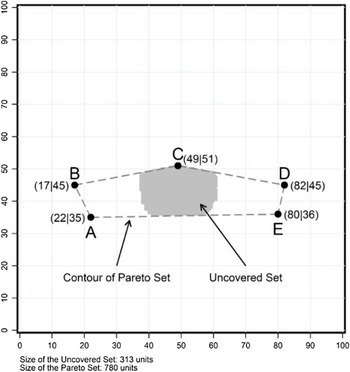
In order to test the influence of prosociality in majority decisions, the three experimental treatments systematically vary the distributional properties of the policy space while holding the location and the size of the UCS constant. Hence, in some treatments, the UCS coincides with distributionally fair alternatives, whereas in others, equally distributed alternatives are located outside the UCS. Figure 2 displays the locations of committee members’ ideal points and the resulting UCS.Footnote 6 The ideal-point configuration is the same in all three treatments throughout the two periods of the experiment. Moreover, payout functions induce Euclidean preferences in all three treatments. Therefore, the location and size of the UCS remain constant throughout the experiment. The UCS is centrally located below Player C’s ideal point. It comprises 313 square-units and thus about 40% of the Pareto set.
Configuration of ideal points and location of the uncovered set.

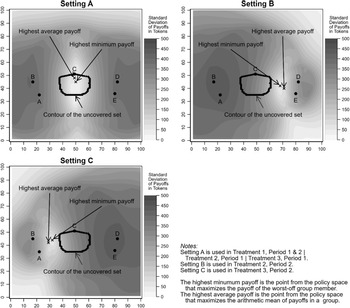
Figure 3 displays the resulting payoff distributions. Footnote 7 Overall, the experiment employs three different settings. Setting A is used in the first period in all three treatments, as well as in the second period of Treatment 1. In Setting A, equally distributed alternatives coincide with the UCS. Hence, the UCS exhibits fairness properties. Setting B is used in the second period of Treatment 2. As Figure 3 shows, the UCS does not contain equally distributed alternatives in Setting B. However, distributionally fair alternatives are located to the right of the UCS. Likewise, in Setting C, all fair alternatives are located to the left of the UCS. Setting C is employed in the second period of Treatment 3, and, as in Treatment 2, the UCS then loses its fairness properties.
Distributional properties of the policy space.

Predictions
Using Setting A in all three treatments in the first period serves as a common baseline. As the UCS exhibits fairness properties in this setting, both the prosociality explanation and the narrow rational choice model resting on egoistically motivated individuals predict that committees will select outcomes from within the UCS in the first period in all three treatments. Using Setting A again in Period 2 of Treatment 1 allows to control for possible learning effects over time. Settings B and C separate prosociality from the UCS. As the UCS’s location depends only on the configuration of committee members’ ideal points and thus remains unaffected by variations in the distributional properties of the policy space, its predictive power should not differ between Settings A, B, and C – if, that is, the UCS captures the true underlying causal mechanism. However, if majority decisions are influenced by prosocial motivations instead, I expect outcomes of committee decisions to deviate from the UCS in Settings B and C. In particular, I expect that committees will choose points to the right of the UCS in Setting B and to its left in Setting C.
It is important to notice that these predictions do not hinge on a specific conceptualization of prosociality. Indeed, there are different theoretical approaches to model prosocial motivations in the literature (for an overview see Rotemberg Reference Rotemberg2014).Footnote 8 Inequality aversion models, for instance, assume that individuals dislike unequal distributions (e.g. Bolton and Ockenfels Reference Bolton and Ockenfels2000; Fehr and Schmidt Reference Fehr and Schmidt1999). In this case, the standard deviation of payouts provides a valid measure of fairness. Rawls (Reference Rawls1971), for example, argues that distributive justice implies that individuals maximize the welfare of the worst-off group member. Accordingly, groups should maximize the lowest individual payout. Finally, Frohlich et al (Reference Frohlich, Oppenheimer and Eavey1987) argue that individuals also have an interest in efficiency and hence should maximize average payouts. As Figure 3 shows, the experimental design does not differentiate between the different conceptualizations of prosociality. In all three settings, the region of the policy space containing alternatives with a low standard deviation of payouts coincides with the region containing alternatives with high average payouts and with the region containing alternatives maximizing the payout of the worst-off group member.Footnote 9 The experiment thus provides a general and robust test of the influence of prosociality in collective decisions under majority rule in comparison to the influence of rationality coupled with egoism.
Procedures
The experiment was conducted in the Cologne Laboratory for Economic Research at the University of Cologne. Participants were randomly recruited via email, from a subject pool comprising about 4,000 registered subjects administered by ORSEE (Greiner Reference Greiner2015). Overall, 180 subjects (94 female, 86 male) participated in the experiment, almost all of them (98.3%) were students from the University of Cologne. Students from economics and management formed the largest subgroup (42.8% of all participants) in the experiment. The experiment was conducted in six sessions with 30 participants in each. In each session, ten subjects participated in each of the three treatments. Subjects were randomly assigned to treatments in each session, and no subject participated in more than one session.
On arrival at the laboratory, subjects were randomly seated in cubicles in order to avoid uncontrolled interactions among participants and preserve participants’ anonymity during the experiment. At the beginning of the experiment, participants received written instructions explaining the rules of the decision-making process in neutral and context-free language. Their general understanding of the instructions was tested in a brief questionnaire.Footnote 10 Participants’ inquiries were answered privately. Once all participants had completed the questionnaire, decision-making started. The whole experiment lasted less than an hour, and participants earned on average €15.17 which includes a lump-sum payment of €4.00 for arriving on time. At the end of the experiment, participants received their payouts in cash and left the laboratory.
Experimental results
In all treatments, committees reached a decision fairly quickly. On average, it took about 4 minutes to arrive at the final result. During that time, on average 4.4 agenda setters had the opportunity to make a proposal or move to adjourn. The longest decision in the experiment took 15 minutes and 30 seconds. Hence, no group reached the automatic time-out after 20 minutes.
Overall, the experimental results are very clear and unambiguously support the prosociality explanation for the predictability of majority rule.Footnote 11 In Setting A, when the equally distributed alternatives coincide with the UCS, 94% of all decisions lie inside the UCS. The UCS thus achieves exactly the same explanatory power as in the study by Bianco et al. (Reference Bianco, Lynch, Miller and Sened2006). In Settings B and C, however, the predictive power of the UCS drops dramatically. When the UCS does not contain equally distributed alternatives, it only predicts 4% of all committee decisions correctly.
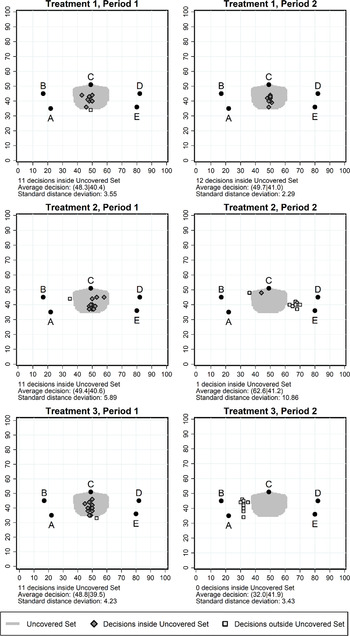
Figure 4 shows the spatial distribution of final results. In Period 1, committees select outcomes from within the UCS in 11 out of 12 decisions in each treatment. Moreover, the three decisions outside the UCS are near misses. In order to test whether the UCS predicts results better than random, I apply binomial tests similar to Bianco et al. (Reference Bianco, Lynch, Miller and Sened2006), comparing the percentage of decisions inside the UCS to the expected share of outcomes in the UCS under the assumption that committees choose points randomly from the Pareto set. In this experiment, the share of the Pareto Set that coincides with the UCS is 40.13%. In all three treatments, the observed share of outcomes in the UCS is significantly higher than expected (p < 0.001, one-tailed test) in Period 1. The same is true in the second period of Treatment 1 where all committees choose outcomes inside the UCS (p < 0.001, one-tailed test). Hence, when the UCS contains distributionally fair alternatives, it predicts final outcomes significantly better than expected.
Spatial distribution of final results.

In Period 2 of Treatment 2, when fair alternatives are located outside the UCS, only one decision is inside the UCS, and the binomial test reveals that the UCS predicts committee decisions significantly worse than assuming random choices from the Pareto set (p = 0.019, one-tailed test). The effect is even more pronounced in Treatment 3, Period 2, where all committee decisions end up outside the UCS (p = 0.002, one-tailed test). Figure 4, furthermore, shows that most outcomes fall in exactly the area where the equally distributed alternatives are located. In line with the prosociality explanation, 10 out of 12 committees choose points to the right of the UCS in Period 2 of Treatment 2 and all committees choose alternatives to the left of the UCS in Period 2 of Treatment 3. Overall, the final results of committee decisions provide overwhelming support for the thesis that prosocial motivations play an important role in majority decisions with an empty core.
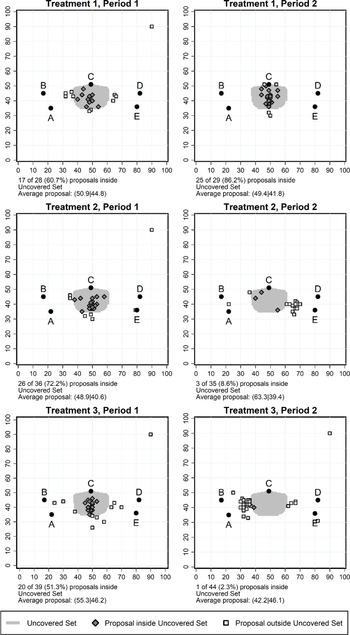
The influence of prosocial preferences on the behavior of committee members is apparent throughout the whole experiment. Figure 5 displays the spatial distribution of proposals. In the first period, the share of proposals inside the UCS varies between 51.3% in Treatment 3 and 72.2% in Treatment 2. In Treatment 1, when the UCS exhibits fairness properties in both periods, the share of proposals inside the UCS increases from 60.7% in Period 1 to 86.2% in Period 2. Hence, agenda setters seem to learn over time to make proposals inside the UCS when the UCS features fair alternatives. In Treatments 2 and 3, however, the share of proposals inside the UCS drops dramatically. In Treatment 2, Period 2, only 8.6% of all proposals are located inside the UCS; in Treatment 3, Period 2, just 1 out of 44 agenda setters (2.3%) proposes a point within the UCS. Moreover, proposals outside the UCS are not randomly dispersed over the whole Pareto set, but cluster in the area containing equally distributed alternatives. Thus, in Period 2 of Treatment 2, 30 of 32 (93.8%) proposals outside the UCS are located to its right; likewise in Treatment 3, Period 2, 34 of 43 (79.1%) proposals outside the UCS are located to its left.
Spatial distribution of proposals.

A final piece of evidence for the importance of prosociality in the committee decisions comes from an analysis of the chat protocols. Most committees use the opportunity to communicate via the chat function during the experiment. Overall, almost all discussions are characterized by a consensual style. In many instances, group members use arguments involving fairness. Many groups cooperatively search for alternatives that are “good for everybody”. On a very few occasions, individual group members propose building minimum winning coalitions of three group members. However, all coalition-building attempts are unsuccessful because other group members argue that such behavior would be very unfair. Moreover, there is no evidence in the chats supporting the underlying mechanism of the UCS. Not a single group discusses the long-term implications of their choices or whether a certain proposal would survive further steps of the decision-making process. Overall, the experimental results clearly demonstrate the influence of prosociality in majority decisions. Prosocial motivations have important effects on group decisions, agenda setters’ proposals, and the content of communication among committee members.
Discussion and conclusion
This study tests the robustness of the predictive power of the UCS in committee decisions under majority rule by varying the fairness properties of the policy space. The experimental results clearly show that the success of the UCS in prior experimental studies is likely to be due to the fact that it guarantees relatively equal distributions of payoffs to all committee members. Once the UCS is stripped of its fairness properties, and all equally distributed alternatives are located outside the UCS, its predictive power decreases dramatically.
Several features of the experimental design probably create favorable conditions for the success of the UCS. The anonymous interactions between subjects should dampen social considerations during the experiment. Moreover, recent research shows that students behave differently from non-students in experiments: they are more likely to act selfishly and display greater abilities to reason strategically than non-students (Belot et al. Reference Belot, Duch and Miller2015). The effect should be even stronger among economics students (Marwell and Ames Reference Marwell and Ames1981). Hence, all these aspects should favor the success of the UCS in the present study, which uses a typical student sample as experimental subjects in which economics students form the largest sub-group.
The fact that committees have the opportunity to communicate in an open chat, however, might promote consensus and fair outcomes. Thus, a large body of research shows that communication strengthens prosocial orientations within groups (e.g. Bicchieri Reference Bicchieri2002; Sally Reference Sally1995). In a recent study, Sauermann (Reference Sauermann2020a) experimentally investigates the effects of publicity of communications in a distributional game. He finds that the prosocial effects of communication dominate when communication is public like in this study, whereas minimal winning majorities form under private communication. Hence, further examinations of the influence of communication on the predictive power of the UCS provide a promising way for future research.Footnote 12
The McKelvey–Schofield theorems (McKelvey Reference McKelvey1976; Schofield Reference Schofield1978) proving the generic indeterminacy of majority rule pose a major challenge for democratic theory. As the dominant preference-based explanation for the predictability of majority decisions, the UCS therefore plays a central role in our current understanding of the viability of democracy. The results presented in this study, however, cast serious doubt on the UCS as a valid explanation for the outcomes of majority decisions. The development of theoretical innovations could profit from supplementing existing approaches with insights from behavioral research. Similar theoretical advances in the field of collective action theory have already demonstrated the great merit of such an approach (see Ostrom Reference Ostrom1998). Hence, the actual shape of individual motivations deserves as much attention as the formal properties of democratic aggregation mechanisms. If we admit all preferences to collective decisions and thus refrain from making restrictive assumptions about individual motivations in our theoretical models, social choice theory demonstrates that majority rule might result in arbitrary and meaningless collective decisions (Riker Reference Riker1982). Hence, interpretable democratic decisions do not arise from nothing, but presuppose the addition of ‘something normative’ to the preferences of the individuals (Frohlich and Oppenheimer Reference Frohlich and Oppenheimer2007, 381; Sauermann et al. Reference Sauermann, Schwaninger and Kittel2020). This study suggests that prosocial motivations can be part of these normative elements. Individuals care about others and take the well-being of other individuals into account. Thus, the viability of democracy rests on the existence of a common social bond between the members of a society – as suggested by Rousseau (Reference Rousseau[1762] 1997, 57) more than 250 years ago.
Supplementary Material
To view supplementary material for this article, please visit https://doi.org/10.1017/XPS.2020.43.