Kawasaki disease is an acute medium vessel vasculitis of childhood characterised by the development of coronary artery aneurysms in 20–25% of untreated patients and in 3–5% of patients treated with intravenous immunoglobulin. Reference Newburger, Takahashi and Gerber1,Reference Ozen, Ruperto and Dillon2 The multisystemic inflammatory syndrome in children related to SARS-CoV2 has also been associated with clinically significant aneurysms. Reference Feldstein, Tenforde and Friedman3 Thresholds based on absolute dimensions of coronary arteries often underestimate the diagnosis of coronary artery aneurysms in paediatrics. Reference de Zorzi, Colan, Gauvereau, Baker, Sundel and Newburger4 Based on the 2017 American Heart Association Kawasaki disease statement, coronary aneurysms are diagnosed based on coronary luminal diameter measured on two-dimensional echocardiography, normalised to body surface area, and reported as Z scores. Normalisation to body surface area in small children allows for standardisation, classification, and serial comparison over time. Reference McCrindle, Li and Minich5,Reference Manlhiot, Millar, Golding and McCrindle6
Coronary Z scores guide the diagnosis, risk stratification, and long-term clinical management in Kawasaki disease. According to the American Heart Association guidelines, Reference Newburger, Takahashi and Gerber1 for children being worked up for atypical Kawasaki disease, a left anterior descending artery or right coronary artery with Z score ≥2.5 is cited as a criterion for the diagnosis of Kawasaki disease and for treatment with immunoglobulin. Aspirin and either warfarin or enoxaparin are recommended for patients with large or “giant” coronary artery aneurysms (Z ≥ 10) because of the high risk for coronary occlusion, myocardial infarction, or death. Reference McCrindle, Rowley and Newburger7 Three coronary Z score systems are commonly used in North America in children with Kawasaki disease, those by Colan et al (Boston), Dallaire and Dahdah (Montreal), and Olivieri et al (DC). Reference Colan8–Reference Olivieri, Arling, Friberg and Sable10 There is significant variation in the rate of diagnosis of coronary aneurysms among these three Z score systems, especially for large aneurysms (Z ≥ 10). Reference Ronai, Hamaoka-Okamoto and Baker11 According to the 2004 American Heart Association guidelines, Reference Newburger, Takahashi and Gerber1 the Boston Z score system was the recommended model but the latest 2017 statement no longer specifies which Z score system be used and references several. In 2017, the Pediatric Heart Network “Echocardiographic Z Score Project” published an evaluation of over 3200 healthy, diverse paediatric patients deriving a Z score system more representative of the United States population than previous systems. Reference Lopez, Colan and Stylianou12
The primary objective of our study was to compare the rate of coronary artery lesions identified by the Pediatric Heart Network, Boston, Montreal, and DC Z score systems and determine the impact of Z score system on the long-term management of patients with Kawasaki disease.
Methods
Population
The study cohort consisted of two comparable patient populations to increase power and allow for meaningful secondary analysis; the first was composed of all children ≤18 years of age diagnosed with Kawasaki disease and treated with intravenous immunoglobulin at the Children’s Hospital at Montefiore from May, 2009 through April, 2019. Children were included if they fit the 2004 or 2017 criteria for acute Kawasaki disease based on their date of presentation and had a transthoracic echocardiogram during their hospitalisation. They were excluded if they had preexisting coronary artery disease or CHD aside from a small atrial septal defect or patent ductus arteriosus. The second study sample was collected from all the patients entered into the publicly available dataset of the National Heart, Lung, and Blood Institute Kawasaki Disease Study by Newburger et al (pediatricheartnetwork.org) who had an initial echocardiogram available for review. The Kawasaki Disease Study recruited children with Kawasaki disease from December 2002 to December 2004 Reference Newburger, Sleeper and McCrindle13 who were between 4 and 10 days of illness without prior immunoglobulin treatment. Coronary aneurysms were defined according to the criteria of the Japanese Ministry of Health, and about half received intravenous methylprednisolone as part of the study which was not shown to affect coronary dimension. The Institutional Review Board of the Albert Einstein College of Medicine approved this investigation with a waiver of informed consent.
Demographic and clinical data were collected from both cohorts including age, height, weight at initial and follow-up echocardiography, race, ethnicity, and coronary measurements. For each Z score system, body surface area was calculated for each patient at each echocardiography timepoint using the Haycock formula with the exception of the DC Z score system which uses the DuBois formula for body surface area. Reference Cantinotti, Kutty and Franchi14 Coronary lesions and anticoagulation management were determined based on the 2017 American Heart Association Kawasaki disease statement, as follows: a coronary artery with a Z score of ≥2.0 to <2.5 was defined as “dilated” and coronary artery aneurysms were defined as “small” (Z score ≥2.5 to <5.0), “medium” (Z score ≥5.0 to <10.0), or “large” (Z score ≥10.0). Using the coronary Z scores calculated by the different Z score systems, the same guidelines provided the recommended long-term anticoagulation that would have been used for each Z score. In children with dilation or small aneurysm, antiplatelet monotherapy is indicated (typically aspirin), dual antiplatelet therapy is recommended for medium aneurysms, and warfarin or enoxaparin is recommended for large aneurysms. Reference McCrindle, Rowley and Newburger7
Echocardiography
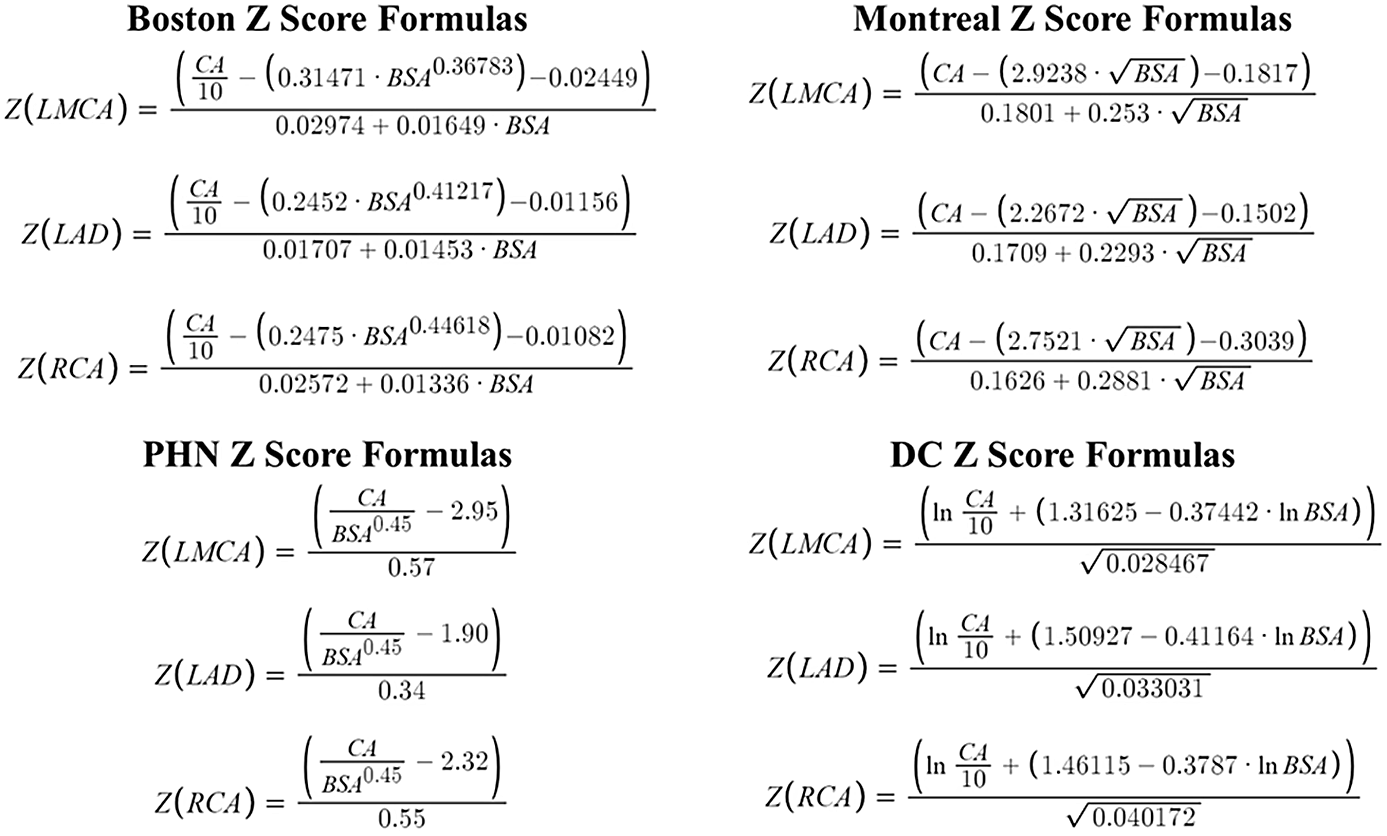
Internal luminal diameters of the left main, left anterior descending, and right coronary arteries measured on two-dimensional echocardiography were collected either from standardised transthoracic echocardiography measurements Reference Lopez, Colan and Frommelt15 at the Children’s Hospital at Montefiore or from the core lab data available in the National Heart, Lung, and Blood Institute Kawasaki disease database. Detailed agreement analysis of the coronary measurement techniques used for these two samples was not possible in this study, but Z score distributions from the two samples were compared. Two timepoints were analysed, the first at the time of initial echocardiography at presentation and the second at the first available follow-up echocardiogram performed more than 4 weeks after the start of fever. Z scores were generated based on coronary dimension and body surface area using the formulas seen in Figure 1. Reference Colan8–Reference Olivieri, Arling, Friberg and Sable10,Reference Lopez, Colan and Stylianou12 The formulas of the original Boston Z score system were based upon publications with first 89 and then 221 normal patients. Reference de Zorzi, Colan, Gauvereau, Baker, Sundel and Newburger4,Reference McCrindle, Li and Minich5 The system has since incorporated hundreds more patients into its methods by report but without recent publication of its evolving formulas; the Boston formulas cited in this paper (Fig 1) come from a personal communication with Dr Steven Colan in October 2018 and represent those being used at that time. Reference Colan8 The Pediatric Heart Network, Montreal, and DC Z score formulas were taken from their respective publications (Fig 1). Reference Dallaire and Dahdah9,Reference Olivieri, Arling, Friberg and Sable10,Reference Lopez, Colan and Stylianou12 The Children’s Hospital at Montefiore was one of a number of sites that contributed healthy standardised echocardiography patient data to the Pediatric Heart Network Z Score Project which produced the Z score system used in this research, but none of the Kawasaki disease data used for this analysis overlapped with that healthy population data.
Z score formulas for each coronary segment for Boston, PHN, Montreal, and DC Z score systems. Coronary artery (CA) in cm, BSA in m2 using the Haycock equation except for DC which uses the DuBois equation. Boston, Pediatric Heart Network (PHN), Montreal, and Washington, DC (DC) Z score systems. Sources: Olivieri (2009, Journal of the American Society of Echocardiography, JASE), Dallaire (2011, JASE), Lopez (2017, Circulation Cardiovascular Imaging), Colan (2018, communication).
Statistical analysis
Descriptive data were reported using mean and standard deviation. The two population samples and the Z score systems were compared by chi-square or Fisher’s exact testing for categorical variables and by two-sample t-tests for continuous variables. The Wilcoxon signed-rank test was used for paired non-parametric comparisons. All tests were two-tailed with a p-value <0.05 considered statistically significant. Correlations among the four Z score systems for each of the coronary artery segments were evaluated with pairwise comparison plots. Agreement among the four Z score systems was evaluated using the intraclass correlation coefficient and Bland–Altman analysis for the left main coronary, left anterior descending, and right coronary arteries. Reference Bland and Altman16 All coronary artery data points from both initial and follow-up echocardiography were pooled for these disease-independent analyses to increase the power to detect a difference among the systems. Data were analysed using Statistical Analysis Systems software (version 9.4; Statistical Analysis Systems Institute Incorporated, Cary, North Carolina, United States of America) and the Statistical Package for the Social Sciences for Windows (version 25.0; International Business Machines, Armonk, New York, United States of America).
Results
Patient population
Of the 333 patients <18 years of age diagnosed with Kawasaki disease and treated with intravenous immunoglobulin, 136 came from the Children’s Hospital at Montefiore and 197 came from the National Heart, Lung, and Blood Institute Kawasaki Disease Study public database. These two samples did not differ in sex, age, body surface area, or degree of coronary artery dilation or aneurysm. They did differ by race and ethnicity with higher rates of Black and Hispanic patients at the Children’s Hospital at Montefiore (Table 1). The total study population was 60% male, 51% White, and 27% Hispanic with an average age of 3.3 ± 2.5 years and an average body surface area of 0.64 ± 0.25 m2.
Population demographics at initial evaluation

BSA=body surface area; CHAM=Children’s Hospital at Montefiore sample; NHLBI=National Heart, Lung, and Blood Institute KD sample; SD=standard deviation.
p values by chi-square or fisher exact tests for categorical data, t tests for continuous data.
Rate of coronary artery lesions
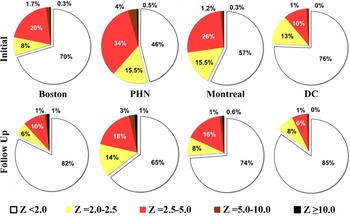
Initial echocardiography was performed in 333 patients at a mean of 7.1 ± 2.3 days of fever; follow-up echocardiography was performed in 313 patients at a mean of 44.7 ± 27 days since the start of the first fever. For initial echocardiography (top row of Fig 2), the distribution of rates of all coronary lesions among each Z score system differs significantly (all p < 0.005 by chi-square where the medium and large coronary aneurysm groups are combined due to low N). When each pair of systems is compared dichotomously (Z < 2.0 vs. ≥2.0), more acute coronary lesions are diagnosed by Pediatric Heart Network (54%) than by Boston (30%, p < 0.001), Montreal (43%, p = 0.003), or DC (24%, p < 0.001). The higher rate is also significant for Montreal compared to Boston or DC (both p < 0.001), but not for Boston versus DC (p = 0.12). On follow-up echocardiography (bottom row of Fig 2), the differences in the diagnosis of coronary lesions are similarly significant for Pediatric Heart Network (36%) versus the three other systems (18%, 26%, and 15%, respectively, all p < 0.05) and for Montreal compared to Boston or DC (both p < 0.001), but not for Boston versus DC (p = 0.33). To determine the drivers of differences among systems, all measurements from the initial and follow-up visits are combined for further analysis in this section.
Coronary Z score distribution diagnosed by each Z score system at initial and follow-up evaluation. Boston, Pediatric Heart Network (PHN), Montreal, and Washington, DC (DC) Z score systems.

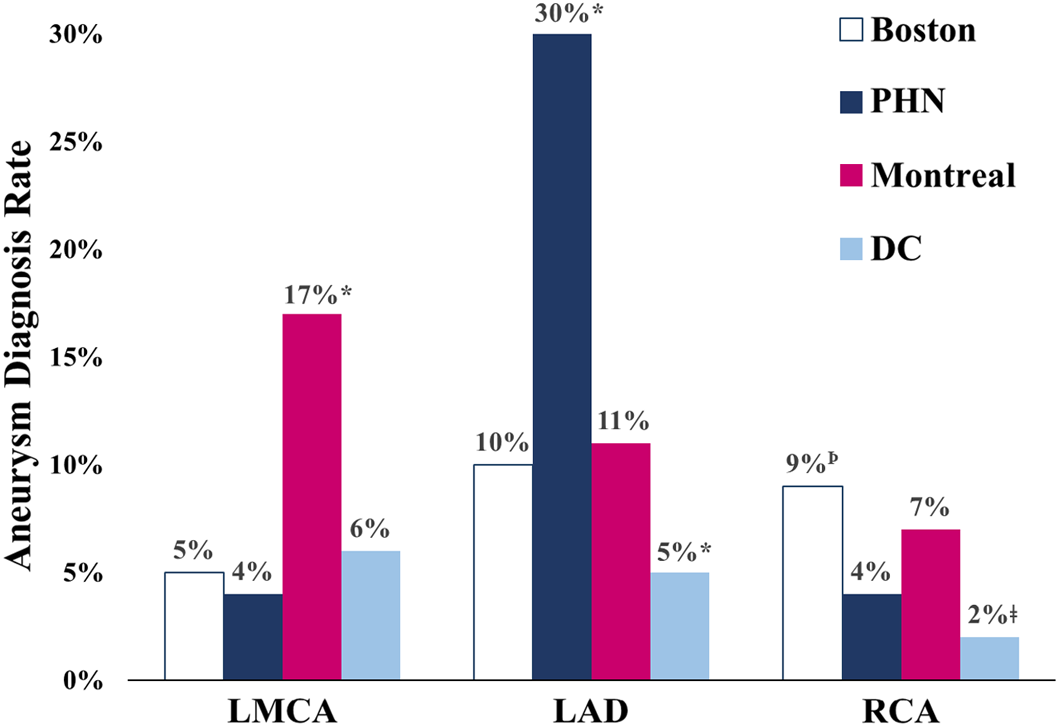
The rate of coronary aneurysms (Z ≥ 2.5) differs significantly by coronary artery segment among the four Z score systems, as shown in Figure 3. The Montreal system diagnoses more aneurysms in the left main coronary than Boston, Pediatric Heart Network, and DC (17% vs. 5%, 4%, and 6%, respectively, all p < 0.001). The Pediatric Heart Network system diagnoses more aneurysms in the left anterior descending compared to Boston, Montreal, and DC (30% vs. 10%, 11%, and 5%, respectively, all p < 0.001). The Boston system diagnoses more aneurysms in the right coronary compared to Pediatric Heart Network and DC (9% vs. 4% and 2%, respectively, both p < 0.01), but not to Montreal (7%, p = 0.30).
Aneurysm (Z ≥ 2.5) diagnosis rate for each coronary artery by each Z score system. * Significantly different (p < 0.001) from all the other Z score systems. Þ Significantly different (p < 0.01) from the other Z score systems except for Montreal, or ‡ except for PHN. Boston, Pediatric Heart Network (PHN), Montreal, and Washington, DC (DC) Z score systems.

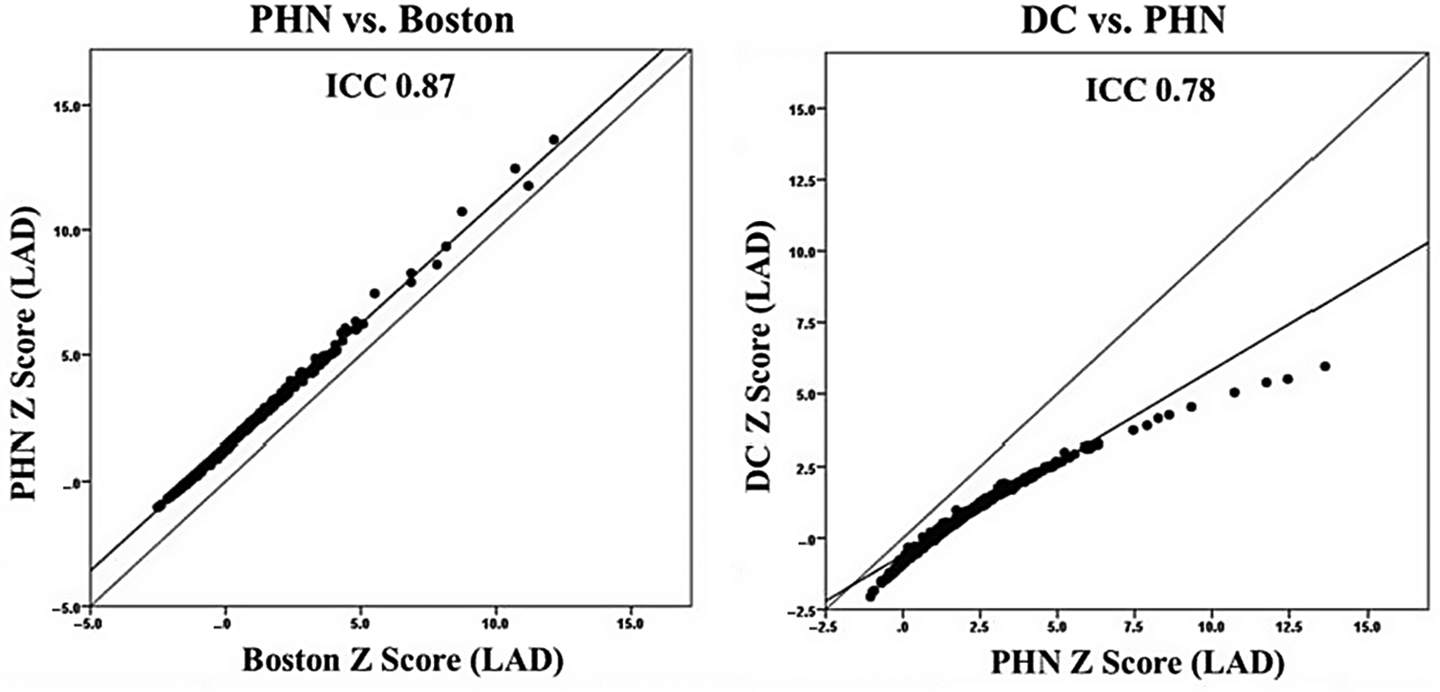
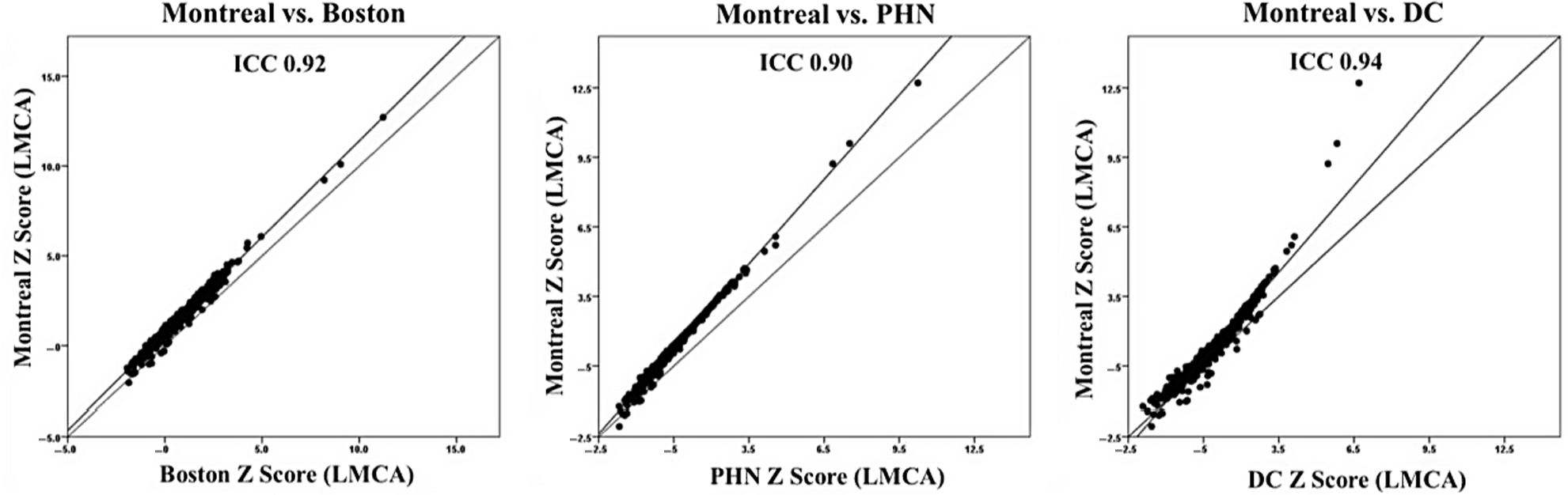
These differences in rates of coronary lesions (Z ≥ 2.0) are explored using pairwise comparison with intraclass correlation and Bland– Altman plots. The intraclass correlation coefficients between each pair of Z score formulas (Supplemental Figure 1a–c, organised by coronary artery segment formula) are “high” (intraclass correlation coefficient >0.90) for all pairwise comparisons except Pediatric Heart Network vs. Boston in the left anterior descending (intraclass correlation coefficient 0.87) and DC vs. Pediatric Heart Network in the left anterior descending (intraclass correlation coefficient 0.78; Figure 4). The difference between the Pediatric Heart Network and Boston systems for the left anterior descending shows that the Pediatric Heart Network Z score is uniformly higher than Boston by 1.3 Z score units across the entire range. In addition, the left main coronary Z scores from Montreal are increasingly greater than the other three systems across the range (Figure 5).
Pairwise comparison of select LAD Z score systems. Intraclass correlation coefficient (ICC); left anterior descending (LAD); Pediatric Heart Network (PHN), Boston, and Washington DC (DC) Z score systems.

Pairwise comparison of select LMCA Z score systems. ICC=intraclass correlation coefficient; LMCA=left main coronary artery; PHN=Pediatric Heart Network, Boston, Montreal, and Washington DC (DC) Z score systems.

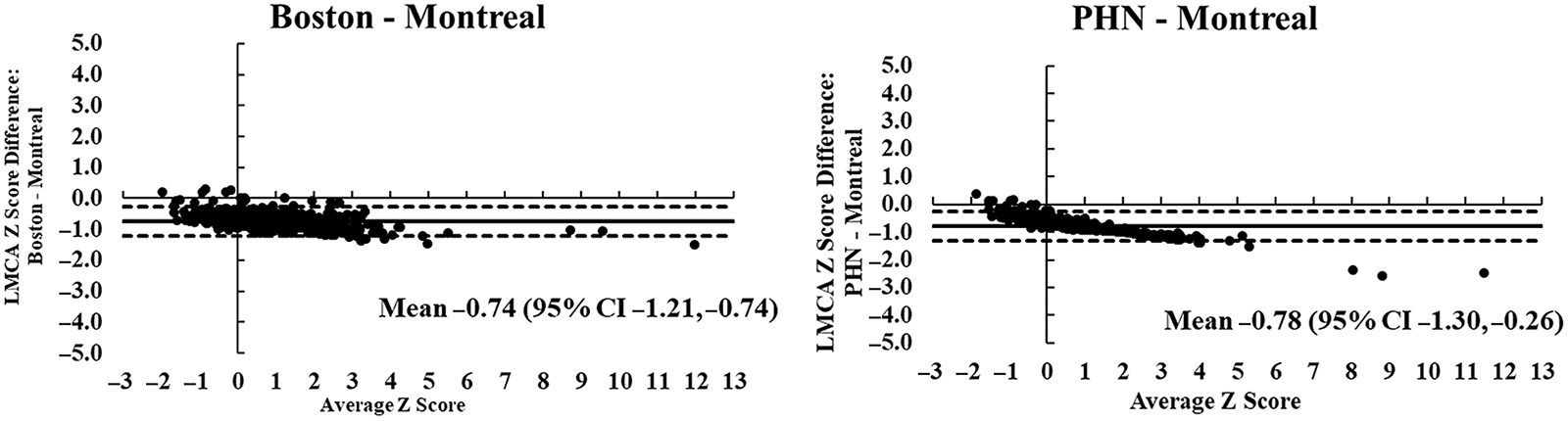
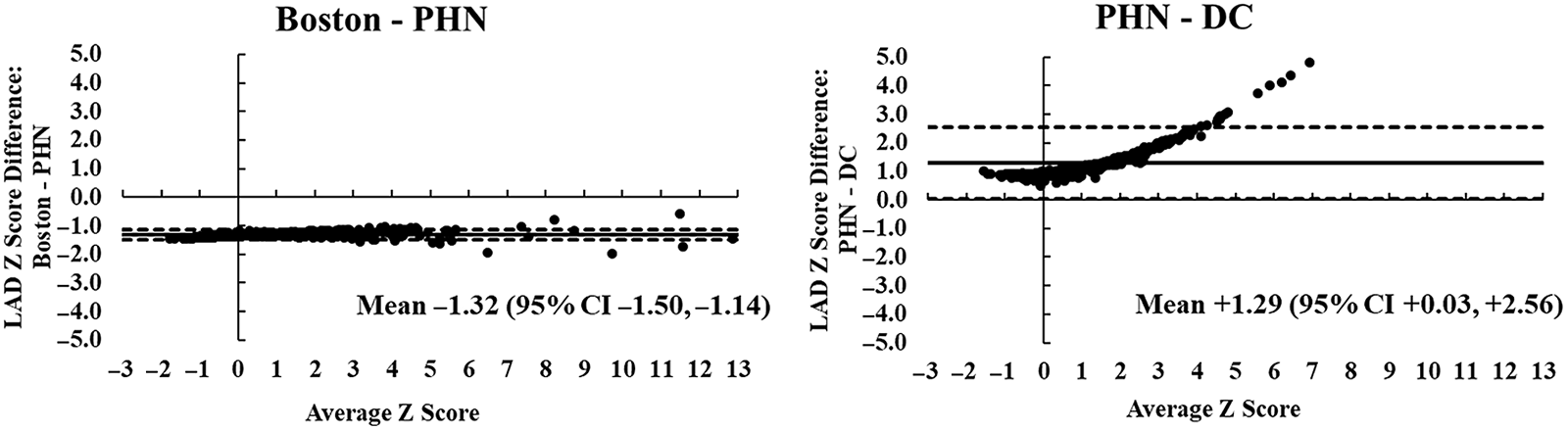
As seen in Figures 6 and 7, the Bland–Altman plots demonstrate significant disagreement in the left main coronary formulas between Boston vs. Montreal and Pediatric Heart Network vs. Montreal, and in the left anterior descending formulas between Pediatric Heart Network vs. Boston and Pediatric Heart Network vs. DC. There is no significant disagreement detected by Bland–Altman among the Z score systems for the right coronary artery. Qualitative intra-plot differences are also noted in the left anterior descending artery formulas where Pediatric Heart Network is increasingly larger than Montreal and DC when Z is greater than about 2.0, as well as in the right coronary artery formulas where Boston is increasingly larger than Pediatric Heart Network, Montreal, and DC when Z is greater than about 1.0. All Bland–Altman plots are included in Supplemental Figure 2a–c for reference.
Bland–Altman plots of select LMCA Z score systems. CI=95% confidence interval; LMCA=left main coronary artery; PHN=Pediatric Heart Network, Boston, and Washington DC (DC) Z score systems.

Bland–Altman plots of select LAD Z scores systems. CI=95% confidence interval; LAD=left anterior descending coronary artery; PHN=Pediatric Heart Network, Boston, and Washington DC (DC) Z score systems.

Anticoagulation management
Depending on the Z score system applied, the American Heart Association-recommended anticoagulation management would differ significantly. At follow-up echocardiography, the Pediatric Heart Network Z score system would have assigned coronary dilation or small aneurysms (Z scores ≥2.0 to <5.0) to 20% more of the population when compared to the Boston Z score system (p < 0.001, paired Wilcoxon signed-rank test); that is, 20% of the whole population would be reclassified from “normal” coronary arteries to having coronary lesions and, as a result, long-term antiplatelet monotherapy (Class I, Level of Evidence C) and more frequent monitoring would have been recommended. Similarly, the Montreal and DC systems would have respectively assigned 9% more (p < 0.001) and 2.3% more (p = 0.02) Z scores ≥2.0 to <5.0 to the population compared to the Boston system. The Pediatric Heart Network system also assigned 2% more medium aneurysms (Z score ≥5.0 to <10.0) to the population compared to the Boston system which could have resulted in a recommendation for dual antiplatelet therapy (Class IIb, Level of Evidence C). No statistically significant differences in recommendation for anticoagulation management for Z score ≥10 among the four systems were detected.
Discussion
This project independently verifies and builds upon recent literature in this area by Lopez et al and Robinson et al. Reference Lopez, Frommelt and Colan17,Reference Robinson, Ware and Sauer18 This study highlights real-world differences found among four popular North American Z score systems and the significant impact on Kawasaki disease management. The choice of Z score system significantly impacts the interpretation of coronary involvement at both diagnosis and follow-up. We show this discrepancy is true for all coronary Z scores at all coronary dimensions except for large aneurysms. With only a single large aneurysm detected by Boston and DC, two by Pediatric Heart Network, and zero by Montreal, power was inadequate to identify statistical differences in this subset of aneurysms. However, we were able to show that differences in the diagnosis and the degree of coronary involvement can result in a significant difference in the recommended anticoagulation protocol and the level of follow-up. Such a large discrepancy may be of concern to patients, parents, and clinicians alike. The analysis also builds on comparative analysis of different Z score systems reported by Manlhiot et al and Ronai et al which did not include the Pediatric Heart Network. The latter of these showed similar differences among Boston, Montreal, and DC Z score systems for a given luminal coronary dimension and body surface area in a selection of patients particularly for large aneurysms (Z ≥ 10.0). Reference Manlhiot, Millar, Golding and McCrindle6,Reference Ronai, Hamaoka-Okamoto and Baker11 Further, the recent publication by Robinson et al demonstrated similar findings between Boston and Pediatric Heart Network Z score systems which were the sole systems discussed. Reference Robinson, Ware and Sauer18
Our results must also be interpreted in the context of limited Z score outcome data for Kawasaki disease. Because of this, a strong conclusion cannot be reached regarding “over-” or “underestimation” of coronary aneurysms for a given Z score system. Pediatric Heart Network diagnoses the highest rate of coronary lesions (Z max ≥2.0) and aneurysms (Z max ≥2.5), almost double that of Boston, and two to three times that of DC (Fig 2). The Boston and DC systems perform similarly to one another in our population and diagnose the fewest coronary aneurysms among the four systems, with DC diagnosing zero large aneurysms. However, the diagnosis of coronary lesions in each coronary artery segment still varies significantly between Boston and DC with, for example, Boston diagnosing twice as many aneurysms in the left anterior descending as DC.
Our analysis identifies the responsible coronary segment in each system that is driving the relative differences among Z score systems; more aneurysms are diagnosed in the left main coronary by the Montreal system, in the left anterior descending by the Pediatric Heart Network system, and in the right coronary by the Boston system. The American Heart Association guidelines recommend against relying on the left main coronary in the workup or management of Kawasaki disease given high inter- and intra-observer variability in the intraluminal measurements. Reference McCrindle, Rowley and Newburger7 With echocardiographic evaluation of cases of atypical Kawasaki disease, the consistent Z score disagreement of 1.3 between the Boston and Pediatric Heart Network left anterior descending formulas will lead to more children diagnosed with Kawasaki disease and treated with intravenous immunoglobulin for left anterior descending Z ≥ 2.5 when the Pediatric Heart Network system is used. This difference for the left anterior descending segment may represent a difference in the populations between the two systems. Due to discrepancies such as these and because of the absence of outcome related data using the PHN Z scores, the Pediatric Heart Network authors recommend using the Boston system until more complete outcome data are available. Reference Lopez, Frommelt and Colan17 Since complete outcome data or a gold standard comparison does not exist, it remains difficult to infer from these findings which Z score system is accurate or to recommend the use of one Z score system over the others.
In addition, the long-term management of Kawasaki disease based on American Heart Association recommendations would vary substantially depending on the Z score system used to define coronary lesions. While this study’s power was not able to assess changes for Z ≥ 10.0, there are significant increases at the Z ≥ 2.0 to <5.0 threshold for all systems compared to the Boston system, and at the Z ≥ 5.0 to <10.0 for the Pediatric Heart Network compared to the Boston system. When using the Pediatric Heart Network system to direct anticoagulation management, 22% more of the entire population would either remain on antiplatelet monotherapy (typically aspirin) or dual antiplatelet therapy or would receive additional anticoagulation compared to the Boston system.
There are various potential causes of disagreements among Z score systems. The systems use two different body surface area equations, where the DuBois equation should be used for the DC system and the Haycock equation for the Boston, Pediatric Heart Network, and Montreal systems. Reference Cantinotti, Kutty and Franchi14 The Z score systems differ in population size, gender, race, and age of the normal patients. Reference Lopez, Colan and Stylianou12 In addition, each system uses different mathematical assumptions (Fig 1) for regression and to account for heteroscedasticity (non-constant variance) among the indexed values at high and low body surface area measurements.
In an attempt to standardise measurements in patients of different sizes, coronary Z score systems transform luminal measurements from normal populations (and the resulting distribution) by including body surface area and a standard error term in the formula. As seen in Figure 1 and unlike in other Z score systems, the Pediatric Heart Network transforms its data through division by body surface area raised to a constant power of 0.45. This correction by Pediatric Heart Network echoes early work by Sluysmans and Colan, which suggested correction by division of body surface area raised to the power of 0.5 is consistent with both theoretical dimensional units and experimental distributions of cardiovascular structures. Reference Sluysmans and Colan19 More recent formulas used by Colan et al for the Boston Z score system stray from that theoretical basis and instead modify coronary measurements by subtraction of a factor of the body surface area raised to a power as low as 0.37. In contrast, parallel works by Olivieri et al in DC (2008, N = 432) and by Dallaire and Dahdah in Montreal (2011, N = 1033) derive their Z score systems through comparison of various mathematical models of regression (i.e. linear, exponential, logarithmic). They then choose from these various regression techniques based on a combination of qualitative (simplicity) and quantitative (best fit) characteristics. Even with a similar approach, Montreal and DC choose different mathematical models to adjust their coronary measurements, with Montreal utilising subtraction and division by body surface area to the power of 0.5 and DC utilising a natural logarithm.
Aside from differences in the mathematical form, other potential sources of disagreement among the Z score systems include interobserver and intraobserver variability for measurements of the coronary arteries related to an institution’s measurement practices and number of echocardiography readers. Studies have shown moderate interobserver agreement for left main coronary artery measurements and high agreement for left anterior descending and right coronary artery measurements. Reference Ronai, Hamaoka-Okamoto and Baker11,Reference Sluysmans and Colan20 Further, variations in study populations may result in significantly different “normal” Z score nomograms unique to that population. Investigation of this last source of error would require a national and international effort to determine if population-specific Z score systems are necessary for a given region. This would run counter to the hope of many in our field that a universal Z score system can be used for the Kawasaki diagnosis and management, but certainly needs to be entertained as is clear from the results of this and other recent research efforts. Reference Lopez, Frommelt and Colan17,Reference Robinson, Ware and Sauer18,Reference Kim, Kim, Kim, Yu and Choi21
The Pediatric Heart Network Z score system was designed to address limitations inherent in small-sample single-institution Z score systems and found only small effects from age, gender, race, and ethnicity on the Z scores that were deemed not clinically important. Unlike other Z score systems, Reference McCrindle, Li and Minich5,Reference Ogata, Tremoulet and Sato22,Reference Benseler, McCrindle, Silverman, Tyrell, Wong and Yeung23 the Pediatric Heart Network system has not been evaluated in the context of Kawasaki disease outcomes. Thus, results from future and existing cardiovascular outcome studies for Kawasaki disease Reference Benseler, McCrindle, Silverman, Tyrell, Wong and Yeung23–Reference Akagi, Rose, Benson, Newman and Freedom26 must be evaluated in the context of the Z score system used before application to clinical practice. As shown in our analysis, even statistically “high” agreement (intraclass correlation coefficient >0.90) among Z score systems does not preclude clinically important Z score differences, and more rigorous agreement standards should be employed for the Z score literature. Clinicians and institutions who choose to transition from one Z score system to another must remain vigilant that the various sources of discrepancy described here are minimised. They might do so by converting between Z score values to identify discrepancies when possible, using their new Z score system for new cases but their original system for existing patients returning for follow-up, and identifying the type of Z score system used on all echocardiography reports. These findings further demonstrate the need for an international collaboration to standardise coronary normalisation methods.
Limitations
This is a retrospective review of children with Kawasaki disease. Although coronary aneurysms are most thoroughly defined by size, comparison to neighbouring segments, and pathologic changes in the vessel wall, the American Heart Association guidelines provide a standardised approach for research purposes that define aneurysms based primarily on size. Thus, we defer to this standard in our research for consistency while understanding that these limitations remain important. For this study, coronary luminal dimensions were collected from echocardiography reports from two different populations and the effect of inter- and intra-observer and institutional variability in coronary artery measurements on Z score variability was not assessed. Others have reported moderate inter- and intra-observer agreement for the left main and high agreement for the left anterior descending and right coronary arteries. Reference Ronai, Hamaoka-Okamoto and Baker11 However, standardised quantification was used for coronary measurement in the population from the Children’s Hospital at Montefiore Reference Lopez, Colan and Frommelt15 and the rate of diagnosis of coronary lesions was not significantly different between these two large samples. The study cohort consisted of two populations that differed in race and ethnicity, yet the rate of aneurysms between the two groups was not statistically different. In this large cohort, the number of coronary arteries with Z ≥ 5.0 was small, which makes it difficult to draw conclusions on the rate of larger aneurysms or on the true change in anticoagulation management using different Z score systems in this subset. The follow-up period in the study was limited to the first 6–8 weeks after the acute illness and thus the impact of using different Z score systems on the rates of regression of aneurysms beyond the initial recovery period could be not analysed. This study was not designed to recommend the use of one Z score system over another as it does not analyse long-term outcome data. Due to the largely theoretical nature of Z score normalisation, no “gold standard” can exist until more robust outcome data are available.
Conclusion
This study performed a detailed comparison of the Boston, Pediatric Heart Network, Montreal, and DC Z score systems using a large real-world Kawasaki disease population. We show that the Pediatric Heart Network and Montreal systems diagnose significantly more coronary dilation and aneurysms than the Boston or DC systems and which coronary segment formula contributes most to these differences. The higher diagnosis rate for Pediatric Heart Network is driven by higher Z scores in its left anterior descending formula, which were shown to be consistently 1.3 Z units above the Boston formula throughout its range. Clinicians and institutions who decide to transition from one Z score system to another must remain vigilant to minimise the sources of error described here. Using comparative Z score research, there is a need for future long-term outcome studies and international collaboration to determine “gold standard” coronary normalisation methods in children with Kawasaki disease to reduce clinically significant variation in the diagnosis and management of coronary artery lesions.
Supplementary material
To view supplementary material for this article, please visit https://doi.org/10.1017/S1047951121003437
Acknowledgements
The National Heart, Lung, and Blood Institute Pediatric Heart Network Kawasaki Disease dataset was used in preparation of this work. Data were last downloaded on 6/01/2020 from: http://pediatricheartnetwork.org/ForResearchers/PHNPublicUseDatasets.aspx
Preliminary data from this report were presented at the 69th annual American College of Cardiology 2020 and the World Congress of Cardiology Scientific Sessions, held virtually March 28–30th 2020
Financial support
This research received no specific grant from any funding agency, commercial or not-for-profit sectors.
Conflicts of interest
None.
Ethical standards
The authors assert that all work for this research complies with the Belmont Report of 1979 and with the Helsinki Declaration of 1975 as revised in 2008 and has been approved by the Albert Einstein College of Medicine Institutional Review Board.
Contributors’ statement
Dr Lorenzoni contributed to the study design, collected data, carried out initial and final analysis, and drafted the initial manuscript and final manuscripts. Dr Elkins and Dr Quezada participated in data collection, analysis, and interpretation. Dr Silver participated in analysis planning and carried out non-parametric analysis. Dr Mahgerefteh and Dr Hsu participated in the design of the study, reviewed, revised, and approved the final manuscript as submitted. Dr Choueiter participated in the design and execution of the study, and reviewed, revised, and approved the final manuscript as submitted. All authors approved the final manuscript as submitted and agree to be accountable for all aspects of the work. Anonymised data available upon request.