

Introduction
Delirium is a frequent syndrome defined as an acute change in cognition and a disturbance of consciousness with impaired attention and typically fluctuations of these phenomenons during the day (1). It occurs with high prevalence between 11 and 33% on admissions in general hospitals (Reference Bucht, Gustafson and Sandberg2–Reference Michaud, Büla and Berney4) and incidence within hospital stay (3–56%) (Reference Bucht, Gustafson and Sandberg2,Reference Inouye, Bogardus and Charpentier5,Reference Inouye6). Although delirium is a common problem with inpatient treatment, it is often misdiagnosed in the clinical setting (Reference Swigart, Kishi, Thurber, Kathol and Meller7,Reference Thomas, Cameron and Fahs8). Apart from the manifold clinical picture with variable sets of symptoms, the duration of delirium can also vary. Especially an extended clinical course can cause delayed identification of delirium. Here we present a case of protracted delirium with Sheehan's syndrome (SS).
Materials and methods
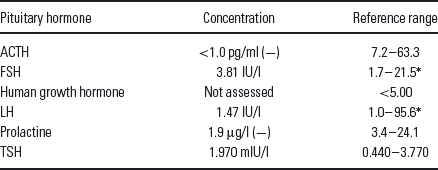
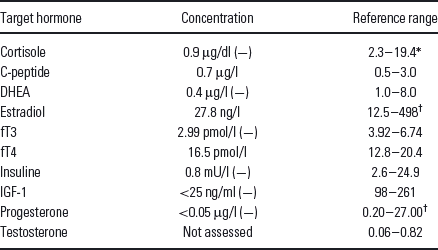
A 39-year old female patient was admitted to the psychiatric clinic 5 months after the development of a severe clinical picture showing epileptical state and consecutive brain oedema due to electrolyte imbalance and hypoglycaemia of 32 mg/dl. At that time, an MRI of the brain showed empty sella syndrome, and endocrinological appraisal revealed a partial insufficiency of the adenohypophysis with decrease of adrenocorticotrope hormone (ACTH), prolactine and insulin-like growth factor 1 (IGF-1) (details are given in Tables 1 and 2). The patient reported to have suffered from domestic violence from her divorced husband over a period of 20 years with the consequence of repeated head injuries. In consideration of significant development of cognitive decline, increasing loss of impulse, changes in character, absent terminal hair, pasty skin since delivery of her first child 15 years ago and repeated head traumas, the aetiology of hypopituitarism was classified as SS, although there was no clear chronological association with the first delivery. After administering a temporary anticonvulsive strategy with valproatic acid and highly dosed hydrocortisone (300 mg once daily) and l-thyroxine (150 μg once daily), the patient's clinical condition improved remarkably. There was no evidence of diabetes insipidus possibly associated with SS, as polyuria and polydipsia were absent and urine osmolarity normalised subsequent to the treatment with hydrocortisone and l-thyroxine. After reduction of hydrocortisone, the patient was discharged with a long-term medication of hydrocortisone (30 mg once daily). Five months later she presented again in the endocrinological department with rapid loss of resilience, increasing fatigue, casually clouding of consciousness, adynamia and apathia and as a consequence inability in everyday life's demands. Suspecting an Addisonian crisis with acute adrenal insufficiency, hydrocortisone was escalated up to 100 mg once daily and given for 5 days resulting in worsening of the initial symptoms. An MRI scan of the brain and examination of cerebrospinal fluid indicated normal findings. Within a first psychiatric bedside consultation in the internal ward, major depressive disorder was diagnosed and escitalopram (10 mg once daily) was administered. The patient was then transferred to the psychiatric clinic. On admission time in the psychiatric clinic she presented a widely disorganised syndrome with inhibition of psychomotor function, disorientation, incoherent thinking, adynamia and sub-depressive mood. Remarks of the patient's partner revealed visual and acoustic hallucinations within the last 5 days that have also been reported by the patient in the next days. Considering that low doses of steroids are occasionally capable of inducing psychosis in SS (Reference Hong, Cho, Kang, Chung and Chung9) we discontinued escitalopram and initiated risperidone (6 mg twice daily) due to DSM-IV criteria for induced psychotic disorder with hallucinations (DSM-IV293.82). Complete cessation of hallucinations was noted within 1 week under that regimen, but deficits in action planning and executive functions together with fluctuating disorientation and disorganisation and clouding of consciousness persisted. Brain MRI scan was repeated which could exclude a persisting brain oedema. To check the patient's every day life performance an early discharge was performed but the patient was readmitted 4 days later with the inability to cope with the previous demands of her life caused by floppiness, fluctuating disorganisation and disturbances in consciousness. Hypothesising another Addisonian crisis we again escalated hydrocortisone up to 100 mg once daily for 3 days without ameliorating tiredness and cognitive deficits. Due to mild akathisia we stopped risperidone and switched to aripiprazole (10 mg once daily) without development of psychotic relapse. Worsening of uneasiness and disturbance of sleep prompted discontinuation of aripiprazole without improvement of cognitive shape or general activity. Administering escitalopram (10 mg once daily) also induced uneasiness and sleep disorder without alleviating symptoms associated with an at least phenomenologically given depressive syndrome. Control MRI scan of the brain showed normal cerebral morphology, and analysis of cerebrospinal fluid for dementia markers (beta-amyloid, tau proteine) was unremarkable. Mini mental state examination demonstrated a normal point value and electroencephalogram was without any pathological findings. Withdrawing any psychopharmacology we observed the patient for another 2 weeks and administered a conservative therapeutic strategy with cognitive training and frequent domestic trials. Since no anastasis developed for a period of 3 months and manifold diagnostic attempts have been performed thoroughly without explanation of the patient's syndrome, we subsumed the symptoms under the concept of a personality change due to a general medical condition, combined type (DSM-IV 310.1). The patient was then discharged with recommendation of regular cognitive training.
Pituitary hormones on day of admission in the endocrinological department
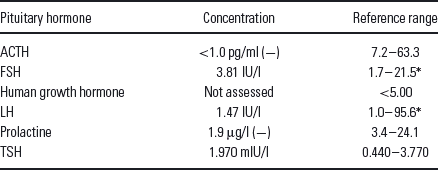
ACTH, adrenocorticotrope hormone; FSH, follicle-stimulating hormone; LH, luteinising hormone; TSH, thyroid-stimulating hormone.
* Full reference range; special reference ranges depend on phase of menstrual cycle that was not available in this case.
Pituitary target hormones on day of admission in the endocrinological department
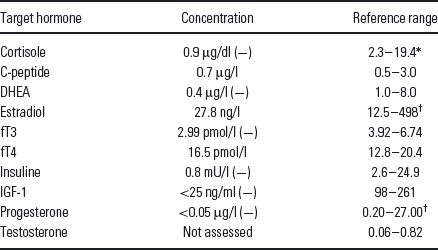
* DHEA, dehydroepiandrosterone; fT3, unbound triiodothyronine; fT4, unbound tetraiodothyronine; IGF-1, insuline like growth factor 1.
* Reference range for the first half of the day.
† Full reference range; special reference ranges depend on phase of menstrual cycle that was not available in this case.
After another 2 weeks the patient was again brought to our clinic by the patient's partner for increasing social distress as a result of the patient's persisting disorientation, listlessness, psychomotor retardation, insomnia, persisting clouding of consciousness, changes in character, apathia and as a new symptom impulsive behaviour. To relieve the social situation at home we admitted the patient to our clinic. Surprisingly the patient developed complete cessation of the described symptoms within 1 week without establishing of a long-term psychopharmacotherapy or any other therapeutical approach. Our clinical impression was in line with the appraisal of the patient's family members, who judged the current constitution of the patient as completely recovered. Retardation of thinking processes and psychomotor activities normalised, mood and interest recovered, and no disorientation or disturbance of consciousness was present. These findings remained stable for 10 days, where the patient tested her condition in her domestic environment with positive results. At follow-up examination 6 months later the patient presented no changes in her condition still without any psychopharmacotherapy. We then considered delirium due to SS (DSM-IV 293.0) as the best explanation for the run of this disease.
Results
A diagnosis of delirium according to the Diagnostical and Statistical Manual of Mental Disorders IV requires disturbance of consciousness, change in cognition, development of the disturbance over a short period of time, fluctuation of symptoms during the course of the day, all that were present in the patient's course of disease. Induced psychotic disorder in the beginning of the psychiatric course distracted the clinician's focus of attention from a possible delirium as an overall explanation for the patient's psychiatric disorder. Nevertheless psychotic disorder induced by escalated prednisolone medication in the beginning of the psychiatric treatment has still to be considered as an additional or even delirium-independent explanation for the initial hallucinations. In the final reflection protracted delirium is the most convincing diagnostical hypothesis for the demonstrated course, particularly regarding that critical illness has been described as a major risk factor for development of delirium (Reference Fann10). However, a main culprit in the aetiology of the demonstrated delirium cannot be isolated.
Discussion
This case of protracted delirium calls attention to the possibility of “hidden” delirium in patients with persisting deficit symptoms and alterations of other neuropsychiatric parameters subsequent to a general medical disease. Considering protracted delirium as the current clinically relevant epiphenomenon of a previous somatic disease should be a basic principle with patients showing unclear confusion after severe somatic illness. This more conservative point of view prevents the clinician from premature diagnostic labelling of the patient with potentially unfavourable prognosis and as a consequence inadequate therapy, as it was done in the presented case when acting on the tentative diagnosis of a personality change and declared the patient's condition as unlikely to be restored.