Introduction
Over the past 15 years, performance management has become an increasingly applied instrument in health care organisations in a number of countries, and is a principal method by which to incentivise changes in behaviour. In the United States (US), an early and continuing innovator in this area, the implementation of performance management grew in the late 1990s in part as a response to reports of avoidable medical mortality and practice variation, mirrored at around the same time in the United Kingdom by, for example, the public inquiry into paediatric cardiac deaths in Bristol (Department of Health, 2001). A new era, focusing more heavily on patient safety, was born, and professional and organisational accountability was highlighted.
Some felt that performance management, using feelings of self-interest to motivate ‘best practice’, would drive improvements in quality. Performance management can, however, take a number of qualitatively different forms, the effectiveness of which might rely on different cognitive responses and each of which may have different negative unintended consequences. Four of the main methods of performance management that are commonly used in practice are broadly defined as follows:
1. Pure financial incentives for pre-defined improvements against specific quality criteria.
2. Public reporting of general performance without financial incentives.
3. Public ranking of performance with apportioned blame for poor relative performance.
4. Public ranking of performance and modest financial incentives for good relative performance.
Although much further work needs to be undertaken in order to conclude more definitively on which, if any, of these four types of performance management offers promise in terms of improving quality at a reasonable cost, there is enough extant literature to enable us to make some educated speculations. Each of the four types will thus now be considered in turn.
Pure financial incentives
Pure financial incentives are better known as pay for performance (P4P). In theory, P4P is a simple instrument that appeals to a straightforward human response, informed by the relative price mechanism of standard economic theory: i.e., if you pay someone to do a particular thing, they are more likely to do it. Unfortunately, the effectiveness of P4P in applied settings, let alone its cost-effectiveness, is less clear-cut. Tanenbaum (Reference Tanenbaum2009) cites evidence that gives a mixed picture of the effectiveness of P4P. For instance, Rosenthal and Frank (Reference Rosenthal and Frank2006), in a review of applications both inside and outside health care, found little evidence of positive effects on quality. Moreover, and more specifically, although Levin-Scherz et al. (Reference Levin-Scherz, DeVita and Timbie2006) found that, under a P4P contract, Partners Health Care System in Boston significantly improved on its performance indicators for diabetes care compared with Partners and non-Partners plans in other locations, these improvements were not replicated for performance in paediatric asthma care.
Many P4P applications might, however, have been insufficiently powered to show much effect. If people are paid enough to do something, we can probably have quite a reasonable degree of confidence that they will do it, a powerful illustration of which has been observed in NHS primary care. In 2004, the UK Government introduced an element of P4P into the contract for paying general practitioners (GPs) by making part of their remuneration dependent on performance against (initially) 146 indicators of clinical quality, practice organisation and patient experience – i.e., the quality and outcomes framework, or QOF. The new P4P incentives were comprised of mostly additional payments, worth up to £1 billion per year in total, 20% of the total GP budget at that time (Roland, Reference Roland2004). Thus, presumably in order to get the acquiescence of the GPs, there were no immediate losers (99.6% of GPs signed up for the new contract, even though participation was voluntary (Campbell et al., Reference Campbell, Reeves, Kontopantelis, Sibbald and Roland2009)).
Doran et al. (Reference Doran, Fullwood, Gravelle, Reeves, Kontopantelis, Hiroeh and Roland2006) observed that during the first year of this P4P mechanism, across the quality indicators, an average of 83.4% of patients were assessed against them. GP practices earned an average of £76,200 from the performance mechanism, which greatly exceeded what the government had anticipated. Prior to the 2004 contract, each GP typically earned £70,000–£75,000 per annum; after the introduction of P4P, their average income rose by £23,000. The GPs clearly responded to the incentives, which, if the chosen quality indicators genuinely improved the quality of care, and there was not substantial gaming activity by GPs, presumably improved primary health care delivery, at least over the period studied.
Although Doran et al. (Reference Doran, Fullwood, Gravelle, Reeves, Kontopantelis, Hiroeh and Roland2006) did not find significant evidence of GPs gaming the system by inappropriately excluding patients who missed the targets, other forms of gaming cannot be ruled out. For instance, pay for performance may still encourage a focus on relatively healthy patients – e.g., if one of the targets is to control cholesterol below a particular level for a certain proportion of patients, one might concentrate on reducing cholesterol in those who are just above the threshold (with a possible increased readiness to prescribe cost-ineffective care), even though population health might be better served by trying to reduce cholesterol for those with levels far above the threshold. Similarly, performance incentives may take time away from sicker or less compliant patients, whose indicators are harder to improve. It is possible that more blatant forms of cheating will also occur, such as doctors recording lower blood pressure measurements than their patients actually have, perhaps necessitating a process of aggressive monitoring and inspection, which inevitably adds to costs.
Moreover, regarding the apparent effectiveness of the GP contract, Campbell et al. (Reference Campbell, Reeves, Kontopantelis, Middleton, Sibbald and Roland2007) struck a note of caution by pointing out that a range of initiatives that had been implemented before the introduction of P4P, including national standard setting for the treatment of major chronic diseases, was already contributing to improvements in process quality. They found that, for asthma, diabetes and coronary heart disease, care had improved significantly more than the longer-term trend for the former two illnesses between 2003 and 2005, but not for the latter. Campbell et al. (Reference Campbell, Reeves, Kontopantelis, Sibbald and Roland2009) reported a follow-up study, and found that by 2007 the rate of improvement had slowed down for all three conditions, to the point where the improvements were increasing at only the pre-2004 rate. The authors suggest several possible reasons for why the improvement in performance slowed down, including the fact that near-maximum performance scores had already been achieved against at least some of the criteria, and that the structure of the incentive mechanism did not reward improvements that exceeded the initial targets. This demonstrates that P4P mechanisms have to be cleverly designed in order to try to secure a sustained effect, but also places a cautionary mark against relying on evidence of short term effect as support for advocating strongly for any behavioural change initiative.
On balance, it appears that P4P can be effective in motivating people to perform incentivised actions, if the incentive is meaningful to them and outweighs the inconveniences that a change in behaviour entails, at least for as long as there is sufficient scope for them to change their behaviour (e.g. if they are doing the best that they realistically can against a performance indicator, then they are unlikely to be able to improve further). The design of the incentive is therefore a key consideration. Moreover, it may be the case that P4P is potentially most effective when targeted specifically at individuals (e.g. GPs) in relation to tightly specified discrete actions, rather than at general organisational-level change. For pure financial incentives to be meaningful, however, comes with considerable cost implications, which places a question mark against the cost-effectiveness of this instrument. Even if they were found to represent good value for money, their impact on the health care budget remains a highly relevant consideration in a cost-constrained environment. We may therefore find it fruitful to turn to other forms of performance management, where effectiveness might not depend on such a substantial monetary input.
Reporting general performance
Simply requiring hospitals to report their general performance to some higher organisational body, or face a financial penalty for not doing so, might be expected to motivate performance improvements, because the hospital managers may perceive that they are being in some sense monitored, and will not want to give the impression that their organisation is performing poorly. Since the mechanism does not reward or punish actual performance – rather, just the reporting of it – the expectation of performance improvement does not seem to be informed by standard economic theory. It may loosely be informed by a psychological finding known as priming. A study undertaken by Bateson et al. (Reference Bateson, Nettle and Roberts2006) helps to illustrate this phenomenon. In their study, office workers were allowed to help themselves to tea or coffee in a shared kitchen, on the understanding that the workers would make voluntary contributions to pay for further supplies. For a period of 10 weeks, a poster was displayed next to the suggested price list, with the picture alternating each week between an image of flowers and an image of a pair of eyes. The contributions were three times higher in the ‘eye weeks’ than in the ‘flower weeks’, indicating that the symbolic reminder of being watched was sufficient to motivate people to contribute more money. Importantly, the priming literature has generally not reported evidence of sustained effect, but we can speculate that if requiring hospitals (or other health care organisations) to report their performance gives the managers a feeling of being watched, then this might incentivise them to strive harder to improve their organisation’s performance.
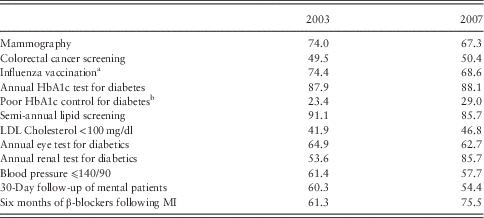
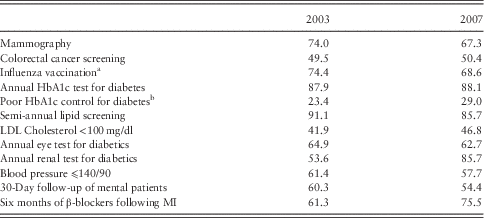
Although relatively inexpensive to implement, however, the evidence of performance improvement consequent on motivating organisations merely to report is not auspicious. For illustrative purposes, consider Medicare, the US publicly financed health care program for the over 65s. Medicare has collected hospital performance data since the early 2000s, and since 2003 has financially penalised hospitals if they fail to provide information on particular measures of clinical quality. By 2004, 98% of hospitals participated in the program (ACHP, 2005). One can to some extent attempt to observe whether this increased reporting has improved performance by looking at the Healthcare Effectiveness Data and Information Set (HEDIS) data reported by the National Committee for Quality Assurance (NCQA). HEDIS measures the performance of managed care plans (to which hospitals are aligned) against a number of performance criteria of the type collected by Medicare. Table 1 summarises the performance of the Medicare plans against a selection of these criteria in 2003 and 2007. The table shows that performance deteriorated between 2003 and 2007 on some indicators and improved on others, but, with the exception of annual renal tests for diabetics, there is no overwhelming evidence that performance had, in general, improved.
Percentage of eligible patients experiencing select indicators of quality
Notes: MI=myocardial infarction.
a For patients aged 65 years and over.
b Lower is better.
Source: NCQA (2008).
Admittedly, this is an imperfect test of the effect of public reporting. For instance, other concomitant Medicare policy initiatives may well have confounded the results, swallowing the effect of reporting, and, moreover, in the counterfactual, without reporting, it is possible that Medicare could have fared worse than it did. Having said this, it is noteworthy that others have similarly stated that the mere publication of reported performance data often has little effect (e.g. see Marshall et al., Reference Marshall, Shekelle, Davies and Smith2003; Fung et al., Reference Fung, Lim, Mattke, Damberg and Shekelle2008; Besley et al., Reference Besley, Bevan and Burchardi2009). This particular form of reporting may thus lack sufficient motivational power, although this is not to suggest that the priming phenomenon ought to be dismissed outright; indeed, priming health care professionals to undertake discrete beneficial acts, such as more regular hand washing, might prove to be a useful line of inquiry, and health care organisations should perhaps therefore be encouraged to experiment with initiatives informed by priming within their work environments. In terms of performance management, however, the mere reporting of performance with no incentives to improve performance appears to be associated with low costs but poor effectiveness. To improve motivational power, the data needs to be presented in such a way as to make it easier for the public and for the health care professionals themselves to discern how health care organisations or even individual professionals are performing relative to their peers, and to ground the policy approach more firmly in behavioural economic theory. Fortunately, there are examples of such initiatives that have demonstrated reasonable effect.
Public ranking with apportioned blame
Publishing the relative performance of health care organisations and/or professionals in an open and easily understood way introduces the concepts of reference points and loss aversion, which are among the strongest findings in the field of behavioural economics (see, for instance, Kahneman and Tversky, Reference Kahneman and Tversky1984; Tversky and Kahneman, Reference Tversky and Kahneman1991). The finding is that when people make choices, they often anchor on something that is salient to them – that is, their reference point – and act as if the avoidance of losses around that reference point is a more powerful motivating force than the possibility of experiencing a gain above the reference point. Hence, they are particularly averse to the possibility of experiencing a loss, far more so than can be explained by standard economic theory. Specifically, in contexts that involve money outcomes (which is the domain over which the main findings of empirical behavioural economics were originally uncovered), the disutility that individuals seemingly suffer from losses is approximately twice as great in magnitude as the utility that they enjoy from gains of the same absolute size. Knowing that people are strongly averse to losses has the potential to be a useful piece of information when designing public policy initiatives.
Therefore, it can reasonably be hypothesised that publishing the performance of health care entities in the form of a league table – with better relative performance winning a higher place in the table – may encourage managers and doctors to adjudge their performance against what they perceive to be their reference point (e.g. the performance of an alternative local hospital, a peer, a reasonable position set by government, etc.). If current performance is poorer than the reference point, this may serve as a motivator to try to improve performance in time for the publication of the next league table. Those who are performing well might be similarly motivated to retain, at the very least, their position – hence, to not lose status (admittedly, if a person or organisation routinely expects that they will perform poorly on the league table, their reference point might be low and the motivating power of loss aversion could be weak).
Some have looked at whether supplementing the league or performance table with some form of blame or punishment for poor relative performance might strengthen the instrument still further, in essence, one might hypothesise, by further strengthening the aversion to losses. We can denote this naming and shaming concept as blame for performance, or B4P. A good example of this type of incentive mechanism was used in England’s NHS hospital sector in the early to mid-2000s. Specifically, in 2001 the government introduced a performance framework called the hospital star rating system, whereby NHS hospitals in England were assessed annually on a number of indicators, including targets against waiting times, cleanliness, treatment-specific data and financial management (the star rating system was replaced by another system of reporting hospital performance against waiting time targets called the Annual Health Check from 2006 to 2010, although the UK Government emphasised a new policy of patient choice during that latter period). After assessment, hospitals were each awarded from zero to three stars, with more stars indicating better performance, and, perhaps, at least two stars serving as a reference point for many providers. The star ratings were publicised in national and local media outlets, and for very poor performance hospital management teams could be dismissed (for very good performance, hospitals could earn greater autonomy from central government, and therefore the instrument did not rely on punishment exclusively as a motivator for behaviour change).
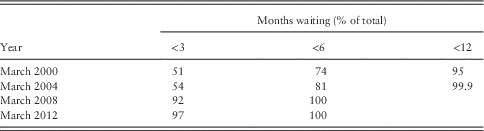
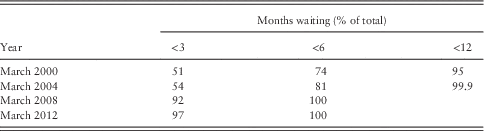
The threat of dismissal and the fact that relative performance was fairly widely publicised clearly demonstrate that the star rating system was a ranking exercise that apportioned blame. Other NHS policies such as the patient choice policy may confound the effectiveness of the star rating system to some extent (although the patient choice policy was not introduced until January 2006), but several authors have lauded the effectiveness of star rating, particularly with respect to reducing waiting times (e.g. Bevan and Hood, Reference Bevan and Hood2006; Propper et al., 2008; Besley et al., Reference Besley, Bevan and Burchardi2009). Mays et al. (Reference Mays, Dixon and Jones2011) concluded from a review of these various reforms that accountability against targets, at least in the quite narrow domains over which targets were set, appeared to be more effective than choice and competition. Moreover, using the star rating system as a natural experiment, Bevan and Fasolo (Reference Bevan and Fasolo2013) note that Wales, Scotland and Northern Ireland, with similar increases in health care spending, did not institute the same magnitude of star rating governance system of targets and reputation, and as a consequence did not achieve the reductions in waiting times observed in England. Initially, the principal waiting time target in the star rating system was that no patient should have to wait more than 12 months for elective hospital care. Subsequently, the target was reduced to six months and then 18 weeks (which, by the end of the decade, had been almost met). Table 2 illustrates the striking reduction in waiting times – arguably the biggest NHS success of the last two decades – since the introduction of the star rating system.
Although it is fairly uncontroversial to conclude that the behavioural motivators instituted by the star rating system contributed substantively to the fall in waiting times, the unprecedented increase in NHS expenditures during the decade beginning in 2000 facilitated an increase in the system’s capacity that was a necessary requirement for the observed decrease in waits [specifically, between 1997 and 2011, public health care expenditure increased from £44 to £118.3 billion, or 7.3% per annum, while average annual general inflation over the period was only 2.4% (ONS, 2013)]. Whether a similar mechanism might work to the same extent in a resource-constrained environment is questionable. Moreover, a sustained use of publicising relative performance alongside naming and shaming when there are resource constraints may negatively impact on morale, undermining the ability and willingness of NHS staff to identify with the system.
The importance of recognising people’s ability to identify with the organisation in which they work, and the effect that this may have on their performance, has been considered in the behavioural economics literature over the last 10 years, particularly in the work of Akerlof and Kranton (Reference Akerlof and Kranton2010). They propose that people experience positive utility from working for an organisation with which they identify and negative utility if they perceive themselves to be outsiders. Identity utility is thus the gain we feel when the actions and ethos of people and things around us (our peer group, our workplace, etc.) conform to our norms and ideals; identity disutility is the converse. Although such a general concept may be familiar in other branches of social science, the utility experienced from feeling that one belongs is not generally incorporated formally into standard economic theory. Akerlof and Kranton apply their framework to firms, the military, the education sector, gender in the labour market and in the home, and race and poverty. If we take the organisational behaviour of firms, for example, according to Akerlof and Kranton, good management involves creating workers who are motivated insiders who identify with the goals of the firm. Aligning the objectives of managers (or policy makers) and workers is the goal of a strategy called ‘management by objective’, which works by changing the self-motivation of workers. The intention is that after a while workers will want to achieve the objectives of the firm, regardless of additional personal financial rewards, because they will identify with those objectives. Akerlof and Kranton did not consider health care, but it is quite plausible that policies such as public reporting with naming and shaming, although well-grounded positively in some aspects of behavioural theory, may, according to other theoretical behavioural postulates, pose the potential to damage the NHS in the long run. In short, it is important to recognise that behavioural economics may sometimes predict policy effects that are socially beneficial or harmful, depending on which behavioural concept dominates. Therefore, if one wants to try to incentivise with league tables, it may be prudent to avoid an excessive focus on punishment.
Public ranking with modest financial rewards
When faced with a performance league table where the focus is on rewards for good relative performance, behavioural economic theory might suggest that managers would still choose a reference point and perceive performance as good or bad – i.e., a gain or a loss – relative to that reference point. Therefore, loss aversion will remain as a motivator, but the fear of punishment and the consequent harms to morale if performance is poor in relative terms is removed, or at least ameliorated (of course, if an individual or organisation is performing poorly in absolute terms, it is the responsibility of the governing authority to attempt to find out why this is the case, and, if necessary, to remove those responsible). In 2003, the Centers for Medicare and Medicaid Services (CMS), which administers both Medicare and Medicaid – the publicly financed health care system that covers many of the US’s indigent – initiated an experiment that combines league table and financial incentives. The experiment, called the Hospital Quality Incentive Demonstration (HQID) project, lasted for three years, and was conducted in co-operation with Premier Inc., a non-profit hospital alliance. There were 270 hospitals of varying size in the project, located across 36 states, which were assessed on more than 30 performance indicators relating to acute myocardial infarction, coronary artery bypass grafting, heart failure, pneumonia and hip and knee replacement. The hospitals were ranked annually according to their performance and hospitals in the top decile received a 2% bonus on their standard payments, while those in the next decile received a 1% bonus. Initially, therefore, the project focused on combining league tables with rewards. In HQID’s final year, hospitals in the bottom two deciles suffered similar payment decrements, indicating that the project eventually involved a mix of positive and negative financial incentives.
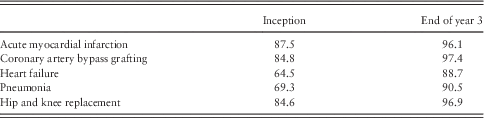
Tanenbaum (Reference Tanenbaum2009) notes that the overall performance improvement for the project’s first year was 6.6%. The magnitude of performance improvement required before one can conclude that an initiative has been a success is subjective, but over the three years of HQID there was an overall average improvement measuring 15.8%, which is not negligible (Table 3 gives a breakdown of improvement by therapeutic area). Less auspiciously, Glickman et al. (Reference Glickman, Ou, DeLong, Roe, Lytle, Mulgund, Rumsfeld, Gibler, Ohman, Schulman and Peterson2007) found no significant difference between the in-hospital mortality rates for acute myocardial infarction in HQID hospitals vs controls. This may have been because the performance indicators in this clinical area are insufficiently linked to in-hospital mortality rates, perhaps highlighting the importance of ensuring that there is a good evidence base to show that the relatively easily influenced indicators of process quality are adequately associated with the primary outcomes of interest. A version of the HQID project has been applied in the English NHS in recent years (Maynard and Bloor, Reference Maynard and Bloor2010).
Performance improvement in the HQID ProjectFootnote a
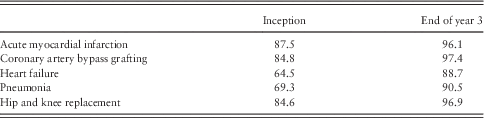
HQID=Hospital Quality Incentive Demonstration.
a The figures are the percentage of eligible patients experiencing the quality indicators.
Source: US Department of Health and Human Services (2008).
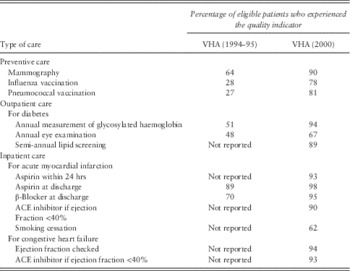
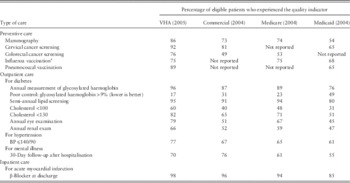
Combining league table competition with a quite modest use of financial incentives for good relative performance is also used in the US Veterans Health Administration (VHA), with apparent positive effect, at least up until the middle of the first decade of this century (Asch et al., Reference Asch, McGlynn, Hogan, Hayward, Shekelle, Rubenstein, Keesey, Adams and Kerr2004; Oliver, Reference Oliver2007). The VHA is the largest integrated health care system in the United States, and provides public sector care for honorably discharged veterans of the US armed forces. The system is financed mostly from general taxation and is structurally very similar to the NHS. The VHA traditionally had a reputation for poor quality, which was a catalyst for a set of reforms introduced in the mid-1990s. As part of these reforms, health care managers were made accountable for performance against process quality indicators (e.g., mammography rates, LDL cholesterol <100 mg/dL, etc.). Only senior managers are eligible to receive bonuses for good performance, which typically amount to up to 10% of their salaries, but this incentive in many cases led in turn to them putting pressure on their clinical teams to improve performance. Moreover, details of the relative performance of each facility are disseminated periodically throughout the VHA in the form of a league table, generating non-financial competition since no hospital wants to be seen as performing worse than a local ‘rival’ (note that there is no competition for patients in the VHA – patients are referred to hospitals by primary care gatekeepers). Other initiatives also facilitated the transformation of the VHA (Oliver, Reference Oliver2007), but probably principally due to the performance incentives, the VHA, within the space of five years, demonstrated significant improvements in process quality (see Table 4), and by 2005, with the exception of outpatient follow-up of those admitted to hospital for a mental illness, the VHA outperformed the commercial sector, Medicare and Medicaid on all of the quality indicators over which these systems could be compared (see Table 5).
Summary of VHA performance at the time of the reforms vs five years after reform

All of the differences 1994–1995 and 2000 are significant at 0.1%.
Source: Jha et al. (Reference Jha, Perlin, Kizer and Dudley2003).
Summary of VHA vs non-VHA performance in 2004–2005

a For patients aged 65 years and over.
Sources: The VHA data is reported in: VA Office of Quality and Performance (2005). The data for the commercial, Medicare and Medicaid sectors is HEDIS data.
Unfortunately, recent evidence of gaming activities and numerous consequent preventable deaths within several VHA medical centres, possibly attributable to unrealistic waiting time targets, has seriously harmed the reputation of the system. These events underline the importance of a careful design of any performance management system if harms are to be limited and positive effects observed. Even without these tragic circumstances, a number of legitimate qualifiers can be brought forth with respect to the positive effects reported in Tables 4 and 5, in that these may at least in part have been the consequence of better documentation rather than reflecting genuine improvements. Moreover, Vladeck (Reference Vladeck2004) has argued that the quality improvements are more likely to have been caused by reinforcing the norms of professional responsibility than by the inherent incentives involved, although that of course is debatable and even if true may in any case indicate that ranking with modest financial incentives is a useful way by which to reinforce those norms. Some would also rightly raise the question of whether ranking with even small incentives, even if effective, represents good value for money. However, given the paucity of cost data in this area and the uncertainty over whether process quality indicators lead to real improvements in health outcomes, not much can be said about the instrument’s cost-effectiveness other than that the financial incentives used in the HQID project and the VHA, as compared with the total cost of health care delivered, were quite modest. There is thus qualified evidence of some positive effect when combining modest financial incentives with a league table ranking exercise. Ranking in and of itself may be insufficient (further research would be required to discern its independent effect), and financial incentives in and of themselves would perhaps need to be prohibitively large in the current public finances climate in order to have the desired effect (although, even here, the independent effect of small financial incentives on professional and organisational behaviour merits further study).
As will be clear from what has been written up to this point, performance management initiatives have tended to focus upon motivating improvements in process quality – i.e. quite specific, discrete, easily acted upon tasks, each of which can be undertaken by a single health care professional, such as, for example, administering vaccinations and blood sugar readings. This begs the question of whether these initiatives could be similarly deployed to improve the more complex aim of motivating a more integrated care process, which would presumably often rely on a co-ordinated response from multiple health care teams who sometimes act independently from one another. Performance management, as it has tended to be applied [i.e. on a limited number of criteria, so as to avoid the possibility of target fatigue among health care professionals (Smith, Reference Smith2002)], is commonly thought to be detrimental to a holistic, integrated approach to health care delivery (see, e.g. Roland, Reference Roland2004) because it may draw attention away from good but non-incentivised practices. Even if performance indicators are restricted to the simple process indicators, performance management has been subjected to a number of criticisms that would presumably apply to an even greater extent as the indicators become more complex. For example, Roland (Reference Roland2004) has stated that it is critical for the indicators to align with the policy goals one is trying to pursue [this is sometimes more difficult than it sounds – e.g. Coleman et al. (Reference Coleman, Reiter and Fulwiler2007) found that pay for performance increased the likelihood of blood sugar tests but did not improve blood sugar control], but Smith (Reference Smith2005) has pointed out that the choice of indicator is often opportunistic and selective rather than rational, and tends to rely on existing data sources. He has therefore argued that data should be collected to match the performance indicator and not vice versa.
Although there are concerns that performance management may crowd out good non-incentivised practices, the evidence on this issue is mixed. Besley et al. (Reference Besley, Bevan and Burchardi2009) maintain that there is little evidence that the shorter waits produced by the star rating system were offset by significant detrimental effects on performance in other quality dimensions, a finding mirrored by Asch et al. (Reference Asch, McGlynn, Hogan, Hayward, Shekelle, Rubenstein, Keesey, Adams and Kerr2004) with respect to the VHA (although in both of these studies, the authors’ timeframes were quite short-term, and, moreover, they concentrated on discrete processes and did not consider the possible negative impact on the overall integrated nature of health care delivery). That said, the events recently uncovered at the VHA suggest that ill-designed waiting time targets may not only lead to the crowding out of good practices but also can lead to corruption with tragic consequences. Smith (Reference Smith2002), also in relation to waiting-time targets but in the UK context, reported that a preoccupation with inpatient waiting times prior to the star rating experiment led to widespread distortions in clinical priorities and a misrepresentation of performance. Campbell et al. (Reference Campbell, Reeves, Kontopantelis, Sibbald and Roland2009), with respect to the GP contract, noted that by 2007 the quality of those aspects of care that were not incentivised had deteriorated for asthma and heart disease care, and that the level of care continuity, as measured by how often patients were able to see their usual doctor, had declined.
Regarding integration, possibly the best starting point would be to engage with health care professionals to attempt to find out what they believe is required to improve a co-ordinated response. An extended consultation exercise of this kind may reveal some relatively simple actions that professionals might readily be able to act upon to ultimately improve the total care experience. Consulting widely with health care professionals when designing a performance framework serves another important function – it helps them to identify with the instrument.
A taxonomy of performance management initiatives
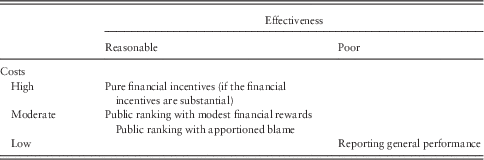
Although nothing definitive can be said about the costs and effectiveness of the different types of performance management, partly because the performance of these initiatives will be highly contextual, there is enough evidence for us to make a speculative taxonomy in this regard. This is given in Table 6.
Taxonomy of the costs and effectiveness of performance management
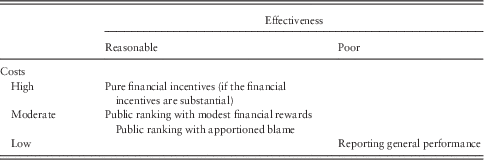
A cursory glance at Table 6 appears to reveal that, in an environment where there are particularly strong constraints on resources, it is advisable for policy makers to focus their attention on carefully designed public ranking exercises, either in conjunction with modest financial rewards or an element of apportioned blame (or both), if considering the application of performance management instruments. However, consideration of behavioural theory might make it advisable to think twice about blaming relatively poor performers because this could serve to alienate and demotivate the very people on whom a health care system relies. Of course, poor performers in the absolute sense need to be identified, blamed and, where appropriate, punished, but relatively poor performance may not be bad in any absolute sense, and could be relatively poor due to circumstances beyond the control of the professionals involved. It is thus incumbent on policy makers to try to better understand why the performance of those towards the bottom of the league table is relatively poor in an attempt to identify if there is anything that can be done to help them.
The suggestion here then is that, even though strengthening loss as a motivational lever is tempting, it is advisable for policy makers to use blame (or other forms of punishment, financial or otherwise) guardedly. It is at least as important to make employees feel that they are motivated insiders – that they share a sense of identity with the institution in question – if one wants to get the best out of them. Therefore, league table ranking, possibly with modest financial rewards, may be the most sensible application of performance management.