




No CrossRef data available.
Article contents
Reversing the trajectory of language change: Subject–verb agreement with be in New Zealand English
Published online by Cambridge University Press: 08 November 2004
Abstract
This article examines the historical evolution of subject–verb concord in New Zealand English. We investigate the usage of the singular form of be with plural NP subjects (existentials and nonexistentials) over the past 150 years. The results demonstrate that the New Zealand English subject–verb concord system has undergone considerable reorganization during this time. Singular concord in nonexistentials occurred in early New Zealand English, but is now largely absent. In existentials, it steadily declined during the late 19th century, and then reversed this trajectory to become a well established feature of modern New Zealand English. Singular concord in New Zealand English existentials is now conditioned by a range of social and linguistic factors, and largely resembles other varieties in this respect.We are indebted to the ONZE team, particularly Elizabeth Gordon, Margaret Maclagan, and everyone involved in the collection and transcription of the corpora over the years. Thanks also to the students of Ling 203 2002 for their preliminary analysis of the data and lively discussion. Helpful feedback on this paper has been provided by David Britain, Elizabeth Gordon, Margaret Maclagan, Andrea Sudbury, Peter Trudgill, Heidi Quinn, the audience at the New Zealand Linguistic Society conference, and three anonymous referees. The authors are listed in alphabetical order.
Information
- Type
- Research Article
- Information
- Copyright
- © 2004 Cambridge University Press
BACKGROUND
Example (1) shows two excerpts from an interview with a speaker of early New Zealand English. Mr. R. was born in New Zealand in 1898. Both excerpts show an example of singular concord with the verb be. An example such as that in (1a) would be unusual in contemporary New Zealand English, whereas that in (1b) would be unremarkable. Such examples indicate that patterns of subject–verb agreement with the verb be may have changed over the history of New Zealand—at least in nonexistential environments such as (1a).

This article traces the use of subject–verb concord with the verb be through the history of New Zealand English. Singular agreement with plural NP subjects is examined, in both existential and nonexistential constructions. We document changes that have occurred with existentials and nonexistentials, and investigate the degree to which these changes are independent of one another.
The verb be is prone to variation in many dialects of English, and the inherent irregularity of the present and past tense paradigms of the English verb be is thus of vital interest to variationist linguistics. The five variants (am, is, are for present, was and were for past tense) give this verb iconic status as they combine in a verbal paradigm so irregular that, in the words of Wolfram, Hazen, and Schilling-Estes (1999:75), it is “without parallel in the current configuration of subject–verb concord.”
English verbal morphology is pervasively regular, and distinct tense variants are minority forms and linguistically marked. Marked variants are often subject to pressures toward analogy (particularly in vernacular varieties), that is, they frequently display tendencies to bring irregular person-number concord in line with the vast majority of verbal paradigms that display no such agreement. Accordingly, there have probably always been trends toward paradigmatic regularization, and most historical and contemporary forms of English are subject to alternation of variants. For instance, a number of historical studies attest to the diachronic dimension of be irregularity; Quirk and Wrenn (1960) documented alternation among distinct patterns in Old English (particularly in existentials), and Traugott (1972), Visser (1970), Jespersen (1961), and Denison (1998) trace its development in the Middle and Early Modern periods of English.
The historical evidence is complemented by a plethora of synchronic studies on be variation in varieties of English around the world. There is a particularly sizeable literature on was/were alternation (or past be regularization), which has been investigated in the British Isles (Britain 2002; Cheshire, 1982; Ojanen, 1982; Tagliamonte, 1998), the United States (Labov, 1972; Labov, Cohen, Robins, & Lewis, 1968; Feagin, 1979; Hazen, 1994, 2000a, 2000b; Mallinson & Wolfram, 2002; Wolfram & Christian, 1976), the South Atlantic (Britain & Sudbury, 2002; Schreier, 2002b, 2003), Australia (Eisikovits, 1991), Canada (Meechan & Foley, 1994), and the Caribbean (Tagliamonte & Smith, 1998). Whereas most of these quantitative studies looked into the patterning of variation and its internal and extralinguistic correlates, research has also focused on the delimitation of genetic relationships and (potential) founder effects (Tagliamonte & Smith, 2000) or on contact-induced regularization mechanisms in new-dialect formation (Schreier, 2002b).
A few general findings emerge from the literature on subject–verb agreement with be. First, the present be paradigm is more robust to levelling than the past be paradigm. Person-number concord involving am, are, and is by and large adheres to the agreement rules of Standard English, whereas extension of the pivot form was (i.e., forms such as we was) is so widespread that it constitutes a “vernacular root” of English. This point is made by Chambers (1995:242), who identified we/you/they was as one of the “variables [that] appear to be primitives of vernacular dialects in the sense that they recur ubiquitously all over the world.” Forms like we was are found in many varieties of English (Cheshire, Edwards, & Whittle, 1989, 1993), whereas I/we is are infrequently reported and geographically restricted to areas such as northern England (Linguistic Atlas of England; Orton, Sanderson, & Widdowson, 1978), the Southern United States (e.g., rural Mississippi; Burkette, personal communication, 2002), or the South Atlantic Ocean (Schreier, 2002a; Schulenburg, forthcoming; Wilson, 1997). Accordingly, there is a particularly extensive literature on past be realignment, and a few trends emerge. One important finding is that, even though extension of was is by far the most common process, multiple pivot forms may be selected during regularization processes. Alternation between variants is thus not necessarily a unilateral process. Alternative regularization trends may occur in one and the same variety, and some studies report considerable variability in terms of directionality. The most usual pattern is for was to feature in contexts of standard were (Chambers' 1995 “vernacular root”), but alternative processes include the extension of were to contexts of was (e.g., I were there last night; Cheshire, 1982; Tagliamonte, 1998) or weren't to the context of wasn't (e.g., I weren't planning to come; Britain, 2002). One important implication is that varieties may develop highly intricate patterns, namely the simultaneous extension of was to positive contexts and weren't to negative ones (Britain, 2002; Schilling-Estes & Wolfram, 1994). Such two-fold leveling processes result in a realignment of the two paradigms, contributing toward a “remorphologization of the was and were allomorphs of past be along positive/negative, rather than person-number, lines” (Schilling-Estes & Wolfram, 1994:280). As a result, both was and weren't allomorphs may occur in all subject contexts, with both numbers and in all persons. This pattern is also found in the contemporary English Fens English, where Britain (2002:17) reported that “Young people […] increasingly use was in affirmative clauses (irrespective of person/number) and almost exclusively use weren't in negative contexts.” Several morphemes may thus undergo parallel extension and reanalysis, and paradigm regularization does not always operate as a unilateral process.
Another finding to emerge from the literature is that alternation between be variants is subject to robust linguistic constraints, and that individual contexts exhibit differential tendencies to cooccur with extended forms. The type of subject plays an important role and, as Tagliamonte (1998) pointed out, modern variationist studies often focus on third-person plural contexts, as this environment offers particularly important insights into linguistic constraints on variation. Third-person plural environments can cooccur with a personal pronoun (they were), a NP (the cows were), or with an existential subject (there were cows). These three environments have different agreement patterns, with existentials having the highest levels of was agreement (there was cows), and personal pronouns having the lowest (we/they was, with forms like we is being very infrequent). This finding is replicated in practically all studies on subject–verb agreement involving finite forms of be (Cheshire, 1982; Eisikovits, 1991; Feagin, 1979; Hazen, 2000a; Wolfram & Christian, 1976). Of the personal plural pronouns, there is evidence that they is the least likely to occur with was (Eisikovits, 1991; Feagin, 1979). Second-person singulars tend to have higher levels of was agreement than first- and third-person plural contexts (Eisikovits, 1991; Feagin, 1979; Smith & Tagliamonte, 1998; Tagliamonte, 1998). This most likely represents a reflection of earlier forms of English, which had particularly extensive was/were alternation in this context. As Forsstrœm (1948:22) noted, second-person singulars were subject to considerable regional variation in Middle English. There was a sharp division between the south of England, with predominant usage of were, and northern varieties, which historically used was with this person.
Plural NP subjects, on the other hand, tend to exhibit higher levels of was agreement than personal pronouns, and studies such as Feagin (1979), Christian, Wolfram, and Dube (1988), and Hazen (2000b) reported that the type of plural NP (simple, collective, or conjoined) may have an effect on agreement patterns, with collectives and conjoined NPs showing higher levels of nonstandard concord than simple NPs.
In some dialects, the type of subject has categorical effects. For example, the Northern Subject rule has operated in the northern dialects of Britain from the 13th century (Montgomery, 1994; Murray, 1873). The Northern Subject rule allows verbal -s endings (including is/was forms of be) after full NPs, but not after pronouns. However, are/were is also used with full NPs in the case when a clause intervenes between the subject and verb. It is thus a combination of a type of subject constraint and a proximity condition.
Of particular relevance is the absolute and relative positioning of verb and subject phrases (Britain & Sudbury, 2002; Meechan & Foley, 1994). Was agreement is much more likely to operate when the verb precedes subject NPs (for instance in existential there V NP constructions) than when the NP occurs in canonical pre-V position. Existential plural constructions have “by far the strongest effect on the use of was in contexts of standard were” (Tagliamonte & Smith, 2000:157), and this finding is reproduced in all varieties that have been subject to linguistic scrutiny (Christian et al., 1988; Eisikovits, 1991; Hazen, 2000b; Schilling-Estes & Wolfram, 1994; Schreier, 2002b). There is also some evidence for an effect of the proximity of the verb and the subject, with intervening linguistic material facilitating nonstandard concord (see, e.g., Britain & Sudbury, 2002; Tagliamonte, 1998).
Even though existentials are usually discussed in conjunction with other linguistic environments, some recent studies have investigated this context separately, with different intentions. Meechan and Foley (1994:63), assuming that “the unusual concord variation pattern was a result of structural differences associated with the restriction on the type of determiners preceding the postverbal NP”, embedded their analysis in a detailed syntactic and phonological framework. They included factors such as the assignment of case and the control of agreement, and considered the implications of there's/there are alternation for syntactic theory and socially or language-internally conditioned effects on variation (Meechan & Foley, 1994:65 ff.; see also, Cheshire, 1999). Britain and Sudbury (2002), on the other hand, investigated existential constructions in terms of their potential for parallel language development in two transplanted forms of English (Falkland Island English, FIE, and New Zealand English, NZE): “the universality of variability in (there's) […] enables us to assess whether the diffusion of (there's) variability across the anglophone world has proceeded in the same way in each speech community” (Britain & Sudbury, 2002:213). They compare a variety of linguistic constraints on agreement with existentials (tense, determiner and quantifier types, distance between VP and NP, etc.) and document remarkable similarities in the two varieties, which they discuss with reference to parallel independent language change and the controversial concept of language “drift” (Sapir, 1921; see also, Hickey, 2003; Trudgill, Gordon, Lewis, & Maclagan, 2000).
Subject–verb agreement with be is consequently one of the most detailed and widely researched variables in English; analysis of this feature has contributed toward the study of language change, variation analysis, dialect transplantation and contact, and genetic linguistics. The present study adds to the literature, focussing on the evolution of concord patterns in a dialect contact scenario. We address questions such as: What trajectory does subject–verb agreement (of present and past tense paradigms) follow in this (post)colonial locale that involves the transplantation of several inputs? Are there parallels and similarities with other varieties, or does concord follow its own path, deviating from dialect to dialect? Is the development of subject–verb agreement patterns in existential constructions linked to patterns of usage in nonexistentials? With these aims, we trace the historical development of subject–verb agreement for the verb be in New Zealand English.
DATA AND METHODS
Archives
The data analyzed come from three archives, all of them held by the Department of Linguistics at the University of Canterbury, Christchurch. One of them is the Mobile Unit (MU) archive, the basis of the Origins of New Zealand English (ONZE) project (Gordon, Campbell, Hay, Maclagan, Sudbury, & Trudgill, 2004). The recordings in the MU database were conducted in 1946–1948 by members of the Mobile Disc Recording Unit of Radio New Zealand, whose principal aim was the collection of personal reminiscences of the earliest phases of British involvement in New Zealand (Lewis, 1996; Woods, 1997). This archive contains recordings of more than 250 people born in New Zealand between 1853 and the early 1900s, and is the only collection of spoken data from 19th-century NZE available to date. Most of the people interviewed were first or second generation New Zealanders, that is, children of the first European colonizers of New Zealand (primarily from England, Scotland, Ireland, and the Australian colonies). The MU archive has been subject to intensive research and has yielded a wealth of information on contact dialectology in general (Trudgill, 1998; Trudgill et al., 2000) and the formation of New Zealand in English in particular (Gordon et al., 2004; Sudbury & Hay, 2002; Trudgill, Gordon, & Lewis, 1998). The other two archives, which are subject to extensive current research, contain recordings of New Zealanders born in the 20th century. The intermediate archive (IA) contains recordings of about 150 New Zealanders born between 1896 and the early 1930s. Most of these data were collected for oral history projects, which may be of importance because they are stylistically less formal than the MU recordings (further discussion later). The third archive, the Canterbury Corpus (CC), contains some 370 speakers. This is an archive created by the University of Canterbury New Zealand English class, which each year interviews individuals fitting into a prespecified sample, stratified by age, gender, and social class. Together, the three corpora contain over 700 speakers born between 1853 and 1980, and span the entire formation period of NZE. This article analyzes subject–verb agreement in a subset of 146 of these speakers.
Extraction and coding procedures
This article has as its origin a class research project assigned to Ling 203 – Sociolinguistics at the University of Canterbury, New Zealand, taught in 2002. In a preliminary stage, each of the 47 participating students was assigned several transcripts (taken from the three corpora described) and took responsibility for coding these for subject–verb agreement.
Students were instructed to extract and code in the transcripts all examples of be with a plural subject, excluding noncount cases such as nonexistential inverted examples (how are the children?). Examples involving mass nouns (the fish weren't present) were also not included. The data analyzed here were thus initially extracted by students and subsequently double-checked by both authors. Examples of be with singular subjects were not analyzed. This is because preliminary analysis of the data revealed that instances of nonstandard are/were were extremely rare in the data set. The quantified analysis was therefore restricted to nonstandard is/was, which preliminary analysis revealed occurred with relatively high frequency.
Note that the analysis was based on orthographic transcripts of the recordings. These transcripts include detail about hesitation and overlap, and have been double-checked by multiple research assistants.
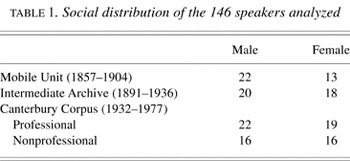
Some attempt was made to analyze a balanced stratified sample, although this was partially limited by practical considerations. The two most important constraints are that the earliest MU corpus contains more male speakers than female speakers, and that not all speakers are stratified along socioeconomic criteria. The most recent corpus makes a distinction between “professional” and “nonprofessional” informants, a distinction which is made both in terms of level of education and type of occupation (see Maclagan, Gordon, & Lewis, 1999, for details). Class-based variables are therefore available for the later-born speakers only. Table 1 shows the social distribution of the 146 speakers analyzed. Entire transcripts were analyzed for all speakers. The recordings differ quite substantially in length, and so the amount of data available differed across speakers. The amount of speech transcribed ranges from 10 minutes to over an hour. Note, also, that there is a slight overlap in birthdates between the MU and the IA, and between the IA and the CC speakers.
Social distribution of the 146 speakers analyzed

Our analysis considered a number of social and linguistic criteria. Social factors considered here include age and gender (and, for speakers for which such information was available, social class). Consequently, all tokens were coded for date of birth and gender of the individual speakers. Lastly, speakers from the CC corpus were coded for social status (professional vs. nonprofessional). We also analyzed a number of language-internal factors, namely:
- Tense (past, present)
- Polarity (positive, negative)
- Modifier type [bare (i.e., no modifier), definite determiner, number, negative, adjective, quantifier, ‘a’ quantifier (e.g., a lot of, a few)].
- Distance between noun and verb (measured in the number of interpositioned words: 0, 1, 2, 3+, or ‘a’ in cases with no overt subject)
- Subject type (regular plural, irregular plural, third-person pronoun, first-person pronoun, conjoined NPs)
- Contractedness of the verb (contracted, notcontracted).
For each data set, the discussion focusses on those factors which had a significant effect on the data. Some factors (e.g., polarity) did not prove significant in either data set, and will not be discussed further.
RESULTS
The final data set contains 1028 tokens of existentials, and 4364 examples of nonexistentials (total = 5392). We present the results of the existentials and the nonexistentials separately from one another, before considering how the two sets of results relate. We begin with the existential forms.
Existentials
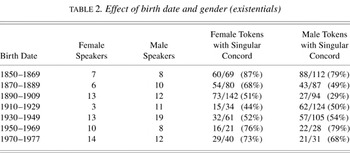
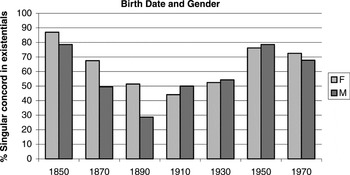
Figure 1 shows the pattern of singular concord with existentials over the period studied. Note that the pattern is distinctly nonmonotonic—use of the singular appeared to decrease during the late 19th century, but then the trajectory of change appears to have reversed, with a relative increase of the singular. This is an unusual trajectory, and certainly does not follow the S-shaped curve which is typical of language change (see, e.g., Bailey, 1973; Kroch, 1989; Weinreich, Labov, & Herzog, 1968). We will return later to the question of how or why such a reversal might have happened. Note, too, that there is a clearly gendered pattern during the late 19th century, with female speakers consistently producing higher rates of singular concord. This pattern is not present among the later speakers. Table 2 shows the breakdown of the data underlying Figure 1.
Effect of birth date and gender (existentials)


Effect of birth date and gender (existentials).
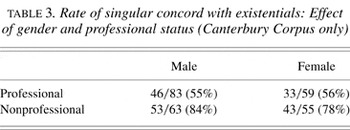
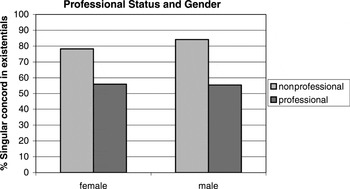
Although we don't have social information available about the earlier speakers, it is available for those speakers belonging to the Canterbury Corpus. Figure 2 and Table 3 show the pattern relating to social class and use of singular concord. Professional speakers show a marked reduction in singular concord relative to nonprofessional speakers. Note that this holds equally for male and female speakers.
Rate of singular concord with existentials: Effect of gender and professional status (Canterbury Corpus only)


Professional status (Canterbury Corpus only). This figure is broken down by male and female to show the results for each gender, but note that there is no significant interaction between professional status and gender.
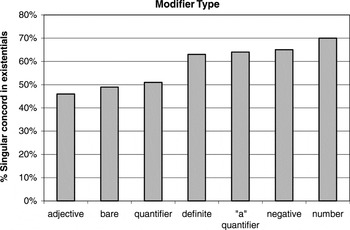
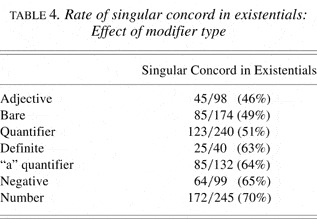
There are three linguistic factors that also play an important role: modifier type, tense, and contractedness. The effect of modifier type is shown in Figure 3 (and Table 4). Following Britain and Sudbury (2002), we coded the following seven categories:

Preference was given to the initial quantifier. For example, “a lot of the cats,” would be coded as an “a” quantifier, and “many red cats” would be coded as a quantifier, rather than an adjective. And coding related to linguistic form only. Thus, although there are many ways to invoke definiteness without the presence of a definite article, the code “definite” indicates the presence of such an article.

The effect of the type of modifier on singular concord with existentials.
Rate of singular concord in existentials: Effect of modifier type

While adjectival, bare NPs and quantifiers showed reduced rates of singular concord, comparatively high rates were returned with definites, negatives, numbers, and quantifiers containing “a” (e.g., a heap of people).1
Note that the varbrul model of the data (Table 10) indicates that a bare NP leads to marginally more singular concord than a quantifier, contrary to the raw data in Figure 3.
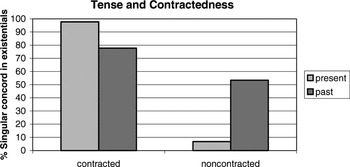
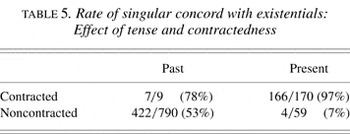
Finally, both tense and contractedness are important determiners of rate of singular concord. There is an important interaction between these two factors, as can be seen in Figure 4 (Table 5). Examples (2a–d) illustrate contracted and noncontracted forms of the verb with singular concord, in decreasing order of likelihood. Note that the surface form of singular concord with contracted verbs in past tense is the same as present tense—context was used to distinguish which was intended. As much of the data involves speakers reminiscing about events in the past, context usually contained clear tense information.


Effect of tense and contractedness (existentials).
Rate of singular concord with existentials: Effect of tense and contractedness

Both contractedness and tense play an important role, and there is a clear interaction between them. Figure 4 indicates that there is a strong interaction. While past tense increases the likelihood of singular concord for noncontracted forms, it decreases the likelihood for contracted forms. We can perhaps account for the extremely high rate of singular concord with sentences such as (2a) by ease of articulation of contracted “there's” forms. “There's” is one syllable, and so provides a strong articulatory advantage over “there is,” whereas “there're” contains the same number of syllables as “there are,” and so does not provide a particularly strong advantage. Of course, many speakers will contract “there're” down to a single syllable. We can speculate that this may also be dispreferred, (relative to “there's”), because of the resulting ambiguity between “there” and “there're”
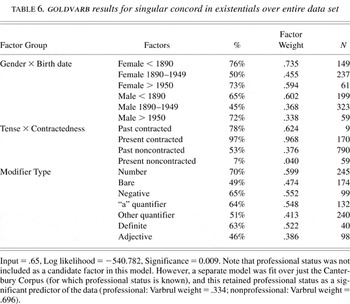
Table 6 shows the varbrul model of the entire data set. Note that the interaction between gender and birth date has been dealt with by combining the two into a single factor group. Three age groups have been defined: those born before 1890, those born from 1890–1949, and those born after 1950. This grouping reflects the patterns revealed in Figure 1, where those born before 1890 and after 1950 appeared to have the highest rates of singular concord. The varbrul model reveals that the reversal in trajectory is robust for the female speakers, but not statistically reliable for the male speakers—the varbrul weights systematically reduce for the male speakers, with the earliest born speakers using most singular concord, and the later born speakers using least.
goldvarb results for singular concord in existentials over entire data set

Tense and contractedness were also combined into a single factor group, which was retained as significant, and reflects the patterns in Figure 4. Modifier type was also retained as significant. Note that the varbrul weights for modifier type reverse the order of “bare NP” and “quantifier,” relative to the ordering shown in Figure 3. Other linguistic factors were also included in the model (as itemized earlier), but these were not retained as significant.
Although professional status was not included in the model of the overall data set, a separate model was fit, based on the Canterbury Corpus only. In this model, professional status was also retained as an important predictor of the data (professional: varbrul weight = .334; nonprofessional: varbrul weight = .696).
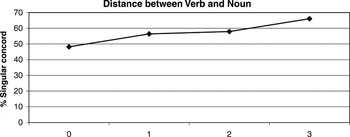
Before turning to the results for the nonexistentials, it is worth considering a trend which was not retained by the varbrul model. In their analysis of (there's) in New Zealand English and Falkland Islands English, Britain and Sudbury (2002) reported a significant effect of distance—the larger the number of lexical items positioned between the noun and the verb, the more likely singular concord was to operate in their data. Tagliamonte and Smith (2000) also reported a similar effect for York. Our results concerning distance, while not significant, do show the same pattern (Figure 5).

Distance between verb and noun. This shows the effect of how many words intervene between the verb and the noun. The result shown in this graph is not statistically significant, given the other factors already discussed.
Our results indicate a (nonsignificant) trend for singular concord to increase with the distance between the subject and the verb. We turn now to the presentation of results concerning nonexistentials.
Nonexistentials
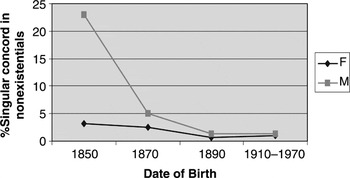
A total of 4364 tokens of nonexistentials were coded. Our analysis showed that singular concord with nonexistentials was very rare in both the Intermediate Archive and in the Canterbury Corpus. Figure 6 breaks down the rate of singular concord over the entire time period, for men and women. Speakers born in the 20th century are grouped together in a single category for the purposes of this graph, as there is practically no variation in this period. From 1900 on, singular agreement with nonexistentials is virtually nonexistent in NZE. In 19th century NZE, however, we find that singular concord with personal pronouns (they was) and plural NPs (the cats was) occurs more frequently, and that men have markedly higher rates than women. We also see a steady decrease of singular concord throughout the second half of the 19th century. It all but disappeared by the turn of the century and is not a characteristic feature of present-day New Zealand English.

Use of singular concord in nonexistential constructions, by gender and birth date.
Because the rate of singular agreement in speakers from the later IA and CC corpora was so low, an investigation of linguistic effects on concord variation would seem largely futile. We therefore decided to confine our statistical analysis to the MU speakers, since they were born in the period where we find the most extensive variation; accordingly, the analysis presented here concentrates on data from 19th-century NZE only, with a data subset of 1064 tokens. The same variables were coded here as in the existentials earlier, with one exception. The type of the modifier was coded for existentials, because related studies (Meechan & Foley, 1994; Tagliamonte, 1998) have indicated the importance of this variable for existentials. Since the literature we consulted reported no such finding for nonexistentials, we decided not to code for modifier type for our nonexistential data. It is perhaps not surprising that the literature should reflect an important role of the modifier type in the case of the existentials but not the nonexistentials. As illustrated in (3a), in the case of existentials, the modifier is positioned near to the verb—between the verb and the head noun. In nonexistentials (3b), the noun intervenes between the modifier and the verb, and it is the noun itself that is likely to be more proximate to the verb.

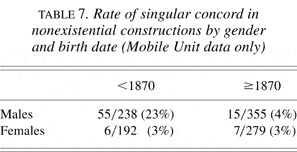
The role of gender and birth date, and their interaction, can be seen in Figure 6. For those born before 1900, singular concord steadily decreased for both men and women. However, the decrease was more dramatic for the male speakers than the female speakers. Thus, as with the existential data, there is an interaction between gender and birth date, which needs to be taken care of in the statistical model. The data for the Mobile Unit speakers (i.e., those speakers who are included in the statistical model) are given in Table 7.
Rate of singular concord in nonexistential constructions by gender and birth date (Mobile Unit data only)

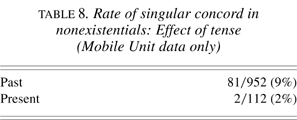
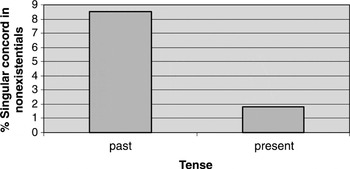
Figure 7 (and Table 8) indicates the very strong effect of tense on concord patterns. Singular concord is much more likely to occur with past-tense reference (the dogs was happy) than in present tense (the dogs is happy). This is consistent with the large literature on subject–verb agreement with be, which has consistently found that the past-tense paradigm is more prone to regularization than the present-tense paradigm (see Chambers, 1995; Feagin, 1979; Hazen, 2000a; etc.).
Rate of singular concord in nonexistentials: Effect of tense (Mobile Unit data only)


Effect of tense on singular concord in nonexistentials.
The next effect concerns the type of subject NP. We looked into the effects of:

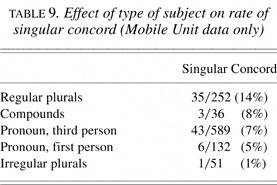
The “conjoined” category included cases in which both singular and plural NPs were combined. However, as there were only 36 conjoined tokens in total, and only three of these exhibited singular concord, we are not in a position to examine whether the type of compounding affects the likelihood of singular concord. There were also three instances where there was no overt subject NP. These cases were excluded from the statistical analysis.
Two absences from this list are second-person plural pronouns and collective nouns. As the majority of the recordings involve just two speakers, the opportunity for the occurrence of second-person plural pronouns was extremely low. This, combined with the potential ambiguity between second-person singular and second-person plural, led us to exclude the second-person plural pronoun from our study.
We also excluded collective nouns, as it has been shown that collective nouns in NZ English show a large degree of variation in terms of whether they prefer singular or plural concord. For example, in Hundt's (1998) study of New Zealand newspapers, team showed a strong tendency toward singular concord, police almost never occurred with singular concord, and family showed considerable variation. As there is a clearly lexical effect here, and as we were unlikely to collect sufficient data to study this on a word-by-word basis, we chose to exclude these from our study.
Table 9 shows the effect of type of subject NP, and shows that the highest rates of singular concord are found when the subject NP is not overtly present (many was waiting for their money). Singular concord decreases with regular plurals, compounds, and pronouns. Irregular nouns (e.g., children) show the lowest rates of singular concord in our sample.
Effect of type of subject on rate of singular concord (Mobile Unit data only)

As outlined earlier, many studies have shown that existentials have the highest levels of was agreement; personal pronouns, on the other hand, have the lowest, with lexical items obtaining intermediary levels (e.g., Cheshire, 1982; Eisikovits, 1991). The results presented here are largely in line with other findings. Existentials have the highest rate of singular agreement, and we also note a type of subject NP effect: regular plurals are more prone to singular agreement than pronouns. The low rate of occurrence with irregulars is unexpected. We distinguished between regulars and irregulars because related studies found some effect here (Britain & Sudbury, 2002; Meechan & Foley, 1994:76), reporting higher rates of singular concord if an overt plural marker was absent. Here we have the opposite result. One possible explanation for this difference is that Meechan and Foley and Britain and Sudbury included collective nouns in their studies, whereas our study excluded these (for reasons discussed earlier). If NPs such as “team” or “family” were included in our data set, this would no doubt have dramatically increased the probability of singular concord with NPs without an overt plural marker. The direction of the difference we have here is nonetheless surprising and somewhat counterintuitive. It should also be noted that the number of tokens concerned is not large (51), and the number of distinct words involved is relatively few.
The results we have outlined: subject type, tense, and the interaction between gender and birth date were the only factors that were retained as significant in the varbrul model. This model is shown in Table 10.2
Note that there were also several tokens with a quantifier and no overt head noun, but these have been omitted from the statistical model because of insufficient data.
goldvarb results for singular concord in nonexistentials (Mobile Unit data only)

Two effects that were not retained in the varbrul analysis are also worthy of note. First, Table 11 shows the frequency of singular concord by number of items positioned between noun and verb. There is some indication of relationship between frequency of singular concord and number of lexical items between the subject and the verb. There were only ten tokens with two intervening lexical items, and so the categories for two and three+ intervening items have been combined together. Table 11 indicates that tokens with more than one lexical item intervening between the subject and verb may be more prone to singular concord. However, the total number of such cases is low, and the factor was not retained in the varbrul model. So, it is unclear whether more data would show this generalization to be robust.
Effect of intervening lexical items on concord in nonexistentials (Mobile Unit data only)

Finally, Table 12 shows the overall results for contractedness. Contractedness was not considered in the statistical model, due to one of the cells being completely empty. Our corpus contains no examples of contracted singular be in nonexistential forms, and sentences like “the people's very happy” or “they's coming” are not attested. Although we are unable to test the level of significance of this generalization, the complete absence of singular contracted forms in this context is quite striking. This may partly result from the fact that these tokens include regular NPs, where singular agreement would involve the conjunction of a contracted “s” form and an item that contains plural -s marking. There is some possibility that such cases occurred, but were not clear from the context, and were missed by the transcriber (e.g., “the dogs's happy” could have been transcribed as “the dog's happy”—if the fact that the noun is plural is not clear from the context—such cases would then not be included in our data set, which considers only plural subjects). However, regular plurals only constitute 24% of the total tokens. The majority of tokens (68%) involve pronouns, and none of these examples involve contracted singular forms of be. Also note, however, that the total number of contracted forms is, in fact, quite low, and it is likely that a larger data set may have produced some examples involving singular concord in a contracted form.
Effect of contractedness on concord in nonexistentials (Mobile Unit data only)

DISCUSSION
The data presented here shed light on important aspects of subject–verb concord in historical and contemporary NZE. First of all, our study traces the development of concord patterns in a colonial dialect of English where this feature has not been subject to previous analysis. Moreover, given the time-depth of the database, our analysis offers the rare opportunity to explore the entire evolution of subject–verb concord in a single variety. Second, our study is of importance for scrutinizing founder effects and subsequent accommodation/formation processes in NZE: Exactly what concord patterns were transplanted to New Zealand, and exactly how did these patterns develop and interact when the colony formed and a localized phonological system evolved? Our findings yield insights into the diachronic dimension of subject–verb agreement, since our data span more than 120 years in apparent time. How are we to explain the differential developments of present concord in the two environments analyzed? Why did singular agreement marginalize in one context (nonexistentials) and thrive in the other (existentials), despite the fact that it decreased in both during the 19th century? And, as a last point, what parallels can we draw between NZE and other varieties? Does subject–verb agreement align distinctly in these varieties, or do we find parallels and common characteristics? If so, what insights does a cross-dialectal comparison yield on the nature of concord in English? We address these issues in turn.
Founder effects and subsequent developments
Based on the apparent-time principle (Bailey, Wikle, Tillery, & Sand, 1991), namely that New Zealanders born in the 1850s continually represent the earliest forms of NZE, and assuming that our data represent an adequate reflection of the original input varieties to NZE (see Gordon et al., 2004 for extensive discussion), an examination of the MU speakers gives us insights into the first stages of this variety of Southern Hemisphere English. We are therefore in the position to delimit the concord patterns transplanted and used by the first generations of New Zealand born colonizers. A first and most immediate finding is that patterns that are well-established elsewhere are not found in our data, most notably the extension of was to positive and the extension of weren't to negative environments. Leveling to weren't is well-attested in American English, where it “now seems to be confined to a primary dialect region along the Mid-Atlantic coastal area that extends from the Eastern Shore of Maryland and Virginia […] to the Outer Banks barrier islands and the adjacent coastal region of mainland North Carolina” (Wolfram & Thomas, 2002:69). We saw that this pattern is attested in the British Isles as well, most notably in the Fens area in the eastern English Midlands (Britain, 2002). In contrast, our analysis revealed that NZE, neither in earlier nor current forms, has tendencies of realigning be paradigms to express positive/negative polarity (as documented by Hazen, 2000b; Schilling-Estes & Wolfram, 1994). Not only is there no evidence of realignment along polarity lines, but there is no evidence that polarity plays any role. Polarity was not retained as a significant factor for either the existentials or the nonexistentials (singular concord in existentials: positive = 7.77%, negative = 8.3%; in nonexistentials: positive = 58%; negative = 60%). Thus, while many other varieties show a clear effect of polarity (see, e.g., Tagliamonte & Smith, 2000), this appears to play no role in New Zealand English.
We can make the same point for leveling to were, which is attested in Yorkshire English (Tagliamonte, 1998) or Southwestern English English (Cheshire, 1982). Our preliminary analysis revealed that forms such as she weren't are practically nonexistent in our corpus, and this strongly suggests that this pattern was not brought to New Zealand. Again, New Zealanders born in the crucial 1850–1880 formation period of NZE have practically no I/she/the cat were forms, and the most plausible explanation is that the inputs either had very low levels or did not have this pattern at all. On the other hand, the most frequent agreement pattern in our corpus (of course, apart from a standard-like alternation between was and were) is the extension of was, and we suggest that this yields insights into input properties as well. Regularization to was is commonly reported in Southeastern English and Scottish English (Orton et al., 1978; Wakelin, 1977, 1986), two varieties that are generally considered principal contributors to early NZE (Gordon et al., 2004).
As Figures 1 and 6 indicate, the input properties were modified considerably, and the crystallization period of NZE witnessed dynamic leveling processes (at least with regard to the feature investigated in the present study). The second half of the 19th century was a period of continuing decrease of singular concord with both existentials and nonexistentials. Originally transplanted patterns do not remain static and may undergo quick adaptations and modifications in contact settings. The trend we note for 19th-century NZE is one of standardization (i.e., an increasing tendency to use standard was/were variants in contexts conforming to the grammar of Standard English). The most plausible explanation for this pattern is to regard it as a leveling process, a mechanism generally involved in new-dialect formation (Trudgill, 1986), which involves the loss of minority and/or marked variants and the adoption of fewer and more stable forms (Siegel, 1987). A closer look at gender-related variation in 19th-century NZE reveals a cross-over effect, inasmuch as it is the men who use more standard there were forms (and appear to lead this change in progress, see Figure 1) and it is the women who use more plural agreement with nonexistentials (and moreover, who are remarkably stable over the entire period of NZE, see Figure 6). The congruent directionality toward standardization in both environments raises the question as to whether the two processes are related and how we can explain the fact that they developed distinctly in 20th-century NZE.
The relationship between singular concord in existentials and nonexistentials
These data show that current NZE has high rates of singular concord in existentials, whereas singular concord in nonexistentials is virtually nonexistent. Concord operates differently with existentials and nonexistentials, in that they are subject to distinct linguistic constraints; for example, verb contraction has an enhancing effect on singular concord in existential forms and an inhibiting effect on nonexistentials. Such differences would suggest that the changes we observe in this corpus result from underlyingly different mechanisms (see, e.g., Kroch, 1989). On the other hand, the two paradigms share properties, as well. For example, both existentials and nonexistentials have a strong preference for singular concord with past tense reference of be (at least in noncontracted forms) and both display a (nonsignificant) tendency to favor singular concord when noun and verb are distant. However, if all is taken into consideration, the two paradigms are more distinct than similar and are, with profit, studied as two separate phenomena and subjected to different analyses, which is what we have done here.
Our analyses show that the two paradigms followed an unusual trajectory during the formation and development stages of NZE. Nineteenth-century NZE had both, yet by 1900, singular concord with nonexistentials was marginal and remained practically nonexistent, whereas singular concord with existentials began to increase again. Thus, contemporary NZE has two quite separate tendencies, favoring one and strongly disfavoring the other. This raises the question as to whether concord in the two environments was connected in early New Zealand English, which still had both, even though they were in the process of decreasing. Was there a connection between the decline of the two processes in the 19th century? Was usage of singular be with plural subjects decreasing generally, regardless of context, or did linguistic environment have an effect? To investigate this, we calculated each Mobile Unit speaker's usage of singular concord for both existentials and nonexistentials, and then examined the degree to which these figures were correlated. The rationale is that if there is a connection between decrease of singular be in existentials and nonexistentials, then individuals with low rates of one would also have low rates of the other. Figure 8 shows the result. Every point on the graph represents a single speaker; filled points represent male speakers and unfilled points represent females. Separate lines are drawn through the male and female speakers; the solid line represents the line of best fit through the females and the dotted line represents the line of best fit through the males. Figure 8 shows a highly significant correlation between usage of singular concord in nonexistentials and existentials. The correlation is significant both when calculated over the entire data set (Spearman's rho = .50, p < .005) and when calculated separately for males (Spearman's rho = .56, p < .01) and females (Spearman's rho = .62, p < .05).

The relationship between existentials and nonexistentials (Mobile Unit data only). Every point represents an individual. Filled points represent males, unfilled points represent females. The solid line represents the line of best fit through the females, and the dotted line represents the line of best fit through the males (using a non-parametric scatterplot smoother). This figure shows a highly significant correlation between an individual's use of singular concord in nonexistentials, and their use of singular concord in existentials. (Males: Spearman's rho = .56, p < .01; Females: Spearman's rho = .62, p < .05; Overall: Spearman's rho = .50, p < .005).
We argue that this finding sheds new light on the change in progress of existentials as outlined in Figure 1. During the second half of the 19th century, singular concord of be as a whole was being leveled out of New Zealand English. The inception stage of NZE still had it, even though a (standard-like) plural concord pattern became increasingly more frequent. Thus, we argue, it is in this period that we observe a single change in progress, namely, the reduction of singular concord with be, even though existential environments, of course, had a favoring effect on singular concord. Then, around the turn of the century, use of singular be concord in nonexistentials all but disappeared from NZE. Strikingly, although singulars were no longer used in nonexistential constructions, they were still relatively frequent in existential constructions (40–50%, Figure 1). At this point, the parallel decrease in both environments reached the point where singular agreement with personal pronouns and subject NPs de facto disappeared. Instead of disappearing as well, there's/there was constructions began to increase again, only to become very robust in contemporary NZE. How are we to account for this phenomenon?
On the one hand, one might suggest sociopsychological and/or stylistic explanations. For instance, World War I led to massive social changes in New Zealand; particularly, New Zealand men became increasingly mobile as a result of their involvement in the British-led Allied Forces in Europe. This could suggest that they may have picked up nonstandard there's/there was features abroad and maintained this usage when returning home. However, although Figure 1 documents a slight, yet insignificant, trend for men to lead this change, it should be noted that the varbrul analysis reflects an increase in singular concord only for the women. As the increase in singular concord is more significantly tractable for the women, it is unlikely that the return of troops to New Zealand can account for the pattern.
A second consideration would be by nature stylistic. As we mentioned, the year 1900 marks an overlap of two of our corpora used. Notably, the two data sets were collected under different circumstances; the formal nature of the MU data often involved an interviewer with an unmistakable upper-class accent, and question–answer type conversations that were not suitable for the elicitation of vernacular forms. The IA corpus, on the other hand, was collected as part of oral history projects; very often interviewer and interviewee were familiar, and this obviously led to more informal and casual conversational styles, and, by implication, to more vernacular variants. However, whereas stylistic and social considerations may perhaps explain overall differences in data from the two corpora, they offer no explanation as to why we would find such a consistent nonlinear patterning. If stylistic/social factors really account for the attested vernacularization of NZE, then we would expect an increase in both environments (existentials and nonexistentials) and are at odds to explain the differential developments that occurred.
We are therefore tempted to offer a more language-internally driven explanation, namely that the demise of singular concord with nonexistentials more or less directly accounts for the increase in singular concord with existentials. Because our statistical analysis showed the two mechanisms to be related (Figure 8), we suggest that existentials developed separate agreement properties when we was forms disappeared and the two paradigms de facto ceased to be related. It is this reinterpretation of the link between existentials and nonexistentials, we argue, that may be the basis for explaining the reversal of the change in progress in the early 1900s. There are thus two changes in NZE singular concord: (1) conjoined standardization in the 19th century, which ended with the loss of singular concord with personal pronouns and plural NPs at around 1900; and (2) the subsequent increase in singular concord with there constructions in the 20th century.
A cross-dialect perspective of singular agreement
The last point we would like to address concerns the wider implications of our study. How does subject–verb concord in NZE compare with the patterns reported for other varieties in England, the United States and Canada, or the Falkland Islands? Are there parallels between these dialects? Or, does agreement align differently in each?
We suggest that there are parallels and differences between dialectal patterns of subject–verb concord. While some principles seem to hold generally, other features are subject to variation and differentiation. Our study uncovers several findings that are attested in every dialect that has been subject to analysis: (1) singular agreement with nonexistentials is much more likely to operate when verbs have past reference (the dogs was > the dogs is); (2) existentials are much more likely to exhibit singular agreement than are personal pronouns and plural NPs; and (3) linguistic factors such as tense, contractedness, and modifier type have an effect on the frequency of singular concord. In these respects, NZE is perfectly in line with practically all other forms of English. However, we also see a number of minor differences that set New Zealand English apart from other varieties. One of these concerns the effect of modifier type. Table 2 provides a comparison of different hierarchies in Canadian English (Meechan & Foley, 1994), York English (Tagliamonte, 1998), New Zealand English (Britain & Sudbury's 2002 results, labeled NZ English 1), Falkland Islands English (FI English, Britain & Sudbury, 2002), and our results (labeled NZ English 2).

Even though subject–verb concord is subject to implicational gradations that hold for all varieties (e.g., a ‘no’ quantifier is more likely to have singular forms than bare NPs or adjectives), the individual ordering of these constraints differs. This may be a function of the idiosyncrasies and sizes of the different data sets analyzed, or it may suggest that each dialect has somewhat idiosyncratic constraint hierarchies.
CONCLUSION
In this article we have traced the entire history of be in New Zealand English. In the dialect contact phase of the creation of New Zealand English, there was a consistent force toward standardization, with singular concord in both existential and nonexistential environments showing a steady decrease. Rates of singular concord in existentials, however, were consistently higher than in nonexistentials. This decrease continued until the end of the 19th century, when singular concord in nonexistentials bottomed out—the feature is close to nonexistent throughout 20th-century New Zealand English.
At this time, existentials apparently became dissociated from the nonexistentials, and, liberated from the standardizing force, the use of singular concord in existentials began to increase. In modern New Zealand English, then, we have high rates of singular concord in existentials (highest among nonprofessional speakers and men).
Analysis of this data set highlights the dynamism of dialect contact situations—input varieties do not remain static and are subject to adaptation when a new dialect forms. It also highlights the possibilities of nonlinearity in language change. A feature that was in clear decline during the 19th century has successfully reversed its trajectory to become a well-established feature of modern New Zealand English.
References
REFERENCES
Bailey, C. J.
(1973).
Variation and linguistic theory.
Washington, DC:
Center for Applied Linguistics.
Bailey, G.,
Wikle, T.,
Tillery, J., &
Sand, L.
(1991).
The apparent time construct.
Language Variation and Change
3:241–264.Google Scholar
Britain, D.
(2002).
Diffusion, levelling, simplification and reallocation in past tense
BE in the English Fens.
Journal of Sociolinguistics
6(1):16–43.Google Scholar
Britain, D., &
Sudbury, A.
(2002).
There's sheep and there's penguins: Convergence,
‘drift’ and ‘slant’ in New Zealand and Falkland
Island English. In
M. C. Jones &
E. Esch (eds.),
Language change: The interplay of internal, external and
extra-linguistic factors.
Berlin:
Mouton de Gruyter.
211–240.
Chambers, J.
(1995).
Sociolinguistic theory.
Oxford:
Blackwell.
Cheshire, J.
(1982).
Variation in an English dialect.
Cambridge:
Cambridge University Press.
Cheshire, J.
(1999).
Spoken standard English. In
A. R. Bex &
R. J. Watts (eds.),
Standard English: The current debates.
London:
Routledge.
129–148.
Cheshire, J.,
Edwards, V., &
Whittle, P.
(1989).
Urban British dialect grammar: The question of dialect levelling.
English World Wide
10(2):185–225.Google Scholar
Cheshire, J.,
Edwards, V., &
Whittle, P.
(1993).
Non-standard English and dialect levelling. In
J. Milroy &
L. Milroy (eds.),
Real English: The grammar of English dialects in the British Isles.
New York:
Longman.
53–95.
Christian, D.,
Wolfram, W., &
Dube, N.
(1988).
Variation and change in geographically isolated communities:
Appalachian English and Ozark English.
Publication of the American Dialect Society, PADS 74. Tuscaloosa:
University of Alabama Press.
Denison, D.
(1998).
Syntax. In
S. Romaine (ed.),
The Cambridge history of the English language.
Volume 4:
1776–1997.
Cambridge:
Cambridge University Press.
Eisikovits, E.
(1991).
Variation in subject-verb agreement in Inner Sydney English. In
J. Cheshire (ed.),
English around the world. Sociolinguistic perspectives.
Cambridge:
Cambridge University Press.
235–255.
Feagin, C.
(1979).
Variation and change in Alabama English.
Washington, DC:
Georgetown University Press.
Forsstrœm, G.
(1948).
The verb ‘to be’ in Middle English: A survey of the
forms.
Lund:
C. W. K. Gleerup.
Gordon, E.,
Campbell, L.,
Hay, J.,
Maclagan, M.,
Sudbury, A., &
Trudgill, P.
(2004).
New Zealand English: Its origins and evolution.
Cambridge:
Cambridge University Press.
Hazen, K.
(1994).
Subject-verb concord in vernacular varieties of English.
MA thesis,
North Carolina State University.
Raleigh, NC.
Hazen, K.
(2000a).
Identity and ethnicity in the rural South: A sociolinguistic view
through past and present be.
Publication of the American Dialect Society, PADS 83. Durham:
Duke University Press.
Hazen, K.
(2000b).
Subject-verb concord in a post-insular dialect: The gradual
persistence of dialect patterning.
Journal of English Linguistics
28(2):127–144.Google Scholar
Hickey, R.
(2003).
How do dialects get the features they have? On the process of new
dialect formation. In
Hickey, R. (ed.),
Motives for sound change.
New York:
Cambridge University Press.
213–239.
Hundt, M.
(1998).
New Zealand English Grammar—Fact or Fiction?
Amsterdam:
Benjamins.
Jespersen, O.
(1961).
A Modern English Grammar. Part IV: Syntax.
London:
Allen and Unwin.
Kroch, A. S.
(1989).
Reflexes of grammar in patterns of language change.
Language Variation and Change
1:199–244.Google Scholar
Labov, W.
(1972).
Sociolinguistic patterns.
Philadelphia:
University of Pennsylvania Press.
Labov, W.,
Cohen, Philip,
Robins, Clarence, &
Lewis, John.
(1968).
A study of the non-standard English of Negro and Puerto Rican
Speakers in New York City
(Vol. 1).
U.S. Office of Education Cooperative Research Project No. 3288.
Lewis, Gillian.
(1996).
The origins of New Zealand English: A report on work in progress.
New Zealand English Journal
10:25–30.Google Scholar
Maclagan, M.,
Gordon, E., &
Lewis, G.
(1999).
Women and sound change: Conservative and innovative behavior by the
same speakers.
Language Variation and Change
11:19–41.Google Scholar
Mallinson, C., &
Wolfram, W.
(2002).
Dialect accommodation in a bi-ethnic mountain enclave community:
More evidence on the development of African American Vernacular
English.
Language in Society
31:743–775.Google Scholar
Meechan, M., &
Foley, M.
(1994).
On resolving disagreement: Linguistic theory and variation –
there's bridges.
Language Variation and Change
6(1):63–85.Google Scholar
Montgomery, M.
(1994).
The evolution of verb concord in Scots. In
A. Fenton &
D. A. MacDonald (eds.),
Studies in Scots and Gaelic: Proceedings of the Third International
Conference on the Languages of Scotland.
Edinburgh:
Canongate Academic.
81–95.
Murray, J.
(1873).
The dialect of the southern counties of Scotland: Its
pronunciation, grammar and historical relations.
London:
Philological Society.
Ojanen, A.-L.
(1982).
A syntax of the Cambridgeshire dialect.
Licentiate thesis,
University of Helsinki.
Orton, H.,
Sanderson, S., &
Widdowson, J.
(1978).
The linguistic atlas of England.
London:
Croom Helm.
Quirk, R., &
Wrenn, C. L.
(1960).
An Old English grammar.
London:
Methuen.
Sapir, Edward.
(1921).
Language: An introduction to the study of speech.
New York:
Harcourt, Brace and World.
Schilling-Estes, N., &
Wolfram, W.
(1994).
Convergent explanation and alternative regularization patterns:
Were/weren't leveling in a vernacular
English variety.
Language Variation and Change
6(3):273–302.Google Scholar
Schreier, D.
(2002a).
Past be in Tristan da Cunha: The rise and fall of
categoricality in language change.
American Speech
77(1):70–99.Google Scholar
Schreier, D.
(2002b).
Sociohistorical and contemporary aspects of present
be regularization in Tristan da Cunha English.
Paper presented at the annual meeting of the American Dialect
Society,
San Francisco, CA.
Schreier, D.
(2003).
Isolation and language change: Sociohistorical and contemporary
evidence from Tristan da Cunha English.
Basingstoke:
Palgrave/Macmillan.
Schulenburg, A.
(forthcoming).
English in St Helena and Ascension. In
L. Todd (ed.),
Varieties of World English.
London:
Cassell.
Siegel, J.
(1987).
Language contact in a plantation environment.
Cambridge:
Cambridge University Press.
Smith, J., &
Tagliamonte, S.
(1998).
We Was all Thegither, I Think We Were all Thegither. Was
Regularization in Buckie English.
World Englishes
17(2):105–126.Google Scholar
Sudbury, A., &
Hay, J.
(2002).
The fall and rise of /r/: Rhoticity and /r/-sandhi
in Early New Zealand English. In Selected Papers from NWAV
30,
UPenn Working Papers in Linguistics
8(3):281–295.Google Scholar
Tagliamonte, S.
(1998).
Was/were variation across the generations:
View from the city of York.
Language Variation and Change
10(2):153–191.Google Scholar
Tagliamonte, S., &
Smith, J.
(1998).
Analogical levelling in Samaná English: The case of
was and were.
Journal of English Linguistics
27(1):8–26.Google Scholar
Tagliamonte, S., &
Smith, J.
(2000).
Old was, new ecology: Viewing English through the
sociolinguistic filter. In
S. Poplack (ed.),
The English history of African American English.
Oxford:
Blackwell.
141–171.
Traugott, E.
(1972).
A history of English syntax.
New York:
Holt, Rinehart, and Winston.
Trudgill, P.
(1986).
Dialects in contact.
Oxford:
Blackwell.
Trudgill, P.
(1998).
The chaos before the order: New Zealand English and the second
stage of new-dialect formation. In
E. H. Jahr (ed.),
Language change: Advances in historical sociolinguistics.
Berlin:
Mouton de Gruyter.
1–11.
Trudgill, P.,
Gordon, E., &
Lewis, G.
(1998).
New-dialect formation and Southern Hemisphere English: The New
Zealand short front vowels.
Journal of Sociolignuistics
2:35–52.Google Scholar
Trudgill, P.,
Gordon, E.,
Lewis, G., &
Maclagan, M.
(2000).
The role of drift in the formation of native-speaker Southern
Hemisphere Englishes: Some New Zealand evidence.
Diachronica
17:111–138.Google Scholar
Visser, F.
(1963–1973).
An historical syntax of the English language
(3 vols.).
Leiden:
Brill.
Wakelin, Martyn F.
(1977).
English dialects: An introduction.
London:
Athlone.
Wakelin, Martyn F.
(1986).
The Southwest of England
(Varieties of English around the world, Vol. 5).
Amsterdam:
Benjamins.
Weinreich, U.,
Labov, W., &
Herzog, M. I.
(1968).
Empirical foundations for a theory of language change. In
W. P. Lehmann (ed.),
Directions for historical linguistics: A symposium.
Austin:
University of Texas Press.
95–195.
Wilson, S.
(1997).
St Helenian English.
Unpublished manuscript.
Wolfram, W., &
Christian, D.
(1976).
Appalachian speech.
Washington, DC:
Center for Applied Linguistics.
Wolfram, W.,
Hazen, K., &
Schilling-Estes, N.
(1999).
Dialect change and maintenance on the Outer Banks.
Publication of the American Dialect Society 80. Tuscaloosa:
University of Alabama Press.
Wolfram, W., &
Thomas, E.
(2002).
The development of African American English.
Oxford and Malden, MA:
Basil Blackwell.
Woods, N.
(1997).
The formation and development of New Zealand English: Interaction
of gender-related variation and linguistic change.
Journal of Sociolinguistics
1:95–125.Google Scholar
Social distribution of the 146 speakers analyzed
Effect of birth date and gender (existentials)
Effect of birth date and gender (existentials).
Rate of singular concord with existentials: Effect of gender and professional status (Canterbury Corpus only)
Professional status (Canterbury Corpus only). This figure is broken down by male and female to show the results for each gender, but note that there is no significant interaction between professional status and gender.
The effect of the type of modifier on singular concord with existentials.
Rate of singular concord in existentials: Effect of modifier type
Effect of tense and contractedness (existentials).
Rate of singular concord with existentials: Effect of tense and contractedness
goldvarb results for singular concord in existentials over entire data set
Distance between verb and noun. This shows the effect of how many words intervene between the verb and the noun. The result shown in this graph is not statistically significant, given the other factors already discussed.
Use of singular concord in nonexistential constructions, by gender and birth date.
Rate of singular concord in nonexistential constructions by gender and birth date (Mobile Unit data only)
Rate of singular concord in nonexistentials: Effect of tense (Mobile Unit data only)
Effect of tense on singular concord in nonexistentials.
Effect of type of subject on rate of singular concord (Mobile Unit data only)
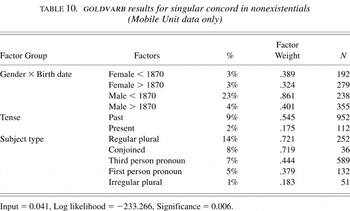
goldvarb results for singular concord in nonexistentials (Mobile Unit data only)
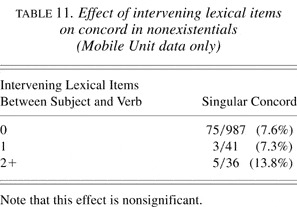
Effect of intervening lexical items on concord in nonexistentials (Mobile Unit data only)
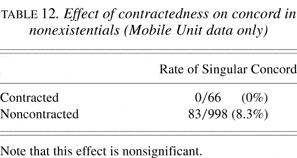
Effect of contractedness on concord in nonexistentials (Mobile Unit data only)
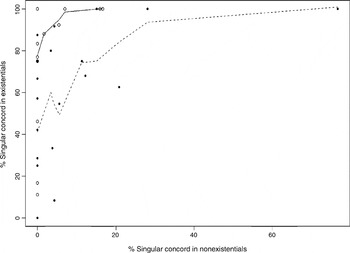
The relationship between existentials and nonexistentials (Mobile Unit data only). Every point represents an individual. Filled points represent males, unfilled points represent females. The solid line represents the line of best fit through the females, and the dotted line represents the line of best fit through the males (using a non-parametric scatterplot smoother). This figure shows a highly significant correlation between an individual's use of singular concord in nonexistentials, and their use of singular concord in existentials. (Males: Spearman's rho = .56, p < .01; Females: Spearman's rho = .62, p < .05; Overall: Spearman's rho = .50, p < .005).
 You have
Access
- 45
- Cited by