The parent–child relationship is one of the most enduring and influential relationships experienced throughout one's lifetime (Maccoby & Martin, Reference Maccoby, Martin and Mussen1983). Not surprisingly, the quality of this relationship has a significant influence on the wellbeing of individuals throughout the lifespan (Herz & Gullone, Reference Herz and Gullone1999), but particularly during childhood and adolescence.
Adolescence can represent a challenging life phase for all involved. It is a period of equilibrium and disequilibrium in relationships, particularly between adolescents and their parents (Baumrind, Reference Baumrind, Lerner, Peterson and Brooks-Gunn1991a). The relationship between parents and adolescents differs from parent and young child relationships, in that parents and adolescents often interact less frequently and interactions are often characterised by power shifts and increased conflict (Coleman & Karraker, Reference Coleman and Karraker1997).
Parents are caught in a dilemma when raising adolescents, who need both freedom to explore and experiment within their world, as well as protection from things that are dangerous (Baumrind, Reference Baumrind1991b). Depending on the context, parents need to know and apply different strategies in order to facilitate optimal adolescent development. Part of optimal development is the development of a strong and positive sense of self.
Self-Esteem
The most commonly recognised element of an individual's sense of self is self-esteem (Swann, Chang-Schneider, & Larsen-McClarty, Reference Swann, Chang-Schneider and Larsen-McClarty2007). While there is no single definition of self-esteem, researchers commonly describe it as the extent to which an individual believes they are capable, significant and worthy; the overall level of regard someone has for themself (Boden, Fergusson, & Horwood, Reference Boden, Fergusson and Horwood2008; Coopersmith, Reference Coopersmith1981a; Luszczynska, Gutiérrez-Doña, & Schwarzer, Reference Luszczynska, Gutiérrez-Doña and Schwarzer2005). Higher levels of self-esteem have consistently been associated with psychological wellbeing. Conversely, low self-esteem has often been found to be predictive of maladaptive psychological states (Herz & Gullone, Reference Herz and Gullone1999). The importance of self-esteem as a global indicator of psychological health has encouraged research about the influence of variables such as parenting style on the development of child and adolescent self-esteem.
Parenting Style
Parenting style refers to the overall combination of attitudes and behaviours expressed by a parent toward their child, and is thought to influence all parent–child interactions (Darling & Steinberg, Reference Darling and Steinberg1993). Parenting style differs from parenting practice or behaviour, in that overall parenting style forms a global approach to parenting, whereas specific parenting practices or behaviours may be used to influence particular behaviours in a child or adolescent (Spera, Reference Spera2005). For example, using ‘time-out’ to discipline a child is a parenting practice.
Research concerning elements of parenting style is not new. In the 1960s, parenting researchers identified two dimensions as the major contributors to various parenting styles. These were labelled as ‘warmth-rejection’ and ‘restrictiveness-permissiveness’. Initially, these dimensions had little theoretical rationale. Warmth-rejection was evaluated in psychoanalytic theory, and restrictiveness-permissiveness was identified post-hoc as a dimension in parenting research (Maccoby & Martin, Reference Maccoby, Martin and Mussen1983).
Later studies in the 1970s incorporated data from interview and observational studies and clarified the existence of two dimensions. In her influential research, Baumrind (Reference Baumrind1971) labelled one dimension as ‘responsiveness’, which had similar elements to but was not the same as warmth (as warmth included affection being given when both contextually appropriate and inappropriate). The restrictiveness-permissiveness dimension was re-formed through factor analysis and was labelled ‘demandingness’. In her most recent conceptualisations, Baumrind (Reference Baumrind, Lerner, Peterson and Brooks-Gunn1991a) identified two orthogonal dimensions: parental responsiveness and parental demandingness. These two dimensions are thought to underlie the different parenting styles commonly recognised in contemporary parenting research (Maccoby & Martin, Reference Maccoby, Martin and Mussen1983).
Parental responsiveness refers to the extent of parental encouragement of a child's individuality, self-regulation and independence, coupled with verbal give-and-take and parents being attuned to the needs and demands of the child (Baumrind, Reference Baumrind1971, Reference Baumrind1991b). Adolescents with highly responsive parents tend to score higher on measures of self, although highly responsive parenting is not thought to contribute to the development of competencies (Suchman, Rounsaville, DeCoste, & Luthar, Reference Suchman, Rounsaville, DeCoste and Luthar2007). Further, parental responsiveness has been linked to multiple positive outcomes in adolescence and into adulthood, including higher personal adjustment and lower levels of internalising disorders (Suchman et al., Reference Suchman, Rounsaville, DeCoste and Luthar2007) and increased empathy and prosocial behaviour (Davidov & Grusec, Reference Davidov and Grusec2006). Alternatively, parental demandingness refers to behavioural control, and the extent of expectation and maturity demands of the child. This includes the intensity of supervision and restriction, disciplinary efforts, and willingness to confront a disobedient child. Adolescents with highly demanding parents are more likely to perform highly at school and in other achievement areas and be less likely to engage in delinquent behaviour (Lamborn, Mounts, Steinberg, & Dornbusch, Reference Lamborn, Mounts, Steinberg and Dornbusch1991). However, demandingness is not linked to promotion of a positive sense of self (Baumrind, Reference Baumrind1991b). Parenting styles are typically defined by combining these two dimensions, as opposed to investigating them separately (Paulson & Sputa, Reference Paulson and Sputa1996).
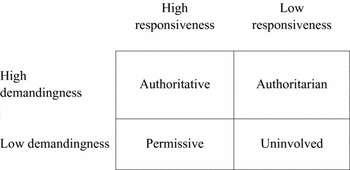
Higher and lower levels of responsiveness and demandingness initially led Baumrind (Reference Baumrind1971) to identify three main styles of parenting, which she labelled the ‘authoritative’, ‘authoritarian’, and ‘permissive’ styles. In this conceptualisation, all low demandingness parents were combined into the permissive style. Maccoby and Martin (Reference Maccoby, Martin and Mussen1983) later noted that combining responsiveness and demandingness yields four distinct parenting styles; a concept ignored in many parenting studies (Buri, Reference Buri1991; Conrade & Ho, Reference Conrade and Ho2001). In contemporary research (Garcia & Gracia, Reference Garcia and Gracia2009; Herz & Gullone, Reference Herz and Gullone1999), the four styles are commonly identified as the authoritative, authoritarian, permissive and uninvolved styles (see Figure 1). The inclusion of a fourth style is logical and allows for a broader range of parenting information adjacent to Baumrind's initial findings (Darling & Steinberg, Reference Darling and Steinberg1993); a conceptualisation with which Baumrind (Reference Baumrind, Lerner, Peterson and Brooks-Gunn1991a) later agreed.
The Four Factor Model of Parenting Styles.

According to Baumrind (Reference Baumrind1971), authoritative parenting involves high levels of responsiveness and demandingness, with key components including reciprocal demands, open communication, and supportive disciplinary methods. The second style identified by Baumrind (Reference Baumrind1971), authoritarian parenting, can be described as involving low levels of responsiveness and high levels of demandingness. Parental demands are not balanced by reciprocal demands from the child, rules are heavily enforced, and children have little input into how the household is run. The third style, permissive parenting, occurs when parents show high levels of responsiveness but low levels of demandingness. Children are allowed considerable self-regulation and parents take a tolerant attitude toward children's impulses. Furthermore, permissive parents avoid the use of punishment and exercise of authority over their children where possible (Baumrind, Reference Baumrind1971). Lastly, uninvolved parenting reflects low parental responsiveness combined with low demandingness. This style is also known as neglecting throughout the literature; however, in the current project we wanted to avoid any negative connotations associated with this label. Uninvolved parents do not monitor and are not supportive of their children. They may be actively rejecting toward their child or may neglect other child-rearing responsibilities (Baumrind, Reference Baumrind, Lerner, Peterson and Brooks-Gunn1991a; Maccoby & Martin, Reference Maccoby, Martin and Mussen1983).
Research concerning the relationship between parenting style and adolescent self-esteem has revealed that adolescents who receive high levels of warmth and acceptance from their parents demonstrate elevated levels of self-esteem, whereas adolescents who experience less-accepting parenting practices show low self-competence, poor self-perception and low self-esteem (Milevsky, Schlechter, Netter, & Keehn, Reference Milevsky, Schlechter, Netter and Keehn2007). This relationship is consistent across cultures (Herz & Gullone, Reference Herz and Gullone1999).
The Current Study
As described above, the four parenting styles were developed using data from interview and observational studies (Baumrind, Reference Baumrind1971). However, there is a growing trend in survey-based parenting research to create the same four styles. This is generally accomplished by dichotomising responsiveness and demandingness scores, then combining them to suit the four-style typology (Lamborn et al., Reference Lamborn, Mounts, Steinberg and Dornbusch1991; Petito & Cummins, Reference Petito and Cummins2000). Transforming observational data into categories has proved to be a popular way of analysing such information; however, in this study we questioned if categorising variables may not be the best method to analyse scaled survey data. In general, survey-based studies have produced results that correspond to the key elements identified by Baumrind. However, if only survey data is used in a particular study, rather than reducing responsiveness and demandingness scores into four categories, it may possibly be more methodologically consistent to examine them as separate, continuous variables. This approach may be more useful than using predetermined categories if examining whether a particular facet of parenting is more influential on a factor, such as adolescent self-esteem.
The present study investigated the effect of maternal responsiveness and demandingness on adolescent self-esteem. For the purpose of this research, ‘mother’ was defined as an adult female who was either the adolescent's biological mother or had taken on a mothering role for that individual since childhood. Mothers (and not fathers) were considered in this study as the majority of parenting research to date has focussed on maternal attitudes and behaviours. Furthermore, mothers are traditionally thought to have a greater influence on adolescent perceptions of self (Baumrind, Reference Baumrind, Lerner, Peterson and Brooks-Gunn1991a).
Research has consistently shown that mothers rate themselves higher on responsiveness and demandingness than their children do (Paulson & Sputa, Reference Paulson and Sputa1996). However, it is often not clear whether parental or adolescent perceptions more accurately reflect the true parenting style that occurs within the home. Given that we were examining adolescent perceptions of self, we felt it more relevant to also consider adolescent perceptions of parenting style.
Aims and Hypotheses
The first aim of this study was to replicate and extend previous research by examining the link between maternal parenting style and adolescent self-esteem. The findings from other research (e.g., Lamborn et al., Reference Lamborn, Mounts, Steinberg and Dornbusch1991; Macek & Jezek, Reference Macek and Jezek2007; Plunkett, Henry, Robinson, Behnke, & Falcon, Reference Plunkett, Henry, Robinson, Behnke and Falcon2007) have led to the hypotheses that the authoritative and permissive maternal parenting styles will be associated with higher scores on adolescent self-esteem, and that authoritarian and uninvolved maternal parenting styles will be associated with lower scores on adolescent self-esteem.
The second aim of this study was to investigate whether using a two-dimensional representation of parenting style may be a more pragmatic approach than using the four separate categories described above. The use of a scaled dimension may lend itself more readily to an applied setting. Instead of changing their parenting ‘style’, mothers of adolescents with self-esteem difficulties could focus on enhancing a particular dimension. Furthermore, if a survey measures the two dimensions of parenting (responsiveness and demandingness) in two separate scales, it might be more methodologically consistent to explain the data in terms of these two separate dimensions rather than combining them to form distinct categories. This would be particularly relevant should the different dimensions be found to have different predictive ability. Consistent with the research outlined above (e.g., Macek & Jezek, Reference Macek and Jezek2007; Milevsky et al., Reference Milevsky, Schlechter, Netter and Keehn2007; Plunkett et al., Reference Plunkett, Henry, Robinson, Behnke and Falcon2007), it is also hypothesised that maternal responsiveness will be a better predictor than maternal demandingness of adolescent self-esteem.
Method
Participants
Approximately 350 Grade 9 and 10 students from two secondary schools in Launceston, Tasmania were approached to participate in this research. The study sample consisted of 140 adolescents (64% female) aged between 13 and 16 years (M = 14.73, SD = 0.70). According to senior staff at each school, students came from a wide variety of socio-economic backgrounds. Each student was required to return a signed parental consent form before they were able to participate.
Materials
Adolescent perceived self-esteem was measured using the Coopersmith Self-Esteem Inventory — School Form (Coopersmith, Reference Coopersmith1981b). This 58-item dichotomous response scale consists of four self-esteem subscales (parental, academic, social and general self-esteem) and an eight-item lie scale. The four subscales combine to form a measure of global self-esteem, with high scores indicating high global self-esteem. Participants respond to a set of short statements, such as ‘Things don't usually bother me’, by circling either Unlike me or Like me. This measure has been found to have high reliability and validity (Coopersmith, Reference Coopersmith1981b). Using an Australian sample, Herz and Gullone (Reference Herz and Gullone1999) demonstrated the Coopersmith Self-Esteem Inventory had internal consistency with a Cronbach's coefficient alpha of .88. They also demonstrated divergent and convergent validity, as total self-esteem scores were found to have a significant negative correlation with neuroticism (r = −.65, p < .001), and a small but significant positive correlation with extroversion (r = .17, p < .05) respectively, using the personality measures from the Eysenck Personality Questionnaire (Eysenck, 1975, cited in Herz & Gullone, p. 751).
Adolescent perceptions of parenting style were measured using the ‘responsiveness’ and ‘demandingness’ subscales from the Parenting Style and Parental Involvement Questionnaire (PSPI; Paulson, Reference Paulson, Touliatos, Perlmutter and Holden2001). Each scale measures adolescent perceptions of maternal responsiveness or demandingness, and consists of a 15-item, 5-point Likert-type scale. Responses range from very untrue to very true, with a high score indicating high levels of perceived maternal responsiveness or demandingness. Example items include ‘My mother encourages me to talk to her about things’ (responsiveness scale) and ‘I would describe my mother as a strict parent’ (demandingness scale). Paulson reports the Cronbach's alpha as .84 for the responsiveness scale and .78 for the demandingness scale.
Design and Analysis
The data was investigated using two separate research designs. The first was a quasi-experimental design with a four-level independent variable (authoritarian, authoritative, permissive and uninvolved parenting styles) and one dependent variable (self-esteem). The second was a correlational design, with two numerical predictor variables (responsiveness and demandingness) and one outcome variable (self-esteem). The first study method is consistent with the vast majority of the existing literature, while the second is proposed as more methodologically valid and possibly a more practical way of interpreting the data.
Procedure
Following ethical approval, adolescent participants were invited to attend a presentation by the researcher, where they were briefed on the study and given a parental consent form. Students who returned a signed consent form were invited to complete the questionnaires during class time at a group testing session. Students who were absent on the day of testing were also given an opportunity to complete the questionnaires. All participants were informed that their participation was voluntary and they had the right to withdraw at any time without penalty. As an incentive to take part in the study, all participating adolescents were entered into a draw to win a $30.00 cinema gift voucher.
Results
Data Screening and Group Assignment
The data was screened to identify any invalid questionnaires or major anomalies and four cases were deleted due to missing one or more scales. No outliers were detected within the dataset. A missing value analysis was conducted on the remaining data, indicating that in all items, less than 3% of values were missing (with the exception of one item on the adolescent demandingness scale — item 12, missing in 7% of cases). Missing values were replaced with the mean score of each item. A visual inspection of histograms for each variable indicated a negative skew was present for self-esteem. However, the sample size and planned analyses were considered sufficient to ensure robustness against deviations from normality.
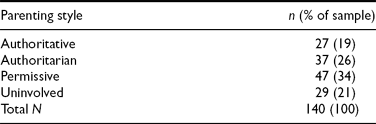
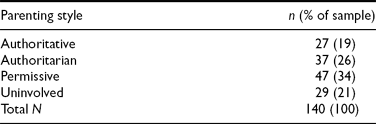
Each parenting style was derived by combining high and low scores of responsiveness and demandingness, split at the mean score of each dimension (see Maccoby & Martin, Reference Maccoby, Martin and Mussen1983, for a review of literature to support this approach). Frequencies for each style are found in Table 1.
Frequencies of Each Parenting Style
Note: N = total sample size, n = group sample size.
Descriptive Statistics
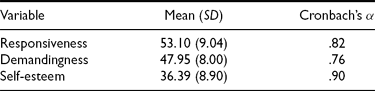
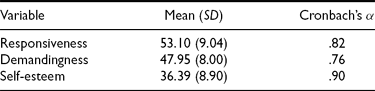
A statistical significance level of .05 was used for all statistical tests and a power analysis indicated that for a small effect size, achieved power approximated 1.0. The means, standard deviations and reliability coefficients for responsiveness, demandingness, and self-esteem are displayed in Table 2.
Means Scores (with Standard Deviation in Parentheses) and Reliability Coefficients for Responsiveness, Demandingness, and Self-Esteem
Note: N = 140, SD = standard deviation.
Analysis 1
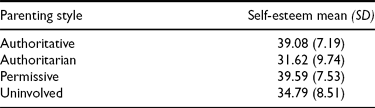
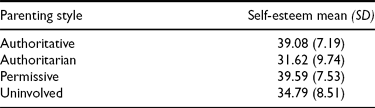
A one-way analysis of variance (ANOVA) was conducted to compare the effect of perceived maternal parenting style on adolescent self-esteem. The mean scores and standard deviations for each parenting style are outlined in Table 3. There was a significant main effect for parenting style on self-esteem, F(3,136) = 7.69, p < .001, η2 = .15. Tukey's LSD post-hoc analyses found significant differences in adolescent self-esteem levels between the authoritative and authoritarian styles (p < .01), the permissive and authoritarian styles (p < .001) and the permissive and uninvolved styles (p < .05).
Mean Scores for each Parenting Style for Perceived Adolescent Self-Esteem (with Standard Deviation in Parentheses)
Note: SD = standard deviation.
Analysis 2
A standard multiple regression was then conducted to test whether responsiveness is a better predictor than demandingness of perceived adolescent self-esteem. The strongest correlation was a moderate positive correlation between self-esteem and responsiveness (r = .34, p < .001), followed by a weak negative correlation between self-esteem and demandingness (r = −.14, p < .05). An ANOVA of the model was significant, F(2,137) = 9.99, p < .001. The adjusted R 2 value was .11; therefore approximately 11% of the variance in self-esteem is accounted for by this model. Responsiveness was the only significant contributor to this model, β = .33, p < .001.
Discussion
The purpose of this study was to replicate and extend current findings related to parenting style and adolescent self-esteem, and to demonstrate a more pragmatic approach to considering elements of parenting. The results showed some interesting outcomes.
Given the authoritative parenting style is generally linked with the best outcomes in children (Plunkett et al., Reference Plunkett, Henry, Robinson, Behnke and Falcon2007; Ruiz, Roosa, & Gonzales, Reference Ruiz, Roosa and Gonzales2002), it was not surprising that adolescents with authoritative mothers scored highly on self-esteem. In contrast, permissive parenting is more often associated with poorer adolescent outcomes such as impulsive behaviour and lower ability to take on growing responsibilities (Maccoby & Martin, Reference Maccoby, Martin and Mussen1983), likely due to lower levels of parental demandingness. However, because high levels of maternal responsiveness promote positive development of child and adolescent sense of self (Suchman et al., Reference Suchman, Rounsaville, DeCoste and Luthar2007), and because the permissive parenting style is associated with high levels of responsiveness, levels of self-esteem in this group were also high.
As expected, statistically significant differences were found between groups. Post-hoc analysis confirmed where differences lay between parenting styles on the level of self-esteem observed in each group. The styles characterised by high levels of maternal responsiveness were more influential for the development of adolescent self-esteem. Differences also suggest maternal demandingness is less influential in the development of adolescent self-esteem, although this difference may be moderated by responsiveness. Therefore, the first hypothesis, that the authoritative and permissive maternal parenting styles will be associated with higher scores on adolescent self-esteem, and authoritarian and uninvolved maternal parenting styles will be associated with lower scores on adolescent self-esteem, was supported.
These findings indicate that the authoritative and permissive styles (those with high levels of responsiveness) are better at promoting adolescent self-esteem than the authoritarian and uninvolved styles (those with low levels of responsiveness). Therefore, of the two parenting variables, responsiveness seems to be more influential than demandingness in the development of positive adolescent self-esteem. This was confirmed by the multiple regression analysis. Furthermore, these findings demonstrated that while maternal responsiveness contributed to 11% of the variance in self-esteem, demandingness did not contribute significantly. Therefore the second hypothesis, that maternal responsiveness will be a better predictor than maternal demandingness of higher adolescent self-esteem, was supported.
The results of this study have important implications for both research and practice. Combining responsiveness and demandingness to produce distinct parenting style categories is one of the most widely used allocation methods in parenting research (Spera, Reference Spera2005). However, using a category-style approach suggests that each parenting style has a bounded set of attributes. Rather than adhere to predetermined categories and parameters, it may be more pragmatic to conceptualise parenting styles as a combination of the two co-existing parenting dimensions. A two-dimension conceptualisation would allow the option of a parent moving up or down the scale on one particular dimension. For example, a mother could undertake parenting skills training to increase her levels of responsiveness, and leave her levels of demandingness constant. Furthermore, this approach would allow clinicians to more easily tailor treatment programs to suit unique family attributes.
It is important to note that use of the four-style typology (i.e., placing families into one of the four categories) is not without merit; a host of research suggests otherwise. Placing families into a traditional parenting style to determine the effect of that style on children and adolescents is used successfully by researchers such as Lamborn and colleagues (Reference Lamborn, Mounts, Steinberg and Dornbusch1991) and Petito and Cummins (Reference Petito and Cummins2000). These studies have shown promising results. However, the present study indicates that it may be more helpful to look at individual parental contributors that affect related adolescent outcomes, rather than global attitudes and behaviours.
This study presents a number of points worthy of further consideration. The first point involves the discrepancy in the percentage of dyads in each parenting style group when compared to similar research. In a non-clinical sample, Lamborn and colleagues (Reference Lamborn, Mounts, Steinberg and Dornbusch1991) found their ‘neglectful’ style (akin to our ‘uninvolved’) to occur most frequently (37% of the time), followed by authoritative (32%), authoritarian (16%) and permissive (15%) parenting styles. In a similar study, Milevsky and colleagues (Reference Milevsky, Schlechter, Netter and Keehn2007) found the authoritative style occurred at the highest rate in their sample (37%), followed by neglectful/uninvolved (29%), authoritarian (22%) and permissive (12%). Based on this research, it seemed reasonable to expect that the authoritative and uninvolved styles would occur most frequently within the sample. However, this study's sample did not reflect the pattern described above, as the permissive parenting style was the most frequent, followed by the authoritarian, uninvolved, and authoritative styles (see Table 1). Even though the expected relationship was observed, the frequency was opposite to what was expected. Most notable was that authoritarian parenting was indicated at a much higher rate than other studies have found. While there was some methodological variability between our study and that of Lamborn and colleagues (e.g., we used a mean split and Lamborn and colleagues used a tertile split) and Milevsky and colleagues (different measures of parenting style were used), it is unlikely this would account for the opposite trends of parenting style reported above. We hypothesised these differences may be due to a number of factors, including that a considerable proportion of adolescents in this study, being contemporary Australian teenagers, might be at a stage in their lives where their limit-testing behaviour elicits a firmer (higher demandingness) parenting approach from their mothers. An alternative explanation for the differences between the frequencies of different parenting styles in this study compared to other studies may also be that this pattern is reflective of a changing fashion of parenting in Australia. While no known studies have formally examined these ideas, further research would certainly be worthwhile.
A potential limitation of this study was the method of allocating parents to particular parenting styles, used to preserve adequate sample size. In the current study, the scores on each parenting dimension were characterised as high or low if they were above or below the mean score of that dimension. This strategy was necessary due to the limited sample size. However, this approach was inconsistent to that that used in previous studies. In her influential research in this area, Baumrind (Reference Baumrind1991b) characterised scores on each parenting dimension as high or low if they were more than half a standard deviation away from the mean score. Lamborn and colleagues (Reference Lamborn, Mounts, Steinberg and Dornbusch1991) used a tertile-split procedure, where the top and bottom third of scores on each dimension were characterised as high and low, respectively, and the remaining scores were excluded from the analysis. Both of these methods result in parenting style groups that are more distinct from each other, reducing the chance of any potential confusion between categories. However, both of these strategies also result in a loss of at least one third of the study sample. If either the half standard deviation or the tertile-split method were applied in this study, there would not have been enough participants in each parenting style group to maintain statistical power for the analysis. Despite the reduced difference between parenting style groups in this study, a difference in scores was still observed. This data loss problem provides further support for the two-dimensional argument. Using a dimensional approach does not require the exclusion of over one third of the original sample, and therefore should result in a more accurate representation of the range of parenting behaviours that exist in the broader population.
A second potential limitation to this study was that we used adolescent reports for both self-esteem and parenting style, increasing the risk of shared method variance. For example, adolescents with low self-esteem may have been more likely to hold a negative view of their mother's parenting style. However, the correlation between self-esteem and parenting style was great enough that a positive relationship between these two variables would still likely exist, even if shared method variance was present (Bögels & Brechman-Toussaint, Reference Bögels and Brechman-Toussaint2006).
This study has identified several directions for further research. We have shown support for the idea that individually, parenting dimensions (such as responsiveness) may be used to reliably predict adolescent self-esteem. However, given that maternal responsiveness only contributed to 11% of the variance, further research is required to determine other parental influences that may contribute to the development of adolescent self-esteem. Additionally, including fathers in parenting studies will also assist researchers to develop greater understanding of the predictors of adolescent self-esteem.
In conclusion, this study has investigated the role of maternal parenting style on adolescent self-esteem. Existing literature clearly shows that the authoritative parenting style (characterised by high levels of responsiveness and demandingness) is associated with the greatest benefits for Western adolescents (Lamborn et al., Reference Lamborn, Mounts, Steinberg and Dornbusch1991; Petito & Cummins, Reference Petito and Cummins2000). However, in this study we have demonstrated that treating responsiveness and demandingness as separate dimensions may be more practical than combining them to identify distinct styles. It is argued this approach has benefits both in research and practice: allowing the consideration of specific dimensions of parenting when considering outcomes for mothers and adolescents.