The study of electoral systems is a key area of research within political science. In part, the attention paid to electoral systems reflects their importance to democratic political systems. Electoral systems define “what constitutes” a vote, establish “a rule for how votes are totaled,” and create a mechanism for “translating vote share into seat allocations” for representative institutions (Bawn Reference Bawn1993, 966). These roles mean that electoral systems impact not only how interests are represented, but also how accountability is structured.
The central political role of electoral systems has not escaped the attention of scholars seeking to explain women's legislative representation. A significant number of studies find that majoritarian electoral systems are inimical for women's representation (e.g., Caul Kittelson and Schwindt Bayer Reference Caul Kittelson and Bayer2012; Matland Reference Matland1998; Matland and Studlar Reference Matland and Studlar1996; Salmond Reference Salmond2006; Schwindt-Bayer and Mishler Reference Schwindt-Bayer and Mishler2005; Vengroff, Nyiria, and Fugiero Reference Vengroff, Nyiria and Fugiero2003). There is a broad consensus in the literature that proportional representation systems create fewer obstacles to women's representation. The implication of this research is that for those countries wishing to improve women's representation, the adoption of a more proportional system will increase the number of women elected to the legislature.
The consequences of electoral systems for women's representation, however, is not unquestioned. Recent studies focusing on the gender consequences of electoral system reform find little evidence that electoral system change results in appreciably more women elected to the legislature (Hinojosa and Franceschet Reference Hinojosa and Franceschet2012; Roberts, Seawright, and Cyr Reference Roberts, Seawright and Cyr2013). The conclusion of this research casts doubt on the importance that electoral rules play in deciding the level of women's representation.
This article attempts to push the debate on the gender effects of electoral institutions further by helping us to rethink how we conceive of electoral system effects. I argue that the impact of electoral systems is greatest over the long term, not the short term. The expectation that electoral reform will bring about significant, immediate changes in the number of female legislators is misguided, since electoral institutions create equilibria that often require time to obtain. Using a dataset of 98 countries from 1955 to 2012, I show that while there are modest, short-term effects of electoral system change, the long-term effects of electoral systems are significantly greater.
The article will proceed as follows. First, I examine the existing literature on electoral systems and women's representation. Here I will explain why some scholars believe that electoral systems have such an important impact on women's representation. I will also explain why we should expect that electoral systems will have a long-term effect. Second, I will estimate the influence electoral systems have on women's representation. I use an error-correction model that can model both the short-term and long-term effects of electoral institutions. Finally, I will conclude with the significance of these findings.
THE IMPACT OF ELECTORAL SYSTEMS ON WOMEN‘S REPRESENTATION
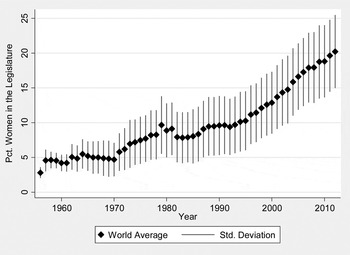
Figure 1 plots the average % age of women in the world's democratic legislatures between 1955 and 2012. While it has steadily increased over time, the average, at its height in 2012, was only 20.2%, well short of the % age of women in the population. In addition, the standard deviation around the average, also plotted in Figure 1, remains quite large across this period. Thus, we see substantial variation around the global average across time.
Average percentage of women in the legislature, 1955–2012.

The data presented in Figure 1 raise an important question: why do women remain underrepresented in the world's democratic legislatures? Scholars researching this question have answered it in several different ways. For some, differences in political culture explain variation in women's representation (Inglehart and Norris Reference Inglehart and Norris2003; Kenworthy and Malami Reference Kenworthy and Malami1999; Norris Reference Norris1985; Paxton and Hughes Reference Paxton and Hughes2007; Reynolds Reference Reynolds1999; Rule Reference Rule1987; Tripp and Kang Reference Tripp and Kang2008; Yoon Reference Yoon2004). Some countries simply have a culture supportive of women's equality, while others maintain traditional, paternalistic cultures that do not encourage gender equality. Others point to differences in levels of female participation in the labor force (Matland Reference Matland1998; Norris Reference Norris1985; Rule Reference Rule1987; Salmond Reference Salmond2006). As women become more active in the job market, they not only gain more resources that enable them to be politically active, but also gain greater insights about the position of women in society, which may also increase their likelihood of political participation. More expansive welfare state policies may also create greater representation for women (Rosenbluth, Salmond, and Thies Reference Rosenbluth, Salmond and Thies2006). Such policies are thought to enable women to participate more in political life. Recent research also demonstrates the importance of gender quotas, which can significantly increase the number of women elected to the legislature (Caul Reference Caul2001; Caul Kittilson Reference Caul Kittilson2006; Krook Reference Krook2007, Reference Krook2009; Murray, Krook, and Opello Reference Murray, Krook and Opello2012; Thames and Williams Reference Thames and Williams2013; Tripp and Kang Reference Tripp and Kang2008).Footnote 1
Much of the existing research also concludes that differences in electoral systems can explain variation in women's representation. The primary conclusion of the literature on electoral systems and gender is that proportional representation systems, on average, promote women's representation better than others (e.g., Caul Kittelson and Schwindt Bayer Reference Caul Kittelson and Bayer2012; Darcy, Welch, and Clark Reference Darcy, Welch and Clark1994; Kenworthy and Malami Reference Kenworthy and Malami1999; Lakeman Reference Lakeman1976; Matland Reference Matland1998; Matland and Studlar Reference Matland and Studlar1996; Norris Reference Norris1985; Reynolds Reference Reynolds1999; Rule Reference Rule1987; Salmond Reference Salmond2006; Schwindt-Bayer and Mishler Reference Schwindt-Bayer and Mishler2005; Thames and Williams Reference Thames and Williams2010; Vengroff, Nyiria, and Fugiero Reference Vengroff, Nyiria and Fugiero2003).Footnote 2 In these systems, the potential costs for party leaders to nominate women is lower in comparison with majoritarian systems (Darcy, Welch, and Clark Reference Darcy, Welch and Clark1994; Lakeman Reference Lakeman1976; Matland Reference Matland1998; Salmond Reference Salmond2006). In proportional representation systems, party leaders typically have considerable control over nominations to the list; therefore, they can create a list that includes women without arousing the ire of influential, entrenched incumbents. This adaptability allows them to compete better for the votes of those who want to support female candidates. In fact, research shows that parties in such systems are more likely to adopt gender quotas in order to compete better with other parties adopting similar rules (Thames and Williams Reference Thames and Williams2013). In majoritarian systems, however, parties have weaker control over candidates, meaning party leaders cannot as easily nominate female candidates. Parties in such systems must cater to strong, entrenched interests to maximize seat share; therefore, party leaders cannot balance nominations as freely.
The strong incumbency advantages of majoritarian systems also help explain why such systems fail to elect more women. The main source of this advantage stems from the fact that incumbents seeking reelection in districts can build personal vote coalitions rather than simply rely upon party labels to obtain votes. Voters may support incumbents because of their personal traits such as their ethnicity or their personalities; furthermore, the provision of state resources in the form of “pork” to the district can aid the formation of such coalitions. The ability of incumbents to exploit legislative “perks” (such as travel support, office resources, etc.) can further strengthen incumbents. Because of the incumbent advantage, legislator turnover in majoritarian systems is lower, creating obstacles for the entrance of new, female representatives (Darcy and Choike Reference Darcy and Choike1986; Matland and Brown Reference Matland and Brown1992; Studlar and McAllister Reference Studlar and McAllister1991; Welch and Studlar 1996). This turnover is one of the reasons why proportional representation systems tend to elect more women than do majoritarian systems (Matland Reference Matland1993). In proportional representation systems, party votes are much more important; therefore, personal vote coalitions are weak or nonexistent. Incumbent personal vote coalitions do not impact party votes substantially, so party leaders can replace incumbents with new candidates—women, for example—without risking vote share. The relative weakness of incumbency advantages in proportional representation systems increases turnover, creating new opportunities for outsider candidates (Andersen and Thorson Reference Andersen and Thorson1984; Welch and Studlar 1996; Zimmerman and Rule Reference Zimmerman and Rule1998).
Even among parties in similar systems, we do see variation in female nominations by party. For some, this variation is explained by ideology. Ample research suggests that party ideology is a strong predictor of the nomination of female candidates (Caul Reference Caul1999; Caul Kittilson Reference Caul Kittilson2006; Kunovich Reference Kunovich2003; Paxton and Kunovich Reference Paxton and Kunovich2003). Often, “left” parties tend to nominate women more than other types of political parties. In addition, some research suggests that parties are more likely to nominate women when women hold critical positions in the party hierarchy. In Canada, Cheng and Tavits (Reference Cheng and Tavits2009) find that women were more likely to run when the local party presidents were women as opposed to men, though this finding may depend on the party (Tremblay and Pelletier Reference Tremblay and Pelletier2001). Evidence that male party elites prefer nominating male candidates may also discourage representation (Niven Reference Niven1998). Other research has found a positive correlation between women's legislative representation and the number of women in key party positions (Caul Reference Caul1999; Caul Kittilson Reference Caul Kittilson2006).
If the electoral system does, in fact, independently affect women's legislative representation, then we would expect that changes in the electoral system or electoral reform will lead to changes in the level of women's representation. If, for example, a country changes from a single-member district plurality system to a closed-list proportional representation system, one would expect that women's representation would increase after the change. The current state of the literature remains, however, split on this question. King (Reference King2002) uses a quasi-experimental design to test the effect of replacing multimember districts with single-member districts in U.S. state legislative elections. The switch to a less proportional system led to fewer women elected, according to this study. This study makes a similar finding as an earlier one that also found that the switch to single-member districts from multimember districts undermined women's representation (Rule Reference Rule1994). In case studies of New Zealand and Russia, Caul Kittelson and Schwindt Bayer (Reference Caul Kittelson and Bayer2012) reveal that the switch to a more proportional mixed-member majoritarian system increased women's representation.
Other research, however, casts doubt on the impact of electoral reform. Hinojosa and Franceschet (Reference Hinojosa and Franceschet2012) examine the effect of municipal electoral reform in Chile. They discovered that informal rules defining candidate selection were able to reduce the impact of beneficial electoral reforms. The finding raises the possibility that scholars overestimate the positive effect of formal institutions such as electoral systems. Roberts, Seawright, and Cyr (Reference Roberts, Seawright and Cyr2013) also reports limited evidence that electoral system change increases women's representation, concluding that other factors, such as changes in cultural values, can swamp the impact of electoral systems.
Does the lack of evidence on the impact of electoral reform on women's representation undermine the conclusion that electoral institutions matter? I argue that the failure to find the impact of short-term changes is based on a faulty understanding of how electoral systems affect women's representation and politics more broadly. Typically, studies examining the effect of electoral reform examine changes in a relatively short time frame (e.g., Roberts, Seawright, and Cyr Reference Roberts, Seawright and Cyr2013). The logic being that in the election immediately following a reform, we should expect to see an appreciable change in the level of women's representation. This change, in theory, is the result of new electoral incentives created by the electoral rules, all else being equal. Given the extensive literature on the effect of electoral systems on women's representation and more broadly on other political outcomes, the expectation that actors will adapt their strategies seems plausible.
Yet, there is also reason to be skeptical of the expectation that electoral reform will lead to immediate changes in women's representation. Di Virgilio and Reed (Reference Di Virgilio, Reed, Giannetti and Grofman2011, 75) argue that “[m]ost generalizations about the effects of electoral systems are correctly framed in terms of statements about equilibrium outcomes. A basic but often-overlooked fact is that it takes time to reach any equilibrium.” For actors, electoral system change often generates uncertainty over future electoral outcomes (Andrews and Jackman Reference Andrews and Jackman2005; Donovan Reference Donovan1995; Dunleavy and Margetts Reference Dunleavy and Margetts1995; Lehoucq Reference Lehoucq2000; Rahat Reference Rahat2004, 2008; Remington and Smith Reference Remington and Smith1996; Shvetsova Reference Shvetsova2003). Given this uncertainty, actors may not immediately understand or react to the incentives created by the new electoral system (Christensen Reference Christensen1998; Crisp and Ingall Reference Crisp and Ingall2002). In fact, contextual factors such as the nature of social cleavages or party organization may slow adaptation (Jou Reference Jou2009).
There are several reasons to expect that the transition to a more proportional electoral system will not immediately translate into more female representatives. Party leaders may not immediately comprehend the incentives of the new electoral system and proceed to balance their tickets. Demands for electoral reform can come from many sources, such as the desire to increase seats (e.g., Benoit and Hayden Reference Benoit and Hayden2004; Benoit and Schiemann Reference Benoit and Schiemann2001; Boix Reference Boix1999; Brady and Mo Reference Brady and Mo1992; Calvo and Micozzi Reference Calvo and Micozzi2005; Remington and Smith Reference Remington and Smith1996), the desire to influence policy (Bawn Reference Bawn1993), concerns for democracy and fairness (Benoit Reference Benoit2004; Renwick Reference Renwick2010), and even from voters (Tolbert, Smith, and Green Reference Tolbert, Smith and Green2009). In fact, recent literature often highlights the sheer complexity of electoral reform causes, arguing against the belief that one logic drives reform (Rahat Reference Rahat2008; Rahat and Hazan Reference Rahat and Hazan2011). The desire to increase women's representation, however, is rarely, if ever, a primary demand of reformers. The adoption of quotas for female candidates, for example, are examples of electoral reform but are rarely considered as instances of it (Celis, Krook, and Meier Reference Celis, Krook and Meier2011). Thus, it is possible that parties may not instantly respond to the new electoral environment. In addition, party actors who previously understood the value of personal vote coalitions may be slow to adapt to a system where they are reduced or are less important. If nominating women was not a priority in the past, parties may lack a significant number of qualified female candidates. In addition, entrenched incumbents may be difficult to replace due to their influence within the party. These incumbents might use their positions to persist, even if party leaders have an incentive to better balance the list.
This logic suggests that we should not necessarily expect political parties to adapt instantly to a new, more proportional system and nominate more women. Instead, it may take several electoral cycles for parties to adapt to the new environment, pushing women's representation higher, toward the expected long-term equilibrium. If this is the case, then we should expect that the impact of the electoral system should take place over time. Put another way, electoral system effects on women's representation may occur primarily over the long term, not the short term. If this is the case, then simply testing the impact of electoral system change may not be the best method to understand how electoral systems affect women's representation. I argue that the greatest impact of electoral systems on women's representation is, in fact, not in the short term, but over the long term.
ESTIMATING THE IMPACT OF ELECTORAL SYSTEMS
To test my argument, I created an unbalanced, times-series cross-sectional dataset of 98 democratic countries from 1955 to 2012.Footnote 3 I code each country year with the percentage of women elected in the lower house of the legislature (Inter-Parliamentary Union 2012; Paxton, Green, and Hughes Reference Paxton, Green and Hughes2008; Salmond Reference Salmond2006; Thames and Williams Reference Thames and Williams2013). I use the percentage of women elected to the lower house as my dependent variable in all specifications.
Measuring the electoral system and electoral system reform is complicated. Part of the difficulty is that we can operationalize electoral systems in various ways. In fact, there is no one accepted measure for them. For this study, I use four different electoral system measures. First, I create a dummy variable that indicates whether a country used a majoritarian electoral formula (Bormann and Golder Reference Bormann and Golder2013). The electoral system literature clearly indicates that these systems elect fewer women in comparison to other systems. A change from a majoritarian system, however, would be toward a more proportional system that should increase women's representation. Several previous studies employed dummy variables to measure the electoral system's effect on women's legislative representation (e.g., Caul Reference Caul1999; Rosen Reference Rosen2012; Rule Reference Rule1981, Reference Rule1987, Reference Rule1990, 1994; Vengroff, Nyiria, and Fugiero Reference Vengroff, Nyiria and Fugiero2003; Yoon Reference Yoon2004). Second, I use the natural log of district magnitude (Bormann and Golder Reference Bormann and Golder2013). A number of studies test the effect of the electoral systems on women's representation using district magnitude (e.g., Matland and Brown Reference Matland and Brown1992; Rule Reference Rule1987; Salmond Reference Salmond2006; Studlar and Welch Reference Studlar and Welch1991; Welch and Studlar Reference Welch and Studlar1990). As district magnitude increases, so does electoral system proportionality. Consequently, I expect that increases in district magnitude should increase women's representation. Third, I code each country with its overall rank in terms of incentives for personal votes (Johnson and Wallack Reference Johnson and Wallack2008).Footnote 4 Previous research used the personal vote index to test the impact of the electoral system on women's representation (Thames and Williams Reference Thames and Williams2010). The measure includes information concerning electoral rules beyond simply district magnitude. It measures the incentives of individual candidates to build personal, as opposed to party, vote coalitions. I expect that as the system creates greater personal vote incentives, the level of women's representation will decrease. I include a logged version of the personal vote rank variable. Finally, I code each country year with the natural log of the number of seats in the legislature. Previous research finds that women's representation increases as does the number of seats (e.g., Kjaer and Elklit Reference Kjaer and Elklit2014; Salmond Reference Salmond2006). As the number of seats increase, we should expect more women to be elected, since they will have more opportunities.
I selected these measures for several reasons. First, as indicated previously, these four measures have been used by the existing literatures on women's representation. Consequently, I can test the impact of the electoral systems using variables that have been previously shown to affect female legislative representation. Thus, this study builds on the existing literature, framing the analysis around already accepted electoral system measures. Second, the measures used here are often used in the electoral reform literature, with the exception of the personal vote index. In fact, Lijphart (Reference Lijphart1994) utilizes three of these measures to code electoral reform: district magnitude, electoral rules, and the assembly size. Thus, these measures touch on concepts that fit within the broader electoral reform literature. Finally, by using four, oft-used electoral system variables, I avoid making inferences using only one measure; instead, I can test whether the expected findings are robust across multiple measures of the electoral system. Given the absence of a single, generally accepted measure of electoral system, I argue that using multiple measures of the electoral system is a safer approach for inference.
To measure electoral reform, I simply create a variable that measures the change in each electoral system measure from t to t + 1. In each case, a change in the variables reflects a change in characteristics that would impact women's representation. Moving from a majoritarian to a proportional system should increase women's representation. An increase in district magnitude or assembly size should increase women's representation, while a decrease in either measure should reduce women's representation. Decreasing incentives for personal votes should increase the number of women elected to the legislature, while increasing personal vote incentives should decrease women's representation.
I adopt this approach for three reasons. First, this strategy allows me to measure electoral reform or change without arbitrarily classifying its “significance.” Many electoral reform scholars concentrate primarily on those reforms considered “major” or “significant” (e.g., Golder Reference Golder2005; Lijphart Reference Lijphart1994; Roberts, Seawright, and Cyr Reference Roberts, Seawright and Cyr2013). Lijphart (Reference Lijphart1994) defines major electoral reforms as those that change the electoral formula or at least 20% of district magnitude, the electoral threshold, or the assembly size. Such reforms would result in significant changes to electoral dynamics, indicating the weight of the reform. Yet, the focus on only “major” reforms obscures the potential important impact of more minor reforms. Jacobs and Leyenaar (Reference Jacobs and Leyenaar2011) presented a more detailed typology of electoral reform that posits five dimensions of reform: proportionality, level of election, inclusiveness of election, ballot structure, and electoral procedures. In this formulation, electoral reform includes such issues as the expansion of the franchise (inclusiveness) and the electoral system used to select the head of government (election level). The authors go further to suggest these reforms have different levels of impact. Major reforms, such as a more than 20% increase in inclusiveness or a change of the electoral formula, do occur; however, minor reforms, such as a change in the district magnitude of less than 20%, and technical reforms, such as a less than 1% change in district magnitude, also occur.
Second, this strategy avoids the arbitrary standard employed to measure the significance of change used in much of the existing electoral reform literature. It is not obvious why a 20% change in district magnitude, for example, is a “major” electoral system change, while a 19% change in district magnitude is only a “minor” reform. The decision, therefore, that a major reform requires a 20% change in district magnitude is, at best, an arbitrary standard. Given that we have alternatives to this arbitrary standard, I prefer to use electoral reform measures that are not based on one.
Finally, creating categorical variables from continuous measures such as district magnitude or seat share tosses out valuable information that we can use to produce better results. If, for example, we categorized electoral reform into major and minor categories, both a 40% change in seat share and a 20% change in seat share are categorized as major reforms. We cannot, with this example, distinguish between the impacts of a 40% and 20% change. Essentially, categorizing reform in this way removes information that we could use to produce better, more robust results. The logic of the argument linking seat share to women's representation, after all, suggests that a 40% increase in seat share should increase women's representation more than would a 20% increase. This difference can only be tested by using a continuous measure.
I include several variables to control for additional factors associated with women's legislative representation. First, the existing literature posits a relationship between female labor force participation and representation. Women's participation in the labor force is thought to grant women greater resources, enabling them to participate politically more easily as well as raising their consciousness about political issues, further enabling participation. Second, I include the number of years since women's suffrage. Countries that allow women to vote earlier, may be more likely to elect female legislators (Kenworthy and Malami Reference Kenworthy and Malami1999; Moore and Shackman Reference Moore and Shackman1996; Tripp and Kang Reference Tripp and Kang2008; Wolbrecht and Campbell Reference Wolbrecht and Campbell2007). Third, I also include a measure of democracy taken from Pemstein, Meserve, and Melton (Reference Pemstein, Meserve and Melton2010). While the dataset does include only democracies as defined by Bormann and Golder (Reference Bormann and Golder2013), there is still significant variation in the level of democracy within the sample. Thus, I include the median for each country year for the democracy measure from the Unified Democracy Score database.
I also include two variables to control for the impact of gender quotas. Typically, quotas fall into two broad categories: Party quotas are adopted by individual political parties that require parties to nominate a certain number of female candidates. In some systems, such quotas require parties to organize the list by gender, ensuring that women are not simply relegated to low list positions. National quotas, either in the form of mandatory nomination quotas for parties or reserved seats for women, are adopted by individual countries. While more rare than party quotas, national quotas are often more effective, since they affect a broader number of actors in the system (Thames and Williams Reference Thames and Williams2013).
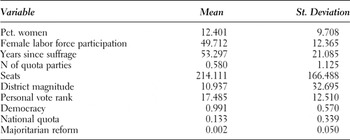
Table 1 contains the descriptive statistics for all variables. For my analysis, I estimate error correction models using Prais-Winsten regression with panel-corrected standard errors and an AR(1) correction (De Boef and Keele Reference De Boef and Keele2008; Goodhart and Xenias Reference Goodhart and Xenias2012). Error correction models provide three advantages for estimating the effect of electoral systems on women's representation. First, data that trend over time are often nonstationary. In nonstationary series, parameters, such as means or variances, trend over time. Most time-series models assume stationarity, however. In this analysis, many of the data series employed in the regression models, such as thepercentage of women in the legislature, female labor force participation, and so forth, often trend over time. To test for evidence of nonstationarity, I used augmented Dickey-Fuller tests for panel data.Footnote 5 I found evidence of nonstationarity across all of the main, continuous independent variables used in this study. Error correction models deal with nonstationarity by modeling the first difference of the dependent variable (De Boef and Keele Reference De Boef and Keele2008). Thus, in all specifications I model the change in women's representation from one year to the next.
Descriptive statistics

Second, time-series models often suffer from cointegration. Cointegration occurs when two variables contain common stochastic trends. Error correction models can model cointegrated variables. To check for cointegration, I ran Westerlund error-correction panel cointegration tests on all specifications and found evidence that the model variables were, indeed, cointegrated.Footnote 6
Finally, by using a “dynamic specification,” I can test both the short-term and long-term effects of the covariates on women's representation (De Boef and Keele Reference De Boef and Keele2008, 191). For understanding electoral systems, this is particularly important. First, I can estimate the immediate impact of electoral reform in the current time period, t. This is the short-term effect of changing the electoral system. Second, I can estimate the long-run effects of covariates on the equilibrium level of women's representation. This particular error correction model specification can tell us whether differences in electoral systems, and other covariates, can increase or decrease this long-run equilibrium.
Typically, error correction models take the following form:
 $$\Delta Y_t = \alpha _0 + \beta _1 \Delta X_t + \rho \left( {Y_{t - 1} - \gamma _1 X_{t - 1}} \right) + \varepsilon _t $$
By taking the first difference of the dependent variable, ΔY t , we create a stationary variable. The β1 coefficient measures the impact of a one-time change in X t on the change in Y t . Thus, I can estimate how changes in the independent variables at time t will affect the change in women's representation at time t. For the electoral system variables, I can, therefore, estimate the impact of changing the electoral system at time t on the change in women's representation (ΔY t ). If electoral system reform has an immediate effect, then we would expect the β coefficients of the electoral system change variables to be statistically and substantively significant.
To measure the long-term impact of a variable, we first estimate the error correction coefficient ρ. The ρ coefficient is the coefficient of the lagged dependent variable, Y t−1 . It measures the “error” between the actual and expected levels of women's representation. A statistically significant ρ indicates the existence of an error correction relationship, which provides justification for using an error correction model. The ρ coefficient expresses the speed of adjustment to changes in the long-term equilibrium created by changes in the values of the lagged independent variables. A large ρ indicates that annual changes in women's representation react quickly to changes in the covariates, while a small ρ indicates that annual changes in women's representation react slowly to changes in the covariates.
We measure the impact of a change in the values of an individual covariate X on the long-term equilibrium of Y by calculating the γ1 coefficient on the lagged value of X (X
t−1
). The γ parameter represents the long-term impact of the independent variables on the equilibrium level of the dependent variable. Positive values of γ1 indicate that as X
t−1
increases, a new higher long-term equilibrium will be established. Negative values indicate that as the variable increases, a new lower long-term equilibrium will be established. The model does not estimate γ directly. I calculate γ using the formula
 $\hat \gamma _j = \displaystyle{{\hat \beta _j} \over {\hat \rho}} \; $
(Goodhart and Xenias Reference Goodhart and Xenias2012). The table of results below presents these transformations for the lagged independent variables.Footnote
7
RESULTS
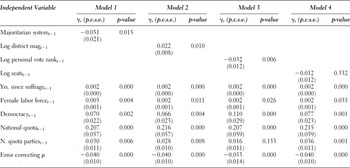
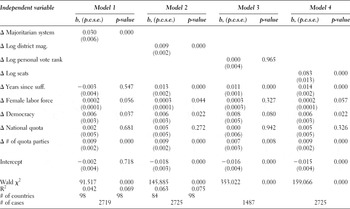
Tables 2 and 3 contain the results of four error correction models, each using a separate measure of the electoral system: the majoritarian system dummy variable (Model 1), the log of district magnitude (Model 2), the log of the personal vote rank (Model 3), and the log of legislative seats (Model 4) variables. Table 2 presents the results of the long-term effects (the ρ and γ parameters) for all four electoral system variables and the control variables. Table 3 contains the results of the short-term effects (the β coefficients) for all variables and the model statistics.
Model results: long-term effect

Model results: Long-term effects

In all specifications (see Table 2), the error correcting ρ is statistically significant, indicating the presence of an error correction relationship in which changes in the lagged covariates lead to changes in the long-run equilibrium level of women's representation. The coefficient varies between −0.04 and −0.053 in all models, indicating that changes in the covariates lead to relatively small yearly changes in women's representation. Consequently, the long-term effects of electoral system changes may only be realized after 10 years, in most cases, meaning several electoral cycles.
We have evidence of an error correction mechanism; moreover, we have evidence that electoral systems are long-term factors that impact the women's representation (see Table 2). The majoritarian γ parameter is statistically significant and negatively correlated with women's legislative representation. Majoritarian systems, over the long term, lower women's representation by just more than 5% in comparison with other systems. Greater levels of district magnitude increase women's representation. In the model, the parameter is statistically significant. A 1% increase in district magnitude increase women's representation by just more than 2%. We also find evidence that those systems with strong personal vote incentives reduce women's representation. The log of personal vote rank is statistically significant and shows that a 1% increase in personal vote ranking decreases women's representation by 3.2%. There does not appear to be, however, a statistically significant relationship between the log of seats and women's representation in the long term.
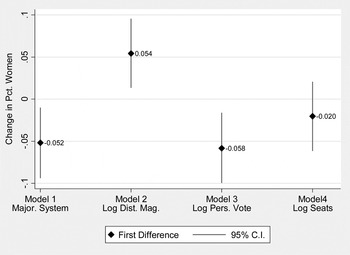
To better address the substantive effect of electoral systems on the long-term equilibrium of women's representation, I used Monte Carlo simulations to calculate expected values, first differences, and 95% confidence intervals for changes in the four main electoral system variables. I plot the results of the long-term effects in Figure 2. In all estimations, I set the values of the control variables at their means. I set the short-term change values at 0. For Model 1, I plot the first difference of increasing the majoritarian variable from 0 to 1. For the remaining three models, I plot the difference of increasing the variable from one standard deviation below its mean to one standard deviation above its mean.
Long-term impacts of electoral systems.

The results of the simulations demonstrate the substantive long-term impact of electoral systems. In the long term, majoritarian systems reduce women's representation by 5.2% (Model 1). If we increase district magnitude from one standard deviation below its mean to one above, we see a 5.4% increase in women's representation (Model 2). We observe a significant decrease in women's representation by increasing personal vote incentives (Model 3). Based on this simulation, we would expect women's representation to fall by nearly 6%. The simulation for the long-term effect of a change in seats (Model 4) does show an expected increase in women's representation if we increase seats; however, as in the case of the parameter estimate, the first difference of the expected value is not statistically significant.
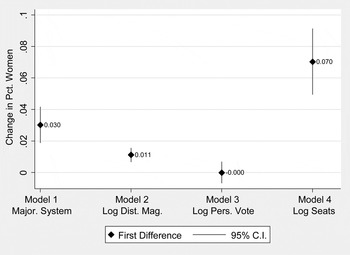
Table 3 contains the results of the short term, immediate impact of electoral system reform. Again, we find that electoral systems do affect the level of women's representation, even in the short term. The majoritarian system variable here represents the change from a majoritarian system to a more proportional system. The change produces an immediate, statistically significant 3% increase in women's representation in the next year. For the log of district magnitude, we see a similar, statistically significant effect. A one% increase in the log of district magnitude increases women's representation by just less than 1%. We do not, however, find a statistically significant effect for a change in the log of personal vote rank. Lastly, we find a statistically significant increase in women's representation associated with an increase in the number of seats. A 1% increase in seats increases women's representation by just more than 8% in the following year.
Figure 3 plots the simulated first differences and 95% confidence intervals generated using the methods indicated above. To simulate the impact of changing the electoral rule, I differenced the expected values of one simulation with the long-term majoritarian variable set to 0 and the change variable set to 0 from one where the long-term variable is set to 0 and the change to one. This increased women's representation by 3% (Model 1). I also simulated a change in the log of district magnitude (Model 2). The long-term value was set to 0, which represents a majoritarian system with a magnitude of 1, while the change variable was set to simulate an increase of one standard deviation in the log of district magnitude. This increased women's representation by just more than 1%. We find no simulated impact for a change in the log of personal vote rank. While the number of seats did not have a long-term impact on women's representation, it does appear to have had a short-term one. If I set the long-term value at the mean of the log of seats and then difference a one standard deviation increase in the log of seats, I find a 7% immediate increase in women's representation.
Short-term impacts of electoral systems

The results of the control variables are relatively straightforward and consistent across all specifications. If we examine the long-term effects (Table 2), we find just this. The number of years since suffrage variable is statistically significant and positively correlated with women's representation across all specifications. A one year increase is associated with a 0.2% increase in the percentage of women in the legislature over the long term. I also find a statistically significant, positive correlation between female labor force participation and thepercentage of women in the legislature. Increasing labor force participation by 1% increased women's representation by between 0.2 and 0.3% across the different models. The Unified Democracy Score median is also statistically significant and positively correlated with women's representation. The magnitude fluctuates between a 6 and 11% increase in representation for a one unit increase in democracy. This finding is interesting since the variable is measuring differences between a set of democratic countries. National quotas improve women's representation in all specifications. The effect is around 20% in all cases. Thus, a national quota substantially increases women's representation. Finally, with the exception of model 3, we see a statistically significant impact of then number of quota parties; a one party increase results in 2.8 to 3.6% increase in representation.
There is weaker evidence of short-term effects of the control variables (see Table 3). The variable measuring the number of years since suffrage is statistically significant and positively correlated in three of the models. The impact of a one unit increase is around 1% for each one-year change. The female labor force participation variable is also statistically significant and positively correlated in 3 of 4 models. The impact of a 1% change is, however, small—between 0.2 and 0.3% across the models. There appears to be a short-term effect for a change in the level of democracy. The positive impact does vary, between 0.6 and 0.8% for a one unit increase in democracy. Interestingly, the adoption of a national quota does not have a short-term impact. The variable is not statistically significant in any specification. This may reflect the fact that quotas may be adopted in periods more than a year before the next election. The addition of a quota party does have an impact. Increasing by one party leads to a 0.7 to 0.9 increase in women's representation across the different models.
DISCUSSION OF RESULTS AND CONCLUSION
Explaining women's legislative underrepresentation remains an important question for gender scholars. The existing research points to a number of determinants of underrepresentation—from socioeconomic factors to cultural explanations. My goal has been to help readers understand better the role of electoral systems in determining the number of women elected to democratic legislatures. Recent research on the gender consequences of electoral system change or reform raised questions about the true influence of electoral systems on women's representation. In this article, I argued that the greatest impact of the electoral system on women's representation will be felt over the long term. The literature on electoral system effects more broadly contends that electoral systems create long-run equilibriums that are reached over time. If this is the case, then we should expect that the true impact of electoral system incentives might occur in time, only after parties and other actors understand more fully the incentives the system creates. Using a dataset of 98 democratic countries from 1955 to 2012, the novel empirical analysis undertaken here did find some short-term consequences of electoral system change; however, many of the effects were found in the long term.
One of the more interesting findings of the research presented here is that the impact of electoral system rules varies across the type of rules measured. The results found the positive impacts of both district magnitude, party-centered electoral rules, and proportional representation electoral rules. The magnitude of their impacts did vary, however—not only between them in the short term, but also in the long term. One of the more interesting findings was the strong, positive impact of simply changing the size of the legislature. The result suggests that short-term increases in the number of legislative seats increases opportunities for women that are exploited by parties and other actors. Interestingly enough, there was no long-term impact of legislature size.
The results also suggest the importance of both national and party quotas. The consequences of quotas, however, appear to play out over time. This may reflect the fact that quota adoption often takes places years before the next electoral cycle. Nonetheless, the extremely strong long-term effect of quotas supports the research that envisions them as a “fast-track” approach to gender equity (Freidnevall Reference Freidnevall2003; Tripp, Konaté, and Lowe-Morna Reference Tripp, Konaté, Lowe-Morna and Dahlerup2006).
There is similarly clear evidence that sociocultural factors matter, again especially in the long term. Both female labor participation and the number of years since suffrage influenced the number of women elected to the legislature. In addition, there are clear, long-term, positive impacts of the level of democracy. The effects of these variables in the short term was smaller, less substantive.
In the end, the empirical results clearly demonstrate that many of the factors we believe impact women's legislative representation have both short- and long-term effects. Yet, the long-term impacts appear more substantive across the board for both institutional and sociocultural factors. This finding is important for two reasons. First, the expectation that electoral systems or other social factors are the only determinants of women's representation are clearly incorrect. Electoral systems do matter, but that does not mean that other elements are trivial. If anything, we may need to pay more attention to models that specify all of the components of women's representation and pay less attention to the role of individual covariates.
Second, the myriad of long-term effects does raise the question of whether we should expect interactive effects between sociocultural factors and institutional ones. In fact, it is possible that the speed at which a change in labor force participation, for example, reaches a new equilibrium may vary by the electoral system. This is the next step in the future of this research.
Finally, and perhaps more importantly, the results of this analysis do suggest that the level of women's representation in any system represents a long-run equilibrium. As such, the exact percentage of women in any given legislature at any given time may be above or below that equilibrium; however, over time, we should expect a return to that equilibrium based on the institutional, social, and cultural context within the system. One clear consequence of this is that any type of change that should improve women's representation—whether institutional, economic, cultural—may take time to improve gender equity.