


Optimal dietary protein intake will provide the 20 α-amino acids (dietary indispensable, conditionally indispensable and dispensable amino acids) in the correct proportions to meet the body's need for metabolic functions including protein synthesis(Reference Lewis and Bayley1). Amino acid composition of foods varies greatly. Especially of importance are the concentrations of lysine, sulphur amino acids (methionine and cysteine) and threonine(Reference Young and Pellett2). In cereals, such as rice and wheat, lysine concentrations are significantly lower than in foods of animal origin. In legumes, such as chickpeas and soyabeans, methionine concentrations are significantly lower than in animal foods(Reference Young and Pellett2). Thus, the study of “protein quality evaluation” of foods aims to determine the capacity of food protein sources to satisfy the metabolic demand for both amino acids and total nitrogen(3).
The quality of dietary proteins is ultimately related to the amount of metabolically available amino acids provided at the cellular level (termed “bioavailable”) for the various functions that protein and amino acids serve in maintaining normal growth and health. In other words, protein quality is a combination of the amino acid content and the bioavailability of those amino acids. The amino acid content (or composition) of common protein sources is reasonably well described(4, 5); however, there is no direct measure of amino acid bioavailability(Reference Stein, Sève and Fuller6). Batterham defines bioavailability as “the proportion of the total amino acid that is digested and absorbed in a form suitable for protein synthesis”(Reference Batterham7). Thus, the bioavailability of amino acids is dependent not only on the digestibility of the dietary proteins, but also on the subsequent absorption, and potential utilization of the absorbed amino acid for metabolic processes.
Within the context of protein quality evaluation for human nutrition, numerous methods have been developed to assess protein quality; however, based on the definitions above most of the methods provide an estimate of bioavailability rather than “protein quality” per se. Tomé and colleagues(Reference Bos, Mahé and Gaudichon8–Reference Tomé and Bos10) suggest that protein quality evaluation methods that encompass both digestibility and protein retention, and thus account for short-term protein utilization, are of primary interest. They also conclude, “that protein quality, in terms of protein utilization, is more than a simple function of the indispensable amino acid content”. The focus of this review is on methods used to define the nutritional value of proteins in relation to the proportion of bioavailable amino acids and protein from protein sources as it relates to practical application in humans. In this context, experimental methods that determine digestibility and/or protein utilization are considered to provide an estimate of bioavailability.
Traditionally, bioassays using growing rats were the preferred approach to assess the nutritional value of proteins for humans, and were expressed as protein efficiency ratio (PER), net protein utilization (NPU), biological value and more recently as the protein digestibility-corrected amino acid score (PDCAAS). The PER, NPU, and biological values measure whole body protein utilization and thus provide an estimate of bioavailability, whereas, PDCAAS is a measure of protein quality as defined above. Several shortcomings of these methods have been identified(Reference Darragh and Hodgkinson11, Reference Moughan12); therefore, there is a need to develop more sensitive and appropriate techniques directly in humans to estimate amino acid bioavailability. Using the minimally invasive indicator amino acid oxidation (IAAO) technique developed to determine amino acid requirements in humans, we have recently developed a new method to estimate the whole body bioavailability, termed “metabolic availability”, of IDAA from dietary protein sources(Reference Moehn, Bertolo and Pencharz13, Reference Humayun, Elango and Moehn14). The current review will outline the concerns related to existing traditional methods and describe the development of the new stable isotope based metabolic availability method in pigs and humans.
Earlier Methods and Related Concerns
Protein Efficiency Ratio
One of the earliest approaches to assess the nutritional quality of proteins for humans was the use of bioassays using growing rats. The Protein Efficiency Ratio (PER) method, which determines the ability of a protein to support growth in young rapidly growing rats, has been applied since 1919 for the routine assessment of protein quality of foods(Reference Young and Pellett2). The PER is calculated as the body weight gain in g per g of test protein consumed. However, the PER overestimates the value of animal proteins and underestimates the value of vegetable proteins. This is primarily because the rapid growth rate of rats increases the proportion of the protein that needs to be IDAA, in comparison to the slow growth rates in humans(15). Additionally, PER is a measure of total protein and not individual amino acid utilization.
Protein Digestibility-Corrected Amino Acid Score (PDCAAS)
Due to the disadvantages of the PER method, an alternative method, the amino acid score method, was proposed for the routine assessment of protein foods during a joint Food and Agriculture Organization/World Health Organization (FAO/WHO) Expert Consultation on Protein Quality Evaluation in 1989(15). The amino acid score is defined as the concentration of the limiting amino acid in the food protein and is expressed as a percentage of the concentration of the same limiting amino acid in a reference amino acid pattern, which is the essential amino acid requirements of preschool-age children, as recommended by the 1985 FAO(Reference Young and Pellett2). The amino acid score for each protein derived by the above described procedure is subsequently corrected for the true faecal protein digestibility (TD) of the test protein, as determined by using a rat model. TD is defined as the difference between the dietary intake of protein N and faecal N excretion, expressed as a % of the dietary N intake. Endogenous faecal N is taken into account by feeding rats a protein free diet(Reference Schaafsma16). This modified amino acid score method is referred to as the Protein Digestibility-Corrected Amino Acid Score (PDCAAS). The PDCAAS is unique compared to other methods of protein quality evaluation because it is primarily a function of the gross amino acid content of a protein source. However, it is currently recommended as the method of choice for the routine assessment of protein quality of foods for humans(15, Reference Schaafsma16) and therefore has been included in the current discussion.
Since its introduction in 1991, the PDCAAS has been extensively studied and various limitations have been reported(Reference Schaafsma16, Reference Reeds, Schaafsma and Tomé17). Specific concerns regarding the PDCAAS method include:
(1) The use of Estimated Average Requirement (EAR) estimates as the reference rather than the safe or RDA estimates. As well, the current reference pattern is restricted to the IDAA and does not take into account the conditionally IDAA(Reference Schaafsma16);
(2) The PDCAAS method does not adequately recognize the nutritional value of high quality proteins because values higher than 100 % are truncated to 100 %. Therefore, differences between two proteins such as milk and soya proteins are not distinguished, although the actual concentrations of some IDAA and the capacity to complement other food sources are higher in milk than in soya protein(15);
(3) The PDCAAS method utilizes digestibility values derived from faecal digestibility coefficients in a rat model. This has many problems at several levels, including the use of rat digestibility values and the use of faecal versus ileal digestibility values.
(4) The PDCAAS method does not take into account the large variations that exist between digestibility values for entire proteins and individual amino acids(Reference Fuller and Tomé18). For example, in human milk, indispensable amino acid digestibility ranged from 86 % for threonine to 100 % for methionine and tyrosine(Reference Fuller and Tomé18).
(5) Another key concern with the PDCAAS method is with respect to application of the method to foods that have been heat processed. Protein foods subjected to heat/alkaline processing to improve food flavour and texture, or sterilization /pasteurization may cause the formation of compounds that render the amino acids unavailable for protein synthesis; for example: Maillard compounds, oxidized forms of sulphur amino acids, D-amino acids, and cross-linked peptide chains, such as lysinolalanine(Reference Gilani, Cockell and Sepehr19).
(6) Furthermore, some foods naturally contain antinutritional factors, such as trypsin inhibitors in soya protein, tannins in legumes and cereals, and phytates in cereals. These decrease the bioavailability of amino acids from the food sources(Reference Myrie, Bertolo and Sauer20); the PDCAAS method does not take into account these factors and thus tends to overestimate the protein quality of such products(Reference Gilani, Cockell and Sepehr19, Reference Sarwar21).
Protein and amino acid digestibility
Digestibility is the percentage of protein or amino acid intake that has disappeared from the digestive tract and has become the standard measure to estimate bioavailability. Digestibility can be divided into faecal (or total tract) and ileal digestibility. Ileal digestibility can be further separated into apparent, standardized, or true depending on the method of correction for endogenous losses(Reference Stein, Sève and Fuller6). Nearly all of the absorption of amino acids occurs in the small intestine, prior to the end of the ileum, which means that faecal digestibility is a poor estimate of actual amino acid bioavailability. There is extensive evidence demonstrating microbial degradation of protein and amino acids in the hindgut(Reference Darragh and Hodgkinson11, Reference Moughan22). Therefore, faecal digestibility values tend to overestimate the bioavailability of many amino acids in dietary protein(Reference Darragh and Hodgkinson11). Conversely, microbes in the hindgut also synthesize many amino acids, which can lead to underestimation of the ileal availability.
Extensive research in pigs(4) clearly demonstrates that ileal digestibility coefficients, which are determined by measurements made of the quantity of amino acids remaining at the end of the small intestine, or ileum, provide a more accurate estimate of protein and amino acid bioavailability. Despite being a major improvement compared to faecal digestibility, ileal digestibility of amino acids is not equal to the true amino acid bioavailability. The reader is directed to detailed reviews of the advantages and potential limitations of ileal digestibility methods(Reference Stein, Sève and Fuller6, Reference Reeds, Schaafsma and Tomé17) and these will not be discussed in detail here. Briefly, three limitations with traditionally determined ileal digestibility are: (1) not all absorbed amino acids are in a form that is biologically available; (2) the quantity of amino acids excreted into the gut, called endogenous protein loss(4), with different foods(Reference Myrie, Bertolo and Sauer20) and must be accurately accounted for; (3) the method requires sampling of ileal digesta. Surgical implantation of a simple t-cannula is a popular technique for collection of ileal digesta in animals(Reference Knabe, LaRue and Gregg23) but is not applicable to humans. Healthy adult ileostomates(Reference Moughan12) and intestinal intubation(Reference Bos, Mahé and Gaudichon8) have been used to determine ileal amino acid digestibility values for humans, but the methods are not suited for routine application thus animal models such as the growing pig or rat are used.
As described earlier, heat processing may cause the formation of compounds that render the amino acids unavailable for protein synthesis. Although unavailable for protein synthesis, these altered amino acids are partly digested and absorbed. Because of the presence of chemically altered AA in heat damaged protein, and their interference during amino acid analysis, traditional estimates of amino acid digestibility can be in error for processed foods. Methods have been developed to address these problems. The reactive lysine assay may be used to assess the degree of chemical modification of lysine in foods due to heat but does not account for incomplete digestion or absorption from the gut(Reference Moughan, Gall and Rutherfurd24). Digestible reactive lysine(Reference Moughan, Gall and Rutherfurd24, Reference Rutherfurd and Moughan25) incorporates true ileal digestibility as well as reactive lysine measurement in both the food and ileal digesta and thus provides a more accurate estimate of the effect of heat damage to lysine bioavailability than the reactive lysine content of the foodstuff alone. The digestible reactive lysine assay has been shown to provide reliable estimates of lysine bioavailability in damaged proteins(Reference Rutherfurd and Moughan25).
Stable isotope based methods for in vivo estimation of amino acid bioavailability of foods
Batterham(Reference Batterham7) suggests that based on the definition of amino acid bioavailability stated previously, techniques that measure the utilization of an amino acid are important for estimating bioavailability. There is a need to develop methods that account for digestibility as well as metabolic utilization of amino acids. Dietary protein utilization is influenced by multiple factors including individual amino acid requirements, dietary energy and nitrogen intakes, genetic and environmental influences, age, physiological stage, presence of antinutritional factors, processing treatments and interactions among other components of the diet(Reference Moughan12). Therefore, the development of new techniques to estimate bioavailability must take care to control or account for the influence of these factors.
We(Reference Moehn, Bertolo and Pencharz13, Reference Humayun, Elango and Moehn14, Reference Moehn, Bertolo and Martinazzo-Dallagnol26, Reference Levesque, Moehn and Pencharz27) have recently applied the IAAO method using carbon (Reference Humayun, Elango and Moehn14C or Reference Moehn, Bertolo and Pencharz13C – labeled amino acid) oxidation as an indicator of amino acid bioavailability, while others(Reference Batterham7–Reference Mariotti, Mahé and Benamouzig9, Reference Gausserès, Mahé and Benamouzig28) have applied the use of [15N]-labeled proteins to determine net postprandial protein utilization (NPPU), or [13C]-leucine balance to predict PPU(Reference Millward, Fereday and Gibson29, Reference Millward, Fereday and Gibson30).
Net postprandial protein utilization (NPPU)
[15N]-labeled proteins (milk, soya protein isolate and wheat) have been used to measure the metabolic fate of dietary nitrogen after its consumption in humans. NPPU is calculated using true ileal digestibility and 15N-labeled protein deamination parameters(9). Intrinsic labelling of dietary proteins with 15N allows the investigation of postprandial N transfers into different metabolic pools. Ileal digesta, blood and urine are sampled. The kinetics of dietary N appearance in ileal effluents, plasma proteins, plasma free AA, body urea, urinary urea and urinary ammonia are calculated using a 13-compartment, 21 parameter model(Reference Juillet, Saccomani and Bos31). NPPU values determined for milk, soya protein isolate and wheat are 81 %, 78 % and 66 %, respectively(Reference Batterham7–Reference Mariotti, Mahé and Benamouzig9, Reference Bos, Juillet and Fouillet32).
This method is a major advancement in the evaluation of protein quality because it determines protein digestibility and post-prandial protein utilization; however, it is restricted to foods which can be intrinsically labeled with 15N and during the study, ileal digesta are collected using a naso-intestinal intubation technique. Therefore, this method is unlikely to be widely adopted for routine application. The model calculations are fairly complex(Reference Juillet, Saccomani and Bos31). Furthermore the NPPU technique cannot be used to determine the utilization of individual amino acids.
Postprandial protein utilization (PPU)
Millward et al. (Reference Millward, Fereday and Gibson29) used a [1-13C]-leucine balance protocol and a single meal of wheat or milk protein to predict postprandial protein utilization (PPU). From the measurement of 13C-leucine oxidation, leucine and nitrogen balances were predicted using the cumulative difference between the pre-meal and post-meal leucine oxidation rate, which is converted to a nitrogen retention value based on an assumed body tissue protein leucine:nitrogen ratio, and the meal nitrogen intake. Nitrogen utilization is assumed to be equivalent to “leucine intake less the meal-dependent leucine oxidation”, and utilization of wheat protein is assumed to be limited by the lysine content(Reference Millward, Fereday and Gibson29). Using this method the authors predicted wheat PPU to be 0·61 using the single meal pattern(Reference Millward, Fereday and Gibson29) or 0·68 using frequent small meals(Reference Millward, Fereday and Gibson30). The method as described above involves several assumptions which have not been validated in subsequent studies, and has been severely criticized by others(Reference Kurpad and Young33). It is not possible to accurately determine the PPU for nitrogen present in the test meal by the present method because it is impossible to estimate how much of leucine oxidized in the 6 h postprandial period is due specifically to exogenous (dietary) and endogenous sources of leucine. The route of isotope delivery was intravenous, and it is unclear whether bypassing the small intestine for the route of isotope had any impact on the measurement of PPU. It is also not clear whether the methodological concerns can be solved with respect to the PPU method, and will be suitable for routine application.
Application of the IAAO method to determine the metabolic availability (MA) of amino acids
The IAAO technique is based on the concept that when one IDAA is deficient for protein synthesis, then the relative surplus of other amino acids including the indicator amino acid (another IDAA, usually L-[1-Reference Moehn, Bertolo and Pencharz13C]phenylalanine) will be oxidized(Reference Pencharz and Ball34). Fundamentally, this is because amino acids cannot be stored and therefore must be partitioned between incorporation into protein or oxidation. With increasing intake of the limiting amino acid, oxidation of the indicator amino acid will decrease, reflecting increasing incorporation into protein. Once the requirement for the limiting amino acid is met, there will be no further change in the oxidation of the indicator amino acid. The inflection point where the oxidation of the indicator amino acid stops decreasing and reaches a plateau is referred to as the ‘breakpoint’. The breakpoint identified with the use of bi-phase linear regression analysis indicates the mean or EAR of the limiting (test) amino acid(Reference Pencharz and Ball34). This minimally invasive IAAO method has been systematically applied to determine IDAA requirements in adult humans(Reference Pencharz and Ball34–Reference Elango, Ball and Pencharz36).
The IAAO method can be applied to estimate the bioavailability of AA, termed metabolic availability (MA)(Reference Moehn, Bertolo and Pencharz13, Reference Moehn, Bertolo and Martinazzo-Dallagnol26, Reference Ball, Moehn and Bertolo37). The IAAO is inversely proportional to the rate of protein synthesis(Reference Ball and Bayley38, Reference Rafii, McKenzie and Roberts39). Therefore, at a given amino acid intake, the relative difference in the IAAO rate between test and reference proteins will be proportional to the whole body MA of the test amino acid for protein metabolism, and thus account for all losses of dietary amino acids during digestion, absorption, and cellular metabolism (Fig. 1). The total losses taken into account by the IAAO method include: incomplete digestion and absorption, gut endogenous amino acid losses, and the unavailability of absorbed amino acids from foods due to the presence of anti-nutritional factors (i.e. Maillard compounds formed due to processing of foods, D-amino acids, and cross linked proteins such as lysinoalanine). In simple terms, the higher the oxidation of the indicator amino acid, the lower the MA of the test amino acid for protein metabolism and vice-versa (Fig. 1).
Conceptual application of indicator amino acid oxidation (IAAO) to determine metabolic availability of amino acids from food sources IAAO is inversely proportional to the rate of protein synthesis. Total losses taken into account by the IAAO method include: incomplete digestion and absorption, gut endogenous amino acid losses, and the unavailability of absorbed amino acids from foods due to the presence of anti-nutritional factors, Maillard compounds formed due to processing of foods, D-amino acids, and cross linked proteins. Thus, the higher the oxidation of the indicator amino acid (breath 13CO2), the lower the metabolic availability of the test amino acid for protein synthesis and vice-versa.

Metabolic availability is based on the principle of the slope-ratio assay where changes in a measured response (i.e. growth) due to changes in intake of the test protein source are compared to the change in response to a reference protein. Assays of amino acid bioavailability that measure parameters of growth (i.e. slope ratio assays) are considered the standard against which other methods of amino acid bioavailability are judged(Reference Lewis and Bayley1). The advantages of slope ratio assays that measure parameters of protein synthesis are that they account for the effect of digestion, absorption and metabolic utilization of the AA provided by the protein source and measure a response that has practical and economic consequences(Reference Lewis and Bayley1) which is of particular importance in animal nutrition. However, one limitation of the slope-ratio assay is that only one amino acid can be examined at a time. Traditionally, body weight or feed efficiency were used to evaluate ‘growth’ in relation to slope-ratio assays(Reference Tomé and Bos10) but may require extended periods of time to measure a change of statistical significance. The short adaptation time ( < 2 days) of the IAAO technique(Reference Elango, Humayun and Ball40) means that multiple amino acids from a protein source may be evaluated in a relatively short period overcoming the limitation of measuring single amino acids at a time. The slope ratio assay is dependent on a number of key criteria(Reference Batterham7) which are discussed further below.
Metabolic availability of lysine in pigs
The initial development of the IAAO method to measure MA was conducted in growing pigs. We(Reference Wykes, Ball and Pencharz41, Reference Ball, House and Wykes42) and others(Reference Moughan, Birtles and Cranwell43, Reference Deglaire, Bos and Tomé44) have successfully used the pig as a model for human protein and amino acid nutrition studies. Anatomical and digestive physiology similarities exist between the pig and human especially with respect to protein and amino acid metabolism, and pigs are well suited for in vivo amino acid bioavailability studies.
The MA of lysine from peas in growing pigs (15-18 kg) was determined by comparing the oxidation of the indicator amino acid (intravenously delivered 1-14C-phenylalanine) to that of pigs fed free lysine (crystalline form)(Reference Moehn, Bertolo and Pencharz13). It has been shown previously that the true digestibility of crystalline amino acids in pigs is essentially 100 %(Reference Baker45, Reference Chung and Baker46). To determine metabolic availability using this method, key criteria must be fulfilled(Reference Levesque, Moehn and Pencharz47): 1) the test amino acid must be first-limiting to ensure that it is the dietary intake of this amino acid that drives the change in indicator oxidation rates; 2) the response of the oxidation rate to increments of the test amino acid must be predictable to allow calculation of availability. For this criterion to be met, the intake of the limiting amino acid must be below the lower confidence interval (CI) of the requirement level in every individual (Fig. 2, Panel A). As well, care must be taken during experimental diet formulation to ensure that other dietary nutrients are similar between test and reference diets so that the only factor driving IAAO is the level of the test AA intake(Reference Levesque, Moehn and Pencharz47).
Pattern of response observed in indicator amino acid oxidation due to intake of free (crystalline) methionine and intact proteins Panel A: Oxidation response measured in breath of orally administered L-1-13C-Phenylalanine (% administered dose) following graded intake of free (crystalline) methionine. Values are means ± SEM; n = 7 human subjects; TSAA, total sulphur amino acids Panel B: Oxidation response of orally administered L-1-13C-Phenylalanine (% administered dose) following intake of free (crystalline) methionine, versus casein and soya protein isolate (SPI) at 60 % of mean methionine requirement (n = 7 subjects) At a given amino acid intake, relative difference in the IAAO rate between test and reference proteins (free crystalline form) will be proportional to the whole body metabolic availability (MA) of the test amino acid for protein synthesis, and thus account for all losses of dietary amino acids during digestion, absorption, and cellular metabolism. The MA is calculated from the ratio of the response to the addition of amino acid intake from test proteins to that of free (crystalline) amino acids. To ensure that the test amino acid is first limiting, the intake of the test amino acid must be below the lower confidence interval (CI), i.e. 1 or 2 SD below the EAR in every individual, as established in Panel A. Adapted from Humayun et al. (Reference Humayun, Elango and Moehn14).

The test diets, raw peas and heated peas (to render some of the lysine unavailable by Mallard reaction), were fed at the 80 % of lysine requirement level and IAAO measured(Reference Moehn, Bertolo and Pencharz13). Replacing the free lysine with equal amounts of protein bound lysine from both samples of raw peas increased IAAO oxidation, demonstrating a lower availability of lysine (Table 1). Heated peas increased IAAO more than raw peas, demonstrating that lysine bioavailability was decreased due to the heating process. MA was calculated from the ratio of the response to the addition of lysine intake from peas/heated peas to that of free lysine (Table 1). The MA of lysine from raw peas was determined to be 88 %, compared to 55 % from heated peas. These values were comparable to earlier published estimates determined using slope-ratio growth assays(Reference van Barneveld, Batterham and Norton48) and digestible reactive lysine(Reference Rutherfurd and Moughan25) where the bioavailability of raw peas was 85 and 87·9 %, respectively and the bioavailability of similarly heated peas was 48 and 67 %, respectively. It should be noted that in similarly heated peas, the reduction in lysine bioavailability was >30 % when based on MA or the slope ratio assay but 20 % when based on digestible reactive lysine.
Metabolic availability of lysine in foods fed to swine

* Moehn et al. (Reference Moehn, Bertolo and Pencharz13), n = 4 growing pigs.
† Moehn et al. (Reference Moehn, Bertolo and Martinazzo-Dallagnol26), n = 8 growing pigs.
‡ Levesque et al. (Reference Levesque, Moehn and Pencharz27) n = 6 pregnant sows.
The method was adapted for oral isotope delivery(Reference Moehn, Bertolo and Martinazzo-Dallagnol26) to make the method minimally invasive and more applicable for routine use. The MA of lysine from soyabean meal (87·5 %, Table 1) correlated well with reported values of 88 % for soyabean meal based on standardized ileal digestibility(Reference Moehn, Bertolo and Martinazzo-Dallagnol26). The MA of raw and heated peas was 76 %, and 68·3 %, respectively. Different feedstuffs and less severe heating conditions were applied in the latter study, which rendered less lysine unavailable. When heated peas were supplemented with free lysine, to the amount that was calculated to be lost during heating, the MA of lysine was determined to be 76·5 %, similar to the raw peas (Table 1). Therefore, the MA method is sensitive to changes in lysine bioavailability.
Metabolic availability of threonine in pigs
By applying the method described by Moehn et al. (Reference Moehn, Bertolo and Pencharz13) in pregnant sows, the MA of threonine in corn was determined to be 88·0 % and in barley 89·3 %(Reference Levesque, Moehn and Pencharz27). These results were 7 and 9 % greater than the published standard ileal digestibility of threonine in corn (82 %) and barley (81 %), respectively, based on growing pig data(4). Previous studies have also suggested that pregnant sows have a greater capacity to digest and utilize protein-bound amino acids compared to growing pigs(Reference Stein, Kim and Nielson49, Reference LeGoff and Noblet50). The standard ileal digestibility of crude protein and amino acids of individual feed grains averaged 10 % greater in pregnant sows with a range from 1·7 to 16 %(Reference Stein, Kim and Nielson49). The threonine MA study(Reference Levesque, Moehn and Pencharz27) results also suggest approximately 10 % greater availability of amino acids in feedstuffs fed to adult sows compared to growing pigs.
Higher nutrient availability in sows is partly due to feed restriction, which increases digestibility in pigs by 10-15 %(4). To support the increased demand for nutrients and changes in nutrient metabolism that occur during pregnancy, utilization of nutrients from the diet may be altered by increasing intestinal absorption(Reference King51). Apparent ileal AA digestibility was 10 % higher in mated ewes compared to non-mated ewes(Reference Coffey, Paterson and Saul52). An increase in the specific activity of digestive enzymes has been shown to occur during late pregnancy and lactation in rats(Reference Burdett and Reek53). Therefore, the increased availability of threonine from corn and barley in sows may be due to the physiological state of pregnancy which leads to more efficient absorption of amino acids from dietary sources. These results also highlight the ability of the metabolic availability method to be applied during different physiological conditions. The method also yields meaningful results, which can be applied to improve health by tailoring nutrient supply to specific physiological needs.
Metabolic availability of sulphur amino acids in humans
We(Reference Moehn, Bertolo and Pencharz13) recently adapted the method in humans to determine the MA of SAA from casein versus soya protein isolate (SPI) using L-[1-13C]phenylalanine as the indicator amino acid. Healthy young men received free methionine (crystalline form) at 20, 40, 50 and 70 % of the TSAA requirement (13 mg/kg/d) previously determined in our laboratory(Reference Di Buono, Wykes and Ball54). With increasing intake of free methionine, a linear decrease in indicator oxidation rate was observed (Fig. 2, Panel A). SPI was also tested to be first limiting in methionine for protein synthesis in these subjects, by the addition of free methionine to a test diet containing 40 % of the TSAA requirement. It was observed that indicator oxidation decreased significantly due to the addition of free methionine to the SPI test diet when compared to the unsupplemented group(Reference Moehn, Bertolo and Pencharz13). The test proteins, casein and SPI were provided at 60 % of the TSAA requirement in the same subjects and the IAAO response compared against the IAAO response observed with addition of free methionine (Table 2 and Fig. 2, Panel B). All other amino acids, except the SAA, were present in excess and were identical in content among the reference and test proteins. Therefore, changes in the IAAO between diets with free methionine versus SAA from casein or SPI reflected the metabolic availability of the SAA. The MA was calculated from the ratio of the response to the addition of amino acid intake from test proteins to that of free (crystalline) amino acids. The MA of SAA in casein and the SPI were determined to be 87 and 72 %, respectively, which are comparable to earlier published net protein utilization (NPU) values of 80-85 % for milk proteins and 71-78 % for soya proteins (Table 2).
Metabolic availability of total sulphur amino acids in casein and soya protein fed to humans*
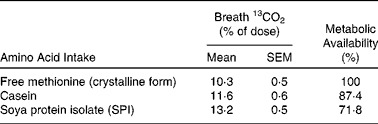
* Humayun et al. (Reference Humayun, Elango and Moehn14), n = 7 healthy young men.
In the human study we also studied IAAO responses with the provision of graded increases in TSAA (40, 50, 60 and 70 %) from casein and SPI, while supplementing all other amino acids to ensure only the SAA from test proteins were limiting. We did not observe a linear decrease in IAAO with increasing SAA from test proteins, as we had observed for the graded increases in free methionine(Reference Moehn, Bertolo and Pencharz13). We reasoned that this was possibly due to the provision of a mixture of free and protein-bound amino acids in the minimally adapted IAAO protocol. In our previous work(Reference Elango, Humayun and Ball40) using IAAO to estimate amino acid requirements in humans an adaptation period of < 8 hr was adequate for adaptation to changes in test amino acid intakes when crystalline amino acids were used. This same adaptation period ( < 8 hr) was used for the test protein (i.e. protein-bound amino acids); however, this may not be sufficient adaptation time for intact proteins. Thus an inadequate adaptation period may have affected the tracer/tracee ratio for the indicator amino acid. To ensure that reliable estimates for TSAA availability can be obtained, we repeated the study in the same human subjects at the 60 % TSAA intake level. Similar metabolic availability for both casein (90·5 vs. 90·6 %) and soya protein (70·6 vs. 69·9 %) were obtained in the second experiment, compared to the first experiment(Reference Moehn, Bertolo and Pencharz13). The 60 % TSAA intake level was chosen to determine availability because it is one SD below the EAR for methionine in each individual(Reference Di Buono, Wykes and Ball54), and meets the criterion that the intake of the limiting amino acid must be below the lower confidence interval (CI) of the requirement level in every individual for the change in IAAO to be predictable (Fig. 2). Future studies in humans need to be conducted to further validate this new concept to determine “metabolic availability”. This method to determine amino acid availability may be more practical and suitable for humans compared to other current in vivo methods for the routine application in various food sources.
Summary
Amino acid requirements in human adults, neonates, children, and in diseased individuals have been systematically studied using the IAAO method(Reference Pencharz and Ball34–Reference Elango, Ball and Pencharz36). The IAAO concept has now been applied to determine the in vivo bioavailability, termed “metabolic availability”, of amino acids from foods for protein synthesis in pigs and humans. The results from studies in pigs suggest that MA can be determined for individual amino acids including lysine, threonine and methionine, typically the first limiting amino acids in diets containing proteins from vegetable origin. The MA also can be applied to determine amino acid losses (especially lysine) due to heat processing of foods. Digestible reactive lysine also accounts for losses in lysine bioavailability due to heat processing but requires sampling of ileal digesta to determine true ileal amino acid digestibility. The adaptation of the study in humans to determine methionine availability has opened the way for further validation and work directly in humans to determine amino acid availability. The other stable isotope based method in humans (using 15N-labeled proteins9) requires sampling of ileal digesta, intrinsic labelling of food proteins and thus is limited in its application. Compared to the 15N-labeled protein method the IAAO method is easier to conduct, less expensive, less invasive, and provides estimates of individual amino acid bioavailability. Future studies need to be conducted to further validate the method for routine application in humans.
Practical application of protein quality evaluation of protein sources includes consideration of the amino acid profile as well as the bioavailability of the amino acids. There are numerous methods to estimate bioavailability; however, amino acid digestibility is currently the most widely used. Standard ileal digestibility provides a reasonable estimate of bioavailability for many foods but it does not account for incomplete digestion and absorption of structurally altered amino acids or short-term amino acid utilization for protein metabolism. The digestible reactive lysine method has been shown to more accurately estimate lysine bioavailability in heat-damaged proteins. The MA method is superior to digestibility as an estimate of bioavailability because it provides estimates of amino acid availability subsequent to digestion and absorption of the test proteins. A new indicator of protein quality for practical application to human nutrition based on amino acid profile and MA would be superior to the current PDCAAS because it would account for differences in protein and AA bioavailability, account for amino acid losses due to heat damage, and be measured directly in humans rather than animal models.
Acknowledgements
The authors have no conflicts of interest. All authors contributed in the preparation of the manuscript.
Supported by the Canadian Institutes for Health Research (grant # MOP 10 321).



