Introduction
In the United States, public university tuition authority is exclusively a state prerogative (Gladieux et al. Reference Gladieux, King and Corrigan2005). The majority of states maintained low tuition rates at public colleges prior to 1970, a year that marked the beginning of a “great transformation in higher education” as financially overextended public colleges found themselves in the middle of state fiscal crises (Kerr Reference Kerr1991). During the 1980s and 1990s, in the states where legislatures still maintained tuition-setting authority, legislators began hearing petitions from leaders of state colleges for market-based tuition pricing. Presidents, chancellors, and regents told policy makers that increased pricing flexibility would “better reflect demand” and “provide more revenue” (New York Legislature 1996b), that they needed “the ability to run like a business,” and that low tuition does not guarantee access (Texas Legislature 1996). This variety of “marketization”—wherein tuition consideration is removed from the political realm of the legislature, whose members set tuition rates based on electoral considerations, to governing boards whose members set tuition rates based on market principles—was successful in almost every state: Seven of the nine states where legislatures still controlled tuition abdicated that authority (McBain Reference McBain2010; Zinth and Smith Reference Zinth and Smith2012). Only policy makers in Florida and New York refused to devolve tuition authority, allowing legislators to retain their control over undergraduate tuition.
In this article, I present a negative case study of New York and Florida policy makers’ refusal to devolve tuition authority. Why, when every state had a devolved tuition-pricing method in place, were leaders of the State University of New York (SUNY) and the Florida State University System (FSUS) unsuccessful in their efforts to pressure their state legislatures to abdicate tuition authority? The common mechanism pushing stakeholders to consider devolution in all nine states was economic necessity: States were funding a decreasing share of public universities’ costs and tuition devolution allowed the use of tuition revenue to fill the gap. What set New York and Florida apart, I argue, was the creation and perpetuation of a distinctive institutional logic, which I call the family of institutions logic. Central to this logic was the belief that all campuses in a state university system ought to be treated equally, although not identically, and the system viewed holistically—like a family. This logic grew out of the institutional ecologies of university systems. Preexisting university policy and regional stakeholders’ political interests led these states in the mid-twentieth century to construct relatively nonhierarchical university systems, for example by refusing to officially recognize a flagship campus in their state university systems. The flattened structure, in turn, defined organizational actors’ subsequent interests and objectives related to tuition policy. In each state, university leadership, politicians, faculty, and students appealed to a family of institutions logic rooted in their state university system’s institutional histories. Their arguments became a hindrance to tuition devolution by making competing logics less persuasive.
With this analysis, I demonstrate the importance of structural conditions specific to the history of state universities in determining tuition policies and show how the perpetuation of an institutional logic retarded this type of institutional change. I also expand theoretical perspectives on marketization in higher education by showing that this form of marketization—tuition devolution—is least successful when stakeholders value institutional similarity in, and discourage competition between, the public colleges of their state.
After providing an account of policy rejection in Florida and New York, I test alternative hypotheses by presenting evidence from Texas and Washington where state legislators approved tuition devolution in 2003 and 2011. In these two states, preexisting policies, organizational arrangements, and political interests did not result in a commitment to a nonhierarchical system. As a result, differentiating tuition levels and devolving authority over tuition did not violate an institutional logic as constructed and perpetuated by lawmakers in New York and Florida.
Adopting Market-Oriented Policies in Higher Education
Rejection of a market reform policy in higher education, even in just two states, is a puzzle from the perspective of existing literature on marketization, which describes an overwhelming regime shift toward neoliberal solutions to social and economic problems (Krippner Reference Krippner2011). Indeed, reforms in higher education during the past 30 years have typically prioritized market-driven, competitive practices over other goals. For example, university reliance on capital accumulation from endowment investments and institutional borrowing has significantly increased for public and private institutions, suggesting a “financialization” of higher education (Eaton et al. Reference Eaton, Habinek, Goldstein, Dioun, Godoy and Osley-Thomas2016). Closer relationships between industry and colleges have led colleges to adopt other market-oriented practices. This is seen in the growing maxim that higher education is itself an industry (Gumport Reference Gumport2000), required to strengthen the economy through inventions and marketable scientific discoveries (Berman Reference Berman2012; Slaughter and Rhoades Reference Slaughter and Rhoades2004), and in universities’ courting of private corporations to recruit employees from the ranks of the student body (Davis and Binder Reference Davis and Binder2016).
Scholars stress the role of economic conditions in the adoption of market-oriented reforms. For example, Berman (Reference Berman2012) shows that the move to promote the marketing of academic science was driven by politicians’ concerns about the stagnant US economy. Competition for paying students, state appropriations, and limited research grants—in short, economic necessity—have pushed public and private postsecondary institutions to remake themselves in the image of industry rather than focus on delivering a public good (Gumport Reference Gumport2000; Kirp Reference Kirp2003; Slaughter and Leslie Reference Slaughter and Leslie1999). But if economic strain always led to market reform, cases in which tuition devolution was not adopted would not exist.
Political party control and interest group influence also do not explain the marketization of higher education. Legislators’ party affiliations do not play a significant role in most prominent historical treatments of market-oriented policy reform in higher education (Berman Reference Berman2012; Gumport Reference Gumport2000; Kirp Reference Kirp2003; Loss Reference Loss2012a). In fact, Slaughter and Rhoades (Reference Slaughter and Rhoades2004) show no substantive partisan division on market-oriented research and development policies at the federal level. What is unclear from this research is whether politicians, of any political party, ever resist marketization and, if they do, whether their resistance has ever slowed the marketization of the university. Little has been written about how higher education policy is affected by the political interests of elected officials at the state level, though two quantitative analyses suggest that state funding of public universities rises as the proportion of legislators who are alumni of the public universities increases (Chatterji et al. Reference Chatterji, Kim and McDevitt2016; McLendon et al. Reference McLendon, Mokher and Doyle2009). Such research addresses the defunding of public higher education, but not the extent to which state policies permit universities to increasingly implement market-oriented practices.
This study builds on prior studies that explain marketization in higher education by examining conditions under which alternative institutional logics might permit a university system to resist marketization. Gumport (Reference Gumport2000) and Berman (Reference Berman2012) demonstrate that a market logic has come to dominate decision making within the university and government. This logic has not completely replaced alternative logics in this domain, such as an academic logic, but it has become the reigning ideal. A case of opposition to a market logic does not disprove these arguments, but these descriptions of the predominance of a market logic cannot explain a deviant case.
Institutional Logics and the Organization of State Higher Education
Attention to organizational structure is often missing from the literature on marketization in higher education. Some scholars attend to the ways that state actors have used universities to accomplish political goals (Loss Reference Loss2012a, Reference Loss2012b; O’Mara Reference O’Mara2012; Stevens and Gebre-Medhin Reference Stevens and Gebre-Medhin2016), but they have paid less attention to the ways that higher education institutional histories—and the policies underlying them—might influence the direction of subsequent government policies. Political theorists have shown that institutional arrangements and preexisting policy conditions filter which policy goals actors pursue, by affecting what political actors believe is worthy of pursuit (Immergut Reference Immergut1998). Such institutional arrangements do more than channel policy or structure political conflict: They define interests and objectives, and those are inseparable from institutional context (Thelen Reference Thelen1999). Policies can become politically consequential structures that “influence…struggles through their material and symbolic effects on political elites, interest groups, and mass publics” (Goldberg Reference Goldberg2007: 9). Such structures affect policy outcomes by creating constraints or opportunities for policy makers to mobilize frames for policy solutions to the problems they face (Campbell Reference Campbell1998).
A powerful logic can emerge and become dominant in a field or institutional arena as practices that support it become more accepted or common (Berman Reference Berman2012: 10; Friedland and Alford Reference Friedland and Alford1991). Dominant logics can “constrain action by limiting the range of alternatives that elites are likely to perceive as acceptable and legitimate rather than useful means to an end” (Campbell Reference Campbell2002: 23). The institutional logics resulting from a policy context become “logics of appropriateness” that are invoked when policy makers must make decisions (McCabe and Berman Reference McCabe and Berman2016).
In the arena of higher education, policies can form, reinforce, or alter the frames and interests of higher education stakeholders as university systems are planned and reorganized. Planning, revising, assessing, and otherwise interrogating the many aspects of public postsecondary educational systems are nearly constant activities in state legislatures and university governing bodies. These are the contingent events when institutional logics compete and, possibly, recede or are reinforced (Mahoney Reference Mahoney2000). In other words, political debates over university structure and policy expose university systems’ structure, policy, and institutional logics to change or further entrenchment. University systems face many different types of pressure within broader state and federal environments. For example, at the state level, university system leaders feel pressure to deliver a thriving, statewide program of postsecondary education. At the national level, university leaders compete to earn top status for research institutions. These pressures contribute to the competing institutional logics that are apparent in university governance and can be called into question any time stakeholders begin reexamining the services that state universities deliver.
Because logics persist through practices and structural hierarchies, actors can challenge or reinforce logics when they seek to maintain or challenge power (Thornton et al. Reference Thornton, William Ocasio and Lounsbury2012). Institutional actors draw on competing logics strategically; they do not choose logics at random. Actors may invoke particular institutional logics based on their assessment of which other actors they can thereby recruit to their coalition. Actors who benefit the most from long-standing institutional logics may be particularly valuable allies. Thus, an institutional logic can persist if policy makers believe that by defending the logic they will win political favor with institutionally favored actors. In this way, political interests may be another mechanism through which a logic persists over time.
In the analysis that follows, I show that a family of institutions idea took hold in New York and Florida for different reasons, but that once it took hold, it became difficult to dislodge. The defining characteristics of the family of institutions logic were the assumption that the state university system should be treated holistically and that the campuses should be treated equally, especially regarding the rules governing financing. The campuses did not necessarily receive identical levels of funding, but they were subject to the same rules regarding how money is allocated. In New York, lawmakers and other stakeholders first embraced the family of institutions logic after early planning documents stressed the equality of each of the SUNY four-year institutions and that explicitly opposed the designation of a flagship university. This logic persisted over time as stakeholders stressed the equivalence of SUNY campuses when they discussed the future of the System. The idea was further entrenched as students and lawmakers associated SUNY’s egalitarian structure with low tuition and student access. In contrast, the political interests of certain alumni and lawmakers in Florida were the driving force behind the emergence of the family of institutions logic there. Stakeholders from areas with lower-ranked, newly established universities fought against a push to designate the older Florida campuses as flagship institutions. The family of institutions logic persisted as these same groups challenged any codification of an institutional hierarchy in Florida. In both Florida and New York, this logic has, over time, become influential.
Case Selection and Research Methods
As the only two states where policy makers have not devolved tuition authority to public universities, New York and Florida are negative cases that can clarify the conditions under which universities either resist a market logic or succumb to it. In the following, I outline the development of statewide, public postsecondary education in these two states (i.e., the SUNY and FSUS systems). Primary data sources for the New York case include legislative committee hearings, legislative reports, and SUNY Board of Trustees reports. Florida data include FSUS Board of Regents reports, news reports of proposed devolution policies between 1987-1990, legislative committee reports, and selectively transcribed portions of legislative hearings and floor debates from 2007 discussions of a proposed tuition devolution bill. Florida committees only record and transcribe legislative hearings selectively, so not as many years of legislative debate are available as for New York.
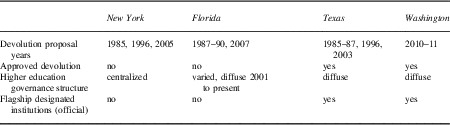
After a discussion of the negative cases, I turn to two additional cases to provide support for the role of institutional logics in my account.Footnote 1 Texas and Washington are valuable comparisons due to similarities in political features and higher education governance arrangements. Table 1 summarizes the timing and outcome of devolution policy proposals and describes the policy features and structural arrangements of higher education in each state, such as the structure of higher education governance and political environment.
Devolution policy and structural details for comparative cases

I had access to Florida Senate hearings and floor debate in 2007, but prior to this year I rely on news articles and secondary sources. Legislative hearing and floor debates were available for the instances of devolution debate in New York, Texas, and Washington. I used these, and policy reports, to construct policy histories for each state and then compared the development of arguments across states, with special attention to the institutional and political histories that led to the conditions in which devolution policy enactment decisions were made.
Rejecting Tuition Devolution in New York and Florida
Establishing a University System and Tuition Policy: New York
New York State has some of the oldest independent (i.e., private, not-for-profit) universities in the nation, and for its first 60 years of statehood did not provide public higher education to state residents (Douglass Reference Douglass2010). The earliest government-funded institutions of higher education in the state were teacher’s colleges, and the City University of New York, all of them founded in the mid-nineteenth century (Ottman Reference Ottman2010). With no public institution to absorb the endowment available through the Morrill Land Grant Act, lawmakers agreed to combine the federal funds with a private endowment from business executive and politician Ezra Cornell to establish a university where Mr. Cornell’s hope to “found an institution in which any person can find instruction in any study” could be achieved (Becker Reference Becker1943, quoting Senator Andrew D. White). Thus, Cornell University became the only institution in the state eligible to receive a Morrill Land Grant appropriation, a boost that facilitated the university’s rise to become an Ivy League institution.
As other states in the nation were laying the foundations of a public university system, New York lawmakers—under pressure from the association representing independent institutions, and from the state’s official body regulating education and trades (the University of the State of New York)—opted to provide public support to private universities through direct institutional aid and scholarships (Gelber Reference Gelber2001; Ottman Reference Ottman2010; University of the State of New York 1944). They also enhanced the state’s limited number of public forestry, teacher education, and junior colleges, including the four “contract colleges” at Cornell that provided education in veterinary science, human ecology, agriculture, and labor relations with support from the state (Ottman Reference Ottman2010; State University of New York 2016). Thus, even without a system of public universities, New York lawmakers supported college education and contributed to the development of Cornell as the state’s flagship university (New York Legislature 1948).
In response to pressure from civil rights groups, whose members faced discrimination in private colleges, and anticipation of increasing demand from veterans, the legislature commissioned studies on the need for a state university system (Clark et al. Reference Clark, Leslie and O’Brien2010; New York Legislature 1948). Legislative members and allies argued that the state’s economic future depended on expanded educational opportunities and urged the establishment of SUNY. The system was not only to build on the state’s foundation of teacher’s, mechanical, and junior colleges but also to expand some campuses into four-year, research universities. After extensive study, state leaders created a highly centralized, state-controlled college system with campuses of relatively equal status (Clark et al. Reference Clark, Leslie and O’Brien2010; Gelber Reference Gelber2001).
SUNY is directed by a single, governor-appointed Board of Trustees. Political scientist Henry Steck (Reference Steck2006) noted that SUNY’s defining feature “was the principle that the SUNY whole was greater than the sum of its campus parts,” expressed through the rejection of a flagship campus, the absence of formal tiers, and a commitment to uniform tuition (212). This strong SUNY brand originates in the initial decisions to structure the state schools as a centralized system, but it became a permanent feature of the system during its largest period of expansion, beginning in 1960 (Levine Reference Levine2010; State University of New York 1960).
In 1960, Governor Nelson Rockefeller responded to pressure for system expansion by seeking input from a governor-appointed committee chaired by Ford Foundation president Henry T. Heald (New York State 1960) and from the SUNY Board of Trustees (State University of New York 1960). These two committees reinforced the initial conditions for SUNY stakeholders’ commitment to an egalitarian system. In particular, the authors of the Heald Report advised policy makers to expand the system by transforming state teacher’s colleges into four-year institutions but stressed that this only be done if those colleges would be of similar quality to the four-year colleges already in the system. If they weren’t, they should become junior colleges. They did advise an expansion of research activities at Stony Brook and a second campus but did not recommend additional flexibility or funding for those campuses. In addition, Heald and his colleagues suggested that a uniform tuition policy be implemented across all SUNY institutions, both two- and four-year, to remove price as a factor in college accessibility for students. The Master Plan of the SUNY Trustees mirrored nearly every recommendation, including uniform and low tuition.
Since this period, four-year institutions in the SUNY system have charged nearly identical tuition rates so that college access could be pursued through a “geographically distributed comprehensive system” and a tuition policy that “most effectively promotes the university’s access goals” (New York State 1985). This practice was reinforced in SUNY planning documents wherein leaders in New York’s higher education field expressed the view that a low and uniform tuition policy was essential to the mission of access (State University of New York 1964, 1972). This claim was contested by advocates for New York’s numerous independent institutions (Levine Reference Levine2010; New York State 1972), but nevertheless persisted. This uniform tuition policy is one incarnation of the idea that SUNY is a system without formal tiers.
Of course, commitment to a uniform tuition and the nonflagship system was not without critics. As I describe in the following text, SUNY administrators repeatedly sought to charge varying tuition levels at the different campuses and at least one gubernatorial administration—that of George Pataki—sought to drastically overhaul SUNY’s structure. This competing institutional inequality logic was present during policy debates but was not the predominant value embraced by stakeholders.
Legislative Rejection of Market Tuition: New York
In 1985, the SUNY Board of Trustees made its first attempt at tuition devolution as part of a broader effort to convince the legislature that the system needed independence from “crippling” state oversight (Independent Commission 1985). Control over tuition was part of the flexibility they desired but was quickly rejected by legislators and students. The issue of tuition devolution ultimately received limited attention during public hearings. One student who spoke out against it explained that tuition devolution would “allot prestige and quality to a certain few [institutions]” because some colleges could raise tuition more than others (New York Legislature 1985: 132). “Altering the University’s tuition policy is clearly not the route to excellence, as it weakens the very basis on which our excellence is built,” explained the student. Devolution was omitted from the official legislative proposal crafted by legislators that granted SUNY a measure of increased autonomy.
SUNY leadership again pursued devolution of tuition authority during the 1995–96 biennium as part of a broader proposal to restructure SUNY. The proposal included increased campus autonomy, privatization of university hospitals, and, in general, a market approach to SUNY management, such as greater competition between campuses and increased emphasis on outside fundraising. In their proposal, the Trustees argued for devolved tuition claiming “[differential] rates…better reflect differences in cost [and] support campus flexibility” (State University of New York 1995). When the Trustees justified differential tuition on the grounds that campuses were unique and needed freedom to develop independently, they challenged the family of institutions logic.
During the hearings, both those who objected to devolution and the SUNY leadership members who promoted devolution supported the idea of the SUNY system being a family, as seen in this dialogue between two Assembly members and a SUNY representative (New York Legislature 1996b):
Assemblyperson Luster: I’m concerned that what we’re seeing here is about conceiving the very attitude … that is, let’s create a batch of colleges, a batch of universities, let’s give them some money so we can call them a state university, but let them actually be so totally autonomous that in almost every way they are privatized in that sense. I think we need to keep focus on a system. (38)
SUNY Binghamton President, Dr. Defleur: I would not disagree with that, but it is in a way, it’s just like a family. We have different talents and different abilities and I believe that we also need to have a system that allows a Binghamton to exist and to flourish as well as some very different kinds of schools and so that’s the balance that we all seek. (39)
Assemblyperson Sullivan: On that subject, if I may, in my family there were my brother and my sister and myself. We all did different things with our lives, right, but we all had the same fruit, we all had the same dinner, we all had the same roughly size bed. We all had the same clothes and then we all went off and did different things. (40)
Assemblyperson Sullivan went on to say that there was some flexibility needed, but even within a similar funding environment, SUNY campuses would have the freedom to meet varying needs. Sullivan’s perspective was common among the Assembly Committee members. Only one Assembly representative at the hearing expressed a desire to see more internal competition in the SUNY system.
Assemblyperson Sullivan asked another campus president whether differential tuition, which he said “brings in a market factor which is not now there,” would allow campuses with “a good reputation” to raise tuition while less prestigious campuses would have to keep tuition low. “Wouldn’t you be exacerbating the differences between those two campuses?” Typically, SUNY leadership responded to such questions as did the president of SUNY Binghamton: They would explain that they valued the unity of the SUNY system, but believed that greater flexibility would allow the institutions to better fulfill their missions. However, they also reassured stakeholders that they would work to “ensure that the State University of New York remains accessible to all qualified students of New York” (New York Legislature 1996a: 129, testimony of Karen Hitchcock, SUNY-Albany President).
Opponents of differential tuition rates worried that devolution would “undermine any cohesiveness that’s left” across the campuses and would be the “nail that seals the coffin of some of the smaller, less competitive campuses” (New York Legislature 1996c: 130). All the students and faculty members who spoke, with one exception, opposed tuition devolution on similar grounds. At the Albany hearing a student association representative drew on the same family metaphor, saying,
I’m really against it because … I view SUNY as a family unit, you know.… [Y]ou wouldn’t find a mother and father telling their little child, go ahead and fend for yourself, make your own money and, send yourself through school.... [T]hey work together and it brings...the status of the entire family to a better degree. Well, if the SUNY University Centers started charging more and essentially having the quality of education in those university centers exceed the quality of education in the four-year institutions, what you would have is just competition within the family. Competition within the family is dangerous. (New York Legislature 1996a: 171–72)
When devolution failed to become part of the legislation granting SUNY increased autonomy from legislative oversight, the legislature requested a report specifically dedicated to the study of devolving tuition authority. In the report, the authors argued that “campus-based tuition” would “make campuses more accountable to students for costs” and give campuses the flexibility they needed to run efficiently (New York Legislature 1996d: i–ii). SUNY leadership overwhelmingly supported devolution, but the authors of the full report noted that the logic of equality across campuses was a common assumption among stakeholders:
[T]he most frequent concern the task force heard—from students, former University officials and a professional union—was that variable tuition would create a system of “have” and “have-not” campuses … Allowing campuses with market flexibility to increase tuition to improve programs will create a gulf between them and campuses that cannot increase tuition because of the market segment they serve. (ibid.: 26–27)
This was reinforced in a public hearing held by the task force when a former SUNY Trustee stated, “Traditionally and for philosophical reasons related to the reason that the State University of New York was founded … variable tuition for undergraduate students has been seen as adverse to the University…. Unity and cohesion of the University have been seen as far more important in providing opportunity for students than imagined financial returns” (ibid.: 47).
In addition to the critics who spoke at hearings, three members of the committee that authored the devolution study filed a dissenting report that reiterated the importance of institutional equality in the SUNY system. They explained that “the New York State Legislature made a promise to its citizens to uphold the mission of the public university…by imposing a uniform tuition policy across all State University undergraduate programs” (ibid.: 46) and that devolution could “eventually decentralize the structure of SUNY from a coherent system of coordinated policies to a collection of campuses competing with and among each other likely to produce conflicting policies.” No legislative action resulted from the committee’s report.
In 2005, SUNY leadership again pursued “sector-varied tuition” as one aspect of SUNY restructuring (New York Legislature 2005b), and again the family of institutions logic held them back. SUNY Chancellor John Ryan proposed a “rational tuition policy” that would allow the universities to set increasing, but predictable rates. SUNY representatives pledged greater accountability in exchange for devolved tuition, promising to submit detailed reports regarding how funds were spent to show whether “this [has] been good for the State University of New York for all the stakeholders, most importantly, for our students” (New York Legislature 2005a: 44). Democratic Assemblyperson Canestrari responded by asking whether a devolution policy would not “hurt some schools as opposed to others” (ibid.: 142). Canestrari’s concerns were shared by others. During a hearing in Stony Brook, Senate Republican Kenneth LaValle responded to a SUNY administrator’s petition that the committee consider devolved tuition by explaining that:
on differential tuition, it has been the policy of our Committee and the Senate to not support that, and for several reasons. Number one, there is a historical and cultural thing in the system…and it’s absolutely real. The second thing is that certain regions of the state become discriminated by a differential tuition because of that region, such as downstate, sends a higher percentage of their students to university centers, therefore, my constituents would be paying, by and large, higher tuition than Legislator X from upstate New York or another part of the state. And so we like the family approach, that everyone in the family is treated fair and equitably in terms of paying tuition. (New York Legislature 2005c: 74–75)
This discourse again highlights the way that the understanding of SUNY’s structure as an egalitarian family constrained the range of policy options LaValle and other legislators believed were appropriate. Responses like this from legislative members quickly eliminated devolution from the conversation of SUNY restructuring in 2005. Tuition remains under legislative control in New York.
Establishing a University System and Tuition Policy: Florida
Like New York, public higher education in Florida is centrally governed by the FSUS Board of Regents, with the Florida State Legislature exercising a high degree of control over system operations. Extensive political oversight began with legislative, line-item control over campus positions, approval of all buildings and details about their construction, and the creation or expansion of programs since the establishment of the FSUS in 1905 (Finney Reference Finney1997; Johnson and Borman Reference Johnson and Borman2007). A governing board was created for the university system to shield it from political influence, although, in practice, the Board of Regents (formerly Board of Control) has been unsuccessful in attempts to insulate itself from political pressures (Chandler Reference Chandler1983; Johnson and Borman Reference Johnson and Borman2007; Schnur Reference Schnur1992).
Early legislative control over FSUS’s affairs stemmed from a malapportioned legislature that granted equal representation to urban and rural counties regardless of population (Chandler Reference Chandler1983; Schnur Reference Schnur1992). This allowed leaders from rural areas to pursue a higher education agenda that included preserving racial segregation, promoting “pragmatic goals rather than esoteric pursuits” and limiting the authority of FSUS, which rural politicians viewed as elitist (Johnson and Borman Reference Johnson and Borman2007; Mautz Reference Mautz1982; Price Reference Price1957; Schnur Reference Schnur1992). Legislative oversight was maintained largely through an elected Board of Education, even as Florida’s population grew and became more urban, because legislative members never granted FSUS’s governing body increased autonomy.
Public higher education in the state was historically unequal due to meager state support for the segregated “negro college,” Florida A&M (FAMU) (Johnson and Borman Reference Johnson and Borman2007). Prior to 1960, the University of Florida (UF), Florida State University (FSU), and FAMU were the state’s only four-year institutions (Finney Reference Finney1997; Florida Legislature 1978b). Each had undergraduate and graduate programs, including professional graduate schools, but in retaliation to demands for racial desegregation on college campuses, legislative members pressured the FSUS Regents to close FAMU’s law school and several other FAMU programs. This made FAMU a shadow of an institution when compared to the other universities (Johnson and Borman Reference Johnson and Borman2007). Extensive legislative oversight allowed segregationists to maintain racial segregation on college campuses during the civil rights movement. That control also allowed them to root out other movements or ideologies they opposed on white campuses, such as perceived dissidence in the 1960s.
During this period, there was little in the way of a statewide, unifying logic or ideal narrating the development of higher education in the state. This was largely because public institutions were located almost entirely in north Florida (Chandler Reference Chandler1983). Students in other populous regions of the state were served by private institutions. In addition, there was little attempt to argue for a system of equal institutions prior to 1960 given the concerted efforts to keep FAMU subordinate to white institutions (ibid.; Johnson and Borman Reference Johnson and Borman2007).
The Florida legislature began a rapid period of expansion for FSUS in the late 1950s: Six universities were added to the system in just a 12-year period, between 1960 and 1972 (Florida State University System Board of Regents 1978 [FSUS BOR]). Several of these were upper-division colleges that expanded their programs to a full four years (Florida Legislature 1978a). This rapid expansion shifted the balance of legislative districts containing universities quite drastically. No longer were northern legislative members the only members with public, four-year institutions to defend; other areas of the state had now become part of the public effort to expand educational opportunity. In addition, to comply with a federal civil rights mandate to desegregate public higher education, state elected officials and FSUS began improvement and expansion efforts at FAMU (Florida State 1975).
Both these factors created a more populous, diverse ecology of postsecondary institutions in the state, challenging the historical power of the state’s oldest campuses—UF and FSU. Then, in 1968, the Board of Control became the Board of Regents, and when the legislature changed the university system’s governing board, it also granted the board greater power, thereby further reducing UF’s and FSU’s autonomy (Finney Reference Finney1997).
The presence of competing institutional logics is apparent during this time in policy recommendations from private business leaders and educational administrators. By focusing on the health and quality of the entire system of universities, a family of institutions logic was invoked by several prominent business leaders and some legislative members as they worked to persuade the state to support and expand postsecondary education opportunities throughout the state. In 1978, a joint legislative committee wrote, “The resources and expertise within the State University System represent a source of great potential assistance to the State in its efforts to improve the economic wellbeing of its citizens and reflect our State’s commitment to excellence in educational programs” (Florida Legislature 1978a: 1). In a report, commissioned by FSUS chancellor E. T. York and staffed by prominent citizens from across the state, private citizens argued that Florida needed a more competitive, high-quality, statewide system because a strong system of higher education would encourage economic development, federal funding, talented students, research, and service (Florida Legislature 1978b: 9). The development of a system of institutions spread throughout the state became a major priority as Florida politicians sought to move the state forward socially and economically (Florida Postsecondary Education Planning Commission 1982 [Florida PEPC]). Thus, although Florida by no means had an equal system of comparable universities, advocates of educational expansion utilized a system-based approach to promote development.
In contrast, in a 1979 Master Plan, FSUS administrators—led by the Board of Regents—suggested that a first step toward improving the system was to designate UF and FSU flagship universities (Mautz Reference Mautz1982). This recommendation angered politicians that represented nonnorthern districts because it relegated all other universities to a second-tier status. The proposal reflected a logic of institutional inequality that some lawmakers did not want to see codified into Florida statute. Southern and eastern lawmakers rejected the plan and, at the urging of university leadership, persuaded the full legislature to remove some of the Board of Regent’s power, thereby reinforcing the legislature’s own direct control over many university-related issues and sending a clear signal that a system of hierarchical institutions was undesirable. In subsequent statements on higher education planning, the Board and other higher education planning commissions avoided any discussion of a tiered system (Florida Postsecondary Education Planning Commission 1982; Mautz Reference Mautz1982).
The next several decades of higher education planning in the state were complicated by the differing needs of the state universities, the political interests of legislative members, and the desires of the Board of Regents to win autonomy for the system. Although some politicians have charged the Regents with parochialism, planning documents for FSUS (and their sister committee, the PEPC) suggest that the Regents were largely focused on maintaining a viable level of funding for the system and distributing the funding as equally as possible (Chandler Reference Chandler1983; Johnson and Borman Reference Johnson and Borman2007). This pleased some politicians, especially those who had newer universities in their districts that may have required lower levels of funding than the large research universities in the north. It frustrated leaders of UF and FSU, leading one UF president to complain that “the System operation under the Board of Regents has tended to reduce everything to the lowest common denominator” (Chandler Reference Chandler1983: 43, quoting UF President J. Wayne Reitz). A former president of University of North Florida agreed, confirming that FSUS’s approach did level the institutions, a fact that benefitted the university he led. He explained that “the System needed the University of Florida, but the University of Florida did not need the System” (ibid.: 43, quoting UNF president Thomas G. Carpenter).
The conflict between these views rose again when the Regents attempted to put additional money into developing institutions in the Southeast. In one report of the various positions on the issue, South Florida politicians claimed that the institutions in their area could not serve local industry or students effectively and that “Southeast Florida has been the stepchild of the state university system for 100 years” while a member of the house from the Central Atlantic coast told reporters “[Insufficient funding is] a problem down there, and I think everyone’s aware of that. We ought to look at it in terms of the whole university system” (Livingston Reference Livingston1985). By the 1980s, the Board of Regents and many legislative members had adopted the view that the member campuses of FSUS should be treated equally, although competition between campuses and regions remained a source of conflict between stakeholders (Ost Reference Ost1987).
Legislative Rejection of Market Tuition: Florida
Florida has long been committed to charging low, and nearly identical, tuition rates at the public universities (Finney Reference Finney1997). Despite differences between the stature and history of the FSUS campuses, tuition rates have remained strikingly similar from 1980 to the present. The campuses can charge fees, which could add more price variation between campuses, but tuition costs have gone from being identical across campuses in 1982 to a range of just $600 (State University System of Florida 2017).
When higher education leaders proposed devolution between 1987 and 1990, students representing the Florida Student Association told reporters that they opposed the proposals and reflected the political language of the eastern and southern legislative members who resisted differentiation. One student argued that devolution would “‘make [FSUS] inequitable’ and encourage a class A, class B mentality among the universities and their students and supporters” (Ost Reference Ost1987). Another told reporters that, “A history degree from the University of Florida or Florida State is no better than a history degree from the University of West Florida. This [proposal] creates a flagship system, where one institution is considered better than the rest” (Marcus Reference Marcus1990). A president of the University of Central Florida said that, “It could be a situation where the rich get richer and the poor stay poorer,” and a Democratic state legislator told reporters that UF and FSU “like to fashion themselves as the flagships…I question that” (Associated Press 1989). Even supporters of devolution proposals avoided talking about UF and FSU as the state’s better universities in quality (Marcus Reference Marcus1990). The FSUS Regents again proposed that the universities be able to charge a variable rate higher than state-established tuition prices in 1993, but the plan failed—in part, because FAMU’s college president objected, telling a reporter that the program would create two-tiers of institutions (Kenyon Reference Kenyon1993). This violated the assumption that “Florida’s students have access to all schools and not just a few” (ibid.: 1).
During the 2007 state legislative session, Republican Senator Steve Oerlich proposed legislation that would allow the UF to charge an additional $500 fee each semester on top of the tuition rate they had in common with the other FSUS campuses. By this time, Florida’s system of public higher education had undergone legislative and voter-mandated organizational restructuring twice (between 1998 and 2003), effectively eliminating centralized control over the public universities. These actions could have weakened politicians’ ability to defend a uniform tuition policy because, as former FSUS leader Charles Reed explained, it has created a “system” in name only (Reed Reference Reed2015). However, legislative testimony suggests that the universities generally viewed the system approach to lobbying for their needs as most effective (Florida Legislature 2007a). Elected officials, although they acknowledged that the universities could come independently to petition for additional funding, also emphasized the importance of taking actions that promoted well-being systemwide.
For example, at a hearing on the fee differential with the Florida Senate Higher Education Committee, most senators and FSUS administrators drew on the idea that a fee increase for UF would benefit all institutions. The bill’s author, Senator Oelrich, urged his fellow policy makers to support the bill, arguing that:
By supporting this bill, you have the opportunity to improve higher education for all of Florida’s students in all the various universities that we have; we’re giving them an opportunity to earn a world-class education. This is a chance to earn a degree from a Top 10 university in the case of the University of Florida. And, as an FSU alumnus, this isn’t solely about the University of Florida, this is about turning the corner in how we invest in the university system. We want to give the students of Florida the best possible education. (ibid.)
A representative of FSUS claimed, “To have a great state you need a great university system. University systems are pulled up from the top…. But more important than for the University of Florida, this is important for the system.” In this way, stakeholders that supported the bill used the language of systemness to argue for a bill that would introduce a greater degree of hierarchy.
Opponents of the legislation rejected the idea of a university system with formally recognized tiers (ibid.; Florida Legislature 2007b). For example, Republican Senator Lee Constantine told the Florida Senate that the result of the bill would be a “two-tier system” that would treat some four-year universities as “stepchildren” by denying them the ability to raise tuition rates, a familial metaphor consistent with the family of institutions logic. The final bill allowed both FSU and UF the ability to charge an additional fee, but legislators also made a commitment to grant all other four-year colleges that same authority in the next legislative session (ibid.), which they did (The Orlando Sentinel 2008).
The Role of Institutional Logics in Tuition Policy
In New York, a family of institutions logic was built into the foundation of SUNY; the system’s original structure and policies created a largely nonhierarchical system of identically priced institutions (Steck Reference Steck2006). The founding of SUNY brought a disparate set of public institutions together into a centralized system with institutions of comparable stature. The exception to their plan was Cornell University, which provides another “public” option (i.e., subsidized by the state) through its contract colleges with very little legislative oversight. In this way, SUNY’s founders created a family of institutions and had little need for a flagship institution because this position was occupied by Cornell.
Over time, SUNY’s uniform tuition and flat structure was associated with the public university mission of access, both by students and some within the system; correspondingly, politicians quickly learned that being associated with access was a politically valuable move. By wedding SUNY’s organizational form and tuition policy to the ideology of access, higher education stakeholders in New York insured a long-lasting commitment to uniform tuition and a flattened system that is nonexistent in most other states. The effect of this policy context enabled actors to embrace a family of institutions logic and reject other understandings of how the state system should be priced—such as by elevating one institution as a flagship, charging much higher tuition for students to attend, and allowing that college to retain the tuition revenue. In short, a structural condition led to an institutional logic that informed politicians’ interests and actions.
Regional competition and the presence of new universities that were struggling for recognition contributed to the development of a relatively flat institutional hierarchy in Florida, which in turn contributed to the development of a family of institutions logic in that state. A logic of institutional inequality remained commonplace in Florida as groups and individuals supportive of postsecondary education discussed FSUS’s future, and especially its future finances. When the FSUS Board of Regents attempted to codify a hierarchy within the system early in that period, by asserting that the state’s oldest white universities—UF and FSU—were the premier campuses, they were met with vociferous opposition. Three decades later, as policy makers debated the merits of a fee differential bill (which was only partial tuition devolution), they drew on both the family of institutions and an institutional inequality logic, ultimately arguing that the state could not move the entire system forward without first moving a prestigious campus forward.
In 2013, the Florida Legislature and Governor Rick Scott approved a funding differential for the state’s “preeminent” universities that gave incentive funding to top-performing institutions (Florida House Bill 7129, Laws of 2013). This change was the first time a Florida law codified an institutional hierarchy between the universities and may be the beginning of the end to a family of institutions logic in the state, which could reorient politicians’ beliefs regarding the most appropriate policies for their state universities.
Additional Cases and Alternative Explanations
In contrast to Florida and New York, legislative members in Texas and Washington voted to approve devolution in 2003 and 2011, respectively. Lawmakers in these states were rarely under pressure from an organizational structure, institutional logic, or concerted political interests to develop a system of equal postsecondary institutions. Rather, the hierarchical systems of public universities in these states made further differentiation a less problematic solution to budget crises. The system of explicitly stratified universities in these states contributed to distinct institutional logics that then shaped lawmakers’ views of devolution policy. To provide additional support for the connection between organizational structure and the development of a family of institutions logic, I briefly describe the higher education institutional ecologies of Texas and Washington and then address alternative explanations for the negative cases of New York and Florida.
Organizational Characteristics
Texas public institutions have differed in quality and cost for decades (Texas Higher Education Coordinating Board 1991). Institutional inequality was built into higher education funding mechanisms, such as the Permanent University Fund that has supplied endowment funds to the University of Texas at Austin (UT Austin) and Texas A&M since 1876, only allowing other institutions to access these and other endowment funds much later (www.utimco.org). The state has consistently elevated UT Austin and Texas A&M as its premier public institutions, rather than pursuing a model of system cohesion with comparable four-year colleges. The Permanent University Fund has made UT Austin and Texas A&M some of the wealthiest public universities in the country, with Texas A&M only surpassed by the University of Pennsylvania and UT Austin ranked only below Harvard and Yale (NACUBO 2017). In addition, Texas has a history of racially segregated colleges that includes underinvestment in historically black and predominantly Latino universities (Shabazz Reference Shabazz2004). Unlike higher education stakeholders in Florida, Texas lawmakers and higher education leaders did not level the status or resources of the state universities in a way that could lend support to a family of institutions logic, although university representatives and lawmakers from El Paso, Houston, and Dallas have argued for more university funding in their areas (Burka Reference Burka2002; Texas Legislature 2003). A distinct set of financing rules has long been applied to these institutions and in this way past decisions have contributed to a present university structure that violated one of the underlying conditions of a family of institutions logic.
Traditionally, when the Texas legislature set tuition rates for the public institutions, one of their main goals was to keep tuition rates—especially for in-state undergraduates—as low as possible. As in other states, Texas politicians viewed low tuition as a primary policy instrument for keeping public institutions accessible to all Texans (Texas Legislature 1996), recommending in October 2000 “the establishment of an affordability policy on tuition and fees that ensures students, especially those students who are economically disadvantaged, are able to participate and succeed in higher education” (Texas Legislature 2000: 46). Unlike Florida and New York, where similar tuition rates were pursued across all four-year institutions, Texas officials did not adopt guiding principles for tuition pricing aside from a general commitment to low tuition.
Higher education in Washington has six baccalaureate institutions governed by six boards of trustees, and a statewide coordinating board that advises, but has little authority over, the colleges (Mayfield et al. Reference Mayfield, Chance and Lieb2002; Washington Higher Education Coordinating Board 2012). Early planning for public higher education focused on the development of a research university (University of Washington), a land grant institution (Washington State University), and three regional comprehensive universities (Eastern, Central, and Western Washington universities). The state’s liberal arts college, Evergreen State College, was founded relatively recently, in 1971 (Zumeta Reference Zumeta2006). These institutions were designed to fulfill distinct roles (Washington Higher Education Coordinating Board 1987). The legislature has set tuition rates in Washington based on the costs associated with educating students at each institution, thereby building institutional differentiation into the price-setting process (Washington Higher Education Coordinating Board 1992).
The notion that Washington’s public colleges should be similarly priced was never mentioned in devolution discussions. In fact, at least nine different stakeholders—including legislators and higher education leaders—drew on an explicit logic of institutional inequality by committing their support for the devolution proposal in 2011 on the grounds it acknowledged the “different roles and missions of the universities” (Washington Legislature 2011b). This logic predated this particular policy debate (Washington State Journal 1999; Zumeta Reference Zumeta2006).
Political Interests
Perhaps the variation in devolution policy adoption described previously is due to differing political interests, apart from the constraining effects of an institutional logic. For example, politicians in districts with lower-ranked SUNY campuses (e.g., Oswego, New Paltz) might oppose devolution as it could disadvantage their institutions if they are unable to charge higher tuition rates and be unable to make desirable improvements. Alternatively, politicians representing the districts that include the higher-ranked SUNY “University Centers” (Albany, Binghamton, Buffalo, and Stony Brook) would support the devolution proposals because they could charge higher tuition and gain greater prestige. However, the state legislators quoted in the preceding text in opposition to devolution came from districts that included SUNY’s most and least prestigious campuses, as well as areas with no SUNY campuses. The most striking example is Senator LaValle, who opposed devolution across all three instances it was proposed despite being a strong supporter of Stony Brook, which is in his senate district. Alternatively, politicians such as LaValle who had University Centers in their districts might have opposed differential tuition if they were concerned that raising tuition at these campuses would restrict access for some constituents. When Senator LaValle told SUNY administrators “certain regions of the state become discriminated by a differential tuition because if that region, such as downstate, sends a higher percentage of their students to university centers…[they] would be paying…higher tuition” (New York Legislature 2005c: 75), he seems to be expressing such concern. The fact that legislators were almost universally opposed to devolution across three decades of debate regardless of which SUNY campus was in their district suggests that other factors were also at play.
The political interests of southeastern and other nonnorthern representatives played an important role in the early construction of the family of institutions logic in Florida. However, over time, regionalism became less important as politicians and higher education presidents from all campuses began desiring advancement for the system above advancement for the university in their own district (Florida Legislature 2007a).
A Texas lawmaker representing a low-ranked University of Texas campus (UT-El Paso) objected that devolving tuition authority would create “have and have-not” campuses, but those same concerns were echoed by lawmakers representing Austin, home of the state’s most prestigious university (Texas Legislature 2003). No clear home-district affiliations were apparent as Washington lawmakers discussed devolution with representatives from Seattle—home of flagship campus University of Washington—recommending devolution along with lawmakers from other parts of the state (Washington Legislature 2011a). The position that politicians took regarding market-priced tuition policies does not consistently align with their most probably political interests.
Political Party Control
There is also insufficient support to suggest that the adoption of tuition devolution policies might be attributable to Republican politicians’ general acceptance of market-oriented policies. When tuition devolution was proposed in 1996 and 2003 in Texas it had the support of Republican lawmakers, with little support from Democrats (Texas Legislature 1996, 2003), yet the devolution charge in Washington was led by Democratic Representative Reuven Carlyle (Washington Legislature 2011b) and passed by a legislature controlled by Democrats (Washington Legislature 2011a).
New York’s political context in 1996 presented an ideal opportunity for devolution advocates’ success, but it failed. The governor, privatization advocate and conservative Republican George Pataki, had influence over the state legislature and the SUNY Board of Trustees, the majority of whom were his appointees (Steck Reference Steck2006). The “Pataki trustees” ushered in an especially conservative era for SUNY and have been described by SUNY faculty members as looking to neoliberal markets for ideas about higher education governance, including the conservative goal to reduce the size of the public sector (Scheuerman Reference Scheuerman2013; Steck Reference Steck2006). And the devolution charge in Florida was supported by Republican governor Jeb Bush, initially discouraged and later supported by Republican governor Charlie Crist, and discouraged by Republican governor Rick Scott (Miami Herald 2008; Palm Beach Post 2001; Tampa Bay Times 2012).
Fiscal Crisis
The economic context during the periods when devolution was pursued was not drastically different across the country. For example, in 1995–96, state contributions to higher education across the nation were in decline (State Higher Education Executive Officers 2016). Texas lawmakers called their funding environment a “higher education crisis” and justified devolution based on drastic budget cuts (Texas Legislature 2003). A Washington representative argued that the state was “well beyond the tipping point of where we’re going to permanently damage our institutions” without increased funding (Washington Legislature 2011b). In New York, politicians were asking all state agencies, including state universities, to absorb severe budget cuts (Jayson Reference Jayson2002). A SUNY faculty union member, Bill Scheuerman, described “horrendous budgets” during the Pataki era (Scheuerman Reference Scheuerman2013) and budget cuts prompted the SUNY Board to suggest devolution when they were asked to formulate plans for how they could operate with reduced revenue (New York Legislature 2005b; State University of New York 1995).
It is the case that New York has consistently appropriated more per full-time equivalent student than the other states included in this article (State Higher Education Executive Officers 2016). However, Florida legislators have not appropriated such high levels of funds to public higher education (Palmer and Gillilan Reference Palmer and Gillilan2001; State Higher Education Executive Officers 2011) and yet lawmakers there have also resisted abdicating tuition authority to the universities. Additionally, Florida’s low-tax policies have put state legislators in the position of making massive cuts to all government programs, much like Texas, yet politicians in Florida have avoided devolution.
Commitment to Access
Differences in student activism and legislative commitment to low-income students also do not explain these divergent outcomes. In all four states, opponents and supporters of devolution discussed the necessity of preserving access to higher education, especially for financially needy students. The issue of student access was the most frequently discussed issue by both opponents and supporters of devolution in Washington. Supporters explained that the state’s defunding of higher education had threatened the mission of access, making tuition flexibility the only sure way public universities could guarantee that students could access the education they deserved (Washington Legislature 2011b). And both supporters and opponents of devolution in Texas reaffirmed their commitment to student access, especially for racial minority students (Texas Legislature 2003). Access was mentioned only slightly less than the family of institutions logic in New York, and almost always in connection with it. In contrast, Florida stakeholders discussed student access least of all (Florida Legislature 2007a, 2007b). What made the difference in New York and Florida was the assumption that preserving access required institutional equality. And that assumption was the core of the family of institutions logic.
Conclusion
Preexisting higher education policies have lasting effects on the institutional logics to which policy makers and other stakeholders have access, leading to divergent outcomes. What policy makers deem appropriate policy in their local context is shaped by a history of education policy making that likely preceded their position in office. However, the structure of institutions and the founding ideas of those institutions—as preserved in planning documents and remembered by some institutional actors—perpetuate a commitment to a certain institutional logic. Additional stakeholders seeking to influence the policy process, such as university presidents and chancellors, commonly frame their arguments within the structural and ideological context created by preexisting policies.
New York policy makers were constrained in their decision making about tuition devolution at multiple points in time by a family of institutions logic that reinforced the importance of SUNY institutions’ lack of formal tiers and its commitment to price similarity. The state policies governing SUNY became politically consequential because policy makers invoked the system cohesiveness mandated by such policies as a principal reason for rejecting devolution proposals. This powerful narrative appears to have precluded the ideational change toward a market university despite a move in this direction in other states and in other areas of New York state policy. A similar institutional logic emerged in Florida, although not due to the historical organizational arrangements of universities. Instead, that logic grew out of politicians’ interests in garnering greater legislative support for the new four-year institutions in their districts.
The type of institutional logics discussed in this article likely influence policy deliberations and outcomes beyond tuition policy. Other aspects of marketization in higher education, such as changes in federal laws governing the marketing of scientific discoveries or campus-level policy decisions, may also be (at least in part) a product of preexisting policy contexts. For example, although an academic logic dominated on university campuses and in some policy circles, a history of laissez-faire higher education governance (Zumeta Reference Zumeta2001) and financial aid policies that empowered student consumers (Loss Reference Loss2012a; Strach Reference Strach2009) may have encouraged the shift to a market logic among federal policy makers documented by Berman (Reference Berman2012). State-level differences in organizational arrangements may have also led to distinct timing in the adoption of neoliberal policies on public university campuses. Future research could focus on the role of preexisting policy conditions in other aspects of marketization in higher education or in higher education policy decisions more generally.
My analysis also contributes to scholarship on institutional change in higher education. Tuition devolution policy is a considerable shift in the power and autonomy of public university governing boards. In some states, like Florida and New York, when public college administrators proposed devolution policy they also promised greater public accountability (New York Legislature 2005a; Palm Beach Post 2001). One condition of tuition devolution in Texas was that universities implement reforms that serve state interests, such as committing to increased financial aid for low-income students funded by tuition payments (Texas Legislature 1995). In this way, tuition policy abdication may not be a clear reversal of legislative oversight (Zumeta Reference Zumeta2001).
Finally, my argument may have implications for market reforms in other domains. Institutional logics that are premised on equality within a system of organizations can provide a powerful rhetorical resource to institutional actors seeking to resist market reforms. For example, a school district where stakeholders emphasized the similarity, unity, and quality of district schools successfully resisted the implementation of charter school legislation in Johnston’s (Reference Johnston2014) comparative study of charter school policy adoption. Although there are many, diverse factors which contribute to the rise of market reforms, scholars should not overlook the influence of organizational features on institutional actors and the logics they adopt.