Introduction
The ability to encode and maintain information in service of higher cognitive activities is a central function of working memory (Miyake & Shah, Reference Miyake, Shah, Miyake and Shah1999). Available evidence indicates that schizophrenia patients have a reduced ability to maintain information in working memory (Park & Holzman, Reference Park and Holzman1992; Reilly et al. Reference Reilly, Harris, Keshavan and Sweeney2006). Reports have noted working-memory encoding and/or maintenance deficits in medication-naive first episode (Lencz et al. Reference Lencz, Bilder, Turkel, Goldman, Robinson, Kane and Lieberman2003; Hutton et al. Reference Hutton, Huddy, Barnes, Robbins, Crawford, Kennard and Joyce2004; Reilly et al. Reference Reilly, Harris, Khine, Keshavan and Sweeney2007) and treated (Park & Holzman, Reference Park and Holzman1993; Pantelis et al. Reference Pantelis, Barnes, Nelson, Tanner, Weatherley, Owen and Robbins1997; Park, Reference Park1999; Low et al. Reference Low, Rockstroh, Harsch, Berg and Cohen2000; Fraser et al. Reference Fraser, Park, Clark, Yohanna and Houk2004) chronic schizophrenia patients. Such deficits persist over the course of the disorder (Park et al. Reference Park, Puschel, Sauter, Rentsch and Hell1999, Reference Park, Puschel, Sauter, Rentsch and Hell2003; Reilly et al. Reference Reilly, Harris, Keshavan and Sweeney2006) and occur in biological relatives (Park et al. Reference Park, Holzman and Goldman-Rakic1995; Myles-Worsley & Park, Reference Myles-Worsley and Park2002).
Internal manipulation of stored information is a higher-order component of working memory needed for cognitive skills such as abstraction, reasoning, language comprehension, problem solving and decision making (Baddeley, Reference Baddeley2000, Reference Baddeley2003). These higher-order abilities are dependent on basic maintenance abilities, as information must be encoded and maintained internally to be accessible for internal manipulation. Increased information load strains the capacity of maintenance systems (Manoach, Reference Manoach2003). When higher-order processing demands are required, the limited capacity of working-memory systems is further strained. Thus, examining the load dependency of deficits and the additional deficits observed when information needs to be manipulated as well as maintained are important strategies for examining working-memory deficits in schizophrenia. Functional imaging findings generally support a crucial role of ventrolateral prefrontal cortex in active maintenance of capacity-limited working-memory representations (D'Esposito et al. Reference D'Esposito, Aguirre, Zarahn, Ballard, Shin and Lease1998; Christoff & Gabrieli, Reference Christoff and Gabrieli2000) while dorsolateral prefrontal cortex (DLPFC) seems to play a greater role when manipulation of internal knowledge is required to meet cognitive challenges (Owen et al. Reference Owen, Evans and Petrides1996; D'Esposito, Reference D'Esposito, Cabeza and Kingstone2001; Glahn et al. Reference Glahn, Kim, Cohen, Poutanen, Therman, Bava, van Erp, Manninen, Huttunen, Lonnqvist, Standertskjold-Nordenstam and Cannon2002).
A variety of paradigms have been utilized to impose manipulation demands in studies of working memory including high-load memory updating (n-back test) and item re-ordering. Reduced DLPFC activation has been reported during tasks that place demands on higher-order working-memory processes and document dysfunction in schizophrenia (Barch et al. Reference Barch, Carter, Braver, Sabb, MacDonald, Noll and Cohen2001; Mattay et al. Reference Mattay, Goldberg, Fera, Hariri, Tessitore, Egan, Kolachana, Callicott and Weinberger2003; Cannon et al. Reference Cannon, Glahn, Kim, van Erp, Karlsgodt, Cohen, Nuechterlein, Bava and Shirinyan2005; MacDonald et al. Reference MacDonald, Carter, Kerns, Ursu, Barch, Holmes, Stenger and Cohen2005; Keedy et al. Reference Keedy, Ebens, Keshavan and Sweeney2006; Tan et al. Reference Tan, Sust, Buckholtz, Mattay, Meyer-Lindenberg, Egan, Weinberger and Callicott2006, Reference Tan, Callicott and Weinberger2007). Investigations of working-memory capacity in schizophrenia have shown a pattern of greater prefrontal activation at low working-memory loads and earlier drop-off in activation as high loads exceed the capacity to accommodate the additional cognitive demands associated with manipulation processing in the disorder (Manoach, Reference Manoach2003). However, because deficits in DLPFC working-memory systems have also been observed with pure maintenance tasks (Keedy et al. Reference Keedy, Ebens, Keshavan and Sweeney2006), and manipulation tasks require both information maintenance and manipulation, it remains unclear whether these deficits are related to impaired maintenance processes or whether higher-order manipulation processes are more severely affected than maintenance of information. It will be important to establish the degree to which impaired maintenance processing could significantly contribute to impairment on tasks requiring manipulation of maintained information. Greater independence between maintenance and manipulation processing would bring into focus more specific systems for cognition enhancing treatments targeting working memory. More closely linked maintenance and manipulation processing would point to a broader range of potential targets for cognition enhancing treatment and increase the relevance of maintenance only translational models.
One study that directly compared maintenance and manipulation paradigms in schizophrenia reported a greater impairment for non-verbal manipulation processing in patients (Kim et al. Reference Kim, Glahn, Nuechterlein and Cannon2004). However, working-memory load was held constant rather than examined parametrically and the relative integrity of maintenance and manipulation processes across a range of working-memory loads remains unclear. Indeed, few studies have directly compared basic maintenance and higher-order manipulation processing across a range of maintenance loads to contrast and examine the relationship between these two critical components of working memory in individuals with schizophrenia. The present investigation was designed to directly compare performance of schizophrenia and healthy comparison participants in maintenance and manipulation processing across a range of working-memory loads (three to five items).
Methods
Participants
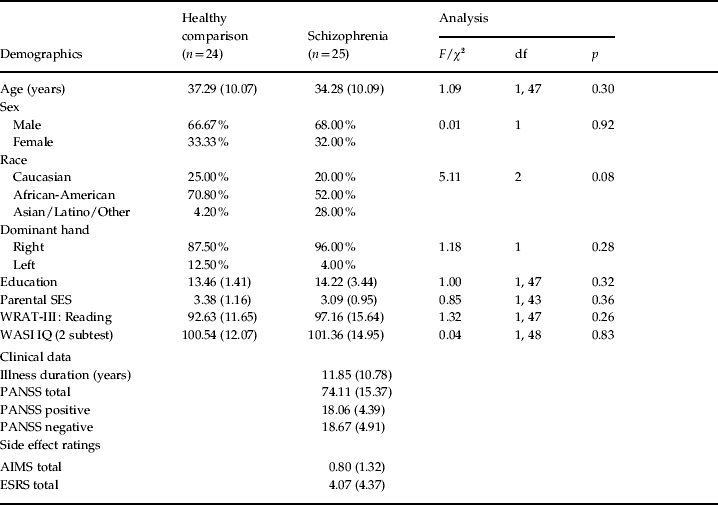
The sample comprised 25 patients who met criteria for schizophrenia spectrum disorders (21 schizophrenia; one schizophreniform; three schizoaffective depressed) based on the Structured Clinical Interview for DSM-IV (SCID). To limit cognitive effects of acute illness and changes to medication treatments, all patients were receiving stable medication treatments for at least 1 month prior to testing. A sample of 24 healthy individuals recruited from the community were free of Axis I diagnosis based on SCID interviews. All participants were free of substance abuse within the last 3 months, lifetime history of substance dependence, history of neurological conditions, including head injury with loss of consciousness, and systemic disorders known to affect brain function. Verbal and written consent was provided by all participants and the study was approved by the Institutional Review Board at the University of Illinois at Chicago. There were no group differences on age, education, parental socio-economic status (SES) and estimated intellectual abilities (Table 1).
Group demographic and clinical data

SES, Socio-economic status; WRAT-III, Wide Range Achievement Test: third edition; WASI, Wechsler Abbreviated Scale of Intelligence; PANSS, Positive and Negative Syndrome Scale; AIMS, Abnormal Involuntary Movement Scale; ESRS, Extrapyramidal Symptom Rating Scale.
Values in parentheses are standard deviations.
Working-memory paradigm
Numerous approaches have been used to assess higher-order components of working memory including re-ordering, updating, sequencing, directing attention and substitution paradigms. Much of the current interest in the distinction between maintenance and manipulation processes in working memory was stimulated by D'Esposito et al. (Reference D'Esposito, Postle, Ballard and Lease1999), who instructed participants to re-order letters as a way of manipulating strings of letters in working memory. Based on this approach, we developed a variant of the re-ordering task to assess a related aspect of manipulation processing, which entails comparison of sequential position of target items rather than re-ordering. Unlike the n-back paradigm, which has more abrupt increases in task difficulty between 1-, 2- and 3-back conditions, we employed a delayed-response task with varying working-memory loads, which approximate difficulty level increases of span tests with variations that emphasized maintenance and manipulation processing demands. Specifically, after a letter string was presented, participants were asked whether one of the letters was before another in serial order, which required participants to locate a target letter in the sequence, hold its position, locate the other letter and then make a decision regarding the relative sequential position of the two targets. Given the multiple processing demands entailed when holding positional information about two targets online while making comparisons about their sequential position, this too is a face valid assessment of higher-order manipulation processing in working memory rather than simple maintenance rehearsal of online information.
Target sequences were pseudo-randomly taken from a pool of 16 phonologically distinct consonants with eight novel sequences presented at each of three levels of working-memory load. Participants were presented with a fixed array of 10 letters with targets highlighted sequentially for 1000 ms each. Target sequences with a 3, 4 or 5 item working-memory load were presented three times on each trial to ensure that participants had sufficient opportunity to encode/learn the letter sequence. Following the third target sequence presentation, there was a 10 s delay period, during which participants were encouraged to utilize rehearsal strategies to remember the letter sequence. We targeted a range of working-memory loads that would allow assessment of the additive or synergistic effects of increasing load and processing demands without exceeding processing limits based solely on the item capacity of working-memory systems. Based on the significant performance declines observed in individuals with schizophrenia at working-memory loads exceeding five on maintenance tasks (Cairo et al. Reference Cairo, Woodward and Ngan2006; Karlsgodt et al. Reference Karlsgodt, Sanz, van Erp, Bearden, Nuechterlein and Cannon2009), we used this as our highest load condition.
For maintenance trials, a five letter series ‘N K R F H’ was followed by the maintenance probe ‘_ H _ _ _?’, the participant indicated by button press whether ‘H’ was the second target letter highlighted in a five-letter sequence. For manipulation trials, if ‘N before R?’ were presented as a probe, the participant responded by button press to indicate whether ‘N’ was highlighted before ‘R’ during stimulus presentation. Five self-paced, yes/no questions were presented for each letter sequence and sets of maintenance or manipulation probes were interspersed and counterbalanced across trials.
Procedures, data processing and statistical procedures
Working-memory tasks were run on a laptop using E-Prime software (Schneider et al. Reference Schneider, Eschmann and Zuccolotto2002), which presented stimuli and recorded reaction time and accuracy. Motivation and cooperation were assessed by inspecting trial responses for patterns of random responding. Inspection of reaction time and accuracy scatterplots for all participants indicated chance levels of accuracy for both maintenance and manipulation probes when response latencies were faster than 450 ms. Thus, trials with response latencies <450 ms were discarded. This accounted for <1.0% of the data in either group and just three participants (schizophrenia=1, health comparison=2) had >5.0% of their data discarded (range 8.82–19.12%). There was no evidence of performance deterioration over the course of testing, as both patients and controls improved modestly and to a similar degree in the second half of testing. Arcsin and natural logarithm transformations were computed to normalize proportion correct and response times for statistical analyses, respectively.
Two separate repeated measures three-way analysis of variance (ANOVA) were computed with reaction time and accuracy as the respective dependent variables. The between-subjects independent variable was diagnosis (patients versus healthy controls) and the within-subjects variables were type of processing (maintenance versus manipulation) and level of working-memory load (3, 4, 5). Between-group effect sizes were computed to index the magnitude of deficit in schizophrenia patients for each type of processing across the three levels of working-memory load relative to healthy controls. Finally, correlational analyses were used to evaluate the degree to which impairments in maintenance were related to deficits in manipulation processing.
Results
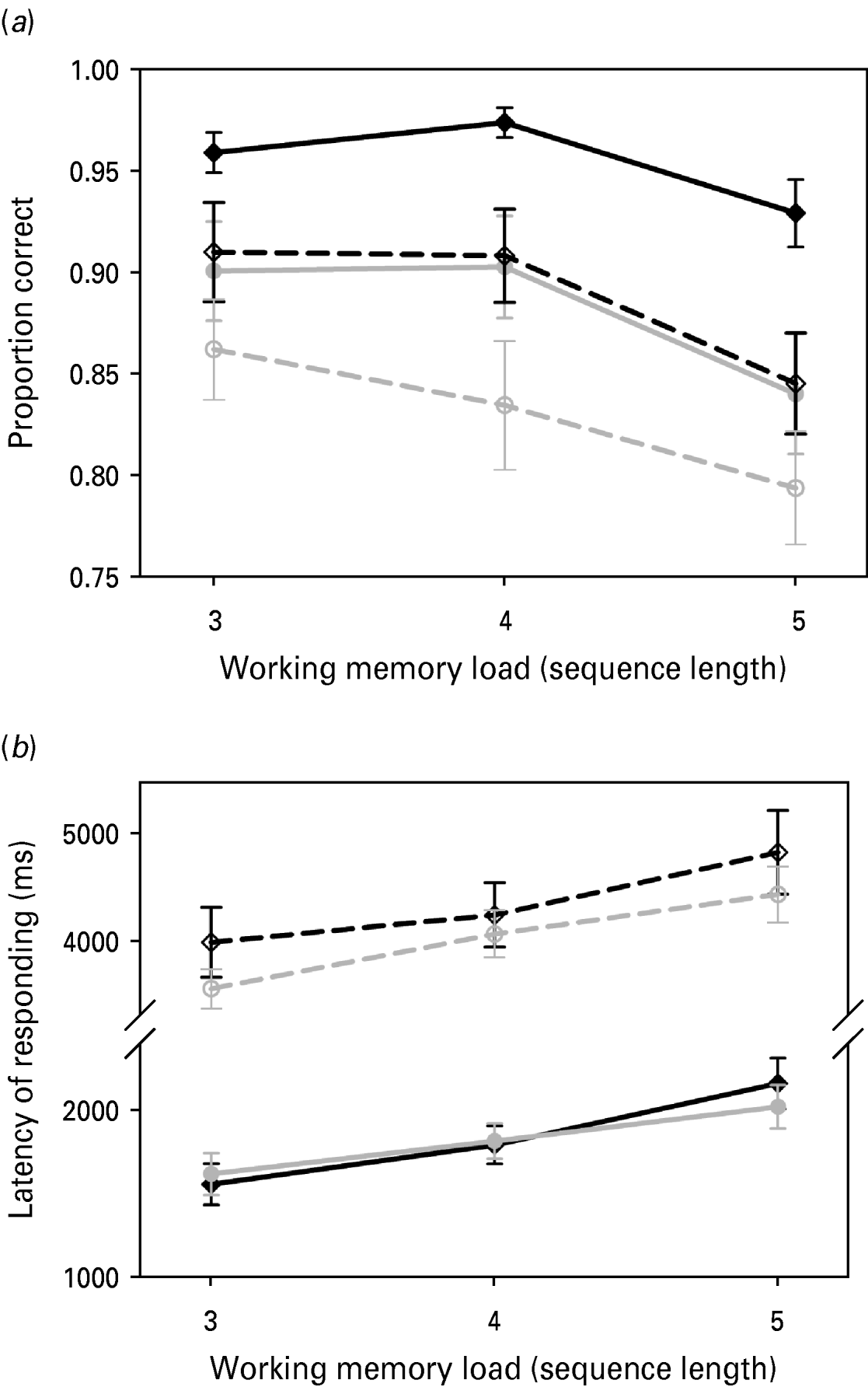
Analysis of performance accuracy data revealed significant main effects of diagnosis [F(1, 47)=5.05, p=0.01], processing type [F(1, 47)=17.10, p<0.001] and working-memory load [F(2, 46)=8.45, p=0.001] with no significant interactions. Thus, the schizophrenia group was impaired relative to the healthy control group regardless of working-memory load or type of processing (maintenance or manipulation). Both groups showed progressively less accurate performance as the number of items to be processed increased, regardless of the type of processing demands (Fig. 1 a), and higher accuracy for maintenance than manipulation questions.
Both groups showed reduced accuracy (a) and increased reaction time (b) for manipulation compared with maintenance processing. Similarly, overlapping standard error bars indicate that both groups showed similar degrees of accuracy declines and reaction time increases as a function of working-memory load. Note that there was no indication of accelerated performance deterioration at higher loads for manipulation processing in the schizophrenia group. —♦—, Healthy comparison (HC) maintenance;  , schizophrenia (SZ) maintenance; – –◊– –, HC manipulation;
 , SZ manipulation.

For reaction time data, a repeated measures ANOVA indicated significant main effects for processing type [F(1, 47)=455.18, p<0.001] and working-memory load [F(2, 46)=45.29, p<0.001], but no significant effect of diagnosis [F(1, 47)=0.19, p=0.67]. A significant processing type by working-memory load interaction [F(2, 46)=3.31, p<0.05] was also observed, but all other interactions were non-significant. The reaction time data indicate greater difficulty for manipulation than maintenance items, and that higher working-memory loads slowed reaction time more for manipulation trials (Fig. 1 b). But these effects did not differ between patients and controls.
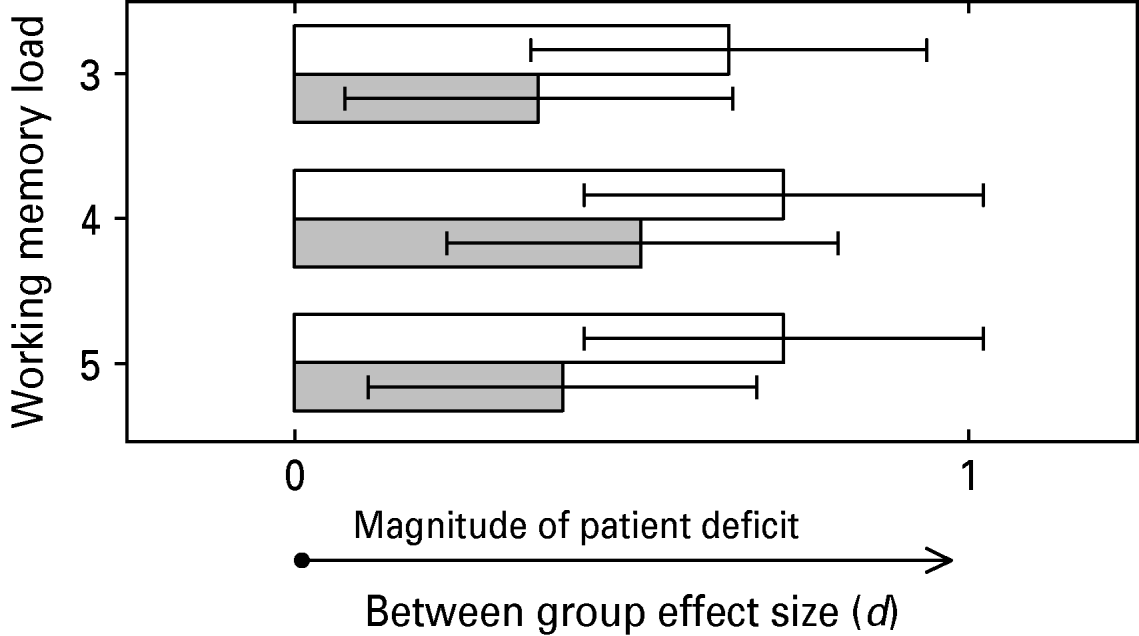
The relative sensitivity of maintenance/manipulation processing to illness effects was descriptively assessed via between-group effect size comparisons. Fig. 2 illustrates the magnitude of patient deficits for both types of working-memory processing across the three levels of working-memory load. Deficits with medium to large effect sizes were observed for maintenance deficits in patients, while deficits for manipulation conditions were smaller. Thus, group differences were not statistically different across maintenance and manipulation conditions and there was no tendency for greater deficits to be observed in the manipulation condition.
Between-group effect sizes illustrate the magnitude of deficit in the schizophrenia group relative to the healthy comparison sample. Standard error bars indicate the degree of overlap; however, the magnitude of patient deficit was numerically larger across all three levels of working-memory load for maintenance tasks as opposed to manipulation tasks. □, Maintenance;  , manipulation.

Significant correlations were observed in patients for maintenance and manipulation processing accuracy rates at working-memory loads of 3 (r=0.47, p<0.05), 4 (r=0.61, p<0.01) and 5 (r=0.42, p<0.05). By definition, these values are underestimates because measurement error reduces the estimate of the true correlation. To calculate the degree that imperfect measurement reliability attenuated true score associations between maintenance and manipulation performance, reliability estimates obtained from 4-week test–retest of patients (with no intervening change in clinical or medication status) ranged from 0.72 to 0.82 for maintenance measures and from 0.51 to 0.71 for manipulation measures. When corrected for attenuation (Nunnally, Reference Nunnally1967), estimates of true score correlations between maintenance and manipulation processing in patients were estimated to be r=0.66, r=0.83 and r=0.69 for working-memory loads of 3, 4 and 5 respectively, illustrating a very high association between maintenance and manipulation abilities in schizophrenia patients.
Discussion
This investigation directly compared verbal working-memory maintenance and manipulation deficits in schizophrenia across a range of working-memory loads. Schizophrenia patients showed reduced performance accuracy, relative to healthy controls, across both types of working-memory processing. The degree of these deficits did not vary in relation to working-memory load. Manipulation deficits were not greater than maintenance deficits and effect size estimates of the magnitude of patient deficit were numerically higher in maintenance compared with manipulation conditions (Fig. 2). Correlation analysis indicated a high association of performance in maintenance and manipulation conditions in schizophrenia patients, suggesting that maintenance deficits may be a significant contributor to manipulation abilities. The findings of robust maintenance deficits were consistent with a recent meta-analysis reporting prominent abnormalities with encoding and/or early working-memory maintenance in schizophrenia (Lee & Park, Reference Lee and Park2005). Thus, on performance of verbal serial order working-memory tasks schizophrenia patients displayed no greater impairment for complex manipulation processing than forming or maintaining mental representations, despite a procedure that optimized encoding prior to maintenance testing.
The link between deficits in maintenance processing and manipulation deficits was not surprising given that the ability to encode and maintain information is a prerequisite for later internal manipulation of such mental representations. To the extent that executively controlled manipulation processes are the dominant feature of working-memory deficits in schizophrenia, one would expect greater vulnerability of manipulation processes beyond the impairments associated with maintenance processes. There was no evidence of an additive or synergistic effect when the demands of higher-order processing were added to online rehearsal/maintenance demands. Not only were manipulation deficits not more severe, but the effect size pattern was in the opposite direction. This runs counter to the prevailing opinion that the primary working-memory deficits in schizophrenia involve higher-order information manipulation processes based on a wealth of evidence implicating deficits in higher level cognitive abilities dependent on working-memory processing and the imaging data implicating DLPFC dysfunction during working-memory manipulation processing (Rypma et al. Reference Rypma, Berger and D'Esposito2002; Veltman et al. Reference Veltman, Rombouts and Dolan2003; Cannon et al. Reference Cannon, Glahn, Kim, van Erp, Karlsgodt, Cohen, Nuechterlein, Bava and Shirinyan2005; Tan et al. Reference Tan, Sust, Buckholtz, Mattay, Meyer-Lindenberg, Egan, Weinberger and Callicott2006). As the present study took special effort to facilitate encoding and maintenance by presenting target sequences three times, the results suggest that maintenance deficits in working memory may be an equal if not greater limiting factor in schizophrenia.
The maintenance task was designed to minimize processing demands beyond those imposed by sequence rehearsal. Whereas target-distractor discrimination probes, used to assess maintenance in some prior studies (Kim et al. Reference Kim, Glahn, Nuechterlein and Cannon2004; Tan et al. Reference Tan, Choo, Fones and Chee2005; Driesen et al. Reference Driesen, Leung, Calhoun, Constable, Gueorguieva, Hoffman, Skudlarski, Goldman-Rakic and Krystal2008), add to rehearsal demands by requiring participants to maintain target items plus the distractor, the present paradigm may be a more pure maintenance measure that simply requires rehearsal of target items in sequence. Whereas prior efforts to assess maintenance have entailed distinguishing between targets and distractors (Kim et al. Reference Kim, Glahn, Nuechterlein and Cannon2004), our pilot studies with 82 undergraduate students and 16 community controls suggested that verifying serial position of targets was less demanding cognitively in terms of impact on response latency and accuracy. Indeed, the current findings with both schizophrenia patients and matched community controls suggested that accuracy for serial position of targets was 5–8 percentage points higher than prior reports for the accuracy for distinguishing verbal targets from distractors (Kim et al. Reference Kim, Glahn, Nuechterlein and Cannon2004). Although previous studies have assessed manipulation processing via re-ordering stimuli into alphabetical order, this was not well tolerated by a pilot sample of individuals with schizophrenia.
The present findings did not indicate an increased difficulty for manipulation compared with maintenance processing in schizophrenia patients whereas a significant decrease in accuracy was previously reported for only the schizophrenia group when verbal maintenance and manipulation were compared (Kim et al. Reference Kim, Glahn, Nuechterlein and Cannon2004). In considering this difference, it is noteworthy that groups in the present study were closely matched for age, education, parental SES and both pre-morbid and current estimates of intelligence. Kim and colleagues reported group differences for level of education (Kim et al. Reference Kim, Glahn, Nuechterlein and Cannon2004), while estimates of either current or pre-morbid intelligence were not reported. This opens the possibility that the previous findings of disproportionately impaired manipulation compared with maintenance processing (Kim et al. Reference Kim, Glahn, Nuechterlein and Cannon2004) may have been driven by group differences favoring general cognitive abilities in the control group.
One important issue is the generalizability of our findings, because assessment of other aspects of manipulation processing may produce dissimilar findings. The present paradigm utilized comparisons of relative sequential position to evaluate manipulation processing in working memory rather than paradigms involving item re-ordering (D'Esposito et al. Reference D'Esposito, Postle, Ballard and Lease1999) or visual inversion to a mirrored location (Kim et al. Reference Kim, Glahn, Nuechterlein and Cannon2004; Cannon et al. Reference Cannon, Glahn, Kim, van Erp, Karlsgodt, Cohen, Nuechterlein, Bava and Shirinyan2005). In the later study, the processing and executive demands for internally altering visuospatial location of target arrays appear to be relatively modest compared with the present paradigm. Reaction times for both the verbal re-ordering and visuospatial inversion manipulation paradigms were similar to response latencies for their respective control maintenance tasks (Kim et al. Reference Kim, Glahn, Nuechterlein and Cannon2004) as opposed to the threefold increase in reaction time observed using the present manipulation task.
Few investigations have directly compared maintenance and manipulation processes in working memory and, in light of the wide range of processes/paradigms attributed to higher-order working-memory processes, it is difficult to draw firm conclusions in this area. No task or paradigm can comprehensively assess a full model of internal manipulation of working-memory information. Thus, inferences drawn from the present findings need to be limited to this specific paradigm until convergent validity with other approaches for assessing components of working memory is available. Further studies are also needed to better understand the role of components of working memory in schizophrenia, to clarify the impact of processing domain and general cognitive abilities on performance and to improve understanding of the relative severity of maintenance and manipulation deficits in working memory.
Investigations in this area have utilized diverse paradigms for assessing executive aspects of manipulation processing in working memory. For many of these tasks, such as the n-back, processing demands and delay period duration/distraction are confounded and it can be challenging to determine whether deficient performance is attributable to encoding/maintenance disturbances, specific alterations of some higher-order process or some combination of the two. Perhaps rapid updating and/or managing high information loads in previous studies have unwittingly imposed double duty on the DLPFC leading to what appears to be greater dysfunction as the central executive struggles with supracapacity maintenance loads while carrying out higher-order processes. It is possible that paradigms that challenge maintenance or manipulation processes differently than in the present study might yield different findings. Although implications for the present findings may be limited to the type and amount of manipulation demand imposed by the current paradigm, it is noteworthy that significant task processing effects differentiating maintenance and manipulation were robust in the present study.
Another important consideration is the potential relevance of the intrinsic level of difficulty posed by specific processes. Manipulation conditions that pose minimal or very high demands may yield different findings. In that regard, parametric approaches, such as those used in the present study, can be helpful in excluding the possibility that data are obtained at an excessive level of task difficulty. Given the increased reaction time and decreased accuracy for maintenance compared with manipulation processing in both groups and the absence of group by task difficulty effects, the present paradigm appears to sample an appropriate range of higher-order working-memory manipulation processes.
Correlation analysis indicated that maintenance abilities were highly related to the ability to manipulate information maintained in working memory. This high correlation together with the observation that adding manipulation processing did not significantly increase performance deficits of schizophrenia patients indicates that manipulation deficits do not appear to be greater than maintenance deficits, and that maintenance deficits may contribute significantly to performance deficits on manipulation tasks. To the extent that working-memory processes are segregated in prefrontal cortex with regard to maintenance and manipulation processing in ventro- and dorsolateral prefrontal cortex respectively (Owen et al. Reference Owen, Evans and Petrides1996; D'Esposito et al. Reference D'Esposito, Aguirre, Zarahn, Ballard, Shin and Lease1998, Reference D'Esposito, Postle, Ballard and Lease1999; Christoff & Gabrieli, Reference Christoff and Gabrieli2000; D'Esposito, Reference D'Esposito, Cabeza and Kingstone2001; Glahn et al. Reference Glahn, Kim, Cohen, Poutanen, Therman, Bava, van Erp, Manninen, Huttunen, Lonnqvist, Standertskjold-Nordenstam and Cannon2002; Rypma et al. Reference Rypma, Berger and D'Esposito2002; Veltman et al. Reference Veltman, Rombouts and Dolan2003), our results implicate ventrolateral regions in relation to working-memory deficits in schizophrenia.
The findings of the present study suggest that translational models of working memory (Pantelis et al. Reference Pantelis, Barnes, Nelson, Tanner, Weatherley, Owen and Robbins1997; Fraser et al. Reference Fraser, Park, Clark, Yohanna and Houk2004; Hutton et al. Reference Hutton, Huddy, Barnes, Robbins, Crawford, Kennard and Joyce2004; Reilly et al. Reference Reilly, Harris, Khine, Keshavan and Sweeney2008) focusing on maintenance systems may have significant potential for understanding the brain physiology and chemistry of working-memory disturbances in schizophrenia and for developing drugs to reduce such disturbances. To this end, establishing links between working-memory maintenance processing and functional status is needed, as are studies that continue to evaluate the role that deficits in maintenance processes of working memory play in higher-order cognitive deficits.
Acknowledgements
This study was supported by funds received from the National Institute of Mental Health (K23MH072767) and the University of Illinois at Chicago Campus Review Board. We thank Dr Melissa Marquart for paradigm development and Dr Peter Weiden and the staff of the UIC Psychotic Disorders Program for facilitating patient recruitment.
Declaration of Interest
None.