INTRODUCTION
French Polynesia encompasses five archipelagos spread over a surface of 5,000,000 km2 between 135°W and 155°W longitude and 7°S and 28°S latitude (Figure 1), two of which, the Marquesas and the Society Islands, are formed of mountains of volcanic origins and extend similarly over about 400 km on a south-east/north-west axis. These two archipelagos differ significantly with respect to geographical location and mesoscale underwater topography. The Marquesas are located at a mean latitude of 9°S and longitude of 140°W, west of the eastern tropical Pacific (ETP) and close to the equatorial band, where moderate primary production occurs (Longhurst, Reference Longhurst1998). The Societies Islands are located at a mean latitude of 17°S and longitude of 150°W in an area of weak large scale primary production, the South Pacific Subtropical Gyre province (Longhurst, Reference Longhurst1998). Furthermore, in the Marquesas, coral reefs do not form a barrier like in the Societies, but every island is surrounded by a narrow ‘continental’ shelf.
Area of study and archipelagos in the tropical Pacific Ocean.

More than 20 species of cetaceans may frequent the waters of French Polynesia, at least seasonally (Reeves et al., Reference Reeves, Leatherwood, Stone and Eldredge1999). The occurrence of the humpback whale (Megaptera novaeangliae), sperm whale (Physeter macrocephalus), dwarf sperm whale (Kogia simus), Blainville's beaked whale (Mesoplodon densirostris), Cuvier's beaked whale (Ziphius cavirostris), as well as 11 delphinids: the spinner dolphin (Stenella longirostris), rough-toothed dolphin (Steno bredanensis), the melon-headed whale (Peponocephala electra), Fraser's dolphin (Lagenodelphis hosei), short-finned pilot whale (Globicephala macrorhynchus), bottlenose dolphin (Tursiops truncatus), spotted dolphin (Stenella attenuata), Risso's dolphin (Grampus griseus), pygmy killer whale (Feresa attenuata), false killer whale (Pseudorca crassidens) and killer whale (Orcinus orca) has been verified from dedicated surveys (Gannier, Reference Gannier2000, Reference Gannier2002), and that of minke whale and Bryde's whale from opportunistic sightings (Sophie Bonnet, personal communication; Rodolphe Holler, personal communication). It is very tentative to compare the odontocete communities of the Society and the Marquesas Islands, and to use remote-sensing variables to shed light on how cetacean populations vary between two broadly similar tropical archipelagos exposed to different environmental conditions. In this study we propose to use updated survey data sets for both archipelagos and to provide comparable sea surface temperature (SST) and remote-sensed primary production (RSPP) situations in order to discuss analogies and differences between the Marquesas and Societies. Other published results on some archipelagos of the tropical Pacific provide comparison elements on how odontocete populations adapt to different environmental conditions.
MATERIALS AND METHODS
Area of study
Both archipelagos comprise almost the same number of islands: ten elevated islands for the Marquesas and ten elevated islands from Mehetia to Maupiti for the Societies (three atolls found further west of Maupiti are not included in this count). Furthermore, in each archipelago individual islands are located in two distinct groups separated by 150–200 km. In the Marquesas, our area of study extended from Hatutu (7°55 S 141°25 W) to Fatu Iva (10°35 S 139°20 W), with a surface of 51,000 km2 (Figure 4A). In the Societies, our area of study extended from Maupiti (16°25 S 152°15 W) to Tahiti (18°00S 149°00 W) with a surface of 41,000 km2 (Figure 4B).
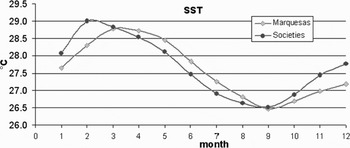
The Marquesas are volcanic islands surrounded by a 4–8 km wide shelf, about 30–60 m deep, locally indented by bays. Depths of over 2000 m are generally found within 10–15 km from shore, the slope of submarine volcanic cones being about 10–14° from a 3500 m deep abyssal plain. In some sectors, the bottom depth could only be estimated from satellite remote sensing data, with a vertical precision of about 500 m. In addition, at least six large seamounts can be found in the whole archipelago. Enhanced primary production is caused by the equatorial divergence lying between about 5°N and 5°S (Longhurst, Reference Longhurst1998), affecting at least the northern part of the Marquesas Islands. Sea-surface temperature features an average lower value of 26°C in September and a higher value of 29°C in March, during a normal year (non-ENSO situation). Signorini et al. (Reference Signorini, McClain and Dandonneau1999) have clearly identified primary production processes in the Marquesas: an ‘island effect’ may be caused by nutrient inputs arising from land wash, or by interaction between oceanic islands and west flowing currents (Heywood et al., Reference Heywood, Barton and Simpson1990).
The Societies are surrounded by a barrier reef, from which water reaches depths of over 2000 m within 6–8 km due to the 13°–18° slope of the volcanic islands. The barrier reef extends sometimes more than 3 km off the true coast line delimiting a lagoon area where water may be adequate to shelter dolphin schools (especially in the bays, passes and channels). This archipelago does not feature large-scale primary production, being located in the South Pacific Subtropical Gyre Province (Longhurst, Reference Longhurst1998). However, passes and edges effects may bring nutrient into the photic zone, in particular due to the outflow of lagoon and river waters. General oligotrophy is triggered by a deep (200–300 m) and stable thermocline (Rougerie & Wauthy, Reference Rougerie and Wauthy1986). SST features a significant seasonal change: during a normal year (non-ENSO situation), lower temperatures of 25°C are found in August–September and higher temperatures of 29°–30°C in February–April (Figure 2).
Remote-sensed SST compared for the Marquesas and Societies: monthly averages during the period of study (in °C).

Remote-sensed data collection and processing
We calculated the RSPP from satellite-derived chlorophyll-a (Chl-a) surface pigments and photosynthetically active radiation (PAR) as measured by SeaWifs scanner, and from SST as measured by AVHRR radiometer. Data were downloaded from Goddard Space Flight Center (http://www.oceancolor.gsfc.nasa.gov) and Jet Propulsion Laboratory (http://www.podaac.jpl.nasa.gov/pub/sea_surface_temperature/avhrr). We chose to use 9 × 9 km monthly averaged products which were mapped onto a uniform latitude/longitude grid with WIMSoft 6.25 (Kahru, Reference Kahru2004). The data set was made of a time-series of monthly files during the period 1997–2001, in agreement with the timing of our successive surveys and the satellite data availability. Data were processed to obtain RSPP (expressed in gC · m−2 · day−1) by modelling the euphotic layer from surface Chl-a pigments (Morel & Berton, Reference Morel and Berton1989) and using the light-photosynthesis model of Behrenfeld & Falkowski (Reference Behrenfeld and Falkowski1997) both options available with WIMSoft. We extracted RSPP monthly average values for both archipelagos of French Polynesia: the Marquesas were represented by a 46 × 42 pixels rectangle, and the Societies by a 57 × 45 rectangle. Then a pooled 1997–2001 RSPP average was calculated from the monthly average time series.
For five regions whose survey results were included in the discussion, Chl-a concentrations were computed from the SeaWiFS cumulative chlorophyll 1997–2006 climatology (http://www.oceancolor.gsfc.nasa.gov/climatologies): areas with Chl-a concentration within 0–0.2 mg · m−3 were termed oligotrophic, those in the range 0.2–0.5 mg · m−3 were termed mesotrophic, while the eutrophic category was eventually reserved for chlrorophyll concentrations over 0.5 mg · m−3. This analysis was done with WIMSoft (Kahru, Reference Kahru2004).
Survey platforms and material
In the Marquesas, two surveys were conducted in 1998–1999 (November–January) and 2000 (September–October) during which a 15 m ketch and a 15 m catamaran were respectively used. During both prospectings a minimal cruising speed of 9 km/h was maintained during sampling. A GPS unit was used for navigation and positioning. Passive acoustic equipment was used, consisting of a 200 Hz–20 kHz mono towed hydrophone and recording devices. This acoustic monitoring was carried out every 3 km of sampling, particularly to control the sperm whale presence. A standard crew of six persons allowed four people to be on scientific duty. Three observers were searching with naked eye: one stood in front of the mast, and two seated on the roof top, observer eyes being about 3.50 m above the sea level.
In the Societies, the survey consisted of 11 sessions organized from September 1996 to December 2001 on a 12 m sloop. During visual sampling, three observers stood on the deck and shared the frontal sector, searching with the naked eye. The same cruising speed as for the Marquesas was adopted (9 km/h). A passive acoustic device was used during surveys from 1997 onwards, and listening rate was performed once every 1.8 to 2.7 km (e.g. 1–1.5 nautical miles) during the humpback whales wintering season (Gannier, Reference Gannier2004) and every 2.7–3.7 km otherwise. Whenever a high level song was heard, a 15–30 minutes stop was allowed to record whale songs.
Although they were of different length, the boats used in each archipelago did not significantly differ in terms of observer altitude. Our survey platforms were not suitable to carry out a survey protocol with a double observer team, which would be necessary to obtain unbiased density estimates (Buckland et al., Reference Buckland, Anderson, Burnham and Laake1993).
Sampling
In the Societies, we only retained surveys carried out during the period September to January, in order to compare populations with the Marquesas without seasonal bias. Field work was carried out with wind speed equal or less than Beaufort 4 (30 km/h); sampling effort was discontinued whenever wind speed was above this limit. Every 20 minutes weather conditions were logged and a sighting conditions index was given between 0 (null) and 6 (excellent) depending on wind, swell and nebulosity (Table 1A). Sampling consisted of random prospectings around the islands, with zigzag patterns weather permitting, i.e. when cruising on leeward sides. Windward sides of islands were covered with suitable sighting conditions, leeward sides being sampled more often. Offshore sampling was obtained during fine-weather journeys between islands. Engine propulsion was used whenever wind did not enable a cruising speed of at least 9 km/h in the planned direction, thus leaving sailing for a minor proportion of survey time (15% in the Societies and 29% in the Marquesas). In case the sailing mode was adopted, observers were disposed to be able to search the frontal sector. Radial distance and bearing were estimated upon cetacean sighting. Among other variables, two were found relevant to give an indication on the cetacean response to the platform: the heading of cetaceans upon detection, with a specific ‘999’ code whenever animals were observed to move directly toward the boat, and the number of dolphins closing to ride the bow. Schools were approached for species identification and size estimate. Due to the low platforms, school sizes could not be accurately determined with the sighting conditions index of 3, i.e. a wind speed of Beaufort 4 or with over 0.5 m swell (Table 1A). Sightings made during non-random legs (such as cruising to a spinner dolphin resting site) were declared off-effort, and effort collected inside the lagoon area (Societies) was not included.
Definition of the sighting conditions index.

Good light applies to clear sky and sun ray incidence higher than 15°; swell applies to waves whose origin is away from sampling site.
Survey data processing
Data were entered into computer databases. ArcGIS 9.1 was used for mapping and effort calculations, digitized isobaths were available for 500 (not for all islands), 1000, 2000, 3000 and 4000 m depths (GEBCO). Sightings were plotted both on nautical chart and computer-based map to determine distance-to-shore and bottom depth. Distribution patterns of different species were described as the frequency of sightings over three strata: coastal area (less than 3.5 km from shore or reef), inshore area (within 10 km) and offshore area:

where nj is the number of sightings of species k in stratum j and nk is the total number of sightings of species k. Odontocete diversity was evaluated for each archipelago with the Shannon–Weaver index, by using all on-effort sightings:

where nt is the total number of odontocete sightings.
Relative abundance indices (RAIs) were calculated for all odontocetes pooled together, in coastal–inshore and offshore areas, retaining data with sighting conditions index over 4, equivalent to Beaufort 3 conditions, as recommended for small cetaceans (Hiby & Hammond, Reference Hiby and Hammond1989). RAIs were density estimator obtained with the conventional line transect method (Buckland et al., Reference Buckland, Anderson, Burnham and Laake1993) and expressed as follows:

where L is the sampling effort, n is the number of on-effort sightings, S is the mean school size and esw is the effective half search width. Mixed species schools were entered as single detections, using global school size. The smearing option (Buckland & Anganuzzi, Reference Buckland and Anganuzzi1988) was used to account for field inaccuracies in bearing angle measurement (±10°) and radial distance (±25%). Although RAI were expressed in individual/km2, they were not considered as true density estimates particularly because we did not control the detection probability on the line (g0). However, RAI may provide unbiased comparisons of relative abundance in each area, if g0 is assumed to be constant in both archipelagos. For a given survey protocol (i.e. same platform type and number of observers) and the same groups of species, the assumption of constant g0 may be valid if sighting conditions (sea state, wind speed and nebulosity) were similar on average during the surveys.
Because this g0 hypothesis could not be controlled, we provided a second set of relative abundance indices by setting the half search width to 500 m, i.e. using a strip transect estimate where all sighting outside the ±500 m band were excluded from the data analysis. The strip transect estimate was SAI:

Both relative abundance indices were computed with Distance 5.0 software (Thomas et al., Reference Thomas, Laake, Strindberg, Marques, Buckland, Borchers, Anderson, Burnham, Hedley, Pollard, Bishop and Marques2006). The daily effort was taken as a unit sample; samples with less than 18.5 km of effort were discarded from this analysis. Variance, SE and CV were obtained with the delta method as implemented by Distance 5.0.
RESULTS
Remote-sensed environmental variables
Average SST values were computed for every month in the period 1998–2001: global average stood at 27.7°C for the Societies and 27.6°C for the Marquesas. We found almost equal SST ranges and synchronous seasonal cycles with SST varying between 26.5°C in September and 28.8°C in March for the Marquesas, and between 26.5°C in September and 29.0°C in February for the Societies (Figure 2).
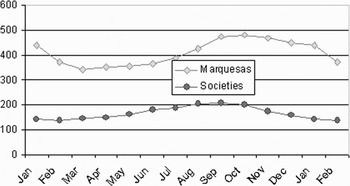
On the contrary, primary production computed from remote-sensed variables was highly contrasted: with an RSPP of 409 mgC · m−2 · day−1 on average, the Marquesas appeared to be mesotrophic in comparison with the Societies, where the RSPP was only 171 mgC · m−2 · day−1. The ratio of 2.4 between the two areas was also consistent year round: the minimal RSPP was encountered in February in the Societies (136 mgC · m−2 · day−1) and in March in the Marquesas (343 mgC · m−2 · day−1), and the respective maxima were in September (208 mgC · m−2 · day−1) and in October (479 mgC · m−2 · day−1). While not exactly in phase (Figure 3) both archipelagos featured a distinct seasonal trend with a maximum/minimum ratio of 1.40 in the Marquesas and 1.53 in the Societies. However, the minimal RSPP value encountered in the Marquesas was still much higher than the maximal RSPP value in the Societies.
Remote-sensed primary production compared for the Marquesas and Societies (mgC · m−2 · day−1).

Effort
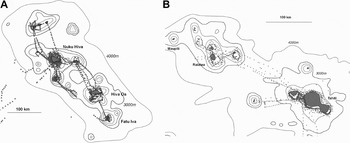
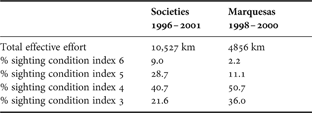
Total effective effort totalled 4856 km in the Marquesas: 3554 km were obtained during the 1998–1999 survey and 1302 km during the 2000 survey. From the total, 3106 km were obtained with a sighting condition index ≥ 4, i.e compatible with abundance indices estimates (Table 1B): 2400 km for the coastal–inshore stratum and 706 km for the offshore stratum. A proportion of 13.3% of effort was obtained with excellent conditions (index 5 or 6), 50.7% with good conditions (index 4) and 36.0% with medium conditions (index 3). All islands were covered at least twice during the surveys (Figure 4A).
(A) Sampling effort in the Marquesas (500, 1000, 2000, 3000 and 4000 m isobaths are drawn); (B) sampling effort in the Societies (500, 1000, 2000, 3000 and 4000 m isobaths are drawn).

Description of sighting conditions in both surveys.
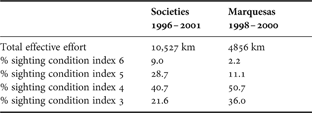
Total effective effort were 10,127 km in the Societies, of which 7943 km were obtained with a sighting condition index ≥ 4: 37.7% with excellent conditions (index of 5 or 6), 40.7% with good conditions, and 21.6% with medium conditions (Table 1B). For relative abundance estimates, 5858 km were obtained inshore and 517 km offshore. Three-quarters of the effective effort was located in the Windward Islands and the remaining in the Leeward Islands (Figure 4B).
Sightings
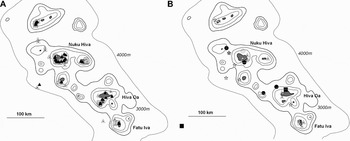
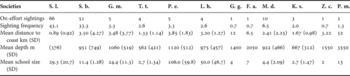
A total of 154 groups of odontocetes were observed on-effort in the Marquesas including ten delphinids species (S. attenuata, S. longirostris, T. truncatus, P. electra, S. bredanensis, G. macrorhynchus, P. crassidens, F. attenuata, G. griseus and O. orca) and an unidentified beaked whale (Figure 5A, B). The backbone of the delphinid sightings, 95%, consisted of five species: the pantropical spotted dolphin (59 sightings), the spinner dolphin (40 sightings), the bottlenose dolphin (22 sightings), the melon-headed whale (15 sightings) and the rough-toothed dolphin (9 sightings). The short-finned pilot whale (3 sightings) and the pygmy killer whale (2 sightings) were occasional, while Risso's dolphin, false killer whale and killer whale were observed once. Melon-headed whales formed usually large groups, with a mean school size (mss) of 150.0 individuals (up to 200 individuals), when other species were seen in smaller shools, averaging 10.7 individuals for the bottlenose dolphin and 26.0 for the spotted dolphin (Table 2). Mixed species sightings included T. truncatus associated with S. longirostris, S. attenuata or P. electra and spinner dolphins mixed with spotted dolphins.
(A) Sightings in the Marquesas: dark triangle, spinner dolphin; dotted triangle, spotted dolphin; dotted square, bottlenose dolphin (1000, 2000, 3000 and 4000 m isobaths are drawn); (B) sightings in the Marquesas: dotted triangle, melon-headed whale; star, rough-toothed dolphin; dark square, pygmy killer whale; dark circle, pilot whale; grey circle, Risso's dolphin; dark hexagon, false killer whale; dotted square, killer whale (1000, 2000, 3000 and 4000 m isobaths are drawn).

On-effort sightings in the Marquesas (1998–2000): basic descriptive statistics (N = 153; species are named by their initials).

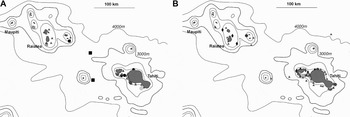
A total of 156 odontocete groups were observed on-effort in the Societies (Figure 6A, B) including 137 of eight delphinids species (S. longirostris, S. bredanensis, G. macrorhynchus, T. truncatus, P. electra, Lagenodelphis hosei, G. griseus and F. attenuata), two physeteroids (P. macrocephalus and K. simua) and two ziphiids (Z. cavirostris and M. densirostris). Two beaked whale sightings and one small delphinid were not identified to species level. Six species represented 89% of the identified sightings with two main species, the spinner dolphin (66 sightings) and the rough-toothed dolphin (51 sightings), and four ‘secondary’ species: the short-finned pilot whale (5 sightings) the bottlenose dolphin (4 sightings), the melon-headed whale and the Fraser's dolphin (9 sightings together). Blainville's beaked whale (10 sightings) and dwarf sperm whale (3 sightings) were also common. Occasional odontocetes included the sperm whale (2 sightings), Cuvier's beaked whale (1 sighting), Risso's dolphin (1 sighting) and the pygmy killer whale (1 sighting). The most common mixed species sighting was the P. electra–L. hosei pair (four cases), when T. truncatus almost systematically associated with either S. bredanensis or G. macrorhynchus. The largest schools were those of melon-headed whales (mss = 106) and Fraser's dolphin (mss = 50), followed by the spinner dolphin (mss = 29.3) and the pilot whale (mss = 24.4). The rough-toothed dolphin had a mean school size of 11.4 and bottlenose dolphins were generally found in small units (mss = 2.7) along with other species (Table 3).
(A) Sightings in the Societies: dark triangle, spinner; grey square, bottlenose; grey circle, Risso's dolphin; dark circle, short-finned pilot; black square, sperm whale. (1000, 2000, 3000 and 4000 m isobaths are drawn); (B) sightings in the Societies: dark triangle, rough-toothed dolphin; grey circle, Fraser's dolphin; dark circle, melon-headed whale; grey square, dwarf sperm whale; blue circle, Cuvier's beaked whales; diamond = Blainville's beaked whales, dark star = pygmy killer whale. (1000, 2000, 3000 and 4000 m isobaths are drawn).

On-effort sightings in the Societies (1996–2001): basic descriptive statistics (N = 153; species are named by their initials).

Distribution
In the Marquesas, the five most common species showed distinct habitat preferences: the spinner and bottlenose dolphins and the melon-headed whale were seen in coastal or slope waters (mean depth of 177, 215 and 129 m, respectively), the former being occasionally observed offshore. The pantropical spotted dolphin was a wide ranging species with medium but variable bottom depth (683 m, SD = 946) and distance-to-coast (5.6 km, SD = 11.4) (Table 2). The rough-toothed dolphin was mostly an offshore species with a mean bottom depth of 1929 m (SD = 957 m) and average distance-to-coast of 15.3 km (SD = 11.9 km) (Table 2). In summary, four of the common species were often seen in neritic habitat (the two Stenella species, the bottlenose dolphin and melon-headed whale), when slope waters were favoured by three of them, and the open ocean was mainly inhabited by rough-toothed and pantropical spotted dolphins.
In the Societies, the two main species did not entirely share the same diurnal habitat, the spinner being met in coastal and slope waters, when the rough-toothed was wide ranging, being met in slope or offshore waters. This is also reflected by a mean distance-to-coast of 0.89 km (SD = 0.92) for S. longirostris and 3.5 km (SD = 4.3) for S. bredanensis, and a mean depth of, respectively, 280 m (SD = 376 m) and 829 m (SD = 749) (Table 3). Most other frequent species favoured slope waters, while G. macrorhynchus was occasionally seen in open sea. Bottlenose dolphins were observed over coastal or inshore habitats. Mean distance-to-coast did not exceed 5 km, except for rarer species such as the Cuvier's beaked whale, Risso's dolphin, pygmy killer whale or the sperm whale (Table 3). Dwarf sperm whale and Blainville's beaked whale had similar preferences, but the former was found closer to shore (1.7 km against 2.4 km) with mean depth of 667 m and 922 m, respectively (Table 3).
Inshore and offshore relative abundances
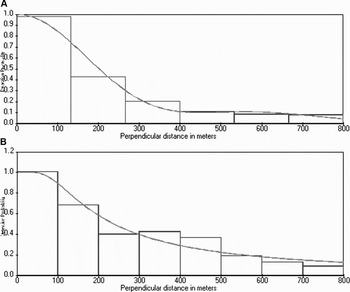
Detection function modelling was carried out for both archipelagos with perpendicular detection distance truncated at 800 m, using a half-normal model with cosine adjustment. An esw of 250 m (CV = 8.3%) was obtained in the Marquesas against 329 m (CV = 19%) in the Societies. The perpendicular detection distance histogram for the Marquesas showed a narrower shoulder compared to the Societies data (Figure 7A, B): 38% of detections were obtained at radial distances ≤ 100 m in the Marquesas, against 17% in the Societies.
(A) Detection function modelling (Marquesas Islands); (B) detection function modelling (Society Islands).

In the Marquesas, a RAI of 2.02 ind/km2 (CV = 19.8%) was found for the inshore stratum against 0.79 ind/km2 (CV = 41.9%) for the offshore stratum (Table 4). Higher mean school sizes were obtained inshore than offshore (27.3 against 19.0). RAI was much lower in the Societies, with 0.63 ind/km2 inshore (CV = 25.2%) and 0.22 ind/km2 offshore (CV = 63.8%). The mean school size (25.4; CV = 13.6%) was estimated on pooled data, because we had only 3 sightings in offshore waters, hence the RAI difference was caused by higher group sighting rates inshore (1.64 school/100 km) compared to offshore (0.58 school/100 km).
Relative abundance indices for odontocetes of the Societies (1996–2001) and Marquesas (1998–2000).

The strip transect estimates brought similar results in terms of relative abundances (Table 4): the SAI were 0.93 ind/km2 and 0.36 ind/km2 for inshore strata of the Marquesas and the Societies, respectively, and 0.28 ind/km2 and 0.14 ind/km2 for the offshore areas of the same archipelagos.
In summary, the inshore relative abundance was 2.6–3.2 times higher in the Marquesas, whatever the estimator, and both inshore relative abundances were 2.6–3.3 times higher than offshore indices. T-tests between estimates showed that relative abundances were significantly (P > 0.95) higher for both habitats in the Marquesas compared to the Societies.
Comparison of odontocete populations
In addition to the differences in relative abundances, the observed populations of both archipelagos were markedly different: the pantropical spotted dolphin was absent from our records in the Societies and the Fraser's dolphin from those in the Marquesas. Four delphinids species scored over 10% each in sighting frequency in the Marquesas, and only two in the Societies. This resulted in a higher Shannon diversity index in the Marquesas (2.34) than in the Societies (1.79), in line with the higher number of species (10 against 8) found in the former archipelago. Beaked whales and dwarf sperm whales were commonly observed in the Societies (9.2% of sight.) and not in the Marquesas. Sperm whales were not observed or listened to in the Marquesas.
The availability of a shelf ‘ring’ off every island of the Marquesas had obviously an influence on distribution patterns. When habitat preferences of common species were compared between both archipelagos, several were seen in shallower waters in the Marquesas compared to the Societies (Tables 2 & 3): spinner dolphins were found in water of 177 m mean depth in the Marquesas and 280 m in the Societies; the same was observed for melon-headed whales (129 m against 1120 m) and bottlenose dolphins (215 m against 562 m). A noticeable exception was the rough-toothed dolphin which was encountered in shallower waters in the Societies than in the Marquesas (829 m against 1929 m).
DISCUSSION
Detection function and strip transect
Our attempt to model detection functions to obtain relative densities resulted in different esw for each survey: the estimated search width for the Societies was wider than for the Marquesas (respectively 329 m and 250 m). The average sighting condition index was 4.3 in the Marquesas against 4.7 in the Societies, illustrating survey conditions (Table 1B), and detections were obtained at shorter radial distances in the former. Another consequence of the degraded sighting conditions in the Marquesas was that a higher proportion of groups were visually detected while they were heading to the boat, likely in response to the platform: 43% in the Marquesas against 9% in the Societies; in both cases 92–94% of these groups came to the boat for bow riding. The proportion of dolphin groups heading to the boat was even higher for shorter radial distances (≤100 m): 65% in the Marquesas and 32% in the Societies. Both indications put together suggest that rougher sea conditions in the Marquesas were harmful to the detection function, as many dolphins were detected at short distances whilst they were attracted to the boat. Spiked detection data preclude a correct esw estimate (Buckland et al., Reference Buckland, Anderson, Burnham and Laake1993), and difference between the modelled esw may be caused by field conditions. For this reason it is preferable to compare both regions with strip transect SAI rather than the conventional line transect RAI estimate. Although for practical reasons we were unable to implement a robust line transect method (see for example Hammond et al., Reference Hammond, Bergreen, Benke, Borchers, Collet, Heide-Jorgensen, Heimlich-Boran, Hiby, Leopold and Oien2002), our field methodology permitted us to evidence the response movement. The strip transect method is unable to provide a true density estimate, but in our case it may deliver more robust comparisons between the two regions.
Species occurrence oceanwide
Delphinid distribution and habitats have been intensively studied for the ETP (Au & Perryman, Reference Au and Perryman1985; Reilly, Reference Reilly1990; Wade & Gerrodette, Reference Wade and Gerrodette1993; Reilly & Fiedler, Reference Reilly and Fiedler1994), but few results are available for the tropical Pacific Ocean. Four archipelagos were considered in our discussion: the Galapagos (Smith & Whitehead, Reference Smith and Whitehead1999), the Hawaiian archipelago (Baird et al., Reference Baird, Webster and McSweeney2005), the Solomon Islands (Shimada & Pastene, Reference Shimada and Pastene1995; Kahn, Reference Kahn, Green, Lokani, Atu, Ramohia, Thomas and Almany2006), and the southern Sulu Sea (Dolar et al., Reference Dolar, Perrin, Yaptinchay, Jaaman, Santos, Alava and Suliansa1997). We took account of surveys whatever the season and the survey vessel, but in order to avoid potential biases, we excluded results obtained from strandings or opportunistic sightings. To extract sighting data for the south-western ETP, the area closest to the Marquesas, we used the distribution maps published in Wade & Gerrodette (Reference Wade and Gerrodette1993).
Sperm whale was absent from our sightings in the Marquesas, as well as from acoustic data (unpublished data), but it was occasionally sighted in the Societies, during September–October period, one sighting including cows, calves and bulls. Baird et al. (Reference Baird, Webster and McSweeney2005) reported sperm whale only on 11 occasions from a survey effort of 27,818 km off the Hawaiian Islands. It is a regular sighting in the Solomon and Galapagos Islands (Shimada & Pastene, Reference Shimada and Pastene1995; Whitehead, Reference Whitehead1989) and also in the south-west ETP (Wade & Gerrodette, Reference Wade and Gerrodette1993). The absence of sperm whales from our two consecutive surveys in the Marquesas was probably not incidental.
Beaked whales, including M. densirostris and Z. cavirostris, were commonly observed in the Societies (11 sightings+1 unidentified) and not in the Marquesas (one sighting), although the sighting difference may be because of better sighting conditions encountered in the Societies (37% of effort in very good conditions against 13% in the Marquesas). The same argument applies of course to the very discrete Kogia genus, which was only observed in the Society Islands with very good sighting conditions. Both genera are regularly sighted off Hawaii (Baird et al., Reference Baird, Webster and McSweeney2005), and observed in the Sulu Sea (Dolar et al., Reference Dolar, Perrin, Yaptinchay, Jaaman, Santos, Alava and Suliansa1997). Because beaked whales and kogiids are relatively inconspicuous with sea state above 3, only carefully processed data can deliver suitable indications on true absence or presence in a given region (Barlow et al., Reference Barlow, Ferguson, Perrin, Ballance, Gerrodette, Joyce, MacLeod, Mullin, Palka and Warin2006).
The spinner dolphin, a cosmopolitan species in tropical waters (Perrin & Gilpatrick, Reference Perrin, Gilpatrick, Ridgway and Harrison1994), was common in both archipelagos, as it is around Hawaii (Norris et al., Reference Norris, Würsig, Wells and Würsig1994; Baird et al., Reference Baird, Webster and McSweeney2005), in the Solomon Islands and the Sulu Sea (Kahn, 2004; Dolar et al., Reference Dolar, Perrin, Yaptinchay, Jaaman, Santos, Alava and Suliansa1997). Large schools are seen in the ETP (Wade & Gerrodette, Reference Wade and Gerrodette1993), but it is not common in the Galapagos (Smith & Whitehead, Reference Smith and Whitehead1999): spinner dolphin seems to be better adapted to warmer oligotrophic environments than to cooler mesotrophic habitats. The availability of a suitable daytime resting site seems to be a favourable condition for local spinner dolphin populations (Norris et al., Reference Norris, Würsig, Wells and Würsig1994; Gannier & Petiau, Reference Gannier and Petiau2006).
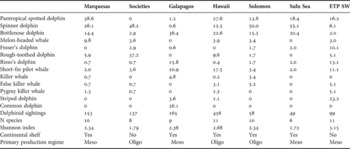
The pantropical spotted dolphin is a frequent species in the tropical Pacific, being observed offshore as well as close to islands (Perrin & Hohn, Reference Perrin, Hohn, Ridgeway and Harrison1994), including the Galapagos (Smith & Whitehead, Reference Smith and Whitehead1999), Solomon Islands and Sulu Sea (Shimada & Pastene, Reference Shimada and Pastene1995; Dolar et al., Reference Dolar, Perrin, Yaptinchay, Jaaman, Santos, Alava and Suliansa1997). This species ranks first among delphinids in Hawaii (Baird et al., Reference Baird, Webster and McSweeney2005), as in the Marquesas. Its absence in the Societies is apparently not linked to low primary production levels, because S. attenuata is a common species in the oligotrophic areas of Hawaii and the Solomons, although both regions are perhaps not as oligotrophic as the Societies (Table 5).
Composition of delphinid populations in 7 regions of the tropical Pacific region (in % of sightings identified to species).

References: Galapagos (Smith & Whitehead, Reference Whitehead1989); Hawaii (Baird et al., Reference Baird, Webster and McSweeney2005); Solomon (Shimada & Pastene, Reference Shimada and Pastene1995; Kahn, Reference Kahn, Green, Lokani, Atu, Ramohia, Thomas and Almany2006); Sulu Sea (Dolar et al., Reference Dolar, Perrin, Yaptinchay, Jaaman, Santos, Alava and Suliansa1997); ETP SW (Wade & Gerrodette, Reference Wade and Gerrodette1993).
The bottlenose dolphin is common in tropical and temperate coastal waters worldwide, but can be found in pelagic waters (Wells & Scott, Reference Wells, Scott, Ridgway and Harrison1999). From our records, T. truncatus was relatively uncommon in the Societies (2.6% of the delphinids), where it favoured the Leeward rather than the Windward Islands (three sightings against one), certainly in relation to the larger extension of the lagoon and coral reef barrier in the latter area; T. truncatus is a common species in the northern and central Tuamotu Islands (personal data). It is seen across the tropical Pacific from the eastern region (Au & Perryman, Reference Au and Perryman1985; Smith & Whitehead, Reference Smith and Whitehead1999), Hawaiian Islands (Baird et al., Reference Baird, Webster and McSweeney2005) to western areas (Kahn, 2004; Dolar et al., Reference Dolar, Perrin, Yaptinchay, Jaaman, Santos, Alava and Suliansa1997). We noted that bottlenose dolphins were not among the common sightings in the south-western ETP (Wade & Gerrodette, Reference Wade and Gerrodette1993). The amount of its contribution to a local cetacean population may be seen as closely related to the shelf extension (Table 5), a perfect illustration of this paradigm being the comparison between the Societies and the Marquesas. There was no evidence of a fully offshore form, sensu Wells & Scott (Reference Wells, Scott, Ridgway and Harrison1999) of T. truncatus, during our surveys in the Marquesas and Societies.
The rough-toothed dolphin is primarily regarded as an oceanic species in sub-tropical and tropical waters worldwide (Miyazaki & Perrin, Reference Miyazaki, Perrin, Ridgway and Harrison1994). It represented 33.1% of the delphinid sightings in the Societies, being year-round resident in the slope habitat of the Societies (Gannier & West, Reference Gannier and West2005) it is less common in the Marquesas (5.9%), where it inhabited deeper waters. Steno bredanensis represented 9.6% of sightings off the Hawaiian Islands, with a slope habitat (Baird et al., Reference Baird, Webster and McSweeney2005) and was also well represented in oceanic waters of the south-western ETP (Wade & Gerrodette, Reference Wade and Gerrodette1993), but is absent or uncommon in the other areas discussed (Table 5). Rough-toothed dolphins were regularly observed in feeding activities during our surveys in the Marquesas and Societies, contrary to most other small delphinids.
The short-finned pilot whale is a widely distributed species in tropical and temperate waters of the Pacific Ocean (Au & Perryman, Reference Au and Perryman1985; Bernard & Reilly, Reference Bernard, Reilly, Ridgway and Harrison1999; Smith & Whitehead, Reference Smith and Whitehead1999; Dolar et al., Reference Dolar, Perrin, Yaptinchay, Jaaman, Santos, Alava and Suliansa1997; Baird et al., Reference Baird, Webster and McSweeney2005): together with the spinner and bottlenose dolphin, G. macrorhynchus was observed in all seven areas discussed here, either in slope or in oceanic habitats. It was an important component of the delphinid population of Hawaii (17.5% of delphinids), Galapagos and the south-west ETP (Table 5).
Melon-headed whales are found in tropical waters of all oceans and are common in the eastern tropical Pacific (Perryman et al., Reference Perryman, Au, Leatherwood, Van Waerebeek, Ridgway and Harrison1994). It was a frequent dolphin species in the Marquesas (9.8% of sight.) and less common in the Societies (2.6%). Interestingly, P. electra was seen in large schools in both archipelagos, but mixed schools with Fraser's dolphin were the rule in the Societies (4 cases out of 5), but not in the Marquesas and off Hawaii (3.9% of sightings in Baird et al., Reference Baird, Webster and McSweeney2005). Peponocephala electra was not observed and L. hosei was rarely seen in the Galapagos (Smith & Whitehead, Reference Smith and Whitehead1999), but Fraser's dolphin was observed in the Sulu Sea (Dolar et al., Reference Dolar, Perrin, Yaptinchay, Jaaman, Santos, Alava and Suliansa1997) and not off Hawaii (Baird et al., Reference Baird, Webster and McSweeney2005). In the south-western ETP, an offshore area, Fraser's dolphins were more common than melon-headed whale (Wade & Gerrodette, Reference Wade and Gerrodette1993), perhaps an indication that P. electra favours the slope habitat. Furthermore this species is apparently common in truly tropical waters, as opposed, for example, to the upwelled mesotrophic area of the Galapagos (Table 5).
Both false killer whale and killer whale were seen in the Marquesas and not in the Societies, and the pygmy killer whale was more frequent around the Marquesas than in the Societies. The frequency of Pseudorca and Feresa is perhaps linked to tuna abundance in the Marquesas region, as these super-predators are known to feed on scombroid fish, as well as, at least occasionally, on marine mammals (Ross & Leatherwood, Reference Ross, Leatherwood, Ridgway and Harrison1994; Odell & McClune, Reference Odell, McClune, Ridgway and Harrison1999). Both false and pygmy killer whales were regular sightings in the south-west ETP (Wade & Gerrodette, Reference Wade and Gerrodette1993) and the former represents 3.1% of delphinids in Hawaii (Baird et al., Reference Baird, Webster and McSweeney2005). Orcas are sometimes reported by fishermen in the Societies, and they are regular sightings in the Marquesas, where they appear to feed inshore on manta ray Manta birostris (hence a rare live stranding in July 2005; Anonymous, 2005). While the killer whale is relatively common off the Galapagos (Smith & Whitehead, Reference Smith and Whitehead1999), it was not observed in the south-west ETP (Wade & Gerrodette, Reference Wade and Gerrodette1993) and seems to be occasional in other archipelagos (Table 5): this wide ranging large delphinid is more coastal than oceanic, with a preference for high latitude (Dalheim & Heyning, Reference Dalheim, Heyning, Ridgway and Harrison1999).
Risso's dolphin distribution extends in tropical and temperate seas (Kruse et al., Reference Kruse, Caldwell, Caldwell, Ridgway and Harrison1999), but it was uncommon both in the Marquesas and the Societies. This picture was confirmed by records from other archipelagos of the tropical Pacific (Baird et al., Reference Baird, Webster and McSweeney2005; Shimada & Pastene, Reference Shimada and Pastene1995; Kahn, 2004; Dolar et al., Reference Dolar, Perrin, Yaptinchay, Jaaman, Santos, Alava and Suliansa1997), with the exception of the Galapagos, where the species was an important component of the observed population (Smith & Whitehead, Reference Smith and Whitehead1999). Furthermore, we noted that G. griseus was also frequent in the south-west ETP (Wade & Gerrodette, Reference Wade and Gerrodette1993), hence the species seems to prefer mesotrophic waters in the eastern part of the tropical Pacific. Similar statements arise from the absence of striped and common dolphins from our surveys in French Polynesia, as well as from reports of most tropical archipelagos, the Galapagos excepted (Table 5) in the ETP. Reilly (Reference Reilly1990) observed that striped dolphins are usually encountered where the thermocline shoals under warm tropical surface waters, when the common dolphins seem to be associated with upwelled waters.
Delphinid diversity and relative abundance in relation to environmental features
Delphinid populations in the Marquesas and Society Islands are different, both in terms of diversity and relative abundance: this is undoubtedly linked to the respective oceanographic and topographic features. Among the discussed areas, delphinids diversity is low in the Societies (8 species, SI = 1.79): in other archipelagos featuring a shelf-like area, the diversity amounts to 9–11 species with Shannon indices of 2.3–2.6 (Table 5). The absence of shelf appears to play a crucial role in limiting diversity, not only by restraining bottlenose dolphin presence: a continental shelf, such as in the Marquesas, probably favours the occurrence of species such as S. longirostris and P. electra, because small delphinids may shelter from predators, large sharks particularly, in shallow sites (Norris et al., Reference Norris, Würsig, Wells and Würsig1994). The highest diversity (11 species and SI = 3.15) was found in the south-west ETP (Wade & Gerrodette, Reference Wade and Gerrodette1993) where there is no continental shelf at all, but the data were obtained from long term surveys in a spatially extended region: temporally variable oceanographic features allow different species assemblages to be represented in the long term. Furthermore, this area can be classified as mesotrophic on average (Table 5).
Strip transect relative abundance indices SAI are clearly higher in the Marquesas than in the Societies, both inshore (0.93 ind/km2, ratio 2.58) and offshore (0.36 ind/km2, ratio 2.0). The offshore effort was modest in the later archipelago but during an early large vessel survey in the Society Islands in December 1996, 2166 km of effective effort was achieved offshore with only three delphinid sightings recorded (Gannier & Gannier, Reference Gannier and Gannier1998). The difference in offshore SRIs can be related to a large gap between RSPP calculated in the Marquesas (409 mgC.m−2. day−1) and the Societies (171 mgC · m−2 · day−1) which is a consequence of the former location, just south of the mesotrophic Pacific Equatorial Divergence Province, when the latter is located in the oligotrophic South Pacific Subtropical Gyre Province (Longhurst, Reference Longhurst1998). Furthermore, the circulation of the Equatorial Current produces eddies and local enrichment of the water upper column around the Marquesas, as stated by Signorini et al. (Reference Signorini, McClain and Dandonneau1999). For instance, small scale edge effects could be visually observed by sharp green/blue contrasts during the Marquesas surveys, and are also visible on a larger scale from satellite imagery. In the Societies, such interactions between local topography and oceanography may exist at a much smaller extent, and were not noticed either visually or on satellite colour files.
Relative abundances were not available from other archipelagos of the tropical Pacific, but we obtained a relative density of 0.52 ind/km2 for striped dolphins (esw = 529 m) during surveys conducted with a 12 m motor-boat in the Pelagos Sanctuary, the Mediterranean Sea (Gannier, Reference Gannier2006). A correlation between relative abundance indices in different regions of the Mediterranean Sea and RSPP was found significant (Gannier et al., Reference Gannier, Bosc and Laran2005). The delphinid abundances in tropical Pacific archipelagos might also be related to regional primary productions, as exemplified by the Societies and Marquesas cases. However, the presence of a shelf, such as in the Marquesas, provides extra ‘niches’ for several species, which in turn may account for higher abundances at least in inshore waters.
CONCLUSION
Our results show different odontocete communities in two archipelagos separated by quite a small distance in the tropical Pacific. Both the latitude of the Marquesas and its proximity to the mesotrophic equatorial divergence, and the presence of a neritic domain could explain higher relative abundances compared to the Society archipelago. Further comparisons with archipelagos such as the Galapagos, Hawaii or Solomons, bring other evidence that the shelf domain favours delphinid diversity, and in turn, the inshore and slope abundance. A significant influence of primary production on offshore and inshore delphinid abundance might also be expected. Habitat-modelling approaches should be carried out to determine the invariants of every species habitat across the different archipelagos worldwide, wherever suitable environmental data are available.
ACKNOWLEDGEMENTS
Thanks to benevolent observers for helping with field work: Guy Aldhuy, Michel Bazin, Stéphane Bourreau, Céline Brossard, David Curtis, Violaine Dulau, Odile Gannier, Michel Genefort, Oliver Kiely, Sophie Laran, Guido Rappe and Guillaume Pernette. Special thanks to the Goddard Flight Test Center and the Jet Propulsion Laboratory (NASA) for enabling access to the colour, PAR and SST remote-sensed data. I thank the Research Office of Gouvernement de la Polynésie Française for having contributed to the funding, and Professor Claude Payri, Université de la Polynésie Française, for her support. Thanks to Jean-Claude Tricottet for a fair price renting of his sailboat and skippering. Thanks to Dr Robin Baird for his remarks on an earlier version of the manuscript. I thank two anonymous referees for their helpful comments on an early version of this paper.