I. INTRODUCTION
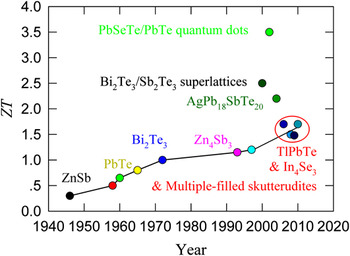
Thermoelectric (TE) techniques have a great potential for applications in high-efficiency heat-to-electricity conversion in waste heat recovery and solid state heating and cooling.Reference Yang and Caillat1, Reference Snyder and Toberer2 There are several unique advantages in TE applications such as no moving parts, low maintenance cost, easy integration with other energy conversion devices, and long-term stability. The efficiency of TE materials is governed by the dimensionless TE figure of merit ZT = S 2T/ρκ, where S is the thermopower, ρ is the electrical resistivity, T is the absolute temperature, and κ is the thermal conductivity. The key and main goal in TE material research is to improve ZT through maximizing the thermopower while minimizing the electrical resistivity and thermal conductivity. Recent improvements in complex TE materials have led to many advances.Reference Snyder and Toberer2 Enhanced ZT values have been reported for several classes of materials, including superlattices,Reference Venkatasubramanian, Siivola, Colpitts and O’Quinn3, Reference Harman, Taylor, Walsh and LaForge4 nanostructured materials,Reference Poudel, Hao, Ma, Lan, Minnich, Yu, Yan, Wang, Muto, Vashaee, Chen, Liu, Dresselhaus, Chen and Ren5, Reference Hsu, Loo, Guo, Chen, Dyck, Uher, Hogan, Polychroniadis and Kanatzidiset6 and bulk materials.Reference Sales, Mandrus and Williams7–Reference Rhyee, Lee, Lee, Cho, Kim, Lee, Kwon, Shim and Kotliar10 The ZTs in bulk materials are improved quickly after 1990s (see Fig. 1), with some of them being reported but not confirmed to be above 2.0.
Timeline of figure of merit (ZTs) reported in Refs. Reference Snyder and Toberer2–Reference Rhyee, Lee, Lee, Cho, Kim, Lee, Kwon, Shim and Kotliar10. The ZTs improved quickly after the 1990s.

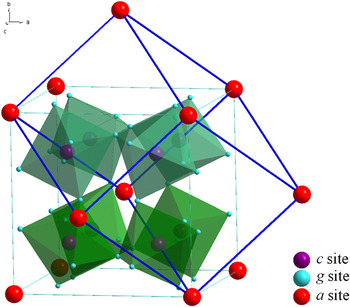
At the search for promising TE materials, skutterudites have emerged as prospective candidates for many intermediate temperature applications.Reference Sales, Mandrus, Chakoumakos and Tritt11, Reference Uher and Tritt12 A binary skutterudite has a general formula MX3, where M is Co, Rh, or Ir, and X stands for P, As, or Sb, and crystallizes with the body-centered cubic structure (Im3). A conventional unit cell contains 32 atoms arranged in eight groups of MX3 blocks. The transition metals M occupy the c sites and the pnicogen atoms X occupy the g sites (Fig. 2). Each metal atom M lies in the center, octahedrally coordinated by six pnicogen atoms to form a MX6 octahedron. The most interesting point in the skutterudite structure is that there exist two large lattice voids (icosahedral voids), and each of the voids is surrounded by 12 X atoms in the structure. Therefore, instead of the general formula of binary skutterudites (MX3) mentioned above, one can also write the chemical formula as □M4Sb12, where □ represents the presence of the void.
Crystal structure of a typical skutterudite material CoSb3. Transition metal atoms, Co, occupy 8c sites and pnicogen atoms, Sb, occupy 24g sites. Guest atom I could be filled into the voids at 2a sites.

The skutterudite structure offers many interesting possibilities to change and optimize both electronic and lattice properties, and thereby has attracted great attention. Many researchers have been working on optimizing the material to achieve high TE efficiency.Reference Sales, Mandrus, Chakoumakos and Tritt11, Reference Uher and Tritt12 The research attempt in skutterudite materials can be traced back to the mid-1950s, when researchers in the former Soviet Union studied a vast number of compounds and alloys at that time.Reference Uher and Tritt12 However, it was found that the thermal conductivity in binary skutterudites was too high for high-efficiency TEs, although they showed outstanding electronic properties, exceptionally high carrier mobilities and modest Seebeck coefficients. In the mid-1970s, Prof. Jeitschko and his colleagues realized that some guest atoms might be filled into the void sites in the open structure of skutterudites (named filled skutterudites),Reference Jeitschko and Brown13 and they actually have investigated a number of filled skutterudites with lanthanide element filling in the voids and charge-deficient element (like Fe, Ru, or Os) substitution at Co sites in experiments.Reference Brown and Jeitschko14–Reference Brown and Jeitschko16 In 1994, Dr. Slack proposed his ideal concept that high efficiency TE materials should be a phonon-glass electron-crystal (PGEC) material.Reference Slack and Rowe17 Filled skutterudites, with guest filler ions in the void sites, were assumed to be potential candidates as ideal PGEC materials even without much in-depth understanding of transport mechanisms in physics. Later, Morelli and MeisnerReference Morelli and Meisner18 demonstrated a dramatic suppression of the lattice thermal conductivity (more than one order in magnitude in the whole temperature range) in the Ce-filled skutterudite CeFe4Sb12. In 1996, Dr. Sales significantly improved ZT in filled skutterudites to be around unity, comparable to the state-of-the-art TE materials.Reference Sales, Mandrus and Williams7 After that, lots of theoretical and experimental efforts generated many exciting data and results, which make the filled skutterudites to one of the most interesting and promising novel TE materials.Reference Sales, Mandrus, Chakoumakos and Tritt11, Reference Uher and Tritt12, Reference Morelli and Meisner18–Reference Chapon, Ravot, Tedenac, Tritt, Kanatzidis, Mahan and Lyon26
Note that by filling guest atoms into the skutterudite voids, filler elements donate their valence electrons to the conduction bands of the material and drive the filled material to n-type with high electron concentration. In earlier studies, filler ions were dominantly rare earth metals.Reference Uher and Tritt12 It was found to be difficult to prepare n-type rare earth filled skutterudites because rare earth fillers always occupy a small percentage of the intrinsic lattice voids (low filling fraction), specifically for the case of filled CoSb3. Electron-deficient elements were often co-doped at Co or Sb sites to balance the charges, which usually drove the filled materials to p-type conducting.Reference Sales, Mandrus, Chakoumakos and Tritt11, Reference Uher and Tritt12 The most promising filled skutterudites reported previously were those systems with Fe substituted for Co atoms in skutterudite crystal. The lattice thermal conductivity was shown to be dramatically depressed by one order of magnitude at 300 K and even a factor of 50 at low temperatures because of the additional phonon scattering from both the Fe substitution and guest atom filling.Reference Morelli and Meisner18, Reference Meisner, Morelli, Hu, Yang and Uher27 By physically extrapolating transport data measured at low-temperature to the high-temperature range, the dimensionless TE ZT was estimated to be able to reach around 1.3 in Fe-substituted La-filled skutterudites (p-type) by Sales et al.Reference Sales, Mandrus, Chakoumakos, Keppens and Thompson22 and Fleurial et al.Reference Fleurial, Caillat and Borshchevsky28 in 1997. With that, the filled skutterudites were then expected to be superior to other state-of-the-art TE materials although the ZT value is still waiting for further confirmation in experiment.
TE technology requires both excellent p- and n-type materials with high ZTs used at the same working temperature. Therefore, the search for excellent n-type skutterudites attracted more and more interests in this field. To achieve n-type conducting in skutterudites, one can dope Ni/Pd/Pt at the Co sites or VIIA elements at the Sb sites to provide extra electrons.Reference Dudkin and Abrikosov29–Reference Anno, Matsubara, Notohara, Sakakibara and Tashiro34 Much work was carried out on the fabrication of these transition metal or VIIA element doped skutterudite alloys, and ZT ∼0.8 at 700 K were reported for the Te-doped CoSb3 skutterudites.Reference Nagamoto, Tanaka and Koyanagi35 An other approach to achieve n-type doping in skutterudites is to partially fill guest atoms into the voids without charge-deficient element substitution in the framework to form filled skutterudites I yCo4Sb12, where I represents guest atoms.Reference Morelli, Meisner, Chen, Hu and Uher36–Reference He, Chen, Rosenfeld and Subramanian53 As mentioned above, it is very difficult to fill rare earth elements into the skutterudite to a very high level. A series of works, focusing on other guest atom filled skutterudites (I yCo4Sb12), have been tried to realize high performance in n-type skutterudites. For example, a Tl-filled skutterudite with a moderate filling fraction (about 0.2) was reported by Sales with an estimated ZT of 0.8 at 800 K.Reference Sales, Chakoumakos and Mandrus41 A Yb-filled skutterudite with a maximum filling fraction around 0.2 was demonstrated by Dilley et al.Reference Dilley, Bauer, Maple and Sales54 and a ZT of 1.0 was estimated by Nolas using a calculated lattice thermal conductivity.Reference Nolas, Takizawa, Endo, Sellinschegg and Johnson46 In 2001, Chen et al.Reference Chen, Kawahara, Tang, Goto, Hirai, Dyck, Chen and Uher44 published the first alkaline earth metal Ba filled skutterudites and reported a measured ZT as high as 1.1 at 850 K. Later, other alkaline earth metal Ca filled skutterudites were also reported in experiment to show a ZT close to 0.5.Reference Puyet, Lenoir, Dauscher, Dehmas, Stiewe and Müller42, Reference Puyet, Dauscher, Lenoir, Dehmas, Stiewe, Müller and Hejtmanek43 Although the ZTs in n-type partially single element-filled skutterudites have been significantly improved compared with that in binary skutterudites, they are still lower than the reported ZTs in the p-type materials mentioned above. Further optimizations to achieve high ZTs in n-type partially filled skutterudites were considered to be really urgent for advanced TE technology.
Most of TE materials are typical narrow gap semiconductors. The electrical transport properties, as well as part of the thermal transport properties, are determined by the electronic band structures near the Fermi level. Therefore, a detailed understanding of the bands including the position of the band edges and the band dispersion could provide valuable insight into the transport mechanism for seeking optimization strategy. Band structure can be calculated effectively by density functional ab initio approach using supercomputers. Some works on the electronic band structures of binary skutterudites and p-type fully filled skutterudites were carried out by first principle approaches in the past decade.Reference Singh and Pickett55–Reference Harima65 Since 2005, n-type partially filled skutterudites have been systematically studied in theory and lots of band structure information have been obtained.Reference Shi, Zhang, Chen and Yang66–Reference Jiong, Xi, Zhang, Chen and Yang68 Furthermore, by corroborating theoretical and experimental efforts (X. Shi et al., unpublished data), in-depth understanding of the correlation between TE transport properties and guest filling has been achieved in n-type partially filled skutterudites, which actually provides a direct guidance for the optimal filler selection and innovative materials design and finally leads to the realization of ZT ∼1.7 in multiple-filled CoSb3 in experiment.
In this review, we briefly summarized our current understanding of the physical properties in n-type partially filled skutterudites and the study with a high TE performance through combining theoretical calculations and experimental study. We hope to provide an in-depth account of the relevant physical, chemical, and material issues pertaining to skutterudites. Our work could also serve as a reference for many other materials exploratory including p-type filled skutterudites and caged clathrates.
II. FILLING FRACTION LIMITS IN SINGLE-FILLED SKUTTERUDITES
Partial filling guest atoms into CoSb3 to form a filled material (I yCo4Sb12) in the same way as done in case of p-type fully filled skutterudites has shown a significant reduction in lattice thermal conductivity and an improvement in ZT.Reference Morelli, Meisner, Chen, Hu and Uher36–Reference He, Chen, Rosenfeld and Subramanian53 The difference between p-type fully filled skutterudites and n-type partially filled skutterudites is that there are no charge-deficient atoms on the framework to capture filler-donated electrons in partially filled CoSb3. Therefore, I yCo4Sb12 always shows n-type conductivity, and electrons are the dominant carriers. The electron concentration in I yCo4Sb12 is only determined by the filling fraction (y) and the effective charge state (q) of the guest atoms in a system with perfect chemical stoichiometric ratio. For a particular guest atom in filled CoSb3, filling fraction (y) is the only parameter to tune electrical and thermal transport properties. Experimentally, people found that there exists a maximum filling fraction, i.e., the so-called filling fraction limit (FFL), for each guest atom in filled CoSb3, which limits the further optimization of performance of single-filled skutterudites.Reference Morelli, Meisner, Chen, Hu and Uher36–Reference He, Chen, Rosenfeld and Subramanian53 The reported experimental FFLs for various impurities are shown in Table I. Only a few lanthanide elements (such as La,Reference Nolas, Cohn and Slack37 Ce,Reference Morelli, Meisner, Chen, Hu and Uher36 Pr,Reference Mei, Zhang, Chen and Yang69 Nd,Reference Kuznetsov, Kuznetsova and Rowe38 Sm,Reference Mei, Zhang, Chen and Yang69 Eu,Reference Lamberton, Bhattacharya, Littleton, Kaeser, Tedstrom, Tritt, Yang and Nolas39 and YbReference Nolas, Kaeser, Littleton and Tritt40) could be successfully filled into the voids and they show relatively low FFLs, whereas most of the alkali (Na,Reference Pei, Yang, Chen, Zhang, Salvador and Yang50 K,Reference Pei, Chen, Zhang, Shi, Bai, Zhao, Mei and Li48, Reference Zhang, Shi, Mei, Xu, Chen, Yang and Meisner70 and RbReference Mei, Yang, Pei, Zhang and Chen71) and alkaline earth metals (Ca,Reference Puyet, Lenoir, Dauscher, Dehmas, Stiewe and Müller42 Sr,Reference Zhao, Shi, Chen, Zhang, Zhang and Pei49 and BaReference Chen, Kawahara, Tang, Goto, Hirai, Dyck, Chen and Uher44) have relatively high FFLs, indicating that they could be easily filled into the skutterudite structure.
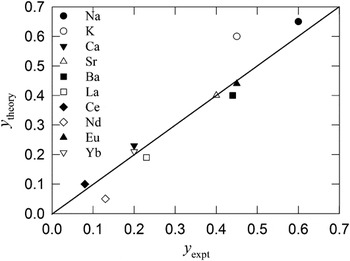
Experimental (FFLexpt) and theoretical (FFLtheory) filling fraction limits for guest atoms in CoSb3. Some of the filled phases (Na, K, and Sr) were found after our theoretical predictions.

We systematically studied the FFL for each type of filler atom in CoSb3 by combining density functional calculations with thermodynamic analysis.Reference Shi, Zhang, Chen and Yang66, Reference Shi, Zhang, Chen, Yang and Uher67, Reference Shi, Zhang, Chen, Yang and Uher72, Reference Shi, Zhang, Chen and Uher73 By comparing the formation energies of the filled phase and secondary phases, the FFLs for various fillers could be accurately predicted, showing good agreement with the reported experimental data. Detailed physical analysis shows that the FFL is related to the ionic bonding between the filler and its surrounding Sb atoms as well as to the columbic interaction between filler ions. By combining these results, the FFL in partially filled skutterudites was found to be sensitive to the electronegativity (specifically the electronegativity difference between filler and Sb atoms) of the filler atom. Combining physical model analysis and first principle energetic calculations, we found a simple but effective electronegativity selection rule to predict thermodynamic stable-filled skutterudites, xI − x Sb > 0.8, where x is the electronegativity. Figure 3 shows the comparison of the calculated FFLs and measured results for all current filled skutterudites. Except for Tl and In, all other filler ions satisfy well this simple selection rule. Furthermore, a few novel filled skutterudites with new types of filler ions, such as Na, K, Rb, Sr, Pr, and Sm,Reference Shi, Zhang, Chen and Yang66, Reference Shi, Zhang, Chen, Yang and Uher67, Reference Mei, Zhang, Chen and Yang69, Reference Mei, Yang, Pei, Zhang and Chen71 were predicted based on the electronegativity selection rule. Later, most of them (Na, K, and Sr) were successfully synthesized in the experiment. The experimental FFLs are also consistent with the theoretical predictions.Reference Pei, Chen, Zhang, Shi, Bai, Zhao, Mei and Li48–Reference Pei, Yang, Chen, Zhang, Salvador and Yang50 Tl and In seem special compared with other fillers. Theoretically, they could not be stably filled into the voids and the filled materials are thermodynamically unstable. Experimentally, Tl- and In-filled skutterudites were reported with impurity FFLs around 0.20,Reference Sales, Chakoumakos and Mandrus41, Reference He, Chen, Rosenfeld and Subramanian53 which needs to be reconfirmed in our understanding. In practice, there have already been In-contained impurity phases observed when the filling fraction of In is still less than the limit value of 0.20,Reference He, Chen, Rosenfeld and Subramanian53, Reference Li, Tang, Zhang and Uher74 indicating that the state of In-contained materials might be different from alkali, alkaline earth, and rare earth metal filled skutterudites in respect of thermodynamic stability.
Theoretical filling fraction limits (FFLtheory) and experimental filling fraction limits (FFLexpt) for guest atoms in CoSb3.

Although other physical parameters and factors, such as the effective charge states and the ionic radii of those fillers as well as the chemical composition deviation, are not directly related to the FFLs based on our theoretical work, they may indirectly affect the thermodynamic state of fillers in skutterudites. The effective charge state of each type of atoms in a material, particularly the filler ions in skutterudites, determines lots of physical and chemical properties. Ref. Reference Shi, Zhang, Chen, Yang and Uher67 systematically summarized and studied the charge states of those filler ions in CoSb3 in both experiment and theory, around +3 for all rare earth metals except Eu and Yb; +2 for all alkaline earth metals, Eu and Yb; and +1 for all alkali metals. Those results indicate that these filler metals donate almost all their valence electrons into the framework, thereby the chemical bonds between the filler and skutterudite host atoms are mainly ionic.
How the ionic radius of the fillers correlates to their FFLs in CoSb3 is a very complicated issue.Reference Shi, Zhang, Chen, Yang and Uher72 The void size in CoSb3 is around 1.9 Å in radius. Those fillers with small size, such as Li, lead to an unstable filled phase because the fillers can easily move out from the voids because of the thermal vibration at a finite temperature.Reference Mei, Yang, Pei, Zhang and Chen71 For a filler ion with a large radius, such as Cs, it is also very difficult to obtain a thermodynamically stable filled phase because the filler-induced lattice expansion and the orbital overlap between the filler and host atoms lead to a strong repulsion interaction between the filler ions and the framework.Reference Shi, Zhang, Chen, Yang and Uher67, Reference Mei, Yang, Pei, Zhang and Chen71, Reference Shi, Zhang, Chen, Yang and Uher72 For a filler ion with a reasonable valence charge state and ionic radius, the filler-induced lattice expansion is almost linear.Reference Shi, Zhang, Chen, Yang and Uher67, Reference Shi, Zhang, Chen, Yang and Uher72 The lattice expansion and coordinate relaxation of the host atoms are observed to fall in the elastic region, which does not introduce abnormally large strain energy into the system. Therefore, the size effect of the filler ions on the lattice structures and thermodynamic state is expected to be small.
During the practical sample synthesis process, the starting chemical composition may be different from the chemical stoichiometric ratio of the final product. In this case, the composition deviation in a material might have a certain effect on the thermodynamic state of a material, and thereby likely affect the FFL of the fillers. If there is a slight excess of Sb in the starting composition, the excess Sb was found to show no obvious effect on the chemical reaction and formation energy of filled skutterudite. It does, however, affect the corresponding formation energy for secondary phases by a different reaction, leading to a slight increase of the FFLs for La and Ce in CoSb3.Reference Shi, Zhang, Chen, Yang and Uher72
III. TE PROPERTIES IN SINGLE-FILLED SKUTTERUDITES
The study of the FFLs for various impurities in CoSb3 provides a theoretical guidance to search for all single-filled skutterudites. The full map of the stable single-filled skutterudites was built soon in experiment and their TE properties were also studied after our theoretical work. Meanwhile, systematic investigations on the electronic structures of those single-filled phases were also carried out. In partially filled skutterudites, electronic structure calculations showed that those fillers donate their outermost valence electrons into the framework but do not significantly affect the electronic structure near the bottom of the conduction bands.Reference Shi, Zhang, Chen, Yang and Uher67, Reference Jiong, Xi, Zhang, Chen and Yang68 Therefore, the general characteristics of the electron density of states (DOS), especially in the position close to the bottom of the conduction band, are very similar to each other for n-type partially filled skutterudites (also similar to pure CoSb3), which also leads to a similar trend in electrical transport properties for those n-type materials.
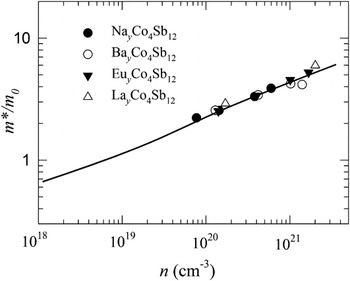
The actual conduction band at Γ point in CoSb3 has a threefold degeneration instead of a single band of parabolic character.Reference Sofo and Mahan64 However, in most cases, single parabolic band approximation could still be used for electrical transport data analysis to provide valuable information for exploring mechanisms and optimizing TE performance. Using the measured electron concentration and thermopower, the effective masses of the carrier electrons were estimated for various n-type filled CoSb3, and they increase with the increase of the electron concentration. Furthermore, n-type partially filled CoSb3, even with various different fillers, shows almost the same value at a given electron concentration, consistent with the electronic structure calculations (see Fig. 4).Reference Pei, Yang, Chen, Zhang, Salvador and Yang50, Reference Bai, Pei, Chen, Zhang, Zhao and Yang75
Electron effective mass as a function of the electron concentration at 300 K for single-filled CoSb3. The solid line is the estimated electron effective mass using the measured electron concentration and thermopower under single parabolic band approximation.

Hall measurements showed that the dominated electron scattering is acoustic phonon scattering near room temperature in n-type partially filled skutterudites. A good T −3/2 characteristic in the temperature dependence of electron mobility was observed in those partially filled phases although various filler ions have different charge states.Reference Morelli, Meisner, Chen, Hu and Uher36–Reference Pei, Yang, Chen, Zhang, Salvador and Yang50 Substituting other elements on the skutterudite framework may obviously change the dominant electron scattering mechanism. A strong ionized impurity scattering was observed in Ni-doped Ba-filled skutterudites with an enhanced electron effective mass.Reference Dyck, Chen, Uher, Chen, Tang and Hirai45 The dependence of the measured thermopowers on the carrier concentration for all partial filled skutterudites was observed to follow a similar trend, and the measured Seebeck coefficient shows almost an identical value at a given electron concentration.Reference Morelli, Meisner, Chen, Hu and Uher36–Reference Pei, Yang, Chen, Zhang, Salvador and Yang50, Reference Bai, Pei, Chen, Zhang, Zhao and Yang75 This agrees well with the electronic structure calculations. The similarity in the observed phenomena indicates that the electrical transport properties are only weakly affected by the filler ions. Partially filled CoSb3 is thus believed to have almost the same electrical transport properties at a given electron concentration. The way of the fillers affecting electrical transport properties is to donate their valence electrons to the framework to adjust the electron concentration. Furthermore, both calculations and experiments proved that n-type partially filled skutterudites require an electron concentration in the range of 0.4–0.6 electrons per Co4Sb12 to achieve the maximum power factors (S 2/ρ).Reference Morelli, Meisner, Chen, Hu and Uher36–Reference Pei, Yang, Chen, Zhang, Salvador and Yang50, Reference Jiong, Xi, Zhang, Chen and Yang68 This is considered to be the optimum carrier concentration in the filled materials.
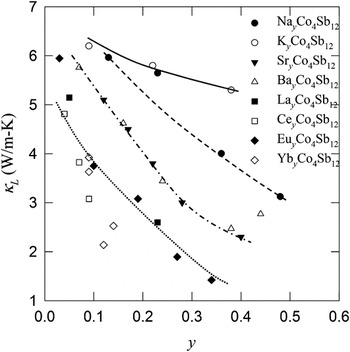
The total thermal conductivity can be divided into two parts: the carrier contribution (κc) and the lattice contribution (κ L). κc can be estimated by the Wiedemann–Franz Law: κc = L 0T/ρ, where L 0 is the Lorentz number, which is 2.45 × 10⁻⁸V2/K2 in a metal and 1.49 × 10⁻⁸V2/K2 in an intrinsic semiconductor material.Reference Goldsmid76 The Lorentz number in a doped semiconductor falls in between these two limits, and it is estimated to be around 2.0 × 10⁻⁸V2/K2 in skutterudites.Reference Sales, Mandrus, Chakoumakos, Keppens and Thompson22 The calculated lattice thermal conductivity in partially filled skutterudites as a function of filling fraction is shown in Fig. 5.Reference Morelli, Meisner, Chen, Hu and Uher36–Reference Pei, Yang, Chen, Zhang, Salvador and Yang50 At a given filling fraction, alkali metal filled systems have the highest κL values and rare earth metal filled CoSb3 have the lowest κL values. This agrees well with the predicted trend based on the calculated vibrational frequencies of the fillers (see Part IV).
Room temperature lattice thermal conductivity as a function of the filling fraction for single-filled CoSb3. The solid lines are guides to the eyes. It is obvious that alkali metal filled skutterudites have the highest κL values while rare earth-metal filled skutterudites have the lowest κL values at a given filling fraction.

The ZT value is determined by both power factors and lattice thermal conductivity. The filling fraction is the only parameter to adjust the ZT value in n-type partially filled skutterudite for a particular filler ion with well-studied charge state. The optimum electron concentration for high ZTs in partially filled CoSb3 is a little lower than that for the maximum power factors, but it is still around 0.4–0.6 electrons per Co4Sb12 unit.Reference Morelli, Meisner, Chen, Hu and Uher36–Reference Pei, Yang, Chen, Zhang, Salvador and Yang50 The reported maximum ZTs change a little for the systems with different single fillers, around 1.0 at 600 K for Yb,Reference Nolas, Kaeser, Littleton and Tritt40 0.8 at 800 K for Tl,Reference Sales, Chakoumakos and Mandrus41 1.2 at 575 K for In,Reference He, Chen, Rosenfeld and Subramanian53 1.1 at 850 K for Ba,Reference Chen, Kawahara, Tang, Goto, Hirai, Dyck, Chen and Uher44 0.9 at 850 K for Sr,Reference Zhao, Shi, Chen, Zhang, Zhang and Pei49 0.45 at 800 K for Ca,Reference Puyet, Lenoir, Dauscher, Dehmas, Stiewe and Müller42 1.2 at 850 K for Na,Reference Pei, Yang, Chen, Zhang, Salvador and Yang50 1.0 at 800 K for K,Reference Pei, Chen, Zhang, Shi, Bai, Zhao, Mei and Li48 and 0.9 at 850 K for EuReference Pei, Bai, Zhao, Zhang and Chen51.
IV. LOCALIZED VIBRATION OR RATTLING MODES OF FILLERS
It is believed that the fillers in skutterudites introduce localized vibrational modes that strongly scatter lattice phonons via resonant scattering. The atomic displacement parameters (ATPs)Reference Sales, Mandrus, Chakoumakos, Keppens and Thompson22 of the fillers in the voids are relatively large in comparison to the ATPs of all other host atoms, and the lattice thermal conductivity in the filled skutterudites is drastically reduced. Those are all considered to be related to the consequence of the rattler-induced phonon scattering by the fillers.Reference Sales, Mandrus, Chakoumakos, Keppens and Thompson22 The localized vibrational frequency of the fillers could be calculated by first principle calculations.Reference Yang, Zhang, Bai, Mei and Chen77 One can move the filler atom away from its equilibrium position in theory to get a relationship of energy versus the shifted distance. The localized vibrational frequency is calculated under harmonic approximation. Phonon spectrum calculations and phonon DOS measurements indicate that the actual vibrations of the fillers in the filled materials may contain more contributions beyond harmonic term, which could partially be observed in the calculated and measured phonon DOSReference Dimitrov, Manley, Shapiro, Yang, Zhang, Chen, Jie, Ehlers, Podlesnyak, Camacho and Li78 (X. Shi et al., unpublished data). However, in general, most of the filled skutterudites show a clear picture that the localized vibrations of the fillers are dominant, which show a typical peak in phonon DOS in practice. Usually, the vibrational frequency of the fillers under harmonic approximation is used for simplifying physical discussion and sample design.
Singh et al.Reference Singh, Mazin, Feldman, Fornari, Tritt, Kanatzidis, Mahan and Lyon60 estimated the “bare” Einstein frequency of the filler ions to be 68 cm−1 for Ce in CeFe4Sb12 and 74 cm−1 for La in LaFe4Sb12. Yang et al.Reference Yang, Zhang, Bai, Mei and Chen77 calculated the vibrational frequencies for various fillers in CoSb3 (see Table II). All the data suggest that the fillers introduce additional vibrational modes at very low frequency or energy range, providing strong scattering to low frequency lattice phonons. This is consistent with the measured low lattice thermal conductivity in filled structure. To detect the presence of the localized modes, a series of experiments was carried out.Reference Keppens, Mandrus, Sales, Chakoumakos, Dai, Coldea, Maple, Gajewski, Freeman and Bennington79–Reference Koza, Johnson, Viennois, Mutka, Girard and Ravot84 Detection of those low-energy modes (less than 100 cm−1) requires an exceptional high resolution for Raman scattering experiment.Reference Nolas, Slack, Caillat and Meisner85–Reference Sekine, Saito, Uchiumi, Sakai and Shirotani87 Fitting low temperature specific heat (Cp) data could obtain some information about the vibrational modes of the fillers.Reference Keppens, Mandrus, Sales, Chakoumakos, Dai, Coldea, Maple, Gajewski, Freeman and Bennington79 However, they are all indirect observations, and fitting Cp data might introduce additional errors to the results and conclusions. The most convincing evidence of rattling modes comes from inelastic neutron scattering studies, which could directly investigate the vibrational properties of materials. P-type Fe-contained skutterudites have been well studied by inelastic neutron scattering.Reference Keppens, Mandrus, Sales, Chakoumakos, Dai, Coldea, Maple, Gajewski, Freeman and Bennington79–Reference Koza, Johnson, Viennois, Mutka, Girard and Ravot84 Since binary skutterudites have no rattling species, it is convenient to compare the data of a filled skutterudite with the data of the parent binary skutterudite to identify its rattling mode. It is also feasible to recognize the rattling modes of one type of the filler with large neutron cross section (such as La) by comparing its neutron scattering data with that of an other type of filler with a very low neutron cross section, such as Ce.Reference Keppens, Mandrus, Sales, Chakoumakos, Dai, Coldea, Maple, Gajewski, Freeman and Bennington79, Reference Koza, Johnson, Viennois, Mutka, Girard and Ravot84 However, the accuracy of this method to obtain the rattling modes of the fillers is uncertain. The inelastic neutron scattering in n-type partially filled CoSb3 has been studied recentlyReference Dimitrov, Manley, Shapiro, Yang, Zhang, Chen, Jie, Ehlers, Podlesnyak, Camacho and Li78 (X. Shi et al., unpublished data). Among all the fillers, Yb shows the lowest vibrational frequency, consistent with our calculations. Furthermore, the Yb-related vibration is truly observed to show a typical isolated peak in the experiment, even overlapped with the weak low-frequency vibrations from the Sb framework. These results provide strong and convincing evidence to confirm the existence of local vibrations in filled skutterudites. It was also found that in all partially filled skutterudites, alkali metals have the highest vibrational frequencies, alkaline earth metals have the mediate, and rare earth metals have the lowest values. The localized vibrational modes of the fillers interact strongly with the lattice phonons to significantly reduce the lattice thermal conductivity. For phonon resonant scattering, only the lattice phonons with the frequencies close to the rattling modes of fillers could be scattered. The calculated localized vibrational frequencies of the fillers consist well with the observed lattice thermal conductivity (see Fig. 5) because low frequency lattice phonons contribute more to the heat conduction in solids.
Localized vibration or rattling frequency of guest fillers in filled CoSb3. The calculated results are obtained under harmonic approximation by shifting the filler in the [111] direction. The values in other directions are also calculated and they are very close to those in the [111] direction.

V. DOUBLE- AND MULTIPLE-FILLED SKUTTERUDITES
Based on the calculated and measured vibrational frequencies of various fillers, double- and multiple-filled skutterudites are designed to achieve high TE performance.Reference Shi, Kong, Li, Uher, Yang, Salvador, Wang, Chen and Zhang8, Reference Yang, Zhang, Bai, Mei and Chen77 The basic idea is to introduce two or more localized rattling modes with different frequencies into the skutterudite void to cover lattice phonon spectra as broad as possible. In this case, a wide range of lattice phonons could be scattered by two or more types of fillers to further reduce the lattice thermal conductivity and thereby enhancing the TE ZT.
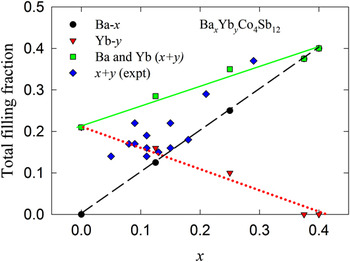
FFLs for the fillers in double- and multiple-filled skutterudites are another important issue for sample design and fabrication. Similar to the partially single-filled CoSb3, FFLs in double- and multiple-filled skutterudites are also studied by density functional ab initio approach.Reference Xi, Yang, Zhang, Chen and Yang88, Reference Xi, Yang, Lu, Mei, Zhang and Chen89 The FFLs in most of the double-filled skutterudites show a linear combination of the filled material for each type of filler in CoSb3 (see Fig. 6). However, there exist a few examples to show abnormal FFLs in double-filled skutterudites. Na- and Eu-double filled skutterudites show an ultrahigh FFL exceeding single Na- and Eu-filled skutterudites. In some other double-filled skutterudites, such as Na–Yb and Eu–La, one type of filler atom is very easy to be filled into the voids (Na in Na–Yb and Eu in Eu–La) and another type of filler atom is very difficult to be filled into the voids (Yb in Na–Yb and La in Eu–La).
Experimental and calculated FFLs for guest atoms Ba and Yb in BaxYbyCo4Sb12 double-filled skutterudites. The red dotted line is the FFL for Yb in double-filled skutterudites. The black dashed line is for Ba in double-filled skutterudites. The green solid line is a linear combination of the red and black lines, and it agrees well with the calculated total FFLs in BaxYbyCo4Sb12 double-filled skutterudites. All the experimental data (blue points) are below, and some of them are close to the calculated values, indicating that the calculations are reasonable. This could provide helpful guides for material design and optimization in double- and multiple-filled skutterudites.

A series of double-filled skutterudites have been reported recently in experiment, such as Ba–Yb,Reference Shi, Kong, Li, Uher, Yang, Salvador, Wang, Chen and Zhang8 Ba–Ce,Reference Bai, Pei, Chen, Zhang, Zhao and Yang75 Ca–Ce,Reference Li, Yang, Hng, Yan, Ma, Zhu and Zhao90 Ca–Ba,Reference Rogl, Grytsiv, Bauer, Rogl and Zehetbauer91 Ca–Yb,Reference Salvador, Yang, Wang and Shi92 Ba–Eu,Reference Bai, Shi and Chen93 Sr–Yb,Reference Bai, Huang, Chen, Zhang, Zhao and Zhou94 and Sr–Ba.Reference Bai, Huang, Chen, Zhang, Zhao and Zhou94 Ba–InReference Zhao, Wei, Zhang, Dong, Liu and Tang95 and Ce–InReference Li, Tang, Zhang and Uher74 double-filled skutterudites. However, In-contained impurity phases were usually observed as nanometer scale dispersions, demonstrating that their thermodynamic state might be different from other double-filled systems. Among these double-filled skutterudites, Ba–Yb and Ba–Ce combinations have very large contrast in the filler vibrational frequencies, and thereby significantly reduce the lattice thermal conductivity. Simple analysis shows that filling two types of guest atoms into the voids in skutterudites probably introduces extra scattering to lattice phonons and leads to a significant increase in the lattice thermal resistivity, even though the detailed understanding is not clear.Reference Bai, Shi and Chen93 Meanwhile, the power factors in these double-filled skutterudites are similar to or comparable with single-filled skutterudites.Reference Shi, Kong, Li, Uher, Yang, Salvador, Wang, Chen and Zhang8, Reference Bai, Pei, Chen, Zhang, Zhao and Yang75, Reference Shi, Salvador, Yang and Wang96 Single- and double-filled skutterudites show almost the same thermopower at a given electron concentration. The highest ZT is reported around 1.3–1.4 in these double-filled skutterudites, showing significant improvement compared with single-filled skutterudites.Reference Shi, Kong, Li, Uher, Yang, Salvador, Wang, Chen and Zhang8, Reference Li, Tang, Zhang and Uher74, Reference Bai, Pei, Chen, Zhang, Zhao and Yang75, Reference Li, Yang, Hng, Yan, Ma, Zhu and Zhao90–Reference Zhao, Wei, Zhang, Dong, Liu and Tang95
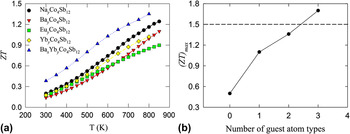
Although there are more composition combinations in triple- or multiple-filled skutterudites, the design for high performance multiple-filled skutterudites is strictly limited by the factors mentioned above. One has to consider these factors carefully for the design and fabrication of triple- or multiple-filled skutterudites. The exact FFLs for triple- or multiple-filled skutterudites are very complicated and only the Na–Ba–Yb triple-filled skutterudite was estimated in theory.Reference Xi, Yang, Lu, Mei, Zhang and Chen89 The filling fraction of Yb in Na–Ba–Yb triple-filled skutterudites is very low as shown for Na–Yb double-filled skutterudites, which is further confirmed by our experimental study. A few other triple-filled skutterudites have been reported in experiment recentlyReference Shi, Salvador, Yang and Wang96, Reference Zhang, Grytsiv, Rogl, Bauer and Zehetbauer97 (X. Shi et al., unpublished data). Because of the similar vibrational frequencies between Sr and Ba, Sr–Ba–Yb triple-filled skutterudites show comparable ZTs with the Ba–Yb double-filled skutterudites.Reference Zhang, Grytsiv, Rogl, Bauer and Zehetbauer97 Because the vibrational frequency of La is in the middle of Ba and Yb, Ba–La–Yb triple-filled skutterudites show a much reduced lattice thermal conductivity and an enhanced TE ZT (X. Shi et al., unpublished data). For example, the triple-filled skutterudite Ba0.08La0.05Yb0.04Co4Sb12 possesses a ZT of 1.7 at 850 K, which is among the highest values reported so far (X. Shi et al., unpublished data). Because the lattice thermal conductivity is continually decreased from pure binary CoSb3 to single-filled, then to double-filled, and finally to triple-filled skutterudites, the maximum ZTs are significantly improved from around 0.5 in pure binary CoSb3 to 1.1 in single-filled, then to 1.3–1.4 in double-filled, and finally to 1.7 in triple-filled skutterudites (Fig. 7) (X. Shi et al., unpublished data).
(a) Temperature dependence of ZTs for Na-,Reference Pei, Yang, Chen, Zhang, Salvador and Yang50 Ba-,Reference Chen, Kawahara, Tang, Goto, Hirai, Dyck, Chen and Uher44 Eu-,Reference Pei, Bai, Zhao, Zhang and Chen51 Yb-single filled,Reference Shi, Kong, Li, Uher, Yang, Salvador, Wang, Chen and Zhang8 and Ba–Yb double filled skutterudites.Reference Shi, Kong, Li, Uher, Yang, Salvador, Wang, Chen and Zhang8 (b) Maximum ZTs in binary CoSb3,Reference Uher and Tritt12 single-,Reference Chen, Kawahara, Tang, Goto, Hirai, Dyck, Chen and Uher44 double-,Reference Shi, Kong, Li, Uher, Yang, Salvador, Wang, Chen and Zhang8 and triple-filled skutterudites (X. Shi et al., unpublished data). The reported highest ZT values in binary, single-, double-, and triple-filled CoSb3 are used for data comparison. The accuracies of the reported ZTs are estimated around 20%, but to a precision (reproducibility), however, is more important here and is usually used in the literature for data comparison. The discrepancies for our single-, double-, and triple-filled skutterudites, if any, are less than 3%, which leads to precision of the ZT values within the range of ±0.1.

VI. CONCLUSION
Skutterudites represent an interesting and important material system with many advantages for real applications in designing a TE generator used at intermediate temperatures. This review has discussed how the FFLs for guest fillers in CoSb3 can be determined, predicted, and realized through theoretical calculations and experimental study. Systematic studies of TE properties for single-filled skutterudites have been successfully performed recently. Significant progress in the understanding on the TE transport properties in partially filled skutterudites has been made. A series of physical questions, including the localized vibration or rattling frequencies of the fillers, and the basic principles to design double- and multiple-filled skutterudites, have also been well studied recently, with a special focus on n-type partially filled skutterudites by combining theoretical calculations and experimental characterizations. These physical understanding provides interesting and important information for material design and optimization, leading to the quick increase of optimal ZTs from single- to double-, and multiple-filled skutterudites. A ZT as high as 1.7 is realized in n-type partially filled CoSb3. The optimization of the performance of n-type partially filled skutterudite could be regarded as a typical example to show strong interplay among material design, TE property characterization, physical understanding, and theoretical calculations. Combining theoretical calculations and experimental study can lead to develop high efficiency filled skutterudites and could be a benefit for the exploration of other TE materials as well.
ACKNOWLEDGMENTS
The authors thank Prof. T.M. Tritt and Dr. H. Böttner for inviting us to prepare this review. This work is in part supported by National Basic Research Program of China (973 program) under Project No. 2007CB607500 and by NSFC Grant (50821004 and 50825205).