1. INTRODUCTION
Were local legal institutions in late medieval Catalonia efficient enough to sustain widespread private contract registration and its subsequent enforcement? To address this question, this article focuses on the machinery of the jurisdictional court (or bailiff's court) in a fourteenth-century Catalan small town, and its role in the administration of private contracts.Footnote 1 We make use of an important but little-studied source – the bailiff's court register – and consider features of the court that might have either fostered or weakened its activity. After describing the bailiff's court and the process of bringing a claim before it, we then consider the spatial limits of the court and its rivalry with other jurisdictions. Second, we describe the different methods of contract registration and their relationship with enforcement mechanisms. Last, we consider the duration and costliness of court procedures. The article will discuss the ways in which these features may have affected the decision making of the court's clientele.
In recent decades, many works on the economic and social history of Catalonia have used data from notarial records. These were the documents provided by civil-law notaries, the public officers in charge of registering and authenticating, among other things, private purchasing contracts and credit agreements. An almost exclusive focus on notarial records prevails within research on private contracts. For instance, historians have relied almost entirely on notarial data to explore the use of credit among individuals and families.Footnote 2 There have also been several evaluations of notarial records as an historical source.Footnote 3
However, a rarer source, complementary to the notarial protocols, awaits our attention: the bailiff's court book. These volumes are legal registers that record the ‘actions carried out in the exercise of jurisdiction by those who hold it or by their officials or representatives’.Footnote 4 These documents cover a variety of governmental matters, such as bylaws, but business related to civil law appears to be preponderant. Because of this, the bailiff's court book offers an extraordinary opportunity to study private contracts among the peasantry. Whilst notarial books recorded the contract itself or a debt derived from it, the court books provide evidence of the contract's execution phase. Used together, these two sources offer a complete view of the life cycle of a contract.
The courts responsible for producing these volumes defined the extent of political boundaries and carried out many of the functions of feudal society. They were facilities set up by jurisdictional lords to settle all types of disputes between neighbours and to discipline the inhabitants of the territory. These courts exerted what shall be categorised as public authority, since they represented a handing over of power from the counts of Barcelona to the nobilitas that had begun as early as the feudal revolution of the twelfth century. In addition, most courts worked according to the same general law, although local customs and uses did bring about some variations.
All documents derived from the exercise of jurisdiction were filed and classified in registers. These registers were usually divided into different series according, in each case, to the institutional complexity of the territory and the volume of documents that were produced. In addition, as stated, each scribal office could use distinctive procedures, reflecting the specific customs of each territory. This means that the structure of the documents encountered in these books varies a good deal. Thus, whilst the judicial body named the Justicia in the city of Valencia issued several different series of registers relating to different legal proceedings, at the other extreme are examples like that of Sant Feliu de Guíxols, a coastal small town in northeastern Catalonia, where during the fourteenth century, a single series was created to assemble all entries of a judicial nature.Footnote 5
To examine these sources in depth we must overcome incomplete knowledge about court records and a deficient cataloguing of the surviving volumes. The institutional historiography of the kingdom of Aragon has rarely studied local jurisdiction in a systematic way. In consequence, there are still many aspects that have not yet been described. We still do not wholly comprehend the manner in which disputes were recorded in the books. For the historian, the process of describing a debt suit in a northeastern Catalan medieval court book is not as simple as examining the evidence and giving account of it. The complexity essentially lies in reconstructing the chronological sequence of entries in the documentation, and in the fact that much of the litigation of a lawsuit was conducted orally. Nevertheless, we are helped by the fact that in recent years some court books, and other evidence emanating from the exercise of jurisdiction, have been edited.Footnote 6 Furthermore, a team led by Antoni Furió of the University of Valencia is already interpreting evidence from the Valencian court records, akin to the Catalan, in order to describe the economic and commercial trends of the fourteenth and fifteenth centuries.Footnote 7 A good deal of further scope for study of these local courts exists.Footnote 8 Furthermore, although we still lack a research monograph on the jurisdictional courts, the existing literature – and in particular the work of Flocel Sabaté – does include studies that can help in understanding the legal mechanisms of civil law.Footnote 9
Jurisdictional courts in Catalonia were permanent institutions, operating almost every day. Thus, each one of the procedures was recorded as its completion was notified to the scribe. This is the main reason why the acts of court are not assembled in dossiers or summaries that would present a particular contract enforcement suit as a whole, from claim to conclusion. In other words, the registration of each action in terms of chronological order makes it difficult to identify the rules followed by the suits. The entries are given in a day-to-day succession, blurring the different steps followed by litigants.
Besides, it should be stressed that not all steps of many of these cases were written down. Although Catalan procedural civil law was ruled by a compound of legal norms and traditions shaped by Roman law, a jurisdictional court operated, as well, on ongoing negotiations among litigants. These informal agreements lessened the impact of procedures. In our attempt to reconstruct civil suits we must deal with the fact that certain cases seem to disappear apparently unfinished.
It must ultimately be remarked that a generally irregular cataloguing of court records hinders our investigation. Many court books have been classified as if they were ordinary secular notarial protocols. Thus, we do not have a clear picture of the availability of this source within most contemporary Catalan judicial districts. In spite of this, we do know that remaining court books comprise chronological series that are less continuous than those of the notaries.
2. THE COURT OF CALDES DE MALAVELLA AND THE PROCEDURE FOR BRINGING A CLAIM
For the period 1328–1369, 15 registers from the court of one town in northeastern Catalonia, Caldes de Malavella, survive. Of these, an almost continuous series, with few chronological gaps, exists for the 1340s. These registers were divided into two different series. One contained the actions of each official in civil law procedures, and the other filed letters sent or received by the bailiff's court. Due to their relatively good condition, all these books have been used in the research for this article.Footnote 10
Evidence from this source is used to reconstruct the court's performance. The court in Caldes was a physical space, probably located around the town gate, in the market square.Footnote 11 Its sessions were held every two or three days. Vibrant activity took place on Mondays – the weekly market day – when claims would be brought, assets seized, or the market square itself taken over by public auctions. Wednesdays and Saturdays were also business days in which anyone might appear before the bailiff. The rest of the week was the time for the officials to carry out the tasks and proceedings that had been written down in the registers of acts.
The court was staffed by a group of officers.Footnote 12 The highest rank was the bailiff, who played a presidential role. Under his orders were an auction broker (a middleman agent, who was in charge of the valuation of assets and coordinating public auctions), the warden, the herald, four stewards (in charge of numerous tasks, including the notification of proceedings to the parties and the seizing of assets) and a public scribe (who registered and filed those acts that had to be recorded). The court procedures involved in litigious jurisdiction were mainly carried out by these officers in response to a plaintiff's complaint. The documents recording these procedures are found in the series of registers dedicated to civil law.Footnote 13
Any individual, male or female, on his or her own behalf or representing an institution or a lordship, could bring a claim (querimonia) into the jurisdictional court.Footnote 14 This mechanism informed the court about a failure in recovering debts arising from a contract, from one or more debtors. Claims could be brought in person or, especially where the plaintiffs were outsiders (usually traders or merchants with no permanent residence in town), through correspondence.
Stewards orally communicated each claim, at every stage, to the delinquent debtor. This was the specific action that would be registered as a new entry in the court book, in a fairly laconic document that generally stated only the identities of plaintiff and defendant, the amount of money or debt in kind complained about, and the date the steward had notified the request. Information is almost never given about the causes of the disputed debt or the contract from which it arose. Comparison of the claims with the original contracts suggests that the disputes were mainly about loans of cash and rents. Nonetheless, there were also frequent disputes about labour contracts, various agrarian arrangements, retail purchases (involving deferred payment) and purchases of real estate.
After the claim – if the amount in dispute was not repaid or new conditions for the contract were not settled – the most frequent mechanism chosen to proceed in a lawsuit was the seizure (empara). In the documents relating to seizures it was recorded that the steward of the town, in response to a previous demand from a lender, notified the defaulting borrower of the provisional embargo of a specific asset. It was a provisional measure, which still enabled different channels of negotiation and settlement before a final confiscation of chattels took place.Footnote 15 In almost all cases, seizures were brought to immobilise crops, usually still unharvested.
The empara decree could also directly affect money in cash, although those plaintiffs who had an interest in recovering cash tended instead to seek the further step of a public auction.Footnote 16 Auctions can be described as public sales controlled by the auction broker, whose main objective was the repayment of due debts. Auctions mainly affected the movables of the defendant, although the court could also occasionally distrain (or seize the goods of) the personal pledges of whom had endorsed the original contract.Footnote 17 Few suits went as far as an auction.
Auctions were registered either in notarial, or in court, registers. Technically, an entry of an auction was the act through which the scribe noted that a broker had declared the celebration of an auction. The entry of an auction recorded the person who had requested it and the official who had mandated it. After the sales had taken place in the main square of Caldes, the broker was in charge of sharing out the resulting cash. A group of debt collectors was also registered in the document. In the list, each surname was followed by the amount they had gained and, eventually, an annotation concerning the reason – the nature of the unpaid debt – that had brought him or her to sue the defendant.
In auctions, the officers of the court who had been, in some way, involved in administering the lawsuit were often rewarded in addition to the creditors. Other individuals, who voluntarily or by compulsion had appeared in the suit, were also compensated. In an auction of a large stock of cattle belonging to one Ramon Oloart and his wife Margarida, from Caldes, Pere Oms received 2 solidii (hereafter s.) because he had gathered the animals and fed them for a couple of days. In the same proceeding, an unnamed woman was paid 9 denarii (hereafter d.) for having shepherded the animals on to the square where the public sale was to take place.Footnote 18
When the money yielded from the sale exceeded the amount that was in dispute, the broker retained the rest, in order to discharge other debts affecting the owners of the chattels that had been brought to auction. An example of this, from 1340, is found in an auction of the physical space of a taula (a shop consisting of a permanent and delimited space, usually under street arcades, where a portable table was installed) belonging to Arnau Llorenç, from Franciac. The auction was originally instigated by the bailiff of Sant Martí Sacosta Monastery, in Girona, for unpaid rent, and it yielded 9 d. The broker kept the money, in order to satisfy other would-be plaintiffs of Arnau Llorenç.Footnote 19
3. DID SPATIAL LIMITS MATTER?
Researchers have been struck by the strength and ubiquity of the commercial business that took place in late-medieval Catalan small towns.Footnote 20 By the fourteenth century, these settlements had become exchange centres, where consumption or investment credit was widely available. It was from these points that the urban commercial elites spread their capital as loans, and at the same time tried to secure the agricultural surplus of the masos (singular mas), which were the primary units of household production and consumption, and were usually scattered throughout the countryside. Credit arrangements were also frequently made between peasants, and between the residents of the small towns themselves, and these also took place and were registered in the towns.Footnote 21 All these contracts involved mobility among the actors. They did not take place in an institutional vacuum. Our focus here is on the jurisdiction of the baronial estate, which typically had its centre of government in a small town. What were the spatial limits on this jurisdiction, and what were the effects of these limits on contract registration and enforcement? Was the commercial dynamism of the region affected by jurisdictional fragmentation? Caldes de Malavella and the city of Girona were only 20 kilometres apart, but lay under two different jurisdictional domains. Did this prevent the maintenance of a successful commercial relationship between the two?
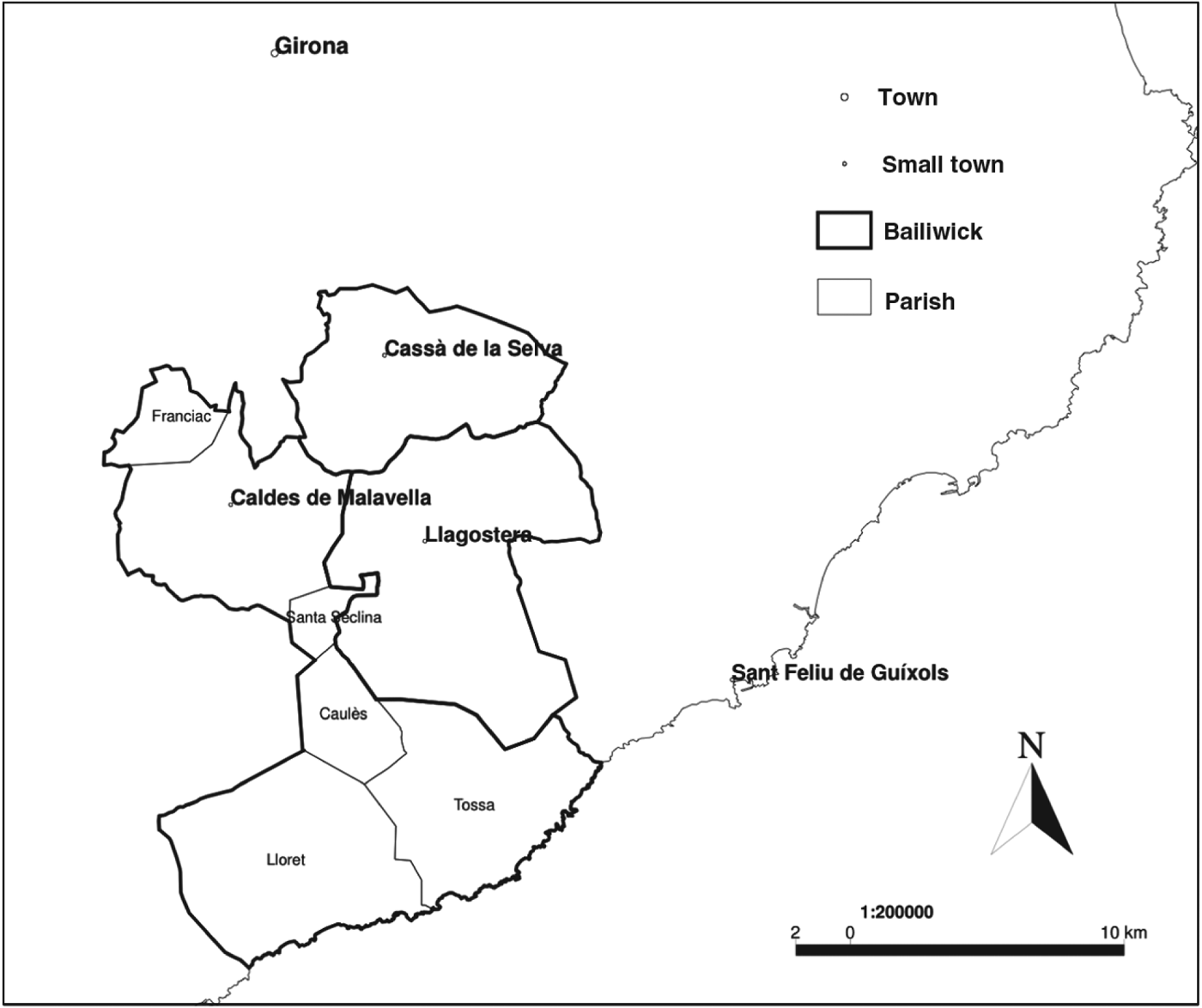
Throughout the fourteenth century, Caldes was one of the core towns of a seigniorial estate belonging to the Montcada lineage, known as the Barony of Llagostera.Footnote 22 This territory comprised the parishes of Cassà de la Selva, Llagostera, Lloret de Mar, Tossa de Mar, Caulès, Santa Seclina and Franciac, and was a compact geographical space of about 260 square kilometres, enclosed by the Selva plain and by the littoral mountain range of l'Ardenya. The small towns in the flatland – Caldes, Llagostera and Cassà – were the most commercially dynamic centres, and also the three places that held jurisdictional courts (see Figure 1).
Map of the barony of Llagostera in the fourteenth century.

The settlement of Caldes had about 1,000 inhabitants before the Black Death of 1348. It operated as a commercial hub for its surrounding rural area, in which dispersed masos were found. This farming zone was economically articulated with the town, seat of a weekly market and two annual fairs. The notary, the bailiff's court, a seigniorial headquarters, the parish church and other permanent commercial services provided a focus for the activities of outsiders. Although they lacked some of the features that might have attracted the residents of the surrounding countryside, similar characteristics were possessed by Cassà de la Selva, laid out around a castle, and by Llagostera, which, despite being a smaller settlement, was the leading political centre of the barony.Footnote 23 Each township had the basic infrastructures that helped incentivise the commercial activities of the peasant population. Proximity to the city of Girona also encouraged commercial dynamism.
In the court of Caldes de Malavella, contentious jurisdiction – that is, jurisdiction over litigation between private parties – was concerned with contractual disputes amongst the residents of the court's territory. Hence, court documents issued in Caldes provide information on an extensive territorial domain (known as the bailiwick or district) encompassing six parishes: Caldes itself, Franciac, Santa Seclina, Caulès, Lloret and Tossa. Furthermore, any individual or lordship (regardless of their origin) to whom a resident owed overdue debts or alleged broken contracts had to bring claims before the local court. Non-residents do appear in the registers, but mainly performing as plaintiffs, when they required the mechanisms of the local court in order to exercise their rights.
It must be stated that although they were part of the same barony as Caldes, residents within the jurisdictions of Llagostera and Cassà were, in practice, treated as non-resident outsiders in civil lawsuits at Caldes and are in consequence only sporadically mentioned in its court books. Despite being part of the same baronial estate, they participated in pleas in Caldes under the same conditions as people belonging to other seigniorial domains. They could act as plaintiffs at any time. But in the case of registering a contract in the local court, the outsider (who was usually accompanied by someone from Caldes) was obliged to pledge the local customs. Only then, in a subsequent suit, could the non-resident debtor be pursued as if he were an inhabitant of the district.
In this system, the jurisdictional rights of the local court were exercised over all the residents of the territory under its control. Serfs, freemen, clergy and nobility were all subject to and used the same court. Furthermore, the court did not exclude particular participants on grounds of religion or ethnicity since (for example) Jews from Girona were also active in litigation, most commonly as plaintiffs. Even landlords and their officials routinely used the shared jurisdictional mechanisms to resolve disputes emerging from the breach of contracts and obligations. A telling example of this is the case registered on 8 June 1349, in which Pere Revelí, steward under the command of the jurisdictional lord Pere de Montcada, who held the court in Caldes de Malavella, in response to a claim brought by Berenguer Riera – revenue-collecting bailiff of the chamber of Sant Pere de Galligants Monastery, in the city of Girona – seized all grain belonging to Saura Nicolau, from the village of Franciac (within Caldes district). Nicolau had not met a debt owing to this religious house.Footnote 24 The court of Pere de Montcada had a central role for any minor landlords who required enforcement of the debts or commitments of their clients.
The actions of the court were limited by geographical boundaries, which were well known to all. In a case of seizure, the court could only reach those chattels or lands of the defendant that lay within these boundaries.Footnote 25 An example of this is the case of Jaume Vendrell and Jaume Mataró, from Caldes, who seized all ashes belonging to Guillem Guerau, from Girona, explicitly ‘those that he possessed inside the bailiwick of Caldes’.Footnote 26
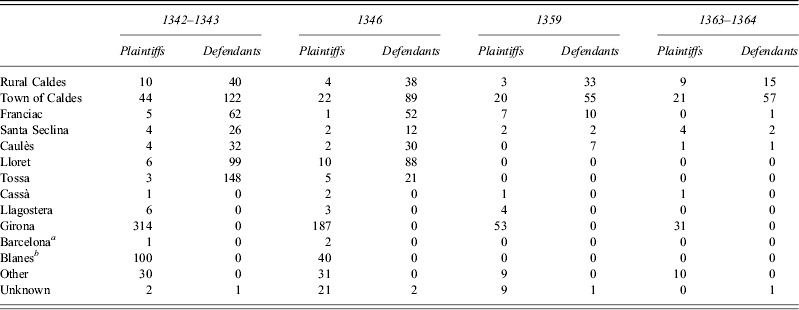
In the year from July 1342 to July 1343, 530 plaintiffs brought claims to the court of Caldes (Table 1). These were mainly residents of external jurisdictional spaces (85 per cent of them, of whom 314 came from Girona). Not surprisingly, all those sued belonged to Caldes, Franciac, Santa Seclina, Caulès, Lloret and Tossa, which represents the territory over which the court had jurisdiction. This pattern is also evident for the other full years that we have been able to analyse (1346, 1359 and the period from August 1363 to August 1364). Plaintiffs had no other impediment in using the court than distance and opportunity cost. The evidence shows that almost all the plaintiffs came from within a 20-kilometre radius of Caldes. Defendants invariably resided in the region in which the officials of the court of Pere de Montcada could legitimately perform their duties.
Places of residence of plaintiffs and defendants in claims brought to the court of Caldes de Malavella
a By road, Barcelona was some 100 kilometres away from Caldes.
b By road, Blanes was 25 kilometres away.
Sources: Historical Archive of Girona (AHG), Caldes-Llagostera 23; AHG, Caldes-Llagostera 29; AHG, Caldes-Llagostera 70.
A careful reading of Table 1 shows that in 1359 and 1363–1364 there were no defendants from Tossa and Lloret. No claims were made against such persons in the court of Caldes. It seems as if this institution no longer had jurisdiction over these parishes. In fact, it is known that the jurisdiction of Tossa had been assigned to the monastery of Ripoll in 1348, and that of Lloret had been transferred to the pabordia (the institution responsible for managing the assets and properties) of the cathedral of Girona in 1357. In both cases, the cessions had taken place after lengthy jurisdictional conflicts with the Montcada family.Footnote 27 Alienations of jurisdictions – due to competing lordships, avid to gain territorial control – would affect the barony of Llagostera throughout the fourteenth century.
The detachment of Tossa and Lloret from the district of Caldes and the whole Barony of Llagostera had an immediate effect upon the litigious material in the court books. Plaintiffs knew that in order to sue someone from those two parishes or to distrain their assets, the jurisdictional courts to seek were now the ones controlled by the cathedral of Girona and by the Monastery of Ripoll. Neither of those two institutions has preserved court registers and we do not know the physical location of the courts themselves. Perhaps this disintegration of a large jurisdictional unit may have discouraged some merchants from attending the central institutions in Caldes. The use of the court may have been discouraged by the fact that it was an institution now competent over a smaller area with reduced production and demand. Nevertheless, a reduction in trade after the Black Death is also a possible explanation for the general reduction in claims observed in Table 1.
One must conclude that in the case of Caldes, fragmentation of jurisdiction was not necessarily an obstacle to trade and contract enforcement, or to market integration more generally. On the evidence of the court books, the economic link between Girona and Caldes, for instance, remained solid as jurisdictional rules were applied by a single court within precise boundaries, even if these shifted over time.
4. WAS THERE COMPETITION AMONGST COURTS?
Within the Barony of Llagostera, a single seigniorial family enjoyed jurisdiction over the full range of legal matters throughout the greater part of the fourteenth century. There is little obvious sign, therefore, of overlapping jurisdiction within the barony itself. This does not mean, though, that the local court would not have had interactions with external courts and, especially, with those foreign tribunals that held some minor jurisdiction (mainly on ecclesiastical issues) over the Barony of Llagostera. The case study of Caldes allows us to analyse the manner in which different jurisdictions interacted.
The two most important courts that operated from the city of Girona and were frequently mentioned in the proceedings of Caldes were the court of the royal vicar and the bishop's court. These were not local institutions. The former was competent over all royal districts in northeastern Catalonia (Caldes was not in the royal domain, but had been until 1323). The latter, competent over the whole bishopric, was active in applying ecclesiastical penalties, namely excommunications. Notifications from courts of nearby districts also appear in our sources. It must be said that we lack original documentation issued by all these institutions; we only know about them through the Caldes court books.
Interactions between courts might help explain, in first place, one surprising feature of the proceedings: that some seizures were not preceded by any claim, or at least by a claim brought before the court of Caldes. Sometimes, the object against which a seizure was implemented was clearly the possession of an outsider, especially someone from a nearby settlement under the control of a different baron. Many people resident in the Caldes district held such items as a result of a comenda (a deposit of cash, grain or livestock arranged between individuals), or a simple loan. In such instances, the creditor dictated a seizure against the belongings of a delinquent client that were in the hands of a third party. On 19 September 1348, Ponç Perpinyà, from Caldes, requested a seizure against all the linen fabric that Guillem Botet, a petty tailor, held within the bailiwick but which really belonged to a certain en Vilar, from Vidreres. This village lay six kilometres south of Caldes and belonged to the jurisdictional domain of the viscounts of Cabrera. It seems that Ponç Perpinyà was suing the man from Vidreres, and Guillem Botet, was, in this context, only a collateral victim. We assume that previous proceedings in this suit were probably brought before the local jurisdictional court competent in Vidreres.Footnote 28 Here, two adjacent courts cooperated in order to seize the goods of a debtor. This was feasible when both institutions had interest in the prosecution and, of course, the specific petition had been properly delivered from one court to the other.
The focus shall be placed now on these petitions between courts. The inhabitants of Caldes visited Girona regularly to attend the weekly market. They registered numerous contracts in the public notary offices that this town hosted.Footnote 29 In case of default, the notarial deeds issued in Girona could be presented as evidence in the vicar's or the bishop's court. An obstacle for these claims, though, was the fact that these institutions were not directly able to exercise jurisdiction over the inhabitants of Caldes. Those courts had to impel the proper authority to satisfy the plaintiffs. They produced letters to the officials in Caldes such as the one that the bishop's court issued in 1345. It instructed the local court to oblige three men, Ramon Oloart, Pere Martí and Guillem Eixandri, to settle on a debt of 113 s. in less than 10 days to Bonanat Tornavells, from Girona. With this accomplished, stated the letter, the three would be acquitted from a penalty of excommunication raised by Tornavells.Footnote 30
Another letter, issued by the court of Caldes in 1363 and addressed to the court of Vidreres, notified its officials that the wealthy merchant Guillem Vives, from Caldes, had claimed against Margarida, wife of Guerau Torrent, from Vidreres, for a debt of 92 s. arising from rent.Footnote 31 Caldes threatened Vidreres: if the breach of contract was not resolved in 20 days’ time, the former would decree a marca, a general order of confiscation of any chattels belonging to the men of the latter town.Footnote 32
Dozens of letters of this type pepper the court books during the period under scrutiny. They are an unmistakable symptom of institutional cohabitation in spite of the widespread fragmentation of jurisdictions. Likewise, their clauses indicate that the tribunals facilitated mobility between jurisdictional spaces. Most letters of request were dealt with satisfactorily. In some cases further letters were issued to resolve the situation. In 1353, a Jew from Girona called Bellhom Falcó revoked a previous letter of request that the vicar's court had issued some time ago urging the court of Caldes to force Berenguer Riera to meet a payment. The message stated that the defendant was discharged, except for the fact that Riera still owed money to the Jew arising from other credit arrangements that were not yet in dispute.Footnote 33
Besides demanding collaboration among courts, a fragmented jurisdictional scene produced other effects: it obliged litigants to be able to negotiate a complex system. A ‘skilful use of formal legal structures in defence of private rights and interests’, as Chris Briggs has defined it when commenting on English peasant strategies in lawsuits, might apply as well in northeastern Catalonia.Footnote 34 Jaume Geronès, from Caldes, ‘firmed the law’ in a suit where the plaintiff Bernat Massot, cloth merchant from Girona, had already instigated a seizure in the court of Caldes. This specific procedure of ‘firming the law’, discussed further below, prevented any more action in this lawsuit, which, we discover, was already being heard in another court: ‘The aforesaid firm of law is entered until Bernat withdraws Jaume [i.e. ends the claim against him] from the bishop of Girona's court, in which the former had claimed against the latter for a debt.’Footnote 35 The hearing of the same suit in different courts was a common practice in medieval litigation. In some settings this practice can be explained by the overlapping jurisdictional competences of different courts, which contended among themselves to mediate in lucrative or symbolically prominent suits. Yet it could also reflect the desire and ability of certain individuals to take advantage of the fact that there was a range of different jurisdictions potentially open to them.Footnote 36
Although there is no direct evidence for it, we must mention here the possibility that some claims could have been brought simultaneously both in the court of Caldes and in the court of another jurisdictional district where the defaulting debtor held assets that could be seized. If the suit was to be handled in this second court, outside Caldes, this circumstance would leave incomplete suits in the local court books, with a claim entered just once and no further record of the matter. Plaintiffs could seek to resolve their disputes both in their own and in other districts.Footnote 37
The examples discussed indicate cooperation among courts despite the fragmentation of jurisdictions. This cooperation took place in the interests of plaintiffs, and also promoted commercial integration and stability in the local financial system. It would, however, be naive to present an excessively positive picture of the court system's efficiency. Courts were institutions embedded in a feudal context, subject to intense pressures from lords and the wealthy strata of the community. There is evidence that courts were sometimes reluctant to implement letters of request from outside, where a dispute involved conflict between lordships, or the interests of elites.Footnote 38 On the other hand, although lacking conclusive evidence, we would argue that the inhabitants of Caldes and the foreigners involved in businesses with locals could have taken advantage of this relative integration. There are hints that litigants sometimes chose the court most likely to bring them success in their lawsuits, and even entered the same suit in different tribunals at the same time, which is a sign of the legal expertise developed by many people in this region.
5. METHODS OF REGISTERING CONTRACTS AND THEIR CONNECTION TO LAWSUITS
The so-called medieval commercial revolution would hardly have taken place without certain institutional innovations.Footnote 39 Dramatic growth of commerce and credit availability required appropriate institutional foundations. In the regions around the northwestern Mediterranean, the key institutions were, on the one hand, the notarial protocols (for contract registration) and, on the other, a jurisdictional system – based on the bailiff's court – efficient enough to guarantee the rights of all parties.
In northeastern Catalonia, the expansion of these institutions can be traced in major cities and in rural contexts alike. We know already that the small towns focused on the development of marketing were the settings in which lords promoted institutional innovations. At this point, the discussion of small towns and their economic relations with their hinterland masos should highlight the pivotal role of notaries and jurisdictional courts. As Catalan records from the thirteenth, fourteenth and fifteenth centuries confirm, the usage of the registers of both institutions in all sorts of contracts had become current practice. Courts and secular notaries were even more closely entangled structures than had been previously thought.
For those scholars engaged in studies of private contracts and contract enforcement, it is interesting that, within courts of civil jurisdiction, two separate areas can be distinguished: a contentious or litigious jurisdiction, aimed at prosecuting delinquent debtors, but also a gracious jurisdiction, that offered an alternative recording framework to ordinary notarial registration.Footnote 40 Although this article focuses on the former, we will now briefly discuss the gracious jurisdictional framework.
Gracious jurisdiction allowed the recording of obligations, that is, those public instruments, resembling debt notes, which were directly liable to punitive action from the court. The court in Caldes permitted all inhabitants of the district to register obligations, arising from new contracts or from debt agreements. No immediate jurisdictional proceedings were followed after their registration, although failure of repayment implied the direct activation of a suit. Obligations are documents in which the scribe noted that an individual or a group promised, before the court, to accomplish a specific duty, or, on the contrary, to compensate it with an amercement (fine). This duty might be an appearance in court or the carrying out of a command or an ordinance, but most frequently it consisted of repaying a debt, arising from a private contract. Swearing an oath in front of the bailiff completed the whole promise. We have to bear in mind that the bailiff represented the institution in charge of ensuring that all clauses laid out in obligations were obeyed.
In an obligation before the court, the main warrant that sanctioned the intercession of the bailiff in case of breach of contract was the ‘one third amercement’ (pena de terç, in Catalan), which implied, in case of default, a fine of one third of the debt's amount. On 20 March 1346 Bernat Rabassa, as a main debtor, and his two peers Pere Geronès and Guillem Dorca, all from Caldes, obliged themselves to repay their neighbour Francesc Mateu the 20 s. that Rabassa had borrowed in a loan. Rabassa acknowledged that, in the event that he did not make repayment before Easter, he would be amerced (or fined) one third of the entire outstanding debt. A marginal notation stated that the obligation previously acknowledged before the court had subsequently been cancelled with the agreement of all parties, since the repayment had been made in time.Footnote 41 In Caldes de Malavella, obligations comprise up to 60 per cent of all documents entered in court books. This emphasises the fact that new contracts – and not solely proceedings in debt suits – are abundantly documented in these jurisdictional sources.
Despite this use of court books, even more contracts per annum were recorded by the notary. What was the raison d’être of a double set of registers? Did this coexistence of notary and court represent an integrated and efficient system or, by contrast, did it create inequalities and prevent some people from enforcing their contracts? It must be said that in Caldes, as almost everywhere in northeastern Catalonia, the baron held a monopoly over both the notarial and court scriptoria. We tend to observe that a lease to the same individual established the two facilities. Hence, the same scribe was in charge of both records.Footnote 42 Though this unified control perhaps assisted the flow of information, it does not explain how the system operated in practice. Why were there two different institutions able to carry out a single duty?Footnote 43
Clearly, there was a close resemblance between notarial debt notes (debitoris, in Catalan) and the obligations from the court books. In instances of debt, the mechanism in both documents was roughly the same: A promised to make a payment to B in due time. But their differences ought to be highlighted. In the first place, notarial debt notes were not directly sanctioned by the bailiff and were not, in consequence, subject to the one third amercement. Second, while we believe court obligations had no registration costs, debt notes were assessed according to local ordinances.Footnote 44 Scholars agree on the fact that issuing the basic documents was generally cheap. The key advantage was that on a simple debt note, more clauses could be aggregated – at the request of the parties – progressively increasing its cost. Frequent clauses that were in fact added to debt notes arising from contracts were the deferment of payment on an installment agreement, the deferment of payment without a specific deadline (‘on the agreement of parties’), or the pledging of collateral. Finally, while debt notes usually mentioned the nature of the contract, court obligations – much more laconic – rarely did.
A new contract was normally entered either in the notarial record or in the court book. Only occasionally did parties agree to register the contract at both the notary's and the bailiff's office. It appears that, in practice, locals could resort freely to the institution that best fitted their interest (trust between the parties must have played an important role in this choice). The records of one institution rarely make reference to the other, but sometimes obligations noted that no instrument had been previously issued by the notary. In 1364 Pere Riurans, Pere Riera, Pere Pradell and Ferrer Cendra, from Caldes, promised before the court to repay 100 s. to Saura Pertegàs by next August. The debt arose from a loan sine instrumenta (without document), that is, the notary had not dealt before with that specific contract.Footnote 45 It can be broadly said that debt notes were produced when dealing with bigger sums, since they could produce more guarantees for both debtor and lender than court obligations.
The notariate and the courts evolved in close cooperation over time. Apart from enforcing contractual agreements made with the notary, the courts had developed a system of free registration sanctioned by the bailiff. As a result there seems to have been little scope for purely oral contracts.
Having assessed the two different ways in which a contract could be registered, the focus returns to their enforcement. A contract could eventually be breached. As has been stressed, contract enforcement falls under the scope of contentious or litigious jurisdiction, which allowed the actors to litigate over outstanding credits or over contract clauses that had not been fully implemented. In this sense, pleas could be brought over credits that had been previously inscribed in court books either as obligations, as notarial debt notes, or even over those agreements that originally did not involve a written contract. An example of the first is the obligation registered on 8 July 1342, when Pere Reynes, from Tossa, promised Pere Tortosa, a well-off mercer from Girona, that he would pay 50 s. 9 d., due for cloths bought on credit. The cash delivery was to take place on 10 February 1343.Footnote 46 Not having been repaid, on 19 May 1343 Pere Tortosa brought a claim against his client for a sum of 50 s.Footnote 47 A debt note that led to a suit was entered on 30 January 1346, when Pere Pradell, Guillem Pradell and a third man bound themselves to pay 63 s. to Bonanat Bordils also for the acquisition of cloth on credit.Footnote 48 Four months later, on 8 May, the cloth merchant Bonanat Bordils addressed the court, claiming that the whole debt was still outstanding.Footnote 49 The court system seems to have operated in an identical manner in suits without previous documentation, like the one described in a summons letter which the bailiff of Caldes sent to the knight Guillem de Lloret, announcing that Pere Huguet, a citizen of Girona, had addressed a claim of 36 s. against him. Huguet was trying to persuade the court that this money was owed to him for a lease of livestock, even though the arrangement had not been registered. The bailiff ordered Guillem de Lloret to amicably settle the debt within 26 days (the usual deadline given to knights), under the threat of proceeding against him and his belongings by means of justice.Footnote 50 A lack of written evidence, though, was an added obstacle to contract enforcement. It meant that the jurisdictional system had to consider other, less impartial, evidence of the debt, such as witnesses.
Most of these pleas did not catch defendants unawares, since from the moment when the contract was registered or established, the borrower was aware of the mechanisms that, later on, would enforce payment. Most documents that registered debt did foresee in their wording the possibility of claims against debtors in case of default. That is to say that when an actor in a credit relation recognised a debt to his creditor by means of a court obligation or a notarial debt note, he was also assuming that he could be sanctioned by this same court in a lawsuit. In fact, conformity with clauses like the ‘one third amercement’ in obligations was an implicit recognition of the bailiff's capacity to regulate contracts.Footnote 51
6. THE EFFICIENCY OF THE COURTS. A QUESTION OF TIME?
How speedy were jurisdictional courts in compelling defendants and executing judgments, and what were the effects of such features on the attitudes of plaintiffs? For Catalonia there is no existing study on this subject, but the reasons for this historiographical void are easily comprehensible. The fact that entries relating to a specific dispute are scattered throughout the court books, combined with the fragmentary conservation of those books, makes it difficult to calculate the timespans involved in contract enforcement. Furthermore, this section will argue that an exercise of this kind risks drawing rather anachronistic conclusions, partly because the use of the court in cases of non-payment may not always have been indicative of a need for immediate repayment. The sequence of stages in contract enforcement in Caldes could also be subject to numerous variations, especially given the role of out-of-court agreements. There are countless cases where the court allowed arrangements of this sort. For instance, on 21 February 1345 Pere Morell, from Caulès, obliged himself under a 20 s. fine to the court that in fewer than eight days he would settle with Pere Cases a 50 s. debt. Often, these arrangements did not terminate the case but simply made the lawsuit return to an earlier procedural stage. In fact, the use of these informal mechanisms prolonged debt lawsuits over longer periods of time.Footnote 52
Any attempt to reconstruct the period of time taken by the court to enforce individual broken contracts may be misleading. It should be stressed that claims for outstanding debts were not all entered immediately as soon as the repayment term had elapsed. Also, to fully comprehend when and why plaintiffs decided to sue someone, we need to take into account the type of credit agreement or contract involved in the dispute. For example, creditors would usually be more tolerant of delays in repayment in a contract for cloth purchased on credit than they would be where a debtor had failed to make a payment under a contract of violari, which was a widespread Catalan variety of the rente constituée, or annuity payment.Footnote 53 It should be noted that we can only assess the duration of contracts and their enforcement when we possess both the notarial protocols and the court books. As we have seen, court claims did not usually specify the original agreement with which the lawsuit was concerned. When possible, the analysis of the timing of claims must also focus on the degree of interdependency or trust established among the parties.
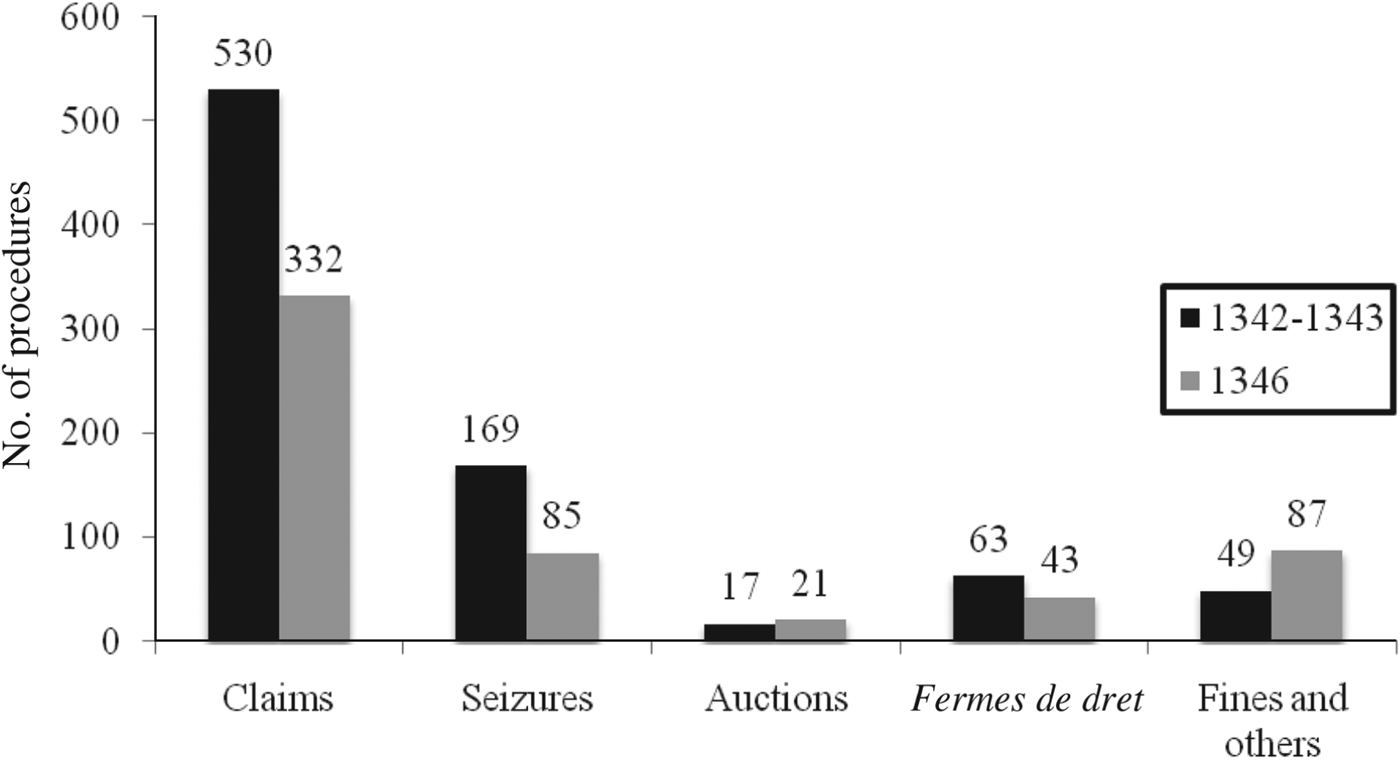
In the later stages of a lawsuit, as has been suggested, negotiation caused delay or even the ending of court proceedings. It is noticeable that the first stages in litigation (claims and seizures) were far more frequent than the subsequent mechanisms. In this sense, in Caldes, only 16.7 per cent of the 530 debt claims brought into the court in the 12 months from July 1342 to July 1343, and 11.7 per cent of the 332 claims brought in 1346, had some continuity as a posterior stage of a suit within the next year after its first entry (i.e. in the periods July 1343–July 1344, and 1347).Footnote 54Figure 2 indicates the marked extent to which claims and seizures were the most common procedures. These tended to be followed by out-of-court settlements that prevented the need for the court to implement further more serious measures.
Numbers of procedures of various kinds implemented in the court of Caldes de Malavella (1342–1343 and 1346). (Sources: Historical Archive of Girona (AHG), Caldes-Llagostera 23; Caldes-Llagostera 29).
The usual form of ending a debt lawsuit, once a seizure had been decreed, was to transform the provisional distraint into an irrevocable confiscation. Most seizures were not followed up by further documentation (86.3 per cent of the acts in 1342–1343 and 75.5 per cent in 1346), a process that might signify direct expropriation. In those cases where the defendant was presumably able to cover his debt, no other procedures were instigated by the court, but neither a receipt, nor a debt diffinitio (cancellation), were issued. A question, though, remains: which kind of out-of-court settlement were actors seeking by bringing claims or seizures to court?
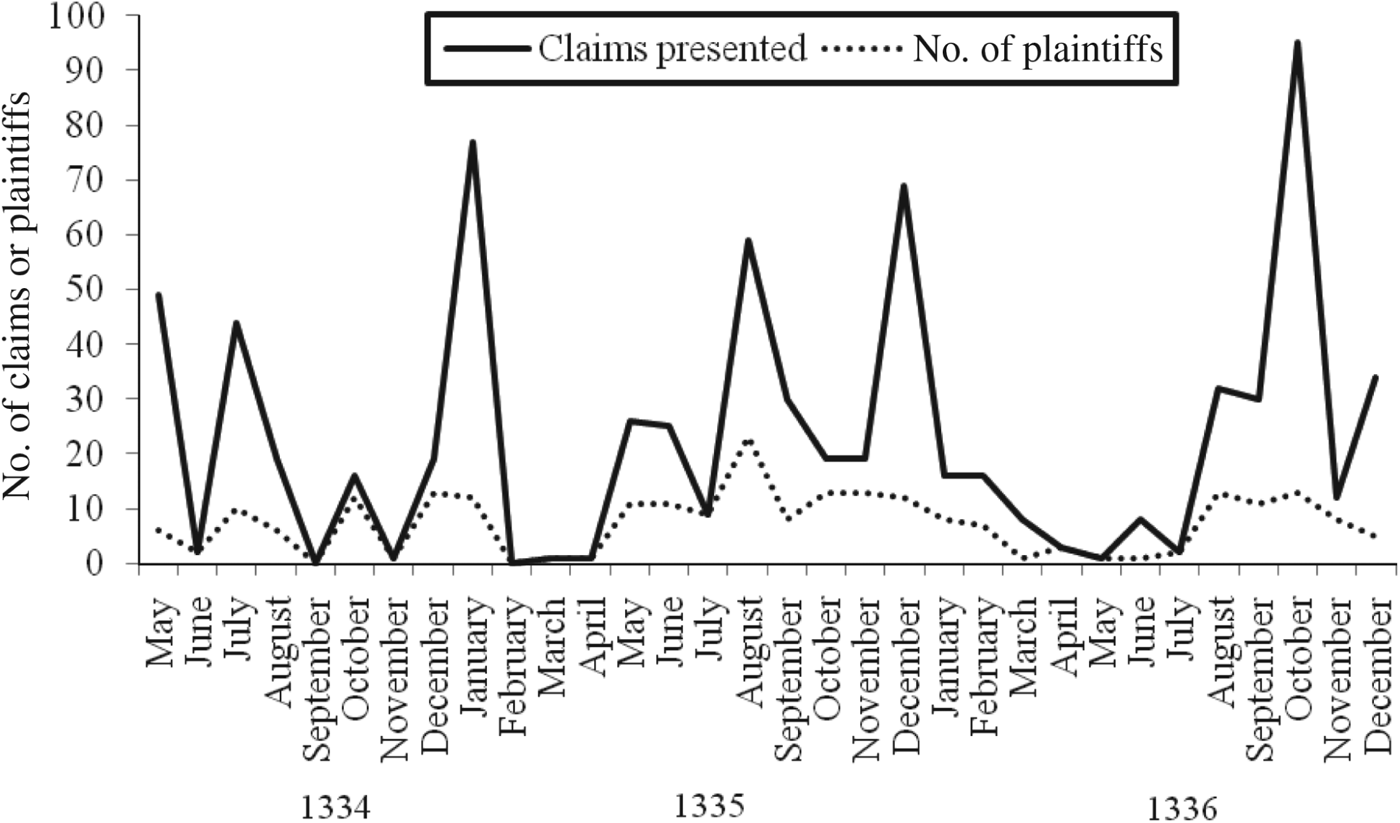
To answer this question it is necessary to emphasise the seasonal patterns of litigation. Claims were mainly brought during specific periods of the year, which coincided with harvest time (from May to September, including the cereal and the wine harvests) or with wintertime (just after the sowing of major cereal grains) (Figure 3). Examining this tendency, there is reason to believe that court procedure could be an operation designed to allow plaintiffs to secure control over agricultural produce, through confiscation sanctioned by the court or, rather less disruptively, through a strategy of negotiation over crops. In debt lawsuits we can certainly identify the preference of plaintiffs for recovering their claims in kind (namely, oil and cereals) rather than cash repayment.
Number of claims brought to the court of Caldes de Malavella by month of year (1334–1336) and the number of plaintiffs. (Sources: Historical Archive of Girona (AHG), Caldes-Llagostera 8; Caldes-Llagostera 12).
Returning to the data from 1342–1343 and 1346, we find that in the former period, of the 40 seizures that were preceded by a claim, both operations were brought on the same day on 19 occasions (47.5 per cent of total cases). Thus the notification of requisition and impounding at the same time – and often even the recording of both in a single document – was a regular practice, which we usually detect in the late spring and summer months. This was the strategy followed by a carpenter from Girona, Bernat Jaufred. On 12 May 1343 he sued for the first time a probable relative of his, Guillem Jaufred from Caldes, for an outstanding debt of 85 s. Besides the claim it was also stated that the seizure had been activated against crops belonging to Guillem Jaufred, and amounted to the value in solidi of the debt demanded.Footnote 55 During that same year, the two procedures were activated within only a week's interval on three other occasions. On the other hand, 18 suits do give longer periods between the two procedures, of 48 to 270 days. In 1346, of 23 seizures that were heralded by claims, 11 pairs were ordained on the same day (47.8 per cent). Again, issuing both was a strategy that plaintiffs implemented during harvest time. In the rest of the cases, two suits also gave short intervals (of 9 and 13 days) and nine others, more than three months.
Some creditors, around half of them, decided to initiate legal process in summer, when crops, namely those grown by borrowers, were available as a means of recovering unpaid debts. Other plaintiffs, instead, were content with longer periods – such as a whole winter season – in which to settle disputes.
We are able to ascertain that in a specific period, namely during harvest time, suing had an explicit collecting purpose. Here, people eager to recover their loans or credits through the confiscation of produce would instigate both claim and seizure, leaving little leeway to negotiate. Alternatively, if a demand was made during winter against a borrower, but he was not skillful enough or simply could not negotiate during these months, then, in late spring a seizure would probably be decreed against him. Claims, in this latter scenario, were certainly seen as stimuli to foster negotiations before the plaintiff took any further action.
We have seen that claims and seizures appear to be the most frequently implemented actions in the court of Caldes de Malavella. Plaintiffs would voluntarily activate these mechanisms in the months preceding harvest time, in order to commence negotiations with their borrowers over the acquisition of agricultural produce. Thus, these were procedures that were used by plaintiffs to secure access to crops and, above all, to increase commercial loyalties from their pool of clients. The attractiveness of court procedure might have depended less on the mere speediness of resolution and more on its mechanisms for fulfilling the economic and even cultural expectations of the parties.
Ultimately, if no agreement between the parties could be made, the system provided the possibility of organising a public auction of assets. Efficiency here depended more on the capacity of the court to satisfy all the demands of plaintiffs in a lawful manner, than on providing a speedy process of enforcement. We should bear in mind that a common circumstance involved different plaintiffs litigating against the same defendant, and thereby acting as instigators of auctions of the same possessions. In the resulting so-called creditors’ meetings it was crucial to declare – in a lawful way – the rights that each plaintiff had against the chattels that were brought to auction.Footnote 56 At the auction itself, documents could be used to determine the priority of claims to its proceeds.Footnote 57
Procedural speediness does not appear to be satisfactory as a measure of the efficiency of medieval courts. For one thing, urgency varied depending on the type of contract. Equally, the court system was designed to fulfill the claims of multiple plaintiffs over a single defendant. The speed of justice, in such cases, was a secondary concern. Above all, if the dynamics of ongoing commercial relationships between litigants are taken into account, the court proceedings are revealed as part of a broader negotiation strategy that had its own pace.
7. FERMA DE DRET AND COURT EFFICIENCY
How did the cost of justice affect the involvement of the parties in pleas? This is a difficult issue, for which little evidence is available. The versatility of court procedures (the various uses of obligations, for instance) has driven scholars to suggest that justice was free of charge, or almost. However, the evidence clearly attests that when an obligation remained unpaid, justice was certainly not free, since procedural costs had to be added to the debt owed.Footnote 58 Second, there was scope for the transfer of debt suits; for instance, some initiated in Caldes were sent to other jurisdictional courts in the city of Girona. Bearing in mind the resulting potential for complexity and prolongation, plaintiffs in these specific lawsuits probably assumed considerable additional costs.Footnote 59 Importantly, there was at least one specific action in court pleading – namely, the ferma de dret – for which a fee was paid. We will now focus on this mechanism, and ask how far it contributed to the efficiency of the system.
Almost all the court mechanisms described up to this point were automatically implemented on the orders of the bailiff, with no intervention of a judicial body. However, in a suit administered by the bailiff, the defendant could halt proceedings and send the case to a judge. This specific action of sending the suit to judicial mediation was entered in the court books, through a ferma de dret.
Although he concerned himself with civil law disputes, the judge was not an office belonging to the court structure. Judges were law experts, usually citizens of Girona, who moved around different baronies and estates offering their knowledge and skills in judicial procedures. They were the only figures with authority to pass sentences. When judges mediated in disputes, arbitrators chosen by the parties could sometimes assist their deliberations.
After the entry of a claim or a seizure, the defendant had the right to appear in court and ask for a judicial process by ‘firming the law’ (afermar-se), paying 5 s. for the privilege. For instance, on 26 May 1340, Bernat Blandric, from Lloret, paid 5 s. and ‘firmed the law’ in a suit that had been brought by the plaintiff Andreu Marcó, because of an outstanding debt.Footnote 60 Through this action all precedent claims and seizures were cancelled and the suit was forwarded to the judge.Footnote 61
As the juridical literature has noted, throughout the entering of a ferma de dret the defendant promised to appear in court and observe all judgments, fines and ordinances related to the case.Footnote 62 In exchange, this sort of pledge conferred legal certainty: it prevented the application of provisional measures – such as seizures – and gave assurance to the defendant that no other jurisdictional court, in the same lawsuit, would step in. Thus, the chance that a defendant would have to plead in the same suit in different courts was ruled out.
There is a lack of evidence on the judicial course, as its mechanisms were generally not registered in court books.Footnote 63 Describing it is thus hazardous. We know that the judge required the presentation of documentary evidence and heard testimonies. We have no account of how documentation was scrutinised, and very few summonses or sworn statements of the testimonies appear in court records from Caldes. Of the latter, an example dates from 23 June 1343, when Guillem Eixandri from the vicinity of Vilarnau admitted before the judge that he still held 3 mitgeres of wheat that had been seized from him as a result of a claim brought by the cloth merchant Ramon Massot. In a sworn statement, he promised that, when asked, he would carry the wheat to the court, so it could be delivered to the plaintiff. It is plausible that Guillem Eixandri had resisted the seizure and, in this circumstance, the court had asked the judge to mediate in order to pass a judgment.Footnote 64
Process concluded with a judicial sentence. Unfortunately, an even smaller number of those were recorded. They were seldom related to credit or breach of contracts. A rare example of a written sentence relates to a tangled suit, concerning 22 s. that had been provisionally deposited in the hands of Pere Vengut, shoemaker of Cassà de la Selva. The money had been raised by the sale of a pig carried out by a woman named Guillemona, wife of Pere Fels, but in the name of Guillem Despou, from the nearby village of Campllong. The pig had been in custody of Guillemona in a comenda contract. The judge, having verified this document, sentenced that the money had to be delivered to Guillem Despou.Footnote 65
Another sentence shows up when the judge Guillem Abadia commanded Bernat Mateu, the bailiff's lieutenant, to enforce Arnau Barceló, from Caldes, to pay in a week's time 50 s. to Ramona, wife of Bernat Miró, also from Caldes. As different witnesses had stated during the process, Ramona was owed this amount as part of her three-year salary as a maid in mas Barceló.Footnote 66
We have learned that judges had the capacity to enforce parties to appear in court, through summonses, as well as to dictate sentences or even bylaws that took into account each litigant's arguments.Footnote 67 They worked individually, with no permanent aid from the court. Notwithstanding this remark, sometimes in their inquiries they made use of the assistance of the court officials. It also appears that judges could ask for the advice of specially chosen arbitrators from the community.Footnote 68 It was customary to request the judge in specific types of lawsuits, such as those requiring crops, fields or the price of movables to be valued.Footnote 69
In some cases, the judge would appoint a body of outstanding figures from the community, especially skilled in measuring or assessing the required prices and values. In a case recorded on 11 March 1329, the judge Miquel Serra confirmed a sentence about the division of the profits of an ox that had been delivered in comenda, for the value of which a suit had taken place between the lender and the borrower. The price of the animal was assessed by a group of people specially drawn from the community.Footnote 70
From works on other regions of Europe, we know that judicial hearings could be complementary to lawsuits that were being dealt with in court, but sometimes also a substitute for the latter.Footnote 71 In some of the phases of the pleas heard in court, the parties could move to the judicial course for many reasons, especially the need to present evidence and witnesses. Hence, it seems that the judicial course was a complex system with its own logic, and not merely a part of the court machinery, possessing no procedural autonomy (as is sometimes argued).Footnote 72 It is, however, not possible to demonstrate conclusively the existence of suits that, because of their own attributes or perhaps due to the choice of litigants, were never heard by the court and, from their inception, were ruled by the judge. One possible example is another tangled suit, in which both a will and a debt owed to a Jew were in question. In this dispute, the parties chose the judicial course because they preferred to keep away from the viam litigi, the litigious path, a likely reference to jurisdictional court.Footnote 73
As we have seen, the ferma de dret was the specific mechanism that allowed one to move directly to the judicial course. As this step generated little documentation, we cannot determine exactly why a suit was referred to a judge. We do have some evidence that shows, though, that the ferma de dret was brought in the event of parties differing over an argument or when the defendant did not agree with the amount for which the demand had been presented. Also in suits over land (namely, over irrigation channels, field boundaries and roads) that entailed discussions among parties, it was common to bring fermes de dret so that disputes could be settled by an unbiased agent, generally the judge.
In our dossier of debt suits there are telling examples of this kind. Bonanat Boïga was a tailor from Caldes, a dynamic actor engaged in commercial activities. During 1339 and 1340 Boïga was indebted to the wealthy cloth merchant from Girona, Tomeu Avellaneda, with the result that the latter brought to court numerous claims against the debtor.Footnote 74 Boïga had probably purchased fabric from him on credit. Finally, on 4 December 1340, the debtor brought a ferma de dret arguing that he was being persistently sued by Tomeu Avellaneda and his business partner, Berenguer Moragues, for a sum he denied owing.Footnote 75 That same day, 4 December, ‘by reason of the said ferma’ (ratione predicte firme), the court steward Bernat Pellicer summoned Boïga to appear before the judge the following Monday, so the dispute could be heard.Footnote 76
To summarise the discussion to this point, we might conclude that judicial procedure achieved success ‘in laying bare the truth of a matter and reaching a reasonable conclusion’.Footnote 77 Although the services of a judge had to be secured via a small payment, the efficiency of this aspect of the system is evident in the fact that the parties usually turned to judges in particularly entangled suits that required a public enquiry and involved the verification of evidence and the hearing of testimony. Through judges, the parties obtained what the community regarded as justice. This kind of justice could only be delivered by an impartial specialist – the judge – who had to be hired and remunerated.
8. CONCLUSION
The judicial structures that have been analysed in this article were designed and promoted by lords to overcome jurisdictional and ethnic–religious fragmentation. Additionally, mechanisms of communication between courts helped to promote the institutional integration of an extensive territory, even though that territory was made up of a number of adjoining estates and jurisdictions. Furthermore, the coexistence of notaries and local courts provided a system that offered strikingly full scope for the registration and enforcement of contracts, which in turn brought security to trade and finance. Finally, access to procedures of civil justice presided over by a judge offered some degree of impartiality in solving disputes.
The development of this sophisticated system is closely related to the flourishing of small towns, and to the economic integration of these towns with their hinterlands in this period. The peasantry had become a very significant consumer of structures for registering and enforcing contracts, which were widely established among small towns.
It has been the aim of this article to answer the question of court efficiency in private litigation. We have tried to demonstrate that this concept – efficiency – in a late-medieval Catalan court is a complex one and should be approached at least from three different angles. First, efficiency of a kind is reflected in those numerous examples of non-payment or breach of contract that were quickly prosecuted by the court with the defendant being required to meet his obligations.
Second, the activation of court procedures could be part of a broader commercial strategy, which included the possibility of resorting to more informal mechanisms at a later stage. It appears that some actions were brought (and, therefore, recorded in the court books) with the sole intention of forcing an oral settlement. In this sense, too, the courts were efficient.
A potential discrepancy may exist between the literal entry of a register and the real aspiration of a plaintiff in the bringing, for instance, of a claim. The restricted formulae through which parties were required to express themselves in court litigation are probably not sufficient to reveal their real aims. By way of illustration, one may note that claims were always recorded in monetary terms, while plaintiffs were not always seeking direct monetary compensation in each lawsuit.Footnote 78 As we have shown, some creditors who at the same time were grain dealers were active in using court mechanisms to secure crop sales at advantageous prices.
Third, and finally, with respect to the strength of the system, it can be argued that parallel negotiation had a key role in solving conflicts and avoiding the increase of tensions among parties. This led to what we might call the ‘social efficiency’ of the whole court system.Footnote 79 When they agreed to do so, the parties could choose to appear before a judge in order to bring about a negotiated agreement. This provided them with a means to opt out of the rather strict disciplinary processes of court proceedings proper. The judicial course could be less damaging to community values, since, for instance, it avoided straining long-term credit relationships and, hence, placing collateral actors (debtors of debtors) under severe pressure.
We know that the entry of a claim against a delinquent debtor could trigger other claims to meet the owed amount of money. This was, for example, the case of Ramon Serracoc, from Caldes, who agreed to pay 150 s. to his neighbour, Bartomeu Fornaca on 24 February 1343. This amount was part of a larger debt – 600 s. – for which a document, today not preserved, was registered at the inception of the debt.Footnote 80 Not being able to meet his payment, on 7 April 1343 Ramon Serracoc enforced a man from Cassà de la Selva, Ramon Guerau, a debtor of his, to pay him back another debt of 135 s. in only two days’ time. In this case, he compelled the payment to be made directly to Bartomeu Fornaca.Footnote 81 Anthropology has long shown how, as well as serving economic purposes, credit relations can be viewed as phenomena of social dependency. Hence, formal contract enforcement measures regarded as too belligerent would leave the plaintiff in a delicate situation with respect to his own community.Footnote 82
ACKNOWLEDGEMENTS
I would like to thank Chris Briggs, Pere Orti Gost and the journal's referees for their comments on earlier versions of the article.