Introduction
Due to global aging, the number of people with dementia is rapidly increasing worldwide. According to the World Alzheimer Report 2015, 46.8 million people were living with dementia worldwide in 2015 (Alzheimer's Disease International, 2015). The number of people with dementia is predicted to double approximately every 20 years, reaching 74.7 million in 2030 and 131.5 million in 2050. Approximately 70%, 61%, and 50% of people with dementia live at their own home in the USA, United Kingdom (Family Caregiver Alliance.2009, 2012), and Japan (Ministry of Health, 2013a), respectively. However, caring for people with dementia brings considerable burden to family caregivers, which is not restricted to only the economical perspective, such as productivity loss but also affects the quality of life. Such a burden often brings isolation from society, which occasionally results in psychiatric diseases, such as anxiety or depression.
Therefore, it is crucial to detect factors that could be a risk for psychological distress of caregivers because it is critical that caregivers remain fit enough to provide good care to people with dementia (Schulz et al., Reference Schulz, Belle, Czaja, McGinnis, Stevens and Zhang2004).
Previous studies indicate an elevated risk of depressive symptoms among the caregivers, compared to the general population (i.e. non-caregiver samples) (Schulz and Beach, Reference Schulz and Beach1999; Roth et al., Reference Roth, Haley, Owen, Clay and Goode2001). Further, in comparison to caregivers of patients with other chronic diseases, those caring for people with dementia have an elevated risk of depressive symptoms (Schulz et al., Reference Schulz, O'Brien, Bookwala and Fleissner1995; Schoenmakers et al., Reference Schoenmakers, Buntinx and Delepeleire2010). Some studies show that 30–40% of the caregivers of patients with dementia suffer from depression and emotional stress (Covinsky et al., Reference Covinsky2003; Mahoney et al., Reference Mahoney, Regan, Katona and Livingston2005; Sink et al., Reference Sink, Covinsky, Barnes, Newcomer and Yaffe2006), which can accelerate the symptoms of the people with dementia themselves, ultimately leading to their institutionalization (Schulz et al., Reference Schulz, Belle, Czaja, McGinnis, Stevens and Zhang2004).
A conceptual model for understanding the effects of context on emotional health outcomes among the caregivers of dementia has been proposed (Pearlin et al., Reference Pearlin, Mullan, Semple and Skaff1990; Williams, Reference Williams2005), which indicates that a variety of factors relevant to both caregivers and care recipients can affect the mental health condition of caregivers. These include sociodemographic, psychological, and behavioral factors. Sociodemographic factors include a low education level (Covinsky et al., Reference Covinsky2003), low income (Schulz et al., Reference Schulz, O'Brien, Bookwala and Fleissner1995), being a spouse caregiver (Pinquart and Sorensen, Reference Pinquart and Sorensen2011), being a woman (Alspaugh et al., Reference Alspaugh, Stephens, Townsend, Zarit and Greene1999), and being of a certain race (white) (Haley et al., Reference Haley1995). Psychological and behavioral factors such as poorer self-rated health (Cucciare et al., Reference Cucciare, Gray, Azar, Jimenez and Gallagher-Thompson2010), smaller social networks (Williams, Reference Williams2005), the use of dysfunctional (emotion-focused) coping (Li et al., Reference Li, Cooper, Bradley, Shulman and Livingston2012), and caregiver stress, which includes role overload, captivity, or burden, are reported to mediate depressive symptoms (Clyburn et al., Reference Clyburn, Stones, Hadjistavropoulos and Tuokko2000). Conversely, factors related to care recipients, such as increased behavioral problems (Covinsky et al., Reference Covinsky2003), the level of physical impairment (deficits in activities in daily living [ADL]) (Pinquart and Sӧrenson, Reference Pinquart and Sorensen2003), and poorer cognitive function have also been reported as risk factors (Covinsky et al., Reference Covinsky2003; Pinquart and Sorensen, Reference Pinquart and Sorensen2003; Schoenmakers et al., Reference Schoenmakers, Buntinx and Delepeleire2010). Although the majority of these findings are based on single studies, meta-analyses that evaluate these factors also exist. For example, Schoenmakers et al. (Reference Schoenmakers, Buntinx and Delepeleire2010), conducted a meta-analysis to evaluate depressive and anxiety symptoms of caregivers. They reported that the sex of caregiver (female), the relationship between the caregiver and patient (spouse), subjective caregiver burden, low ADL, and low cognitive function of the people with dementia, and the severity of behavioral symptoms, are independent risk factors for caregiver depression. Although the behavioral and psychological symptoms of dementia (BPSD) include a wide range of symptoms, depressive symptoms of care recipients, such as sleep disturbance or change in appetite have the greatest effect on the caregivers’ depressive symptoms (Ornstein and Gaugler, Reference Ornstein and Gaugler2012; Ornstein et al., Reference Ornstein, Gaugler, Devanand, Scarmeas, Zhu and Stern2013).
However, these findings are based on data from western countries. In Japan, the situation is more serious compared to that in western countries, as the population aging rate in Japan in 2015 was already 26.3% (compared to 19% in the European Union, 15% in the USA, and 8% worldwide) (Alzheimer's Disease International, 2015), which means that approximately 1 in 4 people is thought to be the elderly. In addition, the population aging rate is expected to increase, so that in 2060 an estimated 39.9% and 26.9% of people will be over 65 years and 75 years, respectively (Government of Japan, 2015). Further, by 2025, 7 million people are estimated to have dementia, that is, approximately 20% of people over the age of 65 years will have dementia (Ninomiya, Reference Ninomiya2015). The Ministry of Health Labor and Welfare launched a “5-year plan for promotion of policy measures against dementia (Orange Plan)” in 2013, which was updated in 2016 (New Orange Plan) (Ministry of Health, 2016). This report emphasized the importance of home care. Although it is important to establish a “dementia-friendly society” to take care of people with dementia in the community as long as possible, it can only become a reality when caregivers are provided adequate and appropriate support. Without this support, caregivers are at risk of developing psychological problems.
To utilize the limited resources allocated to caregivers’ support effectively and efficiently, knowing the risk factors of psychological problems is crucial to prioritizing caregivers to whom support should be provided. Moreover, analysis of risk factors should be conducted based on the Japanese population, to account for cultural and political differences from western countries. However, as far as we know, there are no studies with a relatively large sample examining the risk factors for psychological distress of the caregiver of dementia. Thus, we decided to examine the predictive factors associated with psychological distress of caregivers of people with dementia in Japan.
Methods
Study design
A cross-sectional, secondary analysis of 1,437 caregivers was enrolled in the informal care time study as a part of a study to estimate the cost of dementia in Japan.
Setting
We distributed the questionnaires to 4,236 caregivers through the support organizations and the healthcare institutions, from May 2014 to December 2014. The questions were based on basic characteristics of the caregivers and people with dementia, clinical condition of people with dementia (i.e. psychological symptoms and comorbid disease), informal care time during a week, and Kessler Psychological Distress scale (K6) score of caregivers (the details are shown in measurement in the survey). Questionnaires were distributed with a leaflet providing information about this study. The return of the questionnaires to Keio University was regarded as the consent to participate in this survey. Questionnaire respondents were sent a “Handbook for Carers,” which provides useful information for caring people with dementia, or a prepaid card to the value of JPY 300, as a reward. The current study was ethically approved by Keio University Research Ethics Committee.
Participants
Participants of the survey were caregivers of people with dementia. As previously described, they are recruited through the outpatient clinics at healthcare institutions and through the Japan Carers Association, a support organization for caregivers, which has nationwide network. The inclusion criteria for this survey included being: (1) a caregiver of a person with dementia (the diagnosis was confirmed by asking if the person was clinically diagnosed with dementia by a physician), and (2) 20 years or older.
Measurement in the survey
The caregiver characteristics that were recorded included gender, age, kin relationship to their care recipients (spouse, son/daughter, son/daughter in law, brother/sister, and others), marital status, cohabitation with the care recipients, number of caregivers, and proportion of responders’ care time among all caregivers. The Japanese version of K6 (Furukawa et al., Reference Furukawa2008), which is a validated, self-reported, easy-to-administer tool, was used to evaluate the caregivers’ non-specific psychological distress. It consists of six questions on a five-point scale, ranging from 0 to 4. The total scores ranged from 0 to 24, allowing evaluation of psychological distress, such as depressive symptoms and anxiety. They are reliable and valid scales to screen for present state DSM-IV mental disorder. An optimal cut-off score of 4/5 is recommended to screen for mood disorders and anxiety disorders, while a cut-off point of 12/13 is recommended to identify probable severe mental illness (Sakurai et al., Reference Sakurai, Nishi, Kondo, Yanagida and Kawakami2011).
Caregivers reported the total amount of hours per day spent on caregiving during a typical week, as well as the total amount of hours spent in long-term care services. The informal care time consisted of the following three parts: the ADL, that is the time required to help with any of the activities of daily living (bathing, eating, dressing, transferring, and toileting); instrumental activities of daily living (IADL), which is the time required to complete any instrumental activities of daily living, such as shopping, housework, laundry, meal preparation, paying bills, arranging transportation, using the telephone, and managing medications; and the time required for supervision (SV). As there is still some discussion on if SV should be included in the informal care time measure, we only included ADL and IADL as informal care time in the current study. We set the upper limit of informal care time as 18 hour, with consideration of at least 6 hour of sleeping time.
The recorded characteristics of people with dementia included demographic characteristics, such as the sex, age, prefecture to live, living situation, nursing care level, informal care time, and public care time. We also investigated the existence of the subcategories of BPSDs, including hallucination, delusions, day–night reversed, abusive words, violence, resistance to care, wandering, carelessness of fire, allotriophagy, and sexual problem behavior, as well as eight comorbid diseases namely, stroke, cardiovascular disease, hypertension, pulmonary disease, diabetes, cancer, mental disorder, and arthritis.
Nursing care level
In Japan, long-term care services are provided under the long-term care insurance schema, mainly to the elderly people who need support or care. The degree of needed care should be certified for those who want to receive long-term care services, and is categorized as either requiring support or long-term care. The services in the category of requiring support mainly focus on the prevention of disability, while those in the category of requiring long-term care emphasize on prevention of progress of disability. The requiring support category can further be ranked as requiring support level 1 or 2, while the requiring long-term care category can be ranked into five levels. In the paper, we treated these two separate care categories as one categorical variable.
Statistical method
Univariate regression analysis and multi-regression analysis were performed. First, we conducted univariate analysis to examine the association between each variable and the K6 score. We examined variables related to both caregivers and the people with dementia. The variables related to the caregivers included caregivers’ age, sex, caregivers’ relationship to their care recipients, marital status, living situation (i.e. whether cohabiting with the care recipient), informal care time, and the number of caregivers. The variables relevant to people with dementia included their age, sex, nursing care level, BPSD, and physical comorbid disease. The K6 score was set as the (continuous) dependent variable.
For the multivariate regression analysis, we first used a stepwise method to select variables with a p-value less than 0.15. Next, we entered those variables, as well as sex and age of the caregiver into a model with forced entry method. Finally, we confirmed the model by excluding factors (except sex and age of caregivers) that were not statistically significant (p < 0.05). The K6 score was set as the continuous dependent variable.
In addition, we also conducted logistic regression analyses. Similar to the multivariate regression analysis, a two-step procedure, where only variables with a p-value less than 0.15 and the sex and age of the caregivers, was imputed into the model. Cut-off points of 4/5 and 12/13 of the K6 scores were analyzed separately. All analyses were performed using SPSS 22 (IBM Corp. Released 2013. IBM SPSS Statistics for Windows, Version 22.0. Armonk, NY: IBM Corp.) software.
Results
Study cohort
A total of 4,236 questionnaires were distributed, for which we received response from 1,685 caregivers, that is the response rate was 39.8%. Responses that lacked an answer to at least one question were excluded from the analyses. Thus, 1,437 responses, where all the questions were completely answered, were included in the analyses.
Study cohort characteristics
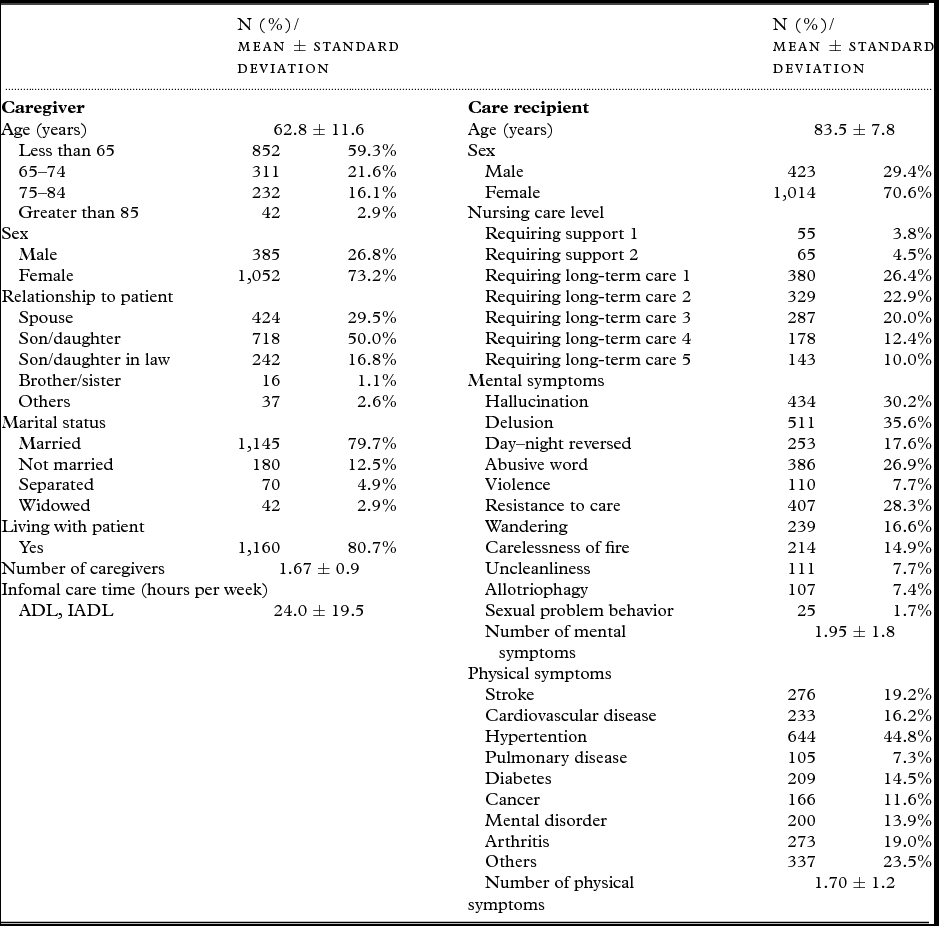
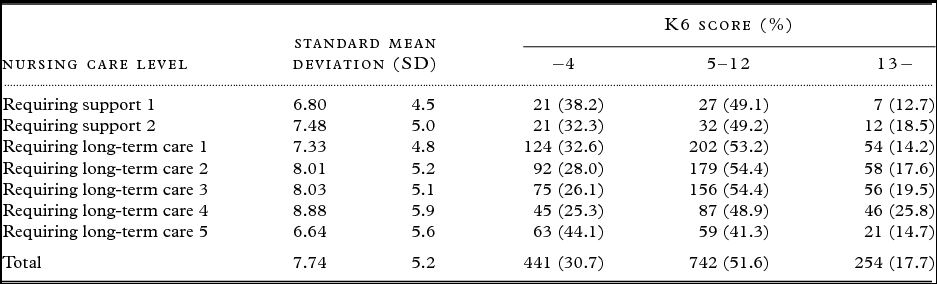
The characteristics of the caregivers and the people with dementia are described in Table 1. The mean age of the caregivers of the samples was 62.8 years (standard deviation [SD] = 11.56 years), of whom 26.8% were men. With respect to the relationship between the caregiver and the person with dementia, 50.0% were patients’ the children and 29.5% were spouses, followed by son/daughter-in-law (16.5%). Approximately 79.7% of caregivers are married and 80.7% lived with their care recipients. The mean number of caregivers per person with dementia was 1.67. The mean informal care time, including ADL and IADL, was 24.0 hours per week (SD=19.5 hours per week). The caregiver's mean K6 score was 7.74 and caregivers scored over 5 and over 13 were 69.3% and 17.7%, respectively. The mean score was highest among the caregivers of the care recipient with required long-term care level 4 (8.88), followed by level 3 (8.03), and level 2 (8.01) (Table 2).
Characteristics of caregivers of people with dementia

*p < 0.05. **p < 0.01. ADL: activities of daily living IADL: instrumental activities of daily living.
Kessler's Psychological Distress scale (K6) scores of caregivers

The average age of people with dementia was 83.5 years (SD = 7.81 years) and the proportion of males among the total was 29.4%. With respect to the distribution of the level of nursing care, the majority required long-term care level 1 (n = 380), followed by level 2 (n = 329) and level 3 (n = 287). As for BPSD, delusions (35.6%) and visual and auditory hallucinations (30.2%) were the most frequent psychiatric symptoms, followed by resistance to care, abusive word, and so on. In regard to physical comorbidities, hypertension (44.8%) was the most frequent coexisting disease, followed by stroke, joint disease, and so on.
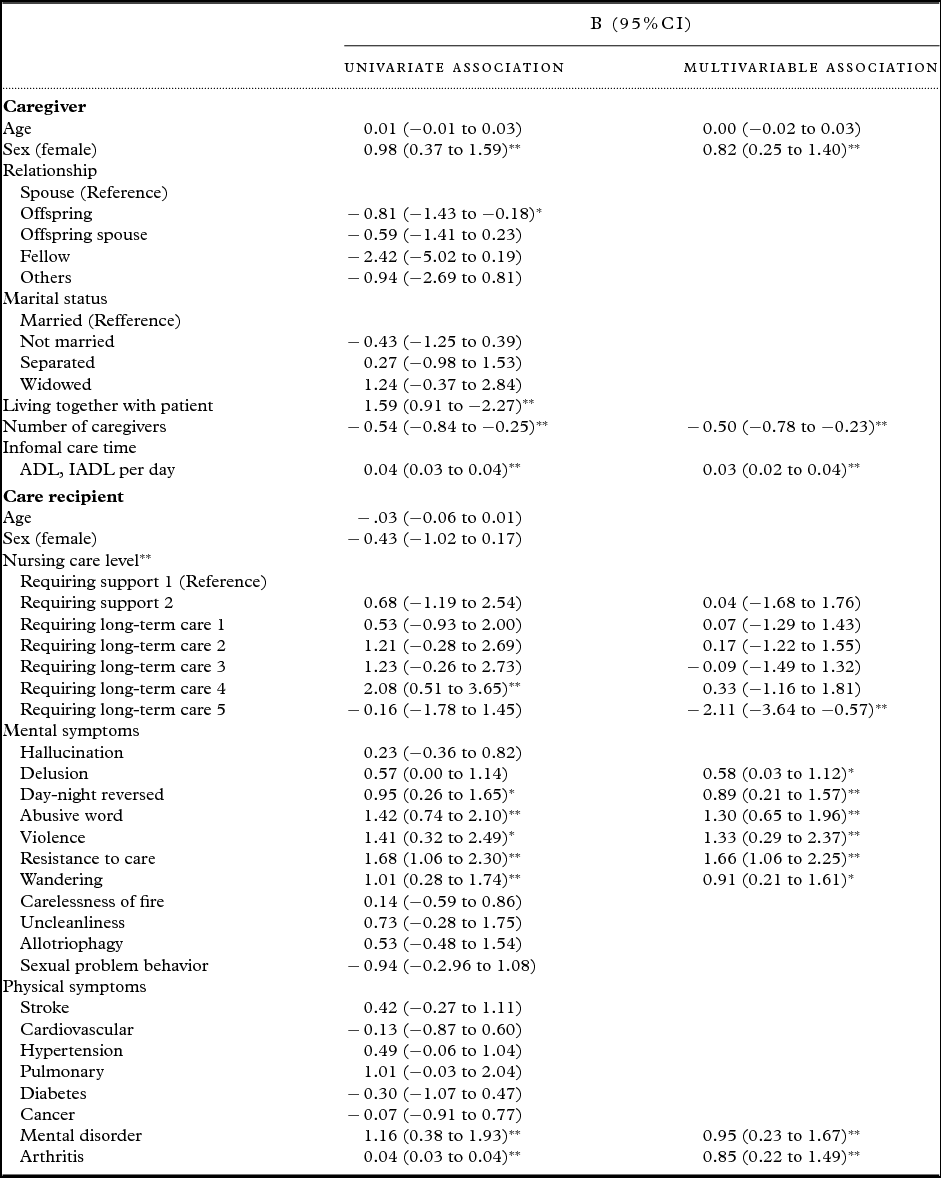
Predictive factors associated with psychological distress of caregivers of people with dementia. The univariate analysis was conducted to assess the relationship between each variable and the K6 score. As shown in Table 3, several variables (point estimate of coefficient; 95% Confidence Interval) were significantly associated with the K6 score. These were, the sex of the caregiver (female) (0.98; 0.37–1.59), caregiver's relationship to care recipient (children) (−0.59; −1.43 to −0.18), cohabitation with care recipients (1.59; 0.91–2.27), the number of caregivers (−0.54; −0.84 to −0.25), total informal care time (0.04; 0.03–0.04), requiring long-term care level 4 (2.08; 0.51–3.65), day–night reversed (0.95; 0.26–1.65), abusive word (1.42; 0.74–2.10), violence (1.41; 0.32–2.49), resistance to care (1.68; 1.06–2.30), wandering (1.01; 0.28–1.74), mental disorder (1.16; 0.38–1.93), and arthritis (0.04; 0.03–0.04).
Linear regression associations between the Kessler's Psychological Distress scale (K6) score and factors pertaining to caregivers and care-recipients

*p < 0.05. **p < 0.01. B = Beta coefficient; CI = confidence interval; OR = odds ratio; ADL = activities of daily living; IADL = instrumental activities of daily living.
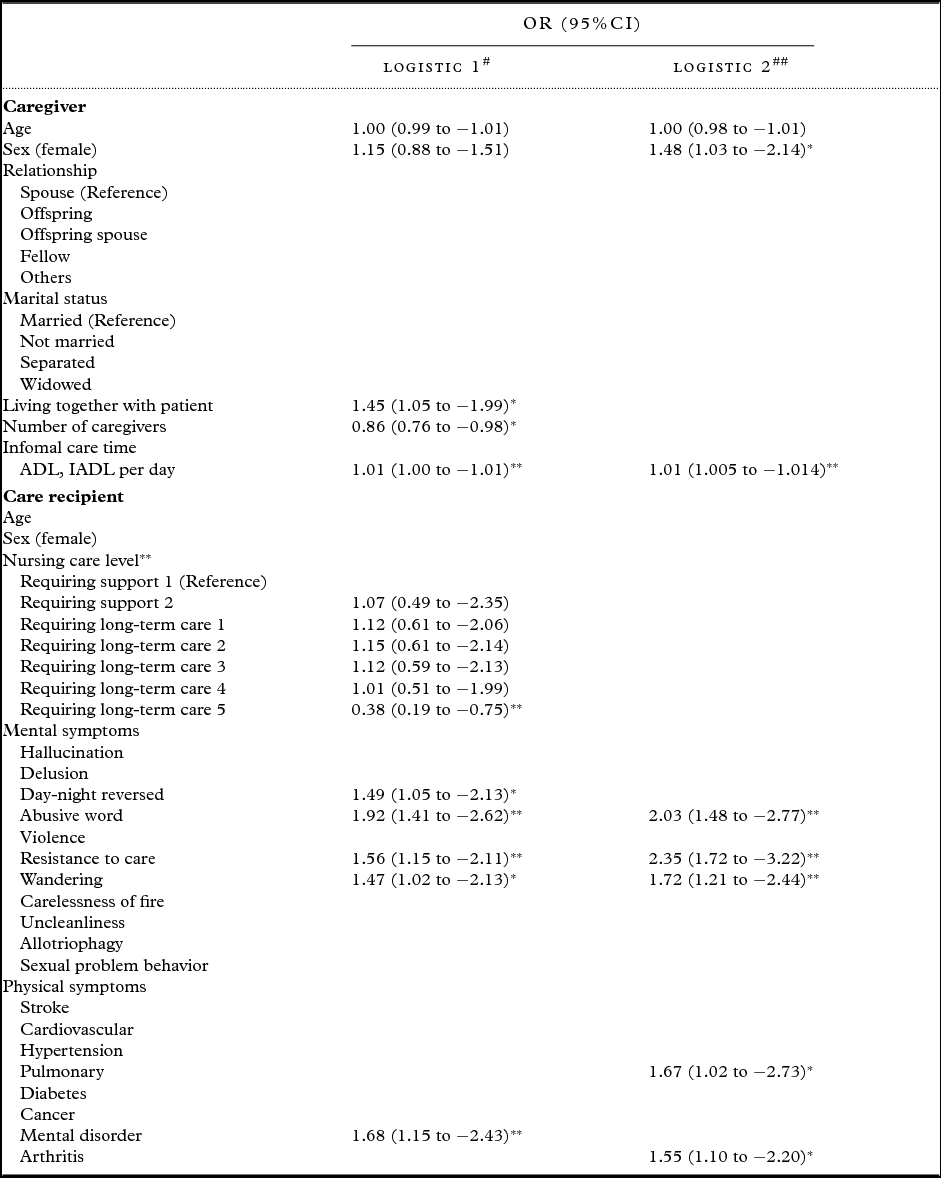
Logistic regression associations between the Kessler's Psychological Distress scale (K6) score and factors pertaining to caregivers and care-recipients

*p < 0.05. **p < 0.01. # K6 cut-off 4/5, ## K6 cut-off 12/13; B = Beta coefficient; CI = confidence interval; OR = odds ratio; ADL = activities of daily living; IADL = instrumental activities of daily living.
The results of multivariate regression analysis are also shown in Table 3. The variables that were significantly associated with the K6 score were the sex of caregiver (female) (0.82; 0.25–1.40), the number of caregivers (–0.50; –0.78 to –0.23), total informal care time (0.03; 0.02–0.04), requiring long-term care 5 (–2.11; −3.64 to −0.54), delusions (0.03; 0.33–1.12), day–night reversed (0.89; 0.21–1.57), abusive word (1.30; 0.65–1.96), violence (1.33; 0.29–2.37), resistance to care (1.66; 1.06–2.25), wandering (0.91; 0.21–1.61), mental disorder (0.95; 0.23–1.67), arthritis (0.85; 0.22–1.49).
We also conducted the logistic regression analysis in order to evaluate the robustness of these results. When cut-off point of the K6 score was set between 4 and 5, the variables (odds ratio; 95% confidence interval) that were significantly associated with the K6 score were as follows: cohabitation with care recipient (1.45; 1.05–1.99), the number of caregivers (0.86; 0.76–0.98), informal care time (1.01; 1.00–1.01), requiring long-term care level 5 (0.38; 0.19–0.75), day–night reversed (1.49; 1.05–2.13), abusive word (1.92; 1.41–2.62), resistance to care (1.56; 1.15–2.11), wandering (1.47; 1.02–2.13), and mental disorder (1.68; 1.15–2.43).
When the cut-off point of the K6 score was set between 12 and 13, the variables (odds ratio; 95% confidence interval) that were significantly associated with the K6 score were: the sex of caregiver (female) (1.48; 1.03–2.14), informal care time (1.01; 1.005–1.014), abusive word (2.03; 1.48–2.77), resistance to care (2.35; 1.72–3.22), wandering (1.72; 1.21–2.44), pulmonary disorder (1.67; 1.02–2.73), and arthritis (1.55; 1.10–2.20).
In all of the analytical methods, informal care time, abusive word, resistance to care, and wandering were significantly associated with caregivers' K6 scores or cut-off points (4/5 and 12/13). Among them, especially the coefficient and odds ratio of factors, such as abusive word and resistance to care were relatively high (Table 4).
Discussion
To the best of our knowledge, this is the first cross-sectional study with such large sample to analyze the predictors of psychological distress symptoms in caregivers of people with dementia in Japan.
We obtained several interesting knowledge from this study, but first, we would like to detect the fact that the prevalence of mood or anxiety disorder among the caregivers was considerably high. The results indicate that 69.3% of caregivers have a K6 score of 5 points or higher. According to Sakurai (Sakurai et al., Reference Sakurai, Nishi, Kondo, Yanagida and Kawakami2011), when a cut-off point of 4/5 is adopted, the positive predictive value of mood or anxiety disorders is 0.215. The means approximately 14.9% of the caregivers in the study samples are expected to suffer depressive or anxiety disorders. Because the 12-month prevalence of mood or anxiety disorders in Japan is estimated as 7.9% based on the result of the previous study (Kawakami et al., Reference Kawakami2005), the prevalence among caregivers appeared to be prominent, in comparison to the general population. This result corroborates with previous studies indicating the high prevalence of psychological distress in caregivers (Covinsky et al., Reference Covinsky2003; Mahoney et al., Reference Mahoney, Regan, Katona and Livingston2005; Sink et al., Reference Sink, Covinsky, Barnes, Newcomer and Yaffe2006).
With respect to factors predicting the psychological distress of caregivers, those such as informal care time, sex of caregivers, the number of caregivers, nursing care level, BPSD, and comorbid disease of care recipients appeared to be associated with the psychological distress of caregivers. Especially, informal care time and some of the BPSD were consistently associated with it through all the analytical methods. Interestingly, the psychological distress of caregivers of people with dementia who required the highest level of care (i.e. those requiring long-term care level 5) was significantly less as compared with that of the reference group (i.e. requiring support level 1); other care levels did not show any significant differences. This could be attributed to the condition of people with dementia, as most people with dementia requiring long-term care level 5 are almost bedridden. Therefore, although the burden caused by care for ADL might increase, psychological distress due to BPSD might decrease. With respect to the subscale of BPSD, abusive word, resistance to care, and wandering were factors that were consistently associated with caregivers’ psychological distress in the current study. Among them, the odds ratio and the coefficients of factors such as abusive word and resistance to care, which is likely to indicate aggression in people in dementia toward their caregivers were relatively high. Therefore, interventions with a focus on improving such symptoms, or supporting caregivers to manage problematic symptoms, such as the Strategies for Relatives (START) program (Livingston et al., Reference Livingston2013), could improve the psychological distress of the caregivers. As resources to care for people with dementia are scarce, it is unrealistic to develop the policy for dementia without support from family caregivers. Thus, it is critical to identify and validate effective intervention and support for caregivers in future research.
Although the current study has added meaningful knowledge to society, it had some limitations. First, the samples used for this study do not necessarily represent the general caregivers in Japan because this survey was not conducted with random sampling and the response rate was relatively low (i.e. approximately 40%). However, the discrepancy in age, the proportion of male, and the proportion of the care recipients living alone between this study samples and the nationwide survey samples are not so big. According to the results of the nationwide survey (Ministry of Health, 2013b), the average age, the proportion of male, and the proportion of those living alone among the care recipients using the public nursing care service in Japan were 83.0 years old (83.5 years old in this study samples), 29.7% (29.4% in this study samples), and 17.7% (13.1% in this study samples), respectively. Therefore, we judged the skewness caused by the sampling bias is too small to reject the generalizability of the results. Second, causation cannot be inferred due to the cross-sectional design of this study. Third, we adopted a screening scale, that is, the K6 scale, rather than clinical severity scales or diagnostic scales to measure the status of psychological distress. Therefore, individuals with scores above the cut-off might not have clinically recognized depression or anxiety disorders. Finally, the existence of BPSD and physical comorbid diseases was judged based on the self-report from the caregivers. Therefore, there remains uncertainty about these symptoms. These points must be taken into account when interpreting the results of the current study.
Conclusion
To our knowledge, this is the first Japanese study of psychological distress in the caregivers of dementia, which focuses on such a wide range of factors pertinent to both the caregivers and their care recipients. We found that the prevalence rate of psychological symptoms of the caregivers was quite high compared to those of general population and several factors, such as, gender, the number of caregivers, informal care time, BPSD and so on was associated with caregiver psychological distress. These findings corroborate with previous research. Thus, it is critical that future research clarifies and provides effective interventions in order to support to alleviate caregiver's psychological distress.
Conflict of interest
Dr. Sado has received research support from the Japan Ministry of Health, Labour and Welfare, Japan Ministry of Education, Culture, Sports, Science, and Technology, Japan Ministry of Economy, Meiji Seika Pharma, Co., Ltd., and Kumon Institute of Education Co., Ltd. The other authors have no conflicts of interest to declare.
Description of authors’ roles
Dr. Sado and Dr. Shikimoto conceived and designed the study. Dr. Sado drafted the study protocol, organized, and supervised study implementation, and Dr. Shikimoto drafted the manuscript. Dr. Mimura and Dr. Ninomiya refined the study protocol and study implementation. Dr. Yoshimura and Dr. Ikeda supervised the statistical analysis. Dr. Sado, Dr. Shikimoto, Dr. Ninomiya, and Dr. Mimura interpreted the results. Dr. Baba provided review of caregivers of people with dementia. Dr. Sado drafted the grant proposal, and was responsible for study implementation and study management, collecting data, and supervision. Dr. Mimura is the director of the study sites and provided clinical expertise and on-site management of the study. Dr. Sado had full access to all of the data throughout the study and take responsibility for the integrity of the data and the accuracy of the analysis. All authors critically reviewed the manuscript for content and approved the final version.
Acknowledgments
This study was funded by Health Labour Sciences Research grant-in-aid from the Ministry of Health, Labor, and Welfare, Japan [H26-Ninchisho-001]. We would like to express our gratitude to the Japan Carers Association and to all the organizations for caregivers and healthcare providers who participated in the informal care time survey. We also would like to express our gratitude to Professor Takao Suzuki, Professor Kei Fukuda, Dr. Shinsuke Kondo, Professor Satoko Hotta, and Dr. Atsushi Nishida for their fruitful suggestions for developing research design.