INTRODUCTION
For parasites with complex life cycles, transmission between hosts often exhibits a seasonal rhythm. Many studies have focused on how seasonal changes in host availability and feeding behaviour affect parasite transmission rates (e.g. Chubb, Reference Chubb1982). For example, Amundsen et al. (Reference Amundsen, Knudsen, Kuris and Kristoffersen2003) found that the abundance of cestodes Cyathocephalus truncatus in arctic charr intestines increased in autumn as the parasite's amphipod intermediate host became a more common item in the fishes' diet. Parasite transmission rates, however, are not solely determined by host ecology. Parasites have evolved a number of strategies to increase their likelihood of transmission (Poulin, Reference Poulin2007), perhaps the most striking of which is host phenotype manipulation. Hosts infected with trophically-transmitted parasites often exhibit altered behaviours and/or appearance that seem to make them more conspicuous to predators (reviewed by Moore, Reference Moore2002; Thomas et al. Reference Thomas, Adamo and Moore2005). Both field observations (e.g. Brown et al. Reference Brown, Loot, Grenfell and Guégan2001; Perrot-Minnot et al. Reference Perrot-Minnot, Kaldonski and Cézilly2007; Lagrue et al. Reference Lagrue, Kaldonski, Perrot-Minnot, Motreuil and Bollache2007) and laboratory experiments (e.g. Bethel and Holmes, Reference Bethel and Holmes1977; Moore, Reference Moore1983; Bakker et al. Reference Bakker, Mazzi and Zala1997) indicate that some manipulative parasites render their intermediate hosts more susceptible to predation. Thus, in many cases, host manipulation clearly seems to be an adaptive parasite strategy to increase the likelihood of reaching the next host. Despite its link with transmission, host manipulation has never been considered as a factor influencing seasonal variation in parasite occurrence.
Organisms with complex life cycles often move from the larval to the adult habitat in particular seasons, because the quality and longevity of these two habitats changes over time (Rowe and Ludwig, Reference Rowe and Ludwig1991; Abrams et al. Reference Abrams, Leimar, Nylin and Wiklund1996; Gotthard, Reference Gotthard, Atkinson and Thorndyke2001). For instance, the larval habitat could deteriorate and/or disappear in some seasons (e.g. summer pond drying), which would restrict the time available for the habitat switch. When confronted with such seasonal time constraints, free-living organisms with complex life cycles are often able to increase their growth rate and/or decrease their transitional size so as to switch habitats before conditions deteriorate (e.g. Leimar, Reference Leimar1996; Johansson and Rowe, Reference Johansson and Rowe1999; Margraf et al. Reference Margraf, Gotthard and Rahier2003). Seasonal time constraints are also common in parasite life cycles. For example, in the arctic charr-C. truncatus system, the fishes' seasonal preference for amphipods restricts parasite transmission mainly to autumn (Amundsen et al. Reference Amundsen, Knudsen, Kuris and Kristoffersen2003). Like free-living organisms, parasites are expected to adjust their transmission strategies when faced with seasonal constraints. Particularly, host phenotype manipulation may become more beneficial, or more necessary, as the time available for transmission shrinks.
We studied seasonal variation in host manipulation by an acanthocephalan (Acanthocephalus lucii). Freshwater fish serve as the definitive host of A. lucii, particularly European perch (Perca fluviatilis). Adult worms mate and produce eggs in the intestine of their fish hosts, and the eggs are released into the environment via the host's faeces. There, they are ingested by the intermediate host, isopods of the species Asellus aquaticus. Parasites develop in isopods over the course of several weeks to the infective cystacanth stage (Andryuk, Reference Andryuk1979). As parasites reach the cystacanth stage, the respiratory opercula of their hosts (appendages used to circulate water for respiration) become conspicuously darker (Brattey, Reference Brattey1983) and the entire host abdomen (pleon) takes on a darker appearance (Benesh et al. Reference Benesh, Valtonen and Seppälä2008). Infected isopods also spend less time hiding than uninfected isopods (Benesh et al. Reference Benesh, Valtonen and Seppälä2008), but their response to light or a disturbance is unaltered (Lyndon, Reference Lyndon, Greenstreet and Tasker1996). Finally, infected isopods are more susceptible to predation by perch, suggesting that some aspect of the infection increases the probability of parasite transmission (Brattey, Reference Brattey1983; Seppälä et al. Reference Seppälä, Valtonen and Benesh2008).
Across Europe, the life cycle of A. lucii has a fairly clear seasonal structure. In general, parasites mature and reproduce in fish in the spring and summer, isopods become infected in the summer and fall, and transmission to fish occurs in the spring (Brattey, Reference Brattey1988; see also Chubb, Reference Chubb1982 and references therein). This is the commonest seasonal cycle reported for acanthocephalans (Nickol, Reference Nickol, Nickol and Crompton1985). Parasite abundance in isopods is low throughout the year, particularly in summer when isopod populations experience considerable turnover (Brattey, Reference Brattey1986). The spring peak in transmission to fish appears to be at least partially caused by an increasing proportion of macro-invertebrates taken by perch at this time of year (Brattey, Reference Brattey1988). Due to seasonal variation in the diet of fish definitive hosts and in the viability of isopod intermediate hosts, the probability and necessity of transmission varies over time, perhaps favouring seasonal changes in A. lucii's manipulation strategy. We evaluated how A. lucii infection affects 2 isopod traits (hiding behaviour and coloration) in different seasons (Experiment 1). We also assessed whether different environmental conditions (Experiment 2) or an increased probability for host mortality (Experiment 3) could induce changes in the parasitic alteration of these traits.
MATERIALS AND METHODS
Study animals
All experimental isopods were collected from Lake Jyväsjärvi, Central Finland (62°14′N 25°44′E). Isopods infected with A. lucii cystacanths were initially identified by their darkened respiratory opercula (Brattey, Reference Brattey1983). Because we used naturally infected isopods, infection was not a randomly assigned treatment. Thus, there may be pre-existing differences between uninfected and infected isopods, and we acknowledge the possibility that such differences might impact the measured phenotypic traits. To describe seasonal changes in host manipulation, though, we preferred to use naturally-infected isopods, because they have been exposed to the myriad of factors that may lead to seasonality. With experimental infections, potential factors affecting manipulation could be explored, but it is not possible to infer a seasonal pattern of host manipulation from such designs. Moreover, experimental infections often produce high infection intensities (i.e. higher than the typical natural infection level of 1 parasite per host; Brattey, Reference Brattey1986; Hasu et al. Reference Hasu, Holmes and Valtonen2007; Benesh and Valtonen, Reference Benesh and Valtonen2007a), which may lead to unnatural changes in host phenotype. Also, in some relevant seasons, such as early spring, experimental infections are impossible, because there are very few gravid female worms in fish at this time (Benesh, unpublished observation).
Experiment 1 – host manipulation in different seasons
In this experiment, isopods were collected at different times of the year, but observed under the same laboratory conditions. Isopods were collected during 3 different seasons in 2006: (1) spring, shortly after the ice thaw, 11–17 May, (2) late summer, 11–21 August, and (3) towards the end of fall, 9–12 October. Immediately after collection, isopods were brought to the laboratory and individually isolated in plastic containers (10×15×5 cm) with 300–400 ml of lake water. Each container was supplied with conditioned alder leaves (Alnus glutinosa), which provided both food and shelter for isopods. Leaves were ‘conditioned’ prior to the experiment by soaking them in lake water for a few weeks to allow microbial colonization; this makes the leaves more palatable for isopods (Graca et al. Reference Graca, Maltby and Calow1993). Isopods were observed in the lab under the same temperature (15–17°C) and light (16:8, L:D cycle) conditions, which approximated natural conditions in late summer. We began observations the day after collection. We observed individual isopods for 15 days, and twice per day, once in the morning and once in the afternoon (generally between 08.00 and 10.00, and between 16.00 and 18.00), their position was recorded as being hidden under the leaves or exposed and visible from above. Fifteen days was chosen as the observation period because, when recorded on this time-scale, within-individual behavioural variation is lower relative to between-individual variation, i.e. the values of refuge use appear individually representative (Benesh et al. Reference Benesh, Valtonen and Seppälä2008). By using leaves as both food and shelter, hiding and foraging behaviour may be confounded. However, isopods could feed on leaves from either above or below, so their recorded position is likely to be more indicative of their hiding behaviour. We only measured isopod behaviour during the daytime, so we cannot assess potential circadian changes in host manipulation (e.g. Levri et al. Reference Levri, Lunnen, Itle, Mosquea, Kinkade, Martin and DeLisser2007). However, perch are visual hunters (Wahl et al. Reference Wahl, Mills, McFarland and DeGisi1993), so we considered daytime hiding behaviour to be the most relevant for isopod predation risk. At the end of the experiment, isopods were frozen at −20°C.
To quantify isopod coloration, the frozen isopods were thawed and individually photographed with a Nikon Coolpix 4500 digital camera attached to a dissecting microscope with an M28×0·75 digital coupler (Thales Optem Inc., Fairport, NY, USA). The analysis of isopod photographs was previously detailed (Benesh et al. Reference Benesh, Valtonen and Seppälä2008). Briefly, abdominal (pleon) reflectance was recorded using Adobe Photoshop 7.0 (Adobe Systems Inc., San Jose, CA, USA). Infection seems to primarily affect abdominal coloration (Benesh et al. Reference Benesh, Valtonen and Seppälä2008), so other areas of the body were ignored in this analysis. The scale of reflectance in the photo-editing software ranged between 0 (black, 100% saturation) and 255 (white, 100% reflectance). Histograms of reflectance of individual pixels within the analysed areas resembled a normal distribution, so the mean value of reflectance from each area was taken as a measure of coloration. After being photographed, isopods were measured to the nearest 0·5 mm, sexed, and dissected to determine infection status.
Isopod hiding behaviour was analysed with a generalized linear model (GLZ) (Wilson and Grenfell, Reference Wilson and Grenfell1997), using the GENLIN function in SPSS 15.0 (SPSS Inc., Chicago, Illinois, USA) with binomial errors and a logit link function. Initially, we considered the first and second week of observations separately, and used ‘week’ as a repeated measure in the model. However, there was no main-effect of week and there were no significant interactions between week, season, and infection (all P>0·118), indicating that isopod behaviour did not change between the two weeks. Thus, in our analysis we simply used the overall proportion of time isopods spent exposed during the 15 days. Abdominal coloration, on the other hand, was assessed with an analysis of variance (ANOVA), because it was normally distributed with homogenous variance. Season (spring, late summer, and late fall) and infection status (infected and uninfected) were fixed factors in both models. Isopod sex was not included in the models because previous studies suggested that it does not affect isopod hiding or abdominal coloration (Benesh et al. Reference Benesh, Valtonen and Seppälä2008), and because including it did not improve the fit of the models (judged by Akaike's Information Criterion for GLZ and adjusted R2 for ANOVA). A small number of infected isopods harboured more than 1 cystacanth (n=9, average 2·2 cystacanths). Removal of these individuals from the data did not alter conclusions, so they were included in the final analysis. We were primarily interested in how the divergence between infected and uninfected isopods changed with season. To facilitate between-season comparisons, Cohen's d effect sizes were computed for the within-season differences between infected and uninfected isopods. Cohen's d is calculated from the means and standard deviations of 2 groups and is a scale-less parameter that increases as the difference between groups increases (Cohen, Reference Cohen1988). Effect sizes have been suggested as useful parameters for comparing differences between experimental groups (Nakagawa, Reference Nakagawa2004).
We also evaluated seasonal variation in isopod size, because it could be a factor underlying seasonality in host alteration. Isopod size is a good predictor of A. lucii size (Benesh and Valtonen, Reference Benesh and Valtonen2007b, Reference Benesh and Valtonenc) and larval size is likely related to parasite fitness (Parker et al. Reference Parker, Chubb, Roberts, Michaud and Milinski2003), so seasonal changes in parasite size may affect how profitable it is for parasites to be transmitted. Seasonal differences in isopod size were assessed with an ANOVA utilizing season and infection as factors. Isopod sex was included in this ANOVA, because A. aquaticus is sexually size dimorphic.
Experiment 2 – host manipulation under different light and temperature regimes
In this experiment, isopods were collected in the same season, but then acclimated to different laboratory conditions. As the experimental isopods were collected in one season, we did not assess any potential interactions between abiotic conditions and the seasonal state of isopods. Isopods were collected at the end of August 2006, brought to the laboratory, and then sorted into tanks (2 l). In each tank, there were 30 isopods (15 infected and 15 uninfected), and there were 9 tanks in total. To evaluate whether the level of host manipulation changes with environmental conditions, the tanks were randomly divided into 3 different light and temperature regimes: (1) warmer/lighter, 15–17°C with 18:6 L:D cycle, (2) colder/darker, 10–12°C with 12:12 L:D cycle, and (3) over-winter, 4–6°C with no light. Isopods were maintained in the assigned conditions for 4 weeks, because Benesh et al. (Reference Benesh, Valtonen and Seppälä2008) noted that uninfected isopod hiding behaviour became relatively consistent after 4 weeks of observation, and they speculated that lab acclimation may have accounted for this. Thus, a 4-week acclimation time was considered adequate for isopods to adjust to the assigned conditions, yet short enough to prevent large ontogenetic differences arising between the treatments. After the acclimation period, isopods were isolated in individual plastic containers and hiding behaviour was observed for 15 days exactly as in Exp. 1. The isopods kept in winter-like conditions were moved to warmer, lighter conditions (i.e. 15–17°C, 18:6 L:D) for the observations, because at 4°C predation risk is probably low and host behaviour less relevant for parasite transmission. Moreover, after being in winter-like conditions, the warmer, lighter regime potentially simulated an approaching seasonal time constraint for parasites. Hiding behaviour in the other two treatments, however, was recorded under the same conditions to which isopods were acclimated. After 15 days, isopods were frozen before being photographed in a manner identical to that described for Exp. 1.
Isopod hiding behaviour and coloration were analysed using statistical models that were nearly identical to those in Exp. 1. The ‘season’ factor, though, was replaced by ‘light/temperature treatment’, and a tank factor, nested within treatment, was added to the models to control for the possibility of a tank effect on isopod phenotype. This tank factor, however, was not a focus of our study and is therefore not reported. As in Exp. 1, a few isopods harboured multiple cystacanths (n=11, mean=2·18 cystacanths), and again, removal of these individuals had no effect on the results. Whether isopod size varied between treatments was assessed using an ANOVA.
Experiment 3 – host mortality and behavioural alteration during winter
Isopods were collected in late October 2006 to assess how host survival affects parasite-induced changes in hiding behaviour over the winter. Isopod survival was manipulated by maintaining isopods at 2 different temperatures. Isopods kept at a high temperature were expected to develop faster and have higher mortality than those maintained at a low temperature (Atkinson, Reference Atkinson1994). In these treatments, host mortality is confounded with direct temperature effects. However, given the negative findings in Exp. 2 (see Results section), we expected the effects of accelerated development and mortality to be more important than those of temperature per se. Infected and uninfected isopods were separated into groups of 15. Infected isopods were initially identified by their darkened opercula, but the infection was also directly observed by checking each isopod's ventral side with a dissecting microscope. Tanks (16×15×9 cm) of 15 isopods, either all infected or uninfected, were randomly assigned to either a high (15–17°C) or low (4–6°C) temperature treatment. In total, there were 5 uninfected and 5 infected tanks at each temperature (i.e. 75 isopods per treatment). The tanks were provided with an ad libitum supply of conditioned leaves.
Behavioural observations began 2 weeks after the temperature treatment was applied. From each tank, 10 isopods were randomly selected and individually isolated in plastic containers (10×15×5 cm). A piece of a conditioned leaf was placed in each container to act as shelter, and isopods were left overnight to acclimate. The next day, isopods were recorded as being hidden or exposed every 20 min for 7 h (always between 08.00 and 16.00), i.e. 20 observations per individual. Isopods were then returned to their tanks and the appropriate temperature. Hiding behaviour was recorded in this manner every 4 weeks for 7 months (i.e. from November until May). This allowed us to evaluate how isopod behaviour changes from fall to spring. The observations were always conducted at 15–17°C. In addition, survival was recorded each time behaviour was observed.
The mean proportion of time that individuals spent exposed was calculated for each tank. The number of isopods left alive in any given tank was often less than 10, and in these cases, the hiding behaviour of all available isopods was observed. As a consequence of these between-tank differences in mortality, the number of individuals contributing to each tank average often varied. Weighting tank averages based on the number of individuals observed gave results qualitatively similar to analyses using unweighted data. Thus, for simplicity, unadjusted tank averages were used in the analyses. A repeated-measures analysis of variance (RM-ANOVA) was used to assess how temperature and infection affected isopod hiding behaviour over time. For each time-point, the behaviour of infected and uninfected isopods was compared with LSD post-hoc tests and Cohen's d. In addition, the proportion of isopods surviving per tank over time was assessed using a GLZ with binomial errors and a logit link function.
RESULTS
Experiment 1 – seasonal differences in host manipulation
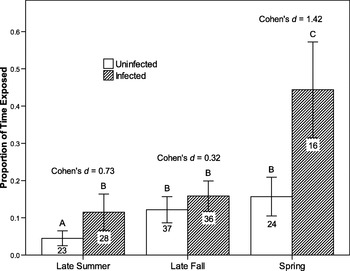
Refuge use by isopods changed significantly between seasons (GLZ, Wald χ22=42·3, P<0·001), and, overall, infected isopods spent more time exposed than uninfected isopods (GLZ, Wald χ21=24·4, P<0·001). However, the effect of A. lucii infection on isopod hiding behaviour depended on the season (GLZ, season×infection interaction, Wald χ22=9·3, P=0·009). Infected isopods spent slightly but significantly more time exposed than uninfected isopods in late summer, but this difference disappeared by late fall (Fig. 1). The largest difference in the hiding behaviour of infected and uninfected isopods was observed in the spring; infected isopods spent much less time under a refuge (Fig. 1).
The average proportion of time uninfected and infected isopods spent exposed, not under a leaf shelter. Isopods were collected in August (late summer), October (late fall), and May (spring), and then observed twice per day for 15 days. Statistical differences (LSD post-hoc tests) between groups are indicated by letters above the columns, i.e. groups that statistically differ do not share a letter. The Cohen's d measure of effect size is given for within-season comparisons between uninfected and infected isopods. Numbers inside columns are sample sizes and bars represent the 95% CI.

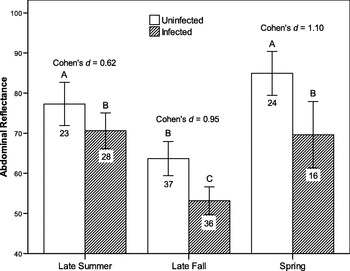
Infected isopods had darker abdominal coloration than uninfected isopods in all seasons (ANOVA, F1, 158=32·2, P<0·001). Isopod abdominal coloration also varied between seasons (ANOVA, F2, 158=33·1, P<0·001); it was darkest in the fall and relatively light in the late summer and spring. The interaction between infection and season was not significant (ANOVA, F2, 158=1·08, P=0·343), suggesting that the effect of A. lucii infection on isopod coloration did not vary between seasons (Fig. 2).
Mean abdominal (pleon) coloration of uninfected and infected isopods collected in August (late summer), October (late fall), and May (spring). Coloration was measured by taking the mean value of pixel reflectance in photographs of individual isopods. Coloration is lighter at higher values on the scale. Statistical differences (LSD post-hoc tests) between groups are indicated by letters above the columns, and the Cohen's d measure of effect size is given for within-season comparisons between uninfected and infected isopods. Numbers inside columns are sample sizes and bars represent the 95% CI.

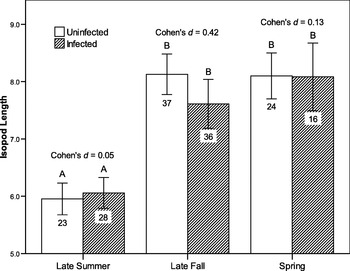
There were seasonal differences in isopod length (ANOVA, F2, 152=45·5, P<0·001); isopods collected in late fall and spring were larger than those collected in late summer (Fig. 3). Male isopods were larger than female isopods (ANOVA, F1, 152=27·9, P<0·001). Infected and uninfected isopods did not significantly differ in length (ANOVA, F1, 152=0·12, P=0·728). None of the interactions between isopod sex, infection, and season were significant (ANOVA, all F<1·40, P>0·24).
The mean length (mm) of uninfected and infected isopods collected in August (late summer), October (late fall), and May (spring). Statistical differences (LSD post-hoc tests) between groups are indicated by letters above the columns, and the Cohen's d measure of effect size is given for within-season comparisons between uninfected and infected isopods. Numbers inside columns are sample sizes and bars represent the 95% CI.

Experiment 2 – effects of light and temperature regime on host manipulation
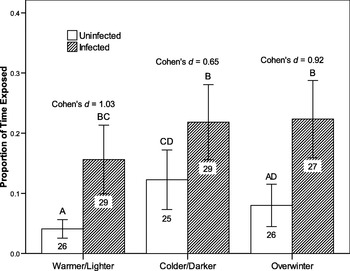
Regardless of the acclimation conditions, infected isopods spent more time exposed than uninfected isopods (GLZ, Wald χ21=30·59, P<0·001; Fig. 4). There was also a main effect of the light/temperature treatment on hiding behaviour (GLZ, Wald χ21=9·82, P=0·007). Isopods in the warmer/lighter treatment tended to spend slightly less time exposed than isopods in the other two treatments (Fig. 4). The divergence between infected and uninfected isopods, however, did not vary significantly between the three treatments (GLZ, treatment×infection interaction, Wald χ21=2·71, P=0·257).
The average proportion of time that uninfected and infected isopods spent exposed, not under a leaf shelter, over 15 days of observation. Before hiding behaviour was observed, isopods were acclimated to 1 of 3 light/temperature regimes for 4 weeks: (1) warmer/lighter, 15–17°C with 18:6 L:D cycle, (2) colder/darker, 10–12°C with 12:12 L:D cycle, and (3) over-winter, 4–6°C with no light. Isopods in the ‘over-winter’ treatment were moved to warmer, lighter conditions (15–17°C, 18:6 L:D) for observation, but hiding behaviour in the other two treatments was recorded under the same conditions to which isopods were acclimated. Statistical differences (LSD post-hoc tests) between groups are indicated by letters above the columns, and the Cohen's d measure of effect size is given for within-season comparisons between uninfected and infected isopods. Numbers inside columns are sample sizes and bars represent the 95% CI.

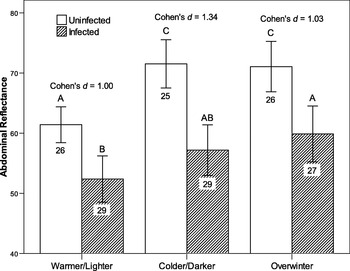
Infected isopods had darker abdominal coloration than uninfected isopods (ANOVA, F1, 155=49·0, P<0·001; Fig. 5). Light/temperature treatment also affected abdominal coloration (ANOVA, F2, 155=10·8, P<0·001). Isopods in the warmer/lighter treatment tended to have darker abdominal pigmentation than isopods in the other two treatments (Fig. 5). The interaction between infection and treatment was not significant (ANOVA, F2, 155=0·89, P=0·412), suggesting that the effect of A. lucii infection on isopod coloration was not affected by the environmental regime.
Mean abdominal coloration of uninfected and infected isopods acclimated to 1 of 3 light/temperature regimes for 4 weeks: (1) warmer/lighter, 16–17°C with 18:6 L:D cycle, (2) colder/darker, 10–12°C with 12:12 L:D cycle, and (3) over-winter, 4–6°C with no light. Coloration was measured by taking the mean value of pixel reflectance in photographs of individual isopods. Coloration is lighter at higher values on the scale. Statistical differences (LSD post-hoc tests) between groups are indicated by letters above the columns, and the Cohen's d measure of effect size is given for within-season comparisons between uninfected and infected isopods. Numbers inside columns are sample sizes and bars represent the 95% CI.

Male isopods were larger than females (ANOVA, F1, 149=8·0, P=0·005). Neither acclimation conditions nor infection alone affected isopod length, and all possible interactions between treatment, infection, and isopod sex were not significant (ANOVA, all F<0·69, P>0·50).
Experiment 3 – host survival and altered behaviour
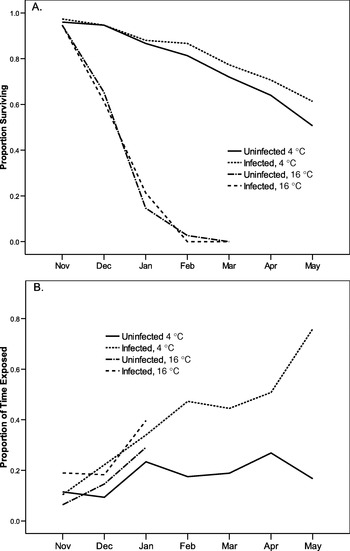
Infection did not affect isopod survival (GLZ, Wald χ21=1·25, P=0·26), but as expected, the isopods maintained at 15–17°C exhibited higher mortality than isopods kept at 4–6°C (GLZ, Wald χ21=782·7, P<0·001). In fact, after 3 months there were not enough isopods alive in the high temperature treatment for additional behavioural observations to be made (Fig. 6A). The time isopods spent exposed tended to increase over the first 3 behavioural observations (RM-ANOVA, F2, 32=5·06, P=0·012). However, this tendency was unaffected by infection or maintenance temperature (Fig. 6B), i.e. all factor by time interactions were not significant (all F<0·64, all P>0·54).
(A) The cumulative survival of uninfected and infected isopods maintained at either 4 or 16°C. (B) The proportion of time that uninfected and infected isopods spent exposed, not under a leaf shelter, for each of the two temperature treatments. Observations on behaviour and survival were made once a month, from November until May. By February, there were not enough isopods surviving in the high temperature treatment for additional behavioural observations to be made.

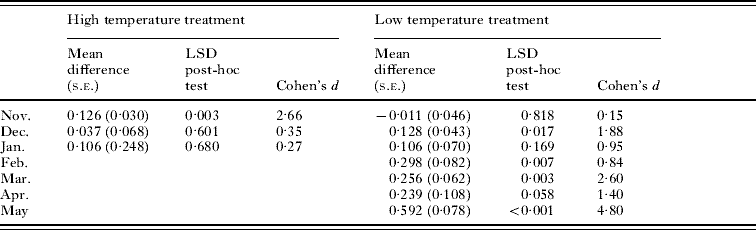
Using just the isopods kept at low temperature, a second RM-ANOVA was conducted to assess isopod behaviour throughout the entire 7 months of observation. For these isopods, refuge use tended to decrease over time (F6, 48=16·8, P<0·001; Fig. 6B). The temporal change in refuge use, though, differed between infected and uninfected isopods (time×infection interaction, F6, 48=8·44, P<0·001). The divergence between infected and uninfected isopods tended to increase over time, peaking in May (Table 1). By May, the time that infected isopods spent exposed had increased to around 75%, but, for uninfected isopods, this value remained around 20% from January onwards (Fig. 6B).
The divergence between infected and uninfected isopod hiding behaviour over 7 months
(Isopods collected at the end of October were subjected to 1 of 2 temperature treatments (4 or 16°C), and their behaviour was observed once a month, from November until May. For each month, the mean difference between infected and uninfected isopods, the P-value associated with an LSD post hoc test, and Cohen's d measure of effect size are given. By February, there were not enough isopods still alive in the high temperature treatment for additional behavioural observations.)
DISCUSSION
Parasitic manipulation of isopod phenotype varied seasonally. Relative to uninfected isopods, the hiding behaviour of infected isopods was heavily modified in spring but minimally altered in late summer and fall. This pattern of behavioural alteration seems to match the seasonal cycle of A. lucii transmission from isopods to fish (i.e. coincident peaks in spring, Brattey, Reference Brattey1988; Chubb, Reference Chubb1982 and references therein). The parasitic modification of host pigmentation, by contrast, did not seem to be more intense in the spring than in the fall, which supports earlier observations that changes in behaviour and coloration are not correlated, perhaps due to dissimilar mechanisms (Benesh et al. Reference Benesh, Valtonen and Seppälä2008). The relative seasonal consistency of altered host coloration may imply that this trait alone does not contribute to A. lucii's seasonal occurrence.
In Exp. 2, isopods maintained in warm, light conditions tended to have darker abdominal coloration and to spend more time hidden than those in the colder, darker treatments, indicating that the traits altered by infection can vary with abiotic factors. The phenotypic divergence between infected and uninfected isopods, however, remained relatively consistent across the three light/temperature regimes. Thus, the seasonal changes in the effect of A. lucii infection on isopod phenotype do not seem to be caused by different abiotic conditions. Indeed, in Exp. 3, isopod behaviour changed over time under constant environmental conditions. Environmentally-mediated changes in host condition also do not seem to induce different levels of host manipulation. In Exp. 3, isopods maintained at about 16°C exhibited the anticipated reduction in survival relative to those kept at 4°C. However, behavioural changes in the infected isopods were not accelerated, suggesting the manipulative effort of A. lucii did not increase as host condition deteriorated. In an 8-week experiment conducted at approximately 16°C, Benesh et al. (Reference Benesh, Valtonen and Seppälä2008) observed a temporal pattern of isopod hiding behaviour that was very similar to that for the isopods observed for 7 months at 4°C, i.e. refuge use decreased over time and then levelled off for uninfected isopods but it continually decreased for infected isopods. It is not known why this accelerated pattern of behavioural changes was not also observed for the infected isopods kept at an elevated temperature in Exp. 3, but these experiments differed in several regards (e.g. mortality levels, animals maintained singly versus in groups). Because neither the abiotic environment nor host condition seem to modify manipulative effort, time remains as the only apparent stimulus for the seasonal changes in the behaviour of infected isopods. Similarly, the acanthocephalan Pomphorhynchus laevis increases manipulation of its gammarid host as it ages (Franceshi et al. Reference Franceshi, Bauer, Bollache and Rigaud2008).
We propose the following events in the seasonal cycle of A. lucii, at least for populations at northern latitudes. Young isopods, born during the summer (Brattey, Reference Brattey1986), can be infected once they reach a size of about 3 mm (Hasu et al. Reference Hasu, Holmes and Valtonen2007). Parasites become infective to fish in late summer or fall (Benesh, unpublished data), but refuge use by infected isopods remains largely unchanged. Because both host manipulation and predation by the definitive host appear low in fall, much of the parasite population is likely to overwinter in isopods (Brattey, Reference Brattey1986). During the winter, the alteration of host hiding behaviour increases as parasites age. Behavioural manipulation reaches a maximum in spring, which presumably facilitates the high levels of recruitment into fish observed at this time of year (Brattey, Reference Brattey1988).
Our observations suggest that changes in host manipulation over time may play a role in A. lucii's seasonal pattern of transmission. However, it is unclear whether the temporal variation in host manipulation is an adaptive consequence of the constraints imposed by seasonally changing conditions. In other words, does seasonality select for a host manipulation strategy in which transmission occurs at an optimal time of year? Though we cannot definitively answer this question, we suggest 3 factors that could make spring a profitable time for A. lucii to be transmitted: (1) frequent encounters with definitive hosts, (2) low potential for additional larval growth, and (3) high likelihood of intermediate host mortality. First, from the parasite's perspective, the availability of definitive hosts increases in spring, as perch seem to consume more macro-invertebrates in spring than fall (Skorping, Reference Skorping1980; Rask and Hiisivuori, Reference Rask and Hiisivuori1985; Brattey, Reference Brattey1988). Some models predict that manipulative effort should increase when encounter rates are low (Poulin, Reference Poulin1994), but this strategy will only be advantageous if increased manipulation actually results in more predation. If isopods are not a major item in the diet of fish in late summer and fall, regardless of how easy they are to catch, then intense host modification at this time of year would not affect parasite transmission success. This could even be a maladaptive strategy if manipulation is energetically costly or if it results in increased susceptibility to non-host predators (Mouritsen and Poulin, Reference Mouritsen and Poulin2003; Seppälä et al. Reference Seppälä, Valtonen and Benesh2008). Second, delaying manipulation may be beneficial if it allows parasites to grow to a larger size, assuming larval size is correlated with fitness (Parker et al. Reference Parker, Chubb, Roberts, Michaud and Milinski2003). Parasites increase in size between late summer and spring, because their hosts grow larger (the size of A. lucii cystacanths increases with isopod size (Benesh and Valtonen, Reference Benesh and Valtonen2007b, Reference Benesh and Valtonenc)). By spring, the potential for additional parasite growth in isopods has thus been reduced, perhaps favouring increased host manipulation. On the other hand, isopod size, and hence parasite size, was similar in late fall and spring, but the alteration of host hiding behaviour was minimal in fall and maximal in spring, suggesting that the behavioural changes are not solely a function of parasite size. Finally, time constraints imposed by isopod life-span could also favour spring transmission. Isopods are older in the spring and presumably more likely to die (Rask and Hiisivuori, Reference Rask and Hiisivuori1985; Brattey, Reference Brattey1986). Thus, the remaining time available for transmission is likely much lower in spring than in fall, perhaps favouring additional investment in host manipulation.
Delaying transmission until spring involves taking the risk of dying during the winter. Parasites do not seem to exacerbate this risk via over-exploitation of their hosts. Infection did not affect isopod survival over 7 months of observation. Moreover, increasing modification of host hiding behaviour did not reduce the survival of infected isopods, although intense host manipulation could be energetically demanding for parasites and thus physiologically stressful for hosts (Poulin, Reference Poulin1994). Nevertheless, some infected isopods died during the winter, indicating that delaying transmission until spring has costs. Alternative transmission strategies might avoid these costs and thereby yield similar or higher fitness, e.g. arrival in fish in late summer and rapid reproduction so as to produce an extra generation before winter. Additional data on A. lucii life history, particularly mortality rates in both hosts and adult fecundity at different times of the year, are thus necessary to confirm that the seasonal changes in host manipulation reflect an adaptive parasite strategy.
As far as we know, this is the first report of seasonal changes in host behaviour associated with infection by a trophically-transmitted parasite. However, the pervasiveness of seasonality in parasite occurrence (e.g. Chubb, Reference Chubb1982) indicates that transmission between hosts is frequently constrained to certain seasons. Consequently, seasonal flexibility in the manipulation of intermediate host phenotypes could often be a profitable parasite strategy.
We gratefully acknowledge financial support from the Biological Interactions Graduate School at the University of Turku (D. P. B.), the Finnish Cultural Foundation (T. H.) and the Academy of Finland (O. S.).