Introduction
The role of pharmacists in disaster medicine is becoming increasingly important.Reference Moore and Kenworthy 1 –Reference Ortmann, Johnson and Jarrell 4 In the United States, pharmacists have helped bridge the gaps in disaster health care by ensuring access to medicines during hurricanes, by conducting interviews, performing triage, and assessing patient treatment needs.Reference Moore and Kenworthy 1 In Japan, which is prone to disasters, 5 the Great East Japan Earthquake (GEJE) of 2011 and other disasters have prompted the establishment of a disaster medical system.
Mobile pharmacy vehicles (MPVs) were also introduced in the wake of lessons learned from the GEJE and can independently dispense and supply prescription drugs in disaster-affected areas. They are converted camper vehicles equipped with portable generators, deep-cycle batteries, solar power units, and water tanks. 6 , Reference Nagata, Iwata and Sone 7 The emphasis on independence stems from the GEJE experience, when disrupted lifelines made dispensing facilities unavailable and support services, such as personnel and medicines, could not be fully utilized.
At 16:00 hours on January 1, 2024, the Noto Peninsula Earthquake (NPE), a magnitude 7.6 tremor in Ishikawa Prefecture, Japan, caused extensive damage. In response, 13 MPVs were dispatched with the cooperation of local pharmacist associations, local governments, and universities. 8
MPVs can be regarded as a disaster preparedness measure unique to Japan, serving as mobile health units (MHUs) 9 focusing on drug supply and dispensing. However, detailed reports on their actual operations remain limited.Reference Sheerazi, Awad and von Schreeb 10 , Reference Sukalo, Catic and Skrbo 11 Given the uniqueness of the system, reports on the currently established command chain and on the operational frameworks for the duration, scale, and prescription of assistance based on actual deployments may provide new international insights in the field of disaster medicine.
This paper aims to describe the current system of MPVs in the “Operational Description” section, report their actual operations by the Wakayama Pharmaceutical Association during the NPE in the “Results” section, and examine the feasibility of their international implementation with reference to existing disaster-response frameworks 12 in the “Discussion” section.
Operational Description
This case report is based solely on the authors’ experience and anonymized, retrospective open-access data, not requiring ethics approval.
Regarding the requirements for MPVs, the Japanese name is trademarked and regulated by the Miyagi Prefectural Pharmacists Association. 13 The name may be used under 5 conditions:
-
(A) the owner or manager must be a pharmacists’ association or a pharmaceutical university;
-
(B) it must not be used for commercial or advertising activities by private companies;
-
(C) the name of the pharmacists’ association or university must be clearly displayed in a visible location on the vehicle;
-
(D) the name or advertisement of a private company must not be displayed on the vehicle; and
-
(E) it must be actively operated by the owning or managing pharmacists’ association or university.
MPV staffing includes an “MPV operation manager” and a “vehicle maintenance manager.” A list of pharmacists should also be prepared for prompt deployment. 13
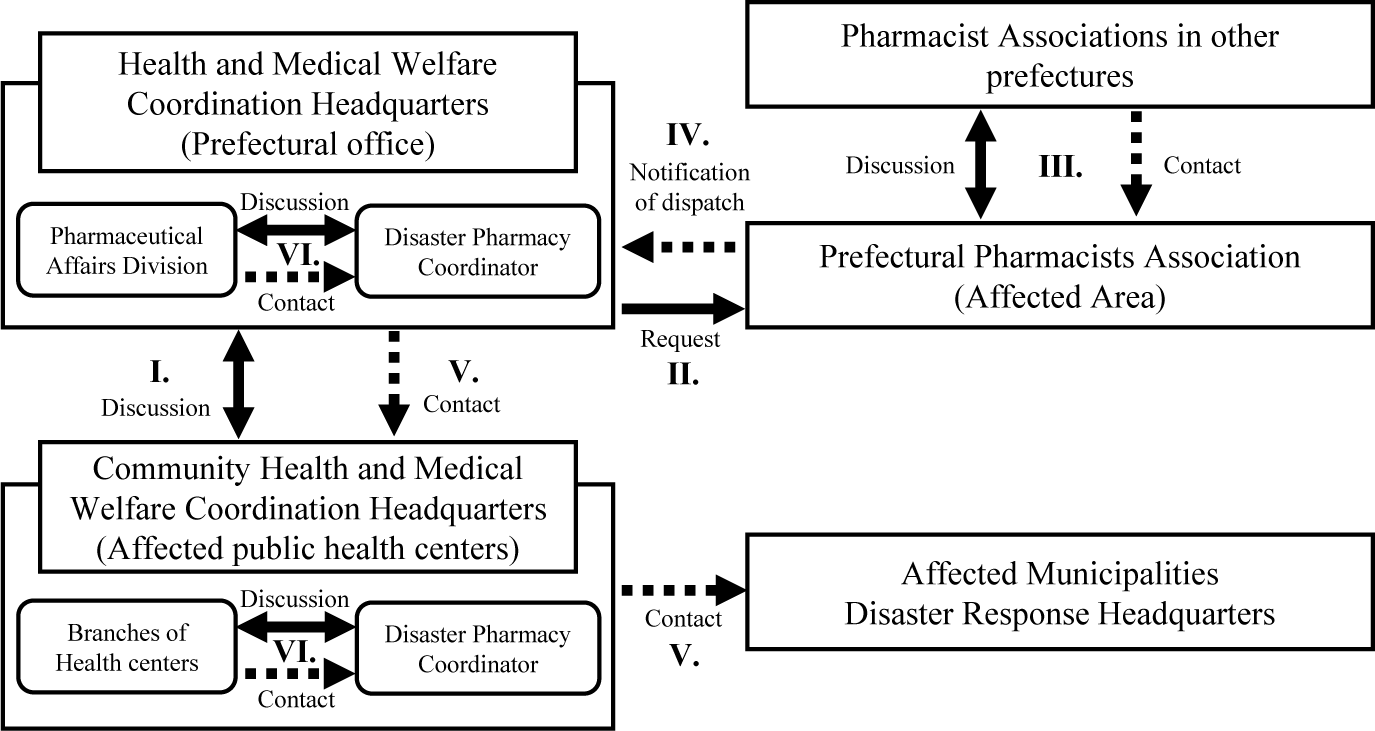
MPVs serve as mobile dispensing centers and consultation points for individual and public health services at disaster evacuation centers. MPVs handle “disaster prescriptions,” issued by noninsured medical institutions such as first-aid stations and evacuation centers. 6 Although not covered by national health insurance, medications are generally provided free of charge as emergency relief. MPVs are crucial for maintaining the supply of medicines in affected areas, but their use in non-critical times may undermine the economic independence and sustainability of local providers and municipalities. Therefore, “disaster pharmacy coordinators” carefully determine areas, duration, and disease coverage for MPV dispensing 14 (Figure 1).
Workflow for the deployment of MPVs (adapted from the “Manual for Pharmaceutical Affairs during Disasters” issued by Miyagi Prefecture 14).
*The numbers I ~ VI indicates the order of the workflow.
I. When a disaster occurs, the Prefectural Pharmaceutical Affairs Division mainly consults with the prefectural disaster pharmacy coordinator to consider the deployment of MPVs.
II. If deployment of MPVs is deemed necessary, the Pharmaceutical Affairs Division requests the prefectural pharmacists’ association to dispatch them.
III. If more MPVs are needed, additional dispatch will be requested by pharmacists’ associations in other prefectures that own MPVs.
IV. The Pharmacists Association will answer whether MPV placement is possible.
V. Regarding the response from the pharmacist association, the Pharmaceutical Affairs Division will contact the prefectural disaster pharmacy coordinator, the Community Health and Medical Welfare Coordination Headquarters, and the Disaster Response Headquarters of the affected municipalities.
VI. The disaster pharmacy coordinators will take the lead in implementing necessary coordination in the acceptance of MPVs.

Results
As outlined above, the MPV system in Japan is built on defined coordination structures. During the NPE, this framework was activated, within which various operational adaptations were implemented.
In the NPE, 13 MPVs received dispatch requests and were operated from January 7 to February 25, patrolling relief stations in the disaster area centered on the Disaster Response Headquarters, and a total of 1,834 disaster prescriptions were issued. 8 Pharmacists operated the MPVs from 9:00 a.m. to 5:00 p.m., followed by reporting and planning sessions. The Wakayama Pharmaceutical Association dispatched the MPVs in 7 teams of 2 to 4 pharmacists each (including one for withdrawal support), which operated from January 9 to 14, January 13 to 17, January 16 to 20, February 15 to 19, February 18 to 22, and February 21 to 25.
MPV medications were standardized by the Ishikawa Pharmaceutical Association and local wholesalers (Supplemental Table 1) and comprised a broad range of medicines, covering both chronic and acute conditions, to allow a flexible response depending on local medical needs. For example, in Anamizu Town, where local medical facilities were largely still operational, the disaster pharmacy coordinator (Figure 1) determined that medications for chronic conditions would be managed by local medical institutions, while MPVs, in coordination with Disaster Medical Assistance Teams (DMATs), would provide acute care. In contrast, in Suzu City, where no operational community pharmacies were present and all clinics were closed due to disaster damage, MPVs primarily dispensed antipyretics, analgesics, and expectorants, partly in response to the concurrent COVID-19 outbreak.
Pharmaceutical inventory and procurement were managed using Google Drive spreadsheets, enabling real-time aggregation of medication needs and coordination of supply decisions, while LINE’s open chat facilitated information sharing among multiple institutions and professions. These measures and the Ministry of Health, Labour and Welfare’s directive to prioritize pharmaceutical supplies for disaster-affected areas averted significant stock shortages.
Discussion
During the NPE, MPVs demonstrated their key strengths—speed and flexibility—through implementation of established procedures described in the “Operational Description” section. Moreover, standardizing medicines stocked on MPVs and developing a drug-ordering information system may have contributed to effective delivery. MPVs were able to begin operations in some affected areas within 1 week of the disaster, possibly because MPVs functioned both as vehicles and as dispensing bases. MPVs also played an important role through their ability to provide adaptable collaborative support with disaster pharmacy coordinators, local pharmacies, and DMATs, thereby enabling tailored responses suited to affected areas.
Experiences from the NPE and previous disasters have informed ongoing refinements of the MPV system. The number of MPVs has increased to over 20 units nationwide, accompanied by ongoing efforts to optimize operational models. An example is the debate over the need for clean benches. Although aseptic procedures are important, space limitations and airlifting of patients requiring advanced treatment have led some pharmacists’ associations to adopt removable clean benches in their MPVs. To avoid confusion, familiarizing all personnel with the capabilities/equipment of each MPV in advance through disaster drills is essential. In addition to reviewing onboard equipment, efforts are underway to develop IT systems for managing dispensing records, patient information, and evacuee locations. Once implemented, these systems are expected to improve information sharing among MPVs and enhance their role as temporary dispensing units.
Based on the established system and its operational performance described above, the MPV system can be considered most similar to the “Type 1 Mobile” category defined by the World Health Organization for Emergency Medical Teams (EMTs).Reference Sheerazi, Awad and von Schreeb 10 , 12 The focus on portability and self-sufficiency, along with establishment of a command structure and headquarters to ensure proper deployment, aligns with the minimum standards for EMTs. However, the MPV system alone is insufficient to meet requirements such as having a multidisciplinary team or providing outpatient clinical services. In this regard, other medical teams, such as DMATs, are required to handle clinical assessments and evaluations, while MPVs complement these teams through close coordination. The small size and limited range of medical services contribute to the rapid initiation of MPV support. Therefore, although the MPV system does not meet all minimum standards, it occupies a unique position in dispensing public health management functions within existing EMTs.
The MPV system utilizes vehicle-based MHUs and is deployed to disaster-affected areas in response to requests. Therefore, countries or regions where road transportation exists are suitable for this service. In addition, in contiguous land areas, MPVs could potentially be used for cross-border humanitarian assistance. However, considering the costs of maintaining and managing vehicles and onboard equipment, exploring non-disaster applications may be necessary to enhance the value of MPV implementation in regions where disasters are infrequent. In recent years, pilot studies have been conducted in depopulated areas of Japan, where establishing pharmacies is challenging, to use MPVs for routine drug supply and medication support. 15 Such regular use may also help maintain MPV operational capacity and enhance readiness for disaster response.
Limitation
This report is based on the authors’ experience and deals only with retrospectively available data. Therefore, detailed patient information is not disclosed, which may lead to potential selection bias. More quantitative data is likely needed to measure MPV’s contribution in more detail.
Conclusion
MPVs are a disaster medical tool unique to Japan, functioning in coordination with local medical institutions and other emergency response teams, including DMATs. In the NPE, MPVs supported existing EMTs by enhancing dispensing and public health management through timely and flexible assistance suited to local medical delivery systems. MPVs are expected to make a similar contribution in regions where vehicles are suitable for transportation and disasters occur frequently. Further development of information management and operational systems, along with their adaptation for other uses, may enhance the utility of the MPV model as a component of disaster medical support in other countries.
Supplementary material
The supplementary material for this article can be found at http://doi.org/10.1017/dmp.2026.10352.
Acknowledgments
We extend our heartfelt gratitude and respect to the members of the Disaster Response Committee of the Wakayama Pharmaceutical Association, whose commitment to emergency response and public health during disasters has greatly informed and inspired our research.
The authors used ChatGPT (OpenAI, GPT-5-mini, accessed at https://chat.openai.com/ on October 2025) to assist with English language phrasing and clarity; all outputs were reviewed and verified by the authors, no data analysis was performed using the AI, and no competing interests arose from its use.
Author contribution
Satoki Kajimoto: Conceptualization, Visualization, Writing—Original draft; Shota Suzuki: Conceptualization, Supervision, Writing—Review and editing; Kunitoshi Okuwa: Resources, Writing—Review and editing; Hiroshi Okada: Conceptualization, Supervision, Writing—Review and editing.
Funding statement
Not applicable.
Competing interests
None.
Ethical standard
Not applicable.