Introduction
Functioning of the hypothalamic-pituitary-adrenal (HPA) axis has frequently been associated with psychopathology. Unfortunately, the prediction of mental disorders from HPA axis functioning prospectively has led to inconsistent results. There are many possible reasons for these inconsistencies, including differences between samples, differences between measures of HPA axis functioning and the measurement of psychopathology. The purpose of the present study is to prospectively predict mental disorders with a first onset between ages 16 and 19 years from HPA axis functioning at age 16 in a large community-based sample while focusing on various indices of HPA axis functioning.
Studies investigating prospective associations between HPA axis functioning and mental disorders in adolescents have mainly focused on various measures of diurnal salivary cortisol and affective disorders. In healthy individuals, cortisol concentrations vary over the day (Kudielka et al. Reference Kudielka, Schommer, Hellhammer and Kirschbaum2004; Fries et al. Reference Fries, Dettenborn and Kirschbaum2009), but are relatively stable when assessed at the same time during consecutive days (Hellhammer et al. Reference Hellhammer, Fries, Schweisthal, Schlotz, Stone and Hagemann2007). Diurnal HPA axis activity can be seen as a trait-like characteristic (Laceulle et al. Reference Laceulle, Nederhof, van Aken and Ormel2014). In various studies, the onset of affective or anxiety disorders could be predicted by either higher peak morning cortisol concentrations (Goodyer et al. Reference Goodyer, Herbert, Tamplin and Altham2000a ), or higher diurnal cortisol concentrations (Harris et al. Reference Harris, Borsanyi, Messari, Stanford, Cleary, Shiers, Brown and Herbert2000; Goodyer et al. Reference Goodyer, Bacon, Ban, Croudace and Herbert2009; Rao et al. Reference Rao, Hammen and Poland2009; Ellenbogen et al. Reference Ellenbogen, Hodgins, Linnen and Ostiguy2011), whereas no prospective association was reported in other studies (Goodyer et al. Reference Goodyer, Herbert, Tamplin and Altham2000b , Reference Goodyer, Herbert and Tamplin2003).
During the first half hour after awakening, there is a steep rise in cortisol concentrations (Kudielka et al. Reference Kudielka, Schommer, Hellhammer and Kirschbaum2004). This increase is called the cortisol awakening response (CAR). The CAR seems a valuable addition to measuring awakening cortisol, because awakening cortisol and CAR represent different functions of the HPA axis. Awakening cortisol represents stable individual differences in HPA axis functioning (Hellhammer et al. Reference Hellhammer, Fries, Schweisthal, Schlotz, Stone and Hagemann2007; Kertes & van Dulmen, Reference Kertes and van Dulmen2012; Laceulle et al. Reference Laceulle, Nederhof, van Aken and Ormel2014), whereas CAR is hypothesized to represent anticipation of the upcoming day (Fries et al. Reference Fries, Dettenborn and Kirschbaum2009; Law et al. Reference Law, Hucklebridge, Thorn, Evans and Clow2013). In a cohort of over 200 17-year-olds a higher CAR predicted episodes of depressive and anxiety disorders in the following years while correcting for waking cortisol (Vrshek-Schallhorn et al. Reference Vrshek-Schallhorn, Doane, Mineka, Zinbarg, Craske and Adam2013; Adam et al. Reference Adam, Vrshek-Schallhorn, Kendall, Mineka, Zinbarg and Craske2014).
Although prospective associations with symptoms of, for example, disruptive behaviours (Sondeijker et al. Reference Sondeijker, Ferdinand, Oldehinkel, Tiemeier, Ormel and Verhulst2008) have been studied, we are not aware of any studies investigating the prospective association between HPA axis functioning and externalizing disorders. This is surprising, because both internalizing and externalizing disorders are stress-related in the broadest sense (e.g. Kim et al. Reference Kim, Conger, Elder and Lorenz2003; Timmermans et al. Reference Timmermans, van Lier and Koot2010). In other words, there are likely causal pathways to a general psychopathology dimension that expresses the tendency to experience psychiatric problems (Lahey et al. Reference Lahey, Van Hulle, Singh, Waldman and Rathouz2011; Caspi et al. Reference Caspi, Houts, Belsky, Goldman-Mellor, Harrington, Israel, Meier, Ramrakha, Shalev, Poulton and Moffitt2014; Laceulle et al. Reference Laceulle, Vollebergh and Ormel2015). Given this overlap in aetiology, we expect HPA axis functioning to be a non-specific predictor of psychopathology.
Cortisol increases as evoked by a social stress test is an aspect of HPA axis functioning which has not previously been studied as a prospective predictor of mental disorders. Social stress tests are an ecologically valid way of inducing stress in human subjects (Benschop et al. Reference Benschop, Geenen, Mills, Naliboff, Kiecolt-Glaser, Herbert, van der Pompe, Miller, Matthews, Godaert, Gilmore, Glaser, Heijnen, Dopp, Bijlsma, Solomon and Cacioppo1998; Dickerson & Kemeny, Reference Dickerson and Kemeny2004). The cortisol increase induced by the test is a frequently used measure of HPA axis functioning (Allen et al. Reference Allen, Kennedy, Cryan, Dinan and Clarke2014). The main physiological function of cortisol is energy mobilization (Sapolsky et al. Reference Sapolsky, Romero and Munck2000), and can be seen as an index of coping effort in demanding situations (Koolhaas, Reference Koolhaas2008). This is consistent with the observation that social situations evoke cortisol increases in the presence of social evaluation, but not in the absence of social evaluation (Gruenewald et al. Reference Gruenewald, Kemeny, Aziz and Fahey2004), the latter being less demanding than the former. In rats, cortisol increases in response to behaviours which differed in perceived stress (winning v. losing a fight, naive v. experienced swimming), were similar in magnitude, whereas differences in cortisol recovery differed (Scheurink et al. Reference Scheurink, Ammar, Benthem, van Dijk and Sodersten1999; Koolhaas et al. Reference Koolhaas, Bartolomucci, Buwalda, Boer, Flugge, Korte, Meerlo, Murison, Olivier, Palanza, Richter-Levin, Sgoifo, Steimer, Stiedl, Dijk, Wohr and Fuchs2011). Thus, the recovery rate might make a better distinction between a perceived stressor and a demanding activity than the rate of activation. Translating these results into the field of psychiatry, we hypothesize that cortisol recovery, rather than cortisol increase, is a predictor of psychopathology.
Another aspect of HPA axis reactivity which could be relevant for psychopathology, is anticipation. ‘Anticipatory HPA axis activity reflects and individual's arousal in expectation of an event’ with unknown content (Laceulle et al. Reference Laceulle, Nederhof, van Aken and Ormel2014, p. 3). Anticipatory cortisol concentrations appear to be associated with mental health, although, to our knowledge, this measure has not frequently been evaluated. Lower anticipatory cortisol concentrations were associated with resilience in a small study with healthy young males (Mikolajczak et al. Reference Mikolajczak, Roy, Luminet and De Timary2008), and higher anticipatory cortisol concentrations seemed associated with psychopathology in adults, although the authors did not report statistical test results (Young et al. Reference Young, Abelson and Cameron2004). Rao et al. (Reference Rao, Hammen, Ortiz, Chen and Poland2008) did not find significant differences in anticipatory cortisol concentrations in adolescents with and without major depressive disorder. In the present study, we wish to explore whether anticipatory cortisol prospectively predicts the onset of mental disorders.
We used data from the TRacking Adolescents’ Individual Lives Survey (TRAILS). Previous investigations of the association between HPA axis functioning and psychopathology in the TRAILS sample have mainly focused on associations of awakening cortisol and CAR with psychopathological symptoms in specific outcome domains. This has not led to a consistent picture (Rosmalen & Oldehinkel, Reference Rosmalen and Oldehinkel2011). A more recent investigation in the TRAILS cohort suggests a cross-sectional association between a higher CAR and more symptoms of depression at age 11, but no association with symptoms of anxiety or externalizing problems (Dietrich et al. Reference Dietrich, Ormel, Buitelaar, Verhulst, Hoekstra and Hartman2013). At age 16, awakening cortisol and CAR were reassessed in a subsample of the TRAILS population, who also participated in a laboratory session during which we assessed HPA axis reactivity to a social stress test. At age 19 a diagnostic interview was administered, which allowed us to study prospective associations of HPA axis functioning with mental disorders. Based on the literature discussed above we hypothesize that CAR, recovery and possibly anticipation are stronger predictors of mental disorders than awakening cortisol and activation during the social stress test.
Method
Sample
Data from the third and the fourth wave of the TRAILS were used. TRAILS is a representative, prospective cohort study of 2230 Dutch adolescents (De Winter et al. Reference De Winter, Oldehinkel, Veenstra, Brunnekreef, Verhulst and Ormel2005; Nederhof et al. Reference Nederhof, Jorg, Raven, Veenstra, Verhulst, Ormel and Oldehinkel2012). Briefly, the TRAILS target sample involved 10- to 12-year-olds living in five municipalities in the North of The Netherlands, including both urban and rural areas. Of the 135 primary schools within the municipalities, 122 agreed to participate in the study, i.e. 90.4% of the schools accommodating 90.3% of the children. School participation was a prerequisite for eligible children and their parents to be approached by the TRAILS staff. Of all children approached for enrolment in the study, 6.7% were excluded because of disability or language problems. Of the remaining 2935 children, 76.0% (n = 2230; 50.8% girls, 49.2% boys; mean age = 11.1 years, s.d. = 0.55) were enrolled in the study. Response rates at the third and fourth waves were 81.4% (n = 1838; 52.0% girls, 48.0% boys; mean age = 16.1 years, s.d. = 0.59), and 83.4% (n = 1881; 52.3% girls, 47.7% boys; mean age = 19.1 years, s.d. = 0.60). All assessments during all waves were approved by the Central Committee on Research Involving Human subjects (CCMO).
Experimental session
At the third measurement wave, a focus sample of 744 adolescents were invited to perform a series of laboratory tasks (hereafter referred to as the experimental session) on top of the usual assessments. Of these adolescents, 715 (96.1%) agreed to do so. Adolescents with one or more risk factors for mental health problems had a greater chance of being selected for the experimental session. The risk factors were defined based on temperament (high frustration and fearfulness, low effortful control), lifetime parental psychopathology, and living in a single-parent family. In total, 66.0% of the focus sample had at least one of the above-described risk factors; the remaining 34.0% were selected randomly from the low-risk TRAILS participants.
During the experimental session, participants’ HPA axis responses to a social stress task were measured. The experimental sessions took place on weekdays, lasted about 3 h and 15 min, and started between 08:00 and 09:30 hours (morning sessions, 49%) or between 01:00 and 02:30 hours (afternoon sessions, 51%). Although free salivary cortisol levels may be higher in the morning due to the circadian rhythm of cortisol production, morning and afternoon cortisol responses to social stress were comparable (Bouma et al. Reference Bouma, Riese, Ormel, Verhulst and Oldehinkel2009), which is in line with other reports (Kudielka et al. Reference Kudielka, Schommer, Hellhammer and Kirschbaum2004). The participants were asked to collect two morning saliva samples in tubes on the day of the experimental session, one directly after waking up (Cm1) (mean time of awakening = 07:39 hours, s.d. = 1:10) and one 30 min later (Cm2). They were instructed not to eat, brush their teeth, or engage in heavy exercise during this half hour, and to bring the tubes with them to the test location. In addition, we asked participants to refrain from smoking and from using coffee, milk, chocolate, and other sugar-containing foods in the 2 h before the session. At the start of the session, the test assistant, blind to the participants’ risk status, explained the procedure and administered a short checklist on current medication use (including oral contraceptives), and adherence to the smoking and food restrictions. The first cortisol sample (Ce1) was taken about 1 h after the start of the session. The social stress test was the last challenge of the experimental session, after which the participants were debriefed.
Social stress test
HPA axis reactivity was assessed in response to the Groningen Social Stress Task (GSST; Bouma et al. Reference Bouma, Riese, Ormel, Verhulst and Oldehinkel2009), a standardized protocol inspired by the Trier Social Stress Task (Kirschbaum et al. Reference Kirschbaum, Pirke and Hellhammer1993) for the induction of moderate performance-related social stress. The GSST elicits significant changes in heart rate and cortisol (Benschop et al. Reference Benschop, Geenen, Mills, Naliboff, Kiecolt-Glaser, Herbert, van der Pompe, Miller, Matthews, Godaert, Gilmore, Glaser, Heijnen, Dopp, Bijlsma, Solomon and Cacioppo1998). Participants were instructed, without prior warning, to prepare a 6-min speech about themselves and their lives and deliver this speech in front of a video camera. They were told that their videotaped performance would be judged on content of speech as well as on use of voice and posture, and rank-ordered by a panel of peers after the experiment. Participants had to speak continuously for the whole 6-min period. The test assistant watched the performance critically, without showing empathy or encouragement. After 6 min of speech, the participants were told that there was a problem with the computer and they had to sit still and be quiet. After this interlude, participants were instructed to subtract 17 repeatedly, starting with 13 278. After 6 min of mental arithmetic, participants had to wait without speaking for 3 min.
Four cortisol samples were taken around the GSST, referred to as Ce2, Ce3, Ce4, and Ce5. Ce2 was taken just before the start of the GSST. There is a delay of approximately 20 min between the production of cortisol by the adrenal glands and the detectability of representative levels of cortisol in saliva. Ce2 hence reflected pre-test HPA axis activity, when the participants completed a rating scale. Ce3 was collected directly after the end of the GSST and reflected HPA axis activity during speech. Ce4 was collected 20 min after the end of the GSST and reflected HPA axis activity during mental arithmetic. Ce5 was collected 40 min after the end of the GSST and reflected post-stress activity of the HPA axis.
Cortisol analysis
Salivary cortisol was assessed by the Salivette sampling device (Sarstedt, Germany) containing a small swab in a plastic tube on which the participants had to chew for 60 s, until the swab was soaked with saliva. This manner of collecting cortisol is relatively stress-free compared to collection by venepuncture and correlations between saliva cortisol levels and serum cortisol concentrations are high (Kirschbaum & Hellhammer, Reference Kirschbaum and Hellhammer1994). After the experimental session, the samples were placed in a refrigerator at 4 °C, and within 4 days brought to the laboratory of the University Medical Center in Groningen, where they were stored at −20 °C until analysis. The intra-assay coefficient of variations were 8.2% for concentrations of 1.5 nmol/ml, 4.1% for concentrations of 15 nmol/ml, and 5.4% for concentrations of 30 nmol/ml. The inter-assay coefficients of variation were, respectively, 12.6%, 5.6%, and 6.0%. The detection border was 0.9 nmol/ml.
HPA axis functioning
Cortisol response variables were computed from the response to awakening and the social stress task. Measures of HPA axis functioning included both morning cortisol and responses to a social stress test. Awakening cortisol was operationalized as cortisol concentration at waking-up (Cm1). The CAR was operationalized as the increase in cortisol in the 30 min after waking-up (Cm2−Cm1). Anticipatory HPA axis activity was operationalized as the first cortisol sample (Ce1) taken at the start of the experimental session, approximately 1 h before the start of the GSST. Awakening cortisol, CAR, and anticipation were standardized using z scores. Cortisol increase by the GSST was computed by regressing cortisol concentrations during the task (Ce3) on cortisol levels before the task (Ce2) and saving the standardized residuals. Positive scores represent relatively high HPA axis activation compared to other participants. Cortisol recovery was computed by regressing cortisol concentrations measured 40 min after the task (Ce5) on cortisol concentrations during the task (Ce3) and saving the standardized residuals. Positive scores represent a flat recovery slope compared to other participants.
Mental disorders
The presence of mental disorders was assessed during the fourth assessment wave, by means of the World Health Organization Composite International Diagnostic Interview (WHO CIDI), version 3.0 (Kessler & Ustun, Reference Kessler and Ustun2004). The WHO CIDI is a structured diagnostic interview which yields lifetime diagnoses and age of first onset of each diagnosis according to the definitions and criteria of the Diagnostic and Statistical Manual of Mental Disorders (DSM-IV; APA, 2000). The following disorders were included in the present study: adult separation anxiety disorder, agoraphobia, alcohol dependence, bipolar I disorder, bipolar II disorder, bulimia, conduct disorder, drug dependence, dysthymia, generalized anxiety disorder, major depressive disorder, neurasthenia, obsessive compulsive disorder, oppositional defiant disorder, pathological gambling, separation anxiety disorder, social phobia and specific phobia. The CIDI has been used in a large number of surveys worldwide, and been shown to have good concordance with clinical diagnoses (Haro et al. Reference Haro, Arbabzadeh-Bouchez, Brugha, de Girolamo, Guyer, Jin, Lepine, Mazzi, Reneses, Vilagut, Sampson and Kessler2006; Kessler et al. Reference Kessler, Avenevoli, Green, Gruber, Guyer, He, Jin, Kaufman, Sampson, Zaslavsky and Merikangas2009). All TRAILS T4 respondents were invited for the diagnostic interview, 84.2% (n = 1584) agreed to attend. Participants were categorized as having no v. at least one first onset during the 3-year follow-up.
For the purpose of additional analyses we also created three variables containing first onsets of narrower disorder categories. Because above-cited evidence for the association between HPA axis functioning and mental disorders was predominantly from the domain of affective/anxiety disorders we created a variable containing all affective and anxiety disorders (i.e. adult separation anxiety disorder, agoraphobia, bipolar I disorder, bipolar II disorder, dysthymia, generalized anxiety disorder, major depressive disorder, separation anxiety disorder, social phobia, and specific phobia). Additionally, we created a variable for major depressive disorder and a variable containing dependence disorders (i.e. alcohol dependence, drug dependence, and pathological gambling). Major depressive disorder and dependence disorders were chosen, because these were the disorder categories with the highest percentage of first onsets during follow-up (5.5% for major depressive disorder, 5.5% for dependence disorders, against 2.8% for neurasthenia and 2.7% for anxiety disorders, all other disorders had less than 2% first onsets during follow-up).
Covariates
Several covariates were included in our study because they were potentially associated with either HPA axis functioning and/or psychopathology: sex, habitual smoking, being overweight, socioeconomic status, educational level, ancestry, start-time of the session and history of psychopathology. In a questionnaire completed at school, about 3 months before the experimental session, smoking behaviour and educational level were assessed. We distinguished non-smokers and habitual smokers (i.e. at least 1 cigarette a day). Educational-level was established by means of the so-called educational ladder, incorporating both progress in and the level of education, a scale ranging from 2 to 10 at the third wave (Nederhof et al. Reference Nederhof, Jorg, Raven, Veenstra, Verhulst, Ormel and Oldehinkel2012). Height and weight were measured at the start of the experimental session. We distinguished between normal and overweight based on these measures in combination with sex and age (Cole et al. Reference Cole, Bellizzi, Flegal and Dietz2000). Ancestry (both parents born in The Netherlands v. others) and socioeconomic position were assessed during the first wave. Socioeconomic position included information about the household income, educational and occupational levels of mother and father (De Winter et al. Reference De Winter, Oldehinkel, Veenstra, Brunnekreef, Verhulst and Ormel2005). The occurrence of a disorder with an onset before the experimental session was derived from the CIDI.
Statistical analyses
Seven-hundred and fifteen adolescents participated in the experimental session. We excluded 126 girls using oral contraceptives (Bouma et al. Reference Bouma, Riese, Ormel, Verhulst and Oldehinkel2009), six participants using corticosteroid-containing medicine or SSRIs, and 22 participants who used a painkiller or who smoked before the experimental session. Missing data in morning cortisol (n = 99), experimental session cortisol (n = 32) and CIDI data (n = 66) were imputed using multiple imputation (Donders et al. Reference Donders, van der Heijden, Stijnen and Moons2006). Twenty datasets were generated using Imputation and Variance Estimation Software (IVEware; Raghunathan et al. Reference Raghunathan, Solenberger and Van Hoewyk2002). Regression coefficients and standard errors (s.e.s) were pooled using Rubin's method for multiple imputation inference in proc mianalyze (Barnard & Rubin, Reference Barnard and Rubin1999). Data of 561 participants were analysed.
We compared participants with and without a new onset disorder after the experimental session using χ2 tests for dichotomous covariates and independent-samples t tests for continuous covariates. The primary analysis consisted of a logistic regression analysis without covariates with awakening cortisol, CAR, anticipation, activation, and recovery as predictors of mental disorders with a first onset during the 3-year follow up. Our secondary analysis included sex, habitual smoking, overweight, socioeconomic status, educational level, ancestry, start time of the session and history of psychopathology as covariates.
Then, analyses were performed to check robustness of the findings from our primary analyses. First, we performed secondary analyses on affective/anxiety disorders while correcting for all other disorders. Then, secondary analyses were performed on major depressive disorder and on dependence disorders, while correcting for all other disorders. As a robustness check, we performed an additional analysis excluding all participants with a past disorder, thus uniquely predicting onsets of first disorders. We also performed a complete case analysis to investigate if our multiple imputations procedure might have affected our results.
Ethical standards
The authors assert that all procedures contributing to this work comply with the ethical standards of the relevant national and institutional committees on human experimentation and with the Helsinki Declaration of 1975, as revised in 2008.
Results
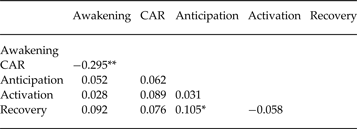
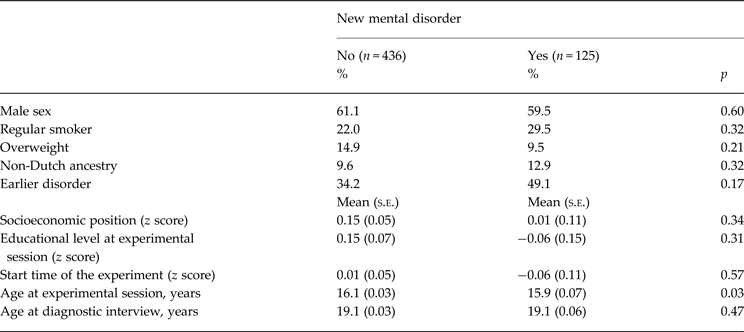
Correlations between unimputed cortisol measures can be found in Table 1. Pooled estimates showed that 125 participants had a mental disorder with an onset after the experimental session, 63 participants had a new onset affective or anxiety disorder, of whom 42 had a major depressive disorder, 40 participants had a new onset dependence disorder. There were no meaningful differences in sociodemographic variables between cases and non-cases (Table 2).
Correlations among cortisol measures

CAR, Cortisol awakening response.
*p < 0.05, **p < 0.01.
Associations with mental disorders with an onset after the experimental session (age 16)

Statistics are based on χ2 tests for dichotomous variables and on independent-samples t tests for continuous variables.
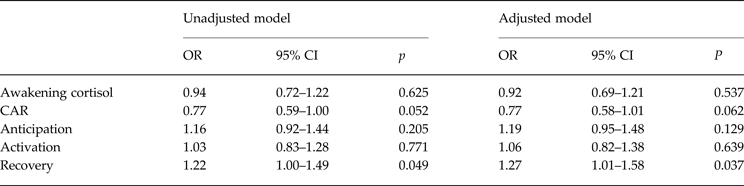
A flat recovery slope predicted disorders with a first onset after the experimental session (Table 3; Fig. 1). A lower CAR marginally significantly predicted new disorders. Including sex, regular smoking, overweight, ancestry, socioeconomic status, educational level, age, start time of the experimental session, and earlier diagnoses as covariates did not alter these results (Table 3). Interactions with sex were not significant (all p > 0.18).
Cortisol concentrations for participants with and without a new onset mental disorder in the 3 years after cortisol assessment at age 16. Cortisol was assessed at awakening, at 30 min after awakening (awakening +30), during the first hour of the experimental session (pre-experiment), during the second hour of the experimental session (pre-test), immediately after the social stress test (stress), 20 min after the social stress test (post-stress), and 40 min after the social stress test (post-test +20).

Results of logistic regression analyses predicting new disorders from indicators of HPA axis functioning (n = 561)

OR, Odds ratio; CI, confidence interval; CAR, cortisol awakening response.
All cortisol variables are standardized. Covariates in the adjusted model: sex, regular smoking, overweight, ancestry, socioeconomic status, educational level, age, start time of the experimental session, and earlier diagnoses.
Recovery revealed smaller, non-significant odds ratios (ORs) when predicting new onset affective or anxiety disorders, corrected for all other new onsets, thus predicting the unique association between HPA axis functioning and affective or anxiety disorders [OR 1.05, 95% confidence interval (CI) 0.97–1.19]. The same was seen when predicting major depressive disorders (OR 1.05, 95% CI 0.91–1.26) or, in a separate model, dependence disorders (OR 1.08, 95% CI 0.91–1.35) from the various indices of HPA axis functioning corrected for all other disorders. ORs for CAR were also not significant when predicting the narrower disorder categories corrected for all other disorders (major depression: OR 0.89, 95% CI 0.74–1.09; dependence: OR 0.72, 95% CI 0.54–1.11), except when predicting affective/anxiety disorders (OR 0.88, 95% CI 0.78–0.95).
Results of our robustness check excluding participants with a past disorder were similar to our main analysis. Recovery significantly predicted first disorders (OR 1.38; 95% CI 1.06–1.79, p < 0.05), CAR marginally significantly predicted first disorders (OR 0.71, 95% CI 0.48–1.03, p = 0.07), whereas the other indicators of HPA axis functioning did not predict first disorders. Moreover, complete case analysis yielded similar findings.
Discussion
This is the first study in which HPA axis functioning during a social stress test was used to predict mental disorders prospectively. Results showed that a flatter recovery after social stress significantly predicted disorders with a first onset in the 3 years following assessment of HPA axis functioning. The effect was smaller and not significant in models including either affective/anxiety disorders, major depression or dependence disorders, each corrected for all other disorders, possibly indicating that the significant prediction of mental disorders in general, or general psychopathology, as Caspi et al. (Reference Caspi, Houts, Belsky, Goldman-Mellor, Harrington, Israel, Meier, Ramrakha, Shalev, Poulton and Moffitt2014) recently labelled it, by cortisol recovery after social stress cannot be fully attributed to a single category of disorders. This suggests that cortisol recovery is an indicator of a more general risk status as opposed to domain-specific risk.
In addition to a statistically significant effect of cortisol recovery, CAR reached marginal significance. A lower CAR predicted mental disorders with a first onset in the 3 years after the experimental session. This finding is not in line with results from another prospective study in adolescents, where a higher CAR predicted the onset and recurrence of depressive and anxiety disorders during follow-up (Adam et al. Reference Adam, Doane, Zinbarg, Mineka, Craske and Griffith2010, Reference Adam, Vrshek-Schallhorn, Kendall, Mineka, Zinbarg and Craske2014; Vrshek-Schallhorn et al. Reference Vrshek-Schallhorn, Doane, Mineka, Zinbarg, Craske and Adam2013). The difference between our study and Adam's studies is the time at which post-awakening cortisol was measured. Adam and colleagues took the second measurement 40 min after awakening, which is 10 min later than our 30 min after awakening. Perhaps, their measure captured a prolonged recovery, which might be more similar to our recovery from the social stress test than to our CAR.
Cortisol recovery after the social stress test showed a prospective association with mental disorders. A flatter recovery predicted new onsets. Results from animal studies suggest that steepness of cortisol recovery gives information about perceived controllability and predictability of the stimulus that elicited a cortisol increase (Koolhaas et al. Reference Koolhaas, Bartolomucci, Buwalda, Boer, Flugge, Korte, Meerlo, Murison, Olivier, Palanza, Richter-Levin, Sgoifo, Steimer, Stiedl, Dijk, Wohr and Fuchs2011). This suggests that individuals at risk for mental disorders perceived the social stress test as less controllable and less predictable. Individuals who experience social situations as less controllable and less predictable could be speculated to be at higher risk for psychopathology through prolonged high cortisol concentrations after such situations. Indeed, prolonged high cortisol concentrations were found in depressed individuals compared to controls in a cross-sectional study (Rao et al. Reference Rao, Hammen, Ortiz, Chen and Poland2008). The question of what caused these prolonged high cortisol concentrations is not answered in these studies. Future studies should unravel whether this is heritable, due to environmental exposure or both.
In this study, prolonged recovery was a predictor of general psychopathology rather than a disorder-specific predictor. If future studies were to reveal a major contribution of environmental exposures to cortisol recovery, this would support the idea that stress predisposes to general psychopathology rather than to any disorder specifically (Caspi et al. Reference Caspi, Houts, Belsky, Goldman-Mellor, Harrington, Israel, Meier, Ramrakha, Shalev, Poulton and Moffitt2014). On the other hand, if future research were to reveal that cortisol recovery is heritable, this would support the idea that most genetic factors are generic risk factors rather than disorder specific (Lahey et al. Reference Lahey, Van Hulle, Singh, Waldman and Rathouz2011). Thus, cortisol recovery is an interesting biomarker for inclusion in future research.
Our results did not suggest a major contribution of awakening cortisol, anticipatory cortisol, or cortisol increase by the social stress test. Several lines of research suggest that an altered cortisol increase is a consequence rather than a predictor of mental disorders with findings pointing in the direction of increased activation in moderate, and blunted responses in severe, chronic cases. For example, in TRAILS, adolescents with a short history of depressive symptoms (less than 2.5 years) had an increased activation in response to a social stress test, whereas adolescents with a long history of depressive symptoms (i.e. at least 5 years) had blunted activation (Booij et al. Reference Booij, Bouma, de Jonge, Ormel and Oldehinkel2013). Another example is that athletes suffering from overtraining syndrome, by definition a chronic disorder, which is characterized by underperformance and fatigue and shows major symptomatic and possibly aetiological overlap with psychiatric disorders (Nederhof et al. Reference Nederhof, Lemmink, Visscher, Meeusen and Mulder2006), have a blunted HPA axis activation in response to exercise, whereas athletes suffering from a less severe form showed increased activation (Meeusen et al. Reference Meeusen, Nederhof, Buyse, Roelands, de Schutter and Piacentini2010).
We showed with data from 561 adolescents that a flatter recovery after a social stress test at age 16 predicts the onset of new mental disorders during a 3-year follow-up. Participants with one or more known risk-factors for psychopathology were over-sampled, because we know that attrition is higher in these participants (De Winter et al. Reference De Winter, Oldehinkel, Veenstra, Brunnekreef, Verhulst and Ormel2005; Nederhof et al. Reference Nederhof, Jorg, Raven, Veenstra, Verhulst, Ormel and Oldehinkel2012), thus increasing the generalizability of our results. A limitation of our study is the exclusion of girls using oral contraceptives. These girls did not show any response to the social stress test in addition to a significantly lower CAR (Bouma et al. Reference Bouma, Riese, Ormel, Verhulst and Oldehinkel2009). It is most likely that this unresponsiveness is directly related to oral contraceptive use, instead of being a precursor of mental disorders. Treating oral contraceptive use as a confounder would not have been sufficient for several reasons. First, including cortisol data unrelated to mental disorders distorts the multiple imputations procedure. Second, oral contraceptive use would need to be included as a moderator of the association between HPA axis functioning and mental disorders, which would have led to decreased power and results that would be difficult to interpret. Therefore, excluding these girls from our analyses seemed most appropriate.
In sum, this was the first study to show that recovery of the HPA axis might be part of a common pathway to psychopathology, not excluding the possibility that other aspects of HPA axis functioning can be disorder-specific.
Acknowledgements
TRAILS has been financially supported by various grants from the Netherlands Organization for Scientific Research NWO (Medical Research Council program grant GB-MW 940-38-011; ZonMW Brainpower grant 100-001-004; ZonMw Risk Behavior and Dependence grants 60-60600-97-118; ZonMw Culture and Health grant 261-98-710; Social Sciences Council medium-sized investment grants GB-MaGW 480-01-006 and GB-MaGW 480-07-001; Social Sciences Council project grants GB-MaGW 452-04-314 and GB-MaGW 452-06-004; NWO large-sized investment grant 175.010.2003.005; NWO Longitudinal Survey and Panel Funding 481-08-013), the Dutch Ministry of Justice (WODC), the European Science Foundation (EuroSTRESS project FP-006), Biobanking and Biomolecular Resources Research Infrastructure BBMRI-NL (CP 32), and the participating universities. This research is part of the TRacking Adolescents’ Individual Lives Survey (TRAILS). Participating centres of TRAILS include various departments of the University Medical Center and University of Groningen, the Erasmus University Medical Center Rotterdam, the University of Utrecht, the Radboud Medical Center Nijmegen, and the Parnassia Bavo group, all in The Netherlands. We are grateful to all adolescents, their parents and teachers who participated in this research and to everyone who worked on this project and made it possible.
Declaration of Interest
None.