INTRODUCTION
In light of the aging global population, the identification of modifiable factors that can prevent or delay cognitive decline in older adults is increasingly important due to the lack of disease-modifying treatments for late-life cognitive disorders, such as dementia. Stress is a modifiable environmental factor that may have important implications for cognitive aging. The psychological experience of stress includes both the occurrence of stressors (e.g., exposure to traumatic life events, ongoing caregiving burden, or job-related strain) and the interpretations of and reactions to these stressors (Cohen, Kessler, & Gordon, Reference Cohen, Kessler and Gordon1997). Indeed, it is the subjective perception of distress that likely triggers the cascade of neuroendocrine changes that can negatively affect health outcomes in the presence of stressful life events (Dedovic, Duchesne, Andrews, Engert, & Pruessner, Reference Dedovic, Duchesne, Andrews, Engert and Pruessner2009). In addition to being a risk factor for numerous negative late-life physical health outcomes (Epel et al., Reference Epel, Lin, Wilhelm, Wolkowitz, Cawthon, Adler and Blackburn2006; Gouin, Hantsoo, & Kiecolt-Glaser, Reference Gouin, Hantsoo and Kiecolt-Glaser2008), stress is also a risk factor for late-life cognitive impairment, cognitive decline (Aggarwal, et al., Reference Aggarwal, Wilson, Beck, Rajan, Mendes de Leon, Evans and Everson-Rose2014; Peavy et al., Reference Peavy, Salmon, Jacobson, Hervey, Gamst, Wolfson and Galasko2009), and dementia (Machado et al., Reference Machado, Herrera, De Pablos, Espinosa-Oliva, Sarmiento, Ayala and Cano2014).
Perceived Stress and Cognition
Prior research on the effects of stress on cognitive aging has largely focused on the influence of specific negative life events (Dickinson, Potter, Hybels, McQuoid, & Steffens, Reference Dickinson, Potter, Hybels, McQuoid and Steffens2011) or daily stressors (Rickenbach, Almeida, Seeman, & Lachman, Reference Rickenbach, Almeida, Seeman and Lachman2014) and whether the occurrence of these “objective” stressors is associated with late-life cognitive impairment or decline. However, measuring exposure to stressors alone may not capture the subjective experience of stress due to individual differences in coping style or appraisals of environmental factors and life experiences. Perceived (i.e., subjective) stress reflects an individual’s cognitively mediated emotional response to a stressor, which includes assessment of available coping resources in response to a stressor, regardless of the type of stressor (Cohen, Kamarck, & Mermelstein, Reference Cohen, Kamarck and Mermelstein1983). Previous research suggests that higher levels of perceived stress is associated with poorer cognitive functioning among older adults (Munoz, Sliwinski, Scott, & Hofer, Reference Munoz, Sliwinski, Scott and Hofer2015). Indeed, high perceived stress was associated with both lower baseline cognition and faster decline over 6 years in adults over age 65 years in the Chicago Health and Aging Project (Aggarwal et al., Reference Aggarwal, Wilson, Beck, Rajan, Mendes de Leon, Evans and Everson-Rose2014). Further, the cognitive domain of episodic memory appears to be particularly sensitive to the effects of greater perceived stress (VonDras, Powless, Olson, Wheeler, & Snudden, Reference VonDras, Powless, Olson, Wheeler and Snudden2005). A deeper understanding of this association is important, as episodic memory difficulties are a prominent aspect of age-related decline, in addition to being one of the earliest predictors of dementia (Bäckman, Small, & Fratiglioni, Reference Bäckman, Small and Fratiglioni2001; Boraxbekk et al., Reference Boraxbekk, Lundquist, Nordin, Nyberg, Nilsson and Adolfsson2015). Although the physiological pathways (e.g., hippocampal atrophy) involving stress biomarkers have been previously explored (Juster, McEwen, & Lupien, Reference Juster, McEwen and Lupien2010; Justice, Reference Justice2018; McEwen & Sapolsky, Reference McEwen and Sapolsky1995), less is known regarding the socioemotional pathways (e.g., depressive symptoms) linking perceived stress and cognition.
The Mediating Role of Depressive Symptoms
In addition to its impact on late-life cognition and dementia pathology, greater perceived stress is also associated with the development of depressive symptoms and clinical depression throughout the lifespan (Cohen, Janicki-Deverts, & Miller, Reference Cohen, Janicki-Deverts and Miller2007; Tafet & Bernardini, Reference Tafet and Bernardini2003). Further, there is growing evidence that late-life depressive symptoms are prospectively associated with cognitive impairment, and decline, particularly in the domain of episodic memory (Dotson, Resnick, & Zonderman, Reference Dotson, Resnick and Zonderman2008; O’Shea et al., Reference O’Shea, Fieo, Hamilton, Zahodne, Manly and Stern2015). Depressive symptoms in late-life have also been associated with clinical dementia (Richard et al., Reference Richard, Reitz, Honig, Schupf, Tang, Manly and Luchsinger2013). Results from a meta-analysis revealed that both diagnosed major depressive disorder and depressive symptoms in late-life are associated with increased risk of dementia (Cherbuin, Kim, & Anstey, Reference Cherbuin, Kim and Anstey2015). There is also evidence to suggest that depressive symptoms precede memory decline, rather than the inverse (Zahodne, Stern, & Manly, Reference Zahodne, Stern and Manly2014).
Despite the link between perceived stress and depression, not all individuals who experience stress develop depressive symptoms or cognitive impairment. Therefore, the presence of depressive symptoms in the face of perceived stress may be an indicator of an individual’s psychological and physiological vulnerability to the toxic effects of stress. Depressive symptoms may therefore function as a mediator of the relationship between perceived stress and cognitive impairment or decline. Most prior studies on perceived stress and late-life cognition have either not considered the role of depressive symptoms or statistically controlled for their presence. However, if depressive symptoms are indeed a part of the underlying process linking perceived stress to late-life cognitive impairment or dementia, interventions designed to reduce or manage depressive symptoms in the face of stress may help promote healthy cognitive aging.
Sociodemographic Moderators
Differential vulnerability to the impacts of perceived stress and depressive symptoms may contribute to late-life disparities in cognitive aging. Women and certain racial and ethnic groups appear to be at greater risk for late-life cognitive disorders such as Alzheimer’s disease (“Alzheimer’s Disease Facts and Figures,” 2019; Carter, Resnick, Mallampalli, & Kalbarczyk, Reference Carter, Resnick, Mallampalli and Kalbarczyk2012; Mayeda, Glymour, Quesenberry, & Whitmer, Reference Mayeda, Glymour, Quesenberry and Whitmer2016; Podcasy & Epperson, Reference Podcasy and Epperson2016). Interactions between sociodemographic characteristics and perceived stress may contribute to these observed inequalities. For example, there is evidence suggesting that older women may experience greater vulnerability to life stress, as evidenced by more symptoms of depression in the presence of chronic financial and health strain, compared to men (Krause, Reference Krause1986). Analyses of gender differences in stress and coping methods suggest that while men and women may not differ on the number of stressful life experiences, women are more likely to rate stressful events as more negative and less controllable than men (Matud, Reference Matud2004). There is also evidence for differential biological reactivity to stress between men and women (Verma, Balhara, & Gupta, Reference Verma, Balhara and Gupta2011), which may contribute to the higher incidence, chronicity, and severity of depression among women (Hammen, Kim, Eberhart, & Brennan, Reference Hammen, Kim, Eberhart and Brennan2009; Kessler, Reference Kessler2003; Kornstein, Reference Kornstein2002). Thus, it is possible that differences in biological and behavioral responses to stress among men and women contribute to the current gender disparities observed in late-life cognitive outcomes.
Compared with non-Hispanic Whites, racial and ethnic minorities may be especially vulnerable to the negative impact of stress due to negative life events and chronic stressors (Ulbrich, Warheit, & Zimmerman, Reference Ulbrich, Warheit and Zimmerman1989), in addition to experiencing more stress overall (Golding & Burnam, Reference Golding and Burnam1990; Salgado de Snyder, Cervantes, & Padilla, Reference Salgado de Snyder, Cervantes and Padilla1990; Shuey & Willson, Reference Shuey and Willson2008; Turner & Avison, Reference Turner and Avison2003; Williams, Yan Yu, Jackson, & Anderson, Reference Williams, Yan Yu, Jackson and Anderson1997). Indeed, one epidemiological study of older adults documented an increase in experiences of stress due to loss-related events for non-Hispanic Blacks, but not Whites, over a period of 9 years (George & Lynch, Reference George and Lynch2003). Additionally, although stress was associated with depressive symptoms regardless of race, increasing stress explained more variance in depressive symptoms for Blacks than for Whites. Finally, depressive symptoms appear to be more strongly associated with episodic memory and executive functioning in Black older adults compared to White older adults (Zahodne, Nowinski, Gershon, & Manly, Reference Zahodne, Nowinski, Gershon and Manly2014).
Prior research on racial/ethnic differences in stress exposure and the impact of stress, however, have largely focused on objective measures of stress rather than perceived stress. Comparisons of perceived stress in response to specific negative life events between Black and White women have revealed group differences in which events were appraised as more subjectively stressful (Vines, Ta, Esserman, & Baird, Reference Vines, Ta, Esserman and Baird2009). Specific types of stress exposure may be unique to racial and ethnic minorities, such as racial discrimination. Differences in perceived stress due to such racial/ethnic differences in stressors, as well as racial/ethnic differences in the likelihood of receiving depression treatments (Williams et al., Reference Williams, González, Neighbors, Nesse, Abelson, Sweetman and Jackson2007), may contribute to the current racial and ethnic disparities observed in late-life cognitive outcomes.
Perceived Control
Identifying modifiable factors that can buffer the negative impacts of perceived stress and depressive symptoms can help inform the development of prevention and intervention strategies to reduce cognitive morbidity and eliminate sociodemographic disparities. Perceived control is one modifiable psychological resource that has been shown to buffer against the effects of traumatic (Elliot, Mooney, Infurna, & Chapman, Reference Elliot, Mooney, Infurna and Chapman2017), acute, and chronic (Cummins, Reference Cummins1988; Diehl & Hay, Reference Diehl and Hay2010) stress exposure. Perceived control refers to the degree to which people believe that they have the capacity to influence life outcomes (Wallston, Wallston, Smith, & Dobbins, Reference Wallston, Wallston, Smith and Dobbins1987). Epidemiological studies have shown that sense of control is among the most important psychosocial predictors of morbidity, mortality, and psychological well-being in later adulthood, independent of key predictors such as age, gender, disability, and socioeconomic status (Gerstorf et al., Reference Gerstorf, Heckhausen, Ram, Infurna, Schupp and Wagner2014; Lachman, Reference Lachman2006). Greater perceived control has also been shown to mitigate risk for the development of depression in the presence of numerous acute and chronic stressors (Grote, Bledsoe, Larkin, Lemay, & Brown, Reference Grote, Bledsoe, Larkin, Lemay and Brown2007). It may be that individuals with greater perceived control engage in more adaptive or solution-focused coping strategies (Gourounti et al., Reference Gourounti, Anagnostopoulos, Potamianos, Lykeridou, Schmidt and Vaslamatzis2012), which may buffer against the negative effects of perceived stress.
In addition to its association with a variety of mental and physical health outcomes (Chipperfield, Campbell, & Perry, Reference Chipperfield, Campbell and Perry2004), perceived control is also associated with cognitive performance in domains such as memory, verbal intelligence, and processing speed among young, middle-aged, and older adults (Windsor & Anstey, Reference Windsor and Anstey2008). Individuals with greater perceived control may be more likely to use compensatory strategies to maintain cognitive functioning (Lachman & Andreoletti, Reference Lachman and Andreoletti2006) or engage in health behaviors that can buffer the negative effects of stress on cognition (Infurna & Gerstorf, Reference Infurna and Gerstorf2013). Thus, it is possible that differences in perceived control influence the degree to which perceived stress and/or depressive symptoms negatively impact cognition among older adults.
The Current Study
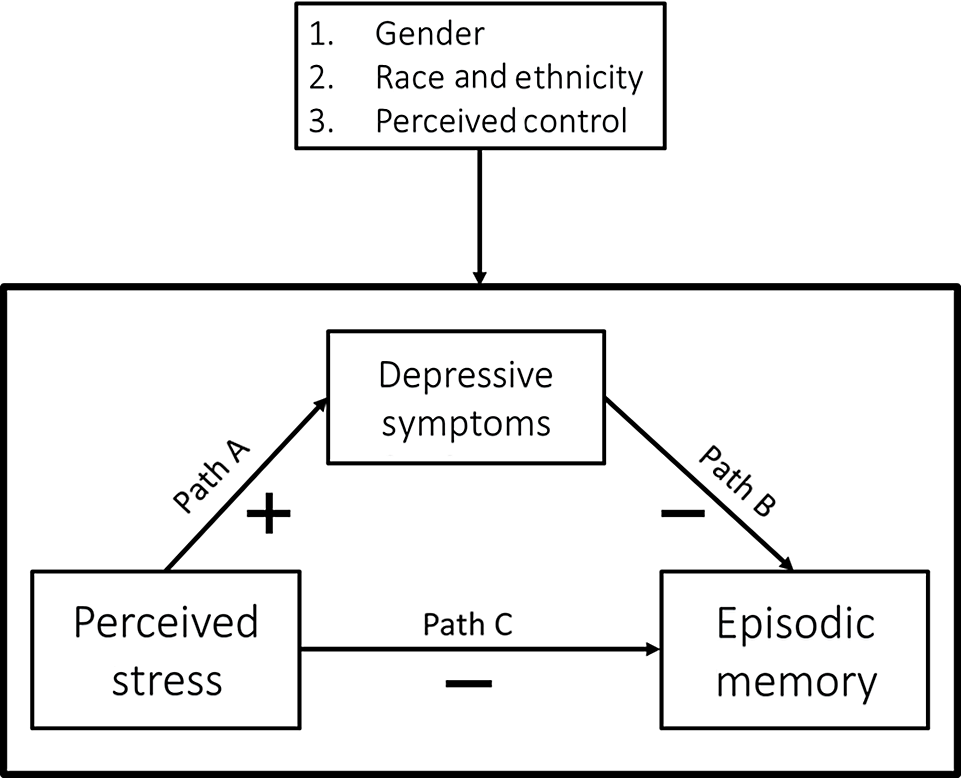
The objective of the current cross-sectional study was to integrate and extend previous research related to perceived stress, depressive symptoms, and cognition in older adults. Our first aim was to replicate prior findings, which suggest that perceived stress may have a negative impact on episodic memory. Thus, we hypothesized that greater perceived stress would be associated with poorer episodic memory (see Figure 1, Path C) in a diverse sample of urban-dwelling older adults.
Conceptual model. Hypothesized positive and negative associations between perceived stress, depressive symptoms, and episodic memory are depicted in the conceptual model. Moderating effects of gender, race, and ethnicity, and perceived control were tested for the direct (c) and indirect (a and b) paths of the mediation model.

Our second aim was to investigate whether the relationship between perceived stress and memory is mediated by depressive symptoms. Specifically, we hypothesized that higher perceived stress would be associated with more depressive symptoms (Figure 1, Path A), and more depressive symptoms would be associated with worse memory performance (Figure 1, Path B).
Our third aim was to identify sociodemographic and psychological factors that could moderate associations involving perceived stress and depressive symptoms. We hypothesized that (1) the positive association between perceived stress and depressive symptoms, (2) the negative association between perceived stress and episodic memory, and (3) the negative association between depressive symptoms and episodic memory would each be stronger in women, non-Hispanic Blacks, and Hispanics, as compared with men and non-Hispanic Whites, respectively. Additionally, we hypothesized that having more perceived control would be associated with weaker associations among perceived stress, depressive symptoms, and episodic memory (see Figure 1 for the full conceptual model).
METHOD
Participants and Procedures
The 578 participants included in this study were participants in the Washington Heights-Inwood Columbia Aging Project (WHICAP), a longitudinal study of aging and dementia in a multiethnic community cohort in New York (Manly et al., Reference Manly, Bell-McGinty, Tang, Schupf, Stern and Mayeux2005; Tang et al., Reference Tang, Cross, Andrews, Jacobs, Small, Bell and Mayeux2001). Participants residing in the northern Manhattan communities of Washington Heights and Inwood were identified through Medicare records and recruited for the prospective study beginning in 1992. Additional participants were recruited in waves beginning in 1999 and 2009. Participants are followed up every 18 to 24 months and undergo detailed assessments of physical health, functional abilities, and cognition in their preferred language of English or Spanish. Cognitive functioning is assessed in-person through a comprehensive neuropsychological battery. Importantly, the same cognitive constructs of memory, language, visual-spatial abilities, and processing speed are measured by the English and Spanish batteries as demonstrated through prior factor analysis in WHICAP (Siedlecki et al., Reference Siedlecki, Manly, Brickman, Schupf, Tang and Stern2010). Beginning in 2013, 600 non-demented participants recruited in the most recent wave (beginning in 2009) also completed validated measures of psychosocial functioning as part of an ancillary study (Zahodne, Watson, Seehra, & Martinez, Reference Zahodne, Watson, Seehra and Martinez2017). Thus, the present cross-sectional study uses data obtained from these participants during study visits that occurred between 2013 and 2017.
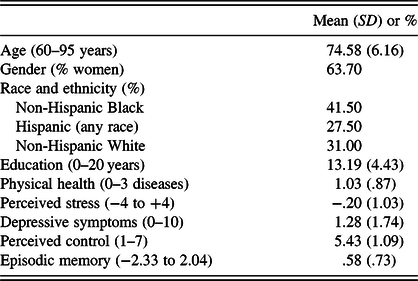
Participants were included in the present study if they (1) had available data on the variables of interest (see below) and (2) self-identified as non-Hispanic Black, non-Hispanic White, or Hispanic of any race (nine participants who identified as “other” race were excluded). Over 95% of participants were retained, leading to a final sample size of 578 individuals. Informed consent was obtained from all participants, and the study was approved by the Columbia University Institutional Review Board. Descriptive characteristics on all study participants are summarized in Table 1.
Participant characteristics

Measures
Outcome
Episodic memory was assessed via the Selective Reminding Test (SRT; Buschke & Fuld, Reference Buschke and Fuld1974). Previous studies demonstrated the clinical utility of the SRT in differentiating normal cognitive aging from dementia at preclinical stages (Masur et al., Reference Masur, Fuld, Blau, Thal, Levin and Aronson1989). A list of 12 words was presented and participants were given six trials to learn this list. At the end of each trial, participants were reminded of any words they failed to recall immediately following list presentation. A total learning score was computed as the sum of words correctly recalled over the six trials. Delayed free recall and recognition were assessed after a 15-min delay. A memory composite score was computed by averaging the Z scores from initial learning, delayed recall, and recognition trials of the SRT based on the performance of the larger WHICAP sample. Higher scores correspond to better memory performance.
Exposure
Perceived stress was measured using the NIH Toolbox Perceived Stress Survey (Kupst et al., Reference Kupst, Butt, Stoney, Griffith, Salsman, Folkman and Cella2015; Salsman et al., Reference Salsman, Butt, Pilkonis, Cyranowski, Zill, Hendrie and Cella2013), a 10-item version of the Perceived Stress Scale (Cohen et al., Reference Cohen, Kamarck and Mermelstein1983), which has been demonstrated to have good internal consistency (Cronbach’s alpha = .91) and concordance with objective measures of stress exposure, such as life events or daily stressors scales (Stawski, Sliwinski, Almeida, & Smyth, Reference Stawski, Sliwinski, Almeida and Smyth2008). The 10-item scale has demonstrated measurement invariance across English and Spanish languages (Perera et al., Reference Perera, Brintz, Birnbaum-Weitzman, Penedo, Gallo, Gonzalez and Llabre2017), gender, and time (Barbosa-Leiker et al., Reference Barbosa-Leiker, Kostick, Lei, McPherson, Roper, Hoekstra and Wright2013) and has also been validated for use with older adults (Ezzati et al., Reference Ezzati, Jiang, Katz, Sliwinski, Zimmerman and Lipton2014). Participants rated the frequency of stressful experiences and the extent to which they felt strained or overloaded during the past month (e.g., How often have you felt nervous and “stressed”? How often have you felt difficulties were piling up so high that you could not overcome them?) on a five-point scale, ranging from Never (1) to Very Often (5). A theta score (range −4 to +4) was computed for each participant, representing the overall perceived stress for that participant; higher scores correspond to greater perceived stress.
Mediator
The presence of depressive symptoms during the week leading up to the interview was assessed with 10 items from the Center for Epidemiologic Studies Depression (CES-D) Scale (Irwin, Artin, & Oxman, Reference Irwin, Artin and Oxman1999). Prior research on older adults has demonstrated the shortened and dichotomous version of the CES-D scale to have adequate internal consistency (Cronbach’s alpha = .78), measurement invariance across English and Spanish languages (González et al., Reference González, Nuñez, Merz, Brintz, Weitzman, Navas and Gallo2017), and factor structure in line with the original 20-item measure which assesses frequency of depressive symptoms on a 4-point Likert scale (Turvey, Wallace, & Herzog, Reference Turvey, Wallace and Herzog1999). Items such as “Everything was an effort” and “I felt depressed” were presented in yes (1)/ no (0) format. Responses were summed, and higher scores correspond to the presence of more depressive symptoms.
Moderators
Sociodemographic data: The WHICAP population comprises three primary racial and ethnic groups: non-Hispanic Black/African American, Hispanic (mostly Caribbean Hispanic), and non-Hispanic White. Race and ethnicity were self-reported, and participants were dummy-coded into three, mutually exclusive categories: non-Hispanic Black, non-Hispanic White, and Hispanic of any race. Non-Hispanic White was selected as the reference category. Gender was assessed via self-report and coded as a dichotomous variable (men/ women) with men as the reference category.
Perceived control: Perceived control was assessed using the Perceived Control Questionnaire (Lachman & Weaver, Reference Lachman and Weaver1998). Of the 578 participants included in this study, 441 had available data on this measure. The questionnaire is composed of 12 statements that assess sense of personal mastery (i.e., “I can do just about anything I really set my mind to”) and perceived constraints on life situations (i.e., “There are many things that interfere with what I want to do”). Participants rated responses on a seven-point Likert scale ranging from Strongly Agree (1) to Strongly Disagree (7). Four of the 12 items were reverse-coded, and a total perceived control score (average) was computed such that higher scores indicate greater perceived control.
Covariates
Age, education, gender, race and ethnicity, and physical health were included as sociodemographic covariates in the primary model (Aim 1). Age was participants’ age (in years) at the time of assessment. Education was participants’ self-reported years of education (0–20). Physical health was assessed via self-report and quantified as the sum of the presence of hypertension, diabetes, and heart disease.
Analytic Strategy
Statistical analyses were conducted using IBM SPSS v. 25. Differences in perceived stress, depressive symptoms, and memory between genders and across racial/ethnic groups were assessed with t tests and analysis of variance. Multiple linear regression models examined direct and indirect effects of perceived stress on episodic memory through depressive symptoms. These models controlled for age, education, gender, race and ethnicity, and physical health. Subsequent models systematically tested for moderation of the perceived stress–depressive symptoms–episodic memory mediation pathways (see Figure 1). Mediation and moderated mediation effects were probed for further analysis using the PROCESS modeling tool for SPSS (Hayes, Reference Hayes2017). Confidence intervals (CIs) of indirect effects (i.e., mediation) of perceived stress through depressive symptoms were generated through 5000 bootstrapped samples (Hayes, Reference Hayes2017). Four separate moderated mediation models included interaction terms involving each of the proposed moderators: gender, Black race, Hispanic ethnicity, and perceived control. Conditional direct and indirect effects of perceived stress were assessed comparing both genders, the three racial/ethnic groups, and three levels of perceived control (high = +1 SD, medium = mean, and low = −1 SD). Diagnostics were included to test for multicollinearity with tolerance value <.2 and variance inflation factor value >4.0 as cutoffs (Garson, Reference Garson2012). Statistical significance at all levels of analysis was evaluated at the p < .05 level.
Results
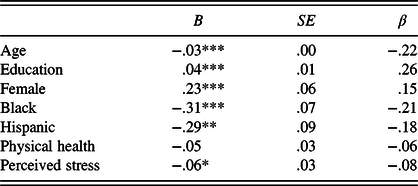
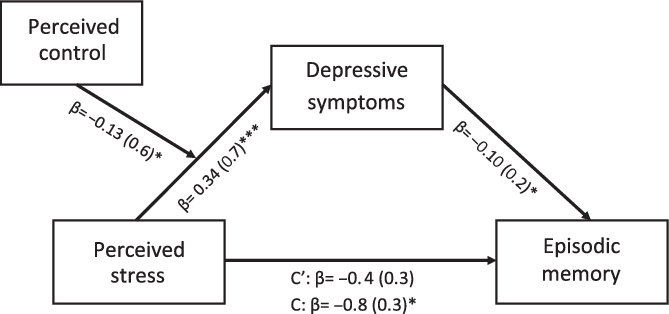
Results from the initial regression model are summarized in Table 2, and all significant paths are depicted in Figure 2. Results did not indicate any concerns of multicollinearity among variables. Participants included in the study (N = 578) did not differ from those who were excluded (N = 22) due to missing data on variables of interest (all ps > .05), except for race and ethnicity. Specifically, the proportion of non-Hispanic Blacks to non-Hispanic Whites was larger among excluded participants (2.25:1) than included participants (1.34:1).
Linear regression of perceived stress and episodic memory (Aim 1)

B = unstandardized coefficient; SE = standard error; β = standardized coefficient.
Standardized estimates from all significant paths. C = total effect. C’ = direct effect. *p < .05, **p < .01, ***p < .001.

Mediation (Aims 1 and 2)
The initial regression model excluding depressive symptoms indicated a negative relationship between perceived stress and episodic memory. Specifically, greater perceived stress was associated with worse episodic memory, independent of the covariates (β = −.08, SE = .03, p < .05). A subsequent model revealed a negative indirect effect of perceived stress on memory through depressive symptoms [completely standardized indirect effect = −.03, SE = .01, 95% CI (−.06, −.01)]. As shown in Figure 2, greater perceived stress was associated with more depressive symptoms (β = .34, SE = .07, p < .001), and more depressive symptoms were associated with worse memory (β = −.10, SE = .02, p = .01).
Robustness of findings was confirmed with the following sensitivity analyses: (1) running an alternate model with perceived stress as the mediator between depressive symptoms and episodic memory, (2) replacing the memory composite with the SRT components (initial learning, delayed recall, and recognition) as separate memory outcomes, (3) excluding participants with mild cognitive impairment, (4) adding monthly household income as an additional covariate, (5) expanding the physical health covariate, and (6) adding time between assessment dates as a covariate. Detailed results are provided in the Supplementary Materials. Notably, effects of perceived stress, both directly and indirectly through depressive symptoms, were the same as the original analyses for initial learning and delayed recall, but not recognition. Upon adjusting for income, depressive symptoms were no longer a significant mediator of the association between perceived stress and episodic memory [completely standardized indirect effect = −.02, SE = .01, 95% CI (−.05, .00)] because there was no longer an association between depressive symptoms and memory (β = −.07, SE = .02, p = .07). However, the total effect of perceived stress on episodic memory (β = −.08, SE = .03, p < .05) and the association between perceived stress and depressive symptoms (β = .34, SE = .07, p < .001) did not change from the original model.
Moderated Mediation (Aim 3)
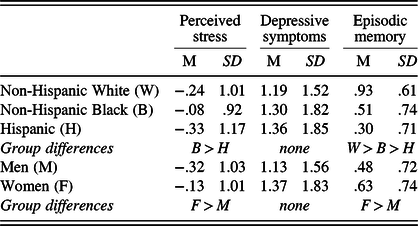
Mean comparisons of key study variables (perceived stress, depressive symptoms, and episodic memory) across race, ethnicity, and gender are reported in Table 3. Analyses revealed racial and ethnic differences in perceived stress [F(2, 575) = 3.26, p < .05] and episodic memory [F(2, 575) =36.75, p < .001]. Non-Hispanic Blacks reported the highest perceived stress, followed by non-Hispanic Whites and Hispanics, and post hoc comparisons using the Tukey’s HSD test revealed a significant difference (p = .02, Cohen’s d = .24) between non-Hispanic Blacks and Hispanics only. All three racial and ethnic groups differed on episodic memory (all ps ≤ .01, ds = .29–.95), such that non-Hispanic Whites demonstrated the highest episodic memory, followed by non-Hispanic Blacks, then Hispanics. There were also gender differences in perceived stress [t(576)= −2.09, p < .05] and episodic memory [t(576)= −2.44, p < .05]. Specifically, women reported higher perceived stress (d = .18) and episodic memory (d = .21) compared to men. There were no group differences in depressive symptoms.
Mean differences in key study variables across race/ethnicity and gender

Note: All group differences were evaluated at p < .05.
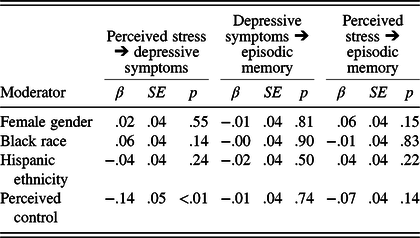
In a moderated mediation model, neither gender nor race/ethnicity moderated any associations among perceived stress, depressive symptoms, and episodic memory (Table 4).
Standardized regression results of interactions with moderators (Aim 3)

SE = standard error.
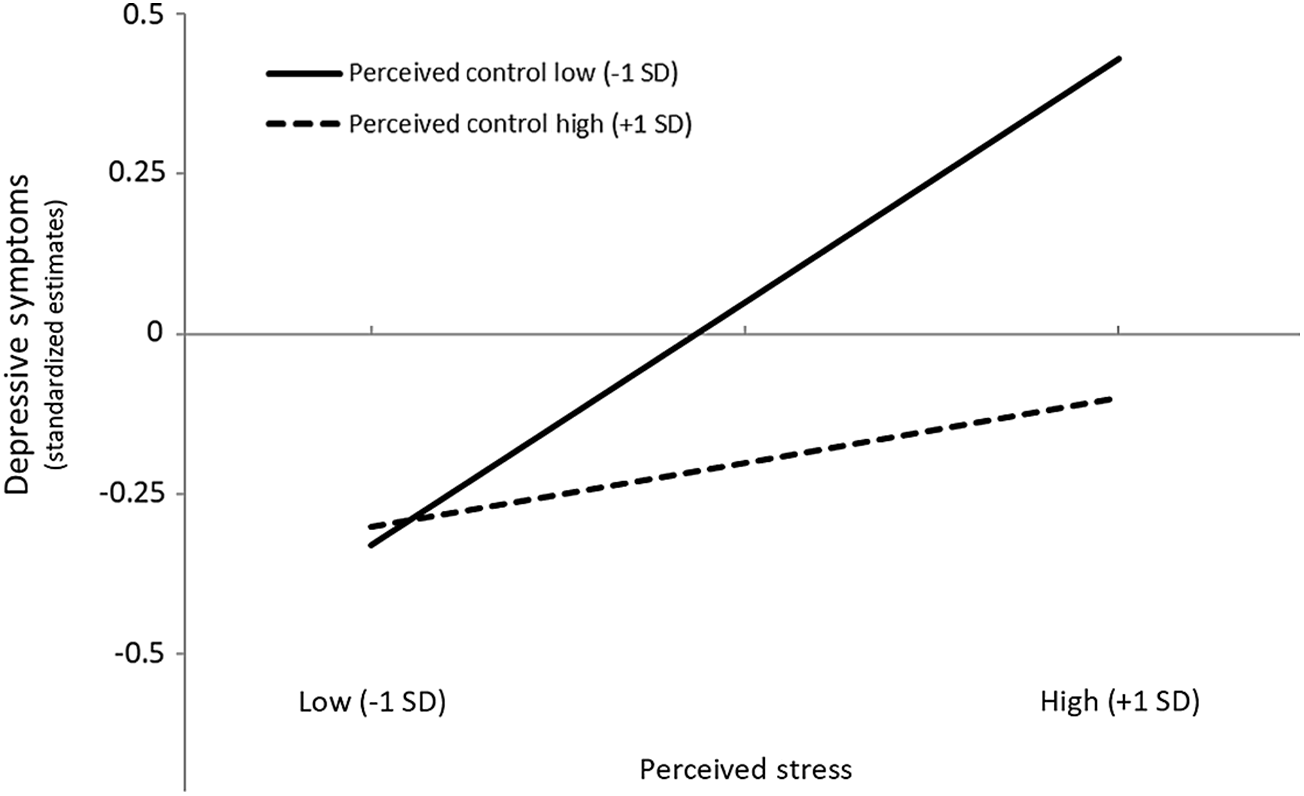
Perceived control moderated the relationship between perceived stress and depressive symptoms (β = −.13, SE = .06, p < .05) only. Simple slopes analysis revealed that in individuals with lower (≤1 SD) perceived control, higher (≥1 SD) perceived stress was associated with more depressive symptoms [t(83) = −2.70, p < .01, d = .59; see Figure 3]. In contrast, depressive symptoms did not differ based on perceived stress level in individuals with higher (≥1 SD) perceived control. Perceived control did not moderate the association between depressive symptoms and episodic memory, or the direct effect of perceived stress on episodic memory independent of depressive symptoms.
Simple slopes of perceived stress predicting depressive symptoms in individuals with low (−1 SD) versus high (+1 SD) perceived control. Estimates for depressive symptoms were adjusted for covariates. SD = standard deviation.

Discussion
In line with previous research, greater perceived stress was associated with poorer episodic memory in this cross-sectional study of diverse urban-dwelling older adults. Furthermore, this association was mediated by depressive symptoms, such that individuals with higher perceived stress also had more depressive symptoms, and those with more depressive symptoms had poorer episodic memory. Although the associations between stress, depressive symptoms, and memory were not modified by sociodemographic characteristics of gender or race/ethnicity, greater perceived control buffered the association between greater perceived stress and more depressive symptoms.
Perceived Stress, Depressive Symptoms, and Episodic Memory
The present study contributes to the growing literature suggesting that perceived stress may be a risk factor for late-life cognitive impairment and decline (Aggarwal et al., Reference Aggarwal, Wilson, Beck, Rajan, Mendes de Leon, Evans and Everson-Rose2014; Korten, Comijs, Penninx, & Deeg, Reference Korten, Comijs, Penninx and Deeg2017; Turner, James, Capuano, Aggarwal, & Barnes, Reference Turner, James, Capuano, Aggarwal and Barnes2017) and dementia (Jiang et al., Reference Jiang, Katz, White, Zimmerman, Sliwinski, Kim and Lipton2014). These findings may reflect detrimental effects of stress on the hippocampus, a key brain structure involved in episodic memory processes that has a high density of glucocorticoid receptors (Ohman, Nordin, Bergdahl, Slunga Birgander, & Stigsdotter Neely, Reference Ohman, Nordin, Bergdahl, Slunga Birgander and Stigsdotter Neely2007). Indeed, higher perceived stress has been associated with smaller hippocampal volume in a diverse sample of older adults cross-sectionally (Zimmerman et al., Reference Zimmerman, Ezzati, Katz, Lipton, Brickman, Sliwinski and Lipton2016). One proposed mechanism for the association between perceived stress and episodic memory is through neuroendocrine dysfunction and dysregulation of glucocorticoid (e.g., cortisol) secretion in response to prolonged stress. Indeed, previous research has found long-term elevation of cortisol levels to be associated with structural and functional changes in brain regions associated with various cognitive domains (Cerqueira, Mailliet, Almeida, Jay, & Sousa, Reference Cerqueira, Mailliet, Almeida, Jay and Sousa2007; Lupien, McEwen, Gunnar, & Heim, Reference Lupien, McEwen, Gunnar and Heim2009; McEwen & Robinson, Reference Mcewen and Robinson2012).
Sensitivity analyses in the present study showed perceived stress was associated directly and indirectly through depressive symptoms with learning and recall, but not recognition memory. This pattern of results is consistent with prior research suggesting that depression is more strongly associated with impairments in recall than recognition memory (Brand, Jolles, & Gispen-de Wied, Reference Brand, Jolles and Gispen-de Wied1992). It may also provide further evidence for a hippocampally mediated relationship between perceived stress and episodic memory impairment. Converging evidence from animal and human studies using neurophysiological, neuroimaging, and neuropsychological methods suggests that, compared with recall, recognition memory may rely more heavily on parahippocampal regions of the medial temporal lobe (particularly the perirhinal cortex) rather than the hippocampus, per se (see Eichenbaum, Yonelinas, & Ranganath, Reference Eichenbaum, Yonelinas and Ranganath2007 for a review).
Although efforts aimed at reducing life course exposure to stressors may protect individuals against later cognitive decline by preserving neurological and immune functioning (Graham, Christian, & Kiecolt-Glaser, Reference Graham, Christian and Kiecolt-Glaser2006), this may not be an immediate practical approach. Rather, interventions aimed at improving older adults’ ability to manage stress may alleviate some of its burden on mental and cognitive health. For example, reflecting on personal values and engaging in value affirmation lead to lower cortisol response to acute stress in the laboratory among older adults (Creswell et al., Reference Creswell, Welch, Taylor, Sherman, Gruenewald and Mann2005). Thus, while the presence of certain stressors may not be eliminated (i.e., caring for a chronically ill or disabled adult, high job-related stress), utilizing adaptive stress management techniques may lead to healthier cognitive aging.
Results from the present study also support previous work on the association between perceived stress and depressive symptoms (Kwag, Martin, Russell, Franke, & Kohut, Reference Kwag, Martin, Russell, Franke and Kohut2011; Tsai, Chi, & Wang, Reference Tsai, Chi and Wang2015), as well as the association between late-life depressive symptoms and cognitive impairment and dementia (Dotson et al., Reference Dotson, Resnick and Zonderman2008; Fiske, Wetherell, & Gatz, Reference Fiske, Wetherell and Gatz2009; Richard et al., Reference Richard, Reitz, Honig, Schupf, Tang, Manly and Luchsinger2013). Stress and depressive symptoms are thought to influence late-life cognition through similar biological mechanisms, including greater hypothalamic–pituitary–adrenal axis dysregulation and hippocampal atrophy (Caraci, Copani, & Nicoletti, Reference Caraci, Copani and Nicoletti2010). However, results from the present study suggest that rather than operating as two separate pathways, depressive symptoms may be part of the underlying process that links experiences of stress to late-life cognitive impairment. If the presence of depressive symptoms increases risk for cognitive impairment or dementia (Cherbuin et al., Reference Cherbuin, Kim and Anstey2015), then interventions aimed at reducing risk for depression or managing depressive symptoms may protect individuals living with high perceived stress against cognitive decline.
Although a sensitivity analysis revealed that the association between depressive symptoms and memory did not remain when household income was included in the model, prior research has demonstrated robust associations between late-life depressive symptoms and cognitive impairment even after accounting for confounding effects of income (Zahodne, Sol, & Kraal, Reference Zahodne, Sol and Kraal2017). Thus, we are hesitant to conclude that there is no link between depressive symptoms and memory independent of income. In the current study, the absence of a unique association between depressive symptoms and memory above and beyond income may reflect the relatively small sample size, low overall endorsement of depressive symptoms, and/or high proportion of individuals with low income. Nonetheless, income likely contributes to both depressive symptoms (Koster et al., Reference Koster, Bosma, Kempen, Penninx, Beekman, Deeg and van Eijk2006) and memory functioning (Marden, Tchetgen Tchetgen, Kawachi, & Glymour, Reference Marden, Tchetgen Tchetgen, Kawachi and Glymour2017) in late-life. Though it is beyond the scope of the present study, systemic interventions targeting late-life poverty as well as individual interventions aimed at increasing personal coping resources may help reduce the risk of depression among older adults. Of note, adjusting for income did not eliminate the associations between perceived stress and depressive symptoms nor the association between perceived stress and memory in the initial model that did not include depressive symptoms. Thus, early detection of the presence of depressive symptoms and interventions aimed at reducing risk for depressive symptoms among older adults may lead to healthy aging more generally (Reynolds et al., Reference Reynolds, Cuijpers, Patel, Cohen, Dias, Chowdhary and Albert2012).
Perceived Control
Previous research has identified perceived control as a psychosocial predictor of cognitive health among older adults (Soederberg Miller & Lachman, Reference Soederberg Miller and Lachman1999). Although perceived control did not modify the direct effect of perceived stress on episodic memory in the present study, it did buffer the association between greater perceived stress and more depressive symptoms. This pattern of results suggests that whether an individual develops depressive symptoms when faced with stress may depend on their control beliefs.
A growing body of research suggests that individuals who perceive less control are more likely to develop depressive symptoms (Diehl & Hay, Reference Diehl and Hay2010; Grote et al., Reference Grote, Bledsoe, Larkin, Lemay and Brown2007; Johnson & Sarason, Reference Johnson and Sarason1978). Control beliefs may influence mental health through behavioral, psychological, and biological mechanisms. It may be that individuals with low perceived control have more negative appraisals of stressful situations and/or engage in fewer adaptive or more maladaptive coping strategies when faced with stress. For example, prior research suggests individuals with lower perceived control are more likely to engage in unhealthy behaviors (i.e., smoking, over-eating) and use fewer compensatory memory strategies (Lachman, Neupert, & Agrigoroaei, Reference Lachman, Neupert and Agrigoroaei2011). In contrast, engagement in healthy behaviors, such as more physical activity, mediated the association between high perceived control and lower cognitive decline among older adults in the Health and Retirement Study (Infurna & Gerstorf, Reference Infurna and Gerstorf2013). Perceiving greater control over one’s environment and life circumstances may also buffer the negative impact of stress by increasing intrinsic motivation to handle stressors in the environment. Physiologically, greater perceived control has been shown to buffer cortisol response to an acute laboratory stressor (Bollini, Walker, Hamann, & Kestler, Reference Bollini, Walker, Hamann and Kestler2004), as well as systemic inflammation in response to lifetime trauma exposure (Elliot et al., Reference Elliot, Mooney, Infurna and Chapman2017).
While the current study did not find evidence that perceived control modifies the negative impact of depressive symptoms on episodic memory, previous research indicates that perceived control may act as a resource for managing cognitive difficulties associated with age-related changes in the brain. For example, greater perceived control was associated with preserved episodic memory function in the presence of lower hippocampal volume among a subset of older adults in WHICAP (Zahodne, Schupf, & Brickman, Reference Zahodne, Schupf and Brickman2018). Thus, modifying control beliefs may lead to healthier cognitive aging through both effects on cognition and a more indirect pathway involving reduced risk for late-life depressive symptoms.
Sociodemographic Considerations
Although the strength of associations among perceived stress, depressive symptoms, and memory did not differ across sociodemographic characteristics in the present study, we did observe group differences in perceived stress (Matud, Reference Matud2004; Meyer, Schwartz, & Frost, Reference Meyer, Schwartz and Frost2008) and episodic memory (Díaz-Venegas, Downer, Langa, & Wong, Reference Díaz-Venegas, Downer, Langa and Wong2016) in line with prior research. While our results suggest that perceived stress and depressive symptoms have negative impacts on cognition regardless of sociodemographic identity, certain groups (i.e., women and non-Hispanic Blacks) appeared to be at greater risk for experiencing stress. This pattern of results indicates that these groups have more frequent exposure to universal stressors, exposure to stressors that are sociodemographically patterned (e.g., sexual assault, racial discrimination), and/or more negative appraisals of stressful experiences. As a result of experiencing higher levels of perceived stress, these groups may have a greater likelihood of experiencing the negative cognitive consequences associated with stress.
Additionally, depressive symptoms did not differ across sociodemographic groups in the present study despite differences in perceived stress, and women in the present study demonstrated higher memory functioning despite reporting greater perceived stress than men. These findings may reflect gender differences in coping resources (West & Simons, Reference West and Simons1983) and suggest that the negative cognitive influence of stress also operates through mechanisms other than depression. Future research on the stress–cognition link should consider the influence of intersectionality when determining which individuals may be at heightened risk for the adverse cognitive impacts of stress. A deeper understanding of these processes may inform interventions aimed at reducing stressors at a structural level in addition to those aimed at increasing person-specific coping resources.
Limitations and Future Directions
The present study was limited to a cross-sectional design due to the relatively recent implementation of an expanded psychosocial battery in WHICAP. A future longitudinal mediation model incorporating follow-up data currently being collected would allow further understanding of associations between perceived stress, depressive symptoms, and episodic memory functioning in older adults. Furthermore, the current study relied on a single self-reported measure of stress. Although perceived stress has been shown to be a proximal indicator of the impact of chronic stressors, future research should incorporate additional measures of stress (e.g., stress biomarkers, lifetime stress exposure checklist) in addition to perceived stress in order to disentangle the effects of stress exposure from reactions to stressors. Incorporation of multiple levels of the stress experience (e.g., exposure, cognitive appraisal, physiological response) may help elucidate the mechanisms driving stress–cognition relationships.
Additionally, the present study focused on participants’ current depressive symptoms which may not be indicative of lifetime presence of depression. Prior research has suggested that late-onset depression may reflect prodromal stages of dementia rather than a risk factor, per se (Steffens, Reference Steffens2017). Thus, additional research is needed to investigate the longitudinal effects of clinical depression or the presence of chronic depressive symptoms throughout the life course on late-life memory trajectories. It should also be noted that the use of a single memory measure may not have captured the extent to which stress, depressive symptoms, and psychosocial or sociodemographic factors affect late-life cognition. Although the SRT taps multiple episodic memory processes and is sensitive to preclinical changes in cognition, future research should investigate whether perceived stress similarly influences other measures of episodic memory and other cognitive domains. Lastly, the geographic specificity of this study limits the generalizability of current findings.
Strengths of this study include its diverse sample and inclusion of relevant covariates. Furthermore, including stress and depressive symptoms together in a mediation framework allows for a deeper understanding of potential mechanisms underlying their previously documented influence on cognitive health and the identification of multiple potential points of intervention. Future intervention studies designed to reduce stress exposure, improve management of stress and depressive symptoms, and/or increase perceived control may facilitate healthy cognitive aging and aid in dementia prevention. Knowledge of these modifiable contributing factors may influence healthcare policy and encourage healthcare providers to screen for and identify stress and depression as potential risk factors for late-life cognitive impairment.
Acknowledgments
Data collection and sharing for this project were supported by the Washington Heights-Inwood Columbia Aging Project (WHICAP, PO1AG07232, R01AG037212, RF1AG054023, R01AG054520, R00AG047963) funded by the National Institute on Aging (NIA). This manuscript has been reviewed by WHICAP investigators for scientific content and consistency of data interpretation with previous WHICAP study publications. The authors thank the WHICAP study participants and the WHICAP research and support staff for their contributions to this study. This publication was also supported by the National Center for Advancing Translational Sciences, National Institutes of Health, through Grant Number UL1TR001873. The content is solely the responsibility of the authors and does not necessarily represent the official views of the NIH.
Conflict of Interest
The authors of this study have no conflicts of interest to declare.
Supplementary material
To view supplementary material for this article, please visit https://doi.org/10.1017/S1355617720001253