


The role of institutions and incentives in shaping political motivations is a key concern of political scientists (Bohnet, Frey, and Huck Reference Bohnet, Frey and Huck2001; Bowles Reference Bowles2008; Jacobs Reference Jacobs2009; Ostrom Reference Ostrom2000; Reeson and Tisdell Reference Reeson and Tisdell2008) and of social scientists more generally (Benabou and Tirole Reference Benabou and Tirole2006; MacKinnon and Luke Reference MacKinnon and Luke2002). Whether and why people engage in various political activities—voting, volunteering in political campaigns, contributing money to candidates for office, participating in social programs, running for political office, and supporting the provision of public goods and redistribution—are likely structured by their institutional context and the incentives that institutions create (Cho, Gimple, and Dyck Reference Cho, Gimple and Dyck2006; Huckfeldt and Sprague 1995; Sinclair Reference Sinclair2012). Yet, the question of precisely how institutions and incentives influence political motivations remains an emergent theme for political and institutional analysis (Bohnet and Baytelman Reference Bohnet and Baytelman2007) that requires more systematic and careful assessment. As Sauerman and Kaiser (Reference Sauermann and Kaiser2010, 667, 680) argue, our knowledge of the role of social preferences and other-regarding motivations in social and political life remains both limited and incomplete.
This article reports on our use of a quasi-experimental research design to examine how changes in institutions and incentives, associated with a government program aimed at improving environmental and development outcomes, influence the motivations of individuals affected by the program. We focus on a particular form of other-regarding motivations—pro-environmental motivations to conserve natural resources—in our research in the Indian Himalaya. The recently completed Mid-Himalayan Watershed Development Program sought to improve environmental awareness, deliver small-scale public goods, and provide private material benefits for participants in Himachal Pradesh state in northern India. Such sustainable development programs are increasingly common throughout the developing world as governments and NGOs seek to combine socioeconomic and environmental goals; they typically use some combination of material benefits delivered to local populations and environmental awareness messages to achieve their joint goals of development and conservation (Adams et al. Reference Adams, Aveling, Brockington, Dickson, Elliott, Hutton, Roe, Vira and Wolmer2004; Spiteri and Nepalz Reference Spiteri and Nepalz2006). Often, these programs implement small-scale infrastructure and public goods projects to provide collective economic benefits and may also provide private material benefits to individual households. One of their goals is to demonstrate that environmental protection need not be in tension with economic improvement.
However, the effects of these programs and their incentives on motivations for conservation of natural resources are poorly understood. On the one hand, such programs could enhance environmental motivations for conservation because they demonstrate the possibility that economic improvement can coexist with environmental protection. The successful joining of economic and environmental motivations presumably improves longer term resource sustainability because, even after program implementation is completed, its beneficial effects on environmental outcomes would continue because of enhanced environmental motivations. Indeed, many sustainable development programs are predicated on this assumed relationship, even if the assumption is so taken for granted that it is seldom stated explicitly. A large literature on environmental conservation, for example, argues for the importance of attending to motivations and attitudes as a way to improve conservation outcomes (Fiallo and Jacobson Reference Fiallo and Jacobson1995; Gillingham and Lee Reference Gillingham and Lee1999; Kaiser, Wolfing, and Fuhrer Reference Kaiser, Wolfing and Fuhrer1999).
On the other hand, such projects can displace environmental with economic motivations for environmental action because participants come to associate environmental protection with economic rewards. If that is the case, then the reduction in economic benefits, once a program ends, may undermine conservation outcomes because pro-environmental motivations have been “crowded out” by the project-based external incentives during its lifetime.
Indeed, available economic and psychological theory lends itself to divergent conclusions about how people will respond to simultaneous economic and environmental messages justifying natural resource conservation. Standard economic theory “does not normally differentiate between different sources of motivation. [They are] just manifestations of underlying preferences” (Frey and Jegen Reference Frey and Jegen2001, 591). Accordingly, this line of reasoning suggests that higher benefits for performing a set of tasks should increase the number of people willing to perform the tasks or that recipients will be willing to undertake tasks of greater difficulty, regardless of the specific content of those benefits or motivations. By contrast, theories that distinguish between intrinsic and extrinsic motivations suggest that the two can be in conflict (Benabou and Tirole Reference Benabou and Tirole2006; Chang and Lai Reference Chang and Lai1999; Deci, Koestner, and Ryan Reference Deci, Koestner and Ryan1999). The way in which external incentives are delivered may matter for whether internal motivations are undermined, improved, or left intact (Frey and Oberholzer-Gee Reference Frey and Felix Oberholzer-Gee1997).
This article presents a quasi-experimental research design that allowed us to test hypotheses about the effects of sustainable development programs/institutions and the incentives they create on individuals’ motivations to conserve natural resources. The next section reviews the theoretical background for our research, followed by a brief description of the empirical context of the study, its design, and methods. We describe our findings next. In the following section, we discuss the scope of the findings and provide evidence for how change in motivations is related to environmental behavior. We conclude with an assessment of the implications of our key results for future research on the relationship between institutions, incentives and motivations.
BACKGROUND
In examining environmental attitudes and attitudinal change, we focus on the question of how changes in institutions and associated incentives change motivations for undertaking actions related to resource conservation. For the purposes of this article, we treat motivations as a subset of attitudes. Our definition of attitudes follows a substantial literature in political psychology on the related concepts of “beliefs,” “attitudes,” and “preferences.” Following several key studies, beliefs can be understood as probability distributions about attributes of objects that individuals encounter in their experiences with the world. Attitudes are opinions about those objects based on beliefs about their attributes, and preferences are comparative evaluations of objects (Churchland and Sejnowski Reference Churchland and Sejnowski1992; Druckman and Lupia Reference Druckman and Lupia2000, 1, 4–5; Gawronski Reference Gawronski2007). Motivations are a subset of attitudes in that they are often linked to dispositions to act or learn, whereas attitudes are favorable, neutral, or unfavorable dispositions toward objects, with or without a link to action (see also Ajzen Reference Ajzen2001; Guthrie Reference Guthrie, Kamil, Mosenthal, Pearson and Barr2000; Kleinginna and Kleinginna Reference Kleinginna and Kleinginna1981).
An important issue that concerns a significant body of scholarship in political science (and related disciplines) is the extent to which beliefs, attitudes, preferences and/or motivations vary across individuals and change over time (e.g., Bowles Reference Bowles1998; Frable Reference Frable1997; Howard Reference Howard2000; Monroe et al. Reference Monroe, Hankin and Van Vechten2000; Palacios-Huerta and Santos Reference Palacios-Huerta and Santos2004). Existing studies such as Pierson's (Reference Pierson1993) work on policy feedback in the social policy arena, for example, suggest that institutions change attitudes of individuals in the direction of the incentives supported by the new institutions. Within the debate on attitudinal change are the related questions of whether exposure to new institutions or policies changes attitudes in a direction toward which institutional incentives are structured (Bowles Reference Bowles2008; Gerber and Jackson Reference Gerber and Jackson1993; Traut-Mattausch et al. Reference Traut-Mattausch, Jonas, Forg, Frey and Heinemann2008) and, increasingly, how motivations and attitudes influence diverse social phenomena and political behavior (Benoit Reference Benoit2004; Festré Reference Festré2010; see also Rothstein and Uslaner's [Reference Rothstein and Uslaner2005] study of the relationships between trust and equality).Footnote 1
Ambiguity about how exposure to public policies or political institutions translates into attitudinal change is demonstrated in diverse political science applications. We illustrate this lack of clarity with three examples. In the study of direct democracy (i.e., voting on ballot initiatives), recent work suggests that exposure to and involvement in the institutions of direct democracy increase feelings of political efficacy and trust in government (Bowler, Donovan, and Karp Reference Bowler, Donovan and Karp2007; Donovan, Tolbert, and Smith Reference Donovan, Tolbert and Smith2009). But other scholars have concluded that direct democracy institutions can lead to frustration and distrust (Dyck and Baldassare Reference Dyck and Baldassare2009; Hibbing and Thiess-Morse Reference Hibbing and Thiess-Morse2002). Similarly, when it comes to the role of motivations in support for direct democracy itself, some scholars have argued that such support comes from greater trust and more politically motivated and engaged citizens (Donovan and Karp Reference Donovan and Karp2006; Govier and Verwoerd Reference Govier and Verwoerd2002; Inglehart Reference Inglehart1990), whereas others locate such support among those who are more disaffected (Dalton, Burklin, and Drummond Reference Dalton, Burklin and Drummond2001). Such differences in conclusions, and implicitly in the causal inferences that underpin the analyses, point to the need for a better accounting of the relationship between institutions and motivations.
A second example of this theoretical and empirical divide comes from a different political context: participation in community organizations and the effect of social capital on political trust. Most notably, work by Putnam (Reference Putnam2000) shows that participants in community organizations become more engaged in political life (presumably because they have greater trust in politics), whereas a number of other scholars have suggested that high levels of community involvement can, in fact, lead to more conflict and less trust (Brehm and Rahn Reference Brehm and Rahn1997; Uslaner Reference Uslaner2002).
As a third example, research more directly related to natural resource governance, the intervention analyzed in this article, has produced conflicting conclusions about whether protection of renewable resources such as forests and wildlife is associated with increasing or declining hostility on the part of local residents toward protected resources (Holmes Reference Holmes2003; Mehta and Heinen Reference Mehta and Heinen2001). This research tends to consider attitudes as being correlated with some context- or individual-specific variables or as pre-dating protection efforts (Allendorf Reference Allendorf2007; Bouton and Frederick Reference Bouton and Frederick2003; Cox, Villamayor-Tomas, and Hartberg Reference Cox, Villamayor-Tomas and Hartberg2014; Dolisca, McDaniel, and Teeter Reference Dolisca, McDaniel and Teeter2007). Few studies make a systematic effort to explain where environmental motivations toward natural resources come from, how they change, or the mechanisms through which they connect to institutional arrangements (cf. Mehta and Heinen Reference Mehta and Heinen2001; see also Steg, Dreijerink, and Abrahamse Reference Steg, Dreijerink and Abrahamse2005 on environmental motivations more broadly).
A substantial literature in psychology and economics examines how changes in incentives may generate predictable changes in motivations for undertaking certain actions. Titmuss's (Reference Titmuss1970) observation that monetary incentives to blood donors had the perverse effect of reducing the blood supply is an early example of research on the interactions between material incentives and motivations of behavior. Recent studies have confirmed the possibility of “motivational crowding,” in which material incentives displace some motivations and replace them with others. These studies provide additional clues as to how incentives affect both motivations and behaviors. For example, the results of a field experiment in Sweden to test whether payments to blood donors were associated with crowding out show substantial gender-based differences in effects (Mellström and Johannesson Reference Mellström and Johannesson2008): Women experienced greater crowding out, and allowing subjects to donate their payments to a charity counteracted the crowding-out effect.
Recent work on changes in motivations as a result of material incentives hinges on the distinction between intrinsic and extrinsic motivations (Benabou and Tirole Reference Benabou and Tirole2003; Bowles and Polanía-Reyes Reference Bowles and Polania-Reyes2012).Footnote 2 Intrinsic motivation for an activity exists when the activity is performed for the sake of performance of the activity, or as Frey (Reference Frey1997, 429) puts it, “work is performed for work's sake.” In the case of environmental protection, intrinsic motivations would correspond to a situation where respondents seek to protect natural resources for environmental rather than for personal economic or material reasons.
Extrinsic motivation, in contrast, depends on whether external rewards or sanctions are used to induce performance. When only extrinsic motivations are in play, we observe higher material incentives “affecting targeted behavior work almost exactly as conventional economic theory predicts” (Bowles and Polanía-Reyes Reference Bowles and Polania-Reyes2012, 369). Larger material incentives activate extrinsic motivations, change the cost-benefit calculations of individual agents in relation to the actions for which incentives are available, and thereby alter behavior.
Net changes in overall motivations and behaviors depend, however, on how incentives interact with intrinsic versus extrinsic motivations (Bowles and Hwang Reference Bowles and Hwang2008, 1816; James Reference James2005). In situations where intrinsic motivations are present, material compensation in exchange for strictly monitored performance—particularly for complex and unstructured tasks—can undermine intrinsic motivations (Angrist and Lavy Reference Angrist and Lavy2009; Bowles and Polanía-Reyes Reference Bowles and Polania-Reyes2012). Both the provision of material incentives and the measurement of performance undermine intrinsic motivations for performing an action (Lindenberg Reference Lindenberg2001). As Frey, Benz, and Stutzer (Reference Frey, Benz and Stutzer2004) argue, procedural utility —not only what people get but also how they get it—matters.
Intrinsic motivations may also be undermined if external interventions impair the agent's control over actions or his or her sense of self-esteem (Frey and Jegen Reference Frey and Jegen2001, 594; Gneezy, Meier, and Rey-Biel Reference Gneezy, Meier and Rey-Biel2011). Conversely, external interventions can strengthen the overall motivation to perform a task if they are large enough or if they dissipate value conflicts. Experimental evidence also suggests that small differences in framing, cues, and available information can make intrinsic vs. extrinsic motivations more salient (Benabou and Tirole Reference Bénabou and Tirole2011; Dana, Weber, and Kuang Reference Dana, Weber and Kuang2007; Mazar, Amir, and Ariely Reference Mazar, Amir and Ariely2008), highlighting the importance for political scientists of more systematic analyses of the interactions between incentives and motivations.
Taken as a whole, these bodies of research imply the following testable hypotheses for our study of how material incentives created by new institutions interact with motivations:
H1 (REINFORCING): Extrinsic motivations created by material incentives provided to participants in sustainable development projects reinforce intrinsic motivations to conserve natural resources.
H2 (CROWDING-OUT): Extrinsic motivations created by material incentives provided to participants in sustainable development projects crowd out intrinsic motivations to conserve natural resources.
H0 (NULL): Sustainable development projects do not change participants’ motivations to conserve natural resources.
We include H1 as an explicit hypothesis because it is the bedrock assumption of a vast number of sustainable development and environmental conservation interventions undertaken in recent years. These programs allocate specified material benefits to project participants in the expectation that such benefits will strengthen their identification with program objectives and that the change in motivations will outlast program implementation. In particular, environmental management programs that provide participants a small sum of money or other benefits for measured improvements in environmental outcomes—often called payments for environmental services (Ajayi, Jack, and Leimona Reference Ajayi, Jack and Leimona2012; Persson and Alpizar Reference Persson and Alpizar2013)—rest on the assumption that underlies our first hypothesis. As Pattanayak, Wunder, and Ferraro (Reference Pattanayak, Wunder and Ferraro2010) observe, few studies of these programs recognize or test the possibility that they may be crowding out intrinsic motivations (or even leaving them unaffected). H2 is a formal statement of the possibility that material incentives undermine such intrinsic conservation motivations, contrary to the assumption underlying many sustainable development policies.
RESEARCH SETTING AND DATA COLLECTION
Most of the empirical evidence on changes in motivations and crowding out effects comes from laboratory experiments (Ariely et al. Reference Ariely, Gneezy, Loewenstein and Mazar2009; Deci, Koestner, and Ryan Reference Deci, Koestner and Ryan1999; Gneezy and Rustichini Reference Gneezy and Rustichini2000). Many studies reporting results from field experiments also identify a crowding-out effect in the presence of various external incentives (Cardenas Reference Cardenas2011; Lopez et al. Reference Lopez, Murphy, Spraggon and Stranlund2012). The approach and analysis in the current study differ from much of the existing work on motivational crowding in two important ways. First, in contrast to approaches that are based on laboratory experiments, field experiments, or randomized control trials implemented by investigators carrying out the research, we sought to directly measure motivational change in a field setting using a research design that collected before and after data from a matched sample of participants and nonparticipants in a large-scale sustainable development project.Footnote 3 The project was implemented much as many such projects get implemented—by personnel in a government agency—with joint funding from a donor and the provincial/country government. We gathered survey data on individuals’ motivations for conserving natural resources, using the government policy intervention as a “treatment” in a quasi-experimental research design. Our research design enabled us to estimate the effects of a change in institutions due to a policy intervention outside of a laboratory setting, resulting in high levels of both internal and external validity.
Second, individuals in our study were exposed to varying levels of the “treatment;” in other words, the intervention involved households in the program to varying degrees and in different project activities. Therefore, we were able to examine not just the overall effect of the program intervention as a whole but also to assess how different types and combinations of exposure to program activities and incentives affected the motivations of “treated” individuals, compared to otherwise similar individuals who were not presented with these incentives. Our use of both matching-based and multivariate analyses helped identify the effects of the program and its distinct activities with a high level of confidence.
The empirical setting for our data collection is Himachal Pradesh state in northern India. The state's predominantly rural population of nearly seven million (in 2011, the most recent census) is highly dependent on agriculture. Population densities exceed 120 persons per square kilometer. Real population densities are much higher because large parts of the upper elevations in this mountainous state are not inhabited. The largely agricultural economy relies heavily on products from local forests: manure for fields, grazing for animals, wood for packing agricultural products, and firewood for household needs.
In 2006, the Himachal Pradesh state government, with support and partial funding from the World Bank, implemented the Mid-Himalayan Watershed Development Project. This “eco-development” project aimed to “reverse the process of degradation of the natural resource base and improve the productive potential of natural resources and incomes of the rural households in the project area” (http://www.hpmidhimalayan.org/Project_discription.htm). The project was typical of the World Bank's eco-development approach that seeks to combine development aid with environmental education and tools to manage and conserve natural resources (see, e.g., World Bank 2007).
More than 800 panchayats in eight districts were selected to participate in the project. Panchayats are the lowest local government unit in India, each encompassing two to seven villages or hamlets with a total population of 2,000–5,000 adults. Interviews with project personnel indicated that panchayats were selected on the basis of their proximity to degraded and vulnerable forests and the need for local infrastructure investment (i.e., not randomly). As part of the project, participating panchayats received material benefits in the form of small-scale public goods (such as concrete footpaths, water-harvesting tanks, or irrigation canals) or private goods given directly to households (such as seeds or livestock) to enhance villagers’ incomes and reduce their dependency on forest resources. In addition, recipients of material benefits were required to attend informational meetings and participate in environmental education training conducted by project personnel. As such, the project provided an ideal—and at the same time commonly used—setting to test how participation in the new institutions created by the project affected the motivations of participants for conserving forest resources. Specifically, the project and our research design allowed us to analyze the effects of both environmental education/awareness efforts to activate intrinsic motivations and of several types of material benefits to stimulate extrinsic motivations.
Our data collection strategy was to treat implementation of the project as the basis for a quasi-experimental research design and to conduct a pre- and post-treatment panel survey with a matched control group. For logistical/cost reasons, it was not feasible to randomly sample treated and untreated households across the geographically large and remote state. Instead, we selected a subset of treated and untreated panchayats and surveyed individuals within those units. Specifically, in early 2006, before implementation of the project began, we used project planning documents to identify a random sample of treatment panchayats in five districts. We then gathered baseline information on these panchayats’ distance from roads, total number of households, population density per hectare of forest, spatial location, caste structure, and poverty level. We selected one panchayat per district to represent the district as closely as possible on the selected variables. To create the control group, we identified five additional panchayats—one for each treatment panchayat—that were not scheduled to be included in the project. Each control panchayat was geographically close but not contiguous to its paired project panchayat and had similar baseline characteristics in terms of the variables mentioned earlier. We selected control cases that were not contiguous to minimize spillover effects from the treatment into the control panchayats. Despite the care we took in selection of the cases, it is certainly possible that there were unobservable factors at play that affected the selection of the treatment panchayats that we could not take into account in the selection of the control cases.
For all 10 panchayats (5 treatment and 5 control), we obtained comprehensive lists of resident households and their members from local government and project officials. We sought to include in our sample one respondent from every household in the 10 panchayats. To achieve gender balance, we randomly placed 50% of the households in a “female group” and interviewed a female resident (also picked at random from all female members of that household above 15 years of age); in the other 50%, we interviewed a male resident.Footnote 4 This process yielded a total sample size of 2,224 respondents distributed across the 10 panchayats.
Interviews with the identified respondents were conducted in Hindi using locally trained interviewers and in accordance with the PIs’ host institutions’ IRB regulations. The response rate for the initial wave of data collection was above 98%; the interviews were conducted in person, and the field research team returned to the homes of selected individuals multiple times to complete the interviews. The interviews included questions about demographic and socioeconomic characteristics, participation in various local institutions and political activities, environmental attitudes, and reliance on forest resources and products. Copies of the data collection instruments are available from the authors on request.
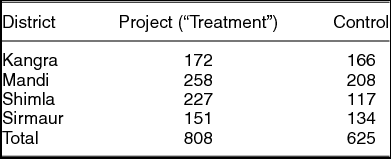
The second round of data collection took place in 2011. Ideally, we would have re-interviewed all 2,224 of the first-wave respondents; however, several practical considerations prevented us from doing so. First, we dropped one pair of panchayats because the household-level data on additional variables (education, age, household size, number of news sources, size of house, and food self-sufficiency) showed that these two panchayats were clearly not well matched and thus were inappropriate for our quasi-experimental design (the other four panchayat pairs were virtually identical in the aggregate in terms of these variables). This left a possible 1,804 individuals in the remaining panchayats. We believe this decision allowed us to maintain a strong research design, as argued by Sekhon (Reference Sekhon2010), who points to problems in matching-based analyses that are not underpinned by a strong research design. Second, the original respondent was occasionally not available to conduct the second wave of the survey, due to various causes (e.g., emigration, marriage, death). These unavailable respondents constituted 10.9% of the sample (198 individuals). Eighty-nine percent of the eligible respondents in the remaining eight panchayats—72% of the total original respondents—completed the second-wave questionnaire. For the purpose of this analysis, we also excluded a further 174 respondents (10.8% of those who completed the second round) because their households had subdivided in the interim five years, rendering the panel data incommensurate. Table 1 reports the number of respondents who were included in both waves of the survey from each panchayat.
Number of Respondents in 2006–2011 Panel, by District

The second-wave questionnaire included many of the same questions as the first-wave survey, especially regarding individual and household characteristics, dependence on forest resources, and environmental attitudes. In addition, it contained questions about the respondent's direct engagement with the project, as well as the engagement of his or her family members.
Variables
Our empirical analyses tested for the impact of exposure to the project on individual motivations for conserving forest resources. In other words, the conceptual dependent variable was the change in respondents’ motivations, and the primary independent variables were measures of project involvement, including participation in its various activities.
Motivations
In both waves of the survey, respondents were asked the following question about motivations for conserving forest resourcesFootnote 5 :
If forests are to be protected, then what reason do you think is more important for justifying their protection? Pick only one option.
 \begin{equation*}
0 = Economic\, reasons; \; 1 = Environmental\, reasons
\end{equation*}
Responses to this question were about evenly split in both waves of the survey. In 2006, 53% of the panel respondents reported that environmental reasons were more important, whereas in 2011, 48% reported that environmental reasons were more important. Table 2 reports the number of respondents in treatment and control panchayats who offered each response in the two waves. The questions implied by our theoretical discussion are whether these responses changed over time at the individual level and whether these changes are different for respondents who were involved with the project in various ways.
Reasons for Conserving Forest Resources, 2006 and 2011, Panel Respondents

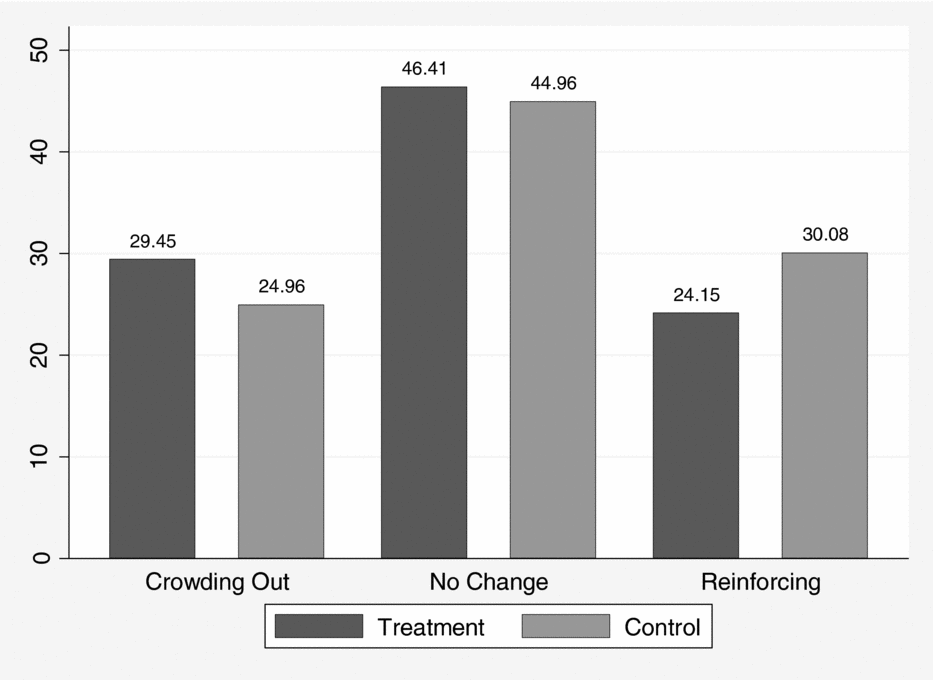
Several important points emerge from Table 2. First, the roughly even split between environmental and economic motivations in 2006 that we see in the full sample holds in both the treatment and control subsamples, with 55% of respondents in treatment panchayats and 51% of respondents in control panchayats reporting environmental motivations in 2006. Second, 47% of respondents in treatment panchayats and 45% in control panchayats reported the same response (either economic-economic or environmental-environmental) in both waves. Third, of those respondents who changed their reported motivations between 2006 and 2011, those in treatment panchayats were significantly more likely to change from environmental to economic motivations (63% of those who changed) than their counterparts in control panchayats (45% of those who changed). This difference is statistically significant (Pearson χ2(1) = 6.92; Pr = 0.008). Figure 1 graphically depicts these changes.
Differences in Motivational Change, 2006–2011, Percent of Respondents from Treatment vs. Control Panchayats

ANALYSES AND RESULTS
The study's sampling strategy involved selecting five treatment panchayats and five control panchayats, each matched to one of the treatment panchayats in terms of size, population characteristics, geography, and forest conditions (we refer to these as “panchayat pairs”).Footnote 6 An estimation strategy that leverages this matching design allows strong causal inferences regarding the treatment effects; because the treatment and control panchayats (and therefore the households in them) were selected to be quite similar in 2006, differences in conservation motivations reported in 2011 can be attributed to the effects of the project.
Average Treatment Effects
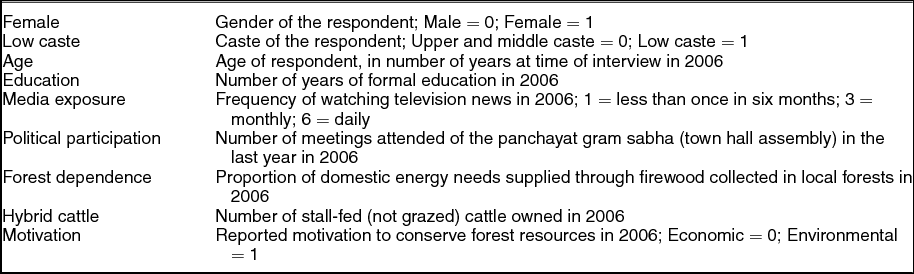
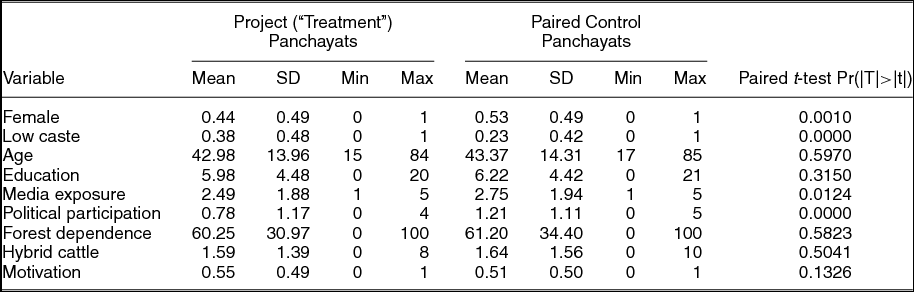
Tables 3 and 4 contain the description and summary statistics, respectively, of variables used to match respondents in treatment panchayats to those in control panchayats: gender, caste, age, education, media exposure, political participation, forest dependence, and hybrid cattle.Footnote 7
Descriptions of Variables Used for Matching Respondents across Treatment and Control Panchayats, 2006–2011 Panel

Summary Statistics for Variables Used for Matching Respondents across Treatment and Control Panchayats, 2006–2011 Panel

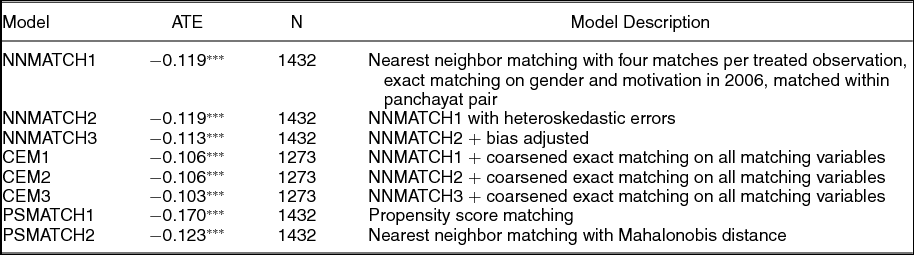
Table 5 reports the estimated average treatment effect (ATE) of living in a project panchayat, based on a variety of matching procedures. In each model, the treatment variable is whether the respondent lived in a project or control panchayat, and the outcome variable is the response to the motivation question in 2011. The first three models employ a nearest neighbor matching procedure (nnmatch in STATA) specifying exact matches on the respondents’ 2006 survey response (i.e., motivations for conserving forests) and gender.Footnote 8 The first model estimates the ATE by matching each treatment observation to four matches from the control group (NNMATCH1 in Table 5). The second model allows heteroskedastic errors by conducting a second matching process (again across the same matching variables), this time matching four observations in the same treatment group to compare variability in outcomes for observations with approximately the same values on the matching variables (NNMATCH2 in Table 5). However, matching is less than exact for some variables, which might bias the estimated treatment effect. The third model corrects for this possibility through bias adjustment on the matching variables (NNMATCH3 in Table 5). Balancing statistics and other diagnostics from the matching procedures are reported in the Appendix.
Effect of Living in a Project Panchayat on Motivations for Conserving Forest Resources, Average Treatment Effects with Alternative Matching Procedures

*p<.10, **p<.05, ***p<.01, two-tailed test
Matching variables: gender, caste, age, education, media exposure, political participation, forest dependence, hybrid cattle and motivation.
To further counter the potential for inadvertent bias introduced by the fact that the matching is not exact for all observations, we applied a coarsened exact matching procedure (cem in STATA) to select a subset of treatment and control observations that are matched exactly on coarsened values of the matching variables (Iacus, King, and Porro Reference Iacus, King and Porro2012). We then estimated the ATE on this subset using the same three models described earlier (CEM1 to CEM3 in Table 5). To further validate our results, we also estimated the same model using propensity score matching (PSMATCH1 in Table 5) and Mahalanobis distance matching, a different nearest neighbor matching procedure (PSMATCH2 in Table 5).
All eight of the estimated treatment effects are negative, significant, and nearly identical in magnitude. In other words, respondents living in a treatment panchayat are significantly less likely to report environmental motivations for protecting forests in 2011 than their counterparts in control panchayats. This effect is robust to alternative matching procedures.Footnote 9 We interpret these results as initial evidence in support of the crowding-out hypothesis (H2).
Engagement with Project Activities and Benefits
The preceding analyses operationalize engagement with the project institutions as simply whether the respondent lived in a treatment panchayat. This measure has the advantage of capturing both (1) direct effects of the project on respondents who personally engaged with the new institutions and (2) indirect effects on respondents who were not personally engaged, but who might have received some exposure to the project through interactions with others in their panchayat. However, by coding as “treated” all respondents in the treatment panchayats, even if they did not engage with the project directly, this operationalization has the disadvantage of potentially overstating the reach of the project and attenuating our estimates of the project's impact.
To address this concern, we constructed three additional measures of engagement with the project. Respondents in the 2011 survey were shown a list of all of the project activities undertaken in their panchayat (compiled from project documents and interviews prior to the survey period) and were asked to identify which specific activities they (or a member of their household) undertook. For the purposes of this analysis, these activities generated benefits that can be classified into three categories:
-
1. Informational Benefits: Involvement in project meetings and activities associated with the meetings imparts new information through such activities as the following:
-
• Attendance in planning meetings at the village, panchayat, and district level
-
• Visits to other panchayats to witness successful initiatives
-
• Meetings for environmental education
These informational benefits may activate intrinsic incentives to conserve natural resources through environmental education or extrinsic incentives through information about and exposure to economic benefits.
-
-
2. Private Livelihood Benefits: The project provided private economic benefits to many village households and participants. These included the following:
-
• Individual rainwater-harvesting tanks
-
• Cattle-feeding troughs
-
• Hay cutters
-
• Chicken coops and fencing
-
• Hybrid and high-yielding seeds and fruit saplings
-
• Training in vermicomposting (earthworms)
-
• Training in mushroom cultivation
-
• Training in mobile phone repair
-
• Training in sewing with sewing machine
-
• Training in cheese making with cheese machines
In terms of our theory, they represent private material incentives to conserve natural resources.
-
-
3. Communal Livelihood Benefits: Communal benefits stem from community-level assets that the project created and include the following:
-
• Concrete footpaths
-
• Irrigation canals
-
• Water-storage tanks for irrigation
-
• Common water-harvesting structures
-
• Upgrading of traditional drinking water sources
-
• Forest plantation
Key aspects of these communal livelihood benefits are that they require participation by the recipient households in constructing the assets, and their benefits directly accrue to multiple households. The implications of these activities are less clear: They provide material incentives, but they also require prosocial behavior and may therefore stimulate intrinsic incentives to conserve natural resources.
-
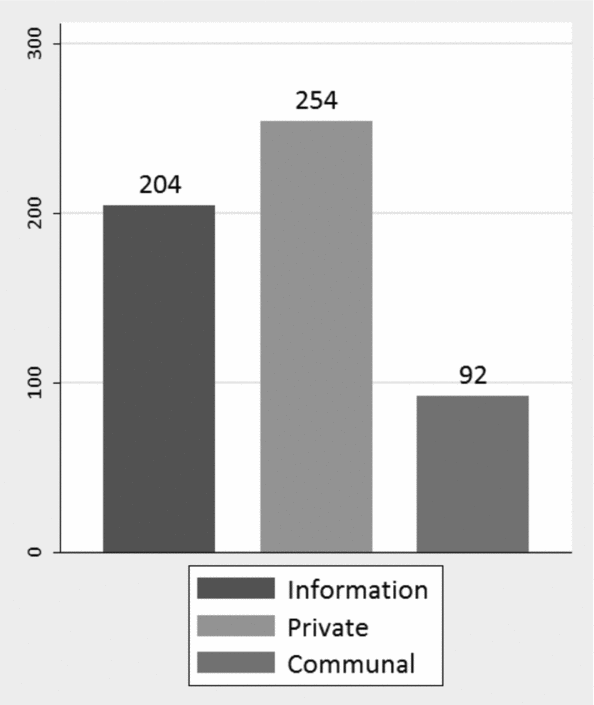
Opportunities to engage in these activities did not apply to respondents in control panchayats, because they were not eligible to participate in any of the project activities; therefore questions about these activities were only asked of respondents in treatment panchayats. Figure 2 reports the number of respondents who reported undertaking each of these activities.
Reported Frequency of Exposure to Project Activities

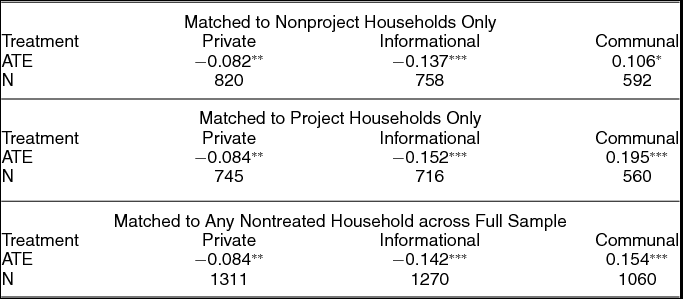
Table 6 reports the estimated ATE for the three different ways in which respondents could engage with the project. It compares respondents from the 2011 survey who answered affirmatively to the three participation measures to various control groups. The analyses reported in this table allow us to more finely test our hypotheses by separating various aspects of the treatment. The top panel of rows in Table 6 matches project participants to respondents in nonproject households (i.e., from control panchayats). This comparison group therefore contains individuals who likely had no direct project exposure and little to no indirect exposure (as in Table 5).Footnote 10 The second panel compares project participants to other respondents in project households who did not report participating in each type of activity. These comparison respondents thus had no direct exposure to the project, but may have had some indirect exposure. The third panel compares project participants to respondents from either project or nonproject households who did not report participating in each activity.Footnote 11
Effect of Participation in Project Activities on Motivations for Conserving Forest Resources, Nearest Neighbor Matching Analysis with Alternative Comparison Groups

*p<.10, **p<.05, ***p<.01, two-tailed test
Matching variables: gender, caste, age, education, media exposure, political participation, forest dependence, and hybrid cattle. Nearest neighbor matching with four matches per treated observation, exact matching on gender and motivation in 2006, matched within panchayat pair, with heteroskedastic errors based on four matches within the treatment group and bias adjustment on matching variables.
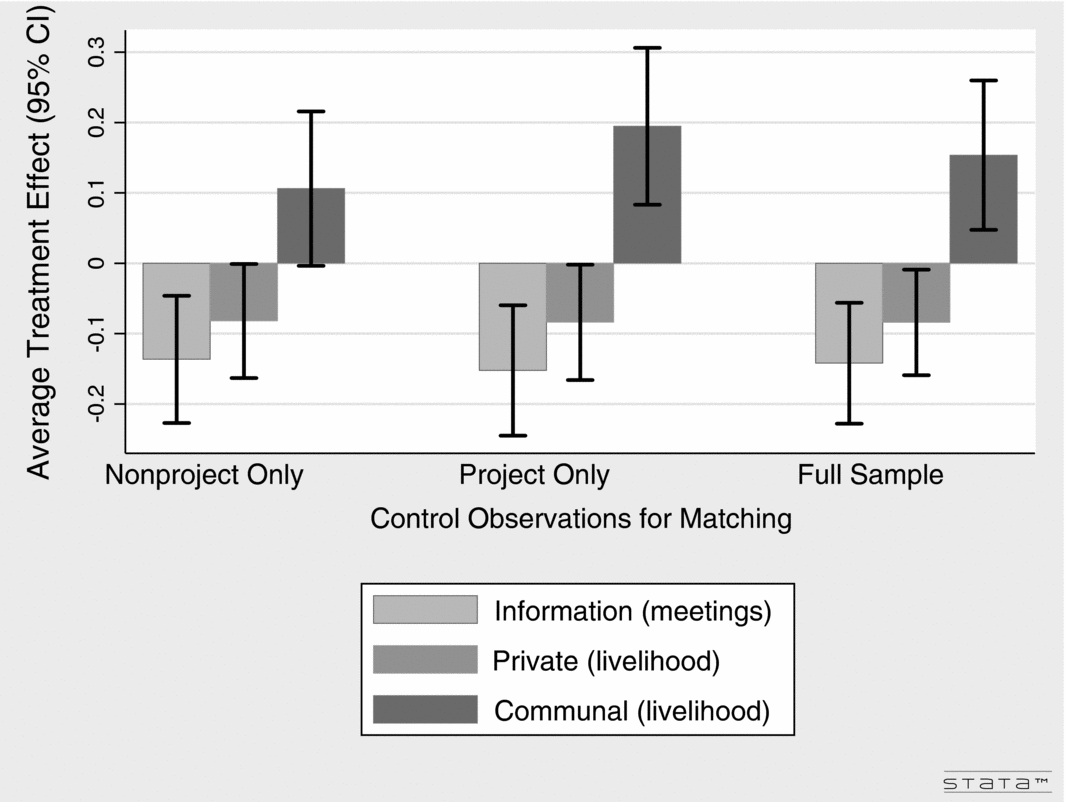
In all three panels, the estimated ATE of private livelihood benefits is negative and significant, and the ATE of participating in communal livelihood activities is positive and significant (Figure 3). The ATE on environmental motivations of obtaining informational benefits from participating in meetings is negative and significant. The size of the negative effect associated with informational benefits is greater than it is for private livelihood benefits.
Nearest Neighbor Matching Results Demonstrating Conditional Motivational Crowding

These results suggest that motivational crowding occurs when project participants are provided with private material benefits and when they receive information in project meetings. But these crowding-out effects appear to be offset by benefits that activate intrinsic or communal motivations. This more nuanced analysis suggests that, although motivational crowding may result from sustainable development projects that combine material benefits and environmental education, such crowding is conditional on the particular kinds of project benefits and the specific form of an individual's engagement with different project activities. It also suggests that it may be possible to offset the negative effects of some project activities by other types of activities.Footnote 12
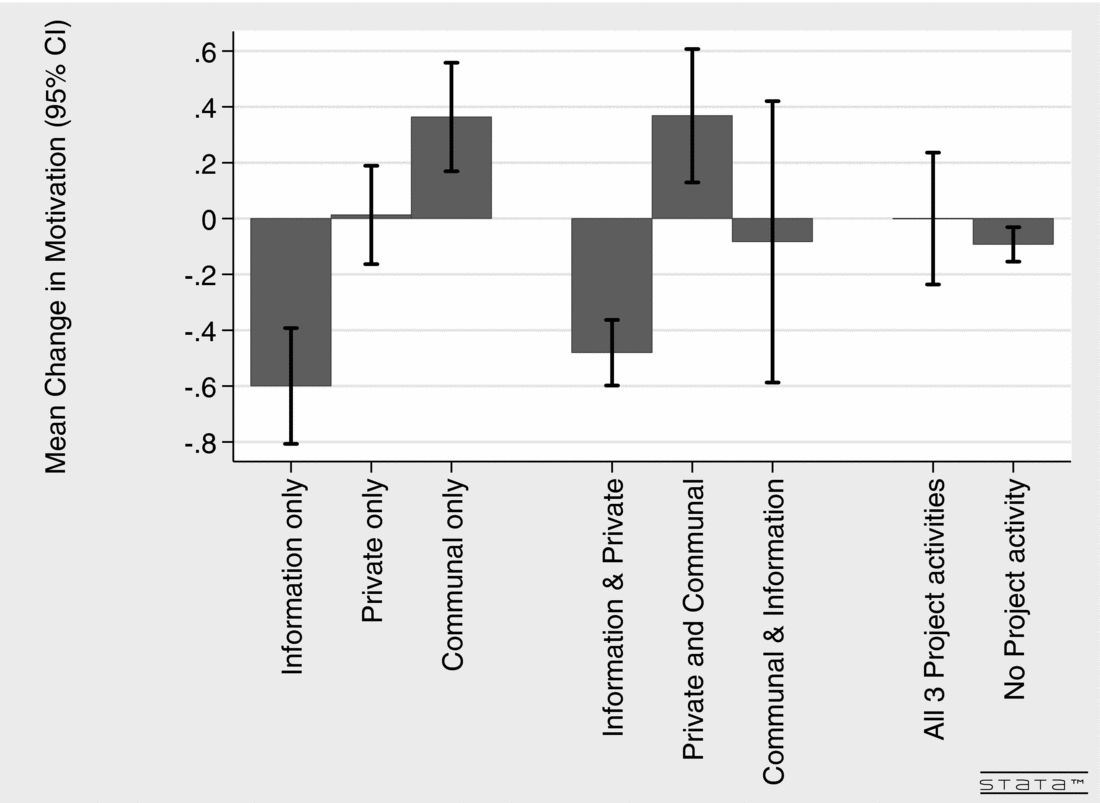
Figure 4 disaggregates the data used for the preceding analysis to more precisely identify the effects of specific combinations of project activities and the possible interactions between them. Whereas the analyses in Table 6 and Figure 3 group together all respondents who reported engaging in any of the three activities, the analyses reported in Figure 4 group respondents based on the specific combinations of project activities in which they were involved. To estimate the effects of involvement in different combinations of activities, we used the same nearest neighbor matching procedure as earlier.
Effects of Participation in Different Combinations of Project Activities on Change in Motivations

Figure 4 provides clearer evidence on the conditional crowding-out effect. The first set of estimates shows the stark contrast between the effect of information from project meetings (negative and significant) and the effect of receiving communal livelihood benefits (positive and significant). Once the receipt of private livelihood benefits is isolated from other activities, however, its effect on motivations is essentially zero, suggesting that it was the combination of private livelihood benefits and information from meetings that produced the apparently negative effect of private livelihood benefits reported previously. This combined effect is further demonstrated in the second set of estimates: Reporting private livelihood activities along with either information or communal livelihood activities causes very little change in the initial effect of information and communal benefits. But there is substantial crowding out of the positive communal livelihood effect on the average participant's motivation when a respondent also reports attending informational meetings. Finally, we observe somewhat greater crowding out of the positive communal livelihood effect when a respondent also reports engaging with activities that lead to private livelihood benefits and information.
Multivariate Analysis
The analyses reported in Table 5 demonstrate that respondents in treatment panchayats are significantly more likely, on average, to change their motivations for conserving forests from environmental to economic, whereas the analyses reported in Table 6 and Figures 3 and 4 show that participation in different project activities has heterogeneous effects on motivations. The crowding-out hypothesis is supported for individuals who gain private livelihood benefits and participate in project meetings. Those who participate in project activities that yield communal benefits through the creation of communal assets are more likely, on average, to express intrinsic motivations. This significant result for the reinforcement of intrinsic motivations through participation in communal activities suggests that a nuanced analysis might uncover additional mechanisms for such outcomes.
To probe deeper into these mechanisms, we estimated a series of logistic regression analyses. The dependent variable was the same measure of motivations for forest conservation as in the previous analyses; it was scored 1 if the respondent reported environmental motivations in 2011 and scored 0 if he or she reported economic motivations. Independent variables included the respondents’ baseline (2006) motivations; personal/demographic characteristics (gender, caste, age, education, reported media exposure, level of political participation, and forest dependence); and various measures of project engagement. The personal/demographic characteristics were measured in 2006 and so were assumed to be largely exogenous to the project treatments. The estimated coefficients indicate how different personal characteristics shape an individual's motivations in response to the project.
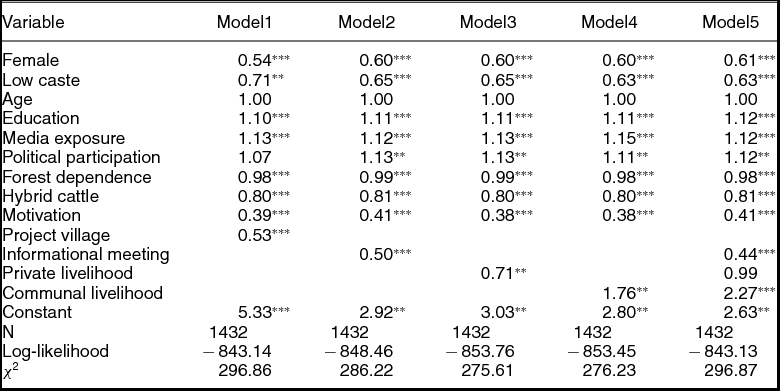
Table 7 reports the results of five separate logistic regression analyses. The models all include baseline motivations and personal/demographic characteristics; each model then includes different combinations of the project engagement variables. Model 1 includes a dummy variable indicating whether the respondent lives in a project (treatment) panchayat versus a control panchayat. Models 2–4 include each of the three activity categories as dummy variables (private livelihood, informational, and communal livelihood) separately, whereas Model 5 includes all three activity variables together. Note that all of the panel respondents are included in all five models; as such, the relevant comparison group in Model 1 is the set of respondents living in control (nonproject) panchayats, whereas the comparison group in Models 2–5 is the set of respondents in both treatment and control panchayats who did not report participating in a given activity. The table reports odds ratios, which are interpreted as the relative odds of reporting environmental motivations for a unit change in the independent variable, relative to a respondent without that characteristic. Odds ratios above 1 indicate that individuals with a given characteristic have higher odds of reporting environmental motivations than individuals without that characteristic.
Effect of Participation in Project Activities on Motivations for Conserving Forest Resources; Logistic Regression Results (odds ratios)

*p<.10, **p<.05, ***p<.01, two-tailed test
All of the treatment/project engagement estimates in Models 1–3 are less than 1 and are statistically significant, indicating that living in a project panchayat, receiving private material benefits, and attending project meetings all reduce the odds of reporting environmental motivations, relative to people in the comparison group. Participating in communal activities has a significant odds ratio above 1 (in Models 4 and 5), indicating that these activities are associated with higher odds of reporting environmental motivations. These results are again consistent with the conditional crowding out of intrinsic motivations demonstrated in the estimated treatment effects reported in Tables 5 and 6 and Figures 3 and 4.
In addition, most of the personal characteristics are significant. Women, low-caste individuals, those with high forest dependence, and those with greater material wealth all have lower odds of reporting environmental motivations for conserving forests, controlling for the other model characteristics. People with more education, higher levels of media exposure, and greater political participation all have higher odds of reporting environmental motivations for conserving forests. Of particular interest here is the strong and positive effect of political participation: Each additional meeting of the panchayat (as opposed to meetings organized by project personnel) attended by a respondent increases the odds of reporting environmental motivations by 12% (Model 5, CI 1–24%).
Environmental Motivations and Behaviors
Although the primary goal of this article is to investigate the relationship between changes in institutions and associated changes in intrinsic and extrinsic motivations, it is also important to assess how changes in motivations are associated with changes in environmental actions and behaviors. As a first step toward investigating whether behavioral changes go together with motivational change, we used some additional data collected in this study to carry out preliminary analyses regarding environmental behavior.
Specifically, we examined how changes in motivations between 2006 and 2011 were related to the reported extraction of firewood and to cattle grazing in local forests. Firewood from forests and cattle grazing are central to the livelihoods of households in rural areas in much of the developing world. The same is true in our study sites. Without firewood, many households would find it harder to cook their food. Cattle grazing relieves the need to purchase fodder from markets, thereby supplementing household incomes.
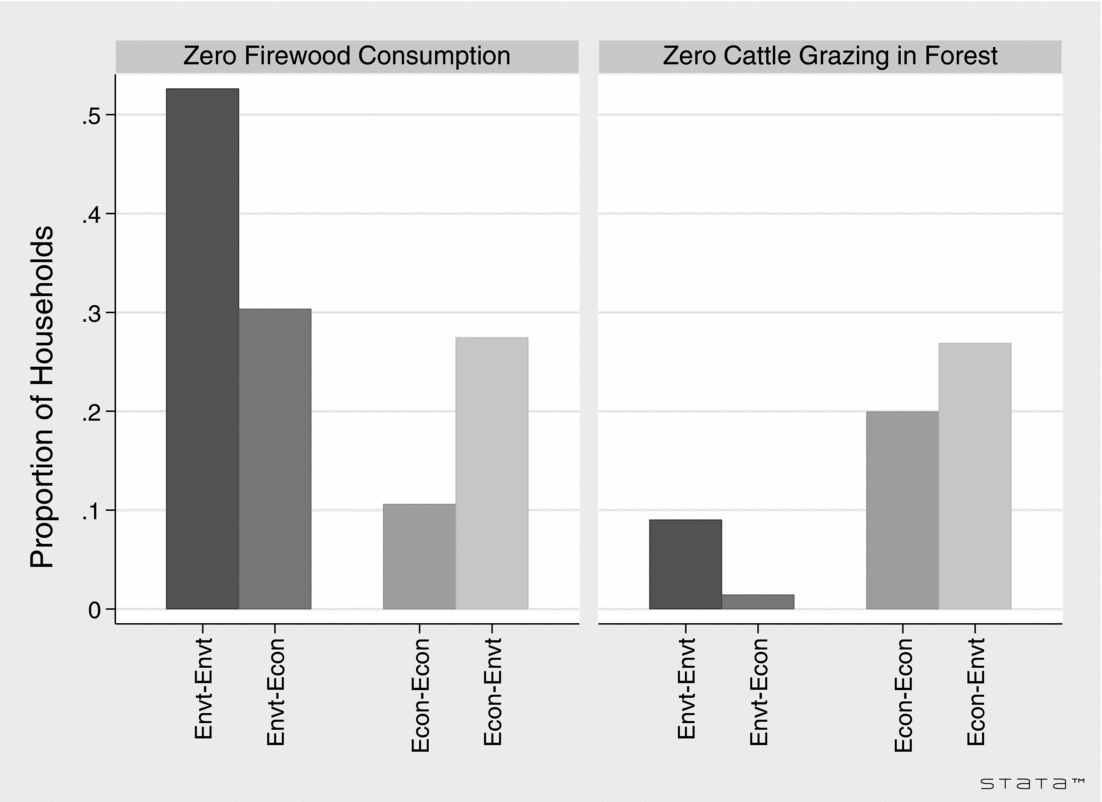
Figure 5 reports the proportion of households that changed from some amount of firewood collection or grazing in the forest in 2006 to discontinuing the practice in 2011. Higher values thus reflect more conservationist behavior. The two panels in Figure 5 show the change in these behaviors across two pairs of respondent groups: The first set of columns compares those who reported environmental motivations in 2006 and maintained those motivations in 2011 (i.e., Envt-Envt) with those whose 2006 environmental motivations were crowded out by economic motivations in 2011 (i.e., Envt-Econ). A much smaller proportion of those whose motivations changed from environmental to economic have stopped relying on firewood for their cooking. The second set of columns compares those who maintained economic motivations in both 2006 and 2011 (i.e., Econ-Econ) with those whose intrinsic motivations were reinforced in 2011 (i.e., who changed from economic to environmental, Econ-Envt). For this second set of respondents, a much greater proportion of those whose motivations changed from economic to environmental have stopped relying on firewood for cooking.
Association between Changes in Respondent Environmental Motivations and Environmental Behavior

This pattern is consistent across both types of conservationist behaviors (firewood collection and cattle grazing). Those whose environmental motivations were crowded out (Envt-Econ) reported lower levels of conservationist behavior than those who reported environmental motivations both in 2006 and 2011 (Envt-Envt). Those whose intrinsic motivations were reinforced between 2006 and 2011 (Econ-Envt) reported a higher level of conservationist behavior relative to those who maintained economic motivations (Econ-Econ). This simple analysis provides preliminary evidence that changes in motivations are in fact associated with meaningful shifts in behavior. Additional research will be necessary to investigate the links between motivational and behavioral changes more rigorously and to enable a better understanding of the conditions under which institutions, interventions, and incentives can induce pro-environmental behaviors.
CONCLUSIONS AND IMPLICATIONS
This article analyzes and estimates the effects of a sustainable development program—a watershed development program in the Indian Himalaya—on individuals’ motivations for conserving forest resources. Such programs are common across the developing world and are typically implemented as a partnership between international donors and country governments. To rigorously estimate project effects on motivational changes, we took advantage of the quasi-experimental opportunity that such interventions enable by collecting data immediately before and after project implementation from a matched set of project and control participants.
Our analyses, using both matching-based and multivariate analyses, show that the project had negative impacts on the environmental motivations of participants. To analyze the reasons why the project produced impacts that its implementers could not have anticipated, we focused on project activities that provided three kinds of benefits to participating households in project villages: informational benefits from project-related meetings (but no material benefits), private livelihood benefits, and collective livelihood benefits from the creation of small-scale communal assets in village neighborhoods.
When respondent households participated in meetings that provided information but no actual material benefits or when they gained small amounts of private livelihood benefits, they reported a change from environmental to economic motivations for protecting forests. This crowding out of intrinsic motivations is consistent with a developing body of experimental evidence that suggests that small amounts of private material incentives can crowd out intrinsic motivations without having a significant reinforcing effect on extrinsic motivations (Gneezy and Rustichini Reference Gneezy and Rustichini2000). At the same time, our analysis of the effects of private benefits in the presence of both collective and information benefits suggests that material benefits have little effect on motivations. This absence of any statistically significant effects runs contrary to the assumptions underlying the sustainable development approach whereby material benefits are typically expected to validate and strengthen environmental motivations and behaviors. Indeed, a large number of international development and conservation projects in developing countries are designed on the basis of this assumption, even when the assumption is not made explicit. Our research and analyses suggest that this assumption may well be unfounded for project interventions that rely on awareness building for environmental protection without any material benefit provisions or on only small amounts of material benefits. Raising environmental awareness of future benefits that might flow from environmental protection, without provision of any material benefits, seems to have a strong negative impact on intrinsic motivations—likely because those subject to such activities come to identify environmental protection with material rewards (Lepper, Greene, and Nisbett Reference Lepper, Greene and Nisbett1973). Thus, if intrinsic motivations are unaffected by interventions that rely on small amounts of material benefits or are undermined by awareness activities that signal a link between environmental protection and material benefits, sustainable development projects can have the perverse effect of undermining their own environmental protection goals.
Our findings regarding the positive impact of communal assets and collective benefits from such assets on environmental motivations are in accordance with earlier work on the subject (Agrawal Reference Agrawal2005), as well as with emerging experimental evidence on “crowding in” of social preferences. As Bowles and Polania-Reyes (Reference Bowles and Polania-Reyes2012, 404) point out in their review of experimental evidence on the subject, such crowding in occurs more in public goods and common pool resource games, when it encourages moral engagement on the part of beneficiaries. The result is of particular importance for sustainable development projects: In contrast to the negligible effects of small private livelihood benefits and the substantial negative effects of awareness-building project activities, collective material benefits may generate significant and substantial positive impacts on environmental motivations. We found that recipients of collective benefits from the project reported a shift in their motivations consistent with the “reinforcement” hypothesis: Their motivation for natural resource conservation changed in an environmental direction, and this shift was sufficiently high to offset the opposite effect of participation in meetings and private livelihood benefits related to the project.
The results of the multivariate analysis show that project participants with higher education, greater media exposure, and more political participation are less likely to experience the crowding out of environmental motivations. Organizations that pursue sustainable development projects may find it beneficial to target these individuals as drivers of attitudinal change within their communities.
Our analysis of the relationship between changes in environmental motivations and environmental behaviors finds strong preliminary evidence in support of a clear link between a shift in the direction of positive environmental motivations and conservationist actions.
The findings of our study should be of particular interest to scholars interested in how institutions shape motivations. In providing a micro-foundational account of this relationship, our study suggests that incentives mediate the link between institutions and motivations and that the nature of the material and informational incentives generated by institutions is of critical importance. Purely informational incentives have negative effects on overall environmental motivations, whereas collective material benefits support improvements in environmental motivations. The picture for the effects of private material incentives is mixed, with some grounds for concern that they may not have the effects claimed for them on the basis of standard economic theory—that more private material incentives will enhance motivations to protect the environment. Thus more work on the precise effects of private benefits on intrinsic and overall motivations is warranted.
Finally, our analysis raises important concerns about whether improvements in extrinsic motivations linked to material benefits will persist after sustainable development projects are completed. Our results suggest that designers and implementers of such projects need to attend much more carefully to the activities that such projects sponsor, the benefits they bestow, and the ways in which they engage local residents in project activities. Our own agenda for future research envisages new data collection to assess whether the effects of sustainable development projects persist beyond the life of the intervention itself. Such assessments are critical to a better understanding of the persistence of project effects and to providing a better sense of the extent to which the scores of billions of dollars invested in sustainable development projects globally are justified.
APPENDIX
We used the coarsened exact matching (CEM) procedure in Stata to divide the treatment and control observations into strata based on our matching variables (Iacus, King, and Porro Reference Iacus, King and Porro2009). The CEM procedures identified strata that did not contain observations for both treatment and control groups. We dropped 158 observations after this exercise because they did not have appropriate matches (88 treatment and 70 control observations).
Our variables and strata for matching under CEM were the following:
-
1. Gender (Male/Female)
-
2. Low caste (Yes/No)
-
3. Age (above and below 25 years)
-
4. Number of years of schooling in 2006 (above or below 5 years)
-
5. Frequency of exposure to mass media (more and less than once a week)
-
6. Participation in local government meeting (Yes/No)
-
7. Proportion of domestic energy needs acquired from local forests in 2006 (above and below 50%)
-
8. Ownership of hybrid cattle (Yes/No)
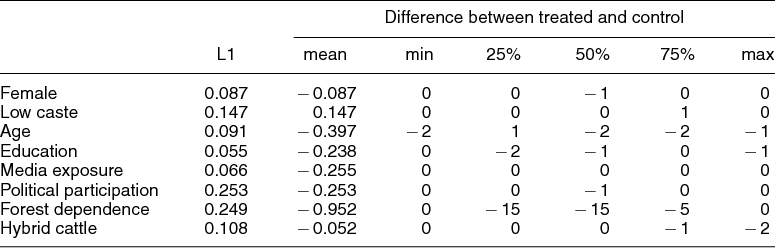
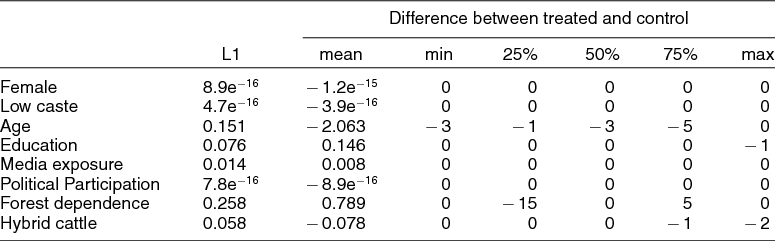
The matching balance before and after the procedure is reported in the following table. L1 is the univariate distance, followed by the difference in means and the respective quartiles of the distribution across treatment and control observations.
Balance Before Matching: N = 1,433; Treated = 808; Control = 625

Balance After Matching: N = 1,273; Treated = 720; Control = 553

The multivariate L1 distance, matching on Project, is L1 = .95354662.
We estimated the average treatment effect (ATE) on this sample of 1,273 observations derived from CEM using the nearest neighbor matching procedure (NNMATCH) in Stata (Abadie et al. Reference Abadie, Drukker, Herr and Imbens2004). We used the same matching variables and specified exact matching on Motivation in 2006 and Female. We matched each observation to four observations of the opposite group (treatment and control) in the calculation of ATE. In addition, we allowed for heteroskedastic errors, using the “robust” option, by conducting a second matching process across the matching variables to compare the variability of outcomes within matched strata. The balance table suggests that age, education, and hybrid cattle may induce bias in the estimated average treatment effect. To counter this possibility, we used the bias adjustment command within NNMATCH. We found that only education affected the estimates to a limited degree, and we only included this variable in our final model. The command syntax for the estimation in Stata is the following:
-
• cem gender06 sc age06(25.5) education06(5.5) newstv06(2.5) panchgh1 hhfuel06(50) cstall06(0.5), tr(project)
-
• nnmatch reasonforest11 project gender06 sc age06 education06 newstv06 panchgh06 hhfuel06 cstall06 if cem_matched = = 1, exact(reason2006 gender06) m(4) robust(4) bias(education06)




Comments
No Comments have been published for this article.