Introduction
The aphids Brevicoryne brassicae (L.) and Lipaphis pseudobrassicae (Davis) (Hemiptera: Aphididae) are cosmopolitan pests that cause significant losses in Brassica crops (Singh and Ellis, Reference Singh and Ellis1993; Blackman and Eastop, Reference Blackman and Eastop2002). During outbreak years, these pests are capable of destroying entire crops (Lammerin and Morice, Reference Lammerin and Morice1970; Parker et al., Reference Parker, Collier, Ellis, Mead, Chandler, Blood Smyth and Tatchell2002; Nebreda et al., Reference Nebreda, Moreno, Pérez, Palacios, Seco-Fernández and Fereres2004). Direct feeding has been reported to cause severe injuries to host plants at all growth stages, causing yellowing, wilting, distorting and stunting of infested plants as a result of nutrient depletion (Cruz et al., Reference Cruz, Vendramin and Oliveira1998). Aphid infestation is among the major causes of low productivity and reduced market values (Costello and Altieri, Reference Costello and Altieri1995) in Brassica crops (Bakhetia, Reference Bakhetia1983; Joshi et al., Reference Joshi, Katiyar, Khan, Banerji, Misra and Nigam1989). To manage these pests, farmers resort to the use of synthetic insecticides, leaving high residue levels in both soil and seeds, resulting in health problems, environmental degradation, development of resistance to insecticides and pest resurgence (Dikshith et al., Reference Dikshith, Raizada, Singh, Kumar, Gupta and Kaushal1989; Kaphalia et al., Reference Kaphalia, Takroo, Mehrotra, Nigam and Seth1990; Gupta et al., Reference Gupta, Stravitz, Dent and Hylemon2001; Clark and Yamaguchi, Reference Clark, Yamaguchi, Clark and Yamaguchi2002), as well as destruction of natural enemies (Xu et al., Reference Xu, Wu, Zhang, Yin and Kuang2009). For these reasons, the use of biological agents as one of the integrated pest management strategies will provide an alternative option for suppressing aphid populations, and provide economic savings to the farmers as well as protect the environment and human health (Ehler, Reference Ehler2006).
Diaeretiella rapae (McIntosh) (Hymenoptera: Aphidiidae) is a solitary koinobiont endoparasitoid (Pike et al., Reference Pike, Starý, Miller, Allison, Graf, Boydston, Miller and Gillespie1999; Zhang and Hassan, Reference Zhang and Hassan2003), associated with Brassica attacking aphids (Starý, Reference Starý, Minks and Harrewijn1988; Mussury and Fernandes, Reference Mussury and Fernandes2002). It has been reported to prefer and cause a high percentage of parasitism on the specialist Brassica aphid species B. brassicae and L. pseudobrassicae compared with the generalist aphid Myzus persicae (Sulzer) (Baer et al., Reference Baer, Tripp, Bjorksten and Antolin2004; Stark and Acheampong, Reference Stark and Acheampong2007) and cereals attacking aphids such as Diuraphis noxia (Bernal and Gonzalez, Reference Bernal and Gonzalez1997). The high potential of D. rapae as a biocontrol agent of aphids on various crops, including crucifers, has been well documented (Brewer et al., Reference Brewer, Nelson, Ahern, Donahue and Prokrym2001; Mussury and Fernandes, Reference Mussury and Fernandes2002; Vaz et al., Reference Vaz, Tavares and Lomônaco2004).
Reports have shown that D. rapae is the most effective natural enemy against the cabbage aphid B. brassicae, causing up to 72% parasitism in The Netherlands (Haifez, Reference Haifez1961) and 76% in Kenya (Bahana and Karuhize, Reference Bahana and Karuhize1986). Parasitism ranged between 60 and 97% in Maharashtra, India on Lipaphis erysimi (Kaltenbach) (Homoptera: Aphididae) (Katole et al., Reference Katole, Nimbalkar, Yadgirwar, Kadu and Kolhe1998). Although the parasitoid is not native to Africa, it is the most common parasitoid species attacking aphids in East Africa (Bahana and Karuhize, Reference Bahana and Karuhize1986). However, D. rapae has not been reported in West Africa.
This parasitoid attacks and develops in all four nympal instars of the aphid hosts (Mackauer, Reference Mackauer and Lowe1973; Liu et al., Reference Liu, Morton and Hughes1984), although at varying degrees, due to different levels in host physiological suitability. Host suitability is considered to be of paramount importance for the development of immature stages of the parasitoid.
A suitable host has quality nutritional resources beyond the minimum required for parasitoid development. High parasitization efficiency implies high host suitability with required quality nutrients to maximize the fitness traits of their offspring (Hubbard and Cook, Reference Hubbard and Cook1978; Pyke, Reference Pyke1984; Sequeira and Mackauer, Reference Sequeira and Mackauer1992), such as fecundity, longevity and female-biased sex ratio (Roitberg et al., Reference Roitberg, Boivin and Vet2001). In turn, several factors, such as host species, host stage and host plant, influence host suitability (Mackauer, Reference Mackauer and Lowe1973; Liu et al., Reference Liu, Morton and Hughes1984; Pandey and Singh, Reference Pandey and Singh1999; Stark and Acheampong, Reference Stark and Acheampong2007).
There is limited information on the relationship between D. rapae and its aphid hosts in Africa, especially on the host/host stage acceptability and suitability, which are critical factors in biological control programmes. In this regard, this study was undertaken to assess the performance of D. rapae on two economically important aphid species, namely B. brassicae and L. pseudobrassicae. The information generated during this study will guide the redistribution efforts of this parasitoid to other parts of Africa where aphids are causing massive yield losses on Brassica crops in the absence of their natural enemies.
Materials and methods
Host plants
Cabbage, Brassica oleracea var. capitata L. (Grand Slam Hybrid), was planted at the International Centre of Insect Physiology and Ecology (icipe), Nairobi, Kenya using seeds purchased from the East African Seed Co. Ltd located in Nairobi, Kenya. The seeds were seeded in plastic germination trays (51 cm length × 32.5 cm width × 6.5 cm height). After 2 weeks, the seedlings (2.5 cm high) were thinned, leaving one healthy plant per cell (7.5 cm top diameter × 5.5 cm bottom diameter × 6.5 cm height). These seedlings (about 8 cm high with five to six leaves) were transplanted individually at the cotyledon stage into 2-litre plastic pots (16 cm height × 15 cm top diameter × 8.5 cm bottom diameter) with soil supplemented with fertilizer composed of farmyard manure. The potted soil was covered with about 2 cm layer of sand to prevent erosion when watered (every 2–3 days). Plants were kept in a screen house (287 cm height × 256 cm length × 252 cm width) at 22 ± 3 °C, 60 ± 10% relative humidity (RH) and a photoperiod of 12 h light:12 h dark. The plants were kept free from other pests and pesticides. New cabbage plants were planted every 1–2 weeks as needed. Standard agronomic practices were adopted for raising healthy plants required for the experiments.
Aphid cultures
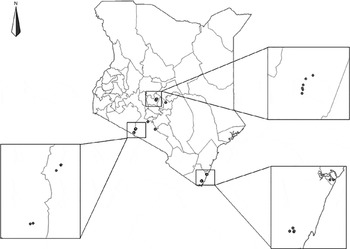
Field surveys for cabbage-infesting aphids were conducted in 19 cabbage-growing areas of Kenya (Fig. 1). Brevicoryne brassicae and L. pseudobrassicae were the most dominant populations of aphids found on cabbage in all the surveyed areas. A colony of the aphid B. brassicae was initiated from a wild population of aphids obtained from a heavily infested cabbage field in Wamunyoro, Nyeri [00°21′13.7″S, 037°05′47.6″E, 1922 m above sea level (masl)], while L. pseudobrassicae was initiated from a cohort obtained from a cabbage-infested field in Likoni, Mombasa (04°04′59.2″S, 039°39′45.6″E, 13 masl). In the laboratory, the infested aphid plant parts of each aphid species were transferred to healthy cabbage seedlings in separate Perspex cages (60 cm height × 50 cm width × 60 cm length). A round opening (15 cm diameter) was made in the front side of the cage to which a sleeve, made of fine net, was fixed. The same material was fixed to the opposite side of the cage for ventilation. The aphids were allowed to move voluntarily to the healthy plants as the introduced aphid-infested plant parts dried up. Some aphid samples from both localities were preserved in 70% alcohol for identifying up to species level. The two colonies were maintained in separate rooms at 25 ± 1 °C, 60 ± 10% RH and photoperiod of 12 h light:12 h dark, and equipped with light-emitting diodes growth light or agri-light to improve indoor plant growth at the Animal Rearing and Containment Unit, icipe, Nairobi, Kenya. The infested potted plants were watered twice a week. Aphid colonies were monitored daily and insects transferred to new potted plants when the old plants withered out. The stock aphid populations were cultured on the cabbage seedlings for eight generations before the start of the experiments. For colony maintenance, weekly or bi-weekly infestation of 20–30 cabbage seedlings was carried out, and after every 6 months, wild aphids from the field were introduced to maintain genetic diversity.
Map of the sampling localities of the cabbage aphids Brevicoryne brassicae and Lipaphis pseudobrassicae, and their associated parasitoid Diaeretiella rapae in Kenya.

Parasitoid colony
Surveys for primary parasitoids of B. brassicae and L. pseudobrassicae were conducted alongside the aphid survey described above (Fig. 1). The emerged parasitoids were initially identified by the Biosystematics Support Unit (BSU) of icipe, Nairobi, Kenya and later confirmed at the Royal Museum for Central Africa (RMCA), Tervuren, Belgium. Voucher specimens of the collected parasitoid samples were deposited at the BSU. Diaeretiella rapae (McIntosh) (Hymenoptera: Braconidae) was found to be the most common parasitoid, constituting more than 95% of the parasitoid species collected from both aphid species; therefore, it was selected for this study. The parasitoid colonies were initiated from mummified B. brassicae and L. pseudobrassicae collected from aphid-infested cabbage farms in Nyeri and Mombasa, respectively. Plant parts with mummified aphids were placed in plastic self-sealing bags and transported to the laboratory in an ice-cooled, insulated box. In the laboratory, mummified aphids were carefully removed from the plant parts using a fine camel-hair brush, and each aphid species was stored in separate glass Petri dishes (9.2 cm diameter × 1.7 cm height). The Petri dishes containing the mummified aphids were placed in separate Perspex cages (30 cm length × 30 cm width × 30 cm height) at ambient room temperature until emergence. A round opening (15 cm diameter) was made in the front side of the cage to which a sleeve, made of fine net, was fixed. The same material was fixed to the opposite side of the cage for ventilation. A small piece of moistened cotton was placed inside the cages to maintain the appropriate moisture. To kill the emerged parasitoids, some were kept in the refrigerator for 10–15 min and slide-mounted at the BSU and others were stocked on triangular-shaped white cards with entomological pins (size #2), labelled and placed in collection boxes (18 cm × 8 cm × 4 cm) for later identification using the methodology described by Raychaudhuri (Reference Raychaudhuri1990). Some adult parasitoids were also preserved in 70% ethyl alcohol in glass vials and others preserved dry in glass vials. Host plants were identified in the field or plant parts such as leaves and flowers, and then dried and preserved for identification.
Additional parasitoids (243 females and 97 males) that emerged in the cages after identification were collected using an aspirator, and released into Perspex cages containing potted cabbage plants infested with B. brassicae or L. pseudobrassicae. The wasps were provided with fine drops of pure honey streaked on the inner topside of the cages and water in cotton wool balls. The parasitoids were allowed to parasitize the aphids for 10–12 days, after which the mummified aphids were collected and placed on moist filter paper (9 cm diameter) in different Petri dishes (9.2 cm diameter × 1.7 cm height) until emergence. The emerged D. rapae were sexed under a stereomicroscope (Leica MZ12), paired for mating in a Perspex cage (20 cm × 30 cm × 20 cm) and fed on pure honey solution as described above. Thereafter, the mated wasps were transferred into new cages with infested host plants, as described above, to maintain the stock colony. The separate Perspex cages were placed in a growth cabinet with 25 ± 1 °C, 65 ± 5% RH and a photoperiod of 12 h light:12 h dark.
Prior to the experiments, the colony of D. rapae was reared on B. brassicae and L. pseudobrassicae colonies for three to four generations to allow them to adapt, and to remove maternal effects (Lacey, Reference Lacey, Mousseau and Fox1998), thus minimizing the effects of associative learning.
At the start of the experiment, and 12 days after the release of the parasitoids, mummies were collected from the infested potted plants and individually placed in gelatin capsules (26.14 mm length × 9.55 mm diameter; Parke-Davis Canada Ltd, Scarborough, Ontario, Canada). Mummies ( < 24 h) were observed twice daily and newly emerged parasitoids were used for the experiments.
Bioassays
Host stage acceptability
The host stage preference of D. rapae females was investigated when provided simultaneously with equal numbers of all instars of either B. brassicae or L. pseudobrassicae. Experiments were conducted in rectangular plastic containers (17 cm length × 16 cm width × 8 cm height) with an opening (8 cm length × 7 cm width) at the top covered with fine muslin. Prior to the start of the experiment, cabbage leaflets were collected and placed on a 3 mm layer of 3% agar in Petri dishes (1.3 cm high × 6.5 cm diameter). Thereafter, the tip of each leaf stem (petiole) was capped with a layer of moistened cotton and later covered with a piece of aluminium foil to help keep the leaf moist before transferring it to a rectangular plastic container, forming arenas. Prior to experimentation, leaf materials were disinfected with 1% sodium hypochlorite solution for 5 min, washed with tap water and rinsed with distilled water for 10 min. This procedure guaranteed the quality of the cabbage leaves, which are sensitive to water loss. After each arena was set up, a 1–2 cm2 piece of leaf containing 30 sexually mature female aphids from the stock culture was removed and transferred with forceps to the arena containing the cabbage leaflet, allowing natural transfer of the aphid to the new leaf.
After the females were transferred, the rectangular containers were placed in the climate chamber and the leaves inspected hourly until the 1st instar nymphs appeared. Thereafter, the adult female aphids were removed after 3 h. Once the nymphs became established, they were allowed to continue development in a climatic chamber at 25 ± 1 °C, 70 ± 10% RH and photoperiod of 12 h light:12 h dark until the desired instar stages were reached (1st = 24 h, 2nd = 48 h, 3rd = 120 h and 4th = 168 h) according to the procedures described by Xiong et al. (Reference Xiong, Wang and Teulon2011).
Fifty individuals of each instar (1st, 2nd, 3rd and 4th) of B. brassicae and L. pseudobrassicae of the same age (3 h old) were transferred with a fine camel-hair brush and left for approximately 30 min to settle on the leaf as described above. Thereafter, 10 newly emerged, mated, naive and fed 3-day-old female D. rapae were introduced into the rectangular plastic containers. The parasitoids were left to forage and oviposit for 24 h in a choice test at the ambient conditions described above, after which the parasitoids were removed and the exposed aphids allowed to continue feeding on their respective leaf. After 24 h, 20 of the exposed nymphs of each aphid species were randomly selected and dissected in phosphate buffer solution under a stereomicroscope. The number of nymphs containing at least one parasitoid egg was recorded. The leaf in each cage was replaced with a new one every 2–3 days.
Host suitability
To further test for host stage suitability for development of immature D. rapae, the remaining 30 aphid nymphs exposed in the previous experiment were maintained under the same conditions described above, except in this experiment, the hosts were allowed to develop until mummification and parasitoid eclosion. The number of mummies and the stage of the aphid at which the aphids were mummified were recorded daily until all the exposed aphid nymphs were either mummified or had developed to adults. The developmental duration from egg to mummification and from egg to wasp eclosion was also recorded. The mummified aphids were counted and placed individually in transparent plastic cups (4 cm height × 5.5 cm base diameter × 7.5 cm top diameter) to assess parasitization, emergence and sex ratio. The experiment was replicated 10 times for each aphid species.
Adult parasitoid longevity
A total of 40 (20 female and 20 male) newly emerged D. rapae wasps (about 3 h old) were randomly selected from the parasitoid culture and placed in Perspex cages (20 cm length × 20 cm width × 20 cm height). The wasps were supplied with pure honey and water, as described above, and allowed to mate. The cages housing the wasps were kept under the same ambient conditions as above. The wasps were monitored daily for mortality twice a day and dead wasps were removed.
Test for ovigeny of Diaeretiella rapae
Newly eclosed D. rapae females (>300) reared on either B. brassicae or L. pseudobrassicae were held separately in Perspex cages (30 cm length × 30 cm width × 30 cm height), and provided with food and water as described above. All females were unmated. To test for ovigeny, 30 wasps were killed by freezing at − 20 °C and dissected at each age class of 1, 3, 6 and 9 days post emergence for each of the aphid host species. Each female wasp was placed in a drop of phosphate buffer solution on a glass slide and the ovaries dissected, and mature eggs counted at 35 × with a Leica EZ4D stereomicroscope with an integral digital camera [Leica Microsystems (Switzerland) Limited].
Adult body size of Diaeretiella rapae
Wasp body size was determined based on the length of the hind tibia, since tibia length is considered an appropriate indicator of the body size of aphidiinae parasitoids (Van Emden and Kifle, Reference Van Emden and Kifle2002). The left hind tibiae of 30 female and 30 male wasps reared on either B. brassicae or L. pseudobrassicae were slide-mounted using Euparal solvent and clove oil. The mounted left tibia was measured to the nearest 0.0025 mm using a calibrated eyepiece micrometre scale on the Leica EZ4D stereomicroscope, as described above, at 10 × magnification. Each female and male parasitoid used was considered a replicate.
Lifetime fertility
Newly emerged pairs of naive D. rapae (1 female+1 male) were offered 50 aphids of either B. brassicae or L. pseudobrassicae on the cabbage plant in a cage (20 cm × 30 cm × 30 cm) daily for 3 h. The wasps were provided with food, as described above, and fresh hosts were provided on a daily basis until the female died. Each day, the exposed aphids were dissected after 24 h and the numbers of parasitized aphids counted. Fifteen pairs of the parasitoids were used for each aphid species.
Statistical analyses
Data on days to mummification, immature developmental time, adult parasitoid longevity, hind tibial length, and egg load of D. rapae were tested for normality and analysed using two-way or three-way ANOVA as appropriate. The percentage data on parasitism, mummification and adult emergence, and sex ratio (expressed as the proportion of females out of total progeny × 100) were arcsine-transformed (Sokal and Rohlf, Reference Sokal and Rohlf1981) before subjecting to two-way ANOVA. Means were separated using the Student–Newman–Keuls test at α = 0.05. All analyses were performed in R (R Development Core Team, 2013).
Results
Host stage acceptability
Diaeretiella rapae parasitized all the nymphal instars of both aphid species. However, percentage parasitism varied significantly across the nymphal instars (F= 5.2; df = 3,75; P< 0.0001 and F= 14.8; df = 3,64; P< 0.0001, for B. brassicae and L. pseudobrassicae, respectively), with the 3rd instar of B. brassicae and the 2nd instar of L. pseudobrassicae being most accepted (Table 1). There was no significant difference in percentage parasitism between the 1st, 2nd and 4th instars of B. brassicae, while for L. pseudobrassicae, there was no significant difference between the 1st and 3rd instars as well as between the 2nd and 3rd instars.
Days to mummification and number of mummies formed by various nymphal instars of Brevicoryne brassicae and Lipaphis pseudobrassicae parasitized by Diaeretiella rapae (mean±SE)

Means within a column or row followed by the same letter for the same parameter are not significantly different (P< 0.05).
When comparing the same nymphal instar across the host species, the 1st and 2nd instars of L. pseudobrassicae had a significantly higher percentage of parasitism compared with their counterparts of B. brassicae (F= 128.29; df = 1,19; P< 0.0001 and F= 28.72; df = 1,19; P< 0.0001 for 1st and 2nd instars, respectively). On the other hand, percentage parasitism was comparable for the 3rd and 4th instars of the two host species (Table 1).
Host suitability
Days to mummification of aphids parasitized by Diaeretiella rapae
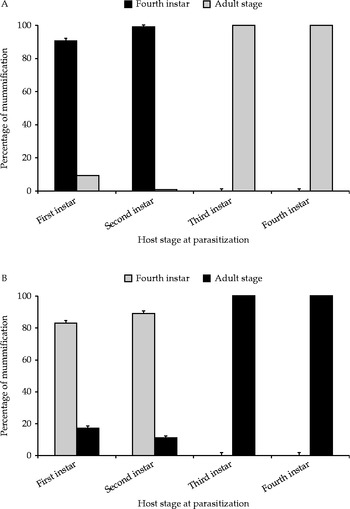
The interaction between host species and host stage had no significant effect (F= 1.55; df = 3,72; P= 0.2085) on the number of days to mummification following the parasitization by D. rapae. Also, the number of days to mummification did not vary significantly (F= 2.5; df = 1.72; P= 0.1159) between the two hosts when the data were pooled for all the stages. Within the same host species, number of days to mummification varied significantly (F= 3.31; df = 3,36; P= 0.0307) across host stages when the parasitoid was reared on L. pseudobrassicae, being highest on the 1st instar (8.57 days). On the other hand, there was no significant difference in the number of days to mummification among nymphal instars when the parasitoid was reared on B. brassicae (F= 0.86; df = 3,36; P= 0.4721). Of all the aphids that were parasitized, 90.6 ± 1.75% of 1st-instar and 96.6 ± 0.52% of 2nd-instar nymphs of L. pseudobrassicae were mummified at the 4th-instar stage, while only 82.9 ± 2.04% of 1st-instar and 88.9 ± 1.50% of 2nd-instar nymphs of B. brassicae were mummified at the 4th-instar stage (Figs 2A and B).
Stage of mummification of (A) Lipaphis pseudobrassicae and (B) Brevicoryne brassicae parasitized by Diaeretiella rapae.

Number of mummified aphids
The number of mummies formed by the two aphid species after exposure to D. rapae was significantly influenced by host (F= 17.5; df = 1,72; P< 0.0001), nymphal instar (F= 5.81; df = 1,72; P= 0.0013) and the interaction between host and nymphal instar (F= 6.04; df = 1,72; P= 0.0010). Within the same host species, the number of mummies varied significantly among nymphal instars for both host species (F= 24.74; df = 3,36; P< 0.0001 and F= 3.37; df = 3,36; P= 0.0289 for B. brassicae and L. pseudobrassicae, respectively). The 3rd instar yielded the highest number of mummies when the parasitoid was reared on B. brassicae, while it was highest on the 2nd, 3rd and 1st instars for L. pseudobrassicae. Between the two host species, the 1st and 2nd instars of L. pseudobrassicae yielded significantly more mummies compared with their counterparts of B. brassicae (F= 7.25; df = 1,18; P= 0.0149 and F= 15.18; df = 1,18; P= 0.0011 for 1st and 2nd instars, respectively), while the number of mummies was comparable when the parasitoid was reared on the 3rd and 4th instars of either host (F= 0.32; df = 1,18; P= 0.5758 and F= 0.76; df = 1,18; P= 0.3942 for 3rd and 4th instars, respectively) (Table 1).
Adult parasitoid percentage emergence
On the same host species, percentage emergence of D. rapae varied among the nymphal instars for both host species (F= 4.6; df = 3,75; P< 0.0001 and F= 123.4; df = 3,89; P< 0.0001 for B. brassicae and L. pseudobrassicae, respectively). However, the percentage of emerged D. rapae was not significantly different when the parasitoid was reared on either host for all the nymphal instars (Table 2).
Percentage emergence, developmental duration and sex ratio of Diaeretiella rapae reared on Brevicoryne brassicae and Lipaphis pseudobrassicae (mean±SE)

Means within a column or row followed by the same letters for the same parameter are not significantly different (P< 0.05).
Developmental time
The developmental duration of D. rapae was significantly influenced by the interaction between host stage age and wasp sex (F= 3.6; df = 3,113; P= 0.0158). However, the interaction between host species and wasp sex (F= 1.70; df = 1,113; P= 0.1954), and host species, host age and wasp sex (F= 0.42; df = 3,113; P= 0.7403) had no significant effect on developmental duration of the parasitoid (Table 2).
On the same host and for the same sex, developmental duration varied across host age (F= 0.93; df = 3,21; P= 0.4443 for males on B. brassicae; F= 0.85; df = 3,28; P= 0.4798 for males on L. pseudobrassicae; and F= 2.76; df = 3,36; P= 0.0561 for females on L. pseudobrassicae), expect when females were reared on B. brassicae, where the developmental time of females reared on the 3rd and 4th nymphal instars was significantly shorter (F= 7.05; df = 3,28; P= 0.0011) than those reared on the 1st and 2nd instars.
On the same nymphal instars of the same host, male and female developmental time was comparable (F= 0.62; df = 1.8; P= 0.4522; F= 1.28; df = 1.11; P= 0.2816; F= 1.29; df = 1,16; P= 0.2719 for 1st, 2nd and 3rd instars of B. brassicae, respectively; and F= 0.39; df = 1,15; P= 0.5400; F= 0.60; df = 1,17; P= 0.4489 for 1st and 2nd instars of L. pseudobrassicae), except when the parasitoid was reared on the third instar of L. pseudobrassicae (F= 5.19; df = 1,18; P= 0.0352) and on the fourth instar of either host (F= 4.88; df = 1,14; P= 0.0444 and F= 9.17; df = 1,14; P= 0.0090 for B. brassicae and L. pseudobrassicae, respectively).
On the same nymphal instar of different hosts, male and female developmental time was comparable with that of their counterparts, except when females were reared on the 2nd instar nymphs, where females reared on B. brassicae had significantly longer developmental time than those reared on L. pseudobrassicae (F= 8.63; df = 1,16; P= 0.0097).
Parasitoid sex ratio (percentage female progeny)
On the same host species, percentage female progeny varied across host instars when the parasitoid was reared on either host (F= 4.6; df = 3,87; P< 0.0001 and F= 24.16; df = 3,85; P< 0.0001 for B. brassicae and L. pseudobrassicae, respectively). On the other hand, percentage female progeny was comparable between the two hosts for all nymphal instars except when the parasitoid was reared on the 1st instar, where percentage female progeny was significantly higher on L. pseudobrassicae (Table 2).
Adult parasitoid longevity
The interaction between host and wasp sex had no effect on the wasps’ longevity (F= 1.84; df = 1,76; P= 0.1790). Similarly, longevity of wasps reared on B. brassicae was not significantly different from those reared on L. pseudobrassicae for both sexes (F= 1.27; df = 1,38; P= 0.2671 and F= 0.62; df = 1,38; P= 0.4345, for males and females, respectively). Also within the same host, longevity was comparable for the two sexes (F= 0.03; df = 1,38; P= 0.8643 and F= 3.12; df = 1,38; P= 0.0851, for B. brassicae and L. pseudobrassicae, respectively) (Table 3).
Parasitoid size, developmental time and longevity of males and females of Diaeretiella rapae reared on Brevicoryne brassicae and Lipaphis pseudobrassicae (mean±SE)

Means within a column or row followed by the same letters for the same parameter are not significantly different (P< 0.05).
Parasitoid egg load
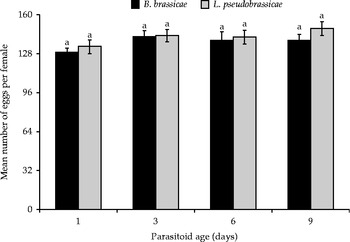
The egg load of D. rapae females was not significantly affected by host species (F= 0.47; df = 1,114; P= 0.4934), female age (F= 1.87; df = 1,114; P= 0.1595) and the interaction between host and female age (F= 0.04; df = 1,114; P= 0.9585) (Fig. 3).
Egg load (mean ± SE) of Diaeretiella rapae reared on Brevicoryne brassicae and Lipaphis pseudobrassicae at different ages. Bars with case letters are not significantly different (P< 0.05; Student–Newman–Keuls test).

Adult body size of Diaeretiella rapae
The interaction between host and sex had a significant effect on wasp size (F= 4.94; df = 1,116; P= 0.0282). Both male (F= 77.72; df = 1,58; P< 0.0001) and female (F= 763.07; df = 1,58; P< 0.0001) parasitoid wasps that emerged from L. pseudobrassicae had significantly longer tibial length compared with those that emerged from B. brassicae. Within the same host, the tibia length was similar for both sexes when the parasitoid was reared on B. brassicae (F= 3.6; df = 1,58; P= 0.0626). On the other hand, females had significantly (F= 11.83; df = 1,58; P= 0.0011) longer tibia compared with those of the males when the parasitoid was reared on L. pseudobrassicae (Table 3).
Lifetime fertility of Diaeretiella rapae
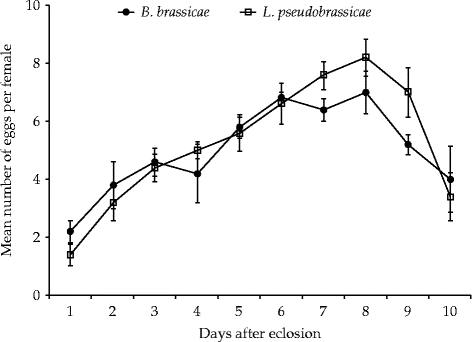
Female fertility (total number of eggs laid during a female's life span) of D. rapae was significantly higher (F= 10.22; df = 1,96; P< 0.0001) when females were offered L. pseudobrassicae compared with those offered B. brassicae. The number of eggs oviposited on both host species increased from the first day up to the 8th day and, thereafter, decreased sharply until the death of female parasitoids (Fig. 4).
Daily fertility of Diaeretiella rapae reared on Brevicoryne brassicae and Lipaphis pseudobrassicae.

Discussion
Results from this study provide considerable evidence that the host aphid species L. pseudobrassicae and B. brassicae were acceptable for oviposition by, and nutritionally and physiologically suitable for, the development of D. rapae. However, the level of acceptance varied across the different host stages of both aphid species. Also, the suitability differed among instars of both hosts as well as between the two host species. Diaeretiella rapae performed better on L. pseudobrassicae compared with B. brassicae in terms of number of formed mummies, percentage wasp emergence, developmental duration, percentage female progeny and female body size. All these traits have profound effects on parasitoid fitness. Also, the shorter days to mummification, and developmental time, narrows the window of exposure of the parasitoids to predation.
Diaeretiella rapae preferred the second and third instars of L. pseudobrassicae over the first and fourth instars of the same host because the parasitoid took a shorter time to mummify as well as produce more mummies on these instars. Among the different nymphal instars of B. brassicae, the parasitoid performed better when reared on the third nymphal instar. This implies that the food resource at the time of oviposition might not be the only factor that determines the oviposition decision of the parasitoid, and parasitoids could have selected these aphid stages according to the optimal trade-off between food supply and oviposition costs. Colinet et al. (Reference Colinet, Salin, Boivin and Hance2005), working with Aphidius ervi Haliday (Hymenoptera: Aphidiidae) on M. persicae, found that host quality was optimal on intermediate host ages and that the females preferred to parasitize these hosts. The authors also reported a shorter developmental time and a higher female-biased sex ratio in hosts of intermediate ages. The preference for younger and smaller aphid nymphs has been well documented (Mackauer, Reference Mackauer and Lowe1973; Mackauer and Kambhampati, Reference Mackauer and Kambhampati1988; Hågvar and Hofsvang, Reference Hågvar and Hofsvang1991; Bernal and Gonzalez, Reference Bernal and Gonzalez1997). Also, He and Wang (Reference He and Wang2006) found that the pea aphid parasitoid A. ervi (Haliday) selected medium-sized hosts over smaller and larger ones. The less developed defensive behaviour of the middle-age nymphal instars compared with the older nymphal instars was one reason why they could have been the preferred and more suitable hosts for D. rapae development (Gerling et al., Reference Gerling, Roitberg and Mackauer1990; Koaumé and Mackauer, Reference Koaumé and Mackauer1991; Losey and Denno, Reference Losey and Denno1998), as well as their suitability for parasitoid development (Liu, Reference Liu1985). Contrary to our findings, preference for older and larger nymphs of B. brassicae for other aphid parasitoid species has been reported (Elzinga et al., Reference Elzinga, Harvey and Biere2003; Harvey et al., Reference Harvey, Bezemer, Elzinga and Strand2004; Sandanayaka et al., Reference Sandanayaka, Charles and Allan2009).
In the present study, more than 90% of L. pseudobrassicae and 88% of B. brassicae parasitized by D. rapae at the 1st and 2nd instars were mummified at the 4th instar, while all nymphs of both species parasitized at the 3rd and 4th instars were mummified at the adult stage. This is in agreement with the results of several studies, indicating that the 1st and 2nd instars become mummies and die before reproducing, and even those that survive to adulthood fail to reproduce (Tremblay et al., Reference Tremblay, Pennacchio and Digilio1998; Digilio et al., Reference Digilio, Isidoro, Tremblay and Pennacchio2000; Sampaio et al., Reference Sampaio, Bueno, Rodrigues, Soglia and De Conti2007). According to van Steenis and El-Kawass (Reference van Steenis and El-Kawass1995), nymphs of aphids parasitized by aphidiine parasitoids that reach the adult stage only produce a small number of offspring; thus, the preference of a parasitoid to oviposit on young instars could be an advantage for its use in biological control because all nymphal instars parasitized at these stages will be unable to produce offspring, leading to suppression of the aphid population.
Charnov et al. (Reference Charnov, Hartogh, Jones and Assem1981) postulated that parasitoid sex ratio is adjusted following the host quality-dependent sex allocation model in parasitic hymenopterans, including Aphidiidae. Female parasitoids are expected to manipulate the sex ratio of their offspring by allocating the majority of unfertilized eggs (producing males) to less quality hosts and fertilized eggs (producing females) to superior quality hosts. In this study, B. brassicae sex ratio seems to follow this model, as there was a male-biased sex ratio when the parasitoid was offered the 1st instars. However, this was not the case with L. pseudobrassicae where the 1st instars yielded a female-biased sex ratio.
The egg loads of D. rapae reared on both host species were comparable for different female age groups, implying that the parasitoid is pro-ovigenic and confirming the earlier report by Starý (Reference Starý1970).
In this study, developmental time of both male and female D. rapae reared on all nymphal instars of the two host species was similar (as both sexes emerged at the same time), thus increasing the chances of early mating. The pro-ovigenic female parasitoids benefit from early mating, as it allows them to have more of their eggs fertilized immediately after emergence.
Conclusion
Diaeretiella rapae is a promising biological control candidate for the management of L. pseudobrassicae and B. brassicae, and can be used for augmentative releases to suppress these pests within the framework of an integrated management approach. Also, the higher performance of D. rapae on the intermediate-aged instars, coupled with the superior quality of the wasps produced from these stages, suggests that they can be used for mass rearing of this parasitoid. The baseline information generated from this study is vital in redistributing this parasitoid to other parts of Africa where L. pseudobrassicae and B. brassicae are inflicting massive yield losses on Brassica crops in the absence of their natural enemies.
Acknowledgements
This research was carried out with the support of the Dissertation Research Internship Programme based at the icipe, Kenya. We wish to express our sincere gratitude to Dr Sunday Ekesi for guidance and revision of earlier versions of the manuscript. The assistance of the BSU, icipe, Nairobi, and the RMCA, Tervuren, Belgium in identifying the parasitoid is appreciated. We thank the growers who granted us access to their farms for the aphids and parasitoid surveys. Last but not least, we are thankful to the project staff for their technical assistance.