Implications
Veal represents 98% of the total meat marketed under the Protected Geographical Indication (PGI) Ternera Gallega, which certified 17 000 T of meat in 2008 (Ternera Gallega, 2008). Ternera Gallega veal is categorized into two commercial classes: ‘Suprema’ and ‘Normal’, from non-weaned and weaned calves, respectively. The aim of this study was to characterize the fatty acid (FA) profile obtained in meat from the two different weaning managements, and therefore to justify the higher production costs of unweaned calves. Moreover, the effect of a longer grazing period on meat FA profile was studied as an alternative of the traditional indoor system, as it decreases production costs.
Introduction
For the last 60 years (Kritchevsky, Reference Kritchevsky1998), human nutritionists have been recommending a moderate total fat intake and a higher intake of polyunsaturated fatty acids (PUFA), mainly n-3 PUFA, because of their cardioprotective effects (Balk et al., Reference Balk, Lichtenstein, Chung, Kupelnick, Chew and Lau2006). Conjugated linoleic acid (CLA) isomers are a quantitively minor PUFA class that receives special attention because of their potential beneficial properties on human health (Tricon and Yagoob, Reference Tricon and Yagoob2006), the ruminant products (milk, meat) being the major natural sources of CLA for human beings (Chin et al., Reference Chin, Liu, Storkson, Ha and Pariza1992). Epidemiological studies have suggested that trans fatty acids (FAs; including trans 18:1) have harmful effects on human health (Willett et al., Reference Willett, Stampfer, Manson, Coditz, Speizer, Rosner, Sampson and Hennekens1993; Odegaard and Pereira, Reference Odegaard and Pereira2006; Dalainas and Ioannou, Reference Dalainas and Ioannou2008). However, vaccenic acid (18:1Δ11trans), a precursor of 9cis, 11trans 18:2 (CLA), might be healthy for human beings, as it has shown hypocholesterolaemic effects in rabbits (Bauchart et al., Reference Bauchart, Roy, Lorenz, Chardigny, Ferlay, Gruffat, Sébédio, Chilliard and Durand2007).
In the rumen, dietary lipids are subjected to hydrolysis and their unsaturated FA to trans isomerization and biohydrogenation (Harfoot and Hazelwood, Reference Harfoot and Hazelwood1988). As a result of these microbial transformations, the FA contained in rumen lipids and post-ruminal digesta differ from those present in the diet. Liquid alimentary sources like milk activate the reticular groove closing reflex, which allows the direct passage of liquid food to the abomasum, without being transformed in the rumen (Guilhermet et al., Reference Guilhermet, Mathieu and Toullec1973).
Beef production in Galicia (Northwest of Spain) has been based on small family herds of the Galician Blond (GB) breed, the most important local beef breed in Spain with more than 200 000 dams (ACRUGA, 2009). The traditional system to produce GB calves involves: indoor management, maternal suckling without weaning, complementary concentrate diet and 7 to 9 months slaughter age. In the last 40 years, alternative systems have been developed. The indoor finishing period makes maternal suckling laborious; and therefore, many farmers choose to wean their calves before slaughter. As the northwest of Spain is a humid region with important areas of grassland, farmers have included a grazing period in the calf feeding system to produce calves with similar carcass and meat quality characteristics to traditional ones (Moreno et al., Reference Moreno, Varela, Portela, Pérez, Carballo and Monserrat2007). Grazing-based beef production allows the herd size to increase and improves animal welfare, while developing a more natural management, in accordance with several European Union (EU) welfare rules (Decision 97/182/EC, Directive 97/2/EC). As GB is considered a late maturating bovine breed, a finishing period with concentrate is needed to increase fat deposition in the carcass of young calves.
Recognition of the unique quality of Galician beef prompted the EU to accept, in 1996, the Protected Geographical Indication (PGI) of Galician veal ‘Ternera Gallega’, which includes pure and crossbred GB. Nowadays, the PGI Ternera Gallega is the major reference in Spain with regard to the commercialization of high-quality meat: 48% is marketed in Galicia, 50% in other areas of Spain and 2% is exported. PGI Ternera Gallega classifies the animals as calves (98%) and steers (2%) depending on whether the age at slaughter was earlier or later than 10 months old, respectively. Two classes of calves are commercialized: ‘Normal’ class calves (40%) suckle their mothers for at least 2 months and are weaned before slaughter, and ‘Suprema’ class calves (60%) suckle their mothers throughout their entire life. Owing to the characteristic way of rearing, the higher PUFA/saturated FA (SFA; P/S) ratio (Moreno et al., Reference Moreno, Varela, Oliete, Carballo, Sánchez and Monserrat2006) and the higher flavour intensity of meat in milk-fed animals (Sañudo et al., Reference Sañudo, Sierra, Olleta, Martin, Campo and Santolaria1998), veal from non-weaned (NW) animals (‘Suprema’ class) is more desirable than weaned (W) veal (‘Normal’ class) and fetches higher prices in the market.
The effect of weaning and finishing systems on the FA profile of GB meat has already been studied separately (Varela et al., Reference Varela, Oliete, Moreno, Portela, Monserrrat, Carballo and Sánchez2004; Moreno et al., Reference Moreno, Varela, Oliete, Carballo, Sánchez and Monserrat2006 and Reference Moreno, Varela, Portela, Pérez, Carballo and Monserrat2007). However, none of the experiments already published characterized veal cis and trans 18:1 and possible interactions between both effects were not checked. The objectives of this study were (i) to study simultaneously the effect of weaning and the finishing feeding treatment on the Longissimus thoracis (LT) FA profile of GB to find possible interactions; (ii) to study the LT muscle FA profile in depth, with a special focus on healthy (n-3 PUFA, CLA and 18:1Δ11trans) and unhealthy SFA, (18:1Δ9trans and 18:1Δ10trans) FA; and (iii) to prove a more suitable FA profile in NW than W calves to contribute to the justification of higher production costs of a non-weaning management.
Material and methods
Animals and management
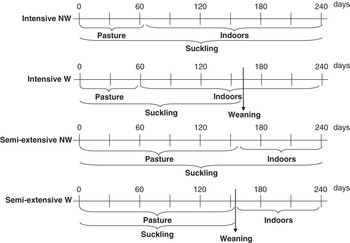
Twenty GB breed male calves, from the Mabegondo Research Centre herd, were used in this study. Calves were born in autumn; they were reared with their mothers on pasture and were allowed to suckle freely. Animals were randomly assigned to two experimental groups (10 calves per group), differing by the duration of the indoor finishing period: intensive system (IS) and semi-extensive system (SES). Within each group, calves were randomly assigned to a NW or to a W treatment before slaughter (10 animals per treatment). A diagram of the experimental protocol is presented in Figure 1.
Diagram of the experiment with Galician Blond calves having a non-weaning (NW) or a weaning (W) treatment in an intensive or semi-extensive feeding system during the finishing period.

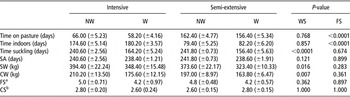
IS calves were housed indoors when they were 62 (±2) days old (Table 1). They were randomly assigned to two subgroups (five animals per group): NW and W. Each subgroup was placed in one pen, which was provided with a concrete floor, straw bedding, good aeration, one drinking trough and one feeding trough. IS calves were given an ad libitum ration of concentrate and hay and they kept suckling their mothers twice daily. Dams, conducted on a rotational grazing system, were taken from the grassland to the feedlot twice a day, for the suckling times. They stayed with their calves for about 20 min, until they stopped suckling; the foreman in charge checked visually that every calf suckled its mother. W calves were weaned 76 (±2) days before slaughter and NW calves kept suckling their mothers until being slaughtered when they were 240 (±1) days old.
Mean time (days) on pasture, indoors and suckling of GB calves. SA, SW, CW FS and CS of GB calves

GB = Galician Blond; SA = slaughter age; SW = slaughter weight; CW = carcass weight; FS = carcass fat score; CS = carcass conformation score; NW = non-weaned; W = weaned; WS = weaning status; FS = finishing system.
aFS: 1 to 15; 4 = 2−; 5 = 2.
bCS: 1 to 6; 2 = O; 3 = R.
SES calves, conducted with their mothers on a rotational grazing system, were given grass silage ad libitum when grass availability on pasture was too limited. Calves were given additional concentrate for 3 weeks before they went indoors. When they were 159 (±2) days old (Table 1), SES calves were housed indoors in the same conditions as IS calves. W calves were weaned when they went indoors to be finished, being slaughtered when they were 242 (±1) days old. NW calves kept suckling their mothers twice daily up to slaughter at 239 days of age.
Pasture
Fourteen hectares of perennial ryegrass (Lolium perenne, 20 kg/ha) and white clover (Trifolium repens, 6 kg/ha) were offered to animals for grazing. In spring, animals grazed 50% of the total area, while the remaining 50% was kept for silage and hay production for complementary requirements in winter. The sward was sown in autumn and the fertilization rates were 84, 84 and 44 kg/ha of P2O5, K2O and N, respectively. The annual maintenance fertilization rates were 80, 80 and 152 kg/ha of P2O5, K2O and N, respectively, for the silage and hay areas.
Animals were grazed on a rotational system, moving into a plot when the grass height was 15 cm; it was measured at 40 to 50 random points on each plot by a swardstick. Calves were rotated using an advanced grazing system that allowed them to select the first grass. Daily dry matter (DM) intake of grass, estimated as the difference between pre- and post-grazing mass, amounted to 4.8 kg/day in SES calves.
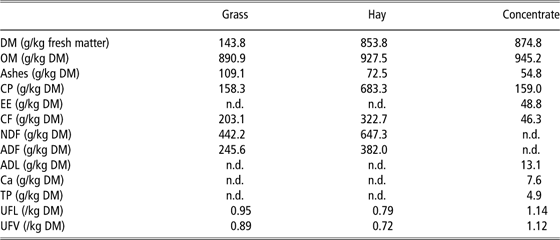
Grass samples collected in each plot were mixed and a 0.5 kg sample was taken for DM determination, as well as a 0.5 kg hay sample collected from each bale used to feed calves. Grass and hay DM were determined gravimetrically in a drying oven at 80°C for 17 h. Half of the samples, milled at the size of 8″, were vacuum-packed and stored at −20°C until FA analysis. The other half was used for the analysis of grass chemical composition by near infrared reflectance spectroscopy (NIRS; Bran Luebe, Infra Alyzer 500, Norderstedt, Germany; Table 2).
Mean chemical composition of grass, hay and concentrate consumed by GB calves
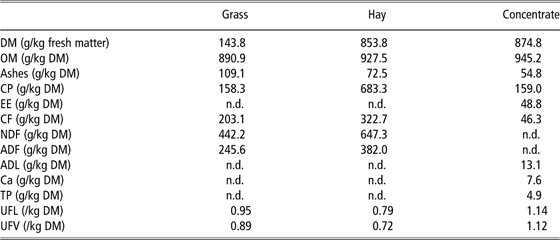
GB = Galician Blond; DM = dry matter; OM = organic matter; EE = ether extract; CF = crude fibre; Ca = calcium; TP = total phosphorus; n.d. = not determined; UFL = net energy value expressed as ‘Unité Fourragère Lait’; UFV = net energy value expressed as ‘Unité Fourragère Viande’ (Vermorel, Reference Vermorel1978).
Indoor period
Concentrate and hay intake were calculated as the difference between the daily amounts offered to and rejected by animals in each pen. In the IS group, concentrate intake were 2.48 and 2.99 kg DM/day and hay intake 0.91 and 0.84 kg DM/day for NW and W calves, respectively; and in the SES group, concentrate intake were 3.89 and 4.76 kg DM/day and hay intake 0.93 and 1.04 kg DM/day for NW and W calves, respectively.
Calf milk intake during the indoor period was assumed to be the cow milk yield, which was estimated using the oxytocin and machine milking method (Le Du et al., Reference Le Du, Macdonald and Peart1979). Cows were injected oxytocin intramuscularly and they were milked with a milking machine, measuring the milk collected. These measurements were taken once in the morning and once in the evening suckling periods, and daily production was considered to be double the milk obtained. A mean of the two quantities obtained was calculated. Milk intake of NW calves, at the end of the finishing period, was estimated as 5.59 and 6.52 kg/day in the IS and SES groups, respectively.
The concentrate given to the different experimental groups consisted, on the basis of 100 g DM, of 38 g corn flour, 17 g corn gluten, 10.5 g soyabean flour (44% protein), 10 g wheat bran, 8 g wheat flour, 5.5 g dried residues from the wheat distillery, 5 g barley flour, 2 g calcique soaps of palm oil, 1 g sugarcane molasses, 0.9 g calcium carbonate, 0.7 g sodium bicarbonate, 0.5 g palm oil (>90% hydrogenated), 0.5 g sodium chloride and 0.07 g phosphate bicalcique. This ration was supplemented with vitamin A (8000 UI/kg), vitamin D3 (2500 UI/kg), vitamin E (20 mg/kg), copper (15 mg/kg) and butyl-hydroxytoluene (0.3 mg/kg).
Chemical composition of concentrate (Table 2) was determined by NIRS. Milk composition, determined by infrared scan (Milkoscan, FT6000, FOSS ELECTRIC, Hillerød, Denmark), contained, on the basis of 100 ml: 3.5 g of crude fat, 4.0 g of crude protein and 4.8 g of lactose.
Veterinary treatments
Calves were not subjected to veterinary treatments. Only dams were vaccinated 3 weeks before calving against rotavirus, coronavirus and enteropathogenic Escherichia coli to prevent diarrhoeas of their calves. Early in the winter, dams were also wormed with ivermectine 1% for protection against gastrointestinal round worms, lungworms, Hypoderma spp, mites and lice.
Sampling procedures
Animals were weighed before being carried to a commercial abattoir situated 4 km away from the Mabegondo Research Centre. They were slaughtered within 2 h of their arrival. Carcasses were weighed and classified for fat (1− = leanest and 5+ = fattest) and conformation (P – poor, O – fair, R – good, U – very good, E – excellent, S – superior) scores using the European Grading Systems (CEE no. 2273/91). Values were given to the different levels of fat score (1 to 15) and conformation score (1 to 6), respectively, for statistical analysis. Mean fat and conformation scores are given in Table 1. After slaughtering, carcasses were chilled at +2°C and a loin commercial piece was removed 24 h post mortem from the left half carcass, between the 5th and 10th ribs. A 250 g sample of LT muscle was collected, blended in a commercial grinder and stored at −20 °C until FA analysis.
FA analysis
LT samples were defrosted and homogenized, at room temperature, using a Heidolph Diax 900 processor (Heidolph Instruments GmbH & Co. KG, Schwabach, Germany). Total lipids were extracted from 50 g of homogenized muscle by the method of Bligh and Dyer (Reference Bligh and Dyer1959) as described by Moreno et al. (Reference Moreno, Varela, Portela, Pérez, Carballo and Monserrat2007). Lipids of LT samples were frozen at −20°C and their total FA (TFA) were extracted and converted into FA methyl esters (FAME) by transesterification (Morrison and Smith, Reference Morrison and Smith1964), first with sodium methanolate and second with BF3-methanol 14% at 20°C.
Total 18:1 cis and trans isomers were isolated from total FAME (20 mg/ml in acetone) by preparative reversed-phase high-performance liquid chromatography using a series of two Kromasil-C18 columns (5 μm, 250 mm length i.d. 10 mm; Thermo Electron, Interchim, Montluçon, France) protected with a pre-column Modulo-cart QS (10 mm) as described by Juanéda (Reference Juanéda2002). FAME were eluted with acetonitrile (4 ml/min) and detected at 206 nm. Cis and trans FAME were selectively recovered manually.
Analysis of centesimal composition of FA and of 18:1 cis and trans isomers was achieved by gas–liquid chromatography using a chromatograph PERI 2100 (Périchrom, Saulx-les- Chartreux, France) fitted with a CP Sil 88 column (100 m length; i.d. 0.25 mm, Varian, Palo Alto, CA, USA). Hydrogen was used as the carrier gas (H2 flow: 1.1 ml/min) in conditions of split injection (1 : 50). Injector and detector temperatures were 235°C and 250°C, respectively. Oven temperature was programmed at 70°C for 30 s, then increased from 70°C to 175°C at 20°C/min, held at 175°C for 25 min, again increased from 175°C to 215°C at 10°C/min, and finally held at 215°C for 42 min. Identification of individual FA was based on comparison of their retention time with commercial FA standard mixtures (FAME Mix C4-C24, Supelco, Bellefonte, PA, USA; methyl trans-vaccenate 99% and methyl oleate 99%, Sigma) and on comparison with some chromatograms published in several studies (Dionisi et al., Reference Dionisi, Golay and Fay2002; Wolff, Reference Wolff2003). Moreover, as there are no commercial standards available for several 18:1 isomers, two FAME samples were transformed in dimethyl disulphide derivates and they were qualitatively analysed by gas chromatography–mass spectrometry (Yamamoto et al., Reference Yamamoto, Shibahara, Nakayama and Kajimoto1991) to confirm the identification of the different trans and cis isomers of 18:1.
Milk fat was extracted by the Rose-Gottlieb method (EU official method, 92/608/CEE) and total plant lipids (fresh grass, hay and concentrate) were extracted by Folch et al.'s method (Reference Folch, Lees and Sloane-Stanley1957) followed by hexane in acid conditions and their FAs were extracted by saponification and methylated by refluxing in methanol HCl 3% (Bauchart et al., Reference Bauchart, Vérité and Rémond1984).
Statistical analysis
Data were analysed by analysis of variance for a completely randomized design using the general linear model procedure of SAS (SAS Institute Inc., 2000). The initial model used was:

where Yijk was the observation of the finishing system i and weaning status j for any of the dependent variables such as live weight and age of animals, carcass weight and conformation and fat scores; FA profile, total and individual 18:1 cis and trans isomers of the intramuscular fat from calves; μ was the overall mean; Wi was the effect of the finishing system i (i = 1, 2); Sj was the effect of weaning status (j = 1, 2); (WS)ij was the interaction between finishing system and weaning status; εijk was the residual random error associated with the observation ijk. The interaction between finishing system and weaning status was not significant (P > 0.05) for all the parameters analysed, and therefore the final model used was:

Least square means are presented in the ‘Results’ section, and finishing systems and weaning status differences were considered significant at P < 0.05.
Results
Dietary lipids and FAs
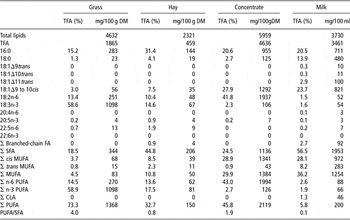
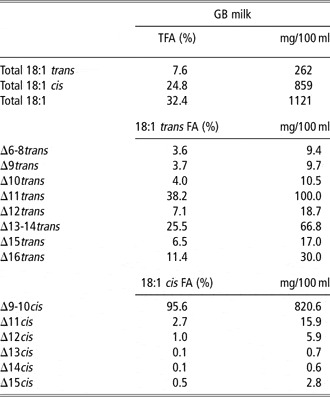
Total lipids and FA and centesimal FA distribution of dietary sources (grass, hay, concentrate and milk) are given in Table 3. SFA was the major FA group in milk (56.5%) and hay (44.8%). Milk was the food with the highest SFA concentration (1.9 g/100 g fresh milk).
Centesimal (% TFAs) distribution and concentration of FAs in dietary solid sources (grass, hay, concentrate; mg/100 g DM) and in the milk (mg/100 ml) produced by the GB cows

TFA = total fatty acids; FAs = fatty acids; DM = dry matter; GB = Galician Blond; SFA = saturated FA; MUFA = monounsaturated FA; PUFA = polyunsaturated FA; CLA = conjugated linoleic acid.
Σ Branched-chain FA = Iso 13 up to 18 + Ant 13 up to 18 + phytanic acid; Σ SFA = 12:0 up to 24:0 + branched-chain FA; Σ cis MUFA = 12:1 up to 18:1 cis isoforms (see Tables 4 and 6); Σ trans MUFA = 16:1Δ9trans + 18:1 trans isomers (see Tables 4 and 6); Σ MUFA = cis MUFA + trans MUFA; Σ n-6 PUFA = C18:2n-6 trans, trans + C18:2n-6 trans cis + C18:2n-6 cis trans + C18:2n-6 cis cis + C18:3n-6 all cis + C20:2n-6 all cis + C20:3n-6 all cis + C20:4n-6 all cis + C22:2n-6 all cis + C22:4n-6 all cis + C22:5n-6 all cis; Σ n-3 PUFA (all cis) = C18:3n-3 + C20:3n-3 + C20:4n-3 + C20:5n-3 + C22:3n-3 + C22:4n-3 + C22:5n-3 + C22:6n-3; Σ PUFA = Σ n-6 PUFA + Σ n-3 PUFA.
PUFA concentration was widely higher in fresh grass (1.4 g/100 g) and concentrate (2.1 g/100 g) than in milk and hay. Linolenic (18:3n-3) and linoleic (18:2n-6) acids represented 80% and 90% of total PUFA in fresh grass and concentrate, respectively. Milk was the only food that contained CLA (46 mg/100 ml).
Monounsaturated FA (MUFA) values were high in concentrate (30% of TFA) and in milk (36%; Table 3). Oleic acid (18:1 Δ9cis) was very low in fresh grass (37 mg/100 g) and hay (19 mg/100 g) compared to that in concentrate (840 mg/100 g). In all dietary plant sources, 18:1 Δ9cis represented at least 90% of total 18:1, whereas in milk (Table 4), 24% of total 18:1 had a trans conformation, dominated by 18:1 Δ11trans (38% of total trans 18:1).
Centesimal distribution (% TFAs) and concentration (mg/100 ml) of the total cis and total trans 18:1 isomers in the milk produced by GB cows. Centesimal distribution (% total 18:1 trans or % total 18:1 cis) and concentration (mg/100 ml) of individual 18:1 isomers in the milk produced by GB cows

TFAs = total fatty acids; GB = Galician Blond; FAs = fatty acids.
Muscle lipids and FAs
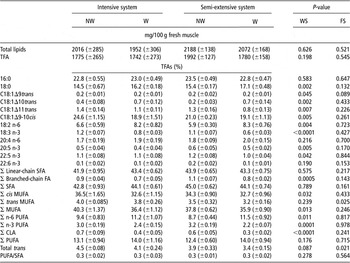
Total lipids and TFA represented 2.0% and 1.9%, respectively, (Table 5) of fresh muscles. No significant variations were found within the four dietary treatments (Table 5).
Concentrations of total lipids and TFAs (mg/100g fresh muscle) and centesimal distribution of FAs (% TFAs) in total lipids of the Longissimus thoracis muscle in GB calves

TFAs = total fatty acids; FAs = fatty acids; GB = Galician Blond; NW = non-weaned; W = weaned; WS = weaning status; FS = finishing system; SFA = saturated FA; MUFA = monounsaturated FA; PUFA = polyunsaturated FA; CLA = conjugated linoleic acid.
For FA details see legends in Table 3.
Total trans = 16:1Δ9trans + Σ18:1trans + 18:2n-6 trans trans + 18:2n-6 trans cis + 18:2n-6 cis trans.
Stearic acid (18:0) was 10% higher in the LT muscles of W calves than NW calves (14.92% v. 16.63% of TFA; P = 0.002). Branched-chain SFA were significantly higher in the LT muscles of NW calves than W calves (0.99% v. 0.75% of TFA; P = 0.0005). The duration of the finishing period had no significant effect on muscle total or individual SFA (Table 5).
Veal total PUFA (% of TFA) were very similar for the four treatments (Table 5). However, proportions of some individual PUFA were significantly different with regard to the weaning status of calves. Total n-6 PUFA were 20% higher (P = 0.011) in W calves than in NW calves (9.04% v. 11.34% of TFA); linoleic acid (18:2n-6), the major n-6 PUFA, was also significantly higher (P = 0.0042) in W veal than in NW veal (8.25% v. 6.21% of TFA). CLA was twice as high (P < 0.0001) in NW calves as in W calves (0.62% v. 0.32%). Veal n-3 PUFA in NW calves were 25% higher (P = 0.0001) than that in W calves. Linolenic acid (18:3n-3), which represented 30% to 40% of total n-3 PUFA, was also significantly higher in NW calves than in W calves (1.15% v. 0.72% of TFA; P < 0.0001). Long-chain n-3 PUFA were significantly higher (P = 0.0001) in NW calves than in W calves. Eicosapentaenoic acid (20:5n-3) was 23% higher in NW calves than in W calves (0.57% v. 0.44% of TFA; P = 0.0052) and docosapentaenoic acid (22:5n-3) was 14% higher (1.17% v. 1.01% of TFA; P = 0.042) in NW calves than in W calves.
The finishing system had a significant (P = 0.025) effect on trans MUFA, being 14% higher in the IS than in the SES (3.89% v. 3.35% of TFA). Weaning status has not presented any effect on trans MUFA.
Muscle cis and trans 18:1 isomers
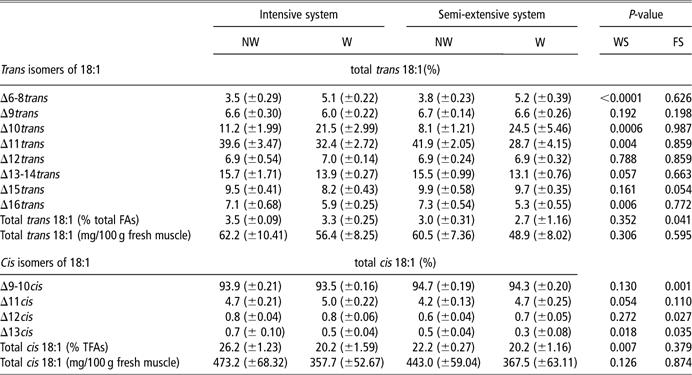
The concentration (mg/100 g of muscle) of total cis 18:1 isomers (Table 6) in LT muscle did not vary with the dietary treatments, but proportions (% TFA) of total cis 18:1 were significantly higher in NW calves than in W calves (24.20% v. 20.22% of TFA; P = 0.007). Centesimal composition of individual cis isomers were mainly affected by the duration of the finishing period. The sum (Δ9 + Δ10) represented 94% of total 18:1 cis isomers and it was significantly higher in the SES than in the IS (94.47% v. 93.69% of total cis 18:1; P = 0.001; Table 6). However, when percentage of TFA were considered, 18:1 Δ9-10cis was significantly affected by the weaning status (Table 5), being higher in NW calves than in W calves (22.8% v. 18.99% of TFA, P = 0.005) In the IS, 18:1 Δ12cis and 18:1 Δ13cis were 16% and 30% higher than in the SES.
Centesimal distribution of individual cis and trans 18:1 isomers lipids of the Longissimus thoracis muscle in GB calves

GB = Galician Blond; FAs = fatty acids; NW = non-weaned; W = weaned; WS = weaning status; FS = finishing system; TFAs = total FAs.
Total trans 18:1 isomers (Table 6) were 16% higher (P = 0.041) in the IS calves than in the SES calves (3.40% v. 2.86% of total trans 18:1).
Centesimal composition of trans isomers (Table 6) was only affected by the weaning status. The sum (Δ6 + Δ7 + Δ8) trans 18:1 was 28% lower (3.68% v. 5.14% of total trans 18:1; P < 0.0001) in NW calves than in W calves. The Δ10trans isomer was 58% higher in W calves than in NW calves (9.64% v. 22.98% of total trans 18:1; P = 0.0006). The Δ11trans isomer was 25% higher in NW calves than in W calves (40.76% v. 30.56% of total trans 18:1; P = 0.004). The 18:1 Δ16trans was about 20% higher (P = 0.006) in NW calves than in W calves.
Discussion
Weaning makes an important change in the digestion metabolism of calves, having consequences on the characteristics of the final meat product. NW calves were suckling from birth to slaughter, suggesting the persistence of the reticular groove closing reflex during their entire life, leading to the direct passage of milk components directly into the abomasum. Indeed, 80% of milk components would escape from rumen fermentation in 1-year-old ruminant calves (Guilhermet et al., Reference Guilhermet, Mathieu and Toullec1973). Moreover, the closing reflex of the reticular groove could persist in varying degrees in the adult ruminant, given a mixture of liquid and solid foods (Dobarganes García et al., Reference Dobarganes García, Pérez Hernandez, Cantalapiedra, Salas and Merino2005). As dietary solid sources do not stimulate the reticular groove closing reflex, it could be assumed that lipids from the solid food (concentrate, hay) given to NW calves were fermented by rumen bacteria and only a fraction of milk FA would escape from bacterial hydrogenation and trans isomerization.
In calves that suckled milk until slaughter, veal total SFA were not affected, but they showed lower values of stearic acid (18:0), as noted earlier in Belgian Blue bulls, given a concentrate diet supplemented with whole milk (Hornick et al., Reference Hornick, Clinquart, Van Eanaeme, Diez and Istasse1996).
Meat deposition of PUFA in our calves was similar to that described earlier in veal lipids (Xiccato et al., Reference Xiccato, Trocino, Queaque, Sartori and Carazzolo2002; Moreno et al., Reference Moreno, Varela, Oliete, Carballo, Sánchez and Monserrat2006; Blanco et al., Reference Blanco, Villalba, Ripoll, Sauerwein and Casassús2009). The P/S ratio of the veal lipids, very similar for all groups, was lower than that recommended for human health (0.45; Department of Health, 1994). Similar P/S ratios have been found recently in other Spanish local beef breeds such as Parda Alpina and Pirenaica (Blanco et al., Reference Blanco, Villalba, Ripoll, Sauerwein and Casassús2009).
In a previous experiment (Moreno et al., Reference Moreno, Varela, Portela, Pérez, Carballo and Monserrat2007), GB calves concentrate-fed for a longer period and with a higher daily intake showed high levels of n-6 PUFA in their meat. In accordance with these results, our W calves, which ingested 1.3 kg/day more concentrate than NW calves, had higher n-6 PUFA. The low 18:2n-6 content in milk could be the reason for these results. In studies in which the effect, on muscle FA, of a concentrate-based diet with a concentrate-based diet supplemented with milk is compared, a higher proportion of 18:2n-6 in meat was noted in muscles of calves given only the concentrate diet (Hornick et al., Reference Hornick, Clinquart, Van Eanaeme, Diez and Istasse1996; Vieira et al., Reference Vieira, García, Cerdeño and Mantecón2005).
The fact that suckling dams’ milk until slaughter increased meat 18:3n-3 and total n-3 PUFA was expected as dams were eating only grass in pasture, rich in 18:3n-3. Nevertheless, in other experiments with GB calves (Moreno et al., Reference Moreno, Varela, Oliete, Carballo, Sánchez and Monserrat2006) and lambs (Velasco et al., Reference Velasco, Canheque, Lauzurica, Perez and Huidobro2004), the weaning status did not affect these FA. It is widely documented that 18:3n-3 is a substrate for further desaturation and elongation of n-3 PUFA (Noci et al., Reference Noci, Monahan, French and Moloney2005); this would explain the higher amounts of 20:5n-3 and 22:5n-3 in NW veal.
Although grazing increases the amount of CLA in intramuscular lipids (French et al., Reference French, Stanton, Lawless, O'Riordan, Monahan, Caffrey and Moloney2000; Moreno et al., Reference Moreno, Varela, Portela, Pérez, Carballo and Monserrat2007) and higher levels were expected in the SES group, the duration of the grazing period has not affected the CLA levels in our study; semi-extensive calves were finished indoors for 80 days, which could have been long enough to suppress the effect of the grazing period on meat FA composition. However, the fact that suckling milk until slaughter increased muscle CLA levels was expected since natural milk intake had increased CLA in intramuscular lipids previously (Lanza et al., Reference Lanza, Bella, Priolo, Barbagallo, Galofaro, Landi and Pennisi2006). Similarly, the variance of CLA in several adipose cells of lambs was highly influenced by the length of the suckling period (Juarez et al., Reference Juarez, Horcada, Alcalde, Valera, Mullen and Molina2008). The higher proportion of CLA in the muscles of NW calves could be due to the persistence of the reticular groove closing reflex as cow's milk is generally rich in CLA. From the CLA health benefits (Tricon and Yagoob, Reference Tricon and Yagoob2006) point of view, ‘Suprema’ meat would be considered more beneficial than ‘Normal’ meat.
Suckling milk until slaughter raised MUFA. The effect of age at weaning (3 and 6 months), studied in other Spanish local breeds, showed higher proportions of meat MUFA in calves having milk for a longer period (Blanco et al., Reference Blanco, Villalba, Ripoll, Sauerwein and Casassús2009). It is well reported (Webb et al., Reference Webb, De Smet, Van Nevel, Martens and Demeyer1998; Moreno et al., Reference Moreno, Varela, Oliete, Carballo, Sánchez and Monserrat2006) that an increase in total beef fat is associated with an increase in MUFA. Although TFA content was higher in NW calves than in W calves, the difference was not statistically significant to explain the higher levels of MUFA in NW calves. The high content of MUFA in GB milk and the persistence of the reticular groove closing reflex could explain the higher levels of MUFA observed in our NW calves compared to the W calves.
Veal trans 18:1 isomers, which averaged in all groups of our calves 3% of TFA, were half as high as those reported in veal from different breeds (Charolais, Asturiana, Holstein–Friesian; Lluch et al., Reference Lluch, Roca de Vinyals, Parcerisa, Guardiola, Docony, Rafecas and Boatella1993). Other studies reported lower proportions of 18:1 trans to the ones obtained in this study; 10 beef retail cuts from different animals and different anatomical parts had 1.95% of total trans 18:1 (% TFA; Wolff, Reference Wolff1995) and six samples of beef LT muscle had a mean value of 1.7% (Lin et al., Reference Lin, Marchello and Fisher1984). In Spain, daily trans FA intake would amount to 2 to 3 g/person (Fernández San Juan, Reference Fernández San Juan1996; Craig-Schmidt, Reference Craig-Schmidt2006). Trans FA from 100 g of GB veal would represent <4% of the daily trans FA intake.
The centesimal distribution of trans isomers in total trans 18:1 was very similar for the GB milk and the NW intramuscular lipids. The main trans isomers in muscles of NW calves (18:1 Δ11trans and 18:1 Δ13-14trans) represented the main trans 18:1 isomers in milk given to the animals (38.2% and 25.5% of total trans FA, respectively), suggesting a direct transfer of milk trans isomers to calf muscle lipids. Significant differences in the amount of the 18:1 trans isomers in veal fat were reported in relation to the farm origin and the diet composition (Lluch et al., Reference Lluch, Roca de Vinyals, Parcerisa, Guardiola, Docony, Rafecas and Boatella1993). Diet affected the concentration of several 18:1 trans isomers in the LT muscle of Holstein bulls (Dannenberger et al., Reference Dannenberger, Nuernberg, Scollan, Schabbel W Steinhart, Ender and Nuernberg2004). It seems reasonable to conclude that the variation in trans 18:1 isomers could be related to the persistence of the reticular groove closing reflex and to the different amounts of concentrate ingested.
Linoleic acid (18:2n-6) ingested in the diet suffers bacterial isomerization and biohydrogenation in the rumen, the main pathway that generates 9cis, 11trans CLA, 18:1 Δ11trans and 18:0 (Harfoot and Hazelwood, Reference Harfoot and Hazelwood1988). The bacterial population may be altered when the rumen pH decreases (van Soest, Reference van Soest1994), affecting FA trans isomerization and biohydrogenation (Bessa et al., Reference Bessa, Santos-Silva, Ribeiro and Portugal2000). In this case, alternative pathways leading to 18:1 Δ10trans instead of 18:1 Δ11trans have been proposed (Griinari and Bauman, Reference Griinari and Bauman1999). This situation may have happened in W calves rumen, as ruminal pH value is reduced by high-concentrate diets (Doreau and Ferlay, Reference Doreau and Ferlay1994). The amount of 18:1 Δ10trans produced in the rumen may have influenced its level in intramuscular lipids, being higher in W calves than in NW calves. In accordance with our results, milk from cows fed high-concentrate diets had higher levels of 18:1 Δ10trans than 18:1 Δ11trans (Piperova et al., Reference Piperova, Sampugna, Teter, Kalscheur, Yurawecz, Ku, Morehouse and Erdman2002).
The health effects of some trans FA (from Δ12 to Δ16) are still unknown, whereas 18:1 Δ9trans and 18:1 Δ10trans are rather detrimental to human health (Dalainas and Ioannou, Reference Dalainas and Ioannou2008). The fact that 18:1 Δ10trans in ‘Normal’ (W) GB veal was twice as high as in ‘Suprema’ (NW) veal led us to consider that such meat FAs were less favourable than NW veal. However, accumulation in meat of our NW calves of 18:1 Δ11trans led us to consider meat from NW calves healthier than W meat, as this isomer is considered innocuous or even protective against cardiovascular disease (Bauchart et al., Reference Bauchart, Roy, Lorenz, Chardigny, Ferlay, Gruffat, Sébédio, Chilliard and Durand2007), being the precursor of 9cis, 11trans 18:2 (CLA).
Conclusion
The indoor finishing period length modified the total 18:1 trans isomers (when expressed in % of TFA) in LT muscle, and it had not had any effect on the isomeric distribution of 18:1 trans isomers (when expressed in % of total 18:1 trans isomers). Moreover, the feeding system did not modify the total 18:1 cis isomers either expressed in % of TFA or as mg/100 g of meat; only slight effects on isomeric distribution (expressed in % total 18:1 cis) were shown. The weaning status had a notable effect on the intramuscular FA profile. Compared to meat from W calves, that from unweaned (NW) calves might be considered healthier due to its higher content in n-3 PUFA, CLA (9cis, 11trans 18:2) and 18:1 Δ11trans, and to its lower content in 18:1 Δ10trans.
Calves suckled (NW) until slaughter kept the reticular groove closing reflex functional, leading to direct access of milk to the abomasum without microbial biochemical transformations in the rumen. The consequences were that some FA found in the intramuscular lipids could have been partially transmitted by the milk intake.
This study proved that a better strategy to produce meats with healthier properties from calves fed concentrate and hay is to allow them to suckle until slaughter. Moreover, NW calves showed the best carcass characteristics. As the results are not significantly different between IS and SES, a longer grazing period should be chosen to save concentrate and managing hours.
Acknowledgements
This research was partially funded by the project PGIDIT05RAG50304PR/Xunta de Galicia and a doctorate fellowship granted to the senior author Ms Esperanza Bispo by INIA/Spain. We are grateful to J. M. Barbeito, F. Piñeiro and J. González Pérez for the farm management work and to C. Legay and M. Brunel for their assistance in the laboratory activities.