1 Introduction
Throughout this paper, let D denote a fundamental discriminant. It is well known that an integer D is a fundamental discriminant of a quadratic field if either D is square-free with
 $D \equiv 1 \pmod {4}$
or
 $D = 4d$
for some square-free integer d satisfying
 $d \equiv 2, 3 \pmod {4}$
. We denote by
 $\mathrm {C}_D$
the narrow class group of the quadratic field
 $\mathbb {Q}(\sqrt {D})$
.
For an abelian group
 $ G $
, we define
 $G^2 = \{x^2 : x \in G\}$
. Given a prime
 $ p $
, the
 $ p $
-rank of
 $ G $
, denoted
 $ \operatorname {r}_p(G) $
, is the dimension of the
 $ \mathbb {F}_p $
-vector space
 $ G/pG $
. Equivalently, it is the dimension of the Sylow
 $ p $
-subgroup of
 $ G $
when regarded as a
 $ \mathbb {Z}_p $
-module.
In their seminal 1984 work, Cohen and Lenstra [Reference Cohen, Lenstra and Jager3] studied the distribution of
 $\operatorname {r}_p(\mathrm {C}_D^2)$
as D varies over positive and negative discriminants. Their original formulation applied to odd primes p. Gerth [Reference Gerth9, Reference Gerth10] later extended their work to include the case
 $p=2$
. They conjectured that for every prime p and every positive integer
 $\alpha $
, the average value of
 $$ \begin{align*} \prod_{0\leqslant i\leqslant\alpha}(p^{\operatorname{r}_p(\mathrm{C}_D^2)}-p^i) \end{align*} $$
is
 $p^{-\alpha }$
when
 $D> 0$
and
 $1$
when
 $D < 0$
.
Prior to this conjecture, Davenport and Heilbronn [Reference Davenport and Heilbronn5] had already established in 1971 the special case where
 $p = 3$
and
 $\alpha = 1$
. Fouvry and Klüners [Reference Fouvry and Klüners7] proved in 2006 that the conjecture holds for
 $p = 2$
and all positive integers
 $\alpha $
. However, the conjecture remains open for all primes
 $p> 3$
, as well as for
 $p = 3$
with
 $\alpha> 1$
.
Now, let p be a prime and
 $\lambda \in \{\pm 1\}$
. For any integer
 $r \geq 0$
, define
 $$ \begin{align*} a_\lambda(r, p)= \begin{cases} p^{-r^2-r}\eta_\infty(p)\eta_r(p)^{-1}\eta_{r+1}(p)^{-1} & \text{if } \lambda=1, \\ p^{-r^2}\eta_\infty(p)\eta_r(p)^{-2} & \text{if } \lambda=-1,\\ \end{cases} \end{align*} $$
where
 $$ \begin{align*} \eta_r(p):=\prod_{j=1}^r(1-p^{-j}), &\quad \eta_\infty(p):=\prod_{j=1}^\infty(1-p^{-j}). \end{align*} $$
Cohen and Lenstra [Reference Cohen, Lenstra and Jager3] also proposed a probabilistic model to predict the distribution of certain algebraic invariants of
 $\mathrm {C}_D^2$
. They conjectured that the probability that
 $\operatorname {r}_p(\mathrm {C}_D^2) = r$
is
 $a_1(r, p)$
when
 $D> 0$
and
 $a_{-1}(r, p)$
when
 $D < 0$
. Fouvry and Klüners [Reference Fouvry, Klüners, Hess, Pauli and Pohst6] showed in 2007 that the validity of the first conjecture for a given prime p and all
 $\alpha $
implies the second conjecture for the same p and all r. These conjectures are collectively known as the Cohen–Lenstra heuristics.
A particularly rich line of inquiry concerns the relationship between the
 $4$
-ranks of real and imaginary quadratic fields. Foundational work in this area (see [Reference Damey and Payan4]) established that for
 $D> 0$
:
 $$ \begin{align*} \operatorname{r}_4(\mathrm{C}_D) \leq \operatorname{r}_4(\mathrm{C}_{-D}) \leq \operatorname{r}_4(\mathrm{C}_D) + 1. \end{align*} $$
The precise conditions under which these bounds become equalities have been extensively studied. Halter-Koch [Reference Halter-Koch13], Habsieger and Royer [Reference Habsieger and Royer12], and Uehara [Reference Uehara17] provided sufficient conditions for
 $\operatorname {r}_4(\mathrm {C}_{-D}) = \operatorname {r}_4(\mathrm {C}_D)$
and
 $\operatorname {r}_4(\mathrm {C}_{-D}) = \operatorname {r}_4(\mathrm {C}_D) + 1$
. In 2001, Gerth [Reference Gerth11] further investigated the probability of these equalities, offering quantitative insights into their frequency.
There is also extensive research on the
 $3$
-rank of
 $\mathrm {C}_D$
. In 2004, Byeon [Reference Byeon1] employed the inclusion–exclusion principle to prove that for any square-free integer m, there exist infinitely many fundamental discriminants
 $D> 0$
of positive density such that the narrow class groups
 $\mathrm {C}_D$
and
 $\mathrm {C}_{mD}$
have trivial
 $3$
-rank. More recently, Chen and Wu [Reference Chen and Wu2] showed that for a certain family of polynomials
 $f_i(x)$
(with
 $1 \leq i \leq t$
) whose coefficients satisfy specific conditions, there exist infinitely many fundamental discriminants
 $D> 0$
such that the
 $3$
-rank of
 $\mathrm {C}_{f_i(D)}$
is less than n for all i; here, n is an arbitrary positive integer and t depends on n.
Fouvry and Klüners [Reference Fouvry and Klüners7], in their pioneering work, first established that the average distribution of the
 $4$
-rank of the narrow class groups of quadratic fields agrees with the Cohen–Lenstra heuristics. More recently, Smith [Reference Smith14, Reference Smith15] introduced novel techniques that provided a complete resolution for the distribution of the
 $2$
-rank and the higher
 $2^k$
-ranks of the class groups of imaginary quadratic fields. It is the third major result towards proving Cohen–Lenstra heuristics for imaginary quadratic fields, after the work of Davenport and Heilbronn [Reference Davenport and Heilbronn5] on
 $3$
-torsion, and that of Fouvry and Klüners [Reference Fouvry and Klüners7] on
 $4$
-rank.
Although Smith’s work offers a complete picture of the hierarchical structure of
 $2^k$
-rank, many questions about explicit relationships between the
 $4$
-ranks of specific families of quadratic fields remain open. This paper continues the latter direction of research, focusing on the
 $4$
-rank of the narrow class groups in families of quadratic fields of the same type. Our main result is as follows.
Theorem 1.1. For
 $\lambda \in \{\pm 1\}$
and a positive integer n, we define
 $$ \begin{align*} c_\lambda(n) := \sum_{r=0}^{n-1} a_\lambda(r, 2), \quad s_{\lambda}(n) := \lfloor (1 - c_{\lambda}(n))^{-1}\rfloor, \end{align*} $$
where
 $a_\lambda (r, 2)$
is as defined in the Cohen–Lenstra heuristics. For any integers
 $t_1$
,
 $t_2$
,
 $\ldots , t_{s_{\lambda }(n)}$
, there exist infinitely many fundamental discriminants D such that
 $$ \begin{align*} \operatorname{r}_4(\mathrm{C}_{D+t_i}) < n \quad \mbox{for } 1\leq i\leq s_{\lambda}(n), \end{align*} $$
where
 $\lambda = 1$
if
 $D> 0$
and
 $\lambda = -1$
if
 $D < 0$
.
The irrationality of
 $\eta _\infty (2)$
implies that
 $c_\lambda (n)$
is irrational, from which it follows that
 $s_{\lambda }(n) < (1 - c_{\lambda }(n))^{-1}$
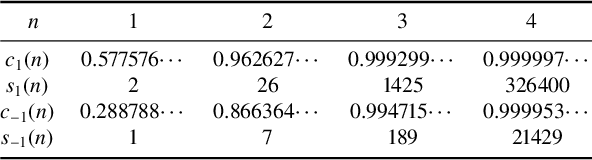
. Table 1 provides explicit values of these quantities for small n.
Values of
 $c_\lambda (n)$
and
 $s_\lambda (n)$
for
 $n=1, 2, 3, 4$
.

Table 1 Long description
The table has five columns. The header row lists n, then 1, 2, 3, and 4. The first data row is labeled c sub lambda of n, with values 0.577576, 0.962627, 0.999299, and 0.999997. The second row is s sub lambda of n, with values 2, 26, 1425, and 326400. The third row is c sub lambda of negative one of n, with values 0.288788, 0.866364, 0.994715, and 0.999953. The fourth row is s sub lambda of negative one of n, with values 1, 7, 189, and 21429. Ellipses are present after each decimal value in the c sub lambda rows, indicating the values are truncated.
A special case of Theorem 1.1 yields the following corollary regarding the simultaneous vanishing of the
 $4$
-ranks.
Corollary 1.2. There exist infinitely many fundamental discriminants
 $D> 0$
such that
 $$ \begin{align*} \operatorname{r}_4(\mathrm{C}_{D+t}) = \operatorname{r}_4(\mathrm{C}_D) = 0 \end{align*} $$
for any integer t.
2 Proof
For any positive real number X, denote by
 $\mathcal {D}_1(X)$
the set of positive fundamental discriminants D satisfying
 $0 < D < X$
and by
 $\mathcal {D}_{-1}(X)$
the set of negative fundamental discriminants D such that
 $-X < D < 0$
. For positive integers
 $A, B$
and
 $\lambda \in \{\pm 1\}$
, define
 $$ \begin{align*} \mathcal{D}_{\lambda}(X, A, B):=\{D: D\in\mathcal{D}_{\lambda}(X), D\equiv A\pmod B\}. \end{align*} $$
The following result of Fouvry and Klüners [Reference Fouvry and Klüners8] extends [Reference Fouvry and Klüners7, Theorem 3] to six families.
Theorem 2.1 [Reference Fouvry and Klüners8, Theorem 2.3].
Let
 $(a, q)\in \{(1, 4), (8, 16), (12, 16)\}$
. For every
 $r\geq 0$
and
 $\lambda \in \{\pm 1\}$
,
 $$ \begin{align*} \liminf_{X\rightarrow\infty}\frac{\sharp\{D: D\in\mathcal{D}_{\lambda}(X, a, q), \operatorname{r}_4(\mathrm{C}_D)=r\}}{\mathcal{D}_{\lambda}(X, a, q)}=a_\lambda(r, 2). \end{align*} $$
Remark 2.2. By summing both sides of the equation in Theorem 2.1 over r,
 $$ \begin{align*} \liminf_{X\rightarrow\infty}\frac{\sharp\{D: D\in\mathcal{D}_{\lambda}(X, a, q), \operatorname{r}_4(\mathrm{C}_D)<n\}}{\mathcal{D}_{\lambda}(X, a, q)}=c_\lambda(n) \end{align*} $$
for every
 $n\geq 1$
and
 $\lambda \in \{\pm 1\}$
, where
 $(a, q)\in \{(1, 4), (8, 16), (12, 16)\}$
.
Fouvry and Klüners [Reference Fouvry and Klüners8] prove a stronger version of the result stated in Theorem 2.1 in which the
 $\liminf $
is replaced by
 $\lim _{X\to \infty }$
. We have given the weaker form of the result because that is all we need in the proof of Theorem 1.1
Proof of Theorem 1.1.
We provide a detailed proof for the case
 $D> 0$
, the case
 $D < 0$
is analogous. For each i with
 $1\leq i\leq s_{1}(n)$
, let
 $u_i$
be the largest integer such that
 $4^{u_i}||(t_i+1)$
. Define
 $$ \begin{align*} u=\max_{1\leq i\leq s_1(n)}\{u_i\} \end{align*} $$
and set
 $B=4^{u+1}$
. For convenience, we define
 $$ \begin{align*} f_{t_i}(x):=\frac{x+t_i}{4^{u_i}}, \quad i=1, 2, \ldots, s_{1}(n). \end{align*} $$
Then, for any fundamental discriminant
 $D\equiv 1\pmod B$
,
 $$ \begin{align*} D+t_i\equiv1+t_i\pmod B, \end{align*} $$
which implies that
 $f_{t_i}(D)\not \equiv 0\pmod 4$
. Further, define
 $$ \begin{align*} l_i=\begin{cases} 1 & \text{if } f_{t_i}(D)\equiv1\pmod4, \\ 4 & \text{if } f_{t_i}(D)\equiv2, 3\pmod4.\\ \end{cases} \end{align*} $$
Note that if
 $f_{t_i}(D)$
is square-free, then
 $l_if_{t_i}(D)$
is a fundamental discriminant.
Let
 $\mu (n)$
denote the usual Möbius function. For
 $1\leq i\leq s_{1}(n)$
, we define
 $$ \begin{align*} T_i(X):=\{D: D\in\mathcal{D}_{1}(X, 1, 4^{u_i}), \mu(f_{t_i}(D))\neq0\} \end{align*} $$
and
 $$ \begin{align*} T(X):=\bigg\{D: D\in\mathcal{D}_{1}(X, 1, B), \prod_{i=1}^{s_1(n)}\mu(f_{t_i}(D))\neq0\bigg\}. \end{align*} $$
Note that
 $\mathcal {D}_{1}(X, 1, B)\subseteq \mathcal {D}_{1}(X, 1, 4^{u_i})$
and so
 $T(X)\subseteq T_i(X)$
for
 $1\leq i\leq s_{1}(n)$
.
By the inclusion–exclusion principle,
 $$ \begin{align*} \sharp T(X)&\leq\sum_{i=1}^{s_1(n)}\sharp\{D\in T(X): \operatorname{r}_4(\mathrm{C}_{D+t_i})\geq n\}+\sharp\Big\{D\in T(X): \max_{1\leq i\leq s_1(n)}\operatorname{r}_4(\mathrm{C}_{D+t_i})< n\Big\}. \end{align*} $$
Since
 $T(X)\subseteq T_i(X)$
, it follows that
 $$ \begin{align*} \{D\in T(X): \operatorname{r}_4(\mathrm{C}_{D+t_i})\geq n\}\subseteq\{D\in T_i(X): \operatorname{r}_4(\mathrm{C}_{D+t_i})\geq n\} \end{align*} $$
and therefore,
 $$ \begin{align*} \sharp\Big\{D\in T(X): \max_{1\leq i\leq s_1(n)}\operatorname{r}_4(\mathrm{C}_{D+t_i})< n\Big\}\geq\sharp T(X)-\sum_{i=1}^{s_1(n)}\sharp\{D\in T_i(X): \operatorname{r}_4(\mathrm{C}_{D+t_i})\geq n\}. \end{align*} $$
Dividing both sides by
 $\sharp T(X)$
yields
 $$ \begin{align} \frac{\sharp\{D\in T(X): \max_{1\leq i\leq s_1(n)}\operatorname{r}_4(\mathrm{C}_{D+t_i})< n\}}{\sharp T(X)} & \geq1-\sum_{i=1}^{s_1(n)}\frac{\sharp\{D\in T_i(X): \operatorname{r}_4(\mathrm{C}_{D+t_i})\geq n\}}{\sharp T(X)}\notag\\ & =1-\sum_{i=1}^{s_1(n)}\bigg(1-\frac{\sharp\{D\in T_i(X): \operatorname{r}_4(\mathrm{C}_{D+t_i})< n\}}{\sharp T(X)}\bigg). \end{align} $$
Observe that each linear polynomial
 $l_if_{t_i}(x)$
induces a bijection
 $$ \begin{align*} l_if_{t_i}: T_i(X)&\longrightarrow \mathcal{D}_1(X, a_{t_i}, q_{t_i})\\ D&\longmapsto l_if_{t_i}(D), \end{align*} $$
where
 $$ \begin{align*} (a_{t_i}, q_{t_i})= \begin{cases} (1, 4) & \text{if } f_{t_i}(1)\equiv1\pmod4, \\ (8, 16) & \text{if } f_{t_i}(1)\equiv2\pmod4, \\ (12, 16) & \text{if } f_{t_i}(1)\equiv3\pmod4. \end{cases} \end{align*} $$
Hence,
 $$ \begin{align*} \sharp T_i(X)=\sharp\mathcal{D}_1(X, a_{t_i}, q_{t_i}). \end{align*} $$
Note that
 $\mathrm {C}_{l_if_{t_i}(D)}=\mathrm {C}_{D+t_i}$
and
 $T(X)\subseteq T_i(X)$
for
 $1\leq i\leq s_{1}(n)$
. Applying Remark 2.2 and the bijection, we obtain
 $$ \begin{align*} \liminf_{X\rightarrow\infty} & \frac{\sharp\{D\in T_i(X): \max_{1\leq i\leq s_1(n)}\operatorname{r}_4(\mathrm{C}_{D+t_i})< n\}}{\sharp T(X)} \\ & \geq \liminf_{X\rightarrow\infty}\frac{\sharp\{D\in T_i(X): \max_{1\leq i\leq s_1(n)}\operatorname{r}_4(\mathrm{C}_{D+t_i})< n\}}{\sharp T_i(X)}\\ & =\liminf_{X\rightarrow\infty}\frac{\sharp\{D\in \mathcal{D}_1(X, a_{t_i}, q_{t_i}): \max_{1\leq i\leq s_1(n)}\operatorname{r}_4(\mathrm{C}_D)< n\}}{\sharp \mathcal{D}_1(X, a_{t_i}, q_{t_i})} =c_1(n). \end{align*} $$
Substituting this into (2.1) gives
 $$ \begin{align} \liminf_{X\rightarrow\infty}\frac{\sharp\{D\in T(X): \max_{1\leq i\leq s_1(n)}\operatorname{r}_4(\mathrm{C}_{D+t_i})< n\}}{\sharp T(X)} &\geq1-\sum_{i=1}^{s_1(n)}(1-c_1(n)) \notag\\ & =1-s_1(n)(1-c_1(n)). \end{align} $$
We now show that
 $T(X)$
has positive natural density as X tends to infinity. For this purpose, we invoke a theorem of Tsang [Reference Tsang16].
Proposition 2.3 [Reference Tsang16, Theorem 3].
For a positive integer t, let
 $f_i(x)$
for
 $1\leq i\leq t$
be irreducible integral polynomials with degree not exceeding l, where
 $l\geq 3$
. Let
 $$ \begin{align*} \Omega(l):=\prod\limits_p(1-\omega(p)p^{1-l}), \end{align*} $$
where for each p,
 $\omega (p)$
denotes the number of solutions to
 $f_i(x)\equiv 0\pmod {p^{l-1}}$
for
 $1\le i \le t$
. If
 $N(X)$
is the number of integers
 $n\leq X$
such that the values
 $f_i(n)$
are all
 $(l-1)$
th power free, then
 $$ \begin{align*} N(X)=\Omega(l)X+O(X(\log X)^k) \quad \mbox{where } k=\frac{2}{l+1}-1. \end{align*} $$
The O-constant depends on t as well as on the coefficients of the given polynomials.
Note that
 $$ \begin{align*} T(X)=\bigg\{n\leq\frac{X-1}{B}: \mu(Bn+1)\prod_{i=1}^{s_1(n)}\mu(f_{t_i}(Bn+1))\neq0\bigg\}. \end{align*} $$
Applying Proposition 2.3 with
 $l=3$
with the irreducible polynomials
 $Bx+1$
and
 $f_{t_i}(Bx+1), i=1, \ldots , s_1(n)$
, yields the asymptotic formula
 $$ \begin{align} \sharp T(X)=\frac{\Omega(3)}{B}X+O\bigg(\frac{X}{\sqrt{\log X}}\bigg). \end{align} $$
One may verify that
 $\Omega (3)\neq 0$
. Now, combining (2.2) and (2.3),
 $$ \begin{align*} \liminf_{X\rightarrow\infty}\frac{\sharp\{D\in T(X): \max_{1\leq i\leq s_1(n)}\operatorname{r}_4(\mathrm{C}_{D+t_i})< n\}}{X}\geq\frac{\Omega(3)(1-s_1(n)(1-c_1(n)))}{B}. \end{align*} $$
Since
 $s_{1}(n) < (1 - c_{1}(n))^{-1}$
and
 $\Omega (3)\neq 0$
, it follows that the above limit is positive. This implies that there are infinitely many fundamental discriminants D satisfying
 $\operatorname {r}_4(\mathrm {C}_{D+t_i})<n$
simultaneously for
 $1\leq i\leq s_1(n)$
. The proof for
 $D<0$
is similar. This completes the proof of Theorem 1.1.
3 Concluding remarks
Theorem 1.1 deals with translations of discriminants, that is, expressions of the form
 $D + t$
for an integer t. The method used in this paper does not give an analogous result for more general linear forms such as
 $kD + t$
with integers k and t. The reason is that as D runs over infinitely many discriminants, the common difference in the resulting sequence
 $kD + t$
may not equal
 $4$
or
 $16$
. Therefore, Theorem 2.1 is not applicable in such cases.
Acknowledgement
I am deeply grateful to my PhD advisor, Professor Shi-Chao Chen, for his invaluable guidance and insightful suggestions throughout this research.