





Introduction
The Developmental Origins of Health and Disease (DOHaD) theory suggests that exposure to environmental and biological factors during early life and prenatal development can permanently influence an individual’s physiological structure, function, and risk of disease later in life. Reference Barker, Eriksson, Forsen and Osmond1,Reference İmre and Akyol2 Developmental plasticity refers to the fetus’s ability to flexibly regulate developmental and metabolic processes in response to environmental conditions. However, exposure to adverse stimuli such as maternal malnutrition may lead to permanent reprogramming of fetal metabolism, increasing the risk of obesity and other non-communicable diseases later in life. Reference Gluckman, Hanson and Low3
Previous research has primarily focused on maternal health and the intrauterine environment, extensively examining the effects of maternal nutritional status, metabolic disorders, and pregnancy complications on fetal development and long-term health outcomes. Reference Patro, Liber, Zalewski, Poston, Szajewska and Koletzko4–Reference McPherson, Smid, Smiley and Stamilio10 In contrast, the role of paternal health in early developmental processes has long been overlooked, and research in this area remains limited. Reference Lin, Chen and Qian7
Obesity is recognized as a major global public health challenge of the 21st century, significantly increasing morbidity and mortality. According to the World Health Organization and national surveillance data, more than two-thirds of adults in Western nations are classified as overweight or obese, a trend mirrored globally and projected to rise continuously by 2030. 9 This global rise suggests that obesity not only affects individual health but may also influence reproductive health and the development of subsequent generations.
While the association between maternal obesity and adverse pregnancy outcomes such as gestational diabetes, hypertensive disorders of pregnancy (HDCP), abnormal fetal growth, and preterm birth is well established, the potential effects of paternal obesity on fetal development and pregnancy complications have been examined in relatively few studies. Existing evidence suggests that paternal obesity may affect sperm quality and epigenetic structure. Reference Salas-Huetos, Maghsoumi-Norouzabad and James11,Reference Houfflyn, Matthys and Soubry12 Pregnancy outcomes such as fetal growth restriction, macrosomia, preterm birth, congenital anomalies, and placental dysfunction are key determinants of early human development and have profound implications for lifelong health. Reference McPherson, Smid, Smiley and Stamilio10,Reference Gette, Aziz Ali and Ho13
Understanding the role of paternal factors in pregnancy and fetal development is therefore critical for adopting a more comprehensive DOHaD perspective. The methodological heterogeneity of existing studies investigating paternal obesity complicates the comparison and generalization of findings. This systematic review aims to evaluate studies examining the effects of paternal obesity on fetal development and pregnancy outcomes within the DOHaD framework and to synthesize current evidence in a holistic manner. The findings are expected to increase awareness of paternal health factors in early human development and inform preconception care strategies and future research.
Methods
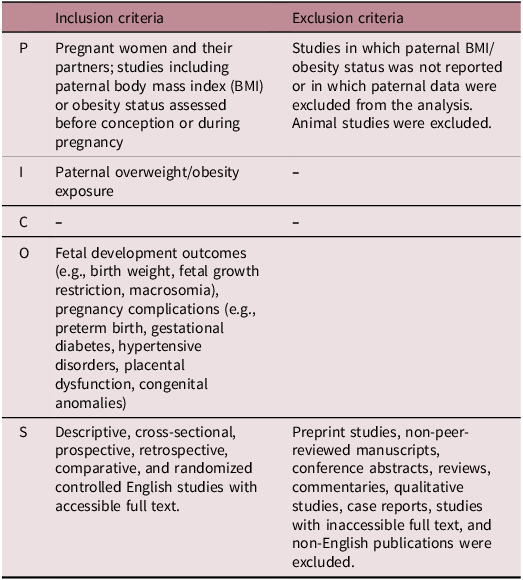
A literature search was conducted between October and December 2025 in PubMed, Scopus, Web of Science, and the Cochrane Library databases. The search covered studies published between 2020 and 2025 and included articles in English. The time restriction was applied to capture the most recent evidence reflecting contemporary preconception care practices, updated BMI classifications, and advances in epigenetic research related to paternal obesity. Earlier studies were screened during preliminary searches; however, many were either superseded by larger contemporary cohorts or did not separately analyze paternal BMI effects. Both MeSH terms and English keywords were used: The complete search strategy used in PubMed was: (‘paternal’ OR ‘father’ OR ‘paternal health’) AND (‘obesity’ OR ‘overweight’ OR ‘body mass index’ OR ‘BMI’) AND (‘fetal development’ OR ‘pregnancy outcomes’ OR ‘pregnancy complications’ OR ‘birth weight’ OR ‘childhood outcomes’). Equivalent adaptations were applied for Scopus, Web of Science, and the Cochrane Library. Studies were selected based on predefined inclusion criteria using the PICOS framework 14 (Table 1). Titles, abstracts, and keywords were initially screened, and full texts of eligible studies were examined in detail. Studies unrelated to the review or duplicate articles were excluded.
PICOS-based eligibility criteria

Table 1. Long description
A table with two columns and five rows, detailing the inclusion and exclusion criteria for a study. The columns are labeled 'Inclusion criteria' and 'Exclusion criteria'. The rows are labeled with letters P, I, C, O, and S. Row P: Inclusion criteria include pregnant women and their partners, studies including paternal BMI or obesity status assessed before conception or during pregnancy. Exclusion criteria include studies in which paternal BMI/obesity status was not reported or in which paternal data were excluded from the analysis. Animal studies were excluded. Row I: Inclusion criteria include paternal overweight/obesity exposure. There are no exclusion criteria listed for this row. Row C: There are no inclusion or exclusion criteria listed for this row. Row O: Inclusion criteria include fetal development outcomes, pregnancy complications, preterm birth, gestational diabetes, hypertensive disorders, placental dysfunction, congenital anomalies. There are no exclusion criteria listed for this row. Row S: Inclusion criteria include descriptive, cross-sectional, prospective, retrospective, comparative, and randomized controlled English studies with accessible full text. Exclusion criteria include preprint studies, non-peer-reviewed manuscripts, conference abstracts, reviews, commentaries, qualitative studies, case reports, studies with inaccessible full text, and non-English publications were excluded.
A total of 5765 records were identified through the literature search. After a rigorous screening process, seven studies met the inclusion criteria and were included in the systematic review. The study selection process is presented using the PRISMA flow diagram Reference Haddaway, Page, Pritchard and McGuinness15 (Fig. 1). The initial review protocol was developed according to PRISMA-P and prospectively registered in PROSPERO (registration number: CRD420261295090), while the reporting of this completed review strictly adhered to the PRISMA 2020 guidelines. All steps of study selection were independently reviewed by the authors, and disagreements were resolved by consensus. Data were extracted using a standardized form that included: author(s) and year, country, study design, sample size and characteristics, intervention or exposure, main findings, and JBI quality score. The study selection process involved an initial screening of titles and abstracts, followed by a detailed full-text review of eligible articles. Data synthesis was performed descriptively by comparing the relationships between paternal BMI categories and reported fetal, pregnancy, and childhood outcomes across studies, factoring in methodological differences and sample sizes. In the review, the titles and abstracts of the studies were initially read and assessed, and then the full-text articles were examined in detail. A meta-analysis was not conducted because the included studies showed substantial heterogeneity in BMI classification systems (WHO vs. Chinese WGOC criteria), outcome definitions, study populations, and statistical adjustment models, which limited the comparability of effect estimates.
PRISMA flow chart of the study selection process for the systematic review.

The methodological quality of the included studies was independently evaluated using the Joanna Briggs Institute (JBI) critical appraisal tools. Initial quality assessments were conducted independently by two reviewers (TGE and EKS), and any discrepancies were resolved via consensus involving all authors Reference Barker, Stone and Sears16 Cohort studies were evaluated using the 11-item JBI checklist (score range: 0–11). Each item was scored as 1 if the criterion was met (“yes”) and 0 if it was not met, unclear, or not applicable (“no,” “not specified,” or “not applicable”). Higher total scores indicated higher methodological quality. In this systematic review, the methodological quality scores of the included studies ranged from 8 to 9, indicating overall medium to high methodological quality. In addition to overall JBI scores, key domains of bias were considered qualitatively, including selection bias, exposure misclassification, outcome assessment, and residual confounding. Particular attention was paid to whether paternal BMI was self-reported or clinically measured and whether studies adjusted for major maternal and socioeconomic variables.
Results
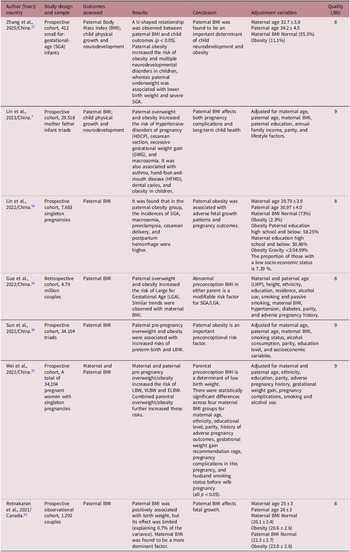
The characteristics of the included studies are presented in Table 2. Seven studies met the inclusion criteria and were included in this review. Most studies were prospective cohort studies conducted in China, with sample sizes ranging from 412 to 4.8 million participants. Overall, the studies evaluated the associations between paternal preconception BMI and fetal development, pregnancy outcomes, and childhood health outcomes. Across studies, the principal risks of bias were related to self-reported paternal BMI, incomplete adjustment for maternal and socioeconomic confounders, and potential selection bias in cohort recruitment. Outcome assessment was generally based on clinical records, reducing the likelihood of differential misclassification for birth outcomes.
Characteristics, main findings, and methodological quality of studies included

Table 2. Long description
The table presents a summary of studies examining the relationship between paternal Body Mass Index (BMI) and various child health outcomes. It includes seven studies, each detailing the study design, sample size, outcomes assessed, results, conclusions, adjustment variables, and quality scores. The studies are from different years and countries, primarily China. Each row provides specific information about the study's focus, such as paternal BMI's impact on child physical growth, neurodevelopment, and pregnancy outcomes. The table also includes the number of participants, the main findings, and the methodological quality of each study. Notable trends include the consistent finding that paternal obesity is associated with adverse pregnancy and child health outcomes. Adjustment variables and quality scores vary across studies, reflecting differences in methodological rigor.
All studies evaluated the effects of paternal obesity on fetal development and pregnancy outcomes. Across studies, the principal risks of bias were related to self-reported paternal BMI, incomplete adjustment for maternal and socioeconomic confounders, and potential selection bias in cohort recruitment. Outcome assessment was generally based on clinical records, reducing the likelihood of differential misclassification for birth outcomes.
In a prospective cohort study conducted in China by Zhang et al. (2025), 412 small-for-gestational-age (SGA) infants were assessed. Fathers were categorized into four groups: underweight (n = 46), normal weight (n = 188), overweight (n = 124), and obese (n = 54). The children of these fathers were followed for 36 months, and their physical development (height and weight measurements) was monitored. The study found a U-shaped relationship between paternal preconception body mass index (BMI) extremes (<18.5 or ≥28 kg/m2) and child outcomes (p < 0.05). Compared with children of fathers with normal BMI (18.5–24.9 kg/m2), paternal obesity was associated with an increased risk of childhood obesity and multi-domain neurodevelopmental disorders. These findings suggest that paternal BMI may be an important determinant of child health and neurodevelopment. Additionally, the study reported no significant differences between groups regarding maternal conditions, including gestational hypertension, preeclampsia, diabetes, hypothyroidism, connective tissue disorders, umbilical cord complications, and placental abnormalities. Reference Zhang, Shao and Qin17
In a prospective study in China by Lin et al. (2023) including 29,518 participants, the mean paternal age was 35.1 ± 4.9 years, and the mean maternal age was 33.0 ± 4.4 years. Based on paternal BMI classifications, 996 fathers (3.4%) were underweight, 16,028 (54.3%) had a normal BMI, 9761 (33.1%) were overweight, and 2.733 (9.3%) were obese. Significant associations were found between paternal BMI groups and paternal age, paternal education, maternal age, maternal BMI, and annual family income. Cesarean delivery, gestational weight gain (GWG) above recommended limits, and macrosomia were significantly higher in the paternal overweight and obese groups compared with the normal BMI group. HDCP were also more frequent in the paternal obesity group. Multivariable logistic regression analyses showed that paternal obesity significantly increased the risks of HDCP, cesarean delivery, excessive GWG, and macrosomia. Moreover, paternal obesity was associated with long-term adverse child health outcomes, including asthma, hand-foot-and-mouth disease (HFMD), dental caries, and obesity. In the overweight paternal group, higher rates of cesarean delivery, excessive GWG, and childhood asthma, HFMD, and obesity were also observed. These findings indicate that preconception paternal obesity is an important risk factor for both pregnancy complications and child health. Reference Lin, Chen and Qian7
In a large-scale retrospective cohort study by Guo et al. (2022) in China, over 4.7 million mother–father–infant triads from the National Free Preconception Health Examination Project were evaluated. Among live births, 5.44% were SGA and 10.73% were LGA. After adjusting for confounding factors, paternal overweight and obesity were found to increase the risk of LGA infants. Similar patterns were observed with maternal preconception BMI and SGA/LGA outcomes. Overall, abnormal preconception BMI in either parent was identified as a preventable and significant risk factor for SGA and LGA infants. Reference Guo, Yang and Jia19
In a prospective cohort study conducted in China by Lin et al. (2022), 7683 singleton pregnancies were evaluated. Grouping according to paternal BMI, 201 were underweight, 3813 were normal weight, 2913 were overweight, and 756 were obese. In the paternal obesity group, incidences of preeclampsia, SGA, macrosomia, cesarean delivery, and postpartum hemorrhage were significantly higher than in the normal BMI group. In the overweight group, rates of macrosomia and cesarean delivery were also significantly elevated. As paternal BMI increased, fetal ultrasound parameters and neonatal and placental weights also increased (p < 0.05), but in the obese group, this increase plateaued, and differences between groups were no longer significant. Reference Lin, Gu and Huang18
Sun et al. (2022) conducted a large cohort study including 34,104 mother–father–infant triads, finding a significant association between paternal obesity and adverse perinatal outcomes. Compared with fathers with normal BMI, paternal overweight and obesity significantly increased the risks of preterm birth and low birth weight (LBW), and these associations remained significant after adjusting for maternal and paternal confounders. These findings support paternal obesity as an important preconception risk factor affecting not only fetal growth but also gestational duration and birth weight. Reference Sun, Zhang and Chen20
In a prospective cohort study by Wei et al. (2022) in central China, including 34,104 mother–father–infant triads, the relationship between parental preconception BMI and LBW, very low birth weight (VLBW), and extremely low birth weight (ELBW) was evaluated. Maternal preconception overweight and obesity were associated with significant increases in LBW, VLBW, and ELBW risk, while paternal preconception overweight and obesity significantly increased LBW and VLBW risk. Additionally, when both parents were overweight or obese before pregnancy, the risk of LBW, VLBW, and ELBW was further elevated. Reference Wei, Wang and Shu21
Sun et al. (2022) and Wei et al. (2022) were derived from the same prospective cohort conducted at Hunan Provincial Maternal and Child Health Care Hospital, including 34,104 couples recruited between 2013 and 2019. However, the studies addressed different research questions and outcomes. Sun et al. investigated the association between paternal pre-pregnancy BMI and preterm birth as well as LBW, whereas Wei et al. examined the effects of both maternal and paternal BMI on low birth weight and its subtypes (VLBW and ELBW). Therefore, both studies were retained in the review, but the shared cohort was acknowledged when interpreting the findings.
In a prospective observational cohort study in Canada by Retnakaran et al. (2021), 1292 pregnant women and their partners were evaluated. The mean birth weight was 3294 ± 450 g, with 11.4% of neonates being LGA and 7.3% SGA. After adjusting for preconception maternal and paternal factors and pregnancy and delivery variables, each unit increase in maternal preconception BMI was associated with a 42.2 g increase in birth weight, while each unit increase in paternal preconception BMI was associated with a smaller 10.7 g increase. Maternal BMI accounted for 6.2% of the variance in birth weight, while paternal BMI explained only 0.7%. Independent predictors of LGA were maternal preconception BMI, maternal age, and gestational weight gain, while paternal BMI showed no independent association with LGA or SGA. This study also confirmed that the effect of paternal BMI on birth weight is more limited compared with maternal factors. Reference Retnakaran, Wen and Tan22
Discussion
This systematic review provides a comprehensive evaluation of current evidence on the role of paternal obesity in fetal development, pregnancy complications, and early childhood outcomes within the framework of the DOHaD theory. Overall, the reviewed studies indicate that preconception paternal BMI is significantly associated with fetal growth patterns, pregnancy complications, and, in some cases, childhood health outcomes. The studies included in this review highlight that, alongside maternal factors, paternal obesity also contributes to fetal development and pregnancy outcomes.
The heterogeneity observed across studies may be explained by differences in study populations, study designs, adjustment strategies, and BMI classification systems, as Chinese studies generally applied WGOC criteria whereas international studies mostly used WHO criteria.
Most of the included studies reported that paternal overweight and obesity were significantly associated with adverse perinatal outcomes, including macrosomia, cesarean delivery, hypertensive disorders of pregnancy, preterm birth, and LBW. Reference Lin, Chen and Qian7,Reference Lin, Gu and Huang18,Reference Wei, Wang and Shu21 Notably, large-scale prospective cohort studies by Lin et al. demonstrated that the effects of paternal obesity on these pregnancy outcomes persisted even after adjusting for important confounders, such as maternal age, maternal BMI, socioeconomic status, and lifestyle factors. Reference Lin, Chen and Qian7,Reference Lin, Gu and Huang18 These findings support the notion that paternal obesity may be an important risk factor for adverse pregnancy outcomes.
Large-scale retrospective cohort studies are consistent with these findings. Guo et al. (2022) reported that paternal overweight and obesity significantly increased the risk of LGA infants. Reference Guo, Yang and Jia19 Similarly, Zhang et al. (2025) showed that paternal BMI above the normal range was associated with childhood obesity and neurodevelopmental problems. Reference Zhang, Shao and Qin17 These findings suggest that the effects of paternal obesity are not limited to the perinatal period but may persist into early childhood. However, some studies reported that the effect of paternal BMI is more limited compared with maternal BMI. In their prospective cohort study in Canada, Retnakaran et al. (2021) found that paternal BMI explained only a small proportion of the variance in birth weight, whereas maternal BMI was a stronger determinant. Reference Retnakaran, Wen and Tan22 Nevertheless, Wei et al. (2022) reported that the effect of paternal BMI became more pronounced in the presence of maternal overweight, obesity, or excessive gestational weight gain, affecting fetal growth and the risk of low birth weight. Reference Wei, Wang and Shu21 These findings highlight the importance of jointly considering the weight status of both parents during the preconception period.
Although the mechanisms underlying the effects of paternal obesity on pregnancy and childhood outcomes are not yet fully understood, current evidence suggests a potential role for epigenetic regulation. Noor et al. (2019) demonstrated that paternal BMI was associated with genome-wide DNA methylation patterns in umbilical cord blood at birth, and these epigenetic changes could persist into childhood. Reference Noor, Cardenas and Rifas-Shiman23 Similarly, Houfflyn et al. (2017) suggested that paternal obesity might influence fetal development through sperm-derived epigenetic modifications. Reference Houfflyn, Matthys and Soubry12
In addition to residual confounding, the direction of potential bias should be considered when interpreting the findings. In most included studies, paternal obesity is likely correlated with unmeasured or incompletely measured lifestyle and socioeconomic factors, including dietary patterns, physical inactivity, and household-level health behaviors. As a result, observed associations may be partially inflated due to positive confounding, leading to an overestimation of the true independent effect of paternal BMI. Conversely, adjustment for maternal BMI and shared environmental factors may also attenuate the observed associations, potentially underestimating the biological contribution of paternal metabolic status. Measurement error in paternal BMI, particularly when self-reported, further increases the likelihood of non-differential misclassification, which may bias effect estimates toward the null. The net direction of bias is therefore uncertain and likely varies across studies depending on study design and adjustment strategies. Overall, these methodological limitations highlight that causal inference regarding paternal obesity should be interpreted with caution.
An important methodological issue across the included studies is residual confounding. Paternal obesity is closely associated with shared household factors such as diet quality, physical activity, smoking, and socioeconomic status. Although several studies adjusted for maternal BMI and parental age, the extent and consistency of adjustment varied substantially. Consequently, some reported associations may partially reflect shared environmental influences rather than a purely paternal biological effect.
Limitations
This systematic review has several limitations. First, the majority of the included studies were conducted in China, which may limit the generalizability of the findings to other geographic regions and ethnic populations. The study designs were primarily prospective and retrospective cohort studies, and the absence of randomized controlled trials prevents drawing definitive causal inferences. Meta-analysis was not performed due to heterogeneity in study design, BMI classifications, outcome definitions, and follow-up durations. Additionally, methods for assessing paternal BMI (self-reported vs. measured) and BMI cut-off values varied across studies, which may limit the comparability of the results. Potential publication bias should also be considered. Because only seven studies met the inclusion criteria, a formal assessment using funnel plots or statistical tests was not appropriate. Nevertheless, studies reporting null associations may be underrepresented in the published literature. Regarding exposure assessment, most included studies relied on self-reported pre-pregnancy BMI, which may have introduced exposure misclassification due to recall bias or underreporting of body weight. Only a limited number of studies used objectively measured anthropometric data. In addition, residual confounding remained a potential source of bias because adjustment strategies varied across studies and some important confounders, such as socioeconomic status, lifestyle factors, and dietary habits, were not consistently controlled.
Conclusion
This systematic review suggests that paternal obesity may play a clinically relevant role. The findings support the notion that preconception care should not focus solely on maternal health, but also incorporate paternal weight management and metabolic health into reproductive health policies. Future large-scale studies are needed to clarify the effects of paternal obesity further and to help translate the DOHaD approach into clinical practice.
Data availability statement
The data that support the findings of this study are available from the corresponding author, TGE, upon reasonable request.
Acknowledgements
The authors thank all researchers whose studies were included in this review.
Author contribution
Tuba Güner Emül: Writing – review & editing, Writing – original draft, Supervision, Methodology, Investigation, Data curation, Conceptualization. Emine Kaplan Serin: Writing – review & editing, Writing – original draft, Methodology, Investigation, Conceptualization.
Financial support
This research received no specific grant from any funding agency, commercial or not-for-profit sectors.
Competing interests
The authors declare no conflicts of interest.
Ethical standard
Ethical approval was not required because this study is a systematic review based exclusively on previously published studies.


 Open access

