1. Introduction
In May 2011, the European Union (EU) completed its first ever anti-subsidy (AS) investigation against a non-market economy (NME),Footnote 1 imposing simultaneous countervailing and anti-dumping duties (CVDs and ADDs, respectively) on Coated Fine Paper from China.Footnote 2 In addition to setting a precedent of breaking with its past practiceFootnote 3 of not conducting AS investigations against NMEs, the EU also set numerous precedents with regard to the various thorny methodological issues relating to the identification and quantification of certain types of subsidies which it considers the Chinese government to provide.
As will be further explained in Section 2, the AS instrument has historically been relatively underused by the EU,Footnote 4 while AD actions against NMEs generally, and China specifically, constitute the lion's share of the EU's post-2001Footnote 5 trade defense practice. Against the backdrop of the EU's sparing use of the AS instrument, on one hand, and its aggressive trade defense practice with respect to China, on the other, this article seeks to determine (1) whether many more AS investigations against China can be expected in the future, (2) if so, when, and (3) the extent to which they can have a significant practical impact on trade flows between China and the EU.
If the Coated Fine Paper case is in fact a sort of ‘one off’, then the various China-specific issues of first impression raised by that case should be no more important than those raised in any other investigation. The view that we shouldn't expect to see more EU AS cases against China in the near future is bolstered by the fact that in the interim between the launching of the Coated Fine Paper case and its conclusion, the WTO Appellate Body (AB) report in US–AD and CVD (China) (hereinafter ‘DS/379’)Footnote 6 made concurrent investigations against China extremely difficult, if not impossible, to conduct, at least to the extent that the AD side makes use of an ‘NME methodology’Footnote 7 for the calculation of normal value.Footnote 8
The provision of China's Protocol of Accession to the WTOFootnote 9 which permits the use of such methodologies is set to expire in 2016, however, and thus it may be the case that even if not in the near term, the pairing of AS investigations with AD investigations against China will eventually become a matter of course.Footnote 10 In that case, and given the frequency with which China is a target of EU trade defense action and the ‘generic’ nature of the subsidies actually countervailed by the EU in the Coated Fine Paper case, the issues germane to AS investigations against NMEs may emerge as the most significant in a suddenly very important EU AS practice.
In Section 2 of this Article we conclude that while the inflationary impact that the NME/analogue country methodology on dumping margins should be expected to dissuade the EU and EU producers from pursuing dual investigations for the time being, we should expect to see a trend toward increased dual AD/CVD cases against China around the time of the 2016 expiration of the provision of China's Protocol of Accession, which permits the use of analogue country normal values in AD investigations.Footnote 11 While that conclusion may seem plain in light of the fact that the main barrier effectively standing in the way of dual investigations it set to disappear in 2016, we explain why the EU's having adopted the lesser duty rule is a serious ‘x factor’ with regard to the practical effect that AS investigations against China can have, even after 2016.
Having concluded that AS investigations against China are more likely than not to be relatively common by 2016, in Section 3 we proceed to examine some of the novel issues raised in the Coated Fine Paper case and their treatment by the EU, along with issues relating to concurrent investigations generally. Given the conclusions reached up to that point, we place special attention on the categories of subsidies which are likely to turn up in most any investigation conducted against China (i.e. land use and financing), at least insofar as the perceptions about the functioning of China's economy do not change. In doing so, we refer to the EU's past practiceFootnote 12 while taking due account of how the constraints of the WTO framework might be expected to shape certain aspects of its future practice, particularly if some of the results similar to those of the Coated Fine Paper case are challenged.Footnote 13
Ultimately, we conclude that the EU's actions in the Coated Fine Paper case foretell a scenario in which the AS instrument can eventually be used by the EU to repair a significant portion of the ‘damage’ caused by the lapse of Paragraph 15(a)(ii) of China's Protocol of Accession in 2016. The extent to which this will be the case will depend partially on the way in which the EU decides to take advantage of the lack of explicit discipline imposed on investigating authorities when countervailing subsidies granted by economies such as China's. It will also depend on China's ability and desire to defend itself vigorously before the WTO in such a way as to create case law, which would have the effect of imposing further discipline on what is at present a relatively ad-hoc process. In that regard, we conclude that certain key aspects of the Coated Fine Paper case do seem ripe for challenge before the WTO.
2. EU AS practice in the context of EU trade defense practice as a whole
2.1 The connection between the lesser duty rule and the relative underuse of the AS instrument by the EU
Beginning with the role of the AS instrument in the context of the EU's trade defense practice as a whole, it is recalled that the three WTO-sanctioned trade defense instruments consist of AD, AS, and safeguards.Footnote 14 Of the three, the AD instrument is far and away the most commonly resorted to by the EU,Footnote 15 with it having initiated 715 cases from 1979 to 2010. The AS instrument comes in a very distant second with 56 cases initiated from 1979 to 2010,Footnote 16 and the safeguard instrument has been used even more sparingly than that.Footnote 17 In light of the foregoing, it would seem fair to say that the AD instrument has traditionally been the cornerstone of EU trade defense policy and practice as a whole. The more recent numbers do not suggest a trend to the contrary even if they do indicate a relative rise in the use of the AS instrument.Footnote 18 There are several reasons why, in spite of the fact that the AD and AS instruments are theoretically ‘stand-alone’ in nature and designed to offset fundamentally different forms of ‘unfair trading’,Footnote 19 it is important to consider the dominance of the AD instrument vis-à-vis that of the AS instrument when discussing the latter.Footnote 20
First, it has increasingly – and within the last decade almost exclusively – been the case that when the European Commission conducts an AS investigation, it only does so in tandem with a parallel AD investigation.Footnote 21 Because certain WTO-mandated rules prohibit the offsetting of the same instance of subsidization twice – that is when an AS investigation is conducted together with an AD investigation and the resulting AD duty reflects at least some of the subsidization on which the parallel countervailing duty is based – the ‘cross referencing’ of the two investigations thus becomes necessary when those rulesFootnote 22 are triggered.
In spite of those rules, which can sometimes render parts of or entire AS investigations duplicative and thus ineffective in terms of the ‘bottom line’ overall level of protection for the domestic producers,Footnote 23 simultaneous investigations are nevertheless conducted by certain WTO members.Footnote 24 Particularly significant in this regard is the most frequent user of both instruments, the United States, which from 1979 through 2010 had initiated 298Footnote 25 dual cases (relative to 880 exclusive AD cases), and this while maintaining from 1986 through 2006 a policy of refusing to conduct AS cases against NMEs, which of course includes its most frequent target of AD action, namely China.
The second most frequent user, the EU, has conducted only 17 dual cases relative to 676 exclusive AD cases. What might explain this extraordinary discrepancy? One part of it might be that, in principle, the EU makes less frequent use of the AS instrument than the United States does.Footnote 26 Another, however, might be that, as opposed to the United States, the EU is one of the few WTO Members which has opted to transpose the optional ‘lesser duty rule’ onto its domestic AD and AS legislation.Footnote 27 The codification of that rule, found in, inter alia, Article 9(4) of the EU's Basic Anti-Dumping Regulation, provides that ‘[t]he amount of the anti-dumping duty shall not exceed the margin of dumping established but it should be less than the margin if such lesser duty would be adequate to remove the injury to the Community industry’.Footnote 28
In a normal case, determining what would be adequate to remove the injury to the domestic industry entails calculating the ‘non-injurious price’, normally by taking the cost of production of the EU industry and adding what is considered to be a reasonable rate of profit. The EU then compares that price to the price of imports deemed to be dumped or subsidized, and the difference, expressed as a percentage, is called the ‘price underselling margin’, ‘injury elimination level’, or simply ‘injury margin’. If the dumping margin is higher than the injury margin, the ADD is then set at the injury margin, that is the rate that will in theory enable the domestic industry to cover its costs and obtain the profit that could reasonably be expected in the absence of dumped imports.Footnote 29 If the injury margin exceeds the dumping margin, then the ADD is set at the dumping margin.
Section 3.1 of this Article provides a detailed discussion of the operation of the EU's application of the rule in dual investigations, but for the purposes of this section it is important to note that the effect of the lesser duty rule in dual remedy cases is that it not only necessarily caps the stand-alone countervailing and ADDs at the level of injury to the domestic industry, but also that it caps the aggregate duty that the two can produce together at the ‘injury margin’. Without the rule, the aggregate duty would be the simple sum of the subsidy and dumping margins.Footnote 30
The limiting effect of this ‘cap’ on the efficacy of an AS investigation acting as a complement to an AD investigation thus has the potential to be tremendous in terms of the marginal difference in the overall level of protection, which an AS investigation can provide when conducted in addition to an AD investigation.Footnote 31 In practice, about halfFootnote 32 of all ADDs imposed are in fact limited by the lesser duty rule, and thus, in those cases, an additional AS investigation would have zero effectFootnote 33 on the aggregate duty to be imposed.Footnote 34 It seems likely, then, that the operation of the lesser duty rule in this context should dissuade potential complainants (not to mention the Commission itself) from expending the resources necessary to seek the initiation of AS investigations when they have reason to believe that the AD investigation would produce a dumping margin at or very close to the injury margin.Footnote 35
In sum, we could consider that the EU's strong preference for the AD instrument over the AS instrument, motivated in large part by the results that AD investigations tend to produce, explains why there are very few AS investigations exclusive of AD investigations. In addition, the frequent triggering of the lesser duty rule in AD investigations – and the nullifying effect that such triggering has on AS investigations conducted in tandem with AD investigations – explains to some extent why there are relatively few simultaneous AD/AS investigations relative to the overall number of AD investigations, especially when compared to a country such as the US, which does not limit aggregate duties to the injury margin.
2.2 The connection between the results of WTO DS/379, the EU Coated Fine Paper case, and the EU's practice of using analogue country-based normal values in NME AD investigations
The purpose of the preceding section is not to attempt to demonstrate a necessary and unbreakable link between the AS instrument, the AD instrument, and the lesser duty rule, but more to show how, as a practical matter, the pieces do not operate independent of one another. Bearing in mind that foundation, we note the following:
First, as the AD instrument must be considered the cornerstone of the EU's trade defense practice as a whole, so too must the EU's AD practice against ‘NMEs’ generally, and China specifically, be considered the de facto cornerstone of its AD practice.Footnote 36
Second, while the proportion of all EU AD cases which result in a triggering of the lesser duty rule is about half,Footnote 37 a triggering of the lesser duty rule is particularly likely in cases making use of the analogue country methodology for calculating normal value (i.e. those against NMEs). Consider, for example, that of the 17 cases against China resulting in definitive duties from 2009 to 2011, only one did not result in any duty triggering the lesser duty rule.Footnote 38 It stands to reason that much of the difference between the likelihood that NME and market economy cases trigger the lesser duty rule is largely due to the use of analogue country methodologies used in NME cases and inflated dumping marginsFootnote 39 which result from it.
Third, the provision permitting the use of the analogue country methodology against the EU's most frequent AD target, China, is set to expire in 2016,Footnote 40 thereby drastically reducing the probability that AD investigations conducted against China thereafter will, in themselves, trigger the lesser duty rule.Footnote 41
Fourth, the AB in DS/379 ruled that, for all intents and purposes,Footnote 42 a WTO Member may not apply concurrent duties arising out of an AD investigation using the analogue country methodology of calculating normal value and a parallel AS investigation.Footnote 43
Fifth, the AB in DS/379 did however make several rulings which appear to condone an interpretation of Article 14 of the SCM Agreement in such a way that key features of China's ‘state capitalism’ make a finding of countervailable subsidization a foregone conclusion with regard to a large swath of China's economy. These rulings relate to the perceived distortion in Chinese prices resulting from the ‘non-market’ nature of China's economy, and permit – in a manner similar to the analogue country use in the AD context – the use of ‘out-of country benchmarks’ for the purpose of the calculation of subsidy amounts.
Like the use of an analogue country as a means to calculate normal value in the AD context, the way in which the EU has conducted the Coated Fine Paper case seems to suggest that its methodology for benchmark calculation will be such that a finding of significant subsidization will effectively be ‘automatic’, just as determinations of dumping are effectively automatic when analogue countries are used in AD investigations against China. Unlike analogue country selection in the context of AD, however, there is no reason to believe that the AS practice with regard to China must or will change in 2016, even though the date is commonly considered to be the date of the conferral of China's unqualified ‘market economy status’.Footnote 44
The conclusion which can be drawn from all of the above might thus be the following: from now until 2016 there should, from a practical point of view, be relatively little incentive to conduct AS investigations against China, because in most cases the analogue country-inflated dumping margin would cause the lesser duty rule to nullify any marginal effect that the AS case could have, and in any case the AB in DS/379 forbade the concurrent imposition of duties in dual investigations concerning NMEs.Footnote 45
In that regard, and assuming that the EU is to continue on its path of aggressive trade defense against China, we should expect an increase in dual AD/AS investigations following the lapse of the provision permitting the use of an analogue country in AD investigations. This is of course not only because the ‘double remedy’ problem ceases to be a bar on the concurrent application of duties without the use of an analogue country, but also because the radically lower dumping margins that the post-2016 AD investigations should be expected to produce will be much less likely to trigger the lesser duty rule, thereby increasing the incentive to bring parallel AS investigations in order to ‘fill the gap’ resulting from the loss of the use of an analogue country in the AD proceedings. The mechanics behind this potential gap filling role will be explored in Section 3, but note here that the potential for anti-subsidy cases to effectively compensate for the loss of inflated normal values in anti-dumping cases should not be understated, at least if they are to be conducted according to the methodologies employed by the EU in Coated Fine Paper.
In that case, the 12% CVD, applied to the largest exporter and ‘all other companies’ except one, was in itself not insignificant, but it is noteworthy that in that case the provision of inputs (i.e. steel) for less than adequate remuneration was not even alleged in the complaint. For an idea of how important that may be in the future, consider that in the first 13 US anti-subsidy cases since 2006, starting with Coated Free Sheet Paper, the provision of subsidized steel was countervailed in six different cases for an average CVD rate of a staggering 26.08% (the second highest category was ‘debt forgiveness’ at 5.34%).Footnote 46
Given what we consider to be the likelihood that AS investigations conducted in the future will be done in the style of the Coated Fine Paper case, we will in the next section turn to an analysis of the extent to which AS investigations against China may become the new means by which EU producers can expect some level of significant, quasi-automatic protection against certain Chinese industries. Before moving on to a discussion of the particulars of the EU's new China AS practice, however, we should first discuss a couple of the alternate scenarios to that predicted above.
Reality bites?
Returning to the third of the five premises listed at the start of this sub-section, is it possible that even without the use of a Paragraph 15(a)(ii) ‘NME methodology’, we might see AD investigations against China trigger the lesser duty rule often enough so as to obviate the need for an additional AS investigation? If one accepts that (1) the analogue country methodology tends to have a very substantial impact on dumping margins (but not export price), and (2) that the loss of such impact would often bring dumping margins below injury margins, then, holding all else equal, the loss of the use of the analogue country will often result in an incentive to add an AS investigation to a normally conducted AD investigation.
It is inductive logic that has gotten us to this point, however, and in practice ‘all else’ does not always remain equal. More specifically, it cannot be claimed definitively that ‘if not for the analogue country, the dumping margin would have been (or will be) x’, because if not for the analogue country, the Commission, either on its own or at the urging of the relevant entrenched domestic interests, may well have devised another way to inflate Chinese normal values so as to bridge any potential gap between the dumping and injury margins in an (arguably) WTO-consistent manner,Footnote 47 just as they may attempt to do in the run up to 2016. The gamut of possibilities as to how this might be attempted is beyond the scope of this article, but it is noteworthy that the Commission already has a system in place to construct normal values for (state-provided) inputs it considers as ‘not having been purchased in the ordinary course of trade, which it routinely applies to “former NMEs”, Russia and Ukraine’.Footnote 48
Furthermore, just as reality may conspire to undermine the theory which holds that AS investigations will considerably more desirable and common after 2016, so too might it result in a series of AS investigations before 2016, even if it is clear from the outset that they will not result in any imposition of duties beyond what a parallel AD investigation alone would yield. A few of the ‘ancillary’, non-duty benefits which pre-2016 AS investigations may be considered to provide include (1) the political palatability of CVDs vis-à-vis ADDs, the latter of which are by now generally recognized by the less-protectionist EU member states as easily manipulated and often attenuated from the detection of ‘unfair trading’,Footnote 49 (2) the perception that political points could be scored with the EU citizenry by making the case that the reason for the EU's lack of competitiveness is the fault of the Chinese state (as opposed to a more anonymous set of Chinese producers), (3) the building of ‘case law’ through precedent so as to both encourage future cases and make them easier to conduct, and (4) to force China – under the threat of resort to ‘facts available’ – to disclose information to which the EU might not otherwise have access (i.e. the ‘fishing expedition’ that the EU's subsidy questionnaires seem to encourage).
3. Recent EU AS law and practice and key issues in the Coated Fine Paper case
The legislation pursuant to which the EUFootnote 50 conducts AS investigations, namely Council Regulation 597/2009 (commonly termed ‘the basic AS Regulation’), is a rough transposition of the WTO SCM Agreement. The basic AS Regulation establishes three substantive requirements for imposing CVDs, that is the existence of a subsidy that is countervailable; the existence of consequent injury; and the existence of EU interest in the imposition of a countervailing duty.
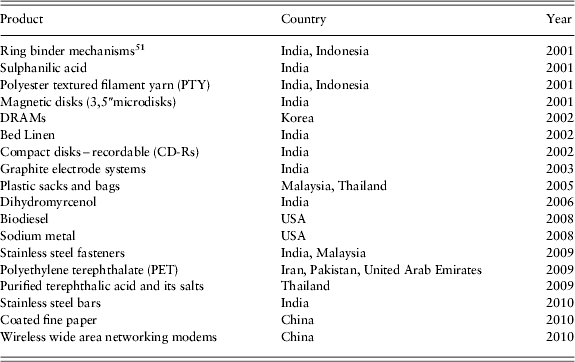
As noted above, we focus our attention principally on the aspects of the AS practice that are germane to AS investigations, and principally on the Coated Fine Paper case, rather than those which feature similarly in all three trade defense instruments. Before a discussion of the substantive elements, which will necessarily be selective in light of space constraints, we begin with an overview of the investigations initiated since the year 2000 (see Table 1).
Overview of the investigations initiated since the year 2000
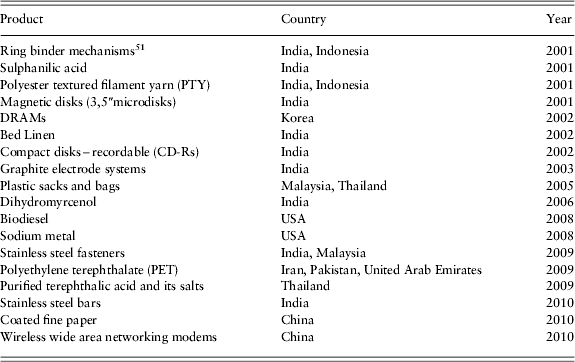
Perhaps the most salient feature of this list is the frequency with which India has been a target of the EU's AS investigations in the past decade, and particularly in the first half of it. In that regard, it should be noted at the outset that the majority of the programs investigated in those cases were, in each investigation, export subsidy schemes for which all or most exporting producers in the country were eligible.Footnote 52 Thus, one contributing factor to the reason why the Indian cases were so frequent might have been the ease with which a complaining producer could blindly allege receipt of those subsidies with regard to almost any industry and likely be right. The prospect of adding ‘cut and paste’ AS complaints to AD complaints is similarly present in the case of China, given the generic nature of the subsidy programs that resulted in the highest subsidy margins in the Coated Fine Paper case.Footnote 53
Another important feature of the past decade of EU AS practice is that, as discussed at length in Section 2, just about every investigation was conducted concurrently with an AD investigation. In light of that, and also because Indian and Chinese cases are particularly likely to trigger them, we first take a look at some of the special rules applicable to dual AS/AD investigations before discussing the treatment in the Coated Fine Paper case of the most basic elements of the identification and quantification of subsidies.
3.1 Concurrent duties
When the EU imposes CVDs resulting from an investigation running concurrently with an AD investigation, there are at least three different scenarios which can require a ‘cross-referencing’ between the two investigations in order to determine the proper aggregate duty which may result from the two investigations. One occurs when all or part of the CVDs are based on exportFootnote 54 (as opposed to ‘domestic’)Footnote 55 subsidies. Another occurs when, as discussed above, either the AD investigation alone or the combination of the two triggers the lesser duty rule, and yet another may occur where AS investigations run parallel to AD investigations making use of an analogue country methodology for calculating the normal value.
In the case of export subsidies already ‘accounted for’ by ADDs,Footnote 56 the EU practice is normally to impose the CVD in full and to deduct from the AD duty the extent of the total subsidy margin accounted for by export subsidies,Footnote 57 and this is true whether or not the investigations run parallel to each other or whether the ADDs are already in place by the time the AS investigation is completed.Footnote 58 It should be noted that the requirement of both, the face of the relevant articles of the basic AS and AD regulations as well as that of GATT VI:5, do not appear to express any preference for the adjustment to be made to the CVD or the ADD, so long as there is an adjustment. In that regard, the fact that the EU's generalFootnote 59 practice is to apply the full CVD and deduct that figure from the ADD may attest to its political preference for CVDs.
One version of the second scenario, in which either the AD investigation alone or the combination of the two, triggers the lesser duty rule, was seen in the 2009 case Biodiesel from the United States of America. In that case, the AD investigation in itself did not trigger the lesser duty rule because the dumping margin did not exceed the injury margin. When combined with the countervailing duty rate, however, the sum of the two did exceed the injury margin, thus triggering the lesser duty rule. Keeping with its practice in the export subsidy cases noted above, the Commission opted to apply the entire CVD, and then deducted that CVD rate from the injury margin to determine the maximum ADD that could be imposed so as to ensure that the aggregate CVD and ADD would not exceed the injury margin common to both investigations.Footnote 60
The other version of the second scenario, in which the AD investigation in itself effectively nullifies the effect of the AS case, was seen in the Coated Fine Paper case. Given the nature of the case, however, the results might reasonably be mistaken for an example of the third scenario, mandated by the AB in DS/379, and applicable only in cases in which there is a dual investigation and the ADD is calculated on the basis of an analogue country normal value.
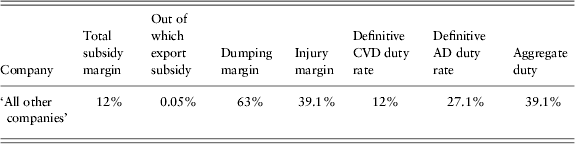
Table 2,Footnote 61 using the ‘all others’ rate as an example, illustrates the final result of the Coated Fine Paper case.
Final result of the Coated Fine Paper case
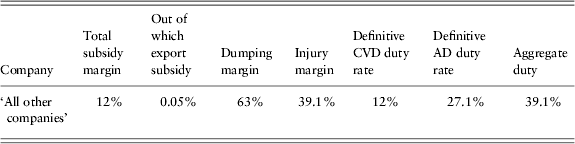
The effect of the AB ruling in DS/379 was to forbid, in cases such as Coated Fine Paper where the dumping margin was calculated based on an analogue country normal value, the imposition of a CVD which might already be reflected in that dumping margin and the ADD resulting from it.Footnote 62 Before that ruling, a country such as the US, which does not use the lesser duty rule, might haveFootnote 63 imposed a 75%Footnote 64 aggregate duty. Today, the highest duty which a non-lesser-duty-rule-implementing member would be able to impose in a WTO-consistent manner would be 51%.Footnote 65
Because of the lesser duty rule, however, the EU managed to remain WTO-consistent at least as far as the duty level was concerned simply by applying the same logic it does in routine market economy AD/AS cases. The Commission reasonedFootnote 66 that the lesser duty rule required that the maximum duty that it could possibly impose in any dual investigation must in all cases be limited to the injury margin, which the dumping margin alone exceeded, thereby eliminating the need to worry about the ‘double remedy’ problem.
3.2 The ‘public body’ question and China's state-owned entities
With regard to the requirement of Article 3.1(a) that the financial contribution be ‘by a government’, Article 2(b) defines ‘government’ as a ‘government or any public body within the territory of the country of origin or export’. The AB in DS/379 recently narrowed the scope of what might be considered to be a public body, rejecting the notion that mere governmental ‘control’ could be sufficient, and instead considering that:
that the determination of whether a particular conduct is that of a public body must be made by evaluating the core features of the entity and its relationship to government in the narrow sense. That assessment must focus on evidence relevant to the question of whether the entity is vested with or exercises governmental authority.Footnote 67 (Emphasis added.)
It was on this basis that the AB overruled the Panel's acceptance of the United States’ decision considering certain of China's state-owned input suppliers to be public bodies based solely on ‘a rule of majority government-ownership’.Footnote 68 The AB did, however, consider the approach of the USDOC with regard to the state-owned commercial banks (SOCBs) to be acceptable under the AB's reformulation.
This is because in the case of the banks, the USDOC did not apply the ‘simple ownership’ test, but rather took into account additional considerations such that the sum of the factual findings was considered sufficient to pass muster under the reformulated test.Footnote 69 The EU in Coated Fine Paper, explicitly adopting the AB's reasoning as its own and taking account the same sort of ‘control plus’ factors as the USDOC,Footnote 70 thus also found the policy banks, along with various State-Owned Commercial Banks (SOCBs), to be public bodies. The apparent key ‘plus’ in this case was the Chinese Commercial Banking Law, which the EU considered to be a mandate that ostensibly private banks carry out and act on ‘government policy’, in particular those outlined in China's Five Year Guidelines, and thus evidence of an exercise of ‘governmental authority’.
This decision by the EU is the first step toward what appears to be a policy of considering all loans made by Chinese banks to any of the industries featured in the planning documents to be countervailable subsidies, and it is unclear what sort of factual differences would have been required in order for the EU's public body analysis to have come out differently. In upholding the USDOC's determination with regard to the banks, the AB seems to have taken some degree of comfort in the ‘USDOC's express acknowledgement in CFS Paper that the ‘scope and extent of government control over SOCBs is changing’’,Footnote 71 but it did not explicitly intimate what further changes would be needed in order to achieve a different result.Footnote 72
3.3 Counterfactual analyses and out-of-country benchmarking
3.3.1 Land use rights
The aspect of the Coated Fine Paper case which will have the most significant practical consequences in terms of the resulting CVD – relates to how the Commission determined (1) that there was no functioning commercial market in China for land and loans, and (2) how the Commission selected an out-of-country benchmark to determine what the amount of the subsidy would have been if not for the distortion. As with the specificity determination in the land context, discussed below, the WTO-consistency of various of the EU's determinations in these respects remains an open question as the AB only treated (and upheld) the US’ determination that the loans were such that the authority was authorized to resort to an out-of-country benchmark.
With regard to the determination that land prices in China were distorted such that resort to an out-of-country benchmark was necessary, the Commission considered that the decision was justified on the basis of the following findings:
Land is government-owned in China and provided by the government on a lease basis. Furthermore, the Chinese authorities control the supply and allocation of land to enterprises including in secondary markets and land assignment to enterprises is linked to a strict set of rules, while any type of change in land assignment, e.g. a transfer of a LUR contract from one enterprise to another enterprise, has to be approved by the State and recognized by a new LUR contract between the assignee with the relevant State authority.Footnote 73
The Commission made a similar finding with regard to the market for financing, concluding that the Government's intervention in the market – and role as predominant supplier – was such that there was no functioning market for loans in China. Provided that the Commission did not abuse its discretion in making those factual findings, they would indeed appear to warrant resort to an out-of-country benchmark in line with the standards set by the AB.Footnote 74
The same cannot be said for the actual benchmarks chosen. With regard to the land use rights’ benchmark:
The Commission consider[ed] Taiwan as an appropriate external benchmark because of the totality of the information on the file, i.e. (i) the level of economic development and economic structure prevailing in Taiwan and the relevant Chinese provinces where the co-operating exporting producers are established, (ii) the physical proximity of these two Chinese provinces with Taiwan, (iii) the high degree of infrastructure that both Taiwan and these two Chinese provinces have, (iv) the strong economic ties and cross border trade between Taiwan and the PRC, (v) the similar density of population in the Chinese provinces concerned and in Taiwan, (vi) the similarity between the type of land and transactions used for constructing the relevant benchmark in Taiwan with those in the PRC, and (vii) the common demographic, linguistic and cultural characteristics in both Taiwan and the PRC. Furthermore, Jiangsu and Shandong provinces are considered top manufacturing provinces in the PRC Although the GDP per capita of Taiwan and the two Chinese provinces is not identical, the GDP of these Chinese provinces has grown rapidly in recent years i.e. they are catching up with Taiwan. In addition, recent data suggest that both PRC and Taiwan have similar real GDP growth rates.Footnote 75
The Commission certainly covers its bases here with the quantity of factors it considers, and while not all of the factors it mentions seem entirely relevant to the proper benchmark inquiry, it cannot be said that the list is an unreasonable one given the inherently difficult, ‘case-by-case’ nature of proxy construction. Given the deference afforded to investigating authorities with regard to factual determinations, it would seem that the WTO-consistency of these benchmarks will ultimately depend more on the process of constructing the benchmark, rather than the result. In that regard, the Commission continues:
However, it is important to note that the exact comparison made between the GDP of a non-market economy (the PRC) and the GDP of a well established market economy (Taiwan) is not a decisive fact because it is normal for a non-market economy to lag behind a functioning market economy in terms of GDP. In addition, many other factors e.g. planning rules, environmental policy may affect the supply and demand of industrial land. The real issue is what would be the ‘prevailing market conditions’ with regard to LUR in the PRC if it was a functioning market economy and on the basis of all evidence they would be very similar to those of Taiwan.Footnote 76 (Emphasis added.)
It is difficult to see how the emphasized portion of the text could be correct. It is ‘the predominant role of the government in the market as a provider of the same or similar goods’Footnote 77 which permits a Member to use an out-of-country benchmark, and as the Panel in DS/379 noted, benchmark construction in the subsidies’ context ‘require[s] an investigating authority to do its best to identify a benchmark that approximates the market conditions that would prevail in the absence of the distortion’.Footnote 78
In our view the purpose of the exercise, or ‘the real issue’, is to attempt to determine what the prevailing market conditions would have been if it were not the case that the government had a predominant role in the market as a provider of the same or similar goods, rather than to engage in the considerably more speculative exercise of attempting to determine what prices would have been if the entire economy were market-based. The fact the Commission seems to ‘counter’ in this particular counterfactual analysis is not only the present status of China's economy, but also the past of the People's Republic as well.
The end result, in terms of the subsidy rate derived, may end up being the same in both cases with regard to some items, but it may be considered that if the fundamental aim of the process is incorrect, then the results derived are similarly tainted. In any event, the distinction is certainly not without a difference because the positive correlation between GDP per capita and prices generally, combined with the Commission's fundamental assumption that China's GDP per capita would be higher if it were ‘a functioning market economy’, effectively ensure that every benchmark selected will result in a positive finding of subsidization, and without regard to the actual conditions in the Chinese market for the actual item concerned. This recalls the EU's practice of selecting developed countries as analogues in AD cases.
3.3.2 Preferential lending rates
A similar issue arises in connection with the propriety of the lending benchmark, where the Commission, again straying from the US practice,Footnote 79 and on the basis of facts available: ‘consider[ed] that all firms in China would be accorded the highest grade of “Non-investment grade” bonds only (BB at Bloomberg) and appl[ied] the appropriate premium expected on bonds issued by firms with this rating to the standard lending rate of the People's Bank of China’.Footnote 80
First, it is unclear from the face of the Regulation how the Commission arrived to a reasoned conclusion that BB was ‘appropriate’ in light of the facts actually available, as opposed to making a simple ‘adverse’ or ‘punitive’ inference, which it claims that it had not done with regard to any of its determinations throughout the case.Footnote 81 The BB rating represents the highest grade of non-investment grade debt – colloquially known as ‘junk’ – and companies issuing debt graded so poorly tend to be highly unstable and must therefore pay very high interest rates in order to borrow.
In any event, the larger of the two investigated producers proffered evidence that Moody's, one of the three major credit rating agencies, had rated it far more creditworthy than BB. The difference between the A-1 rating assigned by Moody's, if accepted, would have resulted in a benchmark of a far lower interest rate. In rejecting the evidence, the Commission considered that:
It is pertinent to note that the particular credit rating note obtained during the investigation links directly the positive future prospects of the company and that the figures calculated in these reports result from the financial situation of the company achieved on the distorted market which is of course affected by the preferential lending as established by the Commission. It is therefore a circular issue, i.e. the company receives preferential lending which has a positive impact on its financial indicators and subsequently these have positive impact on the conditions of future loans.Footnote 82
The Commission is correct that it is a circular issue, but again the counterfactual analysis undertaken by the Commission seems questionable in light of the actual distortion for which the proxy is meant to adjust. In this case, the rating proffered as evidence seemingly undeniably represented what the commercial (i.e. undistorted) market would have assigned as a risk premium. Should that not be the end of the inquiry?
The Commission's reasoning seems to reject the producer's credit rating because it was considered to be tainted in light of that producer's access to subsidized credit as a general matter (i.e. apparently that the producer could possibly access further subsidized capital in the future if in danger of defaulting on its loans). Hence, it seems, the reference to ‘future prospects’, but that means that the rejection of that credit rating effectively amounts to countervailing loans that haven't even been granted yet, but rather might be in the future.Footnote 83
In this regard, the issue raised by the EU practice here, insofar as the decision to resort to the benchmark and its selection are the sine qua non of the China practice as a whole, is once again ‘what, exactly, may be countervailed?’ In this case, the countervailing of the loans seems to go beyond the actual financial contribution at issue in light of the evidence rejected. If the Coated Fine Paper case is a good indication of how the Commission plans on handling the benchmarking issues in future investigations, we would expect the eventual resolution of the question of the correct counterfactual analysis at the WTO level to have a significant impact on its future practice.
3.4 Specificity issues in the Coated Fine Paper case
Historically, the Commission has interpreted sectoral (as opposed to ‘regional’) specificity very broadly, often making it difficult to distinguish between subsidies actually meant to benefit a granting government economy ‘as a whole’, on the one hand, and what are traditionally thought to be ‘specific’ subsidies, on the other.Footnote 84 In the Coated Fine Paper case, the Commission seems to have doubled down on the practice such that it is now difficult to discern to what extent the Commission would consider a subsidy not granted to every enterprise as being granted to ‘certain enterprises’. For example, with regard to the specificity determination for the countervailing of loans generally, and in contrast to the DRAMs case in which loans were found to be made to a small number of specific companies in the context of a special ‘bailout’ type situation, the specificity determination with regard to the ‘preferential lending to the coated paper industry’ program was apparently predicated on the finding that the large group of industries considered to be ‘encouraged’ by the Chinese Government's planning documents constitute ‘specific enterprises’.
Hence, the Commission seemsFootnote 85 to have followed the logic of the US Department of Commerce and later the Panel in DS/379, essentially finding ‘that the GOC Catalogue and the categories thereof are mandatory and that “a principal function of the GOC Catalogue is the allocation of loan financing by financial institutions”’.Footnote 86 Based on the AB's treatment of that finding it would thus appear as though a finding of specificity based partially on the inclusion of an industry on the ‘encouraged’ list, and partially on evidence which shows that there is a specific mechanism for the benefits related to the program at issue (in this case lending) to be channeled to the encouraged industry (in this case the Commercial Banking Law), can be WTO-consistent.
But what about the EU's determination of specificity with regard to land use rights? In DS/379, the United States' consideration of land use rights as ‘regionally specific’ was rejected by the PanelFootnote 87 and not appealed. Thus, unlike the specificity determination in the lending context, in which the Commission finds a significant degree of shelter in the AB Report, its specificity determination with regard to LURs constitutes uncharted waters.
The EU arrived at its conclusion by noting that the papermaking industry is ‘encouraged’, and that it was found that the land was granted ‘in view of the papermaking projects’.Footnote 88 Thus, the EU essentially adopts a pattern of reasoning analogous to the lending situation, except that the facts do not seem at all analogous. Most significantly, the ‘link between the specific policy plans and the financing of the papermaking industry’ that was found in the lending context is conspicuously absent from the LUR determination, that is there is no special ‘land use provision’ section of the Papermaking Plan as there was with regard to financing, nor anything mirroring the provision in the Commercial Banking Law linking the provision of the subsidy and the encouraged enterprises/projects. Therefore, it would appear as though the EU has not made the crucial finding that the provision of the subsidy is explicitly limited to certain/encouraged enterprises, and in fact, the opposite seems to be true as a matter of necessity given that basically all industries in China make use of LURs.
Second, in the event that such a showing would even be legally significant, the recitals of the provisional AD determination to which the EU refers in support of its conclusion ‘that land was allocated to [the producers] in view of their papermaking projects’Footnote 89 cannot reasonably be construed as warranting that conclusion. The relevant recitalFootnote 90 refers to ‘the existence of significant distortions with respect to land use rights (LUR) relevant to the four related exporting producers’ and the Commission considered that ‘such distortions point to the conclusion that the LUR are not granted and maintained in accordance with market economy conditions’. These conclusions do of course relate to the Commission's finding that ‘there is no functioning market for land in China’,Footnote 91 but while that factual finding is of extreme significance in the context of the decision to resort to an external benchmark for the purpose of calculating subsidy amounts, it has nothing to do with the link between the producers’ status as papermakers and the fact that they received subsidized land. That is what de jure specificity is all about.
In sum, the EU's action here seems to represent a significant step beyond what the AB upheld with regard to lending – which itself represented what might be considered a significant expansion of the notion of specificity – and thus might be particularly vulnerable to a WTO challenge. In any event, and given the ease with which a LUR subsidy can be alleged as a matter of course in the case of China, we would expect the practice to continue until and unless the Commission becomes convinced that it is not WTO-consistent.
4. Conclusions
This article has touched upon a wide array of issues and drawn several conclusions, but if there is one take-home message that can be derived from the totality of it, it would be that observers of EU trade defense practice in general – and China and Chinese producers in particular – should take a serious interest in the Coated Fine Paper case even if the EU abstains from launching any more AS cases in the short term.
With regard to the case itself, the true systemic importance of the Coated Fine Paper case might not be immediately clear in light of the fact that (1) the resulting CVD was not particularly high, and (2) because the investigation did not even result in a final aggregate duty beyond what the AD investigation itself would have produced. We have, however, attempted to demonstrate how both of those points can be deceiving.
With regard to the first, the Commission did not investigate certain schemes capable of producing high subsidy rates in other industries, such as the provision of steel at less than adequate remuneration, and it might be considered that while ‘encouraged’, the forestry industry is unlikely to have received the sort of government attention as other industries about which the EU has publically complained. Thus, the 12% CVD resulting from this case may actually be much closer to the lower end of what is to be expected in the future.
With regard to the second point, we have argued that come 2016, the AB ruling in DS/379 should become irrelevant as a means to deter dual AS/AD investigations against China as the analogue country methodology of calculating normal value will no longer be permitted, and thus the decision will place no bar on concurrent duties. In addition, the likelihood of AD investigations triggering the lesser duty rule will be greatly diminished by the loss of the arbitrarily high normal values – and consequent dumping margins – produced by the use of analogue country, and therefore the prospect of triggering the lesser duty rule should become less of a deterrent to the launching of dual investigations. Indeed, it could possibly be the case that even as of 2016 AS cases against China are rendered generally unnecessary by some alternative way of inflating Chinese dumping margins such that AD investigations alone would still be sufficient to trigger the lesser duty rule, but that scenario seems rather unlikely. The foregoing is further compounded by the generic nature of the subsidies countervailed in the Coated Fine Paper case and the ease with which their receipt can be alleged as a matter of course, as we saw with Indian export subsidy cases in the early 2000s.
In spite of all the above, the prospect of AS investigations serving as an effective replacement for the current practice of deriving arbitrary dumping margins from the use of analogue country normal values is not necessarily the EU's decision to make. This will depend partially on the vigor with which Chinese producers defend their interests in future investigations, as well as whether and how the Chinese Government defends its interests at the WTO level so as to ensure further case-law derived discipline on the process of countervailing China's subsidies. What does seem to be clear, however, at least if the benchmarking methodologies and specificity analyses employed in the Coated Fine Paper case are any indication, is that the Commission should not be expected to exercise much restraint in the coming cases which will lay the groundwork for what may be a routine AS practice.