IntroductionFootnote 1
According to Bolton (Reference Bolton, Johannesson and Melchers2013), Chinese university students are invariably multilingual, not only acquiring English at school, but increasingly outside of their formal curricula, through the Internet, music, computer games, movies, and television series. Indeed, many of these students are also highly mobile, and in most cases migrate throughout Greater China (and abroad) in order to pursue higher education degrees. Bolton (Reference Bolton2012, Reference Bolton, Johannesson and Melchers2013) also points out that current theorizing about English in Greater China needs to take into account what he calls ‘the language worlds’ of these young people, especially with regard to how they use various languages in various aspects of their lives, increasingly sampling different ‘worlds’, both ‘physical’ as well as ‘imaginary’ (see also Blommaert, Reference Blommaert2010). Studies of migration and mobility within Greater China – particularly with regard to how this relates to the use of English in the context of local languages and language varieties – have received very little attention. This paper aims to fill this gap by providing a sociolinguistic account of the contemporary use of English in China's higher education, by specifically reporting on a recent large-scale sociolinguistic study that was carried out in Macau and Guangzhou, in southern China. The study reported on in this paper captures the increasing use of English as a medium (or additional medium) of instruction in two universities at these locations. The study also reveals how English is used in the personal lives of ordinary Chinese students.
Sociolinguistic contexts of two universities in Macau and Guangzhou
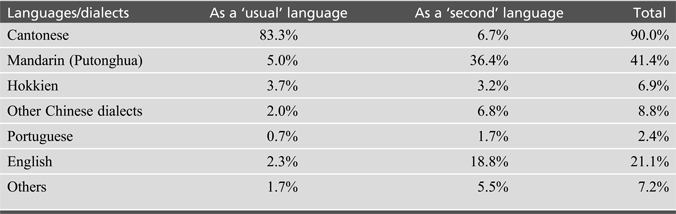
One interesting similarity between the Macau Special Administrative Region (hereafter, Macau) and Guangzhou is that the English language does not have an official legal status in these cities. However, both cities appear to be establishing themselves as educational hubs, with higher education institutes in Macau aiming to attract an increasing number of cross-border students from the Chinese mainland, while institutes in Guangzhou aim to attract significant numbers of students from all over Greater China, as well as from overseas. Both cities have also long been considered Cantonese-speaking centers (along with Hong Kong), but migration to Guangzhou has resulted in an increasing use of Putonghua in Guangzhou, while Cantonese is still the major language of communication in Macau. The latest government census in Macau found that Cantonese is spoken by some 90% of the population, while some 41% of the population claim to be able to speak Putonghua, and just over 21% claim to be able to speak English (DSEC 2011, see Table 1). Interestingly, Portuguese has an official status in Macau, but its use is mainly restricted to the government and its law courts (see Moody, Reference Moody2008). Accurate figures are not available for language use in Guangzhou, but it has been estimated that only half of the Guangzhou population now speaks Cantonese, and as elsewhere in the Chinese mainland, Putonghua in Guangzhou has an official status in education and the media.
2011 Census results for languages/dialects in Macau (DSEC, 2011)

What is notable about Macau higher education is that two universities currently admit mainland students in significant numbers: the University of Macau and the privately-owned Macau University of Science and Technology. Macau University of Science and Technology (hereafter, MUST) is the newest of the territory's ten higher education institutes, and now admits around a half of its undergraduate student population from mainland China, with the other half being local Macau students (MUST Annual Report, 2012). The university is situated in a good location for investigating what is known as ‘cross-border’ education, whereby universities in Macau are increasingly recruiting mainland students by presenting themselves as ‘English-medium’ universities (see Li & Bray, Reference Li and Bray2007). MUST consists of eight primary academic divisions, five of which claim to have English-medium instruction degrees, programs, and courses. In the university handbook, in terms of language policy, all the academic divisions claim to use some form of dual Chinese–English medium teaching (i.e. bilingual instruction). English-medium instruction is promoted by the university in terms of ‘internationalism’ and ‘global competitiveness’, and one might wonder whether this is consonant with the linguistic realities that stakeholders in English-medium instruction programs face on campus (see Botha, Reference Botha2013).
Conversely, Guangzhou has over twelve universities, with three of these being ‘directly under’ the Ministry of Education of the People's Republic of China (or the Chinese Ministry of Education): Sun Yat-sen University (see in Figure 1), Jinan University, and South China University of Science and Technology (Chinese Ministry of Education, 2011). What is interesting about the three institutes ‘directly under’ the Ministry of Education is that they are all increasingly offering bilingual Chinese–English medium courses and degrees. Similar to Macau, it would also appear that mainland China's universities are increasingly promoting themselves as international education hubs, with some of these universities offering degrees to foreign students in the medium of English. For instance, one of the programs that is officially recognized by the Chinese Ministry of Education is the international Bachelor of Medicine and Bachelor of Surgery (MBBS) program offered at Sun Yat-sen University (hereafter, SYSU).
The main campus at Sun Yat-sen University in Guangzhou
A preliminary survey also revealed that English is increasingly used as a language of instruction in one form or another throughout SYSU's forty-two schools, faculties, departments, and institutes. However, there do not appear to be any official policies guiding the use of English as a medium (or additional medium) of instruction at the university. In addition, with the notable exception of the Sun Yat-sen Business School (SYSBS), the university does not appear to overtly promote English-medium instruction on its websites. Interestingly, the Business School website boasts that it offers a range of around fifty courses taught through the medium of English, but this School is the exception at the university in the way it promotes English-medium teaching. This university is also situated in a unique location for investigating the current spread and use of English in China's higher education. In order to account for the spread and use of English in China's higher education, a macro-sociolinguistic study was carried out between mid-2012 and mid-2013 at MUST in Macau and SYSU in Guangzhou. The survey involved 255 students and faculty from MUST, and 236 students from SYSU, and the results specifically aimed to shed light on the use of the English language by students within these two universities, as well as outside the formal curricula in the personal lives of those studying within the institutions.
English as a medium of instruction: realities, attitudes and ‘internationalism’
Much has already been reported on the use of English as a foreign language teaching subject in China's education system (e.g. Adamson, Reference Adamson2002; Feng, Reference Feng2007; Hu, Reference Hu2008, Reference Hu2009; Hu & Alsagoff, Reference Hu and Alsagoff2010; McArthur, Reference McArthur2005; Spalding et al., Reference Spalding, Wang, Lin and Hu2009; Tian & Macaro, Reference Tian and Macaro2012; Wang, Reference Wang2007), but very little research has specifically investigated how the language is currently used and promoted as a language of instruction across tertiary institutes as a whole. In general, the use of English in the formal curriculum of China's universities largely depends on academic divisions within these institutions. In the macro-sociolinguistic survey at MUST in Macau, it was found that the use of English as a medium of teaching was restricted to specific faculties, with more English being used in the Business and Administration and the Hospitality and Tourism faculties, compared to very little use in the other faculties (see Botha, Reference Botha2013). As is shown in Botha (Reference Botha2013), there was a discrepancy with the officially stated language policy of this university, as Putonghua was the most frequently used language in the students' lectures. It was also shown that students typically reported doing less of the required reading in English, and that many students at this university reported difficulties in learning their course materials through the medium of English.
It was found, in a similar survey conducted at SYSU in Guangzhou, that English was to varying degrees being used as a medium of instruction in the university's main academic units, with the most English being used in the students' formal education in the Humanities and the School of Business. In fact, results indicate that some 41% of the undergraduate Humanities students heard ‘about half’ to ‘all’ English in their lectures, while around 30% of undergraduate students in the School of Business reported hearing ‘about half’ to ‘all’ of their lecture content in English. Postgraduate students from the School of Business and the School of Medicine also reported the use of English in lectures, but ‘exposure’ to English was by far the most frequent in the School of Business. These postgraduate students also typically reported reading most of their course material in English, with some 87% of the postgraduate sample reporting that ‘about half’ to ‘all’ of their prescribed reading was in English. Even though the universities that were surveyed are different in many respects, both of these institutions appear not to adequately implement their ‘official’ language policies. As a result, many students appeared to be disadvantaged because the universities' policies are either not evenly implemented across all the academic units, or there is a lack of well-defined policies to inform teachers on how to use English as a medium of teaching.
What was interesting about the two universities was the way in which English was promoted as a language of ‘internationalism’. At both MUST and SYSU, English seems to be marketed in terms of the rhetoric of internationalism, and its websites cite the English language as a symbol of the universities' internationalism. For example, on the SYSU School of Business (SYSBS) website (2013), it is noted that:
SYSBS is determined to building upon our reputation as a premier business school in China and Asia with global impact. It is rated first-in-class business tertiary education institution in China, with its academic and professional programs consistently ranked among the top 10 in the nation. It earns a reputation for academic excellence (e.g., 98% of employment rate for our students), internationalization (30% of our faculty hold doctorate degrees from leading schools overseas; over 50 courses are offered in English; about 70 full-time or visiting foreign students each year), quality of our programs (e.g., MBA program is accredited by AMBA and persistently ranked among the top four in the nation), and contributions to society. [sic, in original]
The declaration above reveals that the School of Business relates English to ‘internationalization’, as the statement ‘over 50 courses are offered in English’ is presented as an example of the School's internationalization. Similarly, the MUST Faculty of Management and Administration website (2013) notes that ‘We intend to provide students an internationalized learning place to polish the communication ability by offering all English lectured courses in junior and senior stages’ [sic, in original], and elsewhere that ‘[in] the entire English teaching, under the raise internationalization field of vision, [Faculty of Management and Administration] students can integrate rapidly into the international competition environment’ [sic, in original]. It is precisely the ideology of internationalism that the universities appear to draw on when promoting their various colleges, and invariably this ideology is translated into students' beliefs and attitudes towards the English language. Overall, the studies at MUST and SYSU reveal that some 76% (321/420) of the Chinese students surveyed agreed with the notion that their respective universities would be more ‘international’ if courses were conducted in English (see Figure 2). A vast majority also agreed that their respective universities should offer more courses conducted only in the medium of English, and that the universities would not be somehow ‘better off’ if Chinese were the sole medium of instruction.
The number of students who feel English ‘internationalizes’ their university
Pan & Seargeant (Reference Pan and Seargeant2012) and Hu (Reference Hu2009) have also noted that links between English and internationalism in China might also be considered to be part of the government's rhetoric towards modernization. Interestingly, there was also a view among many of the respondents in the surveys that the issue of ‘globalization’ is tied to the usefulness and importance of English, as pointed out by one student in a discussion:
[1] It's very important to learn English to communicate…because of the global…globa… glo…globalization…yes…uh…a lot of foreigners are coming to China…and more and more foreigners are coming to…coming here. So it's very useful to communicate (undergraduate female student, aged 20, from SYSU, Humanities).
The student in [1] above remarks that English has an instrumental value because of the global movement of people, with many international visitors (‘foreigners’) coming to China, and this student considers English to be a convenient (and useful) means of communication. Further to this, Kirkpatrick & Xu's (Reference Kirkpatrick and Xu2002) attitudinal survey found that the majority of their student respondents ‘disagreed’ that ‘one day there will be a variety of English called “Chinese English”’. However, in this study it was found that the majority of the respondents intuitively understood the notion of a ‘Chinese variety of English’. Many of these students appeared to simply accept the use of English in their formal education. Overall, some 69% (303/438) of the respondents (including the international students) in this study reported hearing a ‘Chinese variety’ of English in their formal education. However, many of the students did comment negatively on their teachers' use of English in their classrooms. Comments were generally made with regard to ‘fluency’ and ‘pronunciation’, and many students commented that their teachers were good at writing and reading in English, but that their spoken English was not very good, as pointed out by the student in [2] below. The student in [2] highlights one of the important issues about students' attitudes in China today, and suggests that many of these younger students have a grasp of English that many from the previous generations apparently lack.
[2] [The teachers] seldom speak a sentence…uh…mostly some word…yeah…they can…they can use those…they have…they have been abroad to study but I don't think most of them can speak English fluently or correctly…but their writing and reading is very good…they can fluently read the English magazine in science (undergraduate female student, aged 21, School of Mathematics).
In many respects the current research found there to be various extents to which English is used as a medium of instruction at the two universities, and this conforms to the ‘levels’ or ‘degrees’ that Hu & Alsagoff (Reference Hu and Alsagoff2010) highlight, from a predominant use of English as a medium of teaching and learning, to a minimal use of the language.
English in the personal lives of students
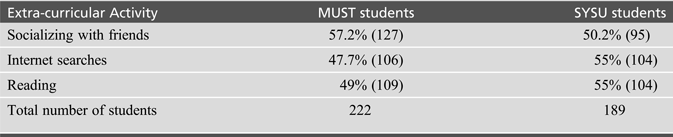
In general, in this study students' reported extra-curricular use of English was found to be varied; the most frequent overall uses identified were ‘socializing with friends’, ‘reading’, ‘Internet searches’, and ‘online socializing’ (see Table 2). It was also found that there were connections between academic units and their respective students' personal use of English, with students in the Faculty of Management and Administration and the Faculty of Tourism at MUST using English the most frequently in their free time. It was also found that in these faculties English was the most widespread and the most often used, compared with the other faculties. Similarly, SYSU undergraduate students in the School of Business, Humanities, and the School of Physics and Engineering reportedly receive more of their formal education in English compared with the other academic units, and it appears that these students use English the most frequently in their personal lives. For instance, 24% of the students who read English ‘some’ to ‘all’ of the time for extra-curricular purposes were from the School of Physics and Engineering, while 13.9% were from the Humanities and 11.3% from the School of Business.
Three top-reported extra-curricular uses of English by students at MUST and SYSU
In addition, it appears that both undergraduate populations at MUST and SYSU use English with a certain regularity in their extra-curricular time, which may be influenced by the required use of the language in their education. This would further suggest there might be a connection between the type of exposure to English students in these units have and their use of English for extra-curricular purposes. The postgraduate students at SYSU also generally appeared to receive a good deal of exposure to English in their formal education, and these students were also exposed to English quite frequently in their extra-curricular time. The postgraduate students reported being most frequently exposed to English-medium reading during their studies, and these students also reported that their most frequent exposure to English in their extra-curricular lives was through reading.
The personal worlds of the students appear to be influenced by their use of languages (especially English) in their respective faculties. However, the important distinction to be made between the students' educational context and their extra-curricular lives is that in the former context their exposure to languages in their classrooms is not so much a choice of code on the part of the students, compared with their choice of being exposed to languages in their free time. Their choice of exposure to English in the contexts of on-line and face to face socializing with their friends, their use of English on the Internet (especially for carrying out searches), and reading all suggest that these students negotiate multiple contexts and multiple languages in their personal lives. The use of English for ‘socializing’ could be misleading, but to use Mufwene's (Reference Mufwene2001) notion of ‘ecology’, one can understand that ‘English’ does not suggest a ‘pure’, enclosed system of language use, but rather a choice of code by which to use certain words or phrases to indicate various aspects of their personal or group identities, or to use Le Page and Tabouret-Keller's (Reference Le Page and Tabouret-Keller1985) terminology, to project various ‘acts of identity’ with their choice of codes. Another very interesting example of this is the fact that many of the mainland Chinese students reported using English on their Weibo microblogs, as one student noted about her use of English in her extra-curricular time in response to the question Do you use English in your free time? If so, where?
[3] Um…movies, magazines, and when I…when I write my diary on the internet…I always use English (undergraduate female student, aged 21, from MUST, Faculty of Business Management and Administration) (From: Botha, Reference Botha2013).
The multiple linguistic worlds (Bolton, Reference Bolton2012, Reference Bolton, Johannesson and Melchers2013) that these students negotiate in their everyday lives appear not only to result from their physical mobility between spaces, but also their ability to move between online, virtual worlds. It is astonishing to note that these Chinese students watch English movies with Chinese subtitles, switching between English and Chinese when searching the Internet, and that they express aspects of their individual identities to their friends in their physical worlds as well as their virtual online worlds. Interviews with the students revealed that a large number felt the language was actually an opportunity to be part of other worlds outside of China. The following responses to the question How do you use English in your spare time, and how does this impact your life? were especially noteworthy:
[4] I think um there Hollywood movies make the biggest difference for us…because uh…we um…uh…we some subjects we seldom talk about in China…uh have been in Hollywood movies like some sex…or um beliefs…or something else…I think it makes a difference for me…I think more open…and um…can accept the different ideas (undergraduate male student, aged 20, from SYSU, School of Physics and Engineering).
[5] A little bit…because…uh…you…you…you have the better English speaking ability and you will feel more confident to…uh…accept different cultures. Maybe you will watch a lot of American movies…American TV programs…and some different countries…uh…different programs…so you will feel more confident to get to know different…cultures (undergraduate female student, aged 20, from SYSU, Humanities).
What is especially notable in [4]–[5] above is the students' reference to media ‘worlds’ and how English presents an opportunity for these students to gain access to these worlds. A key issue to remember is that all foreign media are heavily censored in China, so one may assume that many students have managed to gain access to foreign media by somehow circumventing the government censors. Nevertheless, the students all mentioned the importance of American films, TV series, and news as a way for them to learn about various ideas and to understand or learn more about foreign cultures from these types of media. Particularly noteworthy is that the English language represents an opportunity for these students to gain personal enrichment, which they perceive as allowing them to change the ways in which they understand their worlds in mainland China, as evidenced by the responses in [4]–[5] above. Things certainly have changed since Garrot's (Reference Garrot1991) survey in which respondents had no ‘clear responses’ with regard to how they would use English after graduating from college, as it appears that English now is already an inextricable part of these students' personal lives. Other students also pointed out the differences in their use of English in their lives, especially the differences between how they are using English now, compared with how they used English in their high schools.
[6] from [my high school teachers] I recite many articles…uh…and improve…improve my English and in the high school I…uh…we do the test over and over again and our teacher emphasize on words and grammar so…so…so…the…this time I improve my English the grammar but in but in university I don't…uh…I don't study English like…like like before I just…uh…use English…um…in practical…practical use…like reading newspapers and magazines and listening to the BBC…uh…some other news (undergraduate male student, aged 21, from SYSU, School of Physics and Engineering).
The student in [6] points out that his use of English in high school was restricted to classroom study and preparing for English vocabulary and grammar tests. However, at SYSU this student now uses English in his personal life by reading newspapers and listening to the BBC.
Conclusion
Recent studies continue to show that university students in mainland China are surprisingly multilingual, and constantly switch between different worlds, using different languages and language varieties as they move between various worlds. These students not only learn English as a subject at school and university, but also acquire the language in other spheres in their daily lives, through their use of the Internet, by watching films, and through the international news media. Not only does English offer many of these students better career prospects and tangible success in an increasingly globalized world, but the English language is for many of them a means to explore new worlds, and offers them new ways of expressing their individual identities to others in the worlds they perceive themselves to live in.
The discussion of English in the current paper regarding the increasing use of the language in formal education is having an impact on the ways in which Chinese students are learning their course materials, and even more strikingly in the myriad ways these students are using multiple languages to negotiate their everyday lives. As university students in China become increasingly bilingual, they increase their ability to move across spaces, both in the ‘real’ world, as well as in their Internet and entertainment lives. The varieties of English these students are exposed to no doubt also impact the ways in which they can use varieties of English to construct and reconstruct personal identities. Not only this, these students also open up opportunities for others to share in their worlds by using English in novel and unpredictable ways (see also Zhang, Reference Zhang2012). Research on the spread and use of English in mainland China needs to keep pace with these shifting, multilingual contexts of language use and language ecologies in the Greater China region, and especially with the rich and varied multilingual worlds of students in China's higher education today.
Acknowledgements
I wish to express my gratitude to Prof. Kingsley Bolton and Prof. Lawrie Barnes for their invaluable suggestions and comments on my research on English in China's higher education.
 WERNER BOTHA is currently completing his PhD studies in sociolinguistics, specializing in the spread and use of English in China's higher education. His current research interests include language variation and change, as well as language contact in the Greater Asia region. He has published articles on language variation in Macau Cantonese, and the use of English in higher education in Macau. Email: wrbotha@gmail.com