Introduction
The last two decades have seen a rapid expansion of tourist activity in the polar regions (Stewart and others Reference Stewart, Draper and Johnston2005). Peripheral, remote tourist destinations are by definition distant, rather expensive, often difficult to access, and have a limited tourist season (Brown and Hall Reference Brown, Hall, Brown and Hall2000). Nevertheless demand for new forms of tourism, such as community-based tourism arises from increased concern and interest in unique and fragile ecosystems. Many small-scale regions and remote areas have attempted to enhance their economic situation through the promotion of tourism (Blackman and others Reference Blackman, Foster, Hyvonen, Jewell, Kuilboer and Moscardo2004). Governments consider tourism as one of the possibilities of economic development, since tourism can create a range of employment opportunities. Workers are needed to provide the services and construct the facilities that tourists need, while tourist expenditures can contribute directly and indirectly to local economy. To what extent the development of tourism in a remote peripheral area can be seen as a concrete possibility for viable economic and socio-cultural sustainability, and how can the local communities obtain some benefits from tourist development? Much has been written about the need to involve local population in the planning and development of tourism (Lewis and Newsome Reference Lewis and Newsome2003; Murphy and Murphy Reference Murphy and Murphy2002; Pearce Reference Pearce2002). Less has been written on how to accomplish this ideal and to reach the high expectations of better income, more jobs and an improved quality of life, created by policy-makers and tourism developers.
The National Park of Greenland
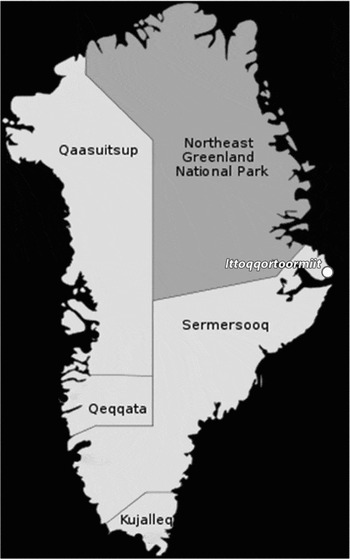
Established on 22 May 1974, located at 71°00ʹ N to 83°00ʹ N, 11°39ʹ W to 63°ʹ W, the park covers a surface of 972,000 km2, from the northern part of Ittoqqortoormiit in East Greenland to the north-eastern part of Qaanaaq in the high north of Greenland (Fig. 1). Mainly composed of inland ice and fjords, the park is an Arctic desert and icecap. Approved in January 1977 as an International Biosphere Reserve under the Unesco ‘Man and the Biosphere’ Programme, the park does not comply with IUCN criteria (protection category II, National Park) since permission to carry out mineral exploitation in the National Park (1994) is permitted. Officially, there is no permanent human population in the park; however, between 20 and 30 scientists, the personnel of a meteorological station, and the military personnel from the Sirius Patrol (a military detachment with duties of territorial control) live in the different stations located in the park area. Allowed are only scientific expeditions, after having received the permission of the authorities, and except for mineral pits, every other activity is forbidden.
Map of Greenland, its National Park, and the community of Ittoqqortoormiit (Source: Ministry of Domestic Affairs, Nature and Environment, Greenland).

Conflicts and strategies
There are potential conflicts between nature and environmental conservation interests, and the field activities of petroleum and mineral projects in Greenland. The general political agreement is that the development of petroleum and mineral resources is a vital part of the future economy of Greenland. The strategy plan for the park, adopted by the Self Government of Greenland, deals with the main pressures that can be expected as a result of activities in the area, and the tools that can be utilised to minimise negative impacts on vegetation and fauna (Departementet for Indenrigsanliggender, Natur og Miljø, 2010).
The community of Ittoqqortoormiit
The region of Ittoqqortoormiit (Scoresby Sund in Danish), in the East Coast of Greenland, is located at approximately 70°31ʹN, 22°00ʹW near the mouth of the Kangertittivaq/Scoresby Sound, and covers an area of 235,000 km2 (91,000 m2) along the Denmark Strait and the Greenland Sea. In the north, it borders on the National Park of Greenland, and to the south west with the Ammassalik region.
Ittoqqortoormiit was established in 1924, with the purpose of moving part of the inhabitants from Ammassalik, 900 km south, which had reached a population limit of what the nearby hunting areas could support. Another reason was geopolitical since after some territorial disputes with Norway, the kingdom of Denmark, which Greenland was a colony at that time, decided to set an outpost far north. Ittoqqortoormiit (529 inhabitants) has a very remote geographical situation, and the climate is typical of the high-Arctic. The economic and social situation in Ittoqqortoormiit is common as in many other places in Greenland and in the Arctic, lack of job opportunities, important out-migration, and very few possibilities of development. Hunting activities are the key part of the local (subsistence) economy; incomes are low, and the unemployment rates high. Except for the small amount of remunerated jobs the local economy is a mix of seasonal tourism activities, subsistence hunting and social assistance. The out-migration is quite significant, an average of 100 people left in the last four years (Statistics Greenland, 2011) and not only for educational purposes. Although Ittoqqortoormiit lies near large populations of shrimp and Greenland halibut, the presence of sea ice prevents exploiting these resources year-round, and as a result fishing has never been extensively developed in the municipality. There are 15 to 18 professional hunters and another 60 to 80 that are hunters in their free time. There are about 40 to 50 boats, and an average of 400 dogs. Hunters have teams of 10 to 15 dogs. Before the limitations the income of a hunter, including the selling of narwhal tooth, walrus teeth and polar bear skin, was at least 150,000 Dkk (€ 20,000)/year. For some time now, due to new rules in Europe and several other countries, the selling of hunting products is possible only inside Greenland. Presently a good professional hunter earns from hunting activities around 50,000 Dkk (€ 6,700)/year; in Ittoqqortoormiit the average income spans from 10,000 to 15,000 Dkk (€ 1,350 to 2,000)/year.
The appeal of tourism
Tourism is growing in importance in Ittoqqortoormiit, due to tourists’ interest for the remoteness and the impressive landscape of the area. The place offers several activities all year round, like dog sledding, sailing, and hiking. According to the local tourist agency Nanu Travel, the number of visitors is around 150 for dog sledding, 180 for sailing and more than 1,000 for cruise ships (Director of Nanu Travel, personal communication, 2009). Tourism can generate good money for the hunters offering dog sledge tours. In town there are about 50 dog sledges and rough calculations indicate that in 2005 an average one million Dkk (€ 135,000), were earned during the whole tourism season, with dog sledding and sailing. From the point of view of tourism, Ittoqqortoormiit has presently limited infrastructure and capacity, there is no place in town where tourists can have refreshments, and the only guesthouse is based on self-catering.
Discussion of findings
A survey in Ittoqqortoormiit took place in 2009 for the research project ‘Community-based tourism as an option for concrete, viable development in peripheral, remote places.’ Qualitative information, participant observation, and quantitative data were used. The sample was constituted by community inhabitants, mainly hunters, doing some activities related to tourism such as guides. The interviewed were asked to respond to a questionnaire. The sample consisted of 16 persons, mainly hunters (9) but also local business people (4) and other informants (3). In what follows are presented the main issues that were raised by the participants to the study regarding tourism in their community.
The analysis of the data shows the need to fill the gap of information, training, financial and technical assistance, and to define a plan for future development of tourism. Another issue is about the required level of investment which is usually high when compared with the shortness of the season and with other unexpected hindrances (like bad weather conditions). Even with the necessary funds, such investments could turn out to be at high risk: conditions that the community does not seem able to accommodate at present. The offer in Ittoqqortoormiit is primarily represented by an impressive landscape, a rich cultural heritage still traditional, and a national park which represents a remarkable appeal from the point of view of tourism. Protected areas are commonly perceived by the government institutions as a powerful marketing brand. The government plans to extend the limits of the National Park to include the village of Ittoqqortoormiit and the Scoresby Sund fjord.
In Ittoqqortoormiit the local population's idea of resource is of something to benefit and take advantage of it, like the allowed seasonal permissions for hunting (according to quota) in limited areas within the national park. Some locally based tourism business providing tourists’ excursions in the protected area, and locally based companies for the logistic support of scientific expeditions may significantly contribute to boost the local economy. The challenge is to develop a tourist product in fact already existent, the park. This needs investment, most of all, in human capital. Trained local guides are winning cards for the future of the community which can thus avoid having guides coming from outside. To become a guide is a task that may requires an important investment in time and money (Nickels and others Reference Nickels, Milne and Wenzel1991), and at the early stages of development it may be too costly for a small community. However a guide can be everyone in the community that knows the place and the surroundings, and to some extent a foreign language. This is a crucial factor, and presently few of the hunters have some knowledge of the English language in Ittoqqortoormiit.
Conclusion
The community of Ittoqqortoormiit is typified by all the characteristics common to peripheral places: tiny population, outmigration flows, low incomes, high unemployment rates, subsidies. The use of some parts of the protected area for tourism activities may well represent a viable alternative to the current economy. Fieldwork has demonstrated that in Ittoqqortoormiit, as in other peripheral areas (Tommasini 2011), local communities seldom have the business skills necessary to engage successfully over the long term. This is mainly because the level of information among the local population regarding tourism development options and support, is quite limited and there is an urgent need for a clear planning of future developments. In Ittoqqortoormiit the tourism season is quite long thanks to dog-sledge activities in the spring, boat tours during summer, and cruise ship tourism in autumn. Tourism activities, apart from a few exceptions like direct arrangements, are in the hands of the local tourist agency. The share holders are Inuit or Danes long-time residents in the village. In an average season, 40 people are engaged with various tourism activities employed in activities related to tourism, and considering the size of the town this is quite a good fraction of the community members. all show interest and wish to expand their business, especially with the use of the bordering resource, the national park. Young people do not seem to be very interested in being involved with tourism, but many of them are out of town for education and may have other plans for their future.
After the 2009 reorganisation of the municipalities, most of the Ittoqqortoormiit population feel more peripheral than previously and not only in geographical sense. This is transposed in terms of a decrease in services, and most of all in moving many of the local competences to Nuuk, the regional capital of Sermersooq (and the capital of Greenland). This has resulted in a lack of local representation and focus point. Nevertheless, the community is trying to find a way through the many changes that have affected this fairly small and peripheral place. The new rules for the national park open the possibility of developing tourism activities in the protected area. This could revitalise the community, and create some additional tourism jobs like guiding, sledging, and boat rides and give way to new seasonal tourism business that will bring benefits and enhancement to the community of Ittoqqortoormiit.
Acknowledgements
This research was made possible thanks to a research grant from the Namminersornerullutik Oqartussat - Grønlands Hjemmestyre, Kultureqarnermut, Ilinniartitaanermut Ilisimatusarnermullu Pisiortaqarfik – Direktoratet for Kultur, Uddannelse og Forskning.