Introduction
Maize (Zea mays L.), often regarded as the ‘queen of cereals’, is a cornerstone of global food security due to its versatility, adaptability, and economic significance. As the leading cereal crop by production volume, maize is projected to become the most widely grown and traded staple in the coming decades (Erenstein et al., Reference Erenstein, Jaleta, Sonder, Mottaleb and Prasanna2022). It serves multiple roles, as a staple food in sub-Saharan Africa and Latin America, as a global source of animal feed, and as a raw material for industrial and biofuel applications. This versatility underscores its centrality in both human and livestock food systems, as well as in national economies dependent on agri-food systems (Erenstein et al., Reference Erenstein, Jaleta, Sonder, Mottaleb and Prasanna2022; Grote et al., Reference Grote, Fasse, Nguyen and Erenstein2021).
In nations like Malawi, maize is not only a dietary staple but also an economic lifeline, intricately linked to food security and rural livelihoods (Nyirenda et al., Reference Nyirenda, Mwangomba and Nyirenda2021). However, this dependence makes maize cultivation especially vulnerable to the escalating impacts of climate change. While short-term warming trends may offer yield advantages in certain regions, long-term projections suggest severe threats from rising temperatures, increased drought frequency, and erratic precipitation patterns (Bracho-Mujica et al., Reference Bracho-Mujica, Rötter, Haakana, Palosuo, Fronzek, Asseng, Yi, Ewert, Gaiser, Kassie, Paff, Rezaei, Rodríguez, Ruiz-Ramos, Srivastava, Stratonovitch, Tao and Semenov2024). In particular, heat stress during pollination and flowering stages can drastically impair yield, and rainfall variability can disrupt planting cycles and water availability (Liu et al., Reference Liu, Dong, Zhang, Gu, Yu, Xie, Yang, Yu and Huang2022).
Recent innovations in crop genetics have provided some relief. For instance, drought-resilient hybrids like the AQUAmax series in the U.S. Corn Belt demonstrate yield stability under water-limited conditions (Gaffney et al., Reference Gaffney, Schussler, Löffler, Cai, Paszkiewicz, Messina, Groeteke, Keaschall and Cooper2015). Similarly, advances in nutrient management, such as improving nitrogen and phosphorus use efficiency, are essential for sustainable intensification and closing existing yield gaps (Wang et al., Reference Wang, Ren, Han, He, Zhang, Zhao, Liu, Zhang, Zhao, Ren and Liu2023). Beyond conventional breeding, microbial interventions, particularly the use of plant growth-promoting rhizobacteria (PGPR), are being explored to enhance resilience by aiding nutrient solubilisation and improving root architecture (Chattaraj et al., Reference Chattaraj, Samantaray, Ganguly and Thatoi2025).
While developed regions, such as the U.S. and Corn Belt, focus on advanced genetics to mitigate abiotic stress, developing regions in Africa and Asia face compounding biotic threats, such as fall armyworm, exacerbated by climate variability and limited infrastructure. This divergence in challenges and capacities underscores the need for context-specific strategies.
Despite these advances, several challenges remain to be addressed. Climate variability continues to exacerbate pest outbreaks, such as the fall armyworm invasion in Africa, placing additional pressure on maize production systems (Togola et al., Reference Togola, Beyene, Bocco, Tepa-Yotto, Gowda, Too and Boddupalli2025). Furthermore, shifts in global maize trade, biofuel policies, and the diversion of maize from food to non-food uses raise concerns regarding long-term food availability, particularly in import-dependent regions (Wu and Guclu, Reference Wu and Guclu2013).
In response to these complex challenges, Climate-Smart Agriculture (CSA) has emerged as a transformative framework. Climate-Smart Agriculture promotes productivity enhancement, climate adaptation, and greenhouse gas mitigation through an integrated suite of practices, including resilient seed systems, precision agriculture, and ecosystem-based approaches (Kabato et al., Reference Kabato, Getnet, Sinore, Nemeth and Molnár2025). It not only improves yield stability but also supports economic viability and sustainability (Bhatnagar et al., Reference Bhatnagar, Chaudhary, Sharma, Janjhua, Thakur, Sharma and Keprate2024).
However, existing reviews often examine these strategies in isolation, focusing either on genetics, agronomy, microbiomes, or policy dimensions separately. However, a unified synthesis that explicitly integrates these domains into a systems-level framework for maize climate resilience is lacking.
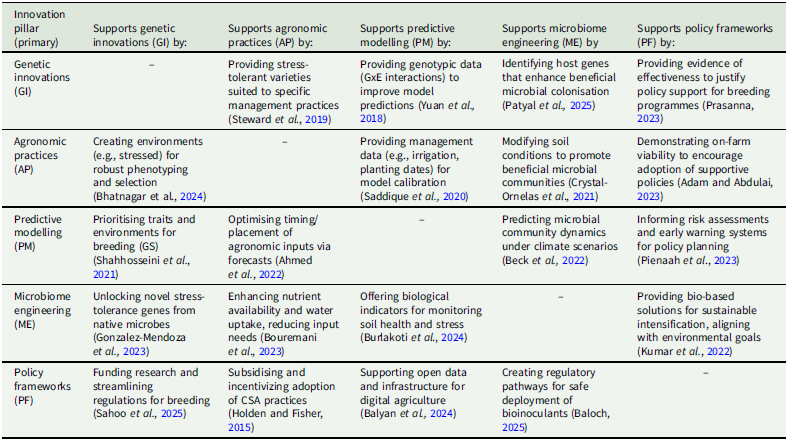
This review fills this gap by presenting a novel five-pillar framework (genetic innovations, agronomic practices, microbiome engineering, digital tools, and policy enablers) that collectively charts a roadmap for climate-resilient maize production. Drawing on global case studies, this review identifies synergies across domains, highlights critical knowledge gaps, and proposes interdisciplinary pathways to future-proof maize systems against climate uncertainty (Figure 1). This framework recognises that no single pillar operates in isolation: genetic innovations must be deployed through appropriate agronomic systems, their performance predicted by climate models, their resilience enhanced by beneficial microbiomes, and their adoption enabled by supportive policies to be effective. The arrows in Figure 1 indicate these synergistic interactions and feedback loops. The interconnected nature of these pillars is further elaborated in Table 2, which presents a conceptual matrix of how each domain supports and benefits from the others.
Integrated framework for climate-smart maize systems. This conceptual model illustrates five synergistic pillars of innovation enabling maize resilience under climate change: Genetic Innovations (blue), including CRISPR-Cas9 editing, genomic selection, and drought-tolerant hybrids (for example, AQUAmax), exemplified by the WEMA Project’s 20 % yield gain in Africa. Agronomic Practices (green): No-till farming, maize-legume intercropping, and precision irrigation, with Latin American no-till systems achieving 70 % adoption and carbon sequestration. Microbiome Engineering (cyan): PGPR (Burkholderia spp.) enhancing water-use efficiency (+12 %) and AMF boosting phosphorus uptake (+35 %) in low-fertility soils. Digital Tools (purple): AI-driven yield forecasting and IoT/satellite phenotyping validated by India’s RH-10 hybrid (8.27 t/ha under heat stress). Policy & Socioeconomics (orange): Gender-inclusive extension services and carbon credit incentives. The arrows signify synergistic interactions and feedback loops between these pillars, highlighting that resilience is maximised when these innovations are deployed in concert. AI, artificial intelligence; AMF, arbuscular mycorrhizal fungi; CRISPR-Cas9, clustered regularly interspaced short palindromic repeats–CRISPR-associated protein 9; IoT, Internet of Things; P, phosphorus; PGPR, plant growth-promoting rhizobacteria; WEMA, Water Efficient Maize for Africa.

Figure 1. Long description
Panel A: Genetic Innovations. This section includes CRISPR-Cas9 editing, genomic selection, and drought-tolerant hybrids like AQUAmax. The WEMA Project in Africa has achieved a 20% yield gain using these innovations. Panel B: Agronomic Practices. This section highlights conservation agriculture (no-till), maize-legume intercropping, and precision irrigation. No-till farming in Latin America has a 70% adoption rate and contributes to carbon sequestration. Panel C: Microbiome Engineering. This section features PGPR (e.g., Burkholderia), arbuscular mycorrhizal fungi (AMF), and rhizosphere modulation. PGPR inoculation leads to 12% higher water-use efficiency, and AMF symbiosis results in 35% more phosphorus uptake in low-fertility soils. Panel D: Digital Tools. This section includes IoT sensors, satellite phenotyping, and AI-driven yield forecasting. India’s RH-10 hybrid achieves 8.27 tons per hectare under heat stress using these tools. Panel E: Policy & Socioeconomics. This section covers seed system governance, gender-inclusive extension, and carbon credit incentives. The arrows signify synergistic interactions and feedback loops between these pillars, emphasizing that resilience is maximized when these innovations are deployed together.
The topic of climate-resilient maize has been addressed in several recent reviews, each focusing on a specific domain. For instance, Li et al. (Reference Li, Li, Sun, Li, Cai, Li, Sun, Yu, Meng and Zhang2025) provided a comprehensive overview of genetic diversity and agronomic innovations, whereas Peer et al. (Reference Peer, Bhat, Lone, Dar and Mir2024) focused specifically on the genetic and molecular pathways for drought tolerance. Bhatnagar et al. (Reference Bhatnagar, Chaudhary, Sharma, Janjhua, Thakur, Sharma and Keprate2024) explored the broader dynamics of Climate-Smart Agriculture practices, and Burlakoti et al. (Reference Burlakoti, Devkota, Poudyal and Kaundal2024) reviewed beneficial plant-microbe interactions for stress tolerance in maize. More recently, Azrai et al. (Reference Azrai, Bahrun, Efendi, Andayani, Jihad, Bahtiar, Muslimin and Aqil2024) analysed global drought-tolerant maize research with a focus on technological visualisation, and Sahoo et al. (Reference Sahoo, Singha, Govind and Moghimi2025) examined climate-resilient agriculture from a sustainability and policy perspective in India. Additionally, Peer et al. (Reference Peer, Wani, Lone, Dar and Mir2025) synthesised advances in drought stress memory mechanisms, covering the transcriptional, epigenetic, and physiological pathways that enable rapid adaptation to recurrent drought events. Recently, Kim et al. (Reference Kim, Park and Lee2026) synthesised biotechnological strategies, including CRISPR, genomic selection, and AI-driven phenotyping, whereas Sophian (Reference Sophian2026) focused specifically on molecular markers and genome-wide association studies for thermotolerance in maize.
Although these contributions are invaluable, they often treat these domains in isolation. The unique contribution of this review is its explicit integrated synthesis of five critical pillars: genetic innovation, climate-smart agronomy, predictive modelling, microbiome engineering, and enabling policy frameworks. The current review goes beyond a simple description of each field to analyse their synergistic interactions, providing a systems-level perspective essential for developing holistic climate resilience. It also critically assesses the translational challenges – from the laboratory to the field to policy – that are often overlooked in domain-specific reviews. This framework identifies not only the latest technological breakthroughs but also the critical socioeconomic and institutional bottlenecks that must be addressed to ensure an equitable and scalable impact, thereby offering a roadmap for future research and action.
Review methodology
To ensure transparency and rigour, the literature for this review was gathered through systematic searches of the following databases: Web of Science, Scopus, Google Scholar, and PubMed. The search strategy employed a combination of keywords related to the five core pillars of the review framework, including: ‘climate-resilient maize’, ‘climate-smart agriculture’, ‘genomic selection’, ‘CRISPR maize’, ‘conservation agriculture’, ‘microbiome engineering’, ‘PGPR maize’, ‘crop modelling’, ‘AI yield forecasting’, ‘seed systems’, ‘climate policy’, and ‘smallholder adaptation’. The search was confined to articles published between 2015 and 2025, with an emphasis on studies from 2020 onwards to capture the most recent advances. The inclusion criteria prioritised peer-reviewed original research, meta-analyses, and comprehensive reviews that explicitly addressed the intersection of maize production and climate change adaptation. The final selection was guided by the relevance of the findings to the five pillars and their contributions to a system-level understanding of climate resilience.
Climate challenges facing maize production
Maize production is increasingly vulnerable to climate-induced stressors that interact across spatial and temporal scales. These challenges include drought, heat, flooding, and shifts in pest and disease dynamics (Ahmad et al., Reference Ahmad, Hussain, Ahmad, Javed, Arshad and Akram2024; Du and Xiong, Reference Du and Xiong2024; Kim and Lee, Reference Kim and Lee2023). While each of these stressors has been studied independently, their combined effects, regional variability, and feedback loops remain inadequately addressed in the current breeding and policy frameworks. This section critically evaluates these dimensions, drawing on recent empirical findings to identify key vulnerabilities, contradictions in current approaches, and underexplored opportunities for building resilience.
Drought and heat stress
The synergistic effects of drought and heat represent the most critical abiotic threats to maize productivity, particularly during the flowering phase (from tassel emergence to silking, VT to R1 stage).
Research has shown that temperatures above 30 °C during flowering reduce grain set by 1.7 % per additional degree, with co-occurring drought capable of causing 30–50 % yield losses in susceptible varieties (Meseka et al., Reference Meseka, Menkir, Bossey and Mengesha2018). Physiologically, drought-induced stomatal closure begins early during vegetative growth, reducing photosynthesis and biomass accumulation even before visual symptoms appear (Li et al., Reference Li, Long, Zhang, Xu and Niu2024). When combined with heat stress, the damage compounds, impaired pollen viability, and silk desiccation disrupt fertilisation, while high root zone temperatures further inhibit nutrient uptake (Liu et al., Reference Liu, Zhou, Sun, Mao, Yao, Li, Wang, Gao, Dong, Liao, Wang and Huang2023a; Meseka et al., Reference Meseka, Menkir, Bossey and Mengesha2018; Peer et al., Reference Peer, Bhat, Lone, Dar and Mir2024; Sheoran et al., Reference Sheoran, Kaur, Kumar, Shukla, Rakshit and Kumar2022; Waqas et al., Reference Waqas, Wang, Zafar, Noor, Hussain, Azher Nawaz and Farooq2021). A comparative analysis across regions reveals disproportionate impacts on rainfed systems, especially in sub-Saharan Africa and South Asia, where irrigation is minimal and cultivars are often not bred for concurrent stress tolerance (Steward et al., Reference Steward, Thierfelder, Dougill and Ligowe2019; Zaidi et al., Reference Zaidi, Thayil Vinayan, Nair, Kuchanur, Kumar, Bir Singh, Prasad Tripathi, Patil, Ahmed, Hussain, Prabhakar Kulkarni, Wangmo, Tuinstra and Prasanna2023). Despite advances in drought and heat stress breeding, most programmes continue to evaluate genotypes under single-stressor conditions, limiting their real-world relevance. Traits such as heat viability, pollen thermotolerance, and canopy temperature depression remain underutilised in varietal selection. There is a pressing need for harmonised, multi-location trials that simulate combined stress conditions, particularly in rain-fed systems. Incorporating dynamic, field-relevant phenotyping platforms, including remote sensing and AI-assisted screening, could greatly enhance the accuracy and efficiency of genotype selection under overlapping climatic stress conditions.
Flooding and waterlogging
Flooding and waterlogging, although historically underrepresented in maize stress research, are becoming more frequent because of intensified rainfall patterns (Azrai et al., Reference Azrai, Efendi, Muliadi, Aqil, Suwarti, Syam, Junaedi, Syah, Dermail, Marwiyah and Suwarno2022; Zhi et al., Reference Zhi, Zhang, Bao, Bao, Dong, Tong and Liu2024). Within 24–48 h of waterlogging, roots shift from aerobic to anaerobic metabolism, resulting in a sharp decline in ATP production and nutrient uptake (Sanclemente, Reference Sanclemente2023). Secondary effects include nitrogen leaching, potassium loss, and increased vulnerability to root and stalk rot pathogens (Jha and Prajapati, Reference Jha and Prajapati2024; Mishra et al., Reference Mishra, Chaturvedi, Arya, Singh and Yadav2024). Although traits such as aerenchyma formation and enhanced anaerobic metabolism have been identified as tolerance mechanisms (Gong et al., Reference Gong, Takahashi, Omori, Wang, Mano and Nakazono2019; Kaur et al., Reference Kaur, Vikal, Kaur, Kalia, Mittal, Kaur and Yadav2021), they remain poorly integrated into breeding objectives.
The severity of waterlogging stress is influenced by the soil type and growth stage. Heavy clay soils exacerbate hypoxia owing to poor drainage, whereas the V3–V6 (vegetative) and reproductive (VT-R2) stages are particularly sensitive owing to their roles in root and ear development (Huang et al., Reference Huang, Gao, Qin, Liu, Zhao, Ning, Ma, Duan and Liu2022; Zhi et al., Reference Zhi, Zhang, Bao, Bao, Dong, Tong and Liu2024). Despite this, global breeding investments remain heavily skewed toward drought tolerance, creating an imbalance in the resilience efforts. Agronomic solutions (e.g. raised beds and ridge planting) dominate waterlogging mitigation strategies, whereas genetic improvement remains marginal. This asymmetry reflects both a gap in funding priorities and limited physiological understanding of flooding tolerance mechanisms.
Despite the growing recognition of its importance, waterlogging remains underprioritized in maize breeding programmes and funding portfolios. The physiological basis for tolerance, such as constitutive aerenchyma formation and metabolic adaptations under hypoxia, is increasingly understood but rarely incorporated into mainstream hybrid development. Moreover, breeding pipelines often lack reliable phenotyping protocols for the early-stage screening of flooding resilience. This gap in genetic preparedness is reflected in the disproportionate emphasis on agronomic interventions. Advancing waterlogging tolerance will require the integration of root architectural traits, hypoxia-inducible pathways, and real-time soil moisture diagnostics into varietal evaluation, particularly for low-lying and flood-prone production systems.
Molecular, genetic, and microbial interventions for climate-resilient maize: mechanisms, stress targets, and translational potential. This table synthesises cutting-edge strategies to enhance maize resilience, categorising interventions by domain (genetic, microbial, and molecular), mechanistic action, targeted stresses (e.g. drought and heat), and quantifiable outcomes. Technology readiness levels (TRLs) indicate developmental stages: TRL 3–4: proof-of-concept (greenhouse/controlled trials), TRL 5–6: multi-environment validation, and TRL 7–8: near-commercial deployment. The data provide a roadmap for translating lab-scale innovations into field-ready solutions, with an emphasis on scalability and interdisciplinary integration

Table 1. Long description
A table with 12 rows and 7 columns. The columns are labeled Domain, Intervention, Mode of action, Stress targeted, Key outcomes, TRL, and References. The table categorizes interventions for climate-resilient maize by domain, mode of action, stress targeted, key outcomes, and TRL. Row 1: Domain, Genetic (TF regulation); Intervention, ZmNF-YC12 overexpression; Mode of action, ABA pathway activation; antioxidant defence; Stress targeted, Drought, heat; Key outcomes, ↑ RWC, and proline; improved antioxidant defence and recovery; TRL, 4-5; References, (Cao et al., 2023). Row 2: Domain, Genetic (GA pathway); Intervention, CRISPR-ZmGA20ox3; Mode of action, ↓ GA1 → semi-dwarfing; ↑ ABA/JA signalling; Stress targeted, Drought; Key outcomes, ↓ ASI by 2 days; maintains>90% yield; TRL, 6-7; References, (Liu et al., 2023). Row 3: Domain, Genetic (root traits); Intervention, ZmTIP1, ZmPIP3 overexpression; Mode of action, ZmTIP1 → ↑ root hair elongation. ZmPIP3 → ↑ drought-responsive gene expression, water retention; Stress targeted, Drought; Key outcomes, ZmTIP1: ↑ root density and ↑ water uptake. ZmPIP3: ↑ RWC, chlorophyll, membrane stability; TRL, 5; References, (Gao et al., 2015; Zhang et al., 2020). Row 4: Domain, Genetic (ethylene regulation); Intervention, ARGOS8 overexpression (CRISPR); Mode of action, ↓ Ethylene sensitivity → improved flowering; Stress targeted, Drought; Key outcomes, ↑ Grain yield; earlier flowering; TRL, 7-8; References, (Shi et al., 2017). Row 5: Domain, Genetic (ethylene biosynthesis suppression); Intervention, Transgenic down-regulation of ACS (ACC synthase); Mode of action, ↓ Ethylene production → ↓ ASI, ↑ kernel number; Stress targeted, Drought; Key outcomes, ↑ Grain yield by 0.58 Mg/ha under flowering stress; TRL, 7; References, (Habben et al., 2014). Row 6: Domain, Genetic (thermotolerance); Intervention, ZmDREB2A overexpression; Mode of action, Activates LEA genes, detoxification genes; Stress targeted, Heat + Drought; Key outcomes, ↑ Pollen viability, antioxidant expression; TRL, 4-5; References, (Qin et al., 2007). Row 7: Domain, Genetic (cross-species); Intervention, OsMYB55 transgene (rice); Mode of action, Induces HSPs; reduces oxidative damage; Stress targeted, Heat (+ Drought); Key outcomes, ↑ Biomass; ↓ leaf damage; TRL, 3-4; References, (Casaretto et al., 2016). Row 8: Domain, Gene editing (metabolic); Intervention, Chloroplast-targeted PGD1/PGD2 fusion; Mode of action, Restores starch biosynthesis under heat; Stress targeted, Heat (high night temp); Key outcomes, Maintains kernel starch & yield; TRL, 4-5; References, (Ribeiro et al., 2020). Row 9: Domain, Microbiome (PGPR); Intervention, Burkholderia, Mitsuaria; Mode of action, ACC deaminase → ↓ ethylene; ↑ proline/ROS scavenging; Stress targeted, Drought; Key outcomes, Improved root traits; ↓ evapotranspiration; ↑ antioxidant activity; TRL, 5; References, (Huang et al., 2017). Row 10: Domain, Microbiome (AMF); Intervention, Glomus spp., Rhizophagus irregularis; Mode of action, ↑ P uptake; ↑ WUEi; stabilised redox and osmotic balance; Stress targeted, Drought; Key outcomes, ↑ Shoot water content; ↑ antioxidant activity; modified cell walls; TRL, 5-6; References, (Le Pioufle et al., 2019; Wilmowicz et al., 2022). Row 11: Domain, Microbiome (consortium); Intervention, B. cereus, L. amnigeno (mixed PGPR); Mode of action, P solubilisation, N fixation, IAA production; Stress targeted, Drought + Heat; Key outcomes, ↑ Shoot/root biomass; ↑ leaf water content; TRL, 5-6; References, (Notununu et al., 2024). Row 12: Domain, Microbiome (synergy); Intervention, Piriformospora indica; Mode of action, ↑ Leaf area, antioxidants; ↓ MDA; Stress targeted, Drought; Key outcomes, ↑ Root/shoot biomass; upregulation of drought-responsive genes; Improved physiological resilience; TRL, 4-5; References, (Xu et al., 2017).
TF, transcription factor; ABA, abscisic acid; RWC, relative water content; GA, gibberellin; CRISPR, clustered regularly interspaced short palindromic repeats; JA, jasmonic acid; ASI, anthesis-silking interval; ACC, 1-aminocyclopropane-1-carboxylic acid; LEA, late embryogenesis abundant; HSP, heat-shock protein; PGPR, plant growth-promoting rhizobacteria; ROS, reactive oxygen species; AMF, arbuscular mycorrhizal fungi; P, phosphorus; WUEi, intrinsic water-use efficiency; N, nitrogen; IAA, indole-3-acetic acid; MDA, malondialdehyde; Ca2+, calcium ion; CDPK, calcium-dependent protein kinase; sHSP, small heat-shock protein; H2O2, hydrogen peroxide; UPR, unfolded protein response; IRE1, inositol-requiring enzyme 1; ER, endoplasmic reticulum;.
Climate-driven pest and disease shifts
Changing climate regimes are altering the epidemiology of pests and diseases in maize, resulting in complex interactions with abiotic stressors (Nega, Reference Nega2025). Elevated temperatures accelerate pest reproduction, widen overwintering zones, and increase the frequency of vector-borne diseases (Azrag et al., Reference Azrag, Obala, Tonnang, Hogg, Ndlela and Mohamed2023; Skendžić et al., Reference Skendžić, Zovko, Živković, Lešić and Lemić2021). For example, the fall armyworm (Spodoptera frugiperda) and western corn rootworm (Diabrotica virgifera) have expanded into new agroecologies, causing substantial losses in sub-Saharan Africa and Asia (Díaz-Álvarez et al., Reference Díaz-Álvarez, Martínez-Zavaleta, López-Santiz, de la Barrera, Larsen and del-Val2023; Singh et al., Reference Singh, Xu, Schaefer, Day, Wang and Zhang2022). Simultaneously, fungal pathogens, such as Puccinia polysora and Fusarium species, thrive under drought-heat stress combinations, raising food safety concerns due to mycotoxin accumulation (Cao et al., Reference Cao, Cheng, Ma, Yang, Liu, Zhang, Zhang, Wu and Duan2024; Kos et al., Reference Kos, Anić, Radić, Zadravec, Janić Hajnal and Pleadin2023).
There is a notable research gap in predictive modelling that integrates climate variables with pest life cycles and pathogen virulence. Most national surveillance systems are reactive and fail to incorporate real-time weather data into risk-assessment frameworks. This is particularly problematic in smallholder systems, where timely responses are critical. Moreover, there are important synergistic effects: drought-stressed plants are more susceptible to stem borers, whereas waterlogged conditions favour soil-borne pathogens (Martínez-Arias et al., Reference Martínez-Arias, Witzell, Solla, Martin and Rodríguez-Calcerrada2022; Wamatsembe et al., Reference Wamatsembe, Asea and Haefele2017). The 2016–2017 East African season, in which fall armyworm invasion coincided with drought, exemplifies how overlapping stressors can severely magnify yield losses (Paudel Timilsena et al., Reference Paudel Timilsena, Niassy, Kimathi, Abdel-Rahman, Seidl-Adams, Wamalwa, Tonnang, Ekesi, Hughes, Rajotte and Subramanian2022).
The acceleration of pest and pathogen shifts due to climate change exposes critical weaknesses in current monitoring and response systems. Despite mounting evidence of stress-induced vulnerability and climate-driven pathogen proliferation, pest forecasting tools remain largely disconnected from climate and crop stress datasets. This disconnect is particularly acute in smallholder-dominated regions, where delayed responses can lead to disproportionate loss. Building climate-resilient maize systems will require predictive frameworks that integrate biotic and abiotic data layers supported by machine learning and real-time environmental monitoring. Coupling early warning systems with targeted breeding for pest- and disease-resilient genotypes will be key to reducing compounded losses in a changing climate.
Regional vulnerability patterns
Climate risks to maize are unevenly distributed across agroecological zones, reflecting differences in the baseline climate, resource access, and institutional preparedness.
Sub-Saharan Africa: With over 90 % of the maize area under rainfed cultivation, yield fluctuations closely mirror rainfall variability (Dirwai et al., Reference Dirwai, Taguta, Senzanje, Nhamo, Cofie, Lankford, Nyambe and Mabhaudhi2024). Projections estimate yield declines of up to 24 % by 2090 in West Africa (Alimagham et al., Reference Alimagham, van Loon, Ramirez-Villegas, Adjei-Nsiah, Baijukya, Bala, Chikowo, Silva, Soulé, Taulya, Tenorio, Tesfaye and van Ittersum2024). In East Africa, heterogeneity in rainfall patterns may lead to both gains and losses, depending on the local microclimates (Abera et al., Reference Abera, Crespo, Seid and Mequanent2018; Msigwa et al., Reference Msigwa, Makinde, Ramoelo, Komakech and Ufoegbune2024). The Drought Tolerant Maize for Africa (DTMA) programme has improved resilience, but its scaling remains inconsistent (Igbatayo, Reference Igbatayo, Leal Filho, Kovaleva and Popkova2022).
South Asia: Projected temperature increases of 1.4–2.6 °C by 2050 threaten maize yield, especially in rainfed systems (Tesfaye et al., Reference Tesfaye, Zaidi, Gbegbelegbe, Boeber, Rahut, Getaneh, Seetharam, Erenstein and Stirling2017). Without adaptation, the yield could decline by up to 12.2 %. However, South Asia has demonstrated adaptive capacity through altered planting schedules, heat-tolerant hybrids, and improved input use.
Latin America: Contrasting climate risks are emerging: whereas highland regions are increasingly affected by flooding, tropical lowlands face recurrent droughts (Hagen et al., Reference Hagen, Huggel, Ramajo, Chacón, Ometto, Postigo and Castellanos2022). The 2021 Brazilian drought reduced second-season maize yield by 35 % (Lovino et al., Reference Lovino, Pierrestegui, Masaro, Müller, Müller and Berbery2025), highlighting the vulnerabilities of even technologically advanced systems. Public–private breeding programmes exist, but their reach to smallholders is limited.
These cases highlight a persistent contradiction: while climate stress is a global phenomenon, its manifestations are deeply localised and mediated by socio-economic and institutional factors. However, many current adaptation strategies continue to apply uniform solutions across diverse contexts, undermining their effectiveness. Building resilient maize systems requires granular, region-specific strategies that reflect agroecological heterogeneity and incorporate local knowledge systems.
These spatial differences in climate exposure and institutional capacity highlight the urgent need for localised, evidence-based adaptation strategies. Future efforts must integrate climate forecasts with breeding, extension, and policy platforms that are responsive to local variability and farmer constraints to ensure food security. Figure 2 synthesises global patterns of climate risks and links them to region-specific interventions such as drought-tolerant hybrids, flood-resilient varieties, and pest-resistant cultivars. By mapping both risk hotspots and areas of successful deployment (for example, DTMA hybrids in East Africa, Bt maize in Latin America, and Sub1 lines in Southeast Asia), this visualisation highlights not only where adaptation is needed but also where innovation is taking root.
Map illustrating the key maize-growing regions facing climate risks – drought (red), flooding (blue), and pest pressures (green). Icons denote specific interventions:  AQUAmax hybrids for drought resilience,
 ‘Sub1’ gene varieties for flood tolerance, and
 Bt maize for pest resistance. The inset graphics summarise the quantitative benefits, including 20 % yield gains in Malawi using DTMA hybrids, 30 % reduction in yield loss from flood-adapted varieties, and 65 % adoption of no-till maize in Brazil. The highlighted regions indicate where these innovations are most urgently needed and effectively deployed. Bt, Bacillus thuringiensis; DTMA, Drought Tolerant Maize for Africa.

Genetic innovations for climate-smart maize
The escalating threats to maize production, as detailed in Section Review methodology, require equally sophisticated genetic solutions. Modern breeding programmes now employ an integrated toolkit that combines cutting-edge genomics, precision gene editing, and accelerated breeding systems to develop varieties capable of withstanding compound climate stress (Li et al., Reference Li, Li, Sun, Li, Cai, Li, Sun, Yu, Meng and Zhang2025). This section reviews the major innovation streams in the genetic improvement of maize under climate stress. The current review advances these into four interlinked domains: (i) harnessing genetic diversity, (ii) deploying genomic tools and gene editing, (iii) accelerating breeding cycles via doubled haploid systems, and (iv) enabling field deployment through partnerships and regulatory frameworks (Figure 3, Table 1).
From lab to field – scaling innovations for climate-smart agriculture: this flowchart illustrates the innovation pipeline from laboratory research to farmer adoption in the context of climate-resilient agricultural technologies. The process progresses through four stages: discovery (e.g. CRISPR-Cas9, microbiome screening), validation (e.g. multi-environment trials, phenotyping under stress), deployment (e.g. seed system development, policy incentives), and adoption (e.g. farmer training, inclusive extension). Key barriers, such as high R&D costs, genotype × environment interactions, regulatory delays, and affordability issues, are highlighted, along with enabling actions and success stories to support equitable scaling. AMF, arbuscular mycorrhizal fungi; CRISPR-Cas9, clustered regularly interspaced short palindromic repeats–CRISPR-associated protein 9; G×E, genotype × environment; MET, multi-environment trials; PGPR, plant growth-promoting rhizobacteria; R&D, research and development.

Figure 3. Long description
Panel A: Discovery (Lab research) includes CRISPR-Cas9 editing, microbiome screening (PGPR/AMF), and high R&D costs. Panel B: Validation (Field testing) involves multi-environment trials (MET), phenotyping under drought/flood, and genotype x environment (GxE) interactions. Panel C: Deployment (Scaling) features seed system strengthening, policy incentives (subsidies, carbon credits), and regulatory delays for gene-edited crops. Panel D: Farmer impact includes farmer training programs, gender-inclusive extension services, and high seed costs for smallholders.
Conceptual matrix of interconnected pillars for climate-resilient maize systems. This matrix illustrates the synergistic interactions between the five innovation domains. Each row shows a primary pillar, while columns indicate the potential benefits it can provide to or receive from other pillars, fostering cross-domain integration

Table 2. Long description
A table with five rows and six columns detailing the interconnected pillars for climate-resilient maize systems. The columns are labeled Innovation pillar (primary), Supports genetic innovations (GI) by, Supports agronomic practices (AP) by, Supports predictive modeling (PM) by, Supports microbiome engineering (ME) by, and Supports policy frameworks (PF) by. The rows are labeled Genetic innovations (GI), Agronomic practices (AP), Predictive modeling (PM), Microbiome engineering (ME), and Policy frameworks (PF). Each cell describes how a primary pillar supports or benefits from other pillars. For example, Genetic innovations support agronomic practices by providing stress-tolerant varieties suited to specific management practices and support predictive modeling by providing genotypic data to improve model predictions.
GxE, genotype x environment; CSA, Climate-Smart Agriculture.
Mining genetic diversity for stress resilience
Building on the physiological stress responses outlined in Section Review methodology, researchers have systematically screened germplasm collections for adaptive traits. Landraces and wild relatives are reservoirs of adaptive traits. For instance, landraces such as GH-3505 and GH-4859 from Ghana and TZm-1353 from Tanzania exhibit exceptional drought and heat tolerance capabilities, whereas wild relatives such as Zea nicaraguensis contribute alleles for waterlogging adaptation, including aerenchyma formation and adventitious root development (Gong et al., Reference Gong, Takahashi, Omori, Wang, Mano and Nakazono2019; Nelimor et al., Reference Nelimor, Badu-Apraku, Tetteh and N’guetta2019). CIMMYT’s studies of tropical maize populations have revealed that landrace polygenic stress tolerance often shows partial dominance, with additive genetic variance playing a greater role than non-additive effects in traits such as waterlogging tolerance (Zaidi et al., Reference Zaidi, Maniselvan, Srivastava, Yadav and Singh2010). Despite their rich adaptive potential, landraces and wild relatives remain underutilised in elite breeding because of phenotyping bottlenecks and the challenge of linkage drag. Future efforts should combine multi-environment field screening with advanced genomic introgression tools to unlock the potential of stress-resilient breeding under real-world conditions.
Decoding resilience through genomic tools
Marker-assisted selection (MAS) has enabled the introgression of major-effect QTLs, such as qRfg1 and qRfg2 for Gibberella stalk rot resistance (conferring 32–125 % increased resistance) or meta-QTLs for drought tolerance linked to reduced anthesis-silking interval (ASI) (Semagn et al., Reference Semagn, Beyene, Warburton, Tarekegne, Mugo, Meisel, Sehabiague and Prasanna2013; Zhang et al., Reference Zhang, Liu, Guo, Yang, Ye, Chen and Xu2012). However, the environmental instability of many QTLs, exemplified by CIMMYT’s findings that only six of 15 drought-related meta-QTLs were expressed across multiple environments, has driven the adoption of genomic selection (GS) (Yuan et al., Reference Yuan, Cairns, Babu, Gowda, Makumbi, Magorokosho, Zhang, Liu, Wang, Hao, San Vicente, Olsen, Prasanna, Lu and Zhang2018). GS leverages genome-wide single nucleotide polymorphism (SNP) data from high-density arrays (for example, Illumina’s 9k SNP chip) to predict breeding values for polygenic traits, proving particularly effective for complex stresses, such as combined heat and drought conditions, where CIMMYT’s whole-genome prediction models outperform conventional MAS (Sandhu et al., Reference Sandhu, Merrick, Sankaran, Zhang and Carter2022; Yuan et al., Reference Yuan, Cairns, Babu, Gowda, Makumbi, Magorokosho, Zhang, Liu, Wang, Hao, San Vicente, Olsen, Prasanna, Lu and Zhang2018).
Recent advances in functional genomics have accelerated trait discovery and deployment. GWAS panels of >500 diverse lines have identified 78 significant SNPs associated with lipid metabolism under heat stress, while fine mapping has localised critical regions, such as the 300-kb qRfg2 locus on chromosome 1, that modulates auxin signalling during stalk rot resistance (Prasanna et al., Reference Prasanna, Cairns, Zaidi, Beyene, Makumbi, Gowda, Magorokosho, Zaman-Allah, Olsen and Das2021; Ye et al., Reference Ye, Zhong, Zhang, Ma, Wang, Yao, Zhang, Zhu and Xu2019). CRISPR/Cas9 editing now targets these loci, modifying stomatal regulators for drought adaptation or heat-shock proteins, such as ZmHSP101, with transgene-free edits bypassing regulatory hurdles (Li et al., Reference Li, Huang, Sun, Wang, Ru, Pan, Zhao, Dong, Huang and Jin2022; Sami et al., Reference Sami, Xue, Tazein, Arshad, He Zhu, Ping Chen, Hong, Tian Zhu and Jin Zhou2021). Parallel transgenic approaches overexpress validated candidates, such as OsMYB5,5, to enhance osmotic adjustment (Casaretto et al., Reference Casaretto, El-kereamy, Zeng, Stiegelmeyer, Chen, Bi and Rothstein2016). For polygenic cold tolerance, GWAS of 306 tropical hybrids revealed stable SNPs clustered in chromosomal bins 2.08 and 6.01, although their minor effects necessitate GS rather than MAS for breeding applications (Li et al., Reference Li, Li, Sun, Li, Cai, Li, Sun, Yu, Meng and Zhang2025). The transition from MAS to genomic selection reflects a necessary shift toward handling complex polygenic stress traits; however, predictive accuracy still suffers from poor trait heritability and limited cross-environment stability. Integrating high-throughput phenotyping, stress-responsive transcriptomics, and machine learning into GS models is critical for improving their robustness and accelerating trait deployment.
Speed breeding and doubled haploid technology
Speed breeding protocols are now being combined with doubled haploid (DH) technology to rapidly fix stress-resilient traits, compressing breeding cycles by up to 50 % (Chaikam et al., Reference Chaikam, Molenaar, Melchinger and Boddupalli2019). CIMMYT’s pipelines utilise paternal inducers with high haploid induction rates (HIR > 10 %) to generate homozygous lines in a single generation, particularly for polygenic traits such as waterlogging tolerance (QTLs on chromosomes 1 and 7) and cold tolerance (29 SNPs across growth stages) (Chaikam et al., Reference Chaikam, Nair, Martinez, Lopez, Utz, Melchinger and Boddupalli2018; Chen et al., Reference Chen, Lübberstedt and Frei2024). This approach synergises with genomic selection, and early generation DH lines are genotyped using high-density SNP chips (for example, Illumina 9k) and phenotyped under controlled stress conditions, enabling concurrent selection for both major and minor effect loci (Bernardeli et al., Reference Bernardeli, Guilhen, Oliveira, Guimarães, Borém, Jarquin and Pastina2025; Zeng et al., Reference Zeng, Xu, Jiang, Lin, Fan, Meng, Maimaiti, Wu and Ren2025). Colchicine-free chromosome-doubling methods further streamline this process, addressing a key bottleneck in DH production (Boerman et al., Reference Boerman, Frei and Lübberstedt2020). Field validations in multi-environment trials confirmed that DH-derived hybrids retain resilience traits, such as the 22 heat-tolerance regions identified in Asian testcrosses, while maintaining yield stability (Zaidi et al., Reference Zaidi, Thayil Vinayan, Nair, Kuchanur, Kumar, Bir Singh, Prasad Tripathi, Patil, Ahmed, Hussain, Prabhakar Kulkarni, Wangmo, Tuinstra and Prasanna2023). This integrated DH pipeline has reduced breeding cycle times by up to 50 % compared to conventional methods, representing a major advancement in breeding efficiency (Chaikam et al., Reference Chaikam, Molenaar, Melchinger and Boddupalli2019). Although DH and speed breeding have revolutionised generation turnover, their full potential in climate-resilient breeding is constrained by technical costs and genotype × environment variability. Scaling these platforms will require open-access DH technology pipelines, especially in low-resource regions, and the integration of predictive phenotyping to guide early generation selection.
Deployment, field validation, and policy support
The translation of genetic innovations into farmer-accessible varieties requires rigorous multi-location testing and supportive-policy frameworks. Accelerated breeding lines undergo extensive field validation across diverse stress environments, confirming both the stability of GWAS-identified resilience loci (e.g. heat-tolerance regions) and the expression of heterotic advantages (such as 27–30 % reductions in Fusarium ear rot incidence) (Hung and Holland, Reference Hung and Holland2012; Yin et al., Reference Yin, Wei, Cao, Dong, Long and Wan2024). Successful deployments, including drought-tolerant hybrids in sub-Saharan Africa, have been facilitated by public–private partnerships and CIMMYT collaborations with NARS partners in South Asia (Prasanna, Reference Prasanna2023). However, significant barriers remain, particularly the high costs of genotyping for genomic selection in resource-limited regions and regulatory delays for gene-edited varieties, despite their transgene-free nature (Namata et al., Reference Namata, Xu, Habyarimana, Palakolanu, Wang and Li2025). Effective scaling requires coordinated investments in phenotyping infrastructure, centralised genotyping hubs, and breeding training programmes (Awada et al., Reference Awada, Phillips and Bodan2024). Policy frameworks must evolve to accommodate new breeding technologies while ensuring equitable access to climate-resilient varieties for smallholder farmers globally (Sahoo et al., Reference Sahoo, Singha, Govind and Moghimi2025). Genetic innovation alone cannot deliver climate resilience without synchronised policies, seed systems, and extension infrastructure. Closing the delivery gap will require regulatory streamlining for gene-edited crops, sustained investment in breeder networks, and inclusive strategies to ensure equitable access to climate-resilient varieties among marginalised farming communities.
The overall flow of discovery-to-deployment is summarised in Figure 3, highlighting the key stages of innovation, structural bottlenecks, and enabling conditions required for scaling genetic solutions in climate-vulnerable maize systems to be effective.
Agronomic strategies and climate-smart practices
To mitigate the effects of climate change on maize production, as discussed in Section Review methodology, agronomic strategies aligned with CSA and Conservation Agriculture (CA) are increasingly being adopted. These practices not only boost productivity and efficiency but also contribute to environmental sustainability and farmer resilience (Bhatnagar et al., Reference Bhatnagar, Chaudhary, Sharma, Janjhua, Thakur, Sharma and Keprate2024). However, the effectiveness and scalability of these interventions remain uneven across regions, constrained by resource limitations, institutional support, and adaptation to local conditions. This section reviews the key climate-smart interventions in maize cultivation, including conservation agriculture, intercropping, crop rotation, precision nutrient management, smart irrigation, and the integration of digital technologies.
Conservation agriculture: minimum tillage and residue retention
CA is a cornerstone of climate-smart farming. It emphasises minimum soil disturbance, permanent soil cover, and crop diversification to build resilient farming systems (Mizik, Reference Mizik2021). Minimum Tillage (MT) reduces soil disturbance and promotes water retention, improves structure, and reduces erosion (Busari et al., Reference Busari, Kukal, Kaur, Bhatt and Dulazi2015). In Ghana, MT has led to a 4.3 % increase in maize yield and a 42 % reduction in household food insecurity (Adam and Abdulai, Reference Adam and Abdulai2023). Long-term adoption enhances soil organic carbon (SOC) and improves biodiversity (Crystal-Ornelas et al., Reference Crystal-Ornelas, Thapa and Tully2021). Residue Retention involves leaving crop residues on the field, which enhances soil fertility, nutrient cycling, and carbon sequestration. It improves aggregate stability, reduces erosion, and increases SOC by up to 26 % when combined with no-tillage practices (Gatkal et al., Reference Gatkal, Nalawade, Sahni, Walunj, Kadam, Bhanage and Datta2024; Srivastava, Reference Srivastava2025). The combined Effects of MT and residue retention improve maize yield by 1.2–1.8 × in sub-Saharan Africa and reduce labour and CO2 emissions, making CA an environmentally and economically viable solution (Micheni et al., Reference Micheni, Gicheru and Kitonyo2022; Sithole and Olorunfemi, Reference Sithole and Olorunfemi2024). However, reductions in iron bioavailability and initial investment costs pose challenges to its widespread adoption (Galani et al., Reference Galani, Ligowe, Kieffer, Kamalongo, Kambwiri, Kuwali, Thierfelder, Dougill, Gong and Orfila2022). Despite its proven benefits, CA adoption in maize systems is often hindered by short-term trade-offs, such as reduced nutrient availability and delayed yield gains. Future efforts must focus on context-specific CA packages supported by soil health diagnostics, carbon accounting tools, and incentives for long-term ecological services.
Intercropping and crop rotation with legumes
Intercropping, especially maize-legume combinations (e.g. maize-cowpea or maize-pigeonpea), enhances yield, nitrogen fixation, and resilience to climatic stress. This system optimises land use and improves soil moisture retention, pest suppression, and food security (Akchaya et al., Reference Akchaya, Parasuraman, Pandian, Vijayakumar, Thirukumaran, Mustaffa, Rajpoot and Choudhary2025; Renwick et al., Reference Renwick, Kimaro, Hafner, Rosenstock and Gaudin2020; Sahoo et al., Reference Sahoo, Maitra, Dey, Vishnupriya, Sairam and Sagar2023). Crop rotation with legumes enhances nitrogen availability, stabilises yield and supports carbon sequestration. Studies from Northeast China and South Asia have shown increased NUE and climate resilience when maize is rotated with soybeans or velvet beans (Jiang et al., Reference Jiang, Zhang, Manuel, Op de Beeck, Shahbaz, Chen, Deng, Xu, Li and Liu2022; Zou et al., Reference Zou, Liu, Chen, Wang and Feng2024). These systems reduce input costs and carbon footprints while increasing long-term productivity, although they may require careful timing and additional labour management (Brankatschk and Finkbeiner, Reference Brankatschk and Finkbeiner2015). While intercrops and rotations clearly enhance agroecosystem function, their success depends on labour availability, market incentives, and agroecological tailoring to local conditions. Scaling such systems requires participatory research and flexible policy mechanisms that reward diversity and resilience, rather than monoculture productivity alone.
Smart irrigation and precision nutrient management
Smart Irrigation practices, such as deficit irrigation, have demonstrated water savings of up to 19 % and reduced carbon inputs by 26 % in semi-arid regions (Halli et al., Reference Halli, Govindasamy, Wasnik, Shivakumar, Swami, Choudhary, Yadav, Singh, Raghavendra, Govindasamy, Chandra and Reddy2024; Teshome et al., Reference Teshome, Bayabil, Schaffer, Ampatzidis, Hoogenboom and Singh2023). In regions such as China, CSA irrigation methods have reduced carbon footprints by over 40 % while boosting grain yield (Feng et al., Reference Feng, Sun, Guo, Cai, Qian, Hao, Yu, Deng, Song and Zhang2023). Precision Nutrient Management, especially using Site-Specific Nutrient Management (SSNM) tools such as Nutrient Expert and chlorophyll metres, improves nitrogen efficiency and profitability. SSNM can increase yield by 14.7 % and generate a benefit-to-cost ratio of 2.47 (Panta et al., Reference Panta, Amgaina, Paudel and Guragaina2022). The integration of organic inputs further enhances soil health and reduces nitrous oxide emissions (Graham et al., Reference Graham, Wortman and Pittelkow2017). Despite their potential, high initial costs and knowledge requirements limit their adoption in smallholder settings, necessitating stronger extension support and policy incentives (Chivenge et al., Reference Chivenge, Zingore, Ezui, Njoroge, Bunquin, Dobermann and Saito2022). The promise of smart irrigation and SSNM is often constrained by infrastructure and knowledge asymmetries in smallholder regions. To move beyond pilot success, integration with digital diagnostics, subsidy redesign, and decentralised training platforms is essential to enable a scalable and climate-responsive input management.
Digital tools: remote sensing, IoT, and decision-support systems
Remote Sensing technologies provide cost-effective, noninvasive tools for monitoring plant stress, nutrient status, and disease outbreaks. They enable timely interventions and spatially targeted management in large-scale maize systems (Parra-López et al., Reference Parra-López, Ben Abdallah, Garcia-Garcia, Hassoun, Trollman, Jagtap, Gupta, Aït-Kaddour, Makmuang and Carmona-Torres2025). IoT Devices capture real-time data on soil moisture, temperature, and crop conditions, facilitating informed decisions regarding irrigation, fertilisation, and pest control (Islam et al., Reference Islam, Oliullah, Kabir, Alom and Mridha2023; Mansoor et al., Reference Mansoor, Iqbal, Popescu, Kim, Chung and Baek2025). In Uganda, IoT-based systems have helped smallholder farmers adapt to climate variability and improve their productivity (Godwin and Johnson, Reference Godwin and Johnson2025). Decision Support Tools (DSTs), such as DSSAT and the Cornell Climate Smart Farming suite, help farmers optimise planting schedules and input use based on climate forecasts, leading to yield improvements and better risk management (Ahmed et al., Reference Ahmed, Gui, Qi, Liu, Liu and Azmat2022; Lambert et al., Reference Lambert, Sekhar, Chatrchyan, DeGaetano, Sarkar, Sensarma and vanLoon2019). The challenges include the digital divide, access to infrastructure, and user training. However, the potential for scalable impact makes digital integration a key priority for future CSA programmes (Rodríguez-Barillas et al., Reference Rodríguez-Barillas, Klerkx and Poortvliet2024). Although digital tools offer unprecedented precision, their transformative impact hinges on overcoming structural barriers, such as digital literacy, affordability, and network coverage. Public–private partnerships and open-source platforms will be central to democratising access and embedding climate intelligence into everyday farming decisions.
Climate modelling and predictive tools
Climate change introduces considerable uncertainty to maize production systems, making accurate yield forecasting essential for food security, resource management and agricultural planning (Zhang et al., Reference Zhang, Wei, Li, Jia, Wang, Li, Lei and Gao2022). Integrating process-based crop models such as DSSAT and APSIM with climate simulation, remote sensing, and machine learning technologies provides a robust framework for predicting maize yield under dynamic climatic conditions (Aderele et al., Reference Aderele, Srivastava, Butterbach-Bahl and Rahimi2025). However, despite technological advances, these tools face barriers related to data quality, calibration complexity and institutional uptake. This section explores the role of integrated modelling frameworks, hybrid approaches, and AI-driven forecasting systems in enhancing climate resilience and adaptive capacity in maize farming.
Integration of crop simulation models
Crop models, such as the Decision Support System for Agrotechnology Transfer (DSSAT) and Agricultural Production Systems Simulator (APSIM), simulate maize growth based on the interactions between genotype, environment, and management practices (Holzworth et al., Reference Holzworth, Huth, deVoil, Zurcher, Herrmann, McLean, Chenu, van Oosterom, Snow, Murphy, Moore, Brown, Whish, Verrall, Fainges, Bell, Peake, Poulton, Hochman, Thorburn, Gaydon, Dalgliesh, Rodriguez, Cox, Chapman, Doherty, Teixeira, Sharp, Cichota, Vogeler, Li, Wang, Hammer, Robertson, Dimes, Whitbread, Hunt, van Rees, McClelland, Carberry, Hargreaves, MacLeod, McDonald, Harsdorf, Wedgwood and Keating2014; Jones et al., Reference Jones, Hoogenboom, Porter, Boote, Batchelor, Hunt, Wilkens, Singh, Gijsman and Ritchie2003). These models have been widely validated across agroecological zones and support decision-making under climate change scenarios (Gobezie et al., Reference Gobezie, Ademe and Sharma2025). DSSAT and APSIM have demonstrated strong performance in predicting maize growth stages and yield, particularly when they are properly calibrated with local data (Feleke et al., Reference Feleke, Savage and Tesfaye2021). Although the operational use of remote sensing for real-time crop monitoring is discussed in Section Deployment, field validation, and policy support, its integration with these simulation models enhances predictive accuracy by supplying spatial and temporal data on crop performance and environmental conditions (Omia et al., Reference Omia, Bae, Park, Kim, Baek, Kabenge and Cho2023). Ensemble modelling using multiple crop models helps reduce prediction uncertainty and improve reliability in diverse environments (Dale et al., Reference Dale, Fant, Strzepek, Lickley and Solomon2017). Although widely validated, process-based models such as DSSAT for Agrotechnology Transfer and APSIM remain highly sensitive to local calibration data, limiting their scalability in data-poor regions. Future studies should focus on modular model architectures and automatic calibration tools to enhance usability across diverse agroecological contexts.
Coupling with climate models and scenario simulations
Climate projections based on the Coupled Model Intercomparison Project Phase 6 (CMIP6), including Shared Socioeconomic Pathway (SSP) scenarios such as SSP1-2.6, SSP2-4.5, SSP3-7.0 and SSP5-8.5, are increasingly coupled with crop simulation models to assess yield responses under alternative future climate conditions (IPCC, 2021). Studies in China, Ethiopia, and Kenya have shown that scenario-based simulations can help evaluate adaptation strategies such as irrigation scheduling and sowing date optimisation (Ogutu et al., Reference Ogutu, Franssen, Supit, Omondi and Hutjes2018; Saddique et al., Reference Saddique, Cai, Xu, Ajaz, He, Yu, Wang, Chen, Khan, Liu and He2020). Recent modelling studies have highlighted the importance of long-term scenario planning for the adaptation of dryland maize. For instance, Wang et al. (Reference Wang, Wang, Mo, Chen, Ashraf, Wang, Li, Duan, Song, Kavagi, Tao and Xiong2026) demonstrated that plastic film mulching could increase biomass and seed yield by 22.2 and 21.0 %, respectively, under future 50-year warming scenarios, underscoring the critical role of adaptive agronomic practices in enhancing climate resilience. These systems predict yield loss under extreme weather scenarios and demonstrate gains under mitigation pathways, informing resilient cropping calendars and land-use planning (Wen et al., Reference Wen, Liu, Qiu, Wang, Niu and Liu2023). Coupling crop and climate models offers powerful insights for long-term planning; however, their accuracy depends on downscaled climate inputs and dynamic adaptation parameters. Further integration with socioeconomic scenarios will be critical for aligning yield forecasts with practical adaptation strategies.
Hybrid approaches with machine learning
Combining crop models with machine learning (ML) enhances predictive accuracy by leveraging both physical process simulations and statistical learning (Shahhosseini et al., Reference Shahhosseini, Hu, Huber and Archontoulis2021). Models such as Random Forest, XGBoost, and Artificial Neural Networks have been integrated with APSIM/DSSAT features to forecast maize yield with improved precision (Han et al., Reference Han, Wang, Yang, Pan, Liu, Zhang and Zhang2024). Hybrid ML-crop models can detect nonlinear relationships and climate thresholds, enabling the early detection of yield risks during critical crop stages (Gyamerah et al., Reference Gyamerah, Asare, Agbi-Kaeser and Baffour-Ata2024; Shahhosseini et al., Reference Shahhosseini, Hu, Huber and Archontoulis2021). Hybrid ML–crop models bridge process knowledge with data-driven flexibility; however, their effectiveness relies on interpretability and model transparency. Incorporating explainable AI frameworks will help enhance trust and usability in operational settings.
AI and predictive analytics for yield forecasting
AI-driven tools incorporate climate, satellite, and field data to forecast maize yield and support adaptation to climate change. Deep learning models using satellite imagery and IoT sensor data have been used in Africa, Brazil, and the U.S. to predict yield 1–2 months in advance (Baio et al., Reference Baio, Santana, Teodoro, ICd, Gava, de Oliveira, CAd, Teodoro and Shiratsuchi2023; Cunha et al., Reference Cunha, Silva and Netto2018; Pukrongta et al., Reference Pukrongta, Taparugssanagorn and Sangpradit2024). AI models have also been employed to assess the impact of CO2 levels, rainfall variability, and extreme heat on maize phenology and production (Abbas et al., Reference Abbas, Ahmed, Fatima, Hussain, Kheir, Ercişli and Ahmad2023; Elghamrawy, Reference Elghamrawy2023). AI tools offer unmatched scalability and real-time capacity but risk the marginalisation of low-connectivity regions and require robust data governance. Prioritising open-access AI models and farmer-centred data platforms is essential to avoid digital exclusion in climate-adaptation planning.
Seasonal forecasting and early warning systems
Dynamic forecasting systems integrate seasonal weather predictions with crop simulations and geospatial data to generate yield outlooks and alerts. Platforms such as TAMSAT-ALERT, CRAFT, and DSSAT-CFSv2 combine satellite observations with real-time meteorological data to deliver location-specific yield warnings months prior to harvest (Asfaw et al., Reference Asfaw, Black, Brown, Nicklin, Otu-Larbi, Pinnington, Challinor, Maidment and Quaife2018). In Sub-Saharan Africa and South Asia, these systems have improved early intervention strategies, enhanced farmers’ preparedness, and minimised losses due to droughts or erratic rainfall (Pienaah et al., Reference Pienaah, Batung, Saaka, Mohammed and Luginaah2023). Early warning platforms are pivotal for anticipatory action; however, their success hinges on farmer access, local credibility, and integration into extension networks. Co-designing alert systems with end-users will increase adoption and ensure actionable outputs.
Limitations and future opportunities
Despite their growing utility, climate-crop modelling systems face several challenges. Model calibration requires site-specific agronomic and soil data, which are often scarce in low-income regions (Beveridge et al., Reference Beveridge, Whitfield and Challinor2018). Uncertainty in climate projections, especially extreme events, can reduce prediction reliability without multi-model ensemble approaches (Dale et al., Reference Dale, Fant, Strzepek, Lickley and Solomon2017). Adoption barriers include limited access to computational tools, digital literacy, and institutional support for decision-making. Future advances will depend on integrating multi-source data (e.g. omics, IoT, and drones), expanding the use of probabilistic forecasting, and improving policy alignment to make climate-smart tools more accessible and actionable at the farm level (Balyan et al., Reference Balyan, Jangir, Tripathi, Tripathi, Jhang and Pandey2024). Ultimately, the utility of climate modelling tools will depend not only on their technical sophistication but also on their integration into inclusive, adaptive governance systems that support farmer decision-making at scale.
Role of microbiomes in climate resilience
The role of microbiomes in enhancing the climate resilience of maize, particularly under drought conditions, is emerging as a transformative frontier in plant science. Rhizosphere and endophytic microbiota play pivotal roles in modulating stress responses, improving nutrient dynamics, and enhancing physiological performance under climatic extremes (Burlakoti et al., Reference Burlakoti, Devkota, Poudyal and Kaundal2024). However, despite their significant potential, translation to field systems remains limited because of ecological complexity, formulation challenges, and policy gaps. This section explores core microbial mechanisms, the role of indigenous taxa, and advances in microbiome engineering and biofertilizer application, with a focus on their integration into climate-resilient maize systems.
Drought-tolerant endophytes and rhizosphere microbes
Microbial-mediated drought resilience in maize involves synergistic interactions between the plant and soil microbiomes. Plant Growth-Promoting Rhizobacteria (PGPR), including Mitsuaria sp. and Burkholderia sp., enhance drought tolerance by restructuring root architecture to reduce evapotranspiration and producing ACC deaminase to degrade ethylene precursors, thereby mitigating stress-induced growth inhibition (Bouremani et al., Reference Bouremani, Cherif-Silini, Silini, Bouket, Luptakova, Alenezi, Baranov and Belbahri2023; Huang et al., Reference Huang, Zhou, Lapsansky, Reardon, Guo, Andales, Vivanco and Manter2017). These bacteria work in concert with Arbuscular Mycorrhizal Fungi (AMF), which amplify drought resilience through enhanced root colonisation and microbial biomass carbon, improving nutrient-use efficiency while reducing oxidative damage to maintain cellular homeostasis (Sun and Shahrajabian, Reference Sun and Shahrajabian2023; Wahab et al., Reference Wahab, Muhammad, Munir, Abdi, Zaman, Ayaz, Khizar and Reddy2023). Drought triggers dynamic shifts in rhizosphere and endosphere microbial communities, favouring taxa specialised in nutrient mobilisation and stress mitigation, creating an ecological buffer against water scarcity (Santos-Medellín et al., Reference Santos-Medellín, Edwards, Liechty, Nguyen and Sundaresan2017; Wang et al., Reference Wang, Marsh, Kruger, Lorenz and Schachtman2020). Notably, soils with prior drought exposure develop microbial legacies, adapted communities that transfer resilience traits to subsequent plant generations, enhancing water-use efficiency and photosynthetic performance through conditioned soil-plant feedbacks (Carter et al., Reference Carter, Nachtsheim, Dickman, Moore, Negi, Heneghan, Sabella, Steadman, Albright, Anderson-Cook, Comas, Harris, Heikoop, Lubbers, Marina, Musa, Newman, Perkins, Twary, Yeager and Sevanto2023). Although the ecological role of drought-adapted microbes is increasingly recognised, their practical deployment remains constrained by variability in colonisation success across soil types and environments. Future strategies should prioritise region-specific microbial screening and long-term field validation to ensure consistent performance under variable climatic regimes.
Mechanisms of microbial-mediated drought tolerance
Microbial-mediated drought tolerance in maize operates through three synergistic mechanisms. First, osmotic adjustment and antioxidant defence are enhanced through microbial induction of osmolyte accumulation (proline and glycine betaine) and activation of antioxidant enzymes, such as superoxide dismutase (SOD), catalase (CAT), and peroxidase (POD), which collectively mitigate oxidative damage during water stress (Mikiciuk et al., Reference Mikiciuk, Miller, Kisiel, Cembrowska-Lech, Mikiciuk, Łobodzińska and Bokszczanin2024). Second, phytohormone modulation occurs as beneficial microbes fine-tune auxin, cytokinin, and abscisic acid levels, stimulating root elongation and priming stress-responsive signalling pathways (Shaffique et al., Reference Shaffique, Khan, Imran, Kang, Park, Wani and Lee2022). Third, microbes directly improve nutrient availability by solubilising phosphorus and nitrogen, critical for energy metabolism and osmotic regulation, thereby sustaining maize growth even under arid, nutrient-depleted conditions (Burlakoti et al., Reference Burlakoti, Devkota, Poudyal and Kaundal2024). These mechanisms are summarised in Figure 4, which illustrates how key microbial taxa, such as Burkholderia, AMF, and Rhizobia, synergistically regulate stress-responsive pathways to enhance drought resilience. Together, these microbial functions form an integrated defence system that enhances drought resilience at the biochemical, physiological, and metabolic levels. These mechanisms underscore the complex multi-layered contributions of microbiota to drought resilience, yet the understanding remains largely derived from controlled experiments. Field-level expression of these microbial traits requires deeper investigation into soil-microbe-plant interactions under dynamic stress gradients and diverse genotypes.
Microbiome-mediated drought resilience mechanisms in maize. This schematic illustrates the role of ( ) Burkholderia in ethylene regulation via ACC deaminase, (
 ) arbuscular mycorrhizal fungi (AMF) in enhancing phosphorus uptake and ROS defence through SOD activation, and (
 ) Rhizobia in nitrogen fixation. Plants with microbiome associations show 30 % less wilting and up to 50 % greater biomass under drought, supporting their integration into stress-resilient maize systems. ACC, 1-aminocyclopropane-1-carboxylic acid; AMF, arbuscular mycorrhizal fungi; PGPR, plant growth-promoting rhizobacteria; ROS, reactive oxygen species; SOD, superoxide dismutase.

Figure 4. Long description
Panel A: A list of microbial mechanisms including Burkholderia, AMF, and Rhizobia. Burkholderia reduces ethylene stress via ACC deaminase, AMF enhances phosphorus uptake and reduces oxidative damage through SOD activation, and Rhizobia increase nitrogen fixation. Panel B: Two illustrations of maize plants, one with and one without microbiome. The plant with microbiome shows less wilting and greater biomass, while the plant without microbiome shows severe wilting and reduced yield. Panel C: A list of plant benefits including osmotic adjustment, proline accumulation, and antioxidant defense.
Microbiome engineering and biofertilizers
Microbiome engineering and biofertilizers represent transformative approaches for enhancing maize climate resilience. Advances in synthetic biology now enable the design of tailored microbial consortia through CRISPR-based gene editing, optimising microbe-host interactions to boost drought tolerance, nutrient-use efficiency, and disease resistance (Patyal et al., Reference Patyal, Bala, Kaur, Faizan and Alam2025). In addition to these engineered solutions, commercial biofertilizers harness native beneficial microbes, including PGPR, nitrogen-fixing bacteria, phosphate solubilisers, and mycorrhizal fungi, to sustainably replace chemical inputs while improving soil health and crop stress adaptation (Kumar et al., Reference Kumar, Diksha and Kumar2022; Yusuf et al., Reference Yusuf, Li, Zhang, Odedishemi-Ajibade, Luo, Wu, Zhang, Yunusa Ugya, Zhang and Duan2025). Notably, traditional maize systems harbour untapped microbial diversity, with indigenous cultivars hosting stress-adapted endophytes that offer valuable genetic resources for microbiome-assisted breeding programmes (Correa-Galeote et al., Reference Correa-Galeote, Bedmar and Arone2018; Gonzalez-Mendoza et al., Reference Gonzalez-Mendoza, Rocha, de la Torre, Oliveira and Fernandes Silva2023). Together, these strategies bridge cutting-edge biotechnology with ecological wisdom to create synergistic solutions for climate-smart maize production. Although microbiome engineering offers a leap forward in targeted resilience-building, the stringent regulatory landscape and the lack of farmer-ready formulations currently limit its scalability. A pragmatic approach combining low-tech native consortia with high-tech synthetic biology may offer a tiered pathway toward widespread field application.
Challenges and prospects
Microbiome-based interventions for maize face both technical and systemic challenges that must be addressed to realise their full potential in the future. Field-level effectiveness is often compromised by environmental variability, which disrupts microbial colonisation and functions (Anas et al., Reference Anas, Khalid, Saleem, Ali Khan, Ahmed Khattak and Fahad2024). Scaling these solutions requires overcoming production hurdles to ensure formulation stability and efficacy at commercial scales, while regulatory frameworks struggle to keep pace with engineered microbial technologies (Baloch, Reference Baloch2025). The inherent complexity of plant-microbe-environment interactions presents additional scientific challenges in predicting and optimising outcomes (Beck et al., Reference Beck, Kleiner and Garrell2022). Future progress will depend on integrating precision agriculture tools with omics-based microbial profiling and AI-driven modelling to develop context-specific solutions. Ultimately, successful incorporation of microbiome strategies into maize breeding programmes and farming systems could become a cornerstone of climate-resilient agriculture, enabling sustainable intensification despite increasing environmental uncertainties. With proper integration into maize breeding and extension systems, microbiome-based strategies could serve as both a buffer and a catalyst, buffering crops against immediate climatic shocks, while catalysing a shift toward more ecologically grounded intensification.
Socioeconomic and policy dimensions
Despite the accelerating technological innovation in climate-smart agriculture, as detailed in Sections Climate challenges facing maize production–Climate modelling and predictive tools, widespread adoption in maize systems remains uneven and constrained. These adoption gaps are rooted not in technical limitations but in structural barriers related to governance, equity, and institutional capacity. The adoption and scalability of climate-smart maize practices are significantly shaped by socioeconomic structures, policy environments, and institutional frameworks. While technological innovations and agronomic strategies are foundational to enhancing maize resilience, their effectiveness is deeply contingent on the broader sociopolitical and economic landscape in which they are embedded (Bhatnagar et al., Reference Bhatnagar, Chaudhary, Sharma, Janjhua, Thakur, Sharma and Keprate2024; Olabanji and Chitakira, Reference Olabanji and Chitakira2025). Smallholder farmers, who constitute most maize cultivators in regions such as sub-Saharan Africa and South Asia, face numerous constraints, ranging from limited access to improved seed systems to exclusion from financial safety nets (Asfaw et al., Reference Asfaw, Asnakew, Sendkie, Abdulkadr, Mekonnen, Tiruneh and Ebad2024; Erenstein et al., Reference Erenstein, Jaleta, Sonder, Mottaleb and Prasanna2022). This section critically examines the interplay of socioeconomic factors, governance mechanisms, seed systems, gendered dynamics, and policy innovations that influence the adoption and success of CSA for maize.
Socioeconomic constraints and adoption barriers
A significant challenge to the widespread implementation of CSA practices in maize cultivation is the socioeconomic vulnerability of smallholder farmers (Wakweya, Reference Wakweya2023). Factors such as low-income levels, lack of education, restricted access to climate information, and resource limitations severely hinder the ability of farmers to invest in new technologies or shift to adaptive practices (Autio et al., Reference Autio, Johansson, Motaroki, Minoia and Pellikka2021). Moreover, smallholders often experience higher exposure to climate-related risks, including drought and soil degradation, which exacerbate their production uncertainties and reduce their appetite for technological adoption (Touch et al., Reference Touch, Tan, Cook, Liu, Cross, Tran, Utomo, Yous, Grunbuhel and Cowie2024). The lack of physical infrastructure, such as storage facilities, irrigation systems, and transportation, further amplifies these vulnerabilities (Harvey et al., Reference Harvey, Rakotobe, Rao, Dave, Razafimahatratra, Rabarijohn, Rajaofara and Mackinnon2014). Consequently, CSA adoption remains uneven and context-dependent, often requiring complementary interventions to address socioeconomic disparities (Olabanji and Chitakira, Reference Olabanji and Chitakira2025). Mitigating socioeconomic barriers requires more than improved inputs; it demands social protection schemes, education, and tailored extension models that reduce adoption risk. Without systemic interventions, technology-led adaptation will remain skewed toward wealthier or better-networked farmers. In low-resource settings, these barriers are further amplified by limited institutional support, weak market linkages, and insufficient infrastructure. Even when climate-resilient technologies are available, smallholders often cannot afford the upfront costs of improved seeds, biofertilizers, or irrigation equipment, and the absence of effective extension services limits their capacity to adopt and benefit from these innovations. Furthermore, risk-averse behaviour among smallholders, driven by the lack of safety nets, often discourages experimentation with new technologies, perpetuating low adoption cycles (Touch et al., Reference Touch, Tan, Cook, Liu, Cross, Tran, Utomo, Yous, Grunbuhel and Cowie2024; Wakweya, Reference Wakweya2023).
Governance of seed systems and regulatory bottlenecks
Access to climate-resilient maize varieties is contingent on the efficiency and inclusiveness of seed systems (Shilomboleni et al., Reference Shilomboleni, John, Maren and Osumba2023). However, in many regions, national seed systems remain fragmented, overregulated or underdeveloped (Marechera et al., Reference Marechera, Muinga and Irungu2016). Although the formal seed sector is regulated for quality assurance, it often fails to reach marginal farmers due to high costs and limited distribution networks (Mondo et al., Reference Mondo, Ndeko, Ayagirwe, Matiti, Bahati and Civava2024). Simultaneously, the informal seed sector, which includes farmer-saved and exchanged seeds, remains the primary source of planting material but lacks mechanisms for climate-resilient trait integration (Westengen et al., Reference Westengen, Dalle and Mulesa2023). Countries such as Ethiopia, Malawi, and Tanzania have implemented reforms to streamline seed certification and promote the inclusion of smallholder-oriented varieties; however, policy gaps persist (Haug et al., Reference Haug, Hella, Mulesa, Kakwera and Westengen2023). In contrast, community-based seed banks in Mexico demonstrate the potential of localised seed governance models that preserve genetic diversity and foster participatory breeding (Cuevas and De la Torre Sánchez, Reference Cuevas and De la Torre Sánchez2015). Closing the gap between the formal and informal seed sectors through decentralised certification, community-based seed banks, and participatory breeding can democratise access to climate-resilient germplasm. For smallholder farmers, regulatory bottlenecks manifest as delayed access to improved varieties, high certification costs passed on to end-users, and limited availability of climate-resilient seeds in local markets. Overly stringent regulatory frameworks, while intended to ensure quality, can inadvertently exclude small-scale seed producers and limit the diversity of varieties available to farmers (Haug et al., Reference Haug, Hella, Mulesa, Kakwera and Westengen2023; Mondo et al., Reference Mondo, Ndeko, Ayagirwe, Matiti, Bahati and Civava2024).
Financial incentives, subsidies, and insurance schemes
Financial and institutional incentives play pivotal roles in catalysing climate adaptation in maize farming (Ma and Rahut, Reference Ma and Rahut2024). Targeted input subsidies, including seed and fertiliser vouchers, have shown promise in facilitating the adoption of drought-resilient maize varieties (Holden and Fisher, Reference Holden and Fisher2015). However, poorly designed subsidy programmes can lead to market distortions and dependency (Peñalosa-Martinell et al., Reference Peñalosa-Martinell, Vergara-Solana and Villarreal Colmenares2025). Crop insurance mechanisms, particularly those bundled with climate-resilient technologies, are emerging as a crucial safety net. These schemes protect farmers from yield losses due to climatic extremes, enabling them to invest in adaptive inputs (Aina et al., Reference Aina, Ayinde, Thiam and Miranda2024). Nonetheless, insurance penetration remains low in many low-income settings due to affordability issues, lack of trust, and administrative inefficiencies. Strengthening rural financial institutions and developing inclusive credit and insurance models are essential for scaling CSA (Ellis, Reference Ellis2016; Nyaaba et al., Reference Nyaaba, Nkrumah-Ennin and Anang2019). Designing bundled, weather-indexed insurance with input support and micro-credit access could dramatically increase farmer uptake of CSA innovations. However, institutional innovation must accompany financial tools to ensure transparency, trust, and scalability. For resource-limited farmers, affordability remains the single most critical barrier. Even subsidised inputs may be beyond the reach of the poorest households, while insurance products often fail to reach remote areas due to high transaction costs and low financial literacy. Bundling insurance with credit and input packages and leveraging mobile technology for premium collection and payout disbursement could enhance accessibility for smallholders (Aina et al., Reference Aina, Ayinde, Thiam and Miranda2024; Nyaaba et al., Reference Nyaaba, Nkrumah-Ennin and Anang2019).
Public–private partnerships (PPPs) and technology deployment
Collaborative models, such as public–private partnerships (PPPs), are increasingly recognised for their role in bridging the gap between research innovation and field-level application (Prajapati et al., Reference Prajapati, Priya, Bishnoi, Vishwakarma, Buvaneswari, Shastri, Tripathi and Jadhav2025). Programmes such as Water Efficient Maize for Africa (WEMA), which integrates private seed companies, CGIAR institutions, and national governments, have successfully developed and distributed drought-tolerant maize hybrids (Edge et al., Reference Edge, Oikeh, Kyetere, Mugo, Mashingaidze, Kalaitzandonakes, Carayannis, Grigoroudis and Rozakis2018). Such initiatives not only facilitate the commercialisation of climate-resilient varieties but also promote regulatory harmonisation, technology transfer, and capacity building across the value chains (Sithole et al., Reference Sithole, Ng’ombe, Musafiri, Kiboi, Sales and Ngetich2023). In Nepal, the Maize Crop Model (MCM) pilot, developed in collaboration with CIMMYT, has demonstrated the benefits of integrating predictive analytics and localised policy responses to guide decision-making at the farmer level (Choudhary et al., Reference Choudhary, Khanal, Pandit, K.C. and Timsina2023). While PPPs accelerate varietal deployment, their success depends on equitable benefit sharing, transparency in licencing, and safeguards against the private capture of public goods.
Gender and equity in climate-smart maize systems
Gender disparities significantly influence climate vulnerability and the adoption of resilience-building technologies (Adhikari and Ghimire, Reference Adhikari and Ghimire2025). Despite comprising a substantial proportion of the agricultural labour force, women farmers often have limited access to land, credit, extension services, and decision-making platforms (Ankrah et al., Reference Ankrah, Freeman and Afful2020). These structural inequalities hinder their ability to benefit from climate-smart innovations in maize cultivation. Moreover, climate shocks, such as droughts and floods, tend to disproportionately affect women because of their roles in food provision, caregiving, and informal labour (Antriyandarti et al., Reference Antriyandarti, Suprihatin, Pangesti and Samputra2024). Promoting gender-responsive CSA requires targeted interventions that address systemic barriers, including tailored extension models, inclusive seed systems, and participatory breeding that reflects women’s varietal preferences and production constraints (Bryan et al., Reference Bryan, Alvi, Huyer and Ringler2024). Empowering women in maize systems is not only a matter of social equity, but also a catalyst for enhanced household resilience and agricultural productivity (Akter et al., Reference Akter, Rutsaert, Luis, Htwe, San, Raharjo and Pustika2017). Gender mainstreaming in CSA requires more than quotas; it calls for the inclusive design of technologies, decision-making processes, and market access to ensure that resilience outcomes are truly shared.
Governance challenges and policy recommendations
The governance of climate-smart maize systems must evolve to become more inclusive, adaptive, and decentralised (Fischer, Reference Fischer2021). Top-down policy approaches often fail to accommodate local ecological and sociocultural conditions. Therefore, the integration of local knowledge systems, participatory policy design, and cross-sectoral coordination is imperative (Kiesel et al., Reference Kiesel, Dannenberg, Hulke, Kairu, Revilla Diez and Sandhage-Hofmann2022). Transparent monitoring mechanisms, outcome-based evaluation, and feedback loops can further enhance policy responsiveness (Dinesh et al., Reference Dinesh, Zougmore, Vervoort, Totin, Thornton, Solomon, Shirsath, Pede, Lopez Noriega, Läderach, Körner, Hegger, Girvetz, Friis, Driessen and Campbell2018). Governments should prioritise investments in rural infrastructure, information dissemination, and institutional capacity to support climate-resilient agricultural practices. In parallel, efforts must be made to align national CSA strategies with global frameworks, such as the Sustainable Development Goals (SDGs) and the Paris Climate Agreement, to leverage technical and financial resources (Zewdu et al., Reference Zewdu, Krishnan, Raj, Arlikatti and McAleavy2025). Resilient governance in maize systems requires flexible, multiscalar institutions that can respond to localised climate signals while aligning with global adaptation frameworks. The co-production of policy with farmer communities is critical for closing the design–delivery gap. Strengthening extension capacity is particularly urgent in smallholder contexts, where farmer-to-farmer learning, participatory demonstrations, and digital advisory services have shown promise in bridging knowledge gaps. Investments in decentralised, demand-driven extension models that are responsive to local needs and gender sensitivity can significantly enhance adoption rates (Bryan et al., Reference Bryan, Alvi, Huyer and Ringler2024; Zewdu et al., Reference Zewdu, Krishnan, Raj, Arlikatti and McAleavy2025).
Case studies: success stories in climate-smart maize
This section presents illustrative case studies to demonstrate how climate-smart maize innovations, both genetic and agronomic, translate into measurable impacts. By analysing context-specific successes, the current review identifies enabling conditions, systemic bottlenecks, and lessons for scaling climate resilience.
CIMMYT’s climate-smart maize in Africa
CIMMYT has played a transformative role in enhancing maize resilience across sub-Saharan Africa through the development and deployment of stress-tolerant maize cultivars. These include drought- and heat-tolerant hybrids and early maturing varieties that are now cultivated across more than 60 % of the maize-growing regions in some countries (Prasanna et al., Reference Prasanna, Nair, Babu, Gowda, Zhang, Xu, Olsen, Chaikam, Cairns, Zaman-Allah, Beyene, Tarekegne, Magorokosho and Kole2020). The WEMA project, a pioneering public–private partnership, achieved a 20 % yield advantage under drought conditions, with the widespread dissemination of both transgenic and non-transgenic varieties (Oikeh et al., Reference Oikeh, Ngonyamo-Majee, Mugo, Mashingaidze, Cook, Stephens, Songstad, Hatfield and Tomes2014). Technological breakthroughs, such as marker-assisted selection and genomic prediction, have led to enhanced nitrogen-use efficiency (NUE) and drought resilience (Azrai et al., Reference Azrai, Bahrun, Efendi, Andayani, Jihad, Bahtiar, Muslimin and Aqil2024; Ertiro et al., Reference Ertiro, Labuschagne, Olsen, Das, Prasanna and Gowda2020).
Beyond genetics, CIMMYT’s efforts have extended to integrated climate-smart agricultural practices, including intercropping, precision agriculture, and sustainable land use (Jat et al., Reference Jat, Jat, Agarwal, Bijarniya, Kakraliya, Choudhary, Kalvaniya, Gupta, Kumar and Singh2020). Extension services and public–private collaborations have driven high adoption rates, especially in Eastern Africa, improving smallholder incomes, food security, and resilience to environmental shocks (Edge et al., Reference Edge, Oikeh, Kyetere, Mugo, Mashingaidze, Kalaitzandonakes, Carayannis, Grigoroudis and Rozakis2018). Kenya saw maize yield rise from 0.5 to 3.2 tons per hectare, and over 90 % of the watershed communities in the region achieved food security (Kwena et al., Reference Kwena, Ademe, Serge, Asmerom, Musana, Razakamiaramanana, Ruttoh, Mogaka, Dereje and Woldearegey2018). Economic impacts are substantial in Ethiopia and Madagascar, households reported increased incomes, while MLN-resistant hybrids and land rehabilitation initiatives tackled long-standing regional constraints (Geffersa et al., Reference Geffersa, Agbola and Mahmood2022; Johnmark et al., Reference Johnmark, Indieka, Liu, Gowda, Suresh, Zhang and Gao2022; Kwena et al., Reference Kwena, Ademe, Serge, Asmerom, Musana, Razakamiaramanana, Ruttoh, Mogaka, Dereje and Woldearegey2018; Tesfaye and Amare, Reference Tesfaye and Amare2023).
Success in Eastern Africa was enabled by integrated seed systems, multi-stakeholder coordination, and context-responsive varietal development. However, translating these project-based successes into sustained national-level programmes requires overcoming persistent adoption barriers. High seed costs, limited availability in remote areas, and insufficient extension support continue to constrain the access of smallholders. To achieve a scalable impact, efforts must shift from project-driven delivery to institutionalised national programmes that integrate seed systems, credit mechanisms, and farmer training as core components of agricultural policy.
India’s heat-resilient hybrid trials
Fertility management using a 100 % recommended dose of fertiliser has been shown to significantly enhance grain yield and benefit-cost ratios (Bharti et al., Reference Bharti, Manjhi, Karmakar, Singh, Mahapatra and Kumar2023). India’s adaptation to rising temperatures is reflected in its robust maize breeding programmes, which focus on heat and drought resilience. Hybrids such as RCRMH-3, UM-12, and RH-10 have demonstrated yield of up to 8.27 t/ha under stress conditions in regions such as Tungabhadra and Prayagraj (Jose et al., Reference Jose, Singh, George and Singh2022; Pandu et al., Reference Pandu, Channabasavanna and Raddy2023). These efforts have been bolstered by the integration of CMS to reduce labour and advanced breeding tools, such as genomic selection and doubled haploid technologies, to accelerate varietal development (Chaikam et al., Reference Chaikam, Molenaar, Melchinger and Boddupalli2019). Fertility management using the recommended fertiliser dose has further enhanced yield and benefit-cost ratios (Bharti et al., Reference Bharti, Manjhi, Karmakar, Singh, Mahapatra and Kumar2023). Collaborations with CIMMYT have scaled certified seed production from 70 MT in 2018–19 to over 1000 MT by 2021–22, reaching more than 128 000 farm families (Beshir and Vinayan, Reference Beshir and Vinayan2024; Cimmyt, 2021). Nonetheless, the variability in genotype-environment interactions highlights the ongoing need for adaptive breeding and enabling seed policy reforms.
India’s success illustrates the benefits of precision breeding and fertility management; however, uneven adoption across agroecologies underscores the need for targeted extension and better genotype × environment mapping.
Latin American maize systems under no-till and climate adaptation
Latin America presents a unique blend of traditional landrace cultivation and conservation agriculture (Guzzon et al., Reference Guzzon, Arandia Rios, Caviedes Cepeda, Céspedes Polo, Chavez Cabrera, Muriel Figueroa, Medina Hoyos, Jara Calvo, Molnar, Narro León, Narro León, Mejía Kerguelén, Ospina Rojas, Vázquez, Preciado-Ortiz, Zambrano, Palacios Rojas and Pixley2021). CIMMYT-supported hybrids, such as CL-04368 and CL-02181, demonstrate superior yield and market performance (Cordova et al., Reference Cordova, Trifunović, Ramirez and Sierra2007). No-till farming, applied to over 70 % of cultivated land in some countries, has yielded multiple co-benefits, including carbon sequestration, improved soil organic carbon, and reduced GHG emissions (Ogle et al., Reference Ogle, Alsaker, Baldock, Bernoux, Breidt, McConkey, Regina and Vazquez-Amabile2019; Wingeyer et al., Reference Wingeyer, Amado, Pérez-Bidegain, Studdert, Varela, Garcia and Karlen2015).
In Mexico and Southern Brazil, integration of leguminous cover crops and conservation practices enhanced soil fertility and microbial biomass (Alvarado-Lopez et al., Reference Alvarado-Lopez, Santos, Jiménez-Osornio and Estrada-Medina2023; Andrade et al., Reference de Andrade, Sagrilo, de Oliveira Júnior, de Sousa, Costa, Costa, de Araújo Neto, de Alcantara, Leite, Furtado, Beltrán, Cafaro La Menza and Souza2025). Simultaneously, smallholder reliance on resilient landraces continues to support food security and agrobiodiversity conservation (Monroy-Sais et al., Reference Monroy-Sais, Tobin, Bellon, Astier, Cibrián-Jaramillo, Gálvez-Reyes, Mastretta-Yanes, Ruiz-Arocho, Wegier and Chen2024). Market collaborations and seed company partnerships further enabled the adoption of hybrid varieties resistant to biotic and abiotic stresses (Prasanna et al., Reference Prasanna, Cairns, Zaidi, Beyene, Makumbi, Gowda, Magorokosho, Zaman-Allah, Olsen and Das2021).
Economic analyses from Brazil and Central America have revealed reduced input costs, improved resource-use efficiency, and enhanced profitability. However, challenges include ensuring varietal diversity and overcoming adoption barriers related to risk perception, education, and market dynamics. Agroforestry and community-based conservation approaches are being explored to buffer climatic shocks and sustain productivity (Borges Pequeno et al., Reference Borges Pequeno, Oliveira, dBLCJ, Gilberto and Pérez Marin2025; Gonçalves et al., Reference Gonçalves, Schlindwein and da Silva2024; Guzzon et al., Reference Guzzon, Arandia Rios, Caviedes Cepeda, Céspedes Polo, Chavez Cabrera, Muriel Figueroa, Medina Hoyos, Jara Calvo, Molnar, Narro León, Narro León, Mejía Kerguelén, Ospina Rojas, Vázquez, Preciado-Ortiz, Zambrano, Palacios Rojas and Pixley2021).
Latin American examples show that combining conservation agriculture with hybrid deployment and landrace conservation can yield co-benefits. However, adoption remains constrained by market access, policy continuity, and risk management tools.
Conclusions and perspective
Despite rapid technological advances, current approaches to climate-resilient maize remain fragmented and technocentric, failing to address interconnected environmental, socioeconomic, and institutional dimensions of resilience. This review introduces a novel systems-level framework that unites genetics, agronomy, microbiome engineering, digital tools, and enabling policies, demonstrating that only integrated strategies can deliver transformative benefits. The evidence is clear: incremental and siloed solutions will not prepare maize systems for escalating climate extremes. The current review calls on the research and development community to adopt this integrative paradigm as the foundation for future actions. Breeders, agronomists, and microbiologists must co-design multi-stress breeding pipelines that incorporate genotype × microbiome × environmental insights. Data scientists and farmers must jointly develop interpretable, low-cost digital tools that function in resource-limited contexts. Economists and policy analysts must reimagine seed systems, subsidies, and extension services to guarantee equitable access and gender inclusivity. Priority areas for immediate action include: (i) multi-location trials of bioinoculants and edited germplasm to establish ecological robustness; (ii) bundled climate-smart agriculture packages linking genetics, agronomy, and digital forecasting; (iii) participatory seed governance frameworks to decentralise variety access; and (iv) gender-responsive financial instruments that align resilience with equity. The call is urgent: climate resilience in maize will not emerge from silver-bullet technologies but from equity-centred, integrative, and co-produced solutions. By embracing this framework, the global community can safeguard maize-dependent livelihoods while offering a transferable blueprint for adaptation to agri-food systems worldwide.
Data availability statement
The data supporting the findings of this study are available from the corresponding authors upon reasonable request.
Author contributions
Authors LAP and BQ contributed to the conception of the study, preparation, and design of this review article. The literature survey was done by the authors BQ and LAP, who wrote the manuscript’s first draft, and all authors commented on it. All authors read, revised, and approved the final manuscript.
Funding statement
This study was not supported by any funding.
Competing interests
The authors declare no conflicts of interest.
Ethical standards
Not applicable.