1. INTRODUCTION
Political scientists have long exhibited an interest in the connection between religion and political culture. In particular, there has been a growing body of recent literature attempting to understand the relationship between Islam and modernity. One question at the heart of the debate is whether Islam, in the sense of a religion or a civilization, is compatible with democracy (Kubba Reference Kubba1996; Lewis Reference Lewis1996; Najjar Reference Najjar1958).
Throughout history the most common type of regime in the Islamic world has been autocracy (Lewis Reference Lewis1996). The third wave of democratization has not yet reached the Muslim world, particularly in the Arab Middle East (Rizzo et al. Reference Rizzo, Abdel-Latif and Meyer2007). According to the Economist Intelligence Unit Democracy Index 2007 (Kekic Reference Kekic2007), which provides a complete “score card” of democracy for over 160 countries, Muslim societies constitute the great majority of the 55 countries categorized as authoritarian regimes. A small number of countries fall into the “hybrid regime” and “flawed democracy.” No full democracy with an Islamic majority exists.Footnote 1
There are different views as to why democracy does not easily take root in Muslim countries. Theoretically, two main competing viewpoints exist, viz., the classic modernization theory and political culture theory.Footnote 2 Each school of thought proposes a primary factor that attempts to explain when and why democratization happens. The debate is whether democracy emerges as a result of increased modernization or whether it is largely a phenomenon that has much to do with the culture and traditions of a society.
Modernization theorists contend that more than religion, modernization encourages the emergence of democracy. Successful economic development brings pervasive cultural changes that produce a more articulate, liberal, and tolerant public. Such value shifts in turn facilitate more democratic government (Inglehart and Welzel Reference Inglehart and Welzel2005). Lipset (Reference Lipset1959) similarly suggests forces of social modernization as prerequisites for democratization. He finds that indices of economic development such as national wealth, degree of industrialization and urbanization, and level of education are much higher for the more democratic countries.
From a modernist perspective, being a Muslim does not make a person more likely either to reject democracy or to endorse dictatorship (Rose Reference Rose2002). Al-Braizat (Reference Al-Braizat2002) for example, finds that socio-economic factors influence democratic beliefs more than Islam does. Using public opinion data, he suggests that there is no significant evidence that Islamic culture predicts attitudes toward democracy; instead, human development and political opportunity structures explain the absence of democracy in the Arab world. Mark Tessler (Reference Tessler2003), too, finds no significant general relationship between religion and democratic attitudes, on the basis of surveys in four Arab countries; he concludes that strong Islamic attachments do not discourage or prevent the emergence of support for democracy. The incompatibility between Islam and democracy is not because of religion but because of other conditions that are not conducive to democracy. As Ross (Reference Ross2001, 357) argues, “the failure of the population to move into industrial and service sector jobs renders them less likely to push for democracy.”
Proponents of political culture theory, on the other hand, argue that Islam is the reason why democratic experiments fail in those societies. The central theme of this perspective is that culture matters. Deeply rooted public values and attitudes affect citizens' acceptance of different types of regime (Nathan Reference Nathan2007). Regarding Islamic countries, lack of resentment toward authoritarianism and the absence of appreciation for democracy get mentioned as inherent traits of Islamic political culture (Huntington Reference Huntington1993; Lewis Reference Lewis1996). The Western and Islamic worlds, according to Samuel Huntington, remain deeply apart in democratic values. Unlike Western Christianity, Islamic values are said to discourage representative democracy, and encourage non-secular authoritarianism (Chandler Reference Chandler2006). Similarly, Fukuyama (Reference Fukuyama2001) advances a cultural theory, arguing that Islam has very little in common with modern democracy. Whereas democracy requires openness, pluralism, and tolerance of diversity, Islam, he and others argue, encourages intellectual conformity and an uncritical acceptance of authority (Tessler Reference Tessler2003). Najjar examines the basic teachings and institutions of Islam and illustrates the anti-democratic nature of Islam as follows:
“In Islam the individual's rights and freedoms are those prescribed by the [divine] law; he can only choose to obey or disobey. The Western notion of individual freedom and natural rights […] is alien to Muslim theory […] A true Muslim will have very serious difficulties resolving the conflict between his loyalty to the Koran and his belief in democracy” (Najjar, Reference Najjar1958).
Several other analysts (Kekic Reference Kekic2007; Rowley and Smith Reference Rowley and Smith2009) have also questioned whether Islamic traditions are congruent with a democratic political system. They document that the deficit of democracy in the Muslim world continues to hold even when gross domestic product (GDP) and oil share are controlled for; the levels of democratization in the Middle East are found to be much lower than could be inferred on the basis of income levels. Culturalist theorists hold firm that successful democratization requires mass support for democratic values and principles, the extent of such orientation is essential for judging the potential for democratization in a society (Dalton and Shin Reference Dalton and Shin2003; Karpov Reference Karpov2002; Kekic Reference Kekic2007; Tessler Reference Tessler2003). Rice and Feldman (Reference Rice and Feldman1997) cite a set of core civic attitudes in a pro-democratic culture, including interpersonal trust, social tolerance, support for political equality, and civic engagement. Abdel Fattah (Reference Abdel Fattah2004) labels this as “democratic software” or “democratic sprit” and suggests that the real challenge of democratization in Muslim countries is not the mere existence of democratic institutions or procedures, but democratic software — the capacity to assimilate democratic values. Welzel (Reference Welzel2009) shares the view that support for democracy without embracing its spirit has no effect on advancing democracy. He carefully distinguishes intrinsic and instrumental support for democracy. The former is motivated by the intrinsic appeal of democracy, that is, the emancipative values it embodies, whereas the latter is motivated by the fruits of democracy in terms of economic well-being achieved in many Western developed societies. He stresses that what matters is not whether people support democracy but for what reasons they do so.
The present article aims to test the cultural claim empirically by studying the correlations between religion and support for democracy of ordinary citizens with the latest available World Values Survey (WVS) 2005–2006 data. We compare the nine Islamic nations for which data in the WVS are available to 11 predominantly Catholic nations. We selected the group of Catholic countries in the WVS data set for two reasons. First, many of these countries are in Latin America, making their level of economic development comparable to the richer Islamic nations. The set of Protestant nations would consist of rich Western countries, much more different from the Islamic world in terms of economic development and liberal history. Also, Catholic nations have a history of strong Church involvement in their governance as well as explicit guidance on many of the moral issues such as abortion and sex outside of marriage that are used in the WVS to measure tolerance — arguably an important supporting factor for a healthy democracy.
We ask two principal questions: (1) Does a strong Islamic or Catholic commitment encourage more authoritarian political views? Are pious Muslims and Catholics less open to democracy? (2) What do Muslims and Catholics associate with democracy: a tolerant society or an efficient and responsive government? The first question assesses how support for democracy varies with religious orientation and individual religiosity. The second question attempts to understand the motives behind such support.
Our empirical results confirm earlier findings suggesting that there is widespread support for democracy among both devout Muslims and practicing Catholics. But democracy lovers from the Catholic countries conceive democracy differently. They consistently demonstrate greater tolerance of diversity, social trust, stronger support for gender equality and a more self-expressive value orientation, while the reverse is true for the Muslims who have a more instrumental view of democracy: they do not aspire to greater tolerance or civic engagement but rather hope that a democratic government brings more prosperity to their country.
2. DATA AND METHODOLOGY
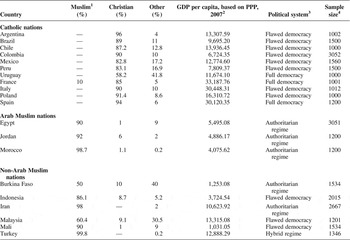
We employ data from the fifth wave of the WVS, conducted in 2005 and 2006. The WVS is an extensive, global academic survey that studies the world views and value profiles of the public on a wide variety of issues, including religion, gender roles, economy, government, family and work relations, etc.Footnote 3 In this article, we focus on a small set of the WVS questions that relate to religion and democracy. Nationally representative data sets of at least some 1,000 adults are taken from the nine Islamic countries and 11 Catholic countries for which the latest data is available. An overview of the countries is shown in Table 1.
Socio-economic and political data for the countries surveyed

1See CIA World Factbook 2008. The population percentage figures in column 3 and 4 are cited from the same source.
2See International Monetary Fund, World Economic Outlook Database, 2008.
3See Kekic (Reference Kekic2007) Economic Intelligence Unit's index of democracy. The index seeks to measure the current state of democracy worldwide based on five categories: electoral process and pluralism, civil liberties, the functioning of government, political participation and political culture. The index has a scale of 0 to 10. Full democracies score 8 to 10 on the index; flawed democracies score 6 to 7.9, hybrid regimes 4 to 5.9 and authoritarian regimes below 4.
4Source: 2005–06 World Values Survey.
Malaysia is the richest Islamic nation in our sample, somewhat richer than Turkey and Iran and much more developed than the other six Muslim countries. It is at about the same level of GDP per capita as Argentina, Chile, and Mexico. As a whole, the group of Catholic countries is more developed, but the seven Latin-American countries and Poland are quite comparable to the richer Islamic countries in the sample; it is just the three developed nations of France, Italy, and Spain that are at a much higher level of GDP per capita.
The empirical analysis is carried out for the individual respondents, both for each country separately and for aggregate samples created by pooling the unweighted national data sets. Since all the survey questions have ordinal answers — sometimes 0 for a no and 1 for a yes; usually a scale from 1 to 4 or 1 to 10 for different degrees of agreement with a value statement — least squares techniques are not appropriate. Throughout the article, we use maximum-likelihood algorithms that have been designed for processing categorical survey answers. The objective of our research is to identify and study different groups of respondents on various issues related to governance and democracy. We are mainly interested in the response patterns that emerge from the survey data and that make cluster analysis a natural way to describe and analyze such data. The “Latent Gold” software offers a new generation of cluster analysis that does not rely on arbitrary measures of “distance” to classify cases into segments. Instead, it defines homogeneity in terms of probabilities — cases in the same latent class are similar to each other because their responses are generated by the same probability distribution (Vermunt and Magdison Reference Vermunt and Magdison2004). The algorithm extracts a number of clusters from the data in such a way that inside each cluster the responses to the different questions (the indicator variables) have independent distributions. The algorithm allows also for additional variables for which that requirement does not hold but which are useful for assigning respondents to the different clusters (the covariates).Footnote 4
This way of modeling has advantages over the traditional approaches: (1) It can cope with categorical data, whereas factor analysis and related techniques were designed for continuous variables. (2) There is no need to reduce the number of responses on each question to two. (3) All models are the outcome of an optimizing process, thus avoiding the arbitrariness of traditional cluster analysis or factor analysis in determining the number of clusters or factors.
In addition, the Latent Class cluster models are able to identify distinct patterns of association in an effective manner, regardless of whether the underlying relationship between the variables is monotonous or not. In economics, many relationships are monotonous in two related variables. Higher price, lower quantity demanded; higher inflation, weaker exchange rate. One step up in one variable means, according to theory, precedent and practice: one interval down in the other variable. This can be easily and appropriately captured by the standard regression model, and if the relationship is not linear or log-linear, it would still be monotonous with some form of transformation of the variables. In social science, on the other hand, important concepts have multiple dimensions, and theories are often less precise in their empirical forecasts than the theories of economics. It has been demonstrated in sociological research that traditional factor models or least square analysis often fail to pick up interesting features of the data that does not fit in a regression plane. By contrast, latent-class models provide a more faithful representation of the heterogeneity of attitudinal and behavioral patterns without assuming a monotonous relationship between the variables (Yamaguchi Reference Yamaguchi2000).
3. RELIGIOSITY AND IMPORTANCE OF DEMOCRACY
In this analysis, support for democracy is measured by a survey question asking ‘How important is it for you to live in a country that is governed democratically?’ Respondents are to provide their answers on a 10-point scale, ranging from 1 = not at all important to 10 = absolutely important.
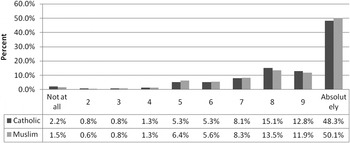
Figure 1 shows the proportions of respondents attaching various degrees of importance to democracy for the Catholic and Muslim pooled samples, respectively. It is obvious that the response distributions do not differ much, consistent with the findings from several previous studies (Inglehart Reference Inglehart2003; Tessler et al. Reference Tessler, Moaddel and Inglehart2006; The Pew Global Attitudes Project 2005). Specifically, 60.3 percent of the respondents from the Catholic countries and 58.2 percent of those polled in the Muslim countries consider democracy to be highly important, giving an answer of 9 or 10 to the question. By contrast, only about one-tenth of the respondents in both societies express a less favorable attitude toward democracy, scoring 5 or less than 5 on the variable. Strong support for democracy is particularly evident among the three Arab Muslim countries surveyed — the percentage of the respondents in such authoritarian nations who believe democracy to be “absolutely important” ranges from 64.3 percent in Morocco to 78.7 percent in Jordan, noticeably higher than in existing full democracies like Spain and France, where 50.1 percent and 42.5 percent of the poll take the same position.
Importance of democracy in Catholic and Muslim countries. Source: 2005–2006 World Values Survey. Catholic countries: N = 14345. Muslim countries: N = 15052.

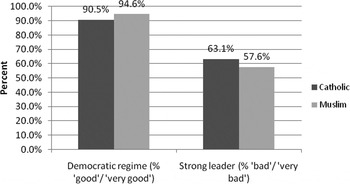
Support for democracy cannot be considered solid if people are just giving lip service to it (Inglehart Reference Inglehart2003). It is important to assess whether such support is qualified by a rejection of alternative regimes, particularly an authoritarian one characterized by undemocratic strong head of government. To provide a more stringent test of pro-democratic sentiment, we look at two additional survey questions.Footnote 5 The first one is an alternative measure of support for democracy, asking how people view a democratic political system. The second question taps respondents' attitude towards non-democratic regimes, measuring preference for a strong leader. Approval of these regimes is expressed in four categories: Very good, fairly good, fairly bad, and very bad. Figure 2 shows that a great majority of the population favors democratic governance, and there is virtually no difference in the attitudes of the citizens between the Catholic and Muslim countries. Equally important, over half of the respondents in both types of society disapprove of strong leadership that is unaccountable to parliament or elections. Our empirical results thus suggest that there is no denominational difference in endorsing democracy as a form of government in the Catholic and Muslim sample.
Support for democratic regime versus strong leadership. Source: 2005–2006 World Values Survey. Catholic countries: N = 11585. Muslim countries: N = 14231.

We now proceed to explore how religiosity (defined here as the degree of personal piety), affects people's attitudes toward governance. In countries like France and Spain, there are large numbers of progressive rationalists, opponents of organized religion with “modern” attitudes in areas such as gender equality, tolerance of diverse social behavior, and strong supporters of a lively democracy. At the same time, among pious Catholics in these two countries, there has historically been a group that was very conservative in its attitudes and more tempted by a strong leader than by a vigorous democracy. But do such patterns hold in other parts of the world, particularly Muslim states?
With the question on “Importance of democracy” as the indicator (“dependent variable”) in our model, we select religiosity as our first covariate (“explanatory variable”). The WVS includes a few variables that deal with various aspects of religiosity, two of which are commonly studied in the literature, one being religious participation/involvement and the other strength of religious beliefs (Afkhami Reference Afkhami2008; Canetti-Nisim Reference Canetti-Nisim2004; Inglehart and Norris Reference Inglehart and Norris2004; Karpov Reference Karpov2002; Tan Reference Tan2006). The first component captures the practice of religion such as participation in organized religious communities and attendance at places of worship (Ben-Nun Bloom and Arikan Reference Ben-Nun Bloom and Arikan2009). It is measured by the frequency of attending religious services (a 7-category variable) in which higher values represent more frequent attendance or involvement. The belief dimension refers to the ideological constructs of the religion, viz., its theology. It may refer to belief in God, heaven, hell, life after death, or to tendencies of people to describe themselves as religious (Ben-Nun Bloom and Arikan Reference Ben-Nun Bloom and Arikan2009; Tan Reference Tan2006). This is measured by a survey question asking “How important is God in your life?” with answers ranging from 1) = not at all important to 10 = absolutely important.
Results from our preliminary test indicate that the practice variable does not appear to be significant in predicting the desire for democracy. It may be that participation in religious activities not always reflects religious commitment. It might be that people participate due to family or friendship circle influences or just as a matter of custom (Ben-Nun Bloom and Arikan Reference Ben-Nun Bloom and Arikan2009; Inglehart and Norris Reference Inglehart and Norris2004). Alternatively, there are two contrasting explanations regarding the effect of religious practice on socio-political attitude. On one hand, empirical studies report that active church attendance, for example, positively affects political involvement and helps believers develop civic skills through active engagement, which generates stronger support for democracy (Ben-Nun Bloom and Arikan Reference Ben-Nun Bloom and Arikan2009). Clingingsmith et al. (Reference Clingingsmith, Khwaja and Kremer2008) studied pilgrims who were selected by ballot to travel from Pakistan to Mecca for the Hajj. They returned more religiously observant from Saudi Arabia and also more tolerant and sympathetic to gender equality, as a result of exposure to and interaction with Hajjis from around the world.
On the other hand, social identity theory suggests that a heightened attachment to a group through interaction may be accompanied by negative feelings toward the outside groups (Tajfel and Turner Reference Tajfel, Turner, Worchel and Austin1986). Participation in religious social networks that typically occurs between like-minded people may reinforce a strong collective group identity. Group-oriented thinking in turn leads to more aggressive attitudes or prejudice toward outsiders. Studies point to the evidence that frequent church attendance and prayer are positively correlated with the tendency to endorse authoritarianism (Ellison and Musick Reference Ellison and Musick1993; Leak and Randall Reference Leak and Randall1995; Steiber Reference Steiber1980). Hence, it seems that while religious social interaction may generate a liberalized effect that leads to a positive evaluation of democracy, it is also likely to produce a counter-working effect that could promote antipathy toward others. The two contrasting forces may cancel out each other, giving an overall insignificant impact of the practice variable. We therefore exclude the practice variable and prefer the belief variable as our measure of religiosity.
In addition to the religious factor, social and economic backgrounds also play a role in predicting one's political attitudes, as the modernization literature shows (Ellison and Musick Reference Ellison and Musick1993; Shu Reference Shu2004; Tessler, Reference Tessler2003). To control for such effects, our models include three variables that measure individual socio-economic status: (1) Level of education measured on a 3-level scale ranging from elementary schooling or less through post-secondary degree. (2) Income level. It is a self-reported measure, where respondents were asked to indicate their gross household income on a scale of 1 to 10, ranging from the lowest to the highest level. (3) A dichotomous variable that indicates whether the respondent lives in a town or in the countryside. This variable is created by referring to the indicated national rural population percentage from the “World Urbanization Prospects: The 2007 Revision Population Database”Footnote 6 and slicing our data accordingly into rural and urban segments for each country. The education and income variables are a proxy for individual modernity; the residence variable on the other hand measures regional modernity.
For comparability across countries, we present results from a 3-cluster model for every country. two clusters per country would not give enough detail; four clusters or more (results available on request) tends to produce very small clusters for most countries that do not contribute to the analysis of the broad pattern and may safely be ignored.
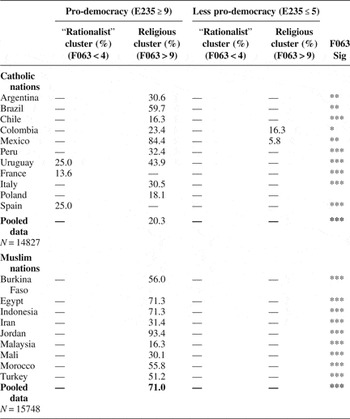
Table 2 summarizes the “profile” of those surveyed, who are classified by both their attitudes toward democracy and their degree of personal piety. With respect to the former, we categorize respondents as either very supportive of democracy or the reverse. Worldwide, answers 9 or 10 are given by 64 percent of all respondents; we combine these two as the pro-democracy group. Answers 1–5 are given by 9.7 percent; these we combine on the other side of the spectrum. Within each group, we further categorize respondents as either “rationalist” in the sense of not being very religious or those being highly religious. The dichotomous measures for each criterion result in four potential clusters. The four clusters presented in the table do not exhaustively capture the entire national sample however. This is because we want to study important clusters with distinct characteristics, in which respondents hold strong views on the variables. Respondents with moderate or neutral answers — those who fall outside the boundaries for the belief and democracy variables will not be included. Also, small cluster with a size less than 5 percent of the sample is not shown in the table.
Support for democracy and belief in God by country

Note: Model estimations are controlled for demographic factors such as educational attainment, self-reported income level and rural-urban residence.
E235: ‘How important is it for you to live in a country that is governed democratically? 1: ‘Not at all importantt’; E235: ‘How important is it for you to live in a country that is governed democratically?’ 1: ‘Not at all important’; 10: ‘Absolutely important’. F063: ‘How important is God in your life?’ 1: ‘Not at all important’; 10: ‘Very important’.
Dashes in the columns indicate that the corresponding cluster for a particular country is not identified. Only clusters within the boundary set for the belief and democracy variables are reported in the table. Small clusters that make up less than 5 percent of the sample are also not shown.
*Differences in the value of variable F063 between the clusters are significant at 0.1 level, **at 0.05 level, ***at 0.01 level.
Source: 2005–06 World Values Survey.
The first column in Table 2 confirms the existence of a group of pro-democratic rationalists in two Western European countries. An estimated 14 percent of the French is found to be not so religious but very keen on democracy. Such a group is also clearly identified in Spain and Uruguay, where one-fourth of the respondents score very high on the democracy variable and low — below 4 — on belief in God.
Degree of religiosity, measured by the belief variable, is a strong attitudinal predictor in almost every country sampled, with its effect particularly significant in the Muslim world. There is very little to suggest that pious believers dislike democracy. On the contrary, our model reveals a distinct cluster of devout supporters of democracy in every country surveyed, with the exception of France and Spain. Among the Catholic countries, Brazil (59.7%) and Mexico (84.4%) stand out. In the Muslim world, the size of such a cluster is, on average, above 30 percent. Note that an overwhelming majority of Egyptians (71.3%) and Indonesians (71.3%) who identify themselves as highly religious have a very favorable attitude toward democracy. Almost every respondent from Jordan demonstrates the same characteristic. At an aggregate level, a substantial percentage of the population (71%) among the Muslim countries falls into the religious pro-democracy cluster, as compared to an average of 20.3 percent from the Catholic countries. This shows that the “clash” thesis, arguing that the more religious in the Muslim world would be against democratization, does not hold up to empirical testing. We conform that undemocratic believers exist (see column four), but nearly always they are a small minority and many more pious people are strongly in favor of democracy.
Note that in countries like Chile, Poland, and Malaysia, the religious pro-democratic individuals constitute a small minority of the sample, as can be seen from the table. The majority of the respondents (over 50%) in these three countries, although not captured by our classification, can indeed be loosely given the same label — they are fairly religious, scoring between 8 and 9 on the belief variable and register a high but not extreme level of support for democracy.
Of the three socio-economic variables, education has the strongest positive link to support for democracy in both the Muslim and Catholic countries. In Spain, France, Mexico, and Colombia, the most educated cluster is also the group most favorably disposed toward democracy; this is also true in Morocco, Mali, and Iran, where the education variable is highly significant. This finding parallels that of Tessler's (2003) paper, where education is also found to be positively and significantly related to a more favorable judgment of democracy in three Arab countries. It has been argued that education improves interpersonal skills and facilitates civic involvement. It also raises support for a broad-based regime (democracy) relative to a narrow-based regime (dictatorship) (Glaeser et al. Reference Glaeser, Ponzetto and Shleifer2007). Mixed results, however, are obtained for the other two covariates. In Morocco, for example, support for democracy is positively related to the income variable, which has a strong influence, whereas in Indonesia, a small, less wealthy minority of the respondents (11%) score 10 — extremely high on the democracy variable. Also, a pro-democracy attitude is positively associated with rural residence in Burkina Faso but urban residence in Uruguay.
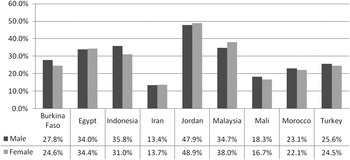
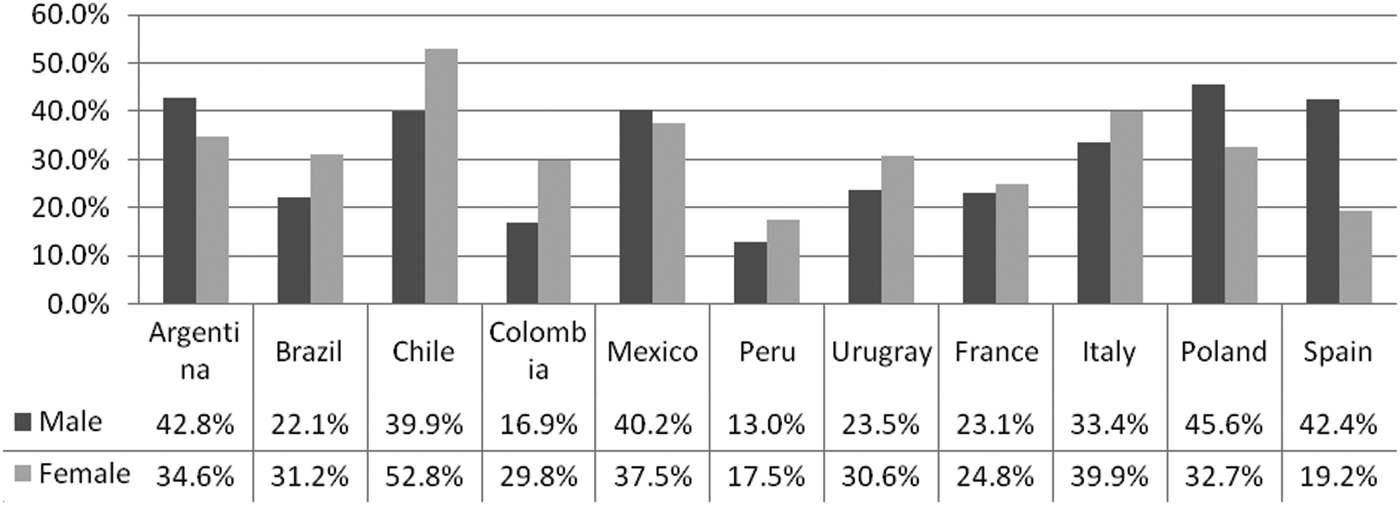
Separately, we examine the effect of one more demographic factor, gender, by a 4-cluster model that pre-determines respondent classes based on gender: cluster one and two are pre-set as the male respondents; cluster three and four are specified as female respondents. For both males and females, we divide the total set of respondents in two clusters, one with the more pro-democracy respondents and the other cluster with the males or females who are less keen on democracy. In many Muslim countries, there are no systematic differences between males and females in their support for democracy. For example, in Morocco, the size of the pro-democracy cluster for male (23.1%) is comparable to that of female (22.1%); in Jordan, the percentages are 47.9% and 48.9%; in Turkey, 25.6% of men and 24.5% of women, and in Egypt, 34.0% of men and 34.4% of women.
On the up-side, the observation that gender has little influence on the legitimacy of democracy is encouraging. Restricted access to education, careers, and political life could well inhibit women's support for democracy in Muslim countries (Bratton and Mattes Reference Bratton and Mattes2000), but our survey evidence indicates that females express as much support for democracy as males. On the down-side, this signifies a dissonance between mass attitudes toward democracy and actual practice, given the under-representation of women in many Muslim-majority nations (Faqir Reference Faqir1997; Fish Reference Fish2002). Despite positive attitudes toward democracy among the female population, structural and institutional factors continue to pose a barrier that restricts women's advancement in public life in Muslim societies (Inglehart and Norris 2003).
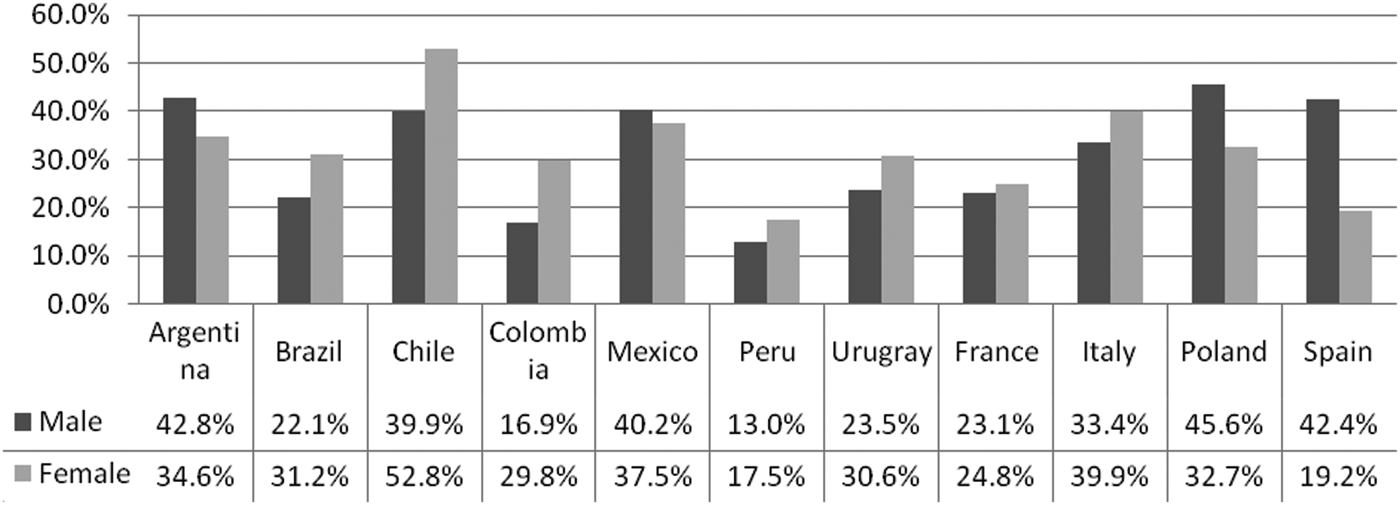
On the other hand, greater disparities by gender are found in the Catholic countries. The population of female democracy lovers is greater than that of males in five out of the seven Latin American countries. Large gender gaps can be seen in countries like Chile and Colombia, where the size of the female cluster in favor of democracy is greater by more than 10 percentage points than that of the corresponding male cluster. There is also considerable gender variation in Poland and Spain but with the opposite pattern. Figures 3 and 4 displays the sharp contrast between the Catholic and Muslim societies.
Support for democracy by gender in Islamic countries. Source: 2005–2006 World Values Survey. N = 15009.

Support for democracy by gender in Catholic countries. Source: 2005–2006 World Values Survey. N = 14345.
4. THE ESSENCE OF A PRO-DEMOCRATIC CIVIC CULTURE
The evidence accumulated so far runs counter to the argument that Islam is hostile to democracy. The image of the rationalists championing democracy fits France and Spain but not elsewhere. The finding that democracy has a global appeal has also been highlighted by other public-opinion surveys such as the Gallup Poll Survey, the Pew Global Attitudes Project, and some regional Barometer surveys (Chandler Reference Chandler2006). Nevertheless, some skeptics suggest that in countries with no or limited experience of democracy, democracy is embraced because of the positive image and legitimacy that it enjoys rather than an appreciation of the outcomes it provides — freedom and liberty (Dalton et al. Reference Dalton, Shin and Jou2007). This raises an interesting question about the substance of the popular support. Does the term “democracy” convey the same implication across publics in different societies?
Inglehart (Reference Inglehart2003, 52) argues that having favorable attitudes toward the general idea of democracy is not sufficient; for democratic institutions to survive in the long-term, they need a mass culture of tolerance, trust, participatory orientations, and an emphasis on self-expression. Using the 1999–2001 wave of WVS, he analyzes the link between mass attitudes and a society's level of democracy across more than 70 countries, ranging from authoritarian regimes to established democracies. What emerges from this empirical research is that overt support for democracy is only weakly correlated to a society's actual level of democracy. A much more powerful predictor of stable democracy is the extent to which a society has an underlying culture of tolerance, trust, political activism, and the extent to which people value freedom of speech and self-expression. Such features, according to Inglehart, are crucial in determining whether democracy survives over the long-term. Putnam (Reference Putnam1993) investigates culture and government in Italy and reaches the same conclusion that adherence of certain civic attitudes such as tolerance, trust, and political equality has a powerful bearing on the viability of democracy.
We thus proceed to examine the linkage between the general explicit measure of “Importance of democracy” and a set of more implicit values underpinning a pro-democratic civic culture. Our approach differs from Inglehart's in that we look at correlations between indicators of political culture and mass preference for democracy and not a society's level of democracy. While Inglehart attempts to make a cross-level linkage between micro-level attitudes, denominated as political culture, and macro-level democracy, our analyses are made exclusively at a micro-level, where all variables are attitudinal items elicited from individual respondents.
We identify several WVS questions as follows to represent some of the cultural qualities of democracy,Footnote 7 although none of these values refer explicitly to democracy itself: (1) Tolerance of diversity. This includes tolerance of racial diversity and tolerance of divergent social behavior such as homosexuality, prostitution, abortion, divorce, euthanasia and suicide. Each of these items is measured on a 10-point scale, where 1 denote never justifiable and 10 denote always justifiable. (2) Support for gender equality in work, politics, and education. This measures the level of agreement with the following: “when jobs are scarce, men should have more right to a job than women”; “On the whole, men make better business executive than women do”; “On the whole, men make better political leaders than women do”; “A university education is more important for a boy than for a girl.” Answers are coded in four categories: 1 = Agree strongly, 2 = Agree, 3 = Disagree, and 4 = Strongly disagree. (3) Interpersonal trust. This includes an indicator of general trust in other people and the trust in people of different religion and nationality. The former is measured on a continuum ranging from 1 = people would try to take advantage of you to 10 = people try to be fair. The latter is originally measured on a 5-point scale where 1 is coded for Trust completely and 5 is for Not trust at all. We have reversed the coding so that higher values represent a more trusting attitude.
In addition, we include two country-level factors — level of democracy and national GDP per capita as control variables in our model, as contextual factors may also significantly affect political attitudes (Fish Reference Fish2002). The former is measured by the Democracy Index (Kekic Reference Kekic2007) that assigns an overall score to each country based on an assessment of five general aspects of a democracy. The higher the index score, the more democratic a country is. We control for the level of democracy because as Inglehart (Reference Inglehart2003) demonstrates, the existence of a pro-democratic culture is closely linked to the degree of democracy of a society. The quality of democracy in a country is believed to create an environment suitable for the internalization of democratic values (Ben-Nun-Bloom and Arikan 2009). The degree of national economic development is also controlled for, as modernists have shown that in post-industrial societies, people are likely to be more self-expressive, keen on human rights, and tolerant of diversity (Flanagan and Lee Reference Flanagan and Lee2000; Wong and Wan Reference Wong and Won2009). By controlling for these two national variables, we can more accurately determine whether any difference observed between societies is due to the religious profile of its citizens.
Given that tolerance of diversity, gender equality, and social trust are important values embedded in a pro-democratic political culture, we expect to find a positive relationship between these emancipative values and explicit support for democracy measured by the variable on importance of democracy. As Welzel (Reference Welzel2006) puts it, support for democracy and emancipative values should be strongly related because democracy is the natural system preferred by people who emphasize human emancipation. Tables 3 to 6 illustrate the outputs for the three cluster models that compare responses between the Catholic and Islamic publics for each cultural component. The variable on importance of God is also included but as an inactive covariate, so that it does not affect the other estimates.
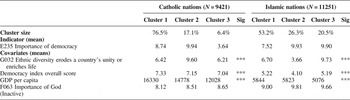
Support for democracy and tolerance of racial diversity

Note: *Differences in the values of covariates between the clusters are significant at 0.1 level,
** at 0.05 level,
*** at 0.01 level.
E235: ‘How important is it for you to live in a country that is governed democratically? 1: ‘Not at all important’; 10: ‘Absolutely important’. F063: ‘How important is God in your life?’ 1: ‘Not at all important’; 10: ‘Very important’.
Higher scores on G032 indicate greater tolerance to ethnic diversity. (1 = ‘Ethnic diversity erodes a country's unity’; 10 = ‘Ethnic diversity enriches life’)
The higher the democracy index score, the more democratic a country is.
Source: 2005–06 World Values Survey.
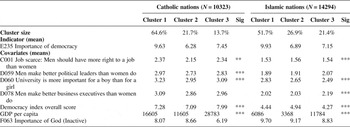
With regard to racial diversity, an estimated 17 percent of the Catholic publics rate democracy highly important and are also very much tolerant of people from different racial backgrounds, scoring close to the maximum on the scale (see Table 3). Such a group also exists in the Muslim countries, where it represents 20 percent of the poll. However, a third cluster from the Muslim countries — the most religious cluster, is found to be equally pro-democratic measured by our indicator, but see racial differences as threatening to their country's unity, scoring below 4 on that variable (cluster 2). In the Catholic nations, we do not find such a group of respondents. A small minority (6.4%) of those polled are not so keen on democracy but still lean toward the tolerant end of the continuum (that is, above the midpoint of 5).
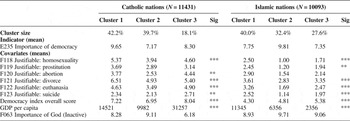
The pro-democracy cluster in the Muslim countries also holds a more conservative view on certain moral issues (see Table 4). Among the six variables, acceptance of homosexuality and divorce correlate strongly with the attitude toward democracy in both the Catholic and Islamic nations; the signs of the correlation however are different. Catholic individuals who are tolerant of homosexuality and divorce display a higher level of support for democracy than do their morally conservative counterparts. In the Muslim world, being pro-democratic does not necessarily imply greater tolerance of social minority groups. This can be seen from cluster 2, where respondents show a very favorable view toward democracy and yet have the most conservative moral standards. They have zero tolerance of homosexuality and leave little room for the other five issues. This may be due to their strong religious condemnation of those practices (Rizzo 2007), as these people are also the most pious believers in God.
Support for democracy and tolerance of diverse social behavior

Note: *Differences in the values of covariates between the clusters are significant at 0.1 level, **at 0.05 level, ***at 0.01 level.
E235: ‘How important is it for you to live in a country that is governed democratically? 1: ‘Not at all important’; 10: ‘Absolutely important’. F063: ‘How important is God in your life?’ 1: ‘Not at all important’; 10: ‘Very important’.
Higher scores on the covariates mean greater social tolerance. (1 = ‘never justifiable’; 10 = ‘always justifiable’)
The higher the democracy index score, the more democratic a country is.
Source: 2005–06 World Values Survey.
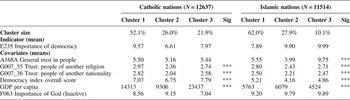
With regard to equal rights for women, similarly, a 3-cluster model shows that support for democracy and support for gender equality go hand in hand in the Catholic countries, but not in the Muslim countries (See Table 5). On the issue of interpersonal trust, Table 6 shows that slightly over half of the respondents (52.1%) from the Catholic sample are highly pro-democratic and also the most trusting compared to the other two clusters. In the Muslim sample, the size of the pro-democratic trusting cluster is reduced to 10 percent (cluster 3). Meanwhile, there exists another cluster (cluster 2) that shares the same pro-democratic sentiment but turns out to be the least trusting of others by all three measures.
Support for democracy and equal rights for women

Note: *Differences in the values of covariates between the clusters are significant at 0.1 level, ** at 0.05 level, *** at 0.01 level.
E235: ‘How important is it for you to live in a country that is governed democratically? 1: ‘Not at all important’; 10: ‘Absolutely important’. F063: ‘How important is God in your life?’ 1: ‘Not at all important’; 10: ‘Very important’.
Higher scores on the covariates indicate greater support for gender equality. (1 = ‘Agree strongly’; 4 = ‘Strongly disagree’)
The higher the democracy index score, the more democratic a country is.
Source: 2005–06 World Values Survey.
Support for democracy and trust towards others

Note: *Differences in the values of covariates between the clusters are significant at 0.1 level, ** at 0.05 level, *** at 0.01 level.
E235: ‘How important is it for you to live in a country that is governed democratically? 1: ‘Not at all important’; 10: ‘Absolutely important’. F063: ‘How important is God in your life?’ 1: ‘Not at all important’; 10: ‘Very important’.
Higher scores on the covariates represent a more trusting attitude. (A168A: 1 = ‘people would take advantage of you’; 10 = ‘people try to be fair’. G007_35 & 36: 1 = ‘Not trust at all’; 5 = ‘Trust completely’)
The higher the democracy index score, the more democratic a country is.
Source: 2005–06 World Values Survey.
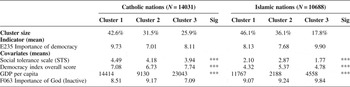
Finally, to test the robustness of the results, we create a Social Tolerance Scale using the WVS questions that ask respondents which group of people they would not like to have as neighbors. The scale is an additive index comprised of five potentially “undesirable” groups including (1) people of a different race, (2) people of a different religion, (3) people who have AIDS, (4) homosexuals, and (5) unmarried couples living together. The scale hence measures respondents' overall tolerance toward social minority groups, different lifestyles, religions, and ethnicities. The five items are all dichotomous, with respondents mentioning a particular group coded 1 and not mentioning coded 0. To facilitate interpretation of the data, we have inverted the scale so that 1 indicates not mentioning and 0 mentioning. The scores of all items are then added, with higher scale values representing higher levels of social tolerance (maximum 5). The Social Tolerance Scale has a reliability coefficient of 0.48 for the Muslim sample and 0.66 for the Catholic sample. In Table 7, a very similar pattern emerges as in the previous models. In the Catholic countries, people with the strongest support for democracy are also the most socially tolerant (cluster 1), scoring close to the maximum scale value of 5, whereas in the Muslim countries, democracy lovers exhibit a strong intolerant attitude, tending toward the other side of the scale (cluster 3).
Support for democracy and social tolerance

Note: *Differences in the values of covariates between the clusters are significant at 0.1 level, ** at 0.05 level, *** at 0.01 level.
E235: ‘How important is it for you to live in a country that is governed democratically? 1: ‘Not at all important’; 10: ‘Absolutely important’. F063: ‘How important is God in your life?’ 1: ‘Not at all important’; 10: ‘Very important’.
Higher scores on the social tolerance scale indicate higher levels of tolerance (a 5—point scale).
The higher the democracy index score, the more democratic a country is.
Source: 2005—06 World Values Survey.
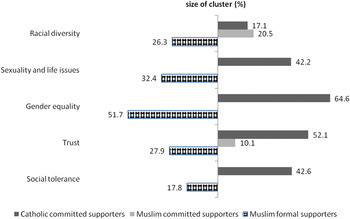
By way of summing up, Figure 5 gives a graphical representation of the important differences we observe between societies. It shows the proportions of individuals who score 9 or above on the democracy variable in the models we run from Tables 3–7. In particular, we distinguish two types of democracy supporters. Bars arrayed to the left of the vertical axis represent “formal supporters,” people who react favorably to the term democracy but attach little importance to civic values, scoring below the midpoint of the scale for a given value item, i.e., question on racial diversity, trust, gender equality, etc. Those charted along the right side of the vertical axis signify the opposite. These are committed supporters who emphasize emancipative values and score above the midpoint of the scale on the civic value question.
(Color online) Differences in citizen's commitment to democratic values. Note: “Committed supporters” represent individuals who score 9 or above on the democracy variable (E235) and score above the midpoint of the scale on the civic value question; “Formal supporters” differ from “Committed supporters” in that they score below the midpoint of the scale on the civic value question. See Tables 3–7 on the origin of the percentage data. Source: 2005–2006 World Values Survey.

Note that for every single value item that we study, there is always a sizeable group of committed supporters from the Catholic countries, whereas such committed clusters only exist in two of the five instances for the Muslim respondents and in a much smaller proportion. More strikingly, for every value item, we identify comparable proportions of Muslim respondents on the other side of the axis, who explicitly support democracy but are less inclined to embrace democratic values, and yet such a group is non-existent in the Catholic sample. These findings provides the empirical evidence that there is a strong positive relationship between civic attitudes and overt support for democracy in the Catholic countries, where there is a genuine endorsement of social trust, tolerance and gender equality among supporters of democracy. By contrast, in the Muslim countries, overt support does not necessarily reflect commitment to core democratic values.
We also observe that in Tables 3 and 6, the Muslim “formal” cluster has the lowest score on the democracy index; this shows that such respondents come from countries that have a more autocratic government. It could be that their strong desire for democracy stems from disillusionment and frustration with authoritarian governments, and a high expectation of democracy in delivering greater social and economic benefits (Inglehart and Welzel Reference Inglehart and Welzel2005), and this is to this subject that we turn now.
5. SUBSTANCE OF POPULAR SUPPORT FOR DEMOCRACY
Inglehart and Welzel (Reference Inglehart and Welzel2005, 268–269) argue that overt support for democracy reflects intrinsic support (democracy valued as an end in itself) only in so far as it is linked with self-expression values, which load heavily on gender equality, trust and tolerance. People who do not emphasize self-expression values support democracy for instrumental purposes, because they reckon it will bring them prosperity and order, holding that democracies are more successful than other regimes in managing economic development and reducing social tensions. Bratton and Mattes (Reference Bratton and Mattes2000) likewise contend that intrinsic support is based on an appreciation of political freedoms and equal rights that democracy embodies, whereas instrumental support sees a democratic regime as a means to other ends, most commonly the alleviation of poverty and the improvement of living standards.
We demonstrate in Section 4 that in Muslim-majority countries, mass preference for democracy loosely embodies core democratic principles that Inglehart label as self-expression values. Indeed, the results of WVS elsewhere place the Muslim countries in a very special location on a global cultural map. While stable democracies tend to be high on both secular-rational values and self-expression, Islamic societies are found in the opposite corner — they are traditional and survival-oriented, attaching more importance to economic and physical security relative to individual freedom and subjective well-being (Inglehart and Welzel Reference Inglehart and Welzel2005; Taagepera Reference Taagepera2003). Esposito and Mogahed (Reference Esposito and Mogahed2008) report findings from the Gallup Poll surveys that, when asked about their hopes and dreams of today, many Muslims cite economic issues as their first desire: better economic conditions, employment opportunities, and improved living standards for a better future.
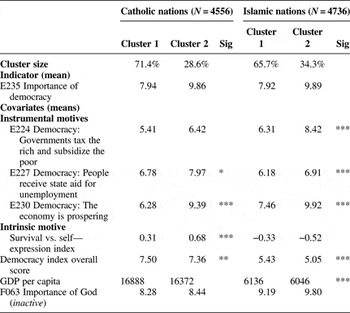
In order to determine whether popular support for democracy hinges on the government's capacity at developing the economy, we introduce three covariates in our model that tap instrumental motives. These are questions on the understanding of the meaning of democracy, measuring the extent to which respondents view democracy in economic terms; higher scores on the variables indicate stronger instrumental support. Intrinsic support for democracy is measured by the survival/self-expression index, where higher scores mean being more self-expressive.
“Many things may be desirable, but not all of them are essential characteristics of democracy. Please tell me for each of the following things how essential you think it is as a characteristic of democracy. Use this scale where 1 means “not at all essential characteristic of democracy” and 10 means it definitely is “an essential characteristic of democracy.”
E224 Democracy: Governments tax the rich and subsidize the poor.
E227 Democracy: People receive state aid for unemployment.
E230 Democracy: The economy is prospering.
The three items emphasize the economic and social benefits that one expects a democratic government to provide, as opposed to the inherent liberating qualities of democracy, i.e., its political benefits. We can see from the two-cluster models in Table 8 that, in the Catholic countries, the pious believers are people who attach greater importance to democracy.Footnote 8 They associate democracy with better economic performance and are also more likely to endorse self-expression values (with a positive score of 0.68). But in the Muslim countries, religious people who place little emphasis on self-expression values (with a negative score of 0.52) also express clear support for democracy (clusters 2), as they associate democracy more strongly with improved material welfare than a commitment to a set of core democratic principles. This is especially evident in their expectation that democracy helps rectifying income inequality (E224) and promises economic prosperity (E 230).
Instrumental vs. intrinsic support for democracy

Note: *Differences in the values of covariates between the clusters are significant at 0.1 level, ** at 0.05 level, *** at 0.01 level.
E235: ‘How important is it for you to live in a country that is governed democratically? 1: ‘Not at all important’; 10: ‘Absolutely important’. F063: ‘How important is God in your life?’ 1: ‘Not at all important’; 10: ‘Very important’.
Higher scores on E224, E227 and E230 indicate stronger instrumental support – the tendency to equate democracy with economic values and social benefits.
Higher scores on the Survival/ self—expression index mean being more self—expressive.
The higher the democracy index score, the more democratic a country is.
Source: 2005–06 World Values Survey.
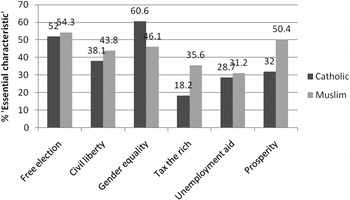
In Figure 6, we look at three additional items that measure public understanding of democracy. It shows the percentage of respondents who consider each of the attributes as an “essential” characteristic of democracy. First we note that both the Muslim and Catholic publics are equally likely to treat free and fair elections as a defining element of democracy. Specifically, 54 percent of respondents in Muslim-majority countries think of democracy in terms of political procedure of competitive election where people have the right to choose their own leaders, a level not too different from citizens in Catholic-majority countries (52 percent). When it comes to the normative aspect of democracy as opposed to the procedural aspect, a significant minority (44 percent) from the Muslim sample agree that civil liberty is essential to democracy, as compared to 38 percent in Catholic-majority countries. However, the latter is much more likely to identify democracy with greater gender equality, with an average of 61 percent versus 46 percent in Muslim-majority countries. This echoes our previous finding that the Catholic public is more inclined than Muslim citizens to internalize certain democratic values. On the three items that signal instrumental support for democracy, once again, we observe systematic differences between the two types of society. Individuals in Muslim-majority countries are much more likely (35.6 percent) than those in Catholic-majority countries (18.2 percent) to equate democracy with achieving income equality, narrowing the gap between the rich and the poor. An equally wide gap (18.4 percentage points) appears in the expectation that democracy brings economic prosperity, where half of the Muslim respondents view democracy as a means to improve material welfare. By contrast, only 32 percent of the respondents in Catholic countries endorse the same position. On the issue of unemployment aid, while the margin is narrower, the same pattern holds: 31.2 percent of the Muslim public sees democracy as a system providing for those who are in need, as compared to 28.7 percent from the Catholic poll.
Essential democratic attributes mentioned in Muslim and Catholic countries. Source: 2005–2006 World Values Survey.

6. CONCLUSIONS
Previous research using public opinion data has shown widespread support for democracy in the Muslim world. The results from the latest wave of WVS confirm this — we found that the vast majority of the Muslim publics are keen on democracy as a model of governance with levels of popular support for democracy roughly similar to what we find in Catholic countries. Further, strong attachments to the Islamic religion do not deter believers from embracing democracy; the general assumption that being “modern” in the sense of favoring democracy means being “less religious” is thus invalidated.
However, we found systematic evidence that the mass publics in the Catholic and Muslim countries diverge in the substance of their support and understanding of the term democracy, after empirically controlling for the levels of democracy and economic development. Support for democracy in the Catholic countries stems from a pro-democratic civic culture that embodies certain distinct attributes such as tolerance of diversity, mutual trust, and an emphasis on gender equality. Citizens in Islamic countries, on the other hand, endorse the term democracy without necessarily embracing those liberal values that arguably are crucial for a vigorous and open democracy. Also it appears that defenders of democracy from the Catholic-majority countries identify democracy with its inherent and intrinsic appeal — greater freedom of expression, whereas the Muslim public tends to define democracy more exclusively by its economic benefits. People equate democracy more strongly with economic well-being relative to subjective well-being, seeing democracy as an instrument to attain social security and economic prosperity.
From the perspective of political culture, our findings suggest that there is a lack of an intrinsically democratic mindset in the Muslim nations, and this may constitute an important factor, among many others, which obstructs the democratization process in Muslim world. Democratic consolidation and sustainability cannot hold up without the commitment of great majority of individuals to liberal-democratic norms (Canetti-Nisim Reference Canetti-Nisim2004; Inglehart Reference Inglehart2003; Tessler Reference Tessler2003); indeed, it is difficult for any system to survive unless an appreciable proportion of its members have internalized the basic values of the system (Esmer Reference Esmer and Inglehart2003). It is true that elite orientation and commitment matter, but democratic deliberation also requires mass support for democratic values, and as our data indicates, such support is largely absent in the our sample of Muslim nations. In the Muslim societies, the publics do find democracy appealing but they combine support for democracy with attitudes that would be judged intolerant in today's Western countries.
Unlike Catholic-majority countries, where support for democracy signifies a firm belief in the liberating qualities of democracy, Muslim countries in our sample are more concerned about the need for democracy to bring more prosperity. It follows that such support for democracy is instrumental and hence conditional — it may decline when citizen expectations are not realized, for example, in the times of economic downturn or social unrest. Chances are that unconvinced democrats may turn to non-elected government or to an autocratic ruler who promises to deliver jobs and houses.
Not long ago, West European Catholics were considerably more traditional and survival-oriented than they are now; yet their values have shifted over time to become progressively more liberal, tolerant, and self-expression oriented in gaining and keeping democracy (Inglehart and Norris 2003; Lewis Reference Lewis1996; Taagepera Reference Taagepera2003). In contrast, as Inglehart and Norris (2003) documented in an extensive global study of cultural change, the younger generations in Muslim societies remain as traditional as their parents and grandparents especially toward issues like equal rights for women and sexual liberalization. We concur with the Culturalist theorists that there is a cultural basis for the absence of democracy in the Muslim world — the democratic deficit has something to do with a shortfall in deeper democratic values and a lack of appreciation of freedom and openness at the mass level. The emergence and consolidation of democracy requires not only a favorable attitude toward democracy per se but also a supportive democratic political culture.
APPENDIX: WVS QUESTIONS USED IN SECTION 4
Tolerance of Diversity
(1) Diversity of social behavior – ‘Please tell me for each of the following actions whether you think it can always be justified, never be justified, or something in between, using this card’ (we select several sexuality and life issues: homosexuality, prostitution, abortion, divorce, euthanasia, and suicide)
1. Never justifiable
…
10. Always justifiable
(2) Racial diversity – ‘Turning to the question of ethnic diversity, with which of the following views do you agree? Please use this scale to indicate your position:
1. Ethnic diversity erodes a country's unity
…
10. Ethnic diversity enriches life
Gender Equality
(1) ‘When jobs are scarce, men should have more right to a job than women’ (the original answers are ordered in this way: 1. Agree, 2. Disagree. 3. Neither. We have rearranged the answers to maintain consistency with the answers for the other three questions and to improve data interpretability):
1. Agree
2. Neither
3. Disagree
(2) ‘On the whole, men make better political leaders than women do’
1. Agree strongly
2. Agree
3. Disagree
4. Strongly disagree
(3) ‘A university education is more important for a boy than for a girl’
1. Agree strongly
2. Agree
3. Disagree
4. Strongly disagree
(4) ‘On the whole, men make better business executive than women do’
1. Agree strongly
2. Agree
3. Disagree
4. Strongly disagree
Interpersonal Trust
(1) ‘Do you think most people would try to take advantage of you if they got a chance, or would they try to be fair?
1. People would try to take advantage of you
…
10. People would try to be fair
(2) ‘I'd like to ask you how much you trust people from various groups. Could you tell me for each whether you trust people from this group completely, somewhat, not very much or not at all’ (we select two groups to study: people of another religion and people of another nationality; the scale has been reversed so that larger numbers represent a more trusting attitude)
1. Not trust at all
2. Not trust very much
3. Neither trust or distrust
4. Trust a little
5. Trust completely
Social Tolerance Scale (STS)
On this list are various groups of people. Could you please sort out any that you would not like to have as neighbors?
-People of a different race
-People of a different religion
-People who have AIDS
-Homosexuals
-Unmarried couples living together
Answers are originally coded as ‘1’ if a particular group is mentioned and ‘0’ if not mentioned. We have reversed the scale so that ‘1’ indicates not mentioning and ‘0’ mentioning. Scale value hence ranges from 0 to 5, with larger numbers representing higher levels of social tolerance.